Oil prices tumbled to around $79.50 per barrel after U.S. President Donald Trump announced that the Strait of Hormuz would be reopened as part of a peace agreement with Iran. Iran stated that shipping traffic through the strategic waterway would resume within 30 days under its own arrangements, easing concerns over global supply disruptions. However, despite the reopening plans, oil supplies may remain constrained in the near term due to extensive damage to energy infrastructure across the Middle East caused by the conflict.
West Texas Intermediate (WTI) crude oil futures traded more than 4% lower, hovering around $79.50 per barrel during Monday’s European session. The sharp decline followed U.S. President Donald Trump’s announcement that the Strait of Hormuz—a key route for nearly 20% of global energy shipments—would reopen after the United States and Iran reached a memorandum of understanding (MoU), scheduled to be formally signed in Switzerland on June 19.
In a post on Truth Social on Sunday, President Trump stated that he had authorized the toll-free reopening of the Strait of Hormuz and ordered the immediate removal of the U.S. naval blockade.
Despite the announcement, Iran’s Mehr News Agency reported that shipping through the strait would resume within 30 days under Iranian supervision. Likewise, according to Seatrade Maritime News, the U.S. blockade on Iran is also expected to be lifted within the same timeframe.
Oil prices had surged earlier in the conflict after Iran closed the Strait of Hormuz and sought international recognition of Tehran’s authority over the strategic waterway. While the latest agreement has eased immediate supply concerns and triggered a sharp correction in prices, analysts remain cautious about the potential for further declines.
Market participants note that extensive damage to Middle Eastern energy infrastructure caused by the conflict between the U.S.-Israel alliance and Iran could continue to support crude prices. Analysts at ANZ suggested that oil could temporarily fall below $80 amid optimism surrounding the deal, but warned that prices may remain elevated if the agreement proves less favorable than expected and infrastructure disruptions continue to constrain supply.
WTI Technical Analysis
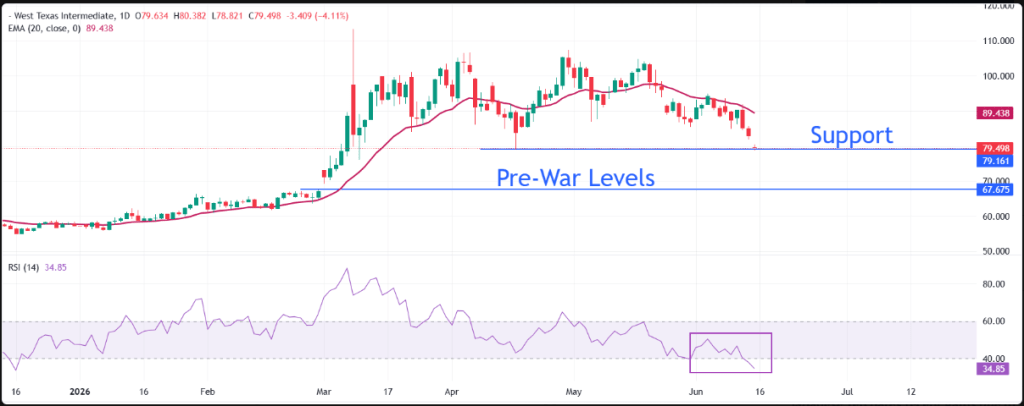
WTI crude oil is trading weaker near $79.50 at the time of writing, maintaining a bearish short-term outlook as it remains firmly below the 20-day Exponential Moving Average (EMA) at $89.44. This highlights ongoing selling pressure and a strong supply overhang following the recent decline.
The Relative Strength Index (RSI) has fallen to 34.84, indicating that bearish momentum remains dominant and could strengthen further in the near term.
On the upside, the 20-day EMA at $89.44 serves as the first key resistance level. A sustained move above this barrier would be required to reduce downside pressure and pave the way for a broader corrective recovery. On the downside, a break below the April 17 low of $78.88 could expose the March 10 low at $75.95. Additional support levels are located around $70.00 and the February 27 high at $67.74, which corresponds to the pre-war price level.
 THE ETERNAL SOVEREIGN
Leave a comment