- Gold prices move lower during Friday’s Asian trading session.
- The precious metal remains under pressure as ceasefire negotiations between the United States and Iran show no meaningful progress.
- Market participants are now awaiting the release of the US Nonfarm Payrolls (NFP) report for May, scheduled later on Friday.
Gold prices (XAU/USD) come under renewed selling pressure during Friday’s Asian session, slipping toward their lowest level of the week. The precious metal remains highly sensitive to ongoing geopolitical developments, with investors closely watching both the status of US-Iran ceasefire negotiations and the release of the US May employment report later in the day.
On Wednesday, Iran’s Foreign Minister, Abbas Araghchi, stated that negotiations aimed at ending the Middle East conflict had produced “no tangible progress.” While he noted that communication channels with Washington remain open, he warned that any Israeli strike on Beirut as part of operations against Hezbollah could trigger a full-scale renewal of the US-Iran confrontation.
Despite Iran’s assessment that talks have stalled, Donald Trump maintained that ceasefire discussions are nearing their final stage. Tensions escalated further on Wednesday after Iran launched missiles and drones at Kuwait and Bahrain, resulting in one fatality and multiple injuries at Kuwait’s main airport, following a US strike on an oil tanker bound for Iran.
The continued lack of progress toward a ceasefire after the most intense violence seen in weeks has heightened concerns about inflation and reinforced expectations that interest rates could remain elevated for longer. These factors have weighed on gold, which offers no yield to investors.
According to Bart Melek of TD Securities, rising inflation expectations linked to negative supply shocks have pushed bond yields higher, supported the US Dollar, and led markets to begin pricing in a potential Federal Reserve rate hike in late 2026.
Attention now turns to the US labor market report. Economists expect the May Nonfarm Payrolls (NFP) report to show an increase of 85,000 jobs, while the unemployment rate is forecast to remain unchanged at 4.3%. Any unexpectedly weak labor market data could pressure the US Dollar and provide support for gold prices in the near term.
Gold Daily Chart
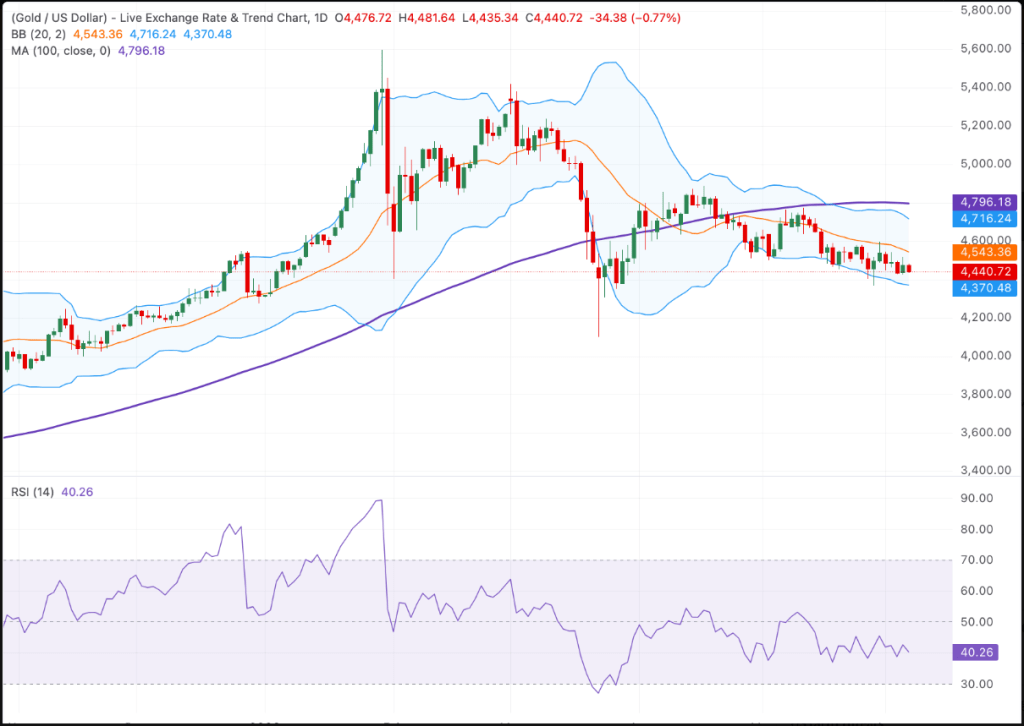
Gold remains under bearish pressure in the near term
From a technical perspective, Gold (XAU/USD) continues to exhibit a negative near-term outlook. On the daily chart, the metal is trading below both the 100-day Moving Average and the middle Bollinger Band, reinforcing the prevailing downward trend. Meanwhile, the Relative Strength Index (RSI) is hovering around 40, indicating weak momentum without yet reaching oversold territory, which suggests there is still room for additional downside before sellers become exhausted.
On the upside, immediate resistance is seen near the middle Bollinger Band at around $4,545. Further barriers emerge at the upper Bollinger Band near $4,715, followed by the 100-day Moving Average at $4,795, which could limit any stronger recovery attempt.
On the downside, initial support lies near the lower Bollinger Band at approximately $4,370. A decisive break below this level could accelerate the correction and expose deeper losses. Conversely, if prices remain above this support area, Gold may enter a period of consolidation while maintaining its broader bearish structure.
 THE ETERNAL SOVEREIGN
Leave a comment