Gold is once again being driven primarily by interest rates rather than risk sentiment, with US Treasury yields taking the lead as markets head into a heavy US data schedule.
The inverse relationship between gold and yields has strengthened notably, placing key inflation readings like CPI and core PCE at the center of attention. Prices are currently moving within a clear range, with support around $4700 and resistance between $4800 and $4850. The next directional move will likely depend on whether yields continue rising or begin to ease, while ongoing developments surrounding the US–Iran ceasefire remain a secondary influence.
This renewed sensitivity to yields signals a return to more traditional macro dynamics, following a period where gold traded more like a high-volatility risk asset.
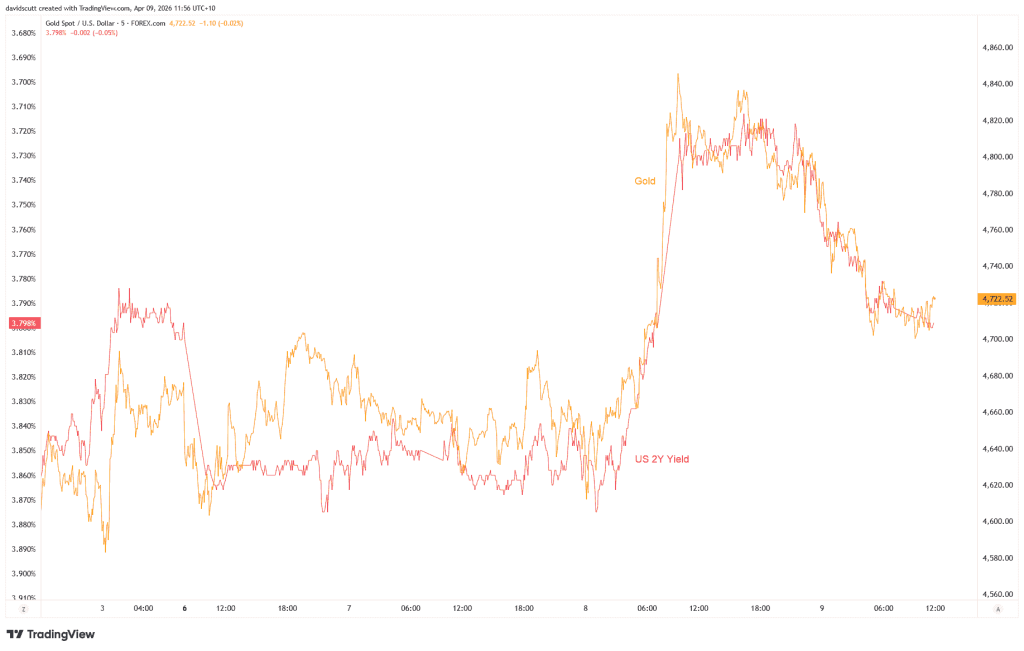
Whether this rate-driven relationship will persist is still uncertain. However, with correlation coefficients currently sitting in the high negative 0.9 range across both short- and long-term Treasury yields, gold is now highly sensitive to movements in interest rates. This sharp linkage brings not only developments in the US–Iran ceasefire into focus, but also an upcoming wave of US economic data that is likely to challenge and validate the strength of this relationship in the near term.
Inflation data is set to put this relationship to the test.
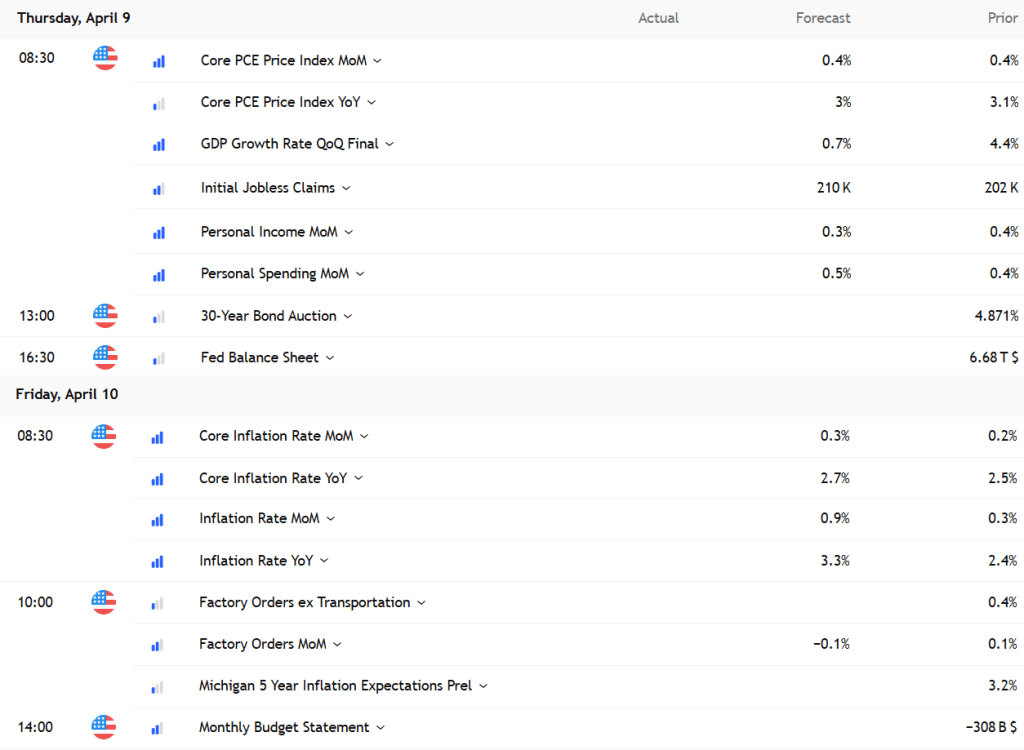
While the Fed’s preferred inflation gauge, the core PCE deflator, is due later today, it may carry less weight as it reflects February data and predates the energy price shock linked to the Iran conflict. Instead, markets may focus more on income and spending figures for clues on consumption and broader economic momentum in the March quarter. Strong data could reignite concerns about rising inflation, while weaker numbers may ease pressure by signaling softer demand and hiring.
Following a weak 10-year Treasury auction midweek, attention may also turn to the 30-year bond auction for its impact on yields. Still, Friday’s release of March CPI is expected to be the key event. Headline inflation is likely to rise due to energy costs, but the critical question is whether those pressures spill into core inflation. Any reading above the 0.3% forecast could push markets to reconsider the possibility of Fed rate hikes rather than cuts this year.
Inflation expectations will also be in focus, with the University of Michigan’s 5-year outlook offering timely insight into consumer sentiment around future prices, wages, and spending.
If inflation surprises to the upside, Treasury yields are likely to climb—potentially weighing on gold given their strong inverse relationship. Conversely, softer inflation data could support bullion. Beyond economic data, developments surrounding the US–Iran ceasefire remain an important underlying risk factor.
Price action remains orderly and well-defined.
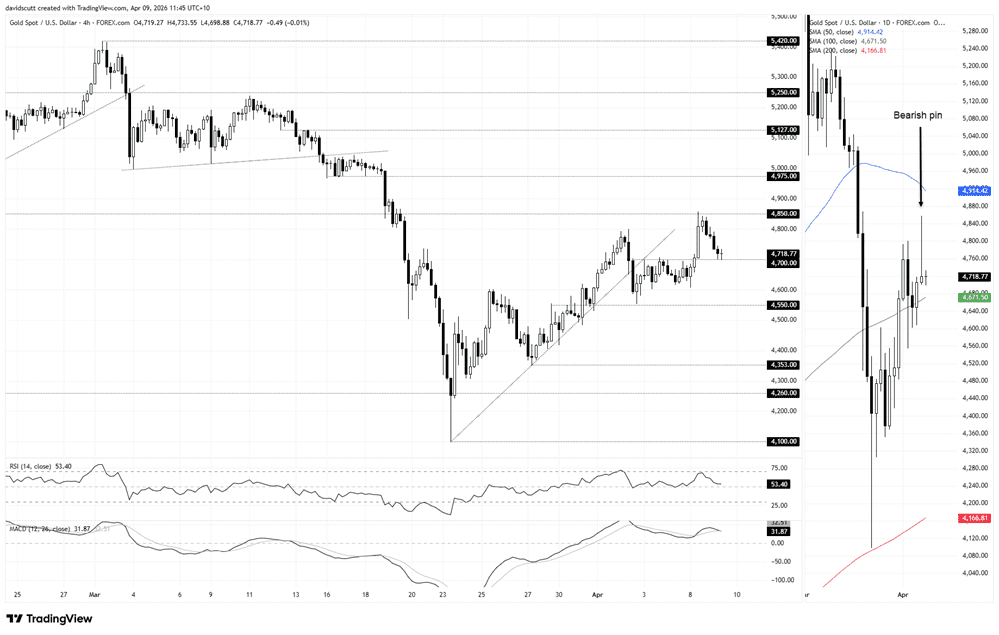
On the daily chart, the presence of a bearish pin bar reinforces the earlier signal that sellers are active in the $4800–$4850 zone, establishing it as a key overhead resistance area for traders.
A closer look at the H4 timeframe confirms both this resistance and the overall clarity of gold’s price action, especially given the broader macro volatility. The $4700 level, which previously acted as resistance, has now flipped into support and serves as the first downside level to watch. Below that, $4600 and $4550 emerge as additional support zones if the current range breaks.
On the upside, a sustained move above $4850 would open the door toward $4975, with the 50-day moving average sitting in between as a potential intermediate hurdle. Momentum indicators such as RSI (14) and MACD remain neutral, offering no strong directional bias and reinforcing the importance of reacting to price behavior around key levels.
From a short-term trading perspective, long positions could be considered above $4700 with tight risk control below that level, targeting a move back toward $4850 resistance. However, conviction in this setup is limited, and a confirmed bounce from $4700 would provide a more reliable entry signal.
Sources: David Scutt
 THE ETERNAL SOVEREIGN
Leave a comment