Gold is stabilizing above $4,500, though its recovery remains uncertain following a steep sell-off earlier this month. Despite a modest rebound at the start of the week, momentum is still fragile.
Gains in oil prices, higher Treasury yields, and a stronger U.S. dollar continue to limit gold’s upside potential. In the near term, resistance around $4,700 and support near $4,400 are expected to define its trading range.
Gold began the week on a positive note, rising დაახლოებით 0.8% in early Monday trading. However, the recent surge in geopolitical tensions between Israel and Iran triggered a sharp decline, and while prices are rebounding, it may be premature to view this as a full recovery.
Oil Price
Oil prices remain the key driver of market sentiment. Crude has stayed elevated after intensified weekend fighting between Israel and Iran, with the Houthis also entering the conflict. Although Trump claimed progress in negotiations, Iran has continued to reject those assertions.
While U.S. futures and European markets showed some early stability, this could prove short-lived, as seen in prior weeks. Meanwhile, the U.S. dollar continues to strengthen and bond yields remain firm.
Brent crude holding above $110 is reducing expectations for rate cuts and even prompting some to consider possible hikes. Typically, a stronger dollar and rising yields would pressure gold, but increased safe-haven demand is helping to keep it supported for now.
Still, investor confidence has weakened after gold’s previous strong upward trend stalled in recent months. Looking ahead, everything hinges on developments in the Middle East and their impact on energy prices, inflation, and central bank policy.
If tensions ease and oil prices decline in the coming weeks, the U.S. dollar could soften, which would support gold and other risk assets. However, the situation remains highly uncertain. Iran appears reluctant to negotiate, potentially leveraging elevated energy prices. Until there is clear progress toward de-escalation, any short-term market moves should be viewed cautiously.
XAU/USD technical analysis
Gold finished last week largely unchanged, rebounding from Monday’s decline after experiencing notable losses in the prior weeks. Importantly, it managed to stay above the $4,400 level — its February low — which provides a modestly positive signal.
That said, stronger confirmation is still needed before traders can conclude that gold has formed a bottom. Multiple resistance levels overhead may limit further gains, particularly as the metal has been in a downtrend since its peak in January.
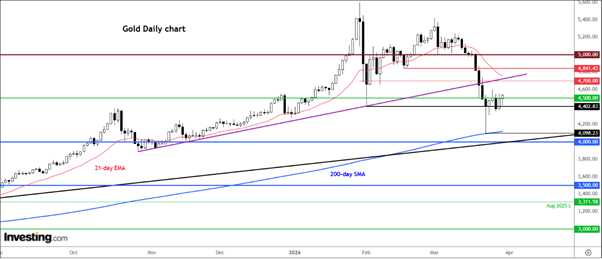
Key Levels to Watch
A crucial area on the upside is the former short-term bullish trendline, now acting as resistance, along with the $4,700 level. This zone is strengthened by the 21-day exponential moving average near $4,750, making the $4,700–$4,750 range a significant barrier if prices continue to rise.
Beyond that, the next resistance lies between $4,800 and $4,840 — a region that has previously served as both support and resistance. A strong breakout above this band could open the path toward the key psychological level of $5,000.
On the downside, the $4,400–$4,500 zone is a critical support area. A daily close below this range would weaken the short-term outlook and could lead to a decline toward last week’s lows near $4,100, where the 200-day moving average provides additional support.
Further down, longer-term support is seen around $4,000, where a major upward trendline aligns with this important psychological level.
Overall, gold remains in a fragile position and has yet to fully stabilize.
Sources: Fawad Razaqzada
 THE ETERNAL SOVEREIGN
Leave a comment