- Gold declines as a surge in oil prices pushes the U.S. dollar and Treasury yields above important levels.
- However, safe-haven demand tied to tensions in the Middle East is helping limit further losses despite the rise in yields.
- For now, the key levels to watch are $5,000 as support and the $5,150–$5,200 resistance zone.
Gold has begun the week on a weaker note after recording its first weekly loss since the sharp drop at the end of January. Although prices attempted to rebound in the latter half of last week, the recovery was not enough to offset the earlier declines.
The move largely reflects the sharp surge in oil prices, which has pushed both the U.S. dollar and bond yields higher. With oil climbing above $100 today, gold slipped again at the start of the session. As a result, gold is currently caught in a difficult position: escalating tensions in the Middle East are generating some safe-haven demand, but the strengthening U.S. dollar and rising bond yields are acting as significant headwinds.
Stronger U.S. Dollar and Rising Yields Offset Safe-Haven Demand
Rising yields typically weigh on assets like gold and silver, which do not generate interest and involve storage costs. In recent months, however, gold has shown notable resilience even as bond yields remained elevated. That strength faded somewhat last week, and at the start of today’s session gold slipped again—an unsurprising move given the firmer U.S. dollar and higher Treasury yields.
As the session progressed, gold did recover from its earlier lows, though it was still trading in negative territory at the time of writing.
The recent spike in oil prices has had a mixed impact on gold. On one side, the rise in bond yields and the stronger U.S. dollar has put downward pressure on the metal. On the other, safe-haven demand has continued to limit the downside. If oil prices were to ease somewhat—perhaps through a coordinated release of strategic reserves—gold could find room to move higher again.
Overall, gold’s price action remains volatile and largely in a consolidation phase, offering both bullish and bearish traders opportunities amid the heightened market swings.
Key Gold Price Levels to Watch
For now, the market appears to be trading strictly between key levels, and this pattern is likely to continue until we see a decisive breakout above resistance or a breakdown below the major support levels protecting the downside.
So, which levels are the most important to watch?
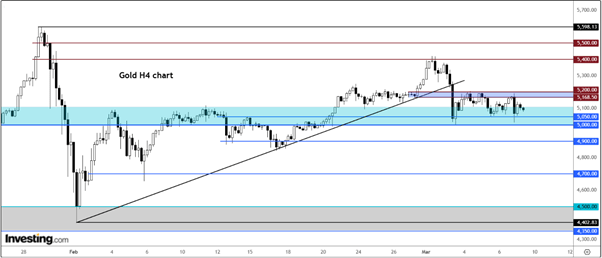
Support is currently located between $5,000 and $5,050. This zone has been tested several times from above in recent days and has held up well so far.
As long as gold does not break decisively below the $5,000 level, the overall bias could still favor the upside. Despite the recent rebound in the U.S. dollar and bond yields, gold’s broader trend has remained bullish, making it difficult to dismiss that outlook—especially given the ongoing tensions in the Middle East.
On the resistance side, the key range lies between $5,150 and $5,200. This area has been tested multiple times since the breakout seen last Tuesday, which initially appeared to signal a potential turning point for gold.
However, there has been little meaningful follow-through to the downside. The fact that gold has managed to hold steady suggests it may be forming a base around $5,000 before possibly attempting another move higher.
For now, the focus remains on these levels. Whether gold breaks above resistance or falls below support will likely determine its next short-term direction.
Sources: Fawad Razaqzada
 THE ETERNAL SOVEREIGN
Leave a comment