Bitcoin dropped under the $65,000 mark on Monday, retreating as higher oil prices dampened investor appetite for risk. Market sentiment was also affected by another Bitcoin sale from major corporate holder Strategy.
The leading cryptocurrency was down 1.6%, trading at $64,147.9 as of 17:00 ET (21:00 GMT).
Traders focus on U.S. inflation data for Federal Reserve signals
Bitcoin and the broader crypto market gained support on Friday after U.S. employment data revealed the first monthly decline in nonfarm payrolls since February, driven largely by losses in local government education jobs. Payroll figures for May and June were also revised down by a combined 103,000 positions.
The labor report added uncertainty to the Federal Reserve’s policy outlook. While the broader job market continues to show resilience, inflation concerns remain elevated due to volatile oil prices linked to the conflict involving Iran. Some Fed officials also indicated a preference for tighter monetary policy during the central bank’s July meeting.
Following the data release, traders reduced expectations for a September interest-rate increase. Higher borrowing costs typically reduce demand for risk-sensitive assets, including cryptocurrencies.
Investors are now turning their attention to a series of key U.S. inflation reports this week for further guidance on the Fed’s next moves. The July Consumer Price Index (CPI) is due on Wednesday, followed by the Producer Price Index (PPI) on Thursday, while July retail sales data will be released on Friday.
Oil surge and Hormuz tensions weigh on crypto sentiment
Oil prices jumped nearly 5% on Monday after Iran rejected direct negotiations with the United States and reiterated that a full reopening of the Strait of Hormuz would depend on Washington meeting a series of demands. Concerns over global energy supplies intensified further following attacks by Iran-backed Houthi forces on Saudi energy facilities, prompting investors to seek safety in the U.S. dollar.
Crude prices had fallen the previous week on optimism surrounding potential U.S.-Iran talks. However, those losses narrowed as Tehran repeatedly denied claims of ongoing negotiations and reports emerged that a proposed Hormuz management framework could restrict access for U.S., Israeli, and other vessels deemed hostile.
Iranian state media reported that a parliamentary committee had approved the framework, including the proposed restrictions. Foreign Ministry spokesman Esmaeil Baqaei said Iran and Oman were still working on a joint statement governing the strait, adding that the plan would establish monitoring mechanisms for vessel traffic and involve compensation arrangements.
Tehran also reaffirmed that direct talks with Washington remain off the table, citing alleged breaches of the temporary peace agreement reached in June. Iranian officials maintained that lifting sanctions, ending the U.S. naval presence, and compensation for wartime damages are prerequisites for fully reopening the strategic waterway.
U.S. President Donald Trump responded by stating that Iran’s compensation demands would be met with U.S. claims for damages as well, adding that his negotiating team had been instructed to include the issue in any future discussions.
Strategy trims Bitcoin holdings
Separately, Strategy disclosed in a filing with the U.S. Securities and Exchange Commission that it sold 1,690 Bitcoin between August 3 and August 9 for approximately $108.6 million, at an average price of $64,262 per coin.
Following the sale, the company’s Bitcoin holdings declined to 840,447 BTC, currently worth about $54.7 billion. Strategy’s average acquisition cost remains around $75,385 per Bitcoin, representing a total investment of roughly $63.4 billion, including related expenses.
The transaction came shortly after the company raised $653.1 million through the sale of more than 6.5 million shares of MSTR stock. Strategy said the proceeds were used to repurchase over 1.15 million shares of its STRC preferred stock and strengthen its cash position, which stood at $4.65 billion as of August 9.
Altcoins track Bitcoin lower
The broader cryptocurrency market also traded in negative territory on Monday, with most major altcoins posting losses alongside Bitcoin.
Ethereum declined 2.4% to $1,877.78.
XRP dropped 2.3% to $1.0189.
Solana lost 1.3%.
Cardano fell 2.6%.
Dogecoin slipped 1%.
The pullback across digital assets reflected a combination of risk-off sentiment driven by geopolitical uncertainty, rising energy prices, and investor caution ahead of key U.S. inflation data later this week.
Bitcoin hovered above $65,000 on Monday, remaining slightly above its 50-day Exponential Moving Average (EMA) at $64,702.
The Bank of Japan signaled that further interest rate hikes could be on the table, according to the summary of opinions from its July policy meeting.
Pump.fun and CurveDAO led the crypto market gains over the past 24 hours, emerging as the strongest performers among major digital assets.
Crypto Market Overview: Bitcoin Holds Firm as BoJ Signals Potential Tightening
The broader cryptocurrency market remained stable on Monday, with Bitcoin (BTC) trading around $65,000 and holding above its 50-day Exponential Moving Average (EMA) at $64,702. Despite growing expectations of tighter monetary policy in Japan after the Bank of Japan’s latest policy discussion summary, market sentiment across digital assets stayed constructive. Among the strongest performers over the past 24 hours were Pump.fun (PUMP) and Curve DAO (CRV), both extending recent gains.
Bank of Japan Hints at Additional Rate Hikes
The Bank of Japan released the summary of opinions from its July policy meeting, revealing a more hawkish tone among policymakers. Four of the nine board members supported further rate increases, while three adopted a neutral stance and two remained dovish. The discussion comes as the Japanese Yen continues to trade near multi-decade lows against the US Dollar, increasing pressure on policymakers to normalize monetary policy more aggressively.
Bitcoin Technical Outlook
Bitcoin traded near $65,200 on Monday, maintaining support above its 50-day EMA at $64,702. However, the leading cryptocurrency remains below the 100-day EMA at $66,905 and the 200-day EMA at $72,686, suggesting that the broader trend has yet to fully turn bullish.
Technical indicators show improving momentum. The MACD has generated a bullish crossover above its signal line, while the Relative Strength Index (RSI) sits around 55, indicating moderate buying strength.
If buyers remain in control, the next key resistance levels are the 100-day EMA at $66,905 and the 200-day EMA near $72,686. A sustained breakout above these barriers could strengthen the bullish outlook. On the downside, the 50-day EMA at $64,702 remains the first important support level, with a daily close below it potentially triggering a deeper pullback.
PUMP Extends Breakout Rally
Pump.fun (PUMP) continued its upward trajectory on Monday after gaining roughly 11% on Sunday. The token remains in a bullish structure after breaking out of a falling wedge formation and is currently trading close to a six-month high.
Momentum indicators continue to favor the bulls. The RSI has climbed to 72, entering overbought territory, while the MACD remains firmly positive with expanding bullish histogram bars.
Should the rally continue, the next upside target is the December 2025 peak at $0.003399. Key support lies near $0.00251, corresponding to the reclaimed high from May 9.
CRV Targets Higher Levels
Curve DAO (CRV) advanced for a third consecutive session, approaching the $0.24 mark. The token remains above both its 50-day EMA at $0.2135 and 100-day EMA at $0.2214, supporting the near-term bullish outlook. Nevertheless, the 200-day EMA at $0.2683 continues to act as a major resistance level and keeps the longer-term trend cautious.
CRV is also trading above the 50% Fibonacci retracement level at $0.2232, calculated from the decline between $0.2931 and $0.1700. Immediate resistance is located near the 78.6% Fibonacci retracement at $0.2608, which aligns closely with the 200-day EMA. A breakout above this zone could open the door for a move toward $0.2931.
On the downside, the $0.2232 retracement level is reinforced by the 100-day EMA at $0.2214 and the 50-day EMA at $0.2135, creating a strong support area for the token.
Optimism surrounding a potential US-Iran agreement has weighed on oil prices, helping ease concerns about inflation.
US equities have climbed to fresh record highs, but the still-weak correlation between BTC and the S&P 500 has limited Bitcoin’s upside momentum.
Continued net inflows into spot Bitcoin ETFs are providing additional support for the cryptocurrency.
Technical outlook: Bitcoin maintains a constructive bias while holding above key support levels, with traders watching for a breakout that could trigger the next leg higher.
Bitcoin remains comfortably above the $64,000 mark, supported by growing optimism over potential U.S.-Iran peace talks and renewed inflows into spot Bitcoin ETFs. Despite these tailwinds, BTC has gained only about 0.7% over the past 24 hours, lagging the broader rally in risk assets.
Market sentiment improved as hopes increased that the U.S. and Iran could reach an agreement to reopen the Strait of Hormuz. Oil prices have fallen for a third consecutive session and are down roughly 10% this week. U.S. Treasury Secretary Scott Bessent indicated that an agreement to restore shipping through the strategic waterway could be reached within days.
The decline in oil prices has helped ease inflation concerns, pushing Treasury yields lower. If the trend persists, investors may further reduce expectations for a more hawkish Federal Reserve stance.
Markets are currently assigning a 59% probability to a Fed rate hike in September, down from 65% a day earlier. The shift in rate expectations has also weighed on the U.S. dollar, creating a more favorable backdrop for Bitcoin and other risk-sensitive assets.
Meanwhile, optimism surrounding a potential Middle East agreement and renewed enthusiasm for AI-related investments have driven U.S. equities to fresh highs, with both the S&P 500 and Dow Jones reaching record levels.
Bitcoin, however, has not mirrored the strength seen in stocks. A relatively weak 30-day correlation between BTC and the S&P 500 helps explain the divergence, suggesting that broader risk-on sentiment alone may not be enough to fuel a major breakout. Instead, Bitcoin may require a crypto-specific catalyst to generate stronger upside momentum.
Institutional Demand Continues to Support Bitcoin
Institutional interest in Bitcoin is showing encouraging signs. Data from SoSoValue revealed that spot Bitcoin ETFs attracted $211.5 million in net inflows on Tuesday, following another strong session that saw $170.1 million in net inflows the day before.
If ETF demand remains robust and Bitcoin begins to strengthen its positive correlation with equity markets, these flows could provide additional support for higher prices. On the other hand, if institutional participation fails to accelerate meaningfully, BTC may continue to underperform despite the broader rally across risk assets.
Looking ahead, market focus is shifting toward upcoming U.S. economic data. Investors will closely monitor the ISM Services PMI release, followed by Friday’s nonfarm payrolls report, both of which could offer important clues about the Federal Reserve’s next move on interest rates and influence Bitcoin’s near-term direction.
Bitcoin has pushed back above the $64,000 level, but the broader technical picture remains slightly bearish. The price continues to trade below the 50-day EMA near $64,600, as well as the 100-day and 200-day EMAs, indicating that the recent advance may still be a corrective rebound within a larger downtrend. Meanwhile, the RSI remains near neutral territory, highlighting a lack of strong bullish or bearish momentum.
On the downside, failure to regain the 50-day EMA could trigger a retest of support around $62,500, which marks both the weekly low and the mid-July trough. A move below this level would bring the psychologically important $60,000 threshold into focus, followed by the 2026 low near $57,700. A break beneath $57,700 would confirm a lower low, increasing the risk of a deeper decline toward $55,000 and potentially $50,000, levels not seen since 2024.
For the bullish outlook to strengthen, Bitcoin must first reclaim the 50-day EMA at $64,600 and then break above the July peak near $67,000. Such a move would establish a higher high and could pave the way for a test of the 200-day EMA, currently located around $72,500.
Bitcoin remains under pressure near the $60,000 mark as weak buyer conviction, persistent selling activity, and cautious positioning in derivatives markets continue to cap recovery attempts.
Meanwhile, Strategy has approved a Bitcoin monetization program that permits the sale of up to $1.25 billion worth of BTC, aiming to enhance liquidity and strengthen its financial flexibility.
According to Bitget analyst Lacie Zhang, the initiative helps alleviate funding concerns but also signals a notable departure from Strategy’s longstanding approach of continuously accumulating Bitcoin.
Bitcoin hovers near $60K as weak demand caps recovery; Strategy approves BTC sales program
Bitcoin (BTC) traded around $60,000 on Monday, attempting to stabilize after last week’s sharp decline. Despite finding support near $58,000, the cryptocurrency has struggled to stage a convincing rebound, with analysts pointing to weak buyer conviction and a broadly defensive market environment.
According to Glassnode, Bitcoin remains stuck near recent lows as buyers have yet to show the confidence needed to drive a sustained recovery. While trading activity has increased, spot markets continue to record net selling pressure, suggesting liquidity is still being used for distribution rather than accumulation.
The cautious mood is also evident in derivatives markets, where traders are scaling back leverage and increasing downside protection. Elevated options skew indicates stronger demand for hedging against further losses, while institutional appetite remains subdued. US spot Bitcoin ETFs have slipped into aggregate unrealized losses and continue to experience net outflows, highlighting limited interest from large investors despite higher trading volumes.
Meanwhile, Strategy unveiled a new Digital Credit Capital Framework aimed at strengthening liquidity and supporting its preferred securities. The company reported a cash reserve of $2.55 billion as of June 28 and authorized a $1 billion repurchase program for its Digital Credit Securities.
As part of the initiative, Strategy’s board approved a Bitcoin monetization program that allows the sale of up to $1.25 billion worth of BTC. The proceeds may be used to bolster cash reserves, fund dividend and interest payments, and support share repurchase programs.
According to Bitget Wallet analyst Lacie Zhang, the move helps ease concerns over Strategy’s liquidity position but also represents a significant shift from the company’s longstanding Bitcoin accumulation strategy. She noted that expanding cash reserves to $2.55 billion extends the firm’s liquidity runway and could improve investor confidence, particularly among holders of its preferred securities.
Strategy currently holds approximately 847,000 BTC, and its MSTR shares rose 12.6% following the announcement, snapping a nine-session losing streak. At the time of writing, Bitcoin was trading near $60,450, up 1.6% over the previous 24 hours.
The Bitcoin ecosystem continues to face mounting challenges, with another major setback emerging from the Layer-2 sector. In a surprising development, Botanix, a prominent Bitcoin Layer-2 network, has announced that it will cease operations, giving users until July 9 to withdraw their assets.
The shutdown comes amid a sharp downturn in the cryptocurrency market. Bitcoin has fallen to around $61,000 during the latest wave of selling pressure, raising concerns that the current correction could evolve into a more prolonged bearish phase.
Botanix confirmed a phased closure of its EVM-compatible Layer-2 network, warning users to remove their funds before the July 9 deadline. Any assets left on the platform after that date will be transferred to the custody of a validator group known as the Federation, making direct withdrawals no longer possible.
The closure marks a disappointing end for a project that previously secured $11.5 million in funding from leading venture capital firms, including Polychain Capital and Placeholder Capital.
In an unusually candid post-mortem, the Botanix team acknowledged that limited user adoption ultimately led to the project’s downfall. According to the developers, demand for Bitcoin-based programmability and decentralized finance remains underdeveloped. Most DeFi participants continue to favor wrapped Bitcoin on Ethereum and other established platforms, while many Bitcoin holders still view BTC primarily as a long-term store of value rather than an asset for active on-chain trading.
As a result, the network struggled to generate sufficient transaction fees to support its operational and infrastructure costs, leading to the decision to shut down the platform.
Bitcoin Price Plunge
The shutdown of Botanix comes at a particularly difficult time for the cryptocurrency market, which is already facing intense selling pressure. Bitcoin has experienced a sharp decline this week, falling below several key psychological support levels and dropping to around $61,600, according to market data from CoinMarketCap.
The latest sell-off has further weakened investor sentiment, triggering concerns that the market could be entering a deeper correction phase. As Bitcoin struggles to regain momentum, risk assets across the crypto sector—including smaller Layer-2 networks and DeFi projects—have come under increased pressure.
For emerging ecosystems such as Botanix, the unfavorable market environment has only amplified existing challenges. With declining trading activity, weaker user engagement, and reduced fee generation, many smaller blockchain projects are finding it increasingly difficult to sustain operations during the downturn.
The sharp decline has significantly weakened retail investor sentiment and sparked a wave of liquidations across major cryptocurrency exchanges. The rapid correction highlights deteriorating market liquidity, creating a more challenging environment for smaller blockchain networks and emerging ecosystems. As capital flows out of riskier assets, projects with limited adoption and weaker financial foundations become increasingly exposed to market stress.
Analysts Predict Bitcoin Bear Market Could Persist
Several well-known cryptocurrency analysts argue that the current downturn may have further room to run. Influential market commentators on X, including Ash Crypto and 0xChiefy, suggest that prevailing macroeconomic conditions and historical Bitcoin market cycles indicate the potential for additional downside pressure.
According to their analysis, a combination of economic uncertainty, tightening liquidity conditions, and recurring bearish patterns from previous market cycles could lead to deeper corrections before a sustainable recovery takes hold. As a result, traders and investors are closely monitoring key support levels and broader market developments for signs of stabilization.
Analysts believe the current bearish momentum could continue to weigh on Bitcoin prices, potentially driving the market lower before a durable macroeconomic bottom is established. Their outlook is further reinforced by a significant wave of institutional selling, with reports indicating that more than 52,500 BTC have been liquidated through spot Bitcoin ETFs.
The large-scale distribution by institutional investors has added considerable selling pressure to the market, creating a supply overhang that may limit the prospects for a near-term recovery. As long as this excess supply remains in circulation, upward price movements could face substantial resistance.
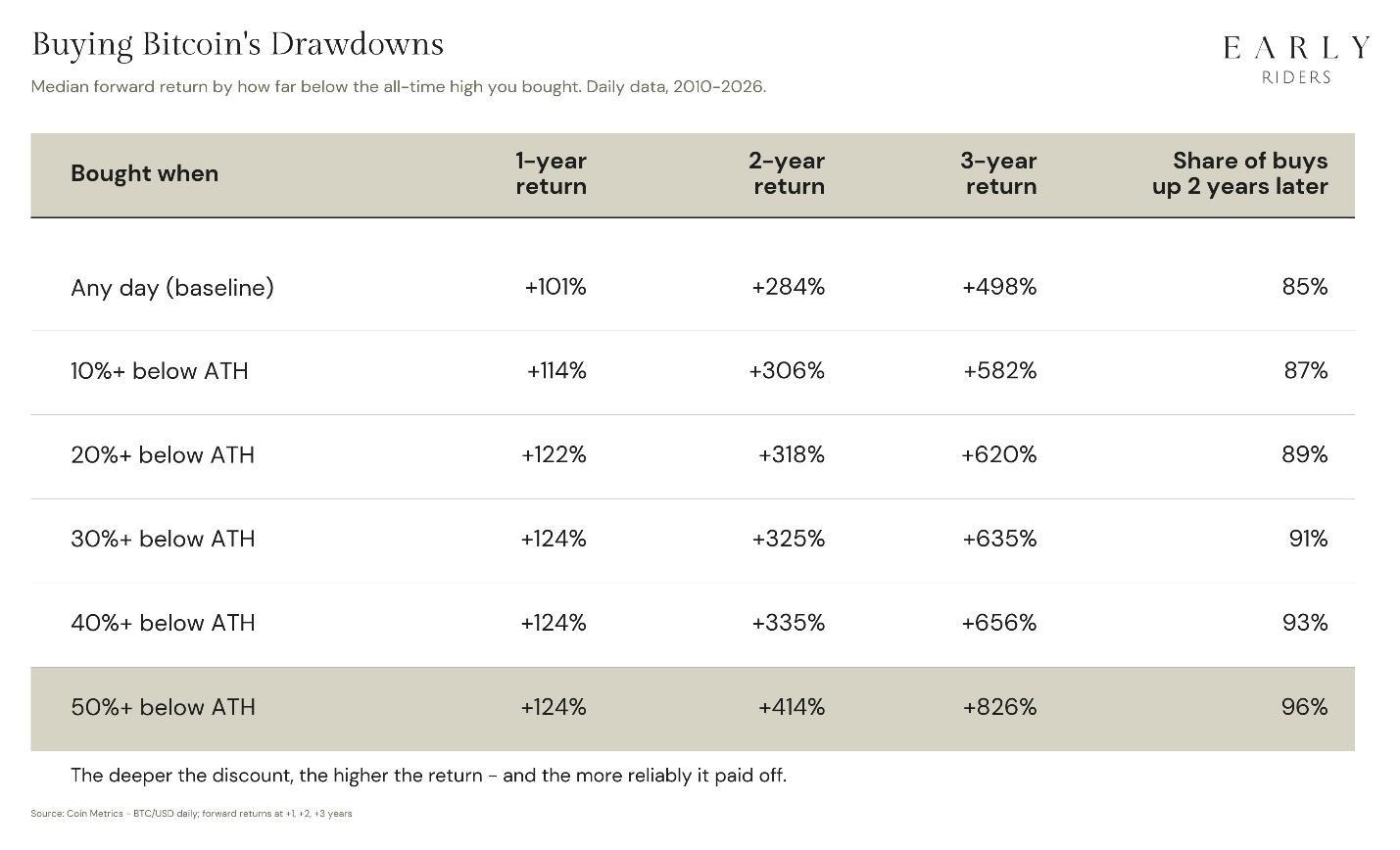
Nevertheless, historical market data offers a more optimistic longer-term perspective. According to CoinMetrics, deeper declines during Bitcoin bear markets have often been followed by stronger and more explosive recoveries. While the current environment remains challenging, past cycles suggest that periods of extreme weakness can ultimately lay the foundation for powerful bullish reversals once market sentiment and liquidity conditions improve.
The chart provides Bitcoin investors with a reason for cautious optimism. Historical market cycles suggest that while bear markets can be painful and prolonged, they have often been followed by powerful recoveries. As a result, many investors believe that once the current downturn reaches its macro bottom, Bitcoin could stage a significant rebound and potentially climb to new all-time highs.
Past performance indicates that deeper corrections have frequently laid the groundwork for stronger bull runs, driven by renewed investor confidence, improving liquidity conditions, and growing institutional participation. Although short-term risks remain elevated, long-term market participants continue to view the current weakness as part of Bitcoin’s broader cyclical pattern.
BTC Technical Indicators Signal Continued Weakness
A review of Bitcoin’s technical indicators reinforces the prevailing bearish sentiment across the market. According to live technical data from Investing.com, Bitcoin is currently generating a strong sell signal on the daily, weekly, and monthly timeframes, suggesting that downward pressure remains firmly in control.
The 14-day Relative Strength Index (RSI) is hovering around 34.8, a level that reflects weakening buying interest and sustained selling activity. While not yet in deeply oversold territory, the indicator points to a market where bears continue to hold the upper hand.
Adding to the negative outlook, key moving averages—from the short-term 5-day MA to the long-term 200-day MA—remain above Bitcoin’s current trading price. This bearish alignment indicates that major trend indicators continue to act as resistance, limiting the potential for a near-term recovery.
As long as Bitcoin trades below these critical moving averages, technical momentum is likely to remain tilted to the downside, with sellers maintaining control of the broader market trend.
The recent wave of selling in US spot Bitcoin ETFs has emerged as one of the clearest signs that institutional investors are becoming more cautious toward risk assets.
The BlackRock iShares Bitcoin Trust (IBIT) experienced net outflows totaling approximately $2.43 billion across nine consecutive trading sessions in May 2026. The streak culminated on May 26 with a $1.26 billion dark-pool block transaction, the largest single-day redemption recorded since the fund launched in January 2024.
Blockchain data reinforced the scale of the withdrawal activity. Roughly 6,005 BTC—worth about $403 million at the time—was transferred from custody wallets associated with IBIT to Coinbase Prime, offering direct evidence of the redemption process behind the reported fund outflows.
The sustained withdrawals effectively erased much of the nearly $3 billion that flowed into IBIT during April, a month that marked one of the strongest periods of spot Bitcoin ETF demand since October 2025.
The sharp reversal in investor flows, coupled with the sizable movement of Bitcoin to an exchange-linked custody platform, intensified risk-off sentiment across crypto markets. It also contributed additional sell-side liquidity to spot markets during a period already characterized by macroeconomic uncertainty.
Understanding the IBIT Redemption Trend
At the time of the outflow cycle, IBIT held an estimated 660,000–670,000 BTC, representing roughly $44–46 billion in assets under management. Against that backdrop, the $2.43 billion withdrawal equates to around 5–5.5% of total fund assets, suggesting a meaningful portfolio reallocation rather than routine redemption activity.
The magnitude of the May 26 event was particularly notable. The previous record for a single-session outflow stood at approximately $649 million in January, making the latest redemption nearly twice as large.
Data from CoinGlass also showed that selling pressure extended beyond IBIT. Comparable outflows were recorded across other major spot Bitcoin ETFs, including Fidelity’s FBTC, ARK Invest’s ARKB, and Grayscale’s GBTC. The synchronized withdrawals point to a broader institutional de-risking trend rather than concerns tied to any individual fund.
Longer-Term Context Remains Constructive
Despite the weakness seen in May, the broader flow picture remains positive. US spot Bitcoin ETFs still entered June with nearly $2 billion in net inflows year-to-date, while cumulative inflows since launch remained in the region of $58–59 billion.
As a result, although the recent redemption wave represents a significant short-term shift in sentiment, it has not fundamentally altered the larger institutional positioning that was built throughout 2024 and 2025. The data suggests a period of risk reduction and portfolio adjustment rather than a wholesale abandonment of long-term Bitcoin exposure.
Macro Conditions and Institutional Positioning: The Risk-Off Shift Driving Bitcoin ETF Outflows
The nine-session streak of Bitcoin ETF outflows unfolded against a backdrop of elevated US Treasury yields and a Federal Reserve policy stance that investors viewed as restrictive for risk assets. As financial conditions tightened, Bitcoin slipped below key consolidation levels, reinforcing bearish sentiment across digital asset markets.
Institutional investors responded by scaling back exposure to higher-volatility assets, including Bitcoin ETFs. The trend was not confined to the United States. Between May 25 and May 29, European crypto exchange-traded products recorded approximately $1.67 billion in net outflows, highlighting a broader global shift toward risk reduction.
The coordinated withdrawals across multiple regions suggest that the recent selling pressure reflects a wider institutional portfolio reallocation rather than concerns tied solely to BlackRock’s IBIT or other US-listed Bitcoin ETFs.
Interestingly, capital has not been exiting the crypto sector altogether. Newly launched XRP spot ETFs attracted roughly $132 million in net inflows without registering a single day of net redemptions during the same period. This divergence points to a rotation within digital assets, as investors selectively reallocate capital toward alternative crypto exposures rather than abandoning the asset class entirely.
$63,000 Emerges as Bitcoin’s Key Inflection Point
Bitcoin continues to trade just above the $63,000 level, a threshold increasingly viewed as the dividing line between a healthy consolidation phase and a more pronounced corrective move.
Should the market break decisively below this support zone, downside momentum could accelerate toward the $60,000 area, where longer-term investors have historically demonstrated stronger buying interest. Such a bearish outcome would likely be driven by continued institutional outflows, persistently high real yields, and Bitcoin’s inability to reclaim resistance around $65,000.
On the other hand, the bullish case remains intact if ETF redemptions begin to stabilize after the recent wave of selling. A softer-than-expected inflation report or a more accommodative tone from the Federal Reserve could improve risk sentiment and encourage fresh institutional allocations. Given that assets held by spot Bitcoin ETFs remain historically elevated despite recent withdrawals, a shift in macro expectations could provide the catalyst for Bitcoin’s next upward move.
For now, the $63,000 region represents the market’s most important near-term battleground, with the interplay between ETF flows and Federal Reserve policy likely determining Bitcoin’s next major directional trend.
Modern portfolios are no longer forced to choose between stability and rapid growth — investors now expect both.
In mid-January, gold climbed above 4,600 USD per ounce while bitcoin slipped below 92,000 USD, remaining volatile yet still resilient on a year-to-date basis. Both assets continue to attract capital. While they are often portrayed as opposing trades, the reality is becoming more complex. Investors are no longer choosing between gold and crypto — they are allocating to both. The key question is no longer which asset will outperform, but why capital is flowing into both simultaneously, and what that says about global markets in 2026.
Why gold is reaching record highs
Gold’s rise beyond 4,600 USD per ounce reflects more than short-term fear. Central bank behavior has undergone a structural shift. For the first time in decades, gold now accounts for a larger share of global reserve allocations than US Treasuries, highlighting changing views on long-term monetary stability among sovereign institutions.
Institutional demand has followed the same trend. Exchange-traded funds experienced renewed inflows throughout 2025, while central banks continued purchasing gold at elevated levels. This is not simply momentum-driven buying — it is strategic positioning. Against a backdrop of geopolitical tension, concerns over fiscal sustainability, and uncertainty surrounding the future path of interest rates, gold is increasingly viewed as both a hedge and a reserve asset free from counterparty risk.
Expectations of lower interest rates have also strengthened gold’s appeal. Falling yields reduce the opportunity cost of holding non-yielding assets, making gold comparatively more attractive. Meanwhile, a weaker US dollar mechanically supports gold demand outside the United States, reinforcing its role as a global store of value rather than merely a defensive asset.
In this environment, gold is no longer seen solely as an inflation hedge. It has evolved into a broader indicator of policy uncertainty and systemic risk — a form of protection against scenarios that traditional fixed-income assets may no longer hedge effectively.
Why crypto continues to attract demand despite volatility
Bitcoin’s volatility has not stopped capital from returning to the market. Although still trading well below its late-2025 peaks, bitcoin remains structurally elevated, reflecting a different form of investor demand. Unlike gold, its appeal lies not in stability, but in responsiveness.
Crypto markets remain closely tied to liquidity conditions and investor risk appetite. Bitcoin does not consistently function as a safe haven. During periods of acute market stress, it can decline alongside equities. However, when liquidity expectations improve or risk sentiment recovers, bitcoin often rebounds more rapidly — and more aggressively — than traditional assets.
This dynamic positions crypto as a performance-oriented asset rather than a defensive hedge. Investors allocate capital to it when they anticipate improving financial conditions, seek exposure to volatility, or pursue asymmetric upside potential. Institutional access has expanded and market infrastructure has matured, but crypto still retains the high-risk, high-reward characteristics that continue to attract investors willing to tolerate significant fluctuations.
The rise of the mixed portfolio strategy
Perhaps the most important development is not gold’s rally or crypto’s resilience individually, but the fact that investors are increasingly holding both simultaneously. This reflects a portfolio strategy designed for a multi-regime market environment.
Gold acts as a stabilizer during periods of uncertainty, while crypto offers convex upside when conditions improve. Holding both is not contradictory — it reflects an acknowledgment that markets in 2026 are no longer driven by a single dominant narrative. Risk can escalate quickly, but liquidity conditions can also improve just as rapidly. Portfolios positioned for only one outcome risk being exposed to the other.
This blended approach suggests investors are managing not only volatility, but also regime uncertainty. They are hedging against systemic risks while remaining positioned for performance opportunities. It represents a more sophisticated style of portfolio construction — one that balances defensive and offensive exposure dynamically rather than statically.
According to Terence Hove, senior market analyst at Exness, execution quality becomes increasingly important when trading assets with vastly different volatility profiles. He notes that cross-asset strategies depend on reliable trading conditions, especially during macro-driven market events, where spreads, execution precision, and slippage control become critical for traders moving between gold and crypto.
This dual-allocation approach also highlights a practical issue that is often overlooked: switching between defensive and performance assets only works efficiently if trading conditions remain stable across both markets. Otherwise, the transition itself becomes an additional cost. In this sense, broker execution quality becomes part of portfolio construction.
For instance, Exness reported that BTCUSD spreads remained at minimum levels 99.98% of the time, while ETHUSD spreads were reduced by 67%. In highly volatile markets, such consistency can help traders adjust exposure without execution risk becoming the dominant variable.
What this says about market psychology
Simultaneous demand for gold and crypto points to a fragmented macro environment. Markets are neither fully risk-on nor fully risk-off. Instead, investors are positioning for multiple possible outcomes at the same time.
Demand for gold reflects concerns over policy credibility, currency stability, and geopolitical tensions. Demand for crypto reflects expectations that liquidity cycles and structural adoption trends can still drive strong performance. These narratives coexist because the current macro backdrop supports both caution and opportunism.
In that sense, markets are not choosing between fear and growth — they are pricing both simultaneously. The combination of strong gold demand and persistent crypto interest suggests investors are building portfolios capable of absorbing shocks while still participating in upside opportunities when conditions improve.
As 2026 progresses, the relationship between gold and crypto will likely remain fluid, shaped by changes in liquidity conditions, policy expectations, and market stress. Investors who understand the distinct role each asset plays — and who operate within trading environments capable of maintaining stability across asset classes — may be better equipped to navigate the volatility ahead.
A Bitcoin investor regained access to almost $400,000 worth of BTC after leveraging Claude AI to unlock a wallet that had remained inaccessible since 2015.
The recovery process involved AI-assisted analysis of legacy wallet files and mnemonic information to help identify the correct password.
Blockchain records later confirmed the transfer of the recovered funds, fueling broader conversations about the expanding role of artificial intelligence in cryptocurrency recovery efforts.
A Bitcoin (BTC) holder reportedly regained access to around 5 BTC — valued at nearly $400,000 — after recovering a forgotten wallet password, according to a viral post on X shared Wednesday.
The user, known on X as cprkrn, said the breakthrough came with the help of Claude AI after years of unsuccessful attempts to recover the wallet.
Crypto community reacts to AI-assisted wallet recovery
According to the post, the wallet became inaccessible after the owner changed the password and later forgot the updated credentials. Over the years, he allegedly tested countless password combinations, hired several recovery experts, and searched through old notes in an effort to regain access to the funds.
The turning point came when the user uploaded files from an old college computer into Claude AI. By combining the data with a recovered mnemonic seed phrase, he was ultimately able to decrypt the wallet and recover the Bitcoin.
“Tried ~3.5 trillion passwords + none worked, ended up matching an old seed phrase found in a college notebook with an old wallet file,” he wrote.
The user later publicly disclosed the forgotten password, triggering widespread reactions throughout the crypto community. In a follow-up post, he admitted he “would’ve been too dumb to figure it out” without the AI’s help.
Blockchain activity appears to support the claim. Wallet records linked to the address show BTC deposits dating back to April 2015, along with recent transactions consistent with a recovery and transfer of the funds to a new wallet, according to data from Blockchair.
The story quickly attracted attention from several notable figures in the crypto space, including Nic Carter, Laura Shin, and Jesse Pollak.
Importantly, the recovery depended on AI-assisted analysis of files and credentials already owned by the wallet holder, helping ease concerns about broader threats to Bitcoin wallet security.
The incident highlights an emerging use case for artificial intelligence in crypto recovery efforts. However, it does not suggest that AI can crack Bitcoin’s encryption, as the recovery relied on existing seed phrases and legacy wallet data rather than bypassing cryptographic protections.
The case also contrasts with other high-profile stories involving lost Bitcoin holdings, including the 2025 attempt by James Howells to recover a hard drive containing thousands of BTC from a landfill.
The BTC/USD pair has delivered several strong and technically reliable price swings in recent years, creating attractive trading opportunities for both investors and short-term traders.
As a result, market participants continue watching Bitcoin closely, anticipating another significant move ahead. However, Bitcoin’s recent climb to a fresh multi-month high lacked the strength and momentum seen in equities and other risk-sensitive assets during the same period. Combined with fading bullish momentum, this has raised questions about whether Bitcoin may be losing some of its long-standing market appeal, either temporarily or for a longer period.
One key reason traders are paying close attention now is that Bitcoin appears to be approaching a critical technical turning point. A closer examination of the chart shows bulls and bears are currently in near equilibrium. When price action compresses into a tightening consolidation phase like this, it often precedes a breakout that can trigger a stronger directional move, either continuing the existing trend or reversing it.
Additional factors adding to Bitcoin’s importance at the moment include:
Uncertain price action in the US Dollar, suggesting Bitcoin’s own dynamics may drive the next move;
Today’s US CPI inflation report, which could surprise markets and spark volatility.
The clearest sign that Bitcoin may be nearing a decisive move is the formation of a narrowing triangle pattern on the chart. The converging trend lines connecting recent highs and lows indicate increasing indecision and the possibility of a breakout in either direction.
That said, the pattern is not perfectly symmetrical, which slightly weakens its reliability. The ascending support trend line is noticeably steeper than the descending resistance line, making the setup less balanced than a classic triangle formation.
Another technical aspect worth noting is that, despite some softness in the broader long-term uptrend, Bitcoin still maintains a meaningful bullish structure after recently reaching fresh multi-month highs. This could strengthen the argument for an upside breakout, particularly if the price manages to break above the recent swing highs and establish itself beyond the $82,500 level.
AUD/USD Technical Analysis
One of the clearest signs that AUD/USD may be approaching a pivotal move is the formation of a tightening triangle pattern on the chart. The converging trend lines connecting recent highs and lows highlight growing market indecision and suggest that a breakout in either direction could soon emerge.
While the pair has remained confined within this narrowing structure for several sessions, the setup is not a perfectly symmetrical triangle. The ascending support line is steeper than the descending resistance line, making the formation slightly uneven and therefore somewhat less reliable as a classic consolidation signal.
Another technical factor worth monitoring is the broader trend structure. Although the longer-term bullish momentum remains relatively modest, AUD/USD has still managed to post fresh multi-month highs recently. This underlying strength may increase the probability of an upside breakout, particularly if buyers succeed in pushing the pair above nearby swing highs and sustaining momentum beyond key resistance levels.
At the same time, traders should remain cautious ahead of major macroeconomic catalysts, especially US inflation data and broader US Dollar movements, as these could determine whether the pair breaks higher or reverses lower from the current consolidation zone.
Watch Closely for US CPI Inflation Data
The primary risk for USD-related currency pairs today is the release of the US Consumer Price Index (CPI) data, widely regarded as one of the most influential monthly indicators in the Forex market.
This inflation report has the potential to trigger sharp volatility, particularly if the figures differ significantly from market expectations. Current forecasts suggest annual inflation could rise from 3.3% to 3.7%. Any meaningful deviation from that estimate is likely to have a direct impact on the US Dollar’s direction.
For instance, if inflation prints at 3.9% or higher, traders may anticipate a more hawkish Federal Reserve stance, which could strengthen the US Dollar and push this currency pair sharply lower. On the other hand, a softer reading of 3.5% or below could weaken the Dollar and fuel a strong upside move in the pair.
During major economic releases like this, market sentiment can shift rapidly, often overpowering existing technical setups and making chart patterns temporarily less reliable.
Could the Triangle Pattern Lose Its Importance?
Today’s analysis is largely based on the expectation that a breakout from the current triangle formation could trigger a decisive — or at least tradable — move in Bitcoin. However, there are several reasons why this pattern may ultimately prove less significant than expected.
First, the broader market trend still leans bullish. For traders who prefer to follow the prevailing trend, or at least avoid trading aggressively against it, a downside break from the triangle could turn into a false breakout that quickly reverses higher.
In addition, the triangle itself is not an especially convincing formation. As noted earlier, the structure lacks the balance and symmetry typically associated with stronger consolidation patterns, which reduces confidence in its predictive value.
There are also major macroeconomic and geopolitical risks that could easily overpower technical signals. Today’s US CPI inflation data has the potential to create sharp volatility across financial markets, while any unexpected developments involving tensions between the United States and Iran could rapidly shift investor sentiment.
In situations like these, strong fundamental catalysts can drive price action straight through technical levels and chart patterns, making formations such as the current triangle temporarily irrelevant.
Outlook on BTC/USD
The key focus for Bitcoin today is likely to be the direction of the eventual breakout from the tightening triangle formation. The first trend line tested could become the market’s main decision point for the session.
If price reacts positively from the ascending support trend line with a strong bullish rebound, it may present an attractive long opportunity — particularly if the nearby support level around $80,558 is also firmly defended. Such a move would suggest buyers are still in control despite recent consolidation.
On the other hand, a rejection from the upper resistance trend line could create a favorable short setup, especially if the psychologically important $82,000 level is rejected at the same time. That combination would reinforce the possibility that bullish momentum is fading near resistance.
As price action remains compressed within the triangle, traders will likely watch closely for confirmation signals before committing to a directional move.
Today’s BTC/USD Trading Signals
Risk per trade: 0.50%
Trade validity: Positions should be opened before 5:00 PM Tokyo time on Wednesday.
Long Trade Setups
Consider long positions after a bullish price action reversal on the H1 chart following a test of the following support levels:
$80,558
$79,440
$77,858
For risk management:
Place the stop loss $100 below the most recent swing low.
Once the trade gains $100 in profit, move the stop loss to breakeven.
Secure partial profits by closing 50% of the position after the first $100 gain, while allowing the remaining portion to continue running.
Short Trade Setup
Consider short positions after a bearish rejection or reversal signal on the H1 timeframe following a test of:
$81,343
Trade management guidelines:
Set the stop loss $100 above the latest swing high.
Move the stop loss to breakeven once the trade reaches $100 profit.
Take profit on half the position after a $100 favorable move and leave the rest open for a larger potential move.
Identifying Price Action Reversals
Common reversal confirmations on the hourly chart include:
Pin bars
Doji candles
Outside candles
Engulfing candles with a stronger close
These candlestick formations can help traders confirm whether support or resistance levels are being respected before entering a position.
Key Events to Watch
There are no major Bitcoin-specific events scheduled today. However, broader market volatility could increase due to important US economic developments, including:
US CPI inflation data release at 1:30 PM London time
Later remarks and developments involving the Federal Reserve Chair
These events could significantly influence US Dollar strength and indirectly impact Bitcoin price action.
Bitcoin’s recovery pauses while the $80,000 support level remains intact, as optimism surrounding a final US-Iran peace deal begins to fade.
Market participants are also staying cautious ahead of key US economic data releases, particularly Tuesday’s CPI report.
Meanwhile, the US Senate Banking Committee is scheduled to conduct its markup hearing on the Clarity Act this Thursday.
On the supply side, roughly $159 million worth of token unlocks — led by Solana’s $40 million and Pump.fun’s $21 million — may add further volatility to the crypto market.
The cryptocurrency market started the week on a subdued note, with Bitcoin (BTC) finding it difficult to maintain support above $80,000 as optimism over a final US-Iran peace agreement weakened due to growing complications in the negotiations.
Altcoins also showed signs of fading momentum, with Ethereum (ETH) retreating from its weekly peak of $2,375, while Ripple (XRP) revisited support around $1.45 after facing rejection near the $1.50 resistance zone.
Trump rejects Iran’s peace proposal
US President Donald Trump has rejected Iran’s latest proposal to end the conflict, calling it “totally unacceptable.” The proposal, reportedly delivered to the White House through Pakistani mediators, was presented as a counteroffer to a one-page US memorandum outlining a phased framework for ending the war — a conflict that has severely disrupted the Strait of Hormuz, one of the world’s most strategically important shipping routes.
Under the proposal, Iran demanded the complete removal of US sanctions, an immediate end to the military blockade around the Strait, and concessions related to its nuclear program, including a shorter moratorium on uranium enrichment. Tehran also sought sovereignty rights over the Strait of Hormuz, including authority to coordinate maritime traffic passing through the route.
Trump has continued to maintain a firm stance on Iran’s nuclear ambitions, insisting that the country’s nuclear program must be fully dismantled.
Meanwhile, global markets remain tense as hopes for a lasting peace agreement continue to weaken amid the fragile diplomatic environment. Oil prices also remain elevated, with West Texas Intermediate (WTI) crude holding near the $95.00 level.
Caution ahead of US macroeconomic data
The US Bureau of Labor Statistics (BLS) is scheduled to release the Consumer Price Index (CPI) report on Tuesday. The CPI is the US’s main inflation gauge, tracking changes in the average prices consumers pay for goods and services such as food, housing, and transportation over time.
For investors, CPI data plays a critical role in shaping expectations for interest rates. A stronger-than-expected inflation reading could further reduce hopes for Federal Reserve rate cuts in 2026, while softer inflation data may strengthen the bullish outlook for risk assets like Bitcoin, as markets anticipate a more accommodative monetary policy stance from the Federal Reserve.
March inflation data came in above expectations, with headline CPI rising to 3.3% year-over-year, compared to 2.4% in February. Core CPI — which excludes volatile food and energy prices — increased to 2.6% in March from 2.5% previously.
Markets are now forecasting April CPI to climb further to 3.7% YoY, while Core CPI is expected to edge up to 2.7%.
Investors will also closely monitor Wednesday’s Producer Price Index (PPI) release, which measures inflation from the producer side by tracking changes in the prices businesses receive for goods and services.
Clarity Act advances to US Senate markup hearing
The Senate Banking Committee is expected to hold its long-awaited markup hearing for the Digital Asset Market Clarity Act of 2025 — commonly known as the Clarity Act — on Thursday.
The legislation had remained largely stalled after Coinbase CEO Brian Armstrong announced in January that the exchange was withdrawing its support over concerns related to stablecoin yield provisions and other aspects of the bill.
However, momentum appears to have returned following the release of a compromise draft by Senators Thom Tillis and Angela Alsobrooks. The revised text reportedly proposes banning crypto firms from offering yield on static stablecoin reserve holdings, while still permitting rewards tied to stablecoin assets actively used in certain activities. The compromise helped move the legislation forward to the next stage of the process.
At the same time, banking industry groups indicated that several concerns with the compromise proposal remain unresolved. According to a report from CoinDesk, industry representatives said they would continue providing feedback in an effort to reach a framework that supports digital asset innovation while also strengthening consumer protections.
Large token unlocks could fuel market volatility
Several cryptocurrency projects are set to unlock additional token supply into the market this week, potentially increasing short-term volatility. The schedule began on Monday with a notable $5 million unlock from Based.
According to data from DefiLlama, Tuesday’s unlocks are expected to be significantly larger, led by Solana with roughly $40 million in tokens entering circulation, followed by Pump.fun at around $21 million and Aptos with nearly $13 million.
Additional sizable unlocks later in the week include approximately $9 million from Sei on Thursday, around $18 million from Connex on Friday, and roughly $13 million from Arbitrum on Saturday.
Token unlocks often increase selling pressure as newly released assets become available for trading, which can lead to heightened price swings, particularly during periods of cautious market sentiment.
Technical outlook: Bitcoin rally loses momentum as support remains intact
Bitcoin is trading around $81,246, maintaining a cautious tone as price action remains below the 50-week and 100-week Exponential Moving Averages (EMAs), as well as the weekly SuperTrend indicator.
Despite the near-term weakness, the 200-week EMA near $68,125 continues to support the broader bullish structure. Momentum indicators also point to consolidation rather than a sharp bearish reversal.
The Moving Average Convergence Divergence (MACD) histogram remains in positive territory, signaling that bullish momentum has not completely faded. Meanwhile, the Relative Strength Index (RSI) on the daily timeframe is hovering near the neutral 50 level, indicating that momentum is stabilizing instead of showing a decisive move higher at this stage.
On the upside, the first major resistance level appears near the 100-week EMA at $82,381, while the 50-week EMA around $85,634 strengthens a heavy supply zone overhead. A stronger bullish recovery would likely require a weekly close above the SuperTrend resistance at $91,753.
On the downside, the 200-week EMA near $68,125 remains the key structural support level for Bitcoin’s broader trend. A sustained move below this area would significantly weaken the medium-term technical outlook.
The gold market initially pulled back during the week but later rebounded and regained strength. The $4,600 level remains a key area to watch closely, as it has repeatedly acted as both support and resistance in the past.
Gold still appears to have solid potential to gradually move higher, although interest rate markets continue to create headwinds. In this environment, gold is likely to remain volatile and range-bound in the short term. Despite that, the longer-term outlook still looks strongly bullish, and I believe the market could eventually reach the $5,000 level. However, that would likely require several supportive factors to align, including a de-escalation of tensions in the Middle East.
USD/CHF
The US dollar initially strengthened against the Swiss franc but has since pulled back quite sharply. The pair is now testing a potential support zone around the 0.7750 level. Among the major currency pairs, this is one where I still favor the US dollar over the longer term. However, falling interest rates and growing concerns that geopolitical conflicts could escalate are boosting demand for safe-haven assets like the Swiss franc.
Ironically, if geopolitical tensions ease and peace returns, interest rates in the United States may decline, but demand for the safe-haven Swiss franc would likely weaken as well. As a result, this pair is expected to remain heavily influenced by headlines and market sentiment. Over the longer term, however, I still believe USD/CHF has room to move higher.
EUR/USD
The euro initially moved lower before rebounding and showing renewed strength. However, the pair continues to face strong resistance around the 1.18 level, extending up to 1.1850. The 1.1850 zone has remained a significant area of selling pressure, keeping the market contained since the summer of last year.
Going forward, we will need to see whether EUR/USD can finally break above this resistance zone, especially since the pair has attempted to do so several times already. Each breakout attempt, however, has been met with heavy selling pressure that quickly pushes the market back down. For now, I suspect the broader trading range will continue to hold.
BTC/USD
Bitcoin moved higher during the week but later surrendered part of its gains. Even though the latest candlestick resembles a shooting star, it is important to note that the previous candle formed a hammer pattern. This combination suggests that Bitcoin could enter a period of sideways consolidation in the near term.
A break above the $84,000 level would be a strong bullish signal and could pave the way for a much larger upward move. In the meantime, I believe short-term pullbacks will likely continue to attract buyers, with many traders viewing dips as potential buying opportunities.
USD/ZAR
If you were searching for volatility, the South African rand certainly delivered during the week. The pair initially attempted to move higher, but later turned lower as the US dollar continued to weaken. That remains the key theme in this market — traders are likely to keep selling into short-term rallies, especially as the interest rate differential continues to favor South Africa and is expected to do so for the foreseeable future.
With that in mind, I believe the market will likely drift back toward the 16.20 level over time, although the move is expected to be gradual rather than aggressive. In the end, this remains more of a carry trade environment, where traders are primarily focused on earning positive swap returns.
NASDAQ 100
The Nasdaq 100 continues to defy gravity and now appears extremely overbought. The index remains locked in a remarkably strong uptrend, but sooner or later, a sizable pullback is likely to occur — one that could catch overly aggressive or greedy traders off guard.
That said, I believe the 28,000 level will be a key area to watch, as many traders are likely to look for signs of support and renewed buying interest if the market pulls back toward that zone.
USD/MXN
The US dollar has remained weak against the Mexican peso for quite some time. The 17.50 level continues to act as a significant resistance barrier, as it has repeatedly attracted strong selling pressure in the past. Overall, the pair still appears to be trapped within a broader trading range, with support near 17.20 and resistance around 17.50.
Ultimately, I believe that if USD/MXN can break above the highs of the last two weekly candlesticks, it could open the door for a move toward the 18.00 level. However, such a rally would likely require a broader risk-off or fear-driven market environment. For now, the overall setup still appears to favor a “sell the rally” approach rather than a sustained bullish trend.
USD/JPY
The US dollar traded in a highly volatile manner against the Japanese yen throughout the week, following last week’s intervention by the Bank of Japan.
That said, the pair is beginning to form a candlestick pattern that suggests stabilization, indicating there is a genuine possibility of another move higher. A breakout above the 160.50 level — or potentially even the 162.00 region — could pave the way for fresh multi-decade highs, with resistance levels stretching back to 1990.
Bitcoin resumes its upward move on Monday following a brief pause last week.
Ethereum is nearing its 200-day EMA, and a strong close above this level could pave the way for further gains.
XRP trades close to the $1.40 resistance area, with a breakout potentially sparking a new rally.
Bitcoin (BTC) climbs on Monday, trading above $80,000 and continuing its uptrend after a short consolidation last week. Ethereum (ETH) and Ripple (XRP) mirror BTC’s momentum, posting early-week gains as they approach key resistance levels, where a breakout could signal the start of another rally.
Bitcoin reaches the $80,000 milestone.
Bitcoin (BTC) is trading around $80,161 on Monday, maintaining a bullish tone as it holds above a strong support zone formed by the 50% Fibonacci retracement at $78,962 and the 100-day EMA near $75,903. The 50-day EMA around $74,448 further supports the ongoing uptrend.
Momentum indicators remain positive, with the RSI near 66 in bullish territory and the MACD crossing higher into positive ground, signaling continued buying interest despite nearby resistance levels.
On the upside, immediate resistance is seen at the 200-day EMA around $81,912, followed by the 61.8% Fibonacci level at $83,437 and a key horizontal barrier near $84,410. A decisive close above this zone could pave the way for a move toward the January high around $97,924.
On the downside, initial support lies at the $80,000 psychological level, with stronger support at $78,962. A deeper correction could target the broader support area between the 100-day EMA at $75,903 and the previous channel top near $75,680, where buyers are likely to step in as long as the overall bullish structure remains intact.
Ethereum may extend gains with a confirmed close above the 50-day EMA
Ethereum (ETH) is trading around $2,370 on Monday, holding a constructive short-term outlook as price remains above both the 50-day EMA (~$2,256) and the 100-day EMA (~$2,344). However, it is now testing a key resistance zone, with the 38.2% Fibonacci retracement at $2,380 acting as the first barrier, while a stronger supply cluster sits near $2,575, where the 50% retracement and the 200-day EMA converge.
Momentum is gradually improving. The RSI is rising toward 58, indicating strengthening bullish momentum without being overbought, while the MACD remains negative but is trending higher, suggesting fading bearish pressure.
On the upside, a break and daily close above $2,380 would expose the critical $2,575 confluence zone. Clearing this area decisively could open the path toward the 61.8% Fibonacci retracement at $2,770.
On the downside, immediate support lies at the 100-day EMA ($2,344), followed by the 50-day EMA ($2,256). A deeper pullback could test the channel resistance-turned-support near $2,148 and the 23.6% retracement at $2,138. Only a move toward the lower channel boundary near $1,747 would begin to threaten the broader bullish structure.
XRP tests key resistance near $1.40
XRP is trading around $1.41 on Monday, hovering just above the 50-day EMA at $1.40, which provides immediate support. However, it remains below the 100-day EMA near $1.50 and the upper boundary of a broader descending channel around $1.54, keeping the medium-term outlook constrained.
Momentum is modest. The RSI sits near 53, indicating mild bullish pressure without being overextended, while the MACD has dipped slightly into negative territory, suggesting that upward momentum may be losing strength as price consolidates.
On the upside, resistance is seen first at the 100-day EMA (~$1.50), followed by the channel ceiling near $1.55. A sustained breakout above this zone would be required to target the 200-day EMA at $1.74 and the longer-term resistance around $1.90.
On the downside, initial support lies at the 50-day EMA ($1.40), followed by a stronger floor at $1.30. If selling pressure intensifies, the lower boundary of the channel near $0.73 could come into focus as a major structural support level.
Bitcoin rebounds to trade above $76,000 on Friday after finding support near a key level the previous day.
Ethereum remains above its 50-day EMA at $2,244, signaling potential recovery momentum.
Meanwhile, XRP continues its decline after dropping below the key 50-day EMA at $1.41 earlier this week.
Bitcoin (BTC) and Ethereum (ETH) are attempting a recovery on Friday after rebounding from key support levels in the previous session. In contrast, Ripple (XRP) remains under pressure, having slipped below a crucial support zone. Overall, price action across the three leading cryptocurrencies reflects a cautious market sentiment, as traders watch whether BTC and ETH can sustain their rebound while XRP continues to underperform.
Bitcoin is trading around $76,600 on Friday, posting a modest rebound after finding support near a key zone in the previous session. The near-term outlook remains slightly bullish, with price holding above both the 50-day and 100-day EMAs, clustered just below $75,700 and aligned with a former channel top that now acts as immediate support around $75,680.
Momentum indicators paint a mixed picture. The daily RSI near 56 points to steady but not overbought strength, while the MACD remains below the zero line, indicating that the broader momentum backdrop is still somewhat weak despite the recent upside.
On the downside, immediate support lies near $75,680 and the 100-day EMA at $75,665. A deeper pullback could find demand around the 38.2% Fibonacci retracement at $74,487 and the 50-day EMA near $73,783.
On the upside, resistance is first seen at the 50% retracement level of $78,962, followed by the key psychological barrier at $80,000. Beyond that, a stronger supply zone emerges between the 200-day EMA near $82,326 and the 61.8% retracement around $83,437, just below a horizontal cap at $84,410, which could limit further gains.
Ethereum’s 50-day EMA remains firm, providing solid support.
Ethereum is trading around $2,265 on Friday, holding just above its 50-day EMA at $2,244, though still facing resistance below the 100-day EMA at $2,344 and the 38.2% Fibonacci retracement at $2,367. This setup points to a neutral-to-slightly capped outlook, with price maintaining position above the former channel top at $2,148 but lacking the strength to push into higher resistance zones.
Momentum signals remain mixed. The daily RSI sits near 49, reflecting neutral conditions, while the MACD stays in negative territory, suggesting fading bullish momentum despite the short-term support holding.
On the downside, immediate support is located at the 50-day EMA around $2,244. Further support lies near the previous channel ceiling at $2,148 and the 23.6% Fibonacci retracement at $2,130. A break below this zone could expose the lower boundary of the channel near $1,747.
On the upside, resistance begins at the 100-day EMA at $2,344, followed by the 38.2% retracement at $2,367. A sustained breakout above these levels could pave the way toward the 50% retracement at $2,558, then the 200-day EMA at $2,613, with the 61.8% retracement at $2,749 as a longer-term target.
XRP price action remains weak, signaling continued bearish pressure.
XRP is trading around $1.37 on Friday, continuing to show near-term weakness as it remains within a broader descending channel and below all major EMAs. The 50-day EMA at $1.40 acts as the closest resistance, with additional barriers at the 100-day EMA near $1.51 and the channel top around $1.56.
Momentum remains soft, with the RSI near 44 staying below the neutral level, while the MACD continues to trend deeper into negative territory—indicating that any short-term rallies may struggle to gain traction under current conditions.
On the downside, immediate support is seen around $1.30, a level that has previously attracted buyers. If selling pressure intensifies, the broader channel support near $0.75 could come into focus.
On the upside, a daily close above the 50-day EMA at $1.40 would be an early sign of stabilization. Further resistance lies at $1.51 and $1.56, and only a sustained breakout above these levels would begin to weaken the prevailing bearish trend, with $1.90 as a more distant resistance target.
Bitcoin trades just above $76,000 on Friday, maintaining support near its 100-day EMA. The Crypto Fear and Greed Index remains stuck in a neutral-to-bearish zone, signaling subdued market sentiment. Meanwhile, Terra Classic and Zcash are finding it difficult to sustain Thursday’s gains, raising the risk of a potential bearish reversal.
Bitcoin (BTC) holds above $76,000 at the time of writing on Friday, remaining stable despite subdued broader market sentiment. Meanwhile, Terra Classic (LUNC) and Zcash (ZEC) are under pressure, struggling to maintain the gains recorded in the previous session.
Market sentiment tilts toward a bearish bias.
Market sentiment tilts bearish as CoinMarketCap’s Crypto Fear and Greed Index reads 41 on Friday, lingering near the line between neutral and fear, signaling that risk-off sentiment is increasingly taking hold among investors.
Bitcoin steadies at a key support level.
Bitcoin holds near a key support level, with the 100-day EMA around $75,719 halting its recent three-day pullback and maintaining a short-term upward bias. However, the MACD remains in negative territory below its signal line, indicating that bullish momentum may be transitioning into a corrective phase. Meanwhile, the RSI at 56 stays above the midpoint, supporting a constructive outlook without signaling overbought conditions.
A break below the 100-day EMA at $75,719 could expose the 50-day EMA near $73,786 as the next support level, while the ascending trendline around $68,707 represents a more distant structural base.
On the upside, the 200-day EMA at 82,494.55 stands as the next key resistance, and a sustained move above this level could pave the way for a fresh advance within the broader bullish trend.
Will Terra Luna and Zcash hold gains?
Terra Classic (LUNC) is trading above $0.000070 on Friday, maintaining its footing after a strong 5% rally in the previous session. The token continues to hold above its 50-, 100-, and 200-day EMAs, signaling a constructive short-term outlook.
However, momentum indicators suggest caution. The RSI is elevated near 79, deep in overbought territory, indicating that the recent upside may be stretched. At the same time, the MACD is flattening around the zero line, pointing to fading bullish momentum following the latest surge.
For now, LUNC faces clear resistance at the $0.000081 swing high. A failure to break above this level could lead to consolidation or a short-term pullback, especially given the overheated conditions.
On the downside, the 78.6% and 61.8% Fibonacci retracement levels at $0.000070 and $0.000062, respectively, act as key support zones for Terra Classic.
Meanwhile, Zcash trades below $350 on Friday, continuing to consolidate within a triangle pattern. Despite this, the broader outlook remains constructive, with price action holding firmly above the 50-, 100-, and 200-day EMAs clustered between roughly $285 and $307.
Zcash also stays above a rising support trendline near $322, indicating that buyers still dominate the medium-term structure. However, the MACD slipping below its signal line points to fading upside momentum, while the RSI at 56 keeps the bias modestly tilted to the upside.
On the upside, immediate resistance lies at the descending trendline around $357, where previous rallies have stalled. A decisive daily close above this level could trigger a stronger recovery, potentially targeting the $400 psychological level.
On the downside, initial support emerges at the rising trendline near $322, followed by the 50-day EMA around $307 and the 100-day EMA near $301. The 200-day EMA at $284 serves as a deeper and more critical support level should selling pressure intensify.
The conflict involving Iran has disrupted many asset classes—except for Bitcoin. In recent weeks, the leading cryptocurrency has shown notable resilience, with far less volatility than other risk-sensitive assets like U.S. equities. While some argue that Bitcoin is becoming less sensitive to geopolitical events, other factors are also at play.
Last week, Bitcoin climbed to a two-month high above $78,000 and has largely maintained those gains, continuing its upward momentum.
Historically, Bitcoin hasn’t been insulated from geopolitical shocks. Its price has tended to drop during sharp escalations—such as the Iranian strikes on Israel in April 2024—and it still behaves like a risk asset, often moving in tandem with equities during periods of extreme market fear. Yet this pattern hasn’t played out in the current Middle East conflict.
That said, the US–Iran war began after Bitcoin had already undergone a steep correction of more than 50% from its all-time high prior to February 28.
This recent resilience could indicate that Bitcoin is in the process of forming a bottom, particularly if it continues to defend key support levels. Beyond the idea that the market had already priced in significant downside, Bitcoin’s stability during wartime may point to stronger underlying demand and a more robust market structure, driven by several supporting factors.
Institutional investors and corporations are increasing their exposure.
Institutional investors have poured more than $3 billion into spot Bitcoin ETFs from March to now, following a relatively modest $206 million outflow in February. This suggests that even after the conflict began at the end of February, net inflows stayed positive—helping support Bitcoin’s resilience as investors stick to a long-term outlook and continue building exposure.
On the corporate side, treasury heavyweight Strategy has maintained its aggressive accumulation strategy despite the geopolitical backdrop and an unrealized Q1 loss of $14.46 billion on its Bitcoin holdings. With its latest purchase, Strategy’s total holdings—now exceeding 815,000 BTC—have even surpassed those of major institutional player BlackRock.
Liquidity injection
Broader liquidity conditions have also been a key driver behind Bitcoin’s resilience, given that BTC remains highly sensitive to global liquidity cycles. Over the past six months, global M2 money supply has been on the rise. Historically, Bitcoin tends to follow this trend with a lag, as expanding liquidity often finds its way into risk assets. This backdrop of increasing global money supply helps explain—and support—Bitcoin’s recent strength.
Additionally, according to Barchart, the United States Department of the Treasury is expected to repurchase $15 billion of its own debt this week—marking the largest Treasury buyback on record. This broader backdrop of expanding liquidity, fueled by both Treasury buybacks and rising global M2, has created supportive conditions that help Bitcoin absorb war-related uncertainty more effectively than in earlier, less liquid market cycles.
Wall Street’s crypto presence keeps growing
Rising interest from major Wall Street banks is another factor underpinning Bitcoin’s resilience. Morgan Stanley launched its Bitcoin Trust (MSBT) on the New York Stock Exchange in early April, marking the first spot Bitcoin ETF introduced by a major U.S. bank. Meanwhile, Goldman Sachs has also entered the ETF race.
This expanding presence of traditional financial institutions in the crypto space strengthens the narrative that Bitcoin is gradually evolving from a purely speculative instrument into a more established asset class.
Iran considers using Bitcoin for toll payments
The Middle East conflict may also be enhancing Bitcoin’s real-world utility. Iran has reportedly proposed that shipping companies pay transit tolls in cryptocurrency for oil tankers passing through the Strait of Hormuz.
Under the plan, tanker operators would need to submit cargo details in advance for approval by Iranian authorities. Approved vessels would then pay a transit fee of roughly $1 per barrel, with payments accepted in Bitcoin, other cryptocurrencies, or the Chinese yuan. Empty vessels would be exempt.
Given Iran’s reliance on crypto to bypass U.S. sanctions, Bitcoin has already been used for import payments and trade settlement. This latest proposal signals a potentially expanding role for crypto in global commerce. If implemented, it could mark a meaningful step in adoption—especially in financially constrained regions—and may provide a near-term boost to demand, particularly as around 20% of global oil shipments pass through the Strait of Hormuz.
Technical Analysis: Is BTC bottoming out?
Bitcoin’s technical structure is starting to show constructive signals. The leading cryptocurrency gained 4.33% last week, reaching an 11-week high near $78,333, and has extended those gains by more than 5% this week. Price is այժմ approaching the key 61.8% Fibonacci retracement level around $78,490, measured from the August 2024 low (~$49,000) to the October 2025 all-time high (~$126,199).
A weekly close above this $78,490 resistance would be significant, opening the door for a move toward the 100-week Exponential Moving Average (EMA) near $82,568. Breaking and holding above that level would establish a higher high on the weekly chart—a strong signal that the broader trend may be turning bullish again.
Momentum indicators are also improving. The Relative Strength Index (RSI) sits at 46 on the weekly timeframe and is trending upward toward the neutral 50 level after rebounding from oversold conditions—suggesting that bearish pressure is fading. Meanwhile, the Moving Average Convergence Divergence (MACD) has just printed a bullish crossover, with a positive histogram reinforcing the case for continued upside.
Taken together, these signals point to a market that may be in the early stages of forming a bottom—though confirmation will depend on whether key resistance levels are decisively broken.
Bitcoin still behaves primarily as a risk asset, and its role as an “inflation hedge” or “digital gold” remains premature—at least until the market matures further. Rather than acting as a clear safe haven during geopolitical turmoil, its recent resilience likely reflects a convergence of factors: capital inflows, improving liquidity conditions, and growing adoption, alongside the aftermath of a deep correction and deleveraging phase.
While headlines will continue to influence Bitcoin—as they do all asset classes—the market, for now, appears to be driven more by liquidity dynamics than by geopolitical shocks.
Bitcoin climbed above $78,000 on Wednesday, supported by President Donald Trump’s extension of the Iran ceasefire and stronger institutional buying, lifting overall market sentiment.
The leading cryptocurrency was last up 2.7% at $78,018.4 around 02:49 ET (06:49 GMT), after touching a 24-hour high of $78,430.4. It was also on track for a third consecutive day of gains.
Trump announces an extension of the ceasefire with Iran
U.S. President Donald Trump announced an open-ended extension of the Iran ceasefire, noting the decision was partly influenced by requests from Pakistani officials seeking additional time for peace talks in Islamabad.
The extension remains unilateral, however, leaving uncertainty over whether Tehran will formally agree.
While the ceasefire is in place, tensions persist. The U.S. continues its naval blockade of Iranian ports, and disruptions in the Strait of Hormuz have yet to fully subside.
Even so, markets viewed the move as a sign of near-term de-escalation. Oil prices declined, and the U.S. dollar weakened after recent gains.
Analysts note that Bitcoin is increasingly behaving as both a risk asset and a hedge against geopolitical tensions, attracting inflows as investors balance easing risks with ongoing uncertainty.
Strategy snapped up roughly $2.5 billion worth of Bitcoin last week, marking one of its largest purchases to date.
Strategy snapped up $2.5 billion in Bitcoin last week, reinforcing market momentum amid a fresh wave of institutional demand.
The firm, Strategy Inc (NASDAQ:MSTR), revealed it purchased 34,164 BTC in the week ending April 19 at an average price of roughly $74,395 per coin. This brings its total holdings to around 815,000 bitcoins, acquired at a cumulative cost of approximately $61.6 billion—marking one of the largest buys in its history.
To finance the acquisition, Strategy leaned heavily on capital markets, raising about $2.18 billion through the sale of high-yield preferred shares and another $366 million via common stock issuance. These preferred instruments, offering yields near 11.5%, have become a central funding mechanism, enabling the company to expand its Bitcoin position while aiming to minimize shareholder dilution.
In the broader crypto market, most altcoins also moved higher on Wednesday, though gains remained modest. Ethereum, the second-largest cryptocurrency, climbed 3.2% to $2,391.53, while XRP added 1.3% to $1.46. Solana, Cardano, and Polygon each rose around 2.5%, and Dogecoin gained 2.3% among meme tokens.
Bitcoin pulled back slightly on Tuesday, falling below $75,000 after briefly reaching a one-month high, but remained broadly higher as optimism over potential U.S.-Iran ceasefire talks lifted risk sentiment. A better-than-expected U.S. producer inflation report also supported the positive mood.
As of 17:35 ET (21:35 GMT), the leading cryptocurrency was up 1.2% at $74,127.8, after earlier climbing to $76,043.7 during the session.
Bitcoin climbs as a broader risk-on sentiment lifts markets.
Bitcoin climbed alongside a broader risk-on trend, mirroring a rebound in global markets as equities posted solid gains. S&P 500 rose over 1%, while Nasdaq Composite advanced as investors continued to favor technology stocks amid optimism around artificial intelligence.
Crypto sentiment was further supported by falling oil prices, which dropped below $100 per barrel after recent spikes, encouraging demand for riskier assets.
Markets were also reassured by ongoing diplomatic signals between the United States and Iran, despite a lack of progress in recent talks. Reports suggested both sides are considering another round of direct negotiations to extend a fragile ceasefire. Donald Trump noted that further discussions could take place within days in Pakistan.
Meanwhile, the U.S. blockade of the Strait of Hormuz entered its second day, with United States Central Command reporting that no vessels had passed through in the first 24 hours, as restrictions targeted ships linked to Iranian ports.
U.S. producer prices increased in March, but by less than expected.
U.S. producer prices increased in March, but not as much as expected. Alongside ongoing Middle East tensions, the inflation data gave investors some reassurance after a volatile period.
The producer price index (PPI) rose 0.5% compared to the previous month and 4.0% year-on-year, according to the Bureau of Labor Statistics—both below forecasts of 1.1% and 4.6%. Core PPI, which excludes food and energy, edged up 0.1% month-on-month and 3.8% annually.
The annual headline increase was the highest since February 2023, largely driven by a sharp 8.5% jump in energy prices during the month. This trend mirrored the consumer price index data released earlier, where rising oil prices linked to the Iran conflict lifted overall inflation, while core inflation remained relatively stable.
Deutsche Börse acquires a $200 million stake in the parent company of crypto exchange Kraken.
Deutsche Boerse has invested $200 million in Payward, the parent company of crypto exchange Kraken, by purchasing existing shares. This gives the German exchange operator a 1.5% fully diluted stake in the firm.
The move strengthens a strategic partnership between the two companies first announced in December 2025, which focuses on connecting traditional financial markets with the digital asset space.
According to Deutsche Boerse, the collaboration will cover areas such as trading, custody, settlement, collateral management, and tokenized assets—aiming to provide institutional clients with smoother, more integrated access to both traditional and crypto markets.
Strategy Inc purchases 13,927 BTC using proceeds from preferred stock sales.
Strategy Inc (NASDAQ:MSTR) announced Monday that it purchased 13,927 bitcoins last week for roughly $1 billion, partly financed through the sale of preferred shares, according to a U.S. SEC filing. The company issued about 10.03 million shares of its variable-rate Series A perpetual preferred stock, generating approximately $1 billion in net proceeds. These funds were used to acquire Bitcoin at an average price of around $71,902 per coin. With this latest purchase, Strategy’s total Bitcoin holdings increased to 780,897 BTC, acquired at a combined cost of $59.02 billion.
Crypto prices today: altcoins rally, with Ethereum surging 7%.
Most altcoins trimmed earlier gains on Tuesday.
The second-largest cryptocurrency, Ethereum, rose 2.6% to $2,319.42, while third-ranked XRP gained 0.7% to $1.3604.
Solana turned lower, slipping 0.3%, whereas Cardano edged up 0.4%.
Among meme coins, Dogecoin posted a modest 0.5% increase.
Bitcoin advanced on Friday as crypto markets turned cautiously optimistic ahead of potential U.S.–Iran ceasefire talks, while expectations surrounding key inflation data kept sentiment restrained.
The world’s largest cryptocurrency gained 1.6% to $72,159.1 by 02:05 ET (06:05 GMT) and was on track for a 7.3% weekly rise, supported by improving risk appetite.
Bitcoin also drew support from hopes of more favorable U.S. crypto regulation, although progress on the CLARITY Act still appeared uncertain.
Ceasefire talks between the U.S. and Iran remained in sharp focus amid mixed and conflicting signals.
The discussions, reportedly scheduled to take place in Pakistan in the coming days, follow a conditional ceasefire agreement reached earlier this week. However, tensions quickly resurfaced as Iran accused the U.S. and Israel of violating the deal and called for Lebanon to be included in any broader peace framework.
Iranian state media also denied reports that its delegates had already arrived in Pakistan, saying negotiations would remain on hold until clearer assurances regarding Lebanon were provided.
Meanwhile, Iran’s continued restriction of shipping through the Strait of Hormuz drew criticism from U.S. President Donald Trump. Tehran has also floated the idea of imposing tolls on passage through the waterway, a proposal Washington has rejected.
The two sides remain deeply divided, with Iran resisting U.S. demands to halt its nuclear program and surrender uranium stockpiles. The ongoing uncertainty over the conflict and its economic implications has weighed on risk assets in recent weeks, though crypto markets have shown relative resilience compared to other sectors.
Crypto prices today: Altcoins gain as markets await CPI data
Broader cryptocurrency prices edged higher on Friday, mirroring Bitcoin’s gains, although upside was capped by caution ahead of key U.S. consumer price index (CPI) inflation data due later in the day.
Headline CPI inflation is expected to have accelerated in March, partly driven by rising global oil and gas prices amid the Iran conflict. Stronger inflation would reduce the Federal Reserve’s incentive to cut interest rates, a development typically negative for speculative assets.
Among major tokens, Ethereum (Ether), the world’s second-largest cryptocurrency, rose 0.1% to $2,184.32, while XRP gained 0.6% to $1.3411.
Meanwhile, Solana, Cardano, and BNB traded in a narrow range, alongside memecoins such as Dogecoin and $TRUMP, which also showed little movement.
Bitcoin edged higher on Tuesday, recovering from earlier losses as risk appetite improved after Pakistan urged President Donald Trump to extend his deadline for Iran to reopen the vital Strait of Hormuz.
Market sentiment had previously been weighed down by stalled U.S.-Iran negotiations and Trump’s warning that Iran could face severe consequences if no agreement was reached by his deadline.
The world’s largest cryptocurrency was last trading 0.5% higher at $69,845.4 as of 17:43 ET (21:43 GMT).
Pakistan calls for a deadline extension and proposes a two-week ceasefire.
Pakistan, now a key intermediary between the U.S. and Iran, said diplomatic efforts to end the Middle East conflict are advancing steadily and could yield meaningful results in the near term.
Prime Minister Shehbaz Sharif urged President Trump to extend his deadline by two weeks to give negotiations more time, while also calling on Iran to reopen the Strait of Hormuz for the same period as a goodwill gesture. He further appealed to all sides to observe a two-week ceasefire to create space for diplomacy and work toward a lasting resolution.
According to Reuters, Tehran is responding positively to the proposal, while Axios reported that Trump has been informed of Pakistan’s initiative, citing the White House press secretary.
Trump’s Tuesday night deadline approaches.
Earlier on Tuesday, Trump warned that “a whole civilization will die tonight,” while expressing reluctance but suggesting the outcome seemed likely. He had already threatened to strike Iran’s bridges and power infrastructure if no deal was reached by his 20:00 ET deadline.
He also insisted that any ceasefire must include Iran reopening the Strait of Hormuz, which has effectively been closed since the conflict began, pushing global oil prices higher.
Reuters reported that Iran denied any negotiations with the U.S., accusing Washington of seeking surrender under pressure. Meanwhile, Iran’s Tasnim news agency said Tehran could target additional oil facilities, including those linked to Saudi Aramco, if U.S. attacks on energy infrastructure proceed.
An analyst at Nexo Dispatch noted that markets remain cautious rather than panicked, with investors waiting for the deadline to pass before taking a clearer stance.
Inflation data due later this week is in focus.
Bitcoin has increasingly moved in line with overall risk sentiment, as geopolitical tensions overshadow earlier optimism about diplomatic progress.
Attention is now shifting to upcoming U.S. economic data, particularly the March consumer price index due Friday. Rising energy costs tied to the Middle East conflict are expected to lift inflation, which could strengthen expectations that interest rates will stay higher for longer.
Such a backdrop may weigh on Bitcoin, as the asset typically underperforms in a high-rate environment.
According to Nexo’s Kalchev, ongoing energy-driven price pressures mean each inflation reading this week carries outsized importance for crypto—cooler data could revive hopes for rate cuts, while stronger figures would reinforce the higher-for-longer outlook.
Bitcoin ETFs record their largest daily inflows since February.
Bitcoin exchange-traded funds (ETFs) recorded their largest daily inflows since late February on Monday, as investors positioned ahead of the Iran deadline.
The funds saw a total of $471.3 million in inflows, led by BlackRock’s IBIT with $181.9 million. Fidelity’s FBTC and ARKB followed, attracting $147.3 million and $118.8 million, respectively, according to SoSoValue. Notably, no ETF reported any outflows during the session.
Most altcoins also rebounded on Tuesday, moving in line with Bitcoin’s gains.
Ethereum edged up 0.1% to $2,141.62, while XRP rose slightly by 0.1% to $1.3366. Solana gained 1.7%, and Cardano increased 0.4%. Among meme tokens, Dogecoin advanced 1.6%.
Bitcoin slipped below $69,000 on Tuesday as risk sentiment weakened ahead of a deadline set by U.S. President Donald Trump for Iran to reopen the Strait of Hormuz or risk military action.
The cryptocurrency was last down 0.8% at $68,525.1 as of 03:06 ET (07:06 GMT).
It had briefly climbed above $70,000 on Monday on hopes of a ceasefire, but was unable to sustain the gains.
Traders on edge as Trump’s deadline for Iran draws near, stoking fears of U.S. strikes and market volatility.
Markets are bracing for possible U.S. strikes on Iran as a deadline set by President Donald Trump approaches.
Sentiment worsened after Iran rejected a U.S.-backed ceasefire plan, instead calling for broader terms, increasing fears of escalation.
Trump has warned Iran could be “taken out” if it fails to comply by his 8 p.m. ET deadline, including potential strikes on critical infrastructure such as power plants and bridges.
The standoff has rattled global markets, pushing oil above $110 per barrel as concerns grow over disruptions in the Strait of Hormuz, a key route for global crude supply.
Rising energy prices have intensified inflation worries and boosted demand for safe-haven assets like the U.S. dollar.
Bitcoin has been trading more closely with overall risk sentiment, with geopolitical tensions outweighing earlier hopes for diplomatic progress.
Attention is now shifting to upcoming U.S. inflation data, especially Friday’s CPI report, which is expected to show upward pressure from higher energy costs—potentially keeping interest rates elevated for longer, a backdrop that could weigh further on Bitcoin.
Most altcoins extended losses on Tuesday as risk-off sentiment persisted in crypto markets.
Ethereum, the second-largest cryptocurrency, fell 1.5% to $2,103.92, while XRP dropped 2.4% to $1.31.
Solana and Polygon each declined about 3%, and Cardano lost more than 4%.
Bitcoin edged slightly higher on Wednesday, trimming earlier gains but still holding just above flat as risk assets benefited from optimism over de-escalation in the Middle East. President Donald Trump stated that Iran’s new leadership had reportedly requested a ceasefire.
The world’s largest cryptocurrency had finished March in the prior session with a gain of nearly 2%, ending a five-month losing streak marked by significant declines.
Bitcoin was up 0.3% at $68,478.6 as of 17:26 ET (21:26 GMT).
Trump says Iran has asked for a ceasefire, but U.S. will only consider it once the Strait of Hormuz reopens.
Trump suggested a possible end to the conflict, claiming on Truth Social that “Iran’s New Regime President, much less radicalized and far more intelligent than his predecessors, has just asked the United States of America for a CEASEFIRE!”
He added that the U.S. would “consider” the request once the Strait of Hormuz is “open, free, and clear,” warning that until then, “we are blasting Iran into oblivion or, as they say, back to the Stone Ages.”
If verified by Iran, the statement would signal a notable step toward de-escalation, though uncertainty remains over the Strait of Hormuz—a key energy route handling about one-fifth of global oil and gas flows—which has been effectively disrupted since the conflict began, driving global oil prices higher.
The remarks followed Trump’s earlier comments on Tuesday that the U.S. planned to wind down military operations against Iran within two to three weeks, arguing that Washington had already met its objectives, including damaging Iran’s nuclear ambitions and contributing to regime change in Tehran.
He also suggested that Iran would not need to formally agree to a deal to end the war, leaving markets uncertain about the reopening of the Strait of Hormuz. Reports this week indicated the U.S. may leave any reopening effort to European and Gulf allies rather than take direct action.
Rising energy prices tied to the conflict have been a key inflation concern for markets throughout March, fueling expectations of a more hawkish stance from global central banks—an outcome typically negative for speculative assets such as cryptocurrencies.
Google research highlights potential cryptocurrency vulnerabilities linked to quantum computing.
In a recent white paper, Google researchers warned that cryptocurrencies may be more exposed to advances in quantum computing than previously believed. They noted that quantum machines could potentially undermine elliptic curve cryptography—the encryption method underlying Bitcoin.
Their analysis suggests that breaking this cryptographic system could require fewer than 500,000 physical qubits on a superconducting quantum computer, about 20 times lower than earlier estimates. Although such hardware does not yet exist in practice, the researchers cautioned it could become feasible by around 2029.
They also encouraged the crypto industry to begin preparing a shift toward post-quantum cryptographic systems to safeguard blockchain networks. The study included contributions from organizations such as Coinbase, the Stanford Institute for Blockchain Research, and the Ethereum Foundation.
Altcoins gain ground today as hopes of de-escalation in Iran tensions lift market sentiment.
Broader crypto markets climbed on expectations that the conflict could be winding down.
Ethereum (Ether) rose 2.7% to $2,159.79, while XRP gained 1.1% to $1.3550.
Solana traded slightly higher, and Cardano advanced 3.6%, while BNB slipped 0.4%.
In memecoins, Dogecoin added 0.8%, whereas $TRUMP declined 0.6%.
Despite a broadly flat-to-weaker March driven by war-related risk aversion, altcoins generally held up better than many other speculative assets.
Bitcoin edged higher on Tuesday, lifted by improved sentiment across risk assets amid renewed hopes of easing tensions in the Middle East. The world’s largest cryptocurrency was also on track to post a monthly gain for March, potentially ending a five-month losing streak. By 18:04 ET (22:04 GMT), Bitcoin had climbed 2.1% to $68,197.3.
Fighting in the U.S.-Israel conflict with Iran showed little sign of slowing, as exchanges of strikes continued across the Gulf region. However, reports suggested that President Donald Trump is weighing a potential reduction in U.S. military involvement, even if the Strait of Hormuz remains blocked. While such a move could hint at partial de-escalation, ongoing disruptions to energy supply are likely to persist, raising inflation risks and keeping global monetary policy tight—conditions that typically weigh on speculative assets like cryptocurrencies. Meanwhile, Iran signaled it could be open to ending the conflict if security guarantees are provided.
Separately, researchers at Google warned that advances in quantum computing may threaten current cryptographic systems sooner than expected. They noted that future quantum machines could potentially break elliptic curve cryptography—the foundation of blockchain security—using fewer resources than previously believed, urging the crypto industry to transition toward quantum-resistant solutions before such risks materialize.
Despite volatility, Bitcoin was still heading for a modest gain in March, although it remained well below its yearly highs and was down roughly 22% year-to-date. Performance across altcoins was mixed: Ether looked set to rise nearly 7% and end a six-month losing streak, while XRP, Solana, and Cardano posted declines, with the latter seeing the steepest drop. Meme tokens also underperformed, with notable losses across the segment.
Overall, digital assets appeared to close out a turbulent quarter on a steadier footing, with total market capitalization hovering around $2.3 trillion and signs of renewed institutional inflows offering some support to the market.
Bitcoin edged higher on Monday as investors digested mixed signals from both the U.S. and Iran regarding the ongoing Middle East conflict.
The world’s largest cryptocurrency had logged a two-week losing streak by Friday, with broader risk assets under pressure since the war began.
As of 18:13 ET (22:13 GMT), Bitcoin was up 1.4% at $66,734.8.
Iran escalation in focus
Markets on Monday signaled a worsening conflict in Iran, particularly after Yemen’s Iran-backed Houthi group entered the fray by launching missiles at Israel over the weekend.
Their involvement risks opening a new front, given their ability to carry out attacks in the Red Sea.
Separately, President Donald Trump warned he could target key Iranian energy infrastructure, including Kharg Island, if Tehran fails to reach an agreement with the U.S.
Trump said Washington was engaged in “serious discussions with a new, and more reasonable, regime,” though he added that failure to strike a deal—and reopen the Strait of Hormuz—could lead to sweeping attacks on Iran’s power plants, oil fields, and desalination facilities.
Iran has denied any direct negotiations. State media reported that while messages had been relayed through intermediaries, Tehran rejected U.S. demands as “excessive” and “illogical,” citing foreign ministry spokesperson Esmaeil Baqaei.
The White House later said public statements differed significantly from private communications, maintaining that talks were still ongoing.
Meanwhile, crypto markets began the week on a steadier note. Total market capitalization rose 1% over the past 24 hours to $2.32 trillion, despite renewed concerns over Middle East tensions, according to Dessislava Ianeva of Nexo Dispatch. She noted that geopolitical developments continue to drive short-term volatility and heighten the importance of upcoming macroeconomic data.
Strategy may pause Bitcoin buying streak
Strategy (NASDAQ:MSTR), the world’s largest corporate holder of Bitcoin, may have skipped adding to its holdings last week, according to a Coindesk report.
Executive Chair Michael Saylor typically hints at upcoming purchases in a Sunday post on X, followed by a formal announcement on Monday. This time, however, his post focused on promoting Strategy’s preferred equity offerings instead.
If confirmed, the pause would break a 13-week buying streak dating back to late December, during which the company accumulated a total of 90,831 Bitcoin, Coindesk said.
Crypto prices moved higher on Monday, with altcoins following Bitcoin’s upward trend.
The second-largest cryptocurrency, Ether, gained 3.1% to $2,034.71, while XRP rose 0.8% to $1.3282. BNB, Solana, and Cardano posted increases of 1.2%, 2.6%, and 2.7%, respectively.
Among meme coins, Dogecoin edged up 1.2%, and $TRUMP jumped 2.9%.
The Nasdaq 100 attempted to rally early in the week but ultimately tumbled as market fear intensified. With U.S. interest rates continuing to rise, the index has now broken below the key 23,800 level.
We are also trading below the 50-week EMA, and quite frankly, this is a market being driven almost entirely by the latest headlines out of Washington or Tehran, as they are causing sharp swings in interest rate expectations. As rates climb, they put significant pressure on technology stocks—and that dynamic is clearly playing out now.
USD/MXN
The U.S. dollar initially declined against the Mexican peso but has now formed a hammer pattern for the third consecutive week. This suggests the peso may start to weaken, and with U.S. interest rates rising, the negative swap cost associated with buying this pair becomes less of a burden.
On the upside, the 50-week EMA is near the 18.29 level, with the 18.50 area as the next likely target. If the pair pulls back from here, pay close attention to next week’s candlestick formation, as it would take significant downside pressure on the U.S. dollar to shift the trend. While the interest rate differential makes me hesitant to buy the dollar against the peso, the market still appears to be attempting a rally.
GBP/JPY
The British pound edged higher against the Japanese yen this week, and the key level to watch now is 214 yen, which has acted as a significant barrier. A break above this level would likely open the door for further upside.
Short-term pullbacks should continue to present buying opportunities, but there is always the risk of intervention from the Bank of Japan. That said, it’s likely a challenging task for the central bank to prevent the yen from weakening significantly. The ongoing interest rate differential will keep driving yen-denominated pairs higher, with the British pound standing out as a key beneficiary.
EUR/USD
The euro has been quite volatile this week, ultimately forming something resembling a shooting star. We remain within the same range that’s held for some time, suggesting little has fundamentally changed. However, a breakdown below the 1.14 level could trigger a sharp strengthening in the U.S. dollar.
In that scenario, you’d likely look to buy the U.S. dollar against most currencies—not just the euro—since this pair often acts as a broader signal for how the greenback performs globally. On the other hand, if we break to the upside and clear this past week’s highs, that would be broadly dollar-negative and could pave the way for a move toward the 1.18 level.
Gold (Xau/Usd)
Gold prices dropped sharply over the week but staged a solid recovery. A large weekly hammer is beginning to form, though a break above $4,600 is needed to confirm strong momentum. While there are many factors supporting further gains, rising U.S. interest rates remain a key headwind.
Rising interest rates remain a significant headwind, weighing on gold despite ongoing geopolitical tensions that could otherwise push prices higher. A drop below the $4,000 level would be severely bearish, but for now, the market appears to be attempting a rebound.
BTC/USD
Bitcoin has been a bit weak over the week, but it’s still holding within the same range. Given the ongoing conflict between the U.S. and Iran, that actually counts as relatively strong performance. The price is currently hovering around the 200-week EMA, a key long-term support level.
The $72,000 level continues to act as resistance, while $60,000 below remains a solid support zone. Overall, the market is quite choppy, but it appears to be in the process of building a base for a potential longer-term move.
Natural Gas
Natural gas declined over the week but has shown a modest rebound. However, it’s likely a market retail traders should avoid for now, as demand is dropping sharply.
While Europe may continue to face supply challenges, this is seasonally a weak period for natural gas demand. Many retail traders also overlook that they are trading a U.S.-centric contract. With spring approaching, the typical strategy is to sell into rallies once signs of exhaustion appear.
USD/CHF
The U.S. dollar has gained solid ground against the Swiss franc and is now approaching the key 0.80 level. A breakout above that point could trigger a stronger upward move, but for now, such a scenario seems unlikely.
In this environment, the outlook remains bullish, with interest rate differentials continuing to support further upside. The Swiss central bank also provides a form of downside protection, having signaled it may intervene if the franc strengthens excessively. This creates a favorable “buy on dips” setup, with the added benefit of earning daily swap.
Bitcoin is heading for a weekly loss as escalating tensions in the Middle East continue to weigh on risk appetite, with the cryptocurrency falling over 4% to around $66,000 after a brief rally. The downturn has been driven by a shift from oil shock concerns to rising interest rate pressures, as the conflict between the U.S., Israel, and Iran dampens expectations for near-term monetary easing.
Additional pressure came from a $14 billion options expiry that triggered significant liquidations, while investors increasingly moved into the U.S. dollar amid geopolitical uncertainty and rising Treasury yields. Elevated oil prices and inflation concerns have further reduced the appeal of non-yielding assets like Bitcoin.
Despite the bearish sentiment, some analysts view the pullback as a temporary reset rather than a fundamental breakdown, maintaining optimistic long-term targets. However, the technical outlook remains fragile, with key support levels under threat and potential for deeper declines if they are breached.
Meanwhile, the broader crypto market also weakened, with Ether, XRP, Solana, Cardano, and Dogecoin all posting notable losses. Until geopolitical tensions ease, Bitcoin is expected to remain volatile and largely influenced by macroeconomic and bond market developments rather than internal crypto factors.
Bitcoin declined on Friday, capping a subdued week as heightened risk aversion tied to the Iran conflict and the looming $14 billion options expiry kept traders cautious on cryptocurrencies.
The world’s largest digital asset dropped 1.9% to $68,739.5 by 02:18 ET (06:18 GMT), putting it on track for a weekly loss of about 0.3%.
Conflicting signals surrounding the U.S.-Israel conflict involving Iran dampened Bitcoin’s earlier momentum, particularly as Washington and Tehran issued mixed messages about the prospects for a ceasefire.
Bitcoin is approaching a $14 billion options expiry on Friday, with most open positions set to settle on the Deribit exchange.
Market attention is firmly on potential price volatility before and after the expiry, particularly against the backdrop of heightened uncertainty driven by the Iran conflict.
According to Bloomberg, the “maximum pain” level—where the most options would expire worthless—is around $75,000. Large institutional players may try to steer prices toward this level to minimize payouts to option holders.
However, as contracts roll off, hedging activity in the near term is expected to decline, potentially leaving Bitcoin more vulnerable to external shocks, especially geopolitical tensions in the Middle East.
Although Bitcoin initially gained following the onset of the conflict nearly a month ago, it has struggled to break past the $75,000 mark. This comes after the cryptocurrency had already fallen by as much as 50% from its late-2025 peak near $126,000.
Much of the recent upward movement may also have been driven by hedging flows ahead of the options expiry.
Crypto price today
Cryptocurrency markets broadly moved lower on Friday, weighed down by mixed signals on a possible de-escalation in the Iran conflict, although prices stayed above their weekly lows.
Ether, the second-largest digital asset, fell 2.6% to $2,066.74, while XRP declined 1.7% to $1.3628. Solana and Cardano each dropped more than 3%, with BNB down about 1%.
Among memecoins, Dogecoin slipped 0.7%, while $TRUMP lost 1.1%.
Market sentiment improved slightly after U.S. President Donald Trump extended the deadline for potential strikes on Iran’s key energy infrastructure and signaled that talks with Tehran were ongoing.
Still, Iran said it was reviewing a 15-point ceasefire proposal from Washington and dismissed the prospect of direct negotiations.
Overall, the conflict showed few clear signs of easing as it entered its fifth consecutive week.
Bitcoin edged higher on Wednesday, staying above $71,000 as improving risk sentiment—driven by hopes of easing Middle East tensions—supported markets, even as Iran pushed back against a proposed U.S. ceasefire.
The leading cryptocurrency rose about 1.1% to $71,129.8 by late trading, recovering after briefly slipping below $70,000 earlier in the week when escalating conflict triggered a broader risk-off move.
Mixed signals from Washington and Tehran kept uncertainty elevated. President Donald Trump said the U.S. was in active discussions with Iran and suggested progress toward a deal, while reports pointed to a 15-point U.S. proposal aimed at ending the conflict. However, Iranian officials denied any formal negotiations, rejecting the ceasefire idea and instead calling for a complete end to the war, alongside conditions such as halting all attacks and securing recognition of its authority over the Strait of Hormuz.
Despite these contradictions, optimism over potential de-escalation weighed on oil prices, easing supply concerns and helping lift overall risk appetite—factors that have increasingly influenced Bitcoin’s price movements. The cryptocurrency’s earlier decline coincided with a surge in crude, highlighting its sensitivity to geopolitical and energy market shifts.
Even amid volatility, Bitcoin has shown resilience around the $70,000 mark, supported by ongoing institutional demand and improving liquidity.
In the U.K., the government announced new political funding rules, including caps on overseas donations and a ban on cryptocurrency contributions until proper regulations are in place—a move that could impact parties like Reform U.K., which had previously embraced bitcoin donations.
Elsewhere in crypto markets, most altcoins traded higher. Ethereum rose 1% to $2,166.45, XRP added 0.2%, while Solana and Cardano gained between 1.1% and 1.7%. Dogecoin also climbed 1.5%.
Bitcoin ticked down on Tuesday, giving back some of the previous session’s gains as investors weighed the chances of easing tensions in the U.S.-Israel conflict with Iran. The крупнейшая cryptocurrency slipped 0.4% to $70,475.6 by late afternoon trading.
According to Arthur Azizov of B2 Ventures, markets remain highly uncertain and need time to stabilize. He noted a growing perception that traditional assets are becoming more speculative than crypto—an unsettling signal for investors.
Reports suggest potential de-escalation underway
Reports after the U.S. market close suggested possible de-escalation efforts. Israeli Channel 12 said U.S. envoy Steve Witkoff and Jared Kushner were exploring a ceasefire framework alongside a 15-point negotiation plan, while The New York Times indicated Washington had already sent a proposal to Iran. Earlier, President Donald Trump said strikes on Iran’s energy sector were being delayed following what he called productive talks. However, Iranian officials denied any negotiations, and conflicting headlines kept markets on edge, with oil prices rebounding sharply.
Investors remain concerned that prolonged high oil prices could fuel global inflation and prompt tighter monetary policy, which typically weighs on non-yielding, risk-sensitive assets like Bitcoin and gold. Still, Bitcoin has held up better than gold since the conflict began, with the latter pressured by profit-taking after hitting record highs.
Bernstein says Bitcoin has likely hit its bottom
Bernstein analysts believe Bitcoin has already bottomed and is poised to move higher. They argue the recent pullback reflects a reset in sentiment rather than weakening fundamentals, noting the absence of systemic stress seen in previous downturns. The firm also highlighted Bitcoin’s roughly 25% outperformance versus gold since late February, reinforcing its appeal as a portable, censorship-resistant asset during geopolitical uncertainty.
Bernstein maintained an “outperform” rating and a $450 price target on Strategy, describing it as a high-beta proxy for Bitcoin exposure with a resilient balance sheet. The company, chaired by Michael Saylor, holds about 3.6% of total Bitcoin supply, worth around $53.5 billion.
Across the broader crypto market, prices mostly declined alongside Bitcoin. Ethereum edged down to $2,153.02, XRP fell 1.2%, and Solana dropped 1.1%, while Cardano rose 1.7%. Among memecoins, Dogecoin gained 0.4% and $TRUMP climbed 3.3%.
Bitcoin surged on Monday as investor appetite for risk improved amid hopes of easing tensions in the Middle East.
Donald Trump highlighted “productive” discussions with Iran and announced that the U.S. would delay planned strikes on Iranian energy facilities for five days. Following these remarks, Bitcoin climbed 4.5% to $70,947.6 after previously trading lower.
However, Iran’s Fars News Agency denied any form of communication with the U.S., stating that no direct or indirect talks had taken place. The report also suggested that Washington’s decision to postpone strikes came after Iran warned it would retaliate by targeting energy infrastructure across West Asia.
Donald Trump highlights “productive” talks, raising hopes for a potential end to the conflict.
Donald Trump claimed that the U.S. had held “productive” discussions with Iran, suggesting a potential path toward ending the conflict. In a social media post, he said both sides had made progress toward a “complete and total resolution” and announced a five-day delay in planned strikes on Iran’s energy infrastructure.
However, officials in Tehran denied that any talks had taken place. Iran’s foreign ministry reiterated that its stance on the Strait of Hormuz and the conditions for ending the conflict remain unchanged.
Reports from The Wall Street Journal, citing Fars News Agency, also stated there had been no direct or indirect communication between the two sides. According to Fars, the U.S. decision to hold off on strikes came after Iran warned it would retaliate by targeting similar infrastructure across West Asia.
Trump later told reporters that the discussions had gone very well and that there was a strong possibility of reaching an agreement, though he emphasized that no outcome was guaranteed.
Meanwhile, Justin Wolfers from the University of Michigan highlighted the uncertainty facing financial markets—whether to trust U.S. statements about negotiations or Iran’s denials.
Earlier, Trump had warned that Iran must reopen the Strait of Hormuz within 48 hours or face military action. In response, Tehran threatened to shut down the waterway entirely and target key energy and water infrastructure in Gulf countries if attacked.
Bitcoin outperforms gold as geopolitical tensions and interest rate concerns weigh more heavily on the precious metal.
Bitcoin has outperformed gold and other precious metals this month since the conflict began, with bullion attracting limited demand despite rising geopolitical tensions.
Bitcoin has gained nearly 6% in March, while spot gold has dropped around 17%. The precious metal came under pressure after hitting a record high in late January, triggering profit-taking and a broader unwinding of long positions.
Even with the escalation involving Iran, gold failed to see strong safe-haven inflows, as concerns over persistent inflation and higher interest rates outweighed its appeal. In contrast, Bitcoin benefited from improving U.S. regulatory sentiment and renewed buying interest after previously falling as much as 50% from its October peak.
However, on a year-to-date basis, gold still leads, rising about 2% compared to Bitcoin’s roughly 19% decline.
Across the broader crypto market, gains followed Bitcoin’s move higher after Donald Trump’s announcement. Ethereum climbed 5.6%, while XRP rose 4.3%. Other major tokens including BNB, Solana, and Cardano also posted gains, alongside memecoins like Dogecoin.
Bitcoin trades just under $68,000 on Monday, marking a decline of more than 6% compared to last week.
Ethereum has broken below a key support level, raising the risk of a deeper pullback.
XRP continues its downward trend, recording seven straight bearish candles.
Bitcoin (BTC), Ethereum (ETH), and Ripple (XRP) remain under pressure on Monday after posting weekly losses of over 6%, 5%, and 4%, respectively. BTC has fallen below the $68,000 mark, while ETH and XRP are trading beneath key support levels. The three leading cryptocurrencies are beginning to show signs of weakness following these breakdowns, suggesting the potential for a deeper correction in the days ahead.
Bitcoin shows early signs of bearish momentum
Bitcoin is trading around $68,000 on Monday, with short-term sentiment tilting slightly bearish. The price continues to stay below the upper boundary of its channel near $72,600 while finding support around $65,900, indicating that sellers remain active during rallies within the current downward structure. Additionally, daily closes are still well below the 50-day and 100-day Exponential Moving Averages (EMAs), which lie between $72,000 and $78,000, reinforcing the view that the market is undergoing a corrective phase within a broader range.
Momentum has weakened, with the Relative Strength Index (RSI) on the daily chart dropping toward the mid-40s, while the Moving Average Convergence Divergence (MACD) remains below its signal line and continues drifting toward the zero level—both signaling fading bullish strength after the rejection above $72,000.
On the upside, immediate resistance is seen near the recent swing high around $69,000, followed by the channel ceiling just below $72,600. This area is further reinforced by the 50-day Exponential Moving Average, creating a strong supply zone. A daily close above this confluence would be required to neutralize the current bearish bias and pave the way for a move toward $73,500 and higher.
To the downside, key support lies near the channel base around $65,900. A breakdown below this level could open the door to $64,000 and then $62,500, where previous demand zones and the lower boundary of the recent range may draw in buyers.
Ethereum deepens its pullback after failing to hold key support
Ethereum is trading around $2,048 on Monday, with the short-term outlook remaining mildly bearish as price stays below the channel ceiling near $2,148. The asset continues to trade well under the 50-day and 100-day EMAs, positioned around $2,200 and $2,470, highlighting persistent downside pressure after the recent rebound failed to hold above $2,100.
Momentum indicators point to further weakness. The Relative Strength Index (RSI) on the daily chart has eased to around 45, reflecting fading bullish strength, while the Moving Average Convergence Divergence (MACD) has crossed below its signal line and turned negative, signaling increasing selling pressure.
On the upside, initial resistance is located near the channel top around $2,148, reinforced by the 23.6% Fibonacci retracement of the move from $1,747.80 to $3,402.89 at $2,138. A decisive daily close above this zone could open the path toward the 38.2% retracement at $2,380, which aligns with the 50-day EMA and would help weaken the current bearish structure.
On the downside, immediate support is seen at the $2,000 level, followed by the channel base and a key horizontal floor near $1,747. A break below this region would likely accelerate the broader decline, paving the way for a deeper move within the prevailing downtrend.
XRP records seven straight bearish sessions
XRP is trading below $1.39 as of Monday, continuing to move within a descending parallel channel that originated from the $2.83 peak. The price remains closer to the lower boundary near $1.09 than the upper limit around $1.90, keeping the broader outlook firmly bearish. Daily closes also sit well beneath the 50-day and 100-day EMAs, positioned between $1.49 and $1.67, reinforcing persistent downside pressure as rebounds struggle to test these dynamic resistance levels.
Momentum indicators reflect weakening strength. The Relative Strength Index (RSI) has slipped to around 43, staying below the midpoint and signaling subdued bullish momentum after the recent attempt to rise toward $1.54. Meanwhile, the Moving Average Convergence Divergence (MACD) is trending toward the zero line, with the MACD line converging toward its signal line and a shrinking positive histogram—both suggesting fading upside momentum within the broader downtrend.
On the downside, initial support is located near $1.30, a prior horizontal level that acts as the last meaningful cushion before the channel floor around $1.09. A break below this area could trigger a deeper decline within the prevailing bearish structure.
To the upside, immediate resistance appears near the recent swing high around $1.45, followed by the psychological $1.50 level, where selling pressure aligns with the descending 50-day EMA. A daily close above this zone would be necessary to target the channel’s upper boundary near $1.90, which also coincides with a key long-term resistance level and would be critical in reversing the medium-term bearish bias.
Bitcoin held above $70,000 on Friday after dipping below $69,000 the previous day, ending a nearly two-week winning streak as risk assets faced pressure.
Initially unaffected by the Middle East conflict, cryptocurrencies have recently felt the impact of rising oil prices, while cautious central bank commentary suggesting sustained higher interest rates also weighed on sentiment. By 18:17 ET (22:17 GMT), Bitcoin was up 1% at $70,843.9, having hit a low of $68,814.4 on Thursday.
Analyst Iliya Kalchev of Nexo Dispatch noted that $70,000 is a key level—holding it could stabilize prices and relieve pressure on leveraged positions, while a break could open the path to the next support zone. On-chain data show long-term holders are selling less, indicating a slowdown in distribution. However, miners remain a vulnerable segment, and overall on-chain activity is down, with trading shifting toward derivatives and ETFs, making price discovery more influenced by macro factors than direct demand.
Equities and other risk assets have been hit hard this week amid escalating Middle East tensions, dragging crypto down with them. Reports indicate the U.S. is exploring troop options in Iran. CBS News reported that Pentagon officials have detailed plans for potential ground deployments, while Reuters noted additional Marines and sailors are being sent to the region.
Oil prices surged, with Brent crude reaching $119 on Thursday, after Israel attacked Iran’s South Pars gas field and Tehran retaliated against regional energy infrastructure. Although the U.S. and allies have sought to ease supply concerns near the Strait of Hormuz, Treasury Secretary Scott Bessent indicated sanctioned Iranian oil already at sea may be allowed into markets, and further Strategic Petroleum Reserve releases remain possible. Israeli Prime Minister Benjamin Netanyahu also pledged to refrain from further strikes on Iranian energy sites.
Federal Reserve signals also influenced crypto sentiment. While the Fed kept rates unchanged, higher energy costs fueling inflation expectations pushed back the timing of potential rate cuts. The European Central Bank and Bank of England similarly maintained rates, taking a wait-and-see approach amid the Middle East crisis.
Most altcoins mirrored Bitcoin’s recovery. Ethereum gained 1% to $2,160, XRP fell slightly to $1.4483, Solana rose 1.4%, Cardano edged up 0.2%, and Dogecoin climbed 1.5%.
On Thursday, Bitcoin briefly fell below $70,000 as investors weighed central bank decisions and rising tensions in the Middle East. The cryptocurrency declined 1.2% to $70,437.1 by 17:48 ET (21:48 GMT), bouncing back from a session low of $68,814.4, after trading above $74,000 in the previous session and touching near $76,000 earlier in the week.
Pressure on digital assets rose after major central banks—including the Fed, ECB, and Bank of England—kept interest rates steady but signaled ongoing inflation risks, especially from energy markets. Policymakers cautioned that surging oil prices could complicate disinflation and delay potential rate cuts. Traders subsequently priced out expectations of rate cuts this year, with the CME FedWatch tool showing none. The Fed also revised its 2026 inflation forecast up to 2.7% from 2.4%, partly reflecting higher oil prices.
The Bank of Japan maintained rates as well, warning that developments in the Middle East and crude oil markets could influence its inflation trajectory. Oil prices initially spiked toward $120 a barrel following Iran’s attacks on regional energy facilities but later reversed after Israel claimed Iran had lost the capability to enrich uranium or produce ballistic missiles.
Cryptocurrencies, increasingly sensitive to macroeconomic trends, faced pressure as higher oil prices boosted bond yields and strengthened the dollar. U.S. stocks also closed lower amid Middle East conflict concerns and soft housing data.
Altcoins mirrored Bitcoin’s decline: Ethereum fell 2.6% to $2,147.41, XRP dropped 1% to $1.4524, Solana slid 1.6%, Cardano lost 2.6%, and Dogecoin dipped 2%.
Bitcoin dropped sharply on Thursday, falling below $71,000 as investors reacted to a more hawkish Federal Reserve outlook and a spike in oil prices fueled by rising Middle East tensions.
The world’s largest cryptocurrency slid 4.2% to $70,817.4 by early trading, retreating from levels above $74,000 in the previous session and nearly $76,000 earlier in the week.
Fed outlook weighs on markets
Pressure on digital assets intensified after the Federal Reserve kept interest rates unchanged but flagged ongoing inflation risks, particularly from rising energy costs. Officials cautioned that higher oil prices could slow the disinflation process and push back expected rate cuts. The Fed also raised its 2026 inflation forecast to 2.7% from 2.4%, signaling concern over persistent price pressures.
Oil prices surged past $110 per barrel on Wednesday and continued climbing in Asian trading Thursday after Iran launched attacks on energy facilities across the Middle East following a strike on its South Pars gas field.
As cryptocurrencies increasingly move in tandem with macroeconomic trends, they faced headwinds from rising bond yields and a stronger U.S. dollar driven by higher oil prices. U.S. stock markets closed lower बुधवार, while Asian equities also declined early Thursday.
Meanwhile, the Bank of Japan held rates steady and warned that developments in the Middle East conflict and oil prices could influence Japan’s inflation outlook.
Kraken delays IPO plans
Crypto exchange Kraken has reportedly paused its plans for a multibillion-dollar IPO due to unfavorable market conditions, according to CoinDesk. The firm, which had confidentially filed a draft S-1 with the U.S. SEC in November, is now expected to delay its listing until market sentiment improves.
The decision reflects a broader downturn in crypto markets since late 2025, with weaker prices and trading volumes dampening valuations and investor demand. Kraken was last valued at $20 billion after raising $800 million.
Altcoins extend losses
Most altcoins also declined on Thursday. Ethereum, the second-largest cryptocurrency, fell 6% to $2,193.41, while XRP dropped 3.5% to $1.47. Solana and Polygon each lost about 4%, and Cardano slid 6%. Among meme coins, Dogecoin fell 5%.
Bitcoin edged slightly lower on Tuesday, easing after briefly nearing the $76,000 mark, as investors kept a close eye on oil price volatility linked to the Middle East conflict and awaited major central bank decisions.
The leading cryptocurrency was last down 0.2% at $74,605.5 as of 18:10 ET (22:10 GMT). Earlier in the session, Bitcoin had climbed to a high of $75,991.2.
Bitcoin buoyed by short covering, ETF inflows
Bitcoin drew support from short covering, as traders closed out bearish positions built during the early-February sell-off. However, the upward momentum faded במהלך the session, leaving prices hovering near unchanged levels.
Further support came from renewed institutional interest and steady inflows into spot Bitcoin ETFs.
“Despite the rebound, Bitcoin’s path through March has been uneven. Each rally has met selling pressure near established resistance levels, as traders take profits following sharp gains,” said IG market analyst Axel Rudolph.
“This has resulted in a pattern of advances followed by consolidation, as the market searches for clearer direction,” he added.
Iran conflict and oil surge concerns linger; Fed decision in focus
Geopolitical tensions remained front and center as the conflict involving the U.S., Israel, and Iran entered its third week, keeping global risk sentiment fragile.
Oil prices slipped overnight but rebounded on Tuesday, staying above $100 per barrel amid ongoing concerns about potential supply disruptions through the Strait of Hormuz.
Persistently high energy prices have fueled worries about prolonged inflation, shaping investor positioning across markets, including cryptocurrencies.
“While escalating global tensions initially sparked risk-off selling, cryptocurrencies later began to behave more like defensive assets as the situation evolved,” said IG analyst Axel Rudolph.
Attention is now turning to the Federal Reserve’s policy decision on Wednesday. While the central bank is widely expected to leave interest rates unchanged, investors are closely watching for signals on inflation.
In addition, several other major central banks are set to hold policy meetings later this week.
Mastercard to buy BVNK in $1.8 billion stablecoin expansion
Mastercard announced on Tuesday that it has reached an agreement to acquire BVNK, a stablecoin payments infrastructure provider, in a deal worth up to $1.8 billion. The acquisition aims to strengthen Mastercard’s footprint in blockchain-driven transactions.
The move reflects increasing regulatory clarity and rising adoption of stablecoins, which are enabling card networks to expand beyond traditional payment systems into faster and more cost-efficient digital transfers. Both Mastercard and Visa are racing to establish an early advantage in this rapidly evolving sector.
The deal includes up to $300 million in contingent payments and is expected to be finalized before the end of 2026.
BVNK offers infrastructure that bridges fiat currencies and stablecoins, facilitating payments across major blockchain networks in over 130 countries. The acquisition is expected to enhance capabilities in areas such as cross-border remittances, business transactions, and digital token payouts.
Crypto prices today: altcoins remain subdued
The second-largest cryptocurrency, Ethereum, fell 0.9% to $2,335.81. Third-ranked XRP declined 1.2% to $1.5324. Solana dropped 1.1%, while Cardano was largely unchanged. Among meme coins, Dogecoin slid more than 1.8%.
Bitcoin climbed on Friday, marking its fifth consecutive day of gains as expectations for more supportive cryptocurrency regulation in the United States helped counter lingering worries surrounding the Iran conflict.
The world’s largest cryptocurrency rose 1.4% to $71,113.1 by 18:00 ET (22:00 GMT).
Bitcoin on track for weekly gains amid regulatory optimism
Bitcoin was heading for a weekly advance of nearly 6%, outperforming broader risk-sensitive assets despite the uncertainty stemming from the ongoing Iran war.
The rally in the leading digital asset was largely fueled by an announcement on Wednesday that the U.S. Securities and Exchange Commission and the Commodity Futures Trading Commission will cooperate to develop a clearer and more comprehensive regulatory framework for U.S. crypto markets.
Through the agreement, the two agencies signaled plans to jointly craft a federal policy that would introduce a “fit-for-purpose regulatory framework for crypto assets and other emerging technologies.”
The initiative, known as the Joint Harmonization Initiative, seeks to establish structured data-sharing practices, simplify reporting requirements, and reduce overlapping enforcement actions between the two regulators.
Although the arrangement is non-binding, the announcement boosted investor confidence that U.S. authorities may move toward clearer and more coordinated regulation for the cryptocurrency sector.
The initiative also aligns with promises by Donald Trump to provide greater regulatory clarity for the crypto industry, with the administration appointing leaders at both agencies viewed as supportive of digital assets.
Bitcoin has climbed about 6.1% since the United States and Israel launched attacks on Iran in late February. Meanwhile, the second-largest cryptocurrency, Ether, has gained roughly 6.2% during the same period.
According to David Morrison, senior market analyst at Trade Nation, both Bitcoin and Ether have demonstrated notable resilience despite growing negative sentiment toward risk assets.
He noted that the two cryptocurrencies have held up well even as global equities—particularly technology stocks—faced significant selling pressure. At the same time, Bitcoin has been rising alongside the U.S. dollar and crude oil, while traditional safe-haven metals such as gold and silver have struggled.
Morrison added that the rebound may partly reflect technical factors. After reaching an all-time high above $126,000 six months ago, Bitcoin lost more than half of its value, dropping to around $60,000 in early February. That sharp correction left the market technically positioned for renewed buying interest. Whether the recovery proves temporary or develops into a more sustained trend remains uncertain.
Despite the recent gains, broader investor appetite for risk remains subdued, as equity markets have experienced sharp declines amid concerns about the economic consequences of the U.S.–Israel conflict with Iran.
One major concern is the war’s potential inflationary impact. Prolonged disruptions to oil supply could push crude prices higher and contribute to global inflation. Such pressures may force major central banks to adopt a more hawkish policy stance, which could weigh on cryptocurrencies and other speculative assets.
Iliya Kalchev, analyst at Nexo Dispatch, said Bitcoin’s rebound from the mid-$60,000 range to above $72,000 suggests the market has stabilized after a brief period of deleveraging. Open interest has recovered to 687,200 BTC—its highest level since late February—while funding rates and trading volume indicators have turned positive. Meanwhile, implied volatility has dropped to a two-week low of 55%.
Inflation data meets expectations
U.S. inflation figures released earlier showed price pressures broadly in line with forecasts but still above the level preferred by the Federal Reserve.
The Personal Consumption Expenditures (PCE) price index, the Fed’s preferred inflation gauge, rose 0.4% month-on-month in January, matching expectations. On an annual basis, core PCE increased 3.1%, also in line with estimates and still well above the central bank’s 2% target.
The Fed closely monitors the core PCE index because it reflects a broader range of consumer spending than the Consumer Price Index and captures shifts in purchasing behavior.
Earlier data from the U.S. Department of Labor showed that February’s headline CPI rose 2.4% year-on-year, while core CPI increased 2.5%—the lowest reading since March 2021, though still above the Fed’s target.
The Federal Reserve is scheduled to announce its next interest-rate decision on Wednesday, with markets currently pricing in an almost certain probability that the Federal Open Market Committee will keep rates unchanged.
Altcoins mostly higher, $TRUMP token surges
The broader cryptocurrency market also moved higher on Friday in line with Bitcoin.
Ether gained 1.3% to $2,089.11, while XRP rose 1.2% to $1.3950. BNB, Cardano, and Solana increased 0.6%, 0.8%, and 2.2%, respectively.
Among memecoins, Dogecoin added 1.4%, while the $TRUMP token surged 30%. The rally followed news of an exclusive cryptocurrency and business conference at Mar-a-Lago, where President Donald Trump is expected to deliver a keynote speech, prompting traders to accumulate the token ahead of an April 25 gala luncheon.
Despite the recent rebound, most altcoins—like Bitcoin—remain significantly below their highs from recent months, with overall sentiment toward the crypto sector still fragile.
Bitcoin edged slightly higher on Thursday, remaining largely insulated from the geopolitical developments unfolding in the Middle East.
The world’s largest cryptocurrency was last trading about 2% higher at $71,653.5 as of 20:23 ET (00:23 GMT).
Prices appear to be consolidating around the $70,000 level as investors assess the ongoing conflict involving the United States, Israel, and Iran.
Oil prices surged back toward $100 per barrel, raising renewed concerns about inflation.
Crude oil prices climbed back toward $100 per barrel, rekindling concerns about inflation. Oil markets were the main force shaping investor sentiment. Brent crude rose above $100 a barrel after retreating from Monday’s spike near $120, its highest level in almost two years.
The latest escalation in the Middle East involved attacks on two fuel tankers in Iraqi territorial waters and strikes on commercial vessels passing through the Strait of Hormuz, a vital global oil chokepoint.
About one-fifth of the world’s oil shipments pass through the strait, but tanker traffic has slowed sharply due to security concerns. Iran’s new leader, Mojtaba Khamenei, said on Thursday that the waterway will remain closed.
The surge in energy prices has renewed fears of global inflation just as central banks had begun considering policy easing. Analysts warn that oil remaining above $100 per barrel could complicate the U.S. Federal Reserve’s plans to cut interest rates and weigh on risk-sensitive assets like cryptocurrencies.
In recent months, Bitcoin has often moved alongside broader risk assets, and traders worry that another inflation shock could reduce market liquidity.
Investors are also watching key U.S. economic data for signals about the Federal Reserve’s next policy moves.
Weekly jobless claims declined slightly last week, indicating that layoffs remain relatively limited. Initial claims for unemployment benefits totaled 213,000 in the week ending March 7, below expectations and slightly down from 214,000 the previous week, according to the Labor Department.
Continuing claims, which measure the number of people still receiving unemployment benefits, fell to 1.85 million in the week ending February 28 from 1.87 million the week before. This data typically lags initial claims by one week.
The jobless claims report follows weaker-than-expected U.S. employment figures released by the Labor Department last week. Meanwhile, the U.S. Personal Consumption Expenditures (PCE) price index—the Federal Reserve’s preferred measure of inflation—is scheduled for release on Friday.
Tether invests in Ark Labs to support programmable payments on Bitcoin.
Tether said Thursday it has invested in Ark Labs as part of a funding round aimed at advancing programmable payments on the Bitcoin network.
The investment was included in a $5.2 million round for the startup, which is developing infrastructure to enable faster transactions and support application development on Bitcoin. With this latest funding, Ark Labs said its total capital raised has reached about $7.7 million.
Ark Labs is building Arkade, a system designed to operate as an execution layer on Bitcoin. The platform aims to help developers create services such as payment networks, lending applications, and digital asset platforms on top of the blockchain.
The project focuses on improving Bitcoin’s practicality for financial services that require quicker settlement and greater automation.
Alongside Tether, the round also attracted backing from Ego Death Capital, Epoch VC, Lion26, Sats Ventures, and Contribution Capital. Anchorage Digital, former PayPal vice president of finance Ralph Ho, and several other investors from the digital asset and fintech sectors also participated.
The project aims to enhance Bitcoin’s usability for financial services that require faster settlement and greater automation.
Alongside Tether, the funding round also drew investments from Ego Death Capital, Epoch VC, Lion26, Sats Ventures, and Contribution Capital.
Anchorage Digital, former PayPal vice president of finance Ralph Ho, and several other investors from the digital asset and fintech sectors also took part in the round.
Crypto prices today: altcoins edge higher.
Most altcoins followed Bitcoin higher on Thursday.
The world’s second-largest cryptocurrency, Ethereum, rose 3.9% to $2,135.71.
The third-largest crypto, XRP, gained 1.2% to $1.4083.
Bitcoin rebounded above the $70,000 mark during Asian trading on Tuesday as risk appetite improved after Donald Trump said the ongoing U.S.–Israel conflict with Iran could soon come to an end.
The world’s largest cryptocurrency was last up 3.4% at $70,201.3 as of 01:02 ET (05:02 GMT), after earlier rising to an intraday high of $70,558.4.
Bitcoin had briefly dropped to around $65,000 over the previous 24 hours as investors moved away from riskier assets amid a sharp surge in oil prices, which heightened concerns over global inflation.
Risk appetite improves after Donald Trump signals Iran war may soon end.
Market sentiment improved after Donald Trump said the war involving Iran could end soon, helping ease tensions in financial markets that had been unsettled by fears of a prolonged regional conflict.
Trump said the situation could ultimately be resolved, although he cautioned that it was unlikely to conclude this week. He also warned that the United States would respond “20 times harder” if Iran attempted to block the strategically critical Strait of Hormuz, a vital route for global oil shipments.
Oil prices fell to around $90 per barrel on Tuesday after surging close to $120 a barrel on Monday. The pullback helped ease worries about a sharp spike in global inflation that had weighed on markets earlier in the week.
Asian stock markets rebounded on Tuesday, with major regional benchmarks recovering part of the heavy losses recorded in the previous session after Monday’s sharp selloff. The improved mood followed gains on Wall Street overnight.
Cryptocurrency markets also moved higher in line with the broader recovery in risk appetite. Still, traders remain cautious as developments in the Middle East continue to influence commodity prices and global market sentiment.
Investors are now turning their attention to upcoming U.S. inflation data, including the January consumer price index due on Wednesday and the February personal consumption expenditures price index— the preferred inflation gauge of the Federal Reserve — scheduled for release on Thursday.
Crypto prices today: Altcoins gain as markets trade within a narrow range.
Most altcoins posted gains on Tuesday, although trading remained within relatively tight ranges.
Ethereum, the world’s No. 2 cryptocurrency, rose 1.8% to $2,046.92. XRP, ranked third by market capitalization, advanced 2.3% to $1.38.
Solana climbed 3%, while Cardano gained 1.2%. Polygon was largely unchanged. Among meme tokens, Dogecoin edged up 0.6%.
Bitcoin edged higher on Thursday, stabilizing after a wave of regulatory optimism and improving market sentiment fueled recent gains in the world’s largest cryptocurrency, though concerns linked to the Iran conflict continued to weigh on markets. The digital asset rose 1.5% to $72,620 by 09:37 ET (14:37 GMT), after reaching a one-month peak of $73,243 on Wednesday.
However, some gains were pared back as U.S. stock index futures turned negative Thursday morning, with ongoing tensions between the U.S., Israel, and Iran keeping investors cautious. Rising oil prices also intensified worries about the conflict’s potential inflationary effects.
Bitcoin had surged on Wednesday, extending earlier weekly gains as a strong performance on Wall Street boosted risk appetite. Bargain buying also contributed to the rally following the cryptocurrency’s sharp losses in February. The market was further supported after U.S. President Donald Trump urged lawmakers to quickly pass a long-delayed crypto market framework bill and criticized major U.S. banking groups for opposing yield payments on stablecoins.
His remarks fueled expectations that the industry could receive more favorable regulation in the U.S., although progress on the CLARITY Act—designed to establish a clear market structure for crypto—remains limited. Earlier optimism was also driven by reports suggesting Iran was seeking talks with Washington, raising hopes for de-escalation. However, Iran denied those reports and launched missile strikes on Israel early Thursday, dampening risk sentiment.
Meanwhile, billionaire hedge fund manager Ray Dalio renewed his criticism of Bitcoin, arguing it should not be compared with gold because it lacks central bank backing, offers limited privacy, and could be vulnerable to advances in quantum computing. Speaking on a podcast, the Bridgewater Associates founder said Bitcoin remains small relative to gold as a monetary asset and questioned its reliability as a safe haven.
Despite his skepticism, Dalio noted in 2025 that he maintains a 1% allocation to Bitcoin in his portfolio and previously suggested investors consider holding around 15% in either Bitcoin or gold amid concerns about the U.S. debt situation.
In corporate news, Intercontinental Exchange—the owner of the New York Stock Exchange—acquired a minority stake in crypto exchange OKX in a deal valuing the platform at roughly $25 billion. As part of the agreement, ICE will license OKX’s spot crypto pricing data and intends to launch U.S.-regulated futures contracts tied to those prices.
Subject to regulatory approval, ICE’s U.S. futures products and tokenized NYSE-listed equities could also become available on OKX’s platform. Financial terms of the investment were not disclosed, though ICE will receive a seat on OKX’s board.
Across the broader crypto market, prices moved slightly higher on Thursday, following Bitcoin’s gains as the sector recovered part of last month’s losses. Ether rose about 2% to $2,123.34, while XRP gained more than 1% to $1.43. Solana, Cardano, and BNB also recorded modest increases. Among memecoins, Dogecoin traded flat, while the $TRUMP token declined around 2%.
Bitcoin was little changed on Wednesday, drawing modest support after Donald Trump called for stronger regulatory backing of the crypto sector.
Still, lingering concerns over the escalating U.S.-Iran conflict—and its potential inflationary fallout—kept broader digital asset markets under pressure, capping what had been a brief rebound earlier in the week.
Bitcoin was flat at $68,147.8 as of 01:30 ET (06:30 GMT). The token had briefly climbed back toward $69,000 earlier this week before surrendering part of those gains.
Trump targets banks over crypto legislation
In a Tuesday evening social media post, Trump accused major U.S. banks of attempting to weaken the GENIUS Act—legislation regulating stablecoins—by delaying progress on the CLARITY Act in the Senate. The latter bill aims to establish a broader regulatory framework for crypto markets.
Trump argued that record bank profits should not come at the expense of the administration’s crypto agenda, warning that failure to pass the CLARITY Act could drive innovation overseas. He urged banks to support, rather than obstruct, efforts to formalize rules for the industry.
According to reports, Trump met privately with Brian Armstrong, CEO of Coinbase, shortly before issuing his remarks. Armstrong has opposed a full ban on yield payments for stablecoins.
The GENIUS Act, passed in June 2025, prohibits issuers such as Tether from directly paying yields to holders. However, third-party platforms like exchanges may still offer such returns—an arrangement banking groups argue creates a regulatory loophole.
The CLARITY Act, approved by the House in July but still awaiting Senate passage, has faced delays largely due to disagreements over whether stablecoin yield payments should be regulated similarly to bank interest payments.
Altcoins muted amid geopolitical strain
Broader crypto markets traded within a narrow range on Wednesday. While optimism over potential U.S. regulatory clarity provided some support, investor sentiment remained constrained by ongoing tensions in the Middle East.
With the U.S., Israel, and Iran conflict entering its fifth day, fears of supply disruptions—particularly in global oil markets—have fueled inflation concerns. Persistent price pressures could prompt major central banks to maintain a hawkish stance, dampening appetite for risk assets, including cryptocurrencies.
Among major tokens, Ethereum fell 1% to $1,979.99, while XRP slipped 0.2% to $1.3594. Solana and BNB were little changed, while Cardano declined 3%. In the meme coin segment, Dogecoin dropped 2.6%, and TRUMP slid 3.4%.
Bitcoin rebounded on Monday, recovering from losses triggered by U.S. strikes on Iran over the weekend. The cryptocurrency’s advance mirrored a broader recovery in equity markets.
The world’s largest digital asset was up 5.7% at $69,428.4 as of 16:40 ET (21:40 GMT).
Bitcoin rebounds after weekend selloff
Bitcoin had dropped sharply after coordinated U.S. and Israeli military operations in Iran reportedly resulted in the death of Supreme Leader Ayatollah Ali Khamenei, marking one of the most severe regional escalations in recent years.
Iran responded with several waves of missile attacks targeting Israeli and U.S. military facilities.
Following the initial strikes, Bitcoin tumbled to around $63,000 before stabilizing and beginning to recover.
According to Dessislava Ianeva, analyst at Nexo Dispatch, Bitcoin held relatively steady as markets evaluated the evolving U.S.–Iran situation. While prediction markets remain split on the likelihood of further escalation, the limited price reaction indicates investors currently see the conflict as a contained, short-term risk rather than the beginning of a sustained downturn.
President Donald Trump stated Monday that the military operation had four key goals: dismantling Iran’s missile capabilities, destroying its navy, preventing the country from acquiring nuclear weapons, and stopping Tehran from supporting and directing terrorist activities.
“We’re already well ahead of schedule, but whatever time is required, that’s fine. We’ll do whatever it takes,” Trump said, adding that although initial projections suggested four to five weeks, the U.S. has the capacity to extend operations significantly if necessary.
Strategy adds $204 million in Bitcoin
Michael Saylor’s company Strategy expanded its Bitcoin holdings last week, purchasing 3,015 BTC valued at approximately $204.1 million, at an average price of about $67,700 per coin.
Following the acquisition, Strategy’s total Bitcoin holdings increased to 720,737 BTC, accumulated at a total cost of roughly $54.77 billion — averaging about $75,985 per Bitcoin.
Strategy remains the largest publicly traded corporate holder of Bitcoin, having steadily built one of the most substantial corporate crypto treasuries.
Altcoins track Bitcoin higher
Most major altcoins also moved higher alongside Bitcoin.
Ethereum, the second-largest cryptocurrency, climbed 6% to $2,045.01. XRP gained 2.9% to $1.3936, while Solana and Cardano rose 5.7% and 2.2%, respectively.
Bitcoin (BitfinexUSD) is rebounding from its weekend slide, trading above the $67,000 mark as investors process a dramatic shift in Middle Eastern geopolitics.
The bounce comes after intense volatility sparked by coordinated U.S. and Israeli strikes on Iran. President Donald Trump stated that the operation led to the death of Supreme Leader Ayatollah Ali Khamenei. Although Tehran initially rejected the reports, Iranian state media later confirmed his death, triggering sharp reactions across global financial markets.
As highlighted in Saturday’s analysis, Bitcoin has a consistent pattern of sharply dropping on unexpected geopolitical shocks before stabilizing. That pattern appears to be unfolding again. After falling to nearly $63,000 yesterday, the cryptocurrency has gradually attracted renewed capital flows as the initial wave of panic selling eases.
Ethereum and XRP are also participating in the broader recovery. ETH/USD has moved back toward the $2,000 level, while XRP is trading near $1.40, with investors anticipating a key March 1 deadline that could bring greater regulatory clarity in the United States.
Regime change dynamics and shifting sentiment
Khamenei’s death was a decisive and largely unforeseen development. The swift return of buyers into Bitcoin reflects a growing belief among traders that the most severe phase of military escalation may have already passed.
At the same time, optimism is tempered by uncertainty surrounding the power vacuum in Tehran. As Iran’s highest authority for decades, Khamenei’s absence leaves open questions about the country’s leadership transition and broader regional stability.
President Trump’s remarks encouraging Iranians to “reclaim their country” indicate that Washington may be aiming for structural regime change. For crypto investors, the coming days represent a critical period of observation. If Iran manages a controlled leadership transition without broadening the conflict, Bitcoin’s rebound could remain intact. However, a drawn-out internal or regional confrontation could quickly pressure the $67,000 support level once more.
Escalation risks and Bitcoin’s “safe haven” debate
Despite the recovery, the possibility of a wider regional conflict persists. Iran’s Revolutionary Guards have reportedly carried out strikes against neighboring states hosting U.S. forces, and casualties have been reported following retaliatory action involving Israel. This ongoing cycle of retaliation continues to unsettle institutional crypto participants.
The central issue now is whether Bitcoin can genuinely function as a “digital gold” hedge during geopolitical crises — or whether it will keep behaving like a high-beta technology asset that reacts sharply to shifts in global risk sentiment.
Bitcoin declined on Friday, halting a recovery from its midweek lows as investor risk appetite stayed weak. The world’s largest cryptocurrency is now on track for a fifth straight month of significant losses.
The broader crypto market moved largely in line with Bitcoin and is also poised for steep losses in February, as both retail and institutional investors continued to avoid the sector.
By 00:48 ET (05:48 GMT), Bitcoin was down nearly 1% at $67,788.0.
Bitcoin on track for fifth straight monthly decline
Bitcoin was down nearly 14% in February, as the risk-off sentiment in the crypto market showed little sign of easing throughout the month.
Rising geopolitical tensions worldwide, uncertainty surrounding major global economies, and concerns over further disruptions from U.S. trade tariffs kept investors cautious and away from speculative assets like cryptocurrencies.
The digital asset dropped as much as 50% from its October record high earlier this month, though it has since staged a modest recovery from those lows.
Bitcoin has remained in a sustained downtrend since October, with purchases by major corporate holder Strategy doing little to stem the losses.
Strategy has also reportedly slowed its pace of Bitcoin acquisitions in recent months, amid mounting concerns that continued price declines could force the company to sell part of its holdings to service its debt.
MARA Holdings jumps as AI deal eclipses weak Q4 results
Shares of MARA Holdings — previously known as Marathon Digital (NASDAQ: MARA) — surged Thursday evening after the Bitcoin mining company revealed a partnership with Starwood Capital to repurpose several of its mining facilities into artificial intelligence data centers. The stock climbed as much as 17% in after-hours trading.
The announcement helped eclipse a steep $1.7 billion loss in the fourth quarter, driven by an extended slump in Bitcoin prices that severely pressured the firm’s mining profitability. Revenue also came in below expectations.
Amid continued weakness in Bitcoin and growing investor enthusiasm around AI, MARA has recently been shifting strategy, aiming to redeploy its computing infrastructure toward AI data center operations rather than focusing solely on cryptocurrency mining.
Crypto prices today: Altcoin recovery fades, February losses loom
Crypto markets retreated on Friday, giving back much of this week’s brief rebound, with most tokens on track to post steep declines for February.
The world’s second-largest cryptocurrency, Ethereum, slipped 1.2% to $2,038.21 and was heading for a monthly drop of nearly 17%. The token faced additional pressure after co-founder Vitalik Buterin sold more of his holdings, reinforcing cautious sentiment across the market.
XRP fell 2.3% and was poised to lose around 15% in February, while BNB held steady on Friday but remained down close to 20% for the month.
Solana was also nursing losses of roughly 17% in February, whereas Cardano traded largely unchanged. In the meme coin segment, Dogecoin declined 5.4% for the month, while Official Trump tumbled about 20% over the same period.
Bitcoin’s latest decline is unfolding amid mounting macroeconomic headwinds and crypto-specific pressures, fueling fears that the downtrend could deepen, with some analysts eyeing a potential floor near $45,000.
Trump’s 15% Global Tariff Weighs on BTC
On Saturday, February 21, US President Donald Trump unveiled a 15% blanket tariff on imports, jolting global financial markets — cryptocurrencies included. The move followed a decision by the US Supreme Court to overturn his earlier sweeping tariff measures. The revised levy, initially proposed at 10% before being lifted to 15%, officially comes into force today, February 24, 2026.
Activated under Section 122 of the Trade Act of 1974, the new tariff covers the majority of imported goods for an initial 150-day period, with any extension subject to congressional approval. Although intended to narrow trade imbalances, the measure has heightened economic uncertainty, triggering a widespread retreat from risk-sensitive assets.
Within the crypto market, the development has reinforced a risk-off mood, as investors rotate out of volatile positions into safer havens. Bitcoin holders are increasingly realizing losses, with on-chain figures indicating more than $2.3 billion in realized losses over the past week.
Crypto analyst IT Tech described the move as one of the most significant capitulation phases in Bitcoin’s history, comparing it to the 2021 market crash, the 2022 Luna/FTX collapse, and the mid-2024 correction. In a post on X, he noted that the scale of losses ranks among the top three to five worst drawdowns ever recorded, adding that only a few moments in Bitcoin’s history have witnessed such intense capitulation.
The reaction reflects mounting concerns that higher import costs could reignite inflationary pressures, potentially forcing the Federal Reserve to delay rate cuts and keeping financial conditions tighter for longer.
Markets sold off swiftly following the announcement, with Bitcoin sliding intraday to below the $63,000 mark.
Spot Bitcoin ETFs Extend Outflow Streak to Five Weeks
Adding to the tariff-driven volatility, U.S.-listed spot Bitcoin ETFs have now recorded five consecutive weeks of net outflows — the longest stretch of withdrawals since February 2025.
Data from SoSoValue shows that nearly $3.8 billion has exited these funds over the five-week period, including $316 million in redemptions last week alone.
BlackRock’s iShares Bitcoin Trust (IBIT) accounted for the largest share of the withdrawals, losing roughly $2.1 billion during the streak. Fidelity Investments’ Fidelity Wise Origin Bitcoin Fund (FBTC) and several other products also saw notable outflows.
The sharp reversal from the strong inflows seen in late 2024 highlights a cooling in institutional appetite, as portfolio managers trim crypto exposure amid heightened macro uncertainty and broader market turbulence.
The persistent ETF withdrawals are intensifying sell-side pressure on Bitcoin, as fund managers are forced to offload underlying BTC holdings to satisfy investor redemptions.
With total net outflows reaching $4.5 billion so far in 2026, much of the earlier inflow momentum has been erased. Analysts describe the environment as a “risk-off stress test,” where macro headwinds — including tariffs and geopolitical tensions — are discouraging fresh allocations into crypto.
Sentiment indicators reflect the strain. The Crypto Fear & Greed Index has plunged to one of its most extreme fear readings on record, reinforcing the ongoing wave of liquidation. Unless ETF flows stabilize or reverse, downside momentum may continue, particularly if institutional distribution remains dominant.
Bear Pennant Signals $45K Target for Bitcoin
From a technical perspective, Bitcoin’s chart structure remains bearish, with a well-defined bear pennant forming on the daily timeframe.
A bear pennant is a continuation pattern that follows a steep decline (the flagpole), then consolidates within a tightening symmetrical triangle before typically breaking lower.
The BTC/USD pair fell below a major support level at $80,117 — its November 2025 low — and slid to $60,000 on February 6, forming the flagpole. A rebound toward $72,000 followed, before price retreated again to around $63,100.
The pattern confirmed on Monday when Bitcoin broke beneath the pennant’s lower trendline near $67,000. Based on the measured-move technique — projecting the height of the flagpole from the breakout point — the downside target falls in the $45,000–$50,000 range.
A drop toward $45,000 would imply roughly a 28% decline from current levels, underscoring the risk of further capitulation if macro and flow dynamics fail to improve.
The bearish outlook is reinforced by strengthening downside momentum, with the RSI sliding from overbought territory near 70 on January 15 to around 29 currently — signaling growing selling pressure and near-oversold conditions.
Bitcoin continues to trade below key moving averages, keeping the broader technical structure fragile. A decisive break beneath the $60,000 threshold could intensify losses, opening the door toward the $52,450 realized price level — a historically significant support area.
On the other hand, a sustained move above $72,700 would invalidate the bear pennant setup and could shift momentum back in favor of the bulls, paving the way for a broader recovery.
Bitcoin fell again on Tuesday, deepening its recent slide and now trading roughly 50% below its October record high, as uncertainty surrounding U.S. tariff policy dampened risk appetite for digital assets.
The world’s largest cryptocurrency slipped 0.9% to $64,169.6 by 17:35 ET (22:35 GMT), after touching an intraday low of $62,650.1.
Broader crypto markets also remained under pressure, with both institutional and retail investors continuing to reduce exposure. Escalating geopolitical tensions involving Iran, along with an AI-driven selloff on Wall Street, further weighed on sentiment.
Bitcoin down 50% from peak
With Tuesday’s losses, Bitcoin is now trading about half below its early-October all-time high of $126,186.
The cryptocurrency has been in a sustained downturn since that peak, as fresh U.S. regulatory measures and ongoing purchases by major corporate holder Strategy failed to meaningfully support prices.
On Monday, Strategy revealed it had acquired an additional 592 Bitcoin. However, the firm is currently facing significant unrealized losses, as Bitcoin trades below its reported average purchase price of $76,020.
On-chain data from CryptoQuant and Coinglass indicated that large holders—commonly known as “whales”—continued transferring substantial amounts of Bitcoin to exchanges, suggesting further selling pressure.
Meanwhile, major buyers appear scarce. Data from Glassnode showed institutional investors recorded a fifth straight week of net outflows from U.S. spot Bitcoin ETFs as of Monday.
Iliya Kalchev of Nexo Dispatch noted that U.S. spot Bitcoin ETFs saw around $203 million in net outflows on Monday alone. At the same time, derivatives markets still show demand for downside hedging, while long-term holders have not signaled broad capitulation—leaving Bitcoin in what he described as a fragile balance between visible pressure and underlying structural conviction.
He highlighted the $60,000–$72,000 range as the key near-term zone. If ETF flows stabilize and macro volatility subsides, the range could form a base. But if outflows continue, focus may shift toward the realized price area near $55,000 as the next major reference point.
Tariff uncertainty adds pressure
Bitcoin’s latest weakness was largely driven by renewed uncertainty over U.S. trade policy after the Supreme Court struck down much of President Donald Trump’s tariff framework.
In response, Trump announced new universal tariffs of 15% under a different legal authority, though the initial rate implemented at midnight Tuesday was 10%. The president now faces additional legal hurdles in expanding tariffs but has shown little intention of retreating from his trade agenda, even warning that countries seeking to renegotiate trade deals could face higher duties.
Although cryptocurrencies are not directly tied to trade flows, they are highly sensitive to shifts in global risk sentiment. The uncertainty surrounding U.S. tariffs has triggered broader risk aversion across financial markets, spilling over into digital assets.
Altcoins follow Bitcoin lower
Most altcoins tracked Bitcoin’s decline, with the broader market showing little sign of relief from the ongoing downturn.
Ethereum slipped 0.1% to $1,857.78, hovering near early-February lows. XRP and BNB fell 0.2% and 1.9%, respectively, while Cardano declined 1.4%. Solana bucked the trend, rising 0.9%.
Among meme tokens, Dogecoin dropped 1.1%, while TRUMP gained 1.3%.
Bitcoin Cash slipped below the $500 mark on Tuesday, extending losses after plunging 13% in the previous session.
Hyperliquid fell another 1% on Tuesday, marking its fourth straight day of declines following Monday’s sharp 9% drop.
Pump.fun also came under pressure, sliding beneath a key psychological support level after tumbling 11% on Monday.
Altcoins such as Bitcoin Cash (BCH), Hyperliquid (HYPE), and Pump.fun (PUMP) have led declines over the past 24 hours as Bitcoin slipped below the $64,000 level on Tuesday. Technical indicators for BCH, HYPE, and PUMP point to further downside risks amid broad-based market selling.
The wider cryptocurrency market remains under strain as Donald Trump explores new legal avenues, citing national security concerns, to introduce additional tariffs. Meanwhile, U.S. equities ended Monday’s session in negative territory, adding to the cautious tone across risk assets.
CoinMarketCap’s Fear and Greed Index has dropped to 11, signaling extreme fear in the market and underscoring that sellers remain firmly in control.
Bitcoin Cash slips beneath the $500 mark
Bitcoin Cash was trading below the $500 level on Tuesday, extending losses after plunging 13% in the prior session. The altcoin has slipped beneath its 200-day Exponential Moving Average (EMA) at $544, while the 50-day EMA — now trending lower at $555 — is approaching a potential death cross formation.
Technically, the path of least resistance appears tilted to the downside, with the next key support seen around $443, corresponding to the October 17 low.
Daily chart indicators reinforce the bearish momentum shift. The Relative Strength Index (RSI) has dropped to 36, edging closer to oversold territory as selling pressure intensifies. Meanwhile, the Moving Average Convergence Divergence (MACD) has crossed below its signal line, signaling a bearish crossover.
BCH/USDT
If Bitcoin Cash reclaims the $500 psychological barrier with a strong daily close above it, selling pressure could begin to fade, potentially paving the way for a rebound toward the 200-day EMA near $544.
Hyperliquid was trading below $26 on Tuesday, extending losses after falling 9% in the previous session. The HYPE token has now declined for a fourth straight day and remains well under both its 50-day EMA at $29.08 and 200-day EMA at $32.37, reinforcing a bearish outlook.
On the daily chart, the Relative Strength Index (RSI) stands at 38 and continues to trend lower, with further room before entering oversold territory. Meanwhile, the Moving Average Convergence Divergence (MACD) and its signal line are steadily declining, with widening bearish histogram bars signaling strengthening downside momentum.
Immediate support levels are seen at $23.58, marking the December 21 low, followed by $20.82, the October 10 low.
HYPE/USDT
On the upside, Hyperliquid would need to break back above its 50-day EMA at $29.08 to revive short-term bullish momentum and signal the start of a potential recovery.
Pump.fun slides toward all-time low amid heavy selling
Pump.fun was trading around $0.001800 at the time of writing on Tuesday, after tumbling 11% in the previous session. The meme-coin launchpad token has continued its broader downtrend since late September and is now eyeing support at $0.001678 — a level that previously sparked a rebound on February 6.
A firm break and close below this support could open the door to further losses toward the S2 pivot at $0.001199.
Momentum indicators point to mounting downside pressure. The Relative Strength Index (RSI) sits at 37, hovering just above oversold territory and reflecting persistent selling interest. Meanwhile, the Moving Average Convergence Divergence (MACD) and its signal line have resumed a downward trajectory following a bearish crossover on Monday, indicating renewed negative momentum.
PUMP/USDT
If Pump.fun climbs back above the S1 pivot at $0.001945, it may pave the way for a move toward the 50-day EMA near $0.002300, potentially easing near-term bearish pressure.
Bitcoin falls beneath the lower boundary of its consolidation range on Monday, and a decisive close below this level could open the door to a more pronounced correction.
Ethereum drops under $1,900, marking a continuation of its six-week decline.
XRP dips below $1.40, unable to hold support at the lower edge of its trendline channel.
Bitcoin (BTC), Ethereum (ETH), and Ripple (XRP) continue to weaken on Monday after posting modest losses last week. BTC has slipped beneath the $65,000 consolidation floor, while ETH has fallen under $1,900, both marking a sixth consecutive week of declines. Meanwhile, XRP drops below $1.40, failing to hold support at its lower trendline — collectively signaling the risk of a deeper correction across the top three cryptocurrencies.
Bitcoin breaks below consolidation support
Bitcoin had been trading within a sideways range between $65,729 and $71,746 since February 7. On Monday, BTC moved below the lower boundary of this range, changing hands near $64,700.
A confirmed daily close beneath $65,729 would strengthen the bearish case and could open the path toward the next major support around $60,000.
On the daily chart, the RSI stands at 31, hovering close to oversold territory and reflecting strong downside momentum. Meanwhile, the MACD lines are tightening, suggesting growing indecision in the market.
BTC/USDT
However, if BTC manages to reclaim and hold above the $65,729 level, a rebound toward the upper boundary of the range at $71,746 remains possible.
Ethereum extends its correction
Ethereum continued to edge lower last week, prolonging its slide that began in mid-January. As of Monday, ETH is down 4.77%, trading around $1,864.
A daily close beneath the lower consolidation boundary at $1,747 would reinforce the bearish outlook and could drive prices toward the next key support at $1,669.
Similar to Bitcoin, Ethereum’s RSI points to strengthening downside momentum, while the MACD lines are narrowing, reflecting growing uncertainty among market participants.
ETH/USDT
On the flip side, a recovery from current levels could see ETH rebound toward the upper end of its consolidation range near $2,149.
XRP deepens its pullback after breaking below key lower trendline support.
XRP is hovering below $1.40 on Monday after slipping beneath the lower boundary of a falling wedge pattern.
Should the pullback persist, the token may slide further toward the weekly support around $1.30.
Similar to Bitcoin and Ethereum, XRP’s RSI points to building bearish pressure, while the MACD lines are tightening, signaling trader uncertainty.
XRP/USDT
On the other hand, if price manages to reclaim and hold the lower trendline as support, a rebound toward the psychological $1.50 level could follow.
Bitcoin edged higher on Friday, drawing some support from dip-buying after recent losses, though overall sentiment toward cryptocurrencies remained weighed down by uncertainty over U.S. interest rates and rising geopolitical tensions.
The world’s largest digital asset was still on track for a weekly decline, as a short-lived rebound from last week quickly lost momentum. Bitcoin has also fallen roughly 25% so far in 2026.
Bitcoin climbed to $67,843.1 by 01:21 ET (06:21 GMT). Despite the modest uptick, it was down 2.8% for the week and poised to register losses in five of the past seven weeks.
Rate uncertainty intensifies ahead of PCE, GDP data
Bitcoin and the broader crypto market extended declines this week as demand for speculative assets weakened amid growing doubts about the U.S. rate outlook.
Concerns escalated after minutes from the Federal Reserve’s January meeting revealed that several policymakers supported keeping the door open to further rate hikes to counter inflation risks — a backdrop that typically pressures high-risk assets.
A string of mixed inflation and labor market reports has further clouded expectations for monetary policy. Cryptocurrencies are particularly sensitive to higher interest rates, as they tend to perform better in environments flush with liquidity.
Investors are now awaiting December’s Personal Consumption Expenditures (PCE) price index — the Fed’s preferred inflation measure — due later Friday, along with fourth-quarter gross domestic product data, both of which could shape longer-term rate expectations.
Iran tensions dent risk appetite
Risk sentiment was also dampened by escalating geopolitical strains between the U.S. and Iran. President Donald Trump reiterated threats of military action if Tehran fails to agree to a nuclear deal, while multiple reports indicated Washington is weighing several military options and has increased its regional presence.
The heightened tensions curbed appetite for riskier assets such as Bitcoin, prompting some traders to favor traditional safe havens including the U.S. dollar and gold.
Altcoins head for weekly losses
Broader crypto markets traded in a narrow range on Friday, with most major altcoins also facing another week of declines.
The second-largest cryptocurrency, Ethereum, slipped 1.5% to $1,954.09 and was set for a 6.2% weekly drop.
XRP and BNB were down around 6% and 3% for the week, respectively, while Cardano and Solana were on track for losses of roughly 5% to 7%.
Among meme tokens, Dogecoin was headed for an 11% weekly decline.
Four months ago, the digital asset market experienced what I consider its most significant liquidation event to date. On October 10, 2025, more than $19 billion in leveraged positions were erased within a matter of hours. Bitcoin tumbled from around $122,000 to $105,000, and over 1.6 million trader accounts were forced into liquidation.
The so-called “10/10” crypto crash did more than shake prices—it reshaped the psychological backdrop of crypto investing.
As I mentioned on PreMarket Prep last week, from a technical perspective Bitcoin is currently trading about two standard deviations below its 20-day average—a condition that has appeared only three times in the past five years. Historically, such stretched readings have tended to precede short-term rebounds over the following 20 trading sessions.
The unwinding of the Japanese carry trade—estimated at roughly $500 billion—likely added to the weakness seen in January and again this month. Still, I believe much of that pressure has now run its course.
With Bitcoin still trading below $70,000—about 45% off its all-time high—some investors may be asking whether the events of October 10 are the reason the downturn has lingered.
The short answer is yes. But the deeper explanation is more complex—and, in my view, more relevant for portfolio positioning going forward.
What Really Happened
To put it in context, the 10/10 crash surpassed the FTX collapse in absolute dollar losses. It effectively overshadowed the failure of what had been the world’s second-largest crypto exchange. Binance alone reportedly drew $188 million from its insurance fund to cover bad debt, while several other trading platforms faced comparable strains.
As for the catalyst, many point to President Donald Trump’s announcement of a 100% tariff on Chinese imports, layered on top of an existing 30% levy.
That geopolitical jolt rattled global markets. But in crypto—where leverage is deeply embedded in the system—it transformed what might have been a routine correction into a cascading liquidation event.
The crash laid bare deep structural flaws in how exchanges were managing risk, with one platform in particular drawing scrutiny.
The Binance Factor
Star Xu, founder and CEO of OKX, recently posted a detailed breakdown on X outlining his view of how the 10/10 meltdown unfolded.
According to Xu, Binance rolled out an aggressive user acquisition push offering 12% APY on USDe, a synthetic dollar built on Ethereum. At the same time, the exchange permitted USDe to be posted as collateral under the same terms as established stablecoins such as Tether (USDT) and USD Coin (USDC).
Xu argues this created a distorted incentive structure. Users were enticed to swap USDT and USDC for USDe in pursuit of higher yields, often without fully appreciating the added risk profile.
A leverage loop soon followed. Traders converted USDT into USDe, pledged USDe as collateral to borrow more USDT, then recycled the borrowed funds back into USDe—repeating the process. Xu claims this dynamic drove advertised yields as high as 24%, 36%, and even above 70%.
When volatility surged, USDe quickly lost its peg, unleashing cascading liquidations. The market entered a classic doom loop: forced selling triggered margin calls, which in turn sparked further forced selling.
For its part, Binance has denied responsibility. Speaking at a crypto conference last week, co-CEO Richard Teng attributed the turmoil entirely to President Donald Trump’s tariff announcement. Still, allowing heavily leveraged positions in a market where stop-losses can be gamed and safeguards are thin creates systemic fragility. In such an environment, even a minor shock can ignite a chain reaction.
The Psychological Fallout
October 10 erased more than leveraged trades—it shattered investor confidence. The event coincided with Bitcoin peaking near $126,000 and sparked a wave of fear that continues to weigh on sentiment.
In the weeks that followed, ETFs saw meaningful outflows. Retail traders—many of whom had piled into futures and margin positions as Bitcoin hit record highs—were hit hardest. More than 1.6 million accounts were liquidated, a large share belonging to smaller participants.
This month’s follow-on decline, which marked Bitcoin’s largest realized loss on record as prices slid from $70,000 to $60,000, was described by one analyst as a “textbook capitulation.” The drop was swift, volume-heavy, and flushed out holders with the weakest conviction.
Why I’m Still Constructive
Despite persistent volatility, I remain long-term bullish because the underlying fundamentals remain intact.
Institutional participation continues to expand. Corporate Bitcoin treasuries—often referred to as Digital Asset Treasury (DAT) firms—now collectively control more than 1.1 million BTC, about 5.7% of total supply, valued near $90 billion. MicroStrategy (now operating as Strategy) alone holds roughly 3.5% of Bitcoin’s circulating supply.
Notably, institutions added around 43,000 BTC in January, even amid adverse price conditions—suggesting that long-term capital remains engaged despite the market’s recent turbulence.
The U.S. Strategic Bitcoin Reserve now reportedly holds more than 325,000 BTC—about 1.6% of total supply—making it the largest sovereign holder globally. At the same time, other nation-states are building positions, much as they do with gold, and major corporations continue to add to their allocations.
The Bottom Line
I’ve long described Bitcoin as “digital gold,” but I don’t believe it has fully evolved into a true safe-haven asset. For now, institutions largely categorize it as a risk-on asset rather than risk-off. That suggests it is still carving out its place within diversified portfolios.
Was October 10 the root cause of Bitcoin’s prolonged weakness? In my view, yes. The event delivered a structural shock that obliterated leveraged positions and forced a sweeping—if painful—deleveraging across the digital asset ecosystem.
Did aggressive marketing and flawed incentive structures at certain platforms worsen the fallout? Again, I would argue yes. Encouraging investors to treat what was effectively a tokenized hedge strategy as if it were a stablecoin—while layering on substantial leverage—inevitably magnified systemic risk.
As severe as the collapse was, it may ultimately prove constructive. Excess leverage often needs to be purged before a sustainable advance can resume. My sense is that we are nearing the final phase of that cleansing process.
Bitcoin declined on Monday, deepening its downturn after crypto markets posted four consecutive weeks of heavy losses, as interest-rate uncertainty continued to dampen appetite for riskier assets.
The largest cryptocurrency briefly touched $70,000 over the weekend before retreating. By 00:58 ET (05:58 GMT), Bitcoin was down 2.7% at $68,409.7.
Strategy says liquidation unlikely unless Bitcoin drops to $8,000
Strategy Inc (NASDAQ:MSTR), the biggest corporate holder of Bitcoin, said Sunday it can meet its debt obligations even if Bitcoin tumbles to $8,000. In a social media update, the company stated it could “withstand a drawdown in $BTC price to $8K and still have sufficient assets to fully cover our debt.”
The firm owns 714,644 Bitcoins, financed through a combination of equity issuance and long-term borrowing. Led by prominent Bitcoin advocate Michael Saylor, Strategy has continued accumulating coins in recent weeks despite the broader market slide.
Bitcoin has now erased about half its value since peaking near $126,000 in October, leading declines across speculative assets as traders grew cautious amid U.S. rate uncertainty.
Extended losses had fueled speculation that Strategy might be forced to sell part of its holdings to service debt, though Saylor has repeatedly downplayed such concerns. Earlier this month, the company reported a $12.4 billion loss for the December quarter, compared with a $670.8 million loss a year earlier. Aside from its substantial Bitcoin position, Strategy generates relatively limited operating revenue.
Broader digital assets also moved lower Monday in line with Bitcoin’s sustained slump. Ethereum fell 6.1% to $1,958.63, while XRP dropped 7.7% to $1.4575.
BNB declined about 4%, with Solana and Cardano sliding 5.4% and 6.2%, respectively.
Among meme tokens, Dogecoin tumbled 11.4%, while TRUMP slipped 2.4%.
Crypto sentiment has remained fragile since October, as both retail and institutional inflows slowed sharply. Meanwhile, a surge in gold prices amid speculative enthusiasm in precious metals has drawn attention away from Bitcoin, with investors favoring tangible assets.
Bitcoin snapped a four-session slide on Friday, climbing nearly 4%, though it remained on course for its first four-week losing streak since November 2025. The leading cryptocurrency was up 3.7% at $68,776.1 by 17:15 ET (22:15 GMT), after dropping close to $65,000 in the prior session.
Bitcoin pressured by tech slump as U.S. inflation eases.
While Friday’s rebound trimmed some weekly losses, Bitcoin was still headed for a roughly 0.6% decline, struggling to build lasting upside momentum after bouncing from earlier lows and drifting back toward last week’s $60,000 support zone.
Risk appetite has been fragile amid a prolonged selloff in technology stocks, driven by renewed concerns that artificial intelligence could disrupt traditional software and office-service business models. Those fears resurfaced on Thursday as investors questioned how automation and emerging AI tools might erode established revenue streams.
At the same time, fresh U.S. inflation data showed price pressures eased more than anticipated in January. According to the U.S. Bureau of Labor Statistics, headline CPI rose 2.4% year-over-year, down from 2.7% in December, while core CPI increased 2.5%, matching forecasts.
On a monthly basis, headline CPI gained 0.2% and core CPI 0.3%, with the softer headline figure boosting expectations that the Federal Reserve could move toward policy easing. However, strong labor market data earlier in the week—highlighting solid payroll growth and a lower unemployment rate—had dampened hopes for near-term rate cuts.
Dessislava Ianeva of Nexo Dispatch noted that crypto markets appear to be stabilizing after the softer CPI reading, even as ETF outflows continue, with positioning data suggesting lower leverage and consolidation rather than a fresh directional breakout.
Crypto leaders appointed to CFTC Innovation Advisory Committee.
Separately, the U.S. Commodity Futures Trading Commission appointed several prominent crypto executives to its new Innovation Advisory Committee, including Brian Armstrong of Coinbase, Brad Garlinghouse of Ripple, Vladimir Tenev of Robinhood, and Hayden Adams of Uniswap Labs.
The committee will advise on emerging technologies such as blockchain and AI in derivatives and crypto markets, as regulators clarify oversight of digital assets, with the CFTC expected to take a leading role.
Elsewhere in the market, altcoins also advanced. Ethereum jumped 5.4% to $2,049.07, XRP rose 2.8% to $1.40, Solana surged 8.3%, Cardano gained 4.1%, and Dogecoin added 4.7%.
Bitcoin has fallen roughly 50% from its October 2025 peak near $126,000 and is now trading around $65,000, marking a far deeper retracement than a routine correction. This downturn reflects not just price volatility but a broader shift in the macro backdrop and crypto’s structural dynamics.
Macro Pressures Reshape the Cycle
As institutional participation has increased, Bitcoin has become more tightly linked to global financial conditions. Rather than acting as “digital gold,” it has moved in closer correlation with U.S. equities—especially technology stocks. Ongoing uncertainty about the pace of disinflation, combined with renewed tariff measures from the Trump Administration targeting Europe and Asia, has strengthened the U.S. dollar and dampened overall risk appetite. Concerns that the artificial intelligence boom may be maturing have further pressured growth assets, including crypto.
Miner Stress and Institutional Retreat
On-chain and industry data reveal mounting supply-side pressure. With the estimated average mining cost around $87,000, many miners are operating below breakeven at current price levels. To stay solvent, some have been liquidating reserves, adding persistent sell-side pressure to the market.
Institutional flows tell a similar story. Roughly $5 billion has exited Bitcoin ETFs in recent weeks, signaling a rotation into safer assets. Meanwhile, reports of operational pauses at certain established crypto platforms have revived memories of the 2022 bankruptcy wave, further unsettling sentiment.
The Crypto Fear and Greed Index remains entrenched in the 5–8 range—classified as “extreme fear”—highlighting the depth of caution across the market.
The Technical Road Ahead
For sentiment to meaningfully reset, Bitcoin must reclaim the $70,000–$78,000 zone, which now represents a critical resistance band. A sustained move above that range would signal renewed confidence and potentially mark the beginning of a recovery phase. Until then, macro headwinds, miner capitulation risks, and fragile investor psychology are likely to continue defining the tone of this cycle.
Bitcoin Technical Outlook
On the daily chart, Bitcoin is attempting to stabilize in a critical technical zone. After sliding to roughly $60,000 last week, price rebounded, but the recovery stalled near $70,000 as sellers re-emerged. Over the past week, Bitcoin has remained below its 8-day EMA, signaling short-term weakness and keeping the broader technical bias cautious.
The $62,800 area—aligned with the Fibonacci 1.272 extension—now stands out as key support. The earlier bounce from $60,000 suggests buyers are active in this region and view it as a potential base. However, a daily close below that level could accelerate downside pressure, exposing the next major support near $55,000, around the Fibonacci 1.414 extension.
One constructive signal comes from momentum indicators. On the daily timeframe, the Stochastic RSI is showing positive divergence: while price has continued to drift lower, the indicator has turned upward from oversold territory. This often signals waning downside momentum and can precede sharp countertrend rallies, including short squeezes or bear traps. Still, for a rebound to evolve into a durable recovery, Bitcoin must reclaim key resistance levels and short-term moving averages. Until then, the market remains delicately balanced between support and renewed selling.
Critical Resistance Levels for a Trend Reversal
A sustained recovery would first require a decisive break above the psychological $70,000 level, ideally accompanied by strong trading volume. Without volume confirmation, upside moves may lack conviction.
A more robust trend reversal signal would come from breaking the descending trendline and reclaiming the Fibonacci 1.0 level near $76,350. The broader $76,000–$78,000 band represents a major technical barrier. Unless Bitcoin can firmly establish itself above this zone, rallies are likely to remain corrective within a broader medium-term downtrend.
Is a Short Squeeze Setup Building?
Bitcoin futures funding rates are hovering around -0.006%, indicating short positioning dominates. When leverage becomes skewed heavily to one side, sharp counter-moves often follow as liquidity is cleared. Combined with the positive Stochastic RSI divergence, this creates the potential for a swift spike toward $70,000.
Zooming out, Bitcoin appears to be navigating a capitulation phase marked by ETF outflows, miner pressure, and macro uncertainty. At the same time, some technical signals hint at a cleansing process that could reset positioning.
A conservative stance would wait for weekly closes above $78,000 before declaring a structural recovery. More tactical traders may view the Stoch RSI divergence as an opportunity for a move toward $70,000, with $62,800 serving as a clear risk threshold.
As the crypto sector enters what looks like a period of corporate restructuring in early 2026, the $55,000 region could eventually be seen as a longer-term base—if stabilization holds. Until stronger confirmation emerges, disciplined risk management remains critical: reduced leverage, smaller position sizing, and strict stop-loss levels are essential in this highly volatile environment.
Total Bitcoin futures open interest has fallen to $34 billion as of Thursday, marking a 28% drop over the past month. However, this decline appears largely driven by price effects rather than a reduction in leverage. When measured in Bitcoin terms, open interest remains broadly unchanged at 502,450 BTC, indicating that underlying demand for leveraged exposure is still intact.
Over the past two weeks, forced liquidations have reached $5.2 billion, contributing significantly to the contraction in nominal dollar terms. Meanwhile, options markets show a 22% bearish skew, and funding rates continue to stay below the 12% threshold, suggesting that sentiment remains cautious but not excessively overheated.
Bitcoin Diverges from Traditional Markets
Bitcoin has declined 28% over the past month, even as gold surged back above the $5,000 psychological threshold and the S&P 500 remains just 1% shy of its record high. This growing divergence has prompted investors to question what is driving crypto’s relative weakness. One possible explanation lies in softer US labor data, with the economy adding only 181,000 jobs in 2025—falling short of expectations.
In derivatives markets, sentiment remains cautious. The annualized funding rate on Bitcoin futures has stayed below the neutral 12% benchmark for four straight months, reflecting persistent risk aversion. Options markets show even stronger defensive positioning, as the delta skew on Deribit climbed to 22%. This suggests traders are paying a notable premium for protective put options. Under typical conditions, the skew fluctuates between -6% and +6%, signaling more balanced sentiment.
Despite the bearish tone in derivatives, institutional participation appears steady. US-listed Bitcoin ETFs are recording average daily trading volumes of $5.4 billion, challenging narratives of fading institutional interest. Ultimately, Bitcoin’s near-term rebound may hinge on clearer signals about the direction of the US labor market and broader macroeconomic stability.
Bitcoin remained under pressure on Thursday as investors stayed cautious and its divergence from the rallying stock market widened. The BTC/USD pair slipped below 68,000, a sharp decline from its year-to-date peak of 126,300.
The pullback came even as US equities extended their strong advance, with the Dow Jones reaching a record high. The decline followed the release of solid US labor market data. According to the Bureau of Labor Statistics, the economy added more than 130,000 jobs, while the unemployment rate eased to 4.3%. However, some analysts cautioned that the figures could be revised lower, as has happened previously.
Indeed, revisions to last year’s employment data revealed that job growth averaged 15,000 per month, significantly below the initially reported 49,000 average.
Bitcoin also weakened amid a continued drop in futures open interest, which has fallen to $45 billion from last year’s peak of over $95 billion—an indication that market participation and demand have cooled.
Additional pressure followed warnings from the Congressional Budget Office (CBO) about the US government’s unsustainable fiscal trajectory. The deficit is projected to rise by $4.7 trillion over the next decade. Increased immigration-related spending, estimated at more than $500 billion, is cited as one contributing factor, while Trump’s tariffs are expected to generate approximately $3 trillion in revenue.
BTC/USD Technical Analysis
On the daily chart, BTC/USD remains in a pronounced downtrend, sliding from its October high of 126,300 to around 67,665. The decline persists despite continued accumulation by large holders.
Technically, Bitcoin is trading below both the 50-day and 100-day Exponential Moving Averages, as well as the Supertrend indicator, reinforcing the bearish bias. The MACD has crossed below the zero line, while the Relative Strength Index hovers near 30, suggesting weak momentum and near-oversold conditions.
The most probable scenario is a continued decline toward the key support level at 60,000. Conversely, a break above the major resistance at 72,000 would negate the bearish outlook and signal the potential for renewed upside momentum.
Bitcoin hovered around $67,000 during Thursday’s Asian session, showing little movement as investors weighed stronger-than-expected U.S. jobs data that reduced hopes for an imminent Federal Reserve rate cut. The leading cryptocurrency edged up 0.4% to $67,102.8 but remained below the crucial $70,000 threshold, with trading subdued amid thinner liquidity conditions.
After bouncing back from a steep drop toward $60,000 earlier this month, Bitcoin has struggled to rebuild bullish momentum.
Robust U.S. jobs data tempers rate-cut expectations; CPI in focus
Figures released Wednesday showed U.S. nonfarm payrolls rose more than anticipated in January, highlighting ongoing strength in the labor market. The unemployment rate stayed near multi-month lows, and wage growth remained solid—reinforcing expectations that the Fed may keep interest rates elevated for longer.
In response, traders scaled back bets on a near-term rate cut, with market pricing now suggesting lower chances of easing before June. Prolonged higher rates tend to pressure risk-sensitive assets like cryptocurrencies.
Market participants are now looking ahead to weekly jobless claims data due later Thursday for additional insight into labor conditions. Friday’s U.S. Consumer Price Index (CPI) report will also be closely watched for signals on inflation and the Fed’s policy path.
Bitcoin’s continued failure to break above $70,000 underscores cautious sentiment and lingering volatility following its recent decline, keeping prices largely range-bound.
Crypto liquidity provider BlockFills has reportedly paused client withdrawals amid a sharp downturn in digital asset prices, according to multiple media outlets on Wednesday.
The Financial Times and other sources said the suspension, which began last week, aims to safeguard both clients and the company during turbulent market conditions while restoring liquidity on the platform.
Clients are reportedly still able to trade spot and derivatives under certain restrictions.
BlockFills serves over 2,000 institutional clients and processed more than $60 billion in trading volume in 2025, the FT noted. The move echoes similar steps taken by crypto firms during previous market slumps.
Crypto prices today: Altcoins edge higher in sideways trade
Most major altcoins posted modest gains Thursday amid range-bound trading.
Ethereum, the second-largest cryptocurrency, rose 1.1% to $1,972.92, while XRP gained 1.6% to $1.38. Solana traded flat, whereas Cardano and Polygon each climbed 2.5%. Among meme coins, Dogecoin advanced 2.2%.
The total cryptocurrency market capitalization has fallen about 10% over the past week to roughly $2.36 trillion. Paradoxically, this also marks a 10% rebound from Friday’s lows. Despite that uptick, near-term prospects remain uncertain, as the recovery stalled over the weekend and met selling pressure around the $2.4 trillion level. This suggests the move may have been a temporary bounce within a broader decline that has yet to fully run its course.
The sentiment index dropped to 6 over the weekend, matching the lows seen on June 18–19, 2022, and only falling lower once before, on August 22, 2019. By Monday, it had rebounded to 14 in line with market prices, but this remains an extremely depressed level and does not yet support confident buying.
Bitcoin recovered steadily on Friday after an early sharp sell-off, but from Saturday onward it encountered strong resistance around the $71,000 level. Significant supply remains in the market from investors looking to exit on rebounds, suggesting persistent selling pressure. Under these conditions, the possibility of a fresh test of the 200-week moving average in the near term should not be ruled out.
The decline in Bitcoin prices has been accompanied by shrinking liquidity, heightened volatility, weaker risk appetite, and a stronger correlation with equity markets. CryptoQuant suggests BTC could drop to around $54,600, a level at which the market may shift from capitulation toward accumulation.
Amid the broader crypto sell-off, Strategy reported a net loss of $12.6 billion for the fourth quarter, with operating losses totaling $17.4 billion. CEO Fong Le said the company would only face debt-servicing risks in the event of an extreme Bitcoin collapse to about $8,000.
Cardano founder Charles Hoskinson disclosed unrealized losses exceeding $3 billion, while emphasizing that he has no plans to liquidate his holdings even if market conditions deteriorate further.
Bitcoin miners are increasingly shutting down operations as losses mount. Mining profitability has fallen to record lows due to declining crypto prices and higher electricity costs, with JPMorgan estimating the average cost of mining at roughly $87,000 per BTC.
Following the latest adjustment, Bitcoin’s mining difficulty dropped 11.16% to 125.86 trillion, marking the steepest decline since 2021, when China banned cryptocurrency mining.
Despite the prevailing pessimism, JPMorgan remains constructive on Bitcoin’s long-term outlook, forecasting that it could eventually reach $266,000. The bank has also recently lifted its long-term gold price forecast to $8,000–8,500.
Bitcoin hovered above the $70,000 mark on Monday, stabilizing after a sharp rebound late last week from lows near $60,000, as investors reassessed risk appetite following widespread liquidations and shifted focus to key U.S. economic data due later in the week.
The world’s largest cryptocurrency was last up about 1.5% at $70,402.5 by 01:25 ET (06:25 GMT), moving further away from a roughly 16-month low of around $60,187 reached earlier in the week.
On Friday, Bitcoin surged back above $70,000, jumping more than 12% in a single session as rallies in technology stocks and precious metals lifted risk assets more broadly. The rebound was supported by bargain hunting after the steep selloff, alongside signs of stabilisation across global markets.
Bitcoin’s sharp decline last week reflected a broader risk-off environment, driven by a selloff in U.S. technology shares — especially AI-related stocks — and forced liquidations in crypto futures markets, which intensified downward pressure.
Ongoing outflows from Bitcoin spot ETFs and a pullback from leveraged positions were also seen as key contributors to the heightened volatility.
Japan election reinforces the shift in risk sentiment
Japanese Prime Minister Sanae Takaichi’s decisive election victory on Sunday reinforced her mandate to push ahead with fiscal stimulus and tax reductions. The landslide result lifted regional equities and was linked to a renewed appetite for risk across some global markets.
Although the yen initially weakened ahead of the vote, it later steadied alongside equity gains, helping to support broader market sentiment.
Attention is now turning to a series of important U.S. economic releases later this week, including delayed employment data due on Wednesday and the consumer price index report on Friday.
These figures are expected to shape expectations for the Federal Reserve’s policy path, with markets currently factoring in potential rate cuts later in 2026 should inflation cool and labour market momentum slow.
Crypto prices today: altcoins remain subdued after rebounding from recent lows
Most major altcoins moved within narrow ranges on Monday, showing limited follow-through after their recent rebound.
Ethereum, the world’s second-largest cryptocurrency, traded largely unchanged at $2,076.41. XRP, ranked third, edged 1.1% higher to $1.43.
Solana slipped marginally, while Cardano and Polygon were little changed on the day.
In the meme-token space, Dogecoin underperformed, falling about 2%.
Over the past year, market attention has largely centered on bitcoin’s price volatility and shifting investor sentiment. Headlines were dominated by discussions around regulation, adoption, and inflation. Meanwhile, a more subtle but potentially significant risk has been developing in the background: advances in quantum computing. Bitcoin has recently come under pressure as investors begin to factor in these concerns, prompting renewed debate over the cryptocurrency’s long-term security and durability.
Introduction
Rapid progress in quantum computing is raising fresh questions about the future security of blockchain-based systems. Bitcoin’s network depends on cryptographic algorithms to protect transactions and verify ownership, and researchers are increasingly examining whether sufficiently powerful quantum computers could one day compromise these safeguards.
These worries are no longer confined to academic circles. Christopher Wood, Jefferies’ global head of equity strategy, recently removed bitcoin from his model portfolio, citing the risk that breakthroughs in quantum computing could erode the cryptographic foundations underpinning the asset. He cautioned that any successful attack would call into question bitcoin’s credibility as a long-term store of value.
The Quantum Computing Threat
Quantum computing is widely viewed as the next major leap in computational technology. Traditional computers process information using binary bits—either a 0 or a 1. Quantum computers, by contrast, rely on quantum bits, or qubits, which can exist in multiple states simultaneously due to a phenomenon known as superposition. When combined with other quantum effects such as entanglement and interference, this capability allows quantum systems to solve certain classes of problems far more efficiently than classical machines.
Timothy Hollebeek, Industry Standards Strategist at DigiCert, offers a helpful analogy: classical computing is like navigating a maze by testing one route at a time, while a quantum computer can explore all possible paths simultaneously. This parallelism is what makes quantum computers especially powerful for tasks involving complex mathematics, including factoring large numbers and uncovering patterns within massive datasets.
Recent breakthroughs highlight the promise of quantum technology. Google’s quantum processor, Willow, reportedly completed a specialized computation in under five minutes—an exercise that would take classical supercomputers an impractically long time to finish. The chip is estimated to be roughly 13,000 times faster than the world’s most powerful traditional systems for that task. Achievements like this help explain why quantum computing is drawing growing interest across sectors such as healthcare, logistics, and materials research.
Still, despite the enthusiasm, quantum computing remains in its early developmental phase. Current systems face significant technical limitations. Qubits are highly fragile, must operate at temperatures close to absolute zero, and are extremely sensitive to environmental noise, which can introduce errors. Even in tightly controlled settings, sustaining a stable quantum state for more than a short duration remains challenging. For instance, Google’s Willow chip uses 105 qubits, whereas practical, fault-tolerant quantum computers would likely require thousands of reliably connected and stable qubits.
The rapid progress of quantum computing has prompted renewed scrutiny of the long-term security of cryptography-dependent digital systems, including cryptocurrencies. Because bitcoin’s architecture rests on assumptions about the limits of computational power, any transformative advance in computing naturally warrants closer evaluation.
The Real Threats That Could Undermine Bitcoin’s Value
“Quantum computers are not a matter of if, but when,” said Timothy Hollebeek, Industry Standards Strategist at DigiCert—a sentiment that helps explain why quantum advancements are increasingly viewed as a potential long-term risk to bitcoin’s security and valuation.
The most significant risk centers on Shor’s algorithm, a quantum method capable of compromising the elliptic curve digital signature algorithm (ECDSA) that bitcoin relies on to verify ownership of funds. Under today’s classical computing constraints, deriving a private key from a public key is computationally infeasible. However, in a future with sufficiently powerful quantum computers, this assumption may no longer hold. In theory, an attacker could extract a private key from its corresponding public key in a relatively short period, enabling unauthorized transfers of funds.
The quantum risk is not evenly spread across the bitcoin network. Roughly 25% of all bitcoins—more than 5 million BTC—are held in so-called “vulnerable” addresses, including early P2PK addresses and reused P2PKH addresses. This category also encompasses the estimated 1.1 million BTC attributed to Satoshi Nakamoto. These holdings are more exposed because their public keys are already visible on the blockchain, making them potential targets for quantum-enabled attacks. If even a fraction of these coins were moved by a quantum adversary, the resulting supply shock could be severe, shaking confidence in bitcoin’s ownership framework and placing significant downward pressure on prices.
Even newer address formats are not entirely risk-free under extreme assumptions. One commonly cited theoretical vulnerability involves transactions sitting in the mempool—the queue of unconfirmed transactions shared across network nodes. In this scenario, a sufficiently advanced quantum computer could detect a transaction before it is confirmed, derive the corresponding private key in real time, and submit a competing transaction that redirects the funds. Although highly speculative, this example illustrates how execution speed could become as critical as raw computational power.
Beyond outright theft, quantum computing could also erode trust in bitcoin’s neutrality and privacy. Through Grover’s algorithm, quantum-capable miners could gain a disproportionate advantage in proof-of-work mining, increasing the risk of mining centralization. If a single entity accumulated enough influence, it could censor transactions or reorganize blocks, undermining bitcoin’s decentralised ethos.
Another frequently cited risk is the concept of “harvest now, decrypt later,” where encrypted blockchain data is collected today with the expectation that future quantum computers could decrypt it. While this would not alter historical transactions, it could reveal identities behind pseudonymous wallets or expose past activity, weakening perceived privacy guarantees.
These technical risks are increasingly showing up in market behavior. By early 2026, quantum-related concerns had moved beyond abstract theory and begun to affect investor positioning. Bitcoin, for instance, lagged gold by roughly 6.5% year-to-date, while gold advanced about 55% over the same period. As a result, the bitcoin-to-gold ratio fell to around 19 BTC per ounce, signaling a more cautious stance toward bitcoin among investors.
Bitcoin Relative to Gold
How Bitcoin Could Be Compromised—and Why It Remains Resilient
At present, Bitcoin depends on elliptic curve cryptography (ECC)—specifically the secp256k1 curve—to generate public and private keys. Transactions are authenticated using ECDSA signatures, a system that is secure against classical computers but could be vulnerable to sufficiently advanced quantum machines. If that were to happen, both fund ownership and transaction integrity could be at risk.
One practical solution is the adoption of post-quantum cryptography (PQC), which is designed to withstand quantum attacks. Rather than requiring a complete overhaul of the network, PQC could be introduced incrementally, allowing vulnerable cryptographic components to be replaced over time.
Under a PQC framework, security would be reinforced through a three-layer defense. Kyber would protect communications between nodes and wallets, preventing interception or eavesdropping. Dilithium would handle transaction verification and safeguard private keys against quantum-enabled attacks. SPHINCS+ would ensure the integrity of transaction records, effectively giving each transaction a unique, tamper-resistant cryptographic fingerprint.
Bitcoin is not a static system. In January 2026, the first “Bitcoin Quantum” testnets began experimenting with post-quantum cryptography using NIST-standardised algorithms such as ML-DSA (formerly Dilithium). These trials demonstrated that quantum-resistant upgrades can be tested safely before any network-wide rollout. Such technologies strengthen transaction validation, data transmission, and record integrity, helping ensure bitcoin’s durability in a future shaped by quantum computing. Previous upgrades—including SegWit and Taproot—illustrate that bitcoin can evolve without disrupting network operations.
Resilience is not purely technical; it is also economic and social. A visible quantum-related attack would pose an immediate threat to bitcoin’s value, creating strong incentives for miners, developers, exchanges, and large holders to coordinate a rapid response. Historically, the network has shown an ability to converge quickly on practical solutions when facing systemic risks. Moreover, quantum computing is advancing incrementally, giving bitcoin ample time to prepare, test, and deploy defensive measures before the threat becomes acute. In this context, resilience is about managing technological change carefully rather than attempting to stop it outright.
Bitcoin’s robustness is rooted in both its architecture and its incentives. The network has no central authority, physical headquarters, or kill switch. Its ledger is maintained by thousands of independent nodes globally, eliminating single points of failure. A fixed supply cap of 21 million coins guards against monetary inflation, while the proof-of-work mechanism—secured by vast computational resources—makes large-scale attacks prohibitively expensive.
Widespread adoption further reinforces this resilience. By 2024, an estimated 500 million people held bitcoin or other cryptocurrencies, while institutional participation expanded through ETFs, hedge funds, pension funds, and even sovereign entities. As bitcoin becomes increasingly embedded in the global financial system, the economic and political costs of attempting to disrupt it continue to rise. Major stakeholders now have strong incentives to preserve long-term stability rather than undermine it.
Some observers, including Michael Saylor, have argued that a shift to quantum-resistant addresses could materially affect bitcoin’s market dynamics. If the network were to establish a migration deadline, coins held in legacy addresses—whose owners have lost access or passed away—could become permanently inaccessible. This would effectively remove millions of bitcoins from circulation, tightening supply and increasing scarcity. While the timing and market response remain uncertain, such a transition underscores the intricate relationship between technological evolution and bitcoin’s economic framework.
Conclusion
Quantum computing poses challenges that extend well beyond bitcoin, as many digital platforms and internet communications depend on the same public-key cryptographic systems that could eventually be vulnerable to quantum attacks. Nvidia CEO Jensen Huang has suggested that truly practical quantum computers may still be 15 to 30 years away, providing a meaningful window for industries to prepare and adapt.
In the meantime, leading technology firms are already moving to address these risks. Microsoft, for instance, is incorporating post-quantum cryptography (PQC) into its core software libraries and working alongside global standards organizations to develop quantum-resistant protocols for secure communications.
Together, these initiatives indicate that both the broader technology sector and the cryptocurrency ecosystem are actively planning for a post-quantum future, testing and deploying safeguards well ahead of the arrival of commercially viable quantum computers.
Bitcoin may be extended and capable of sharp countertrend bounces, but the broader signal is clearly weakening. When market leaders begin to roll over and assets start moving in lockstep, liquidity is usually the underlying issue.
When risk assets move together, it’s rarely intentional. Dispersion has collapsed, leadership is breaking down, and liquidity is retreating to the sidelines. Volatility is no longer being absorbed—it’s being amplified.
The extent of the damage matters. The very assets that led the risk rally are now suffering the most, not because the narrative has shifted, but because capital is being withdrawn rather than reallocated. That’s how selloffs become disorderly.
Signs of stress are already emerging in rates markets. Expectations for Federal Reserve easing this year have surged from 41 basis points to 61 basis points in just a few days—nearly a full rate cut being priced in within a week. Markets don’t make that kind of adjustment unless financial conditions are tightening rapidly.
Bitcoin is deeply stretched and prone to sharp countertrend rallies, but being oversold does not mean the downside is finished. This feels like the phase where correlations converge, risk assets move as one, and capital preservation takes precedence.
BTC/USD Price Action Deteriorates Sharply
My long-held view is that bitcoin’s price is ultimately driven by its own price action. Whatever the underlying catalysts, the market repeatedly failed to break above the $123,600 level in the second half of last year, with four separate weekly rejections at that resistance. That ceiling capped the advance and set the stage for a pullback toward the $99,800 support area, before price eventually slipped below the 50-week moving average—a level that had consistently provided support throughout last year’s uptrend.
From there, downside momentum intensified. Bitcoin broke decisively through the $99,800 support and then consolidated within a rising wedge, a bearish continuation pattern, before breaking down last week on a clear surge in volume. The move below $74,400 triggered a sharp acceleration lower, pointing to forced liquidations of long positions rather than orderly selling.
So far, price has rebounded from around $60,000, which is not surprising given how stretched conditions have become. Bitcoin remains well below the lower Bollinger Band, RSI is deeply oversold, and MACD is at extreme levels by historical standards. A rebound toward $74,400 is therefore quite possible, but unless that level is decisively reclaimed, any rally is likely to be sold into.
On the downside, there is limited meaningful support below $60,000 until roughly $49,400—a level that served as both support and resistance during parts of 2024.
Gold, silver, and mining stocks did initially move higher, but the rally was short-lived. Prices reversed intraday and then pushed lower, with the declines continuing today—benefiting all of our open trading positions. Hopefully, you followed the recommendation to short bitcoin, as previously emphasized.
The key question now is whether the corrective rebound has already run its course. In today’s analysis, the focus is on bitcoin and the equity market, as both remain closely linked to the performance of precious metals.
At this point, the odds appear evenly balanced. I’d put the chances at roughly 50/50, largely due to the factors driving the current pullback, at least over the near term.
Looking Beyond the U.S. Dollar
The U.S. Dollar Index has rallied recently, and while it was one of the drivers behind last week’s decline in precious metals, it does not account for this week’s weakness, as the USDX has been relatively subdued.
So what drove the sharp selloff in silver and mining stocks? What triggered the move—aside from the fact that both markets were extremely overbought from a technical standpoint?
The key driver was the sharp drop in equities. While the S&P 500’s decline may not appear dramatic on the surface, it is notable given the unusually low volatility that had prevailed in recent months.
That situation is likely to shift. Some traders may even consider exposure to VIX-related instruments or call options, though shorting bitcoin arguably offers greater leverage.
Equities have moved back toward their recent lows, and silver and mining stocks followed suit. This type of synchronized behavior is typical—and closely mirrors the market dynamics observed in 2008.
And this is where the situation turns especially grim
The stock market is now in a position similar to where it stood last year. After multiple attempts, it failed to hold a breakout above the prior year’s highs, effectively invalidating that move. The market also peaked shortly after reaching the vertex formed by earlier support and resistance lines.
If this pattern plays out again, the S&P 500 could fall toward the 6,300 area in the near term, stage a corrective rebound, and then slide further toward roughly 5,500.
Could it really drop that far?
Yes.
And in fact, a move to 5,500 may not mark the end of the market’s broader decline.
The AI Bubble Is Bursting
If the AI bubble does burst—and the sharp selloff in bitcoin suggests that risk appetite may already be cracking—the broader stock market could face a severe downturn. Much of the market’s prior strength was driven by aggressive buying in tech and AI-related names in the first place.
On the topic of bitcoin, here’s what I noted in yesterday’s Gold Trading Alert when discussing its recent “rebound”:
And while we’re on the subject of rebound magnitude, this is bitcoin’s rebound that barely qualifies as one. While prices did tick higher briefly, the move is almost imperceptible when viewed against the scale of the prior decline, visible only on very short-term charts.
This further underscores bitcoin’s underlying weakness and reinforces the case that gains on our short positions were likely to expand in the near term.
And that is precisely what unfolded.
The encouraging takeaway is that bitcoin still appears to have further downside ahead, suggesting our profits are likely to continue growing. The next meaningful support sits just below $60,000, though a brief drop toward the $50,000 level—a key round number and prior low—remains possible.
Such a move could, but does not necessarily have to, spark a rebound similar to the consolidation seen in 2024. If that scenario unfolds, it would likely form the right shoulder of a head-and-shoulders pattern, which could ultimately point to a much deeper decline toward the $30,000–$35,000 range.
So what does all of this mean for the precious metals market?
It suggests that a 2008-style crisis could indeed unfold again in the coming months.
This is a critical point. Although there is limited data to confirm it conclusively, silver and mining stocks have so far shown a strong correlation with the broader equity market’s performance.
Bitcoin plunged on Thursday to its lowest level since mid-October 2024, as thinning liquidity and a broad selloff in global technology stocks renewed pressure on risk assets. The world’s largest cryptocurrency was last down 12.4% at $63,539.4 by 17:28 ET (22:28 GMT).
The token has fallen in seven of the past eight sessions and is now down nearly 50% from its record high of around $126,000 reached in October 2025. Interactive Brokers chief strategist Steve Sosnick said the scale of the decline suggests the crypto market has moved beyond a normal cycle, describing it as a full-blown bear market given drawdowns of 40% to 50% or more.
Tailwinds that once boosted crypto now turning into headwinds
Bitcoin’s sharp selloff has intensified in recent days amid a broader rout in technology stocks, as investors rotate out of high-risk assets. According to Interactive Brokers strategist Steve Sosnick, several of the forces that fueled bitcoin and other cryptocurrencies’ rapid ascent in 2025 have now turned into headwinds.
Strong inflows following the launch of bitcoin ETFs in January 2024, the Trump administration’s supportive stance toward digital assets, and substantial purchases by crypto-focused treasury firms all helped drive prices higher, Sosnick said. He added that crypto also benefited during the rally from minimal margin constraints, as many exchanges and dealers offered extremely high leverage. Unlike stocks and ETFs, which are limited by Regulation T and similar rules, this leverage allowed investors to amplify gains—an effect that is now accelerating losses as prices fall.
After bitcoin surged to a record high above $126,000 on October 6, the broader cryptocurrency market experienced a sharp selloff just four days later. Analysts later described the move as a “flash crash,” attributing it to heavily leveraged dealers being forced to unwind positions amid margin-related losses.
Interactive Brokers strategist Steve Sosnick said that as market momentum shifted, several of the factors that had previously supported cryptocurrencies began to turn into headwinds. He noted that while leverage can significantly amplify gains during rallies, it can also sharply magnify losses during downturns. Sosnick added that progress on anticipated crypto regulation stalled in Congress, while equity-focused investors rotated toward other opportunities as momentum faded. He also pointed out that although exchange-traded funds made it easy for investors to gain crypto exposure, they also enabled swift exits when sentiment turned.
According to Sosnick, what began as a routine correction ultimately snowballed into a full-blown rout, mirroring selloffs seen in other assets that had posted outsized gains, including software stocks and precious metals.
Dwindling liquidity
Reports indicated that market liquidity was particularly thin, magnifying price swings and triggering a wave of forced liquidations as bitcoin fell through closely watched technical levels. The selloff was intensified by aggressive unwinding of leveraged positions—especially in derivatives markets—after bitcoin’s slide below $75,000 activated a series of stop-loss orders. Data from crypto analytics firm CoinGlass showed that nearly $770 million worth of cryptocurrency positions were liquidated over the past 24 hours.
Most major altcoins also moved sharply lower on Thursday. Ethereum, the world’s second-largest cryptocurrency, fell 11.5% to $1,878.11, while XRP, the third-largest token, plunged 21% to $1.19. Solana and Cardano recorded steep losses as well, sliding 11.9% and 11.1%, respectively. Meme coins were also hit hard, with Dogecoin down 12.1% and the $TRUMP token sinking more than 14%.
In our Ethereum (ETHUSD) update from three weeks ago, we noted that ETH had been forming an ascending triangle since 2020—characterized by higher lows and relatively equal highs—signaling that the long-term uptrend remained intact. We also highlighted that a pullback toward the ~$2,200 support area, followed by a breakout, could open the door for a move toward ~$6,190.
Today, Ethereum is trading near that trend line at around $2,150. At the same time, the daily RSI(30) has declined to 32. Historically, aside from the 2018 bear market, this zone has provided attractive low-risk, high-reward opportunities for investors with a long-term horizon or those employing a dollar-cost averaging (DCA) strategy (see Figure 1).
Figure 1: Ethereum’s daily price action since 2015.
More on the RSI is discussed below. In the meantime, what would be the downside risk if the trend line fails to hold, allowing for some short-term whipsaw action? That scenario is illustrated below using the Elliott Wave Principle (EW). Under this framework, ETH’s price action suggests it may be unfolding within a larger, higher-degree fourth wave—labeled as the black Wave 4. See Figure 2.
Figure 2: Ethereum’s monthly price action since 2015.
In this scenario, Ethereum would gravitate toward the lower black dotted trend line, which has acted as key downside support since 2021 and is currently near $1,450. From that level, the second-largest cryptocurrency by market capitalization could still resume its advance, unfolding a (black) fifth wave that ideally targets around $6,200 (4,865 − 1,08? + 1,450). This aligns closely with the breakout objective from our original analysis, where we noted: “If Ethereum drops to ~$2,200 support first and then breaks out, we can expect ~$6,190.”
Lastly, it is worth noting that the monthly RSI(5) has now fallen below 30. Similar to the daily RSI(30), historical data shows that this level has typically provided low-risk, high-reward opportunities for investors with a long-term horizon and/or those employing a dollar-cost averaging (DCA) approach.
The slide followed heavy losses in Asian and U.S. technology stocks, as fears that AI investment may be peaking—alongside stretched valuations and slowing earnings growth—pushed investors away from risk assets.
What to know:
Bitcoin dropped as much as 7.5% during Asian trading on Thursday, falling below $71,000 as a global tech-led selloff spilled over into crypto markets.
The move came after sharp declines in Asian and U.S. tech shares, driven by concerns over cooling AI spending, elevated valuations, and weakening earnings momentum.
Bitcoin’s latest fall, alongside steep losses in silver and gold, highlights its behavior as a high-beta risk asset. Thin liquidity and rising macro uncertainty have amplified price swings, pointing to fragile investor conviction rather than a definitive trend reversal.
Bitcoin fell below the $71,000 threshold during Asian trading on Thursday as a renewed global selloff in technology stocks spilled over into crypto markets, dampening hopes of a sustained recovery after last week’s sharp volatility.
The world’s largest cryptocurrency dropped as much as 7.5% over the past 24 hours, briefly touching lows near $70,700 before trimming some losses, according to CoinDesk data.
The decline followed steep losses across Asian equity markets, where rising concerns about slowing artificial intelligence spending, elevated valuations, and weakening earnings momentum pushed investors further away from risk assets. MSCI’s Asia technology index fell for the fifth time in six sessions, led by a roughly 4% drop in South Korea’s Kospi as AI-linked heavyweight stocks came under pressure.
Weakness in Asia followed a selloff in U.S. markets, where the Nasdaq slid after underwhelming earnings from companies including Alphabet, Qualcomm, and Arm reinforced fears that the AI investment cycle may be peaking sooner than expected.
Bitcoin has increasingly behaved like a high-beta risk asset during equity-driven downturns, particularly when liquidity is thin and macroeconomic uncertainty intensifies.
The latest slide comes after choppy price action earlier in the week, when bitcoin dropped toward $73,000 before rebounding above $76,000—moves that signaled fragile investor conviction rather than a decisive trend reversal.
Pressure was exacerbated by sharp moves in commodities. Silver plunged as much as 17%, while gold fell more than 3%, extending a severe unwind that has already triggered significant liquidations in tokenized metals products across crypto trading platforms.
Stellar continued its corrective move on Thursday after failing to reclaim a previously broken trendline. Derivatives data points to mounting weakness, with short positions increasing even as open interest declines. The technical picture remains bearish, suggesting sellers retain control and could push the price into a deeper correction.
Stellar (XLM) continued its corrective decline on Thursday, trading below $0.167 at the time of writing after facing rejection at a key resistance level. Derivatives indicators signal growing weakness, with short positions increasing even as open interest declines. From a technical perspective, bearish momentum remains dominant, leaving XLM vulnerable to further downside and potential new lows.
Derivatives data signals downside bias for XLM
CoinGlass data shows XLM’s long-to-short ratio at 0.85 on Thursday, close to its lowest level in a month. A reading below one indicates a bearish skew in market positioning, with a greater share of traders betting on further price declines.
Stellar’s futures open interest fell to $95 million on Thursday, marking its lowest level since November 2024 and continuing a steady decline seen since the start of the year. The reduction in open interest signals diminishing trader participation and reinforces the broader bearish outlook for XLM.
Stellar Price Forecast: XLM deepens correction after slipping below key support
Stellar fell more than 13% last week, closing below the lower boundary of a falling wedge pattern on Saturday. Since then, XLM has repeatedly faced rejection near the broken trendline through Wednesday, extending losses by more than 5%. As of Thursday, the token is trading around $0.169.
If the corrective move continues, XLM could slide further toward its 2025 yearly low at $0.160, recorded on October 10.
Momentum indicators continue to point lower. The daily Relative Strength Index (RSI) stands at 26, signaling oversold conditions and strong bearish pressure. Meanwhile, the Moving Average Convergence Divergence (MACD) has remained in a bearish crossover since mid-January, with expanding red histogram bars below the zero line reinforcing the negative technical bias.
Alternatively, a recovery in XLM could see prices push higher toward the lower boundary of the trendline, near the $0.180 level.
Bitcoin fell to a 15-month low on Wednesday, sliding toward the $72,000 level amid a broad-based selloff across global financial markets.
The world’s largest cryptocurrency dropped as much as 5.4% to $72,047, its weakest level since Nov. 6, 2024—the day after Donald Trump’s U.S. presidential election victory. Bitcoin has now shed more than 40% from its record high reached in October 2025.
While earlier declines this week were largely driven by crypto-specific liquidations, Wednesday’s losses appeared to be part of a wider risk-off move. Global markets saw coordinated selling pressure, with the Nasdaq 100 falling more than 2% as software stocks, semiconductor names, and other interest rate–sensitive sectors came under pressure.
Bitcoin on Tuesday wiped out all of the gains it had made since President Donald Trump’s election victory in early November 2024. Selling pressure continued into Wednesday, briefly dragging the world’s largest cryptocurrency below the $72,000 level.
The digital asset has now plunged roughly 42% from its record high above $126,000 reached last October, firmly placing it in bear-market territory.
Bitcoin surged through 2025 on expectations of a more crypto-friendly regulatory environment under the Trump administration, strong inflows into spot exchange-traded funds, and growing institutional adoption. Since peaking, however, prices have fallen sharply, with losses accelerating in 2026.
Citi Research analyst Alex Saunders said downside sensitivity to equity markets, heightened geopolitical risks, and long-position liquidations have weighed heavily on bitcoin and the broader crypto market.
Saunders also noted a clear slowdown in inflows to U.S. spot bitcoin ETFs since Oct. 10 last year, which he views as a key source of incremental demand. The drop in new money has coincided with increased caution among long-term holders, who have grown more concerned about cyclical weakness in bitcoin.
Nearing critical levels
Bitcoin slid as much as 5% on Wednesday to an intraday low of $71,913.4, marking its weakest level since early November 2024.
Citi Research analyst Alex Saunders said bitcoin is now nearing critical price thresholds. He noted that prices have fallen below Citi’s estimated average U.S. spot ETF entry level of $81,600 and are approaching the roughly $70,000 level that prevailed ahead of the U.S. presidential election.
Saunders pointed to U.S. legislation passed by the House in July 2025—currently stalled in the Senate—as a potential catalyst for renewed investor interest. He said there has been some progress early this year, with the Senate Finance Committee releasing a draft bill intended to be reconciled with the House-approved CLARITY Act, although the proposal has yet to gain broad support and a committee vote has been delayed. The Senate Agriculture Committee has also advanced its own version of the legislation.
According to Saunders, positive developments on the regulatory front could provide a meaningful boost to market sentiment and capital inflows, citing past examples such as stronger ETF demand following the U.S. election and the passage of the GENIUS Act in July 2025.
No signs of structural stress in crypto markets
Analysts say bitcoin’s latest selloff does not signal deeper structural problems, but rather reflects the normal ebb and flow of bull and bear cycles.
“Recent price movements in bitcoin don’t suggest that anything has broken in the crypto market—they simply mirror the current stage of the broader macroeconomic cycle,” said Gil Rosen, co-founder of the Blockchain Builders fund, in comments to Investing.com. He noted that earlier gains had overshot reality, with markets pricing in an unrealistically smooth rally. The subsequent decline, Rosen added, was not driven by crypto-specific factors, but by external pressures including geopolitics, tariffs, and policy uncertainty. As institutional investors now play a larger role, bitcoin increasingly trades like a risk asset, making it more vulnerable when macro conditions deteriorate.
Nicholas Motz, CIO of Soil.co and CEO of ORQO.digital, echoed this view, arguing that the sharp unwinding of precious metals positions late last week triggered a broader risk-off move across asset classes.
“When investors face pressure in traditional safe havens, they often sell their most liquid and profitable holdings—such as bitcoin—to offset losses elsewhere,” Motz said. He characterized the recent decline as a forced deleveraging episode rather than a fundamental change in long-term crypto adoption.
Solana remains below the $100 level on Wednesday after shedding more than 6% in the previous session.
Weakening retail sentiment alongside subdued institutional interest points to a growing bearish bias.
From a technical perspective, rising selling pressure suggests further downside toward the $85 region.
Solana (SOL) remains below the $100 mark at press time on Wednesday, following a decline of more than 6% in the prior session amid broader weakness across the cryptocurrency market. Both institutional and retail interest in Solana continue to fade, even as on-chain metrics recorded a record 150 million daily transactions on Tuesday. From a technical standpoint, strengthening bearish momentum points to the risk of a further slide toward the $85 level.
Solana continues to see robust on-chain user activity, with daily transaction volume reaching a record high on Tuesday. According to Blockworks data, the network processed over 150 million transactions during the day, averaging approximately 1,743 transactions per second.
Despite resilient on-chain activity, institutional inflows have stayed muted over the past three weeks, averaging no more than $9 million per day since January and including three sessions of net outflows. Data from Sosovalue shows that U.S. Solana-focused exchange-traded funds (ETFs) posted inflows of $1.24 million on Tuesday, following a $5.58 million inflow recorded on Monday.
Meanwhile, signals from the derivatives market point to a bearish tilt in Solana sentiment, accompanied by capital outflows. CoinGlass data shows that SOL open interest fell by 1.24% over the past 24 hours to $6.37 billion, suggesting capital exited the market through position closures or reduced leverage.
Liquidation data further highlights the bearish bias, with long liquidations totaling $22.31 million during the period—more than five times the $4.39 million in short liquidations.
In addition, Solana’s OI-weighted funding rate has slipped to -0.0238%, underscoring increasingly negative sentiment as traders holding or initiating short positions are willing to pay a premium to maintain them.
The waning bullish appetite for Solana mirrors the broader market downturn, which has seen total liquidations of around $735 million over the past 24 hours, including approximately $529 million from long positions.
Moreover, the broader cryptocurrency market remains under pressure, with the Fear and Greed Index falling to 14 on Wednesday—pointing to extreme risk-averse sentiment among investors. Without a meaningful improvement in market mood, Solana may face additional downside.
Technical Outlook: Is Solana headed toward $85?
Solana continues to trade below its 50-, 100-, and 200-day Exponential Moving Averages at $127, $139, and $153, respectively, keeping the broader trend firmly under pressure. The shorter-term EMAs remain positioned beneath the longer-term averages, forming a bearish alignment that has capped recent rebound attempts.
A sustained move below the $95 level would leave the S1 Pivot Point at $85 as the next downside target.
Momentum indicators remain decisively negative, with the MACD and signal line both trending lower and extending further into bearish territory on the daily chart. Meanwhile, the Relative Strength Index stands at 28 and is consolidating within oversold territory, a setup that could still allow for additional downside despite stretched conditions.
On the upside, a recovery back above the $100 level could shift focus toward the 50-day EMA near $127 as the initial upside objective.
WisdomTree CEO Jonathan Steinberg said the firm’s push into tokenization is approaching profitability, underscoring a shift in which crypto has evolved from a small-scale experiment into a core pillar of the company’s strategy.
The asset manager has rapidly expanded its digital-asset business, growing tokenized assets under management from roughly $30 million to about $750 million, while extending its offerings across additional blockchains, including Solana.
Steinberg described crypto as a foundation for modernizing financial infrastructure, pointing to initiatives such as tokenized investment products, the WisdomTree Connect platform, and a deliberate focus on compliance-oriented tokenization technology as central to the firm’s long-term growth plans.
New York — WisdomTree’s crypto business has moved beyond the experimental phase and is now central to the firm’s long-term strategy, with profitability coming into view, CEO Jonathan Steinberg said during a fireside chat at the Ondo Summit in New York on Tuesday.
“We want to continue to scale,” Steinberg said, noting that the firm’s digital-asset business expanded from roughly $30 million to about $750 million in assets last year. While WisdomTree does not yet generate profits from its crypto operations, Steinberg said the company is now “within line of sight of taking this to a profitable business.”
The $150 billion asset manager has been investing heavily in blockchain infrastructure, rolling out tokenized investment products and expanding to additional blockchains, including Solana. Steinberg emphasized that the push reflects long-term conviction rather than short-term experimentation. “It’s still early days, but it’s not an experiment now,” he said. “We have conviction, and we believe that eventually everything will move on-chain.”
WisdomTree’s growing commitment to digital assets was also highlighted in its latest earnings presentation, which showed total tokenized assets under management rising to $770 million—an increase of roughly 25 times from 2024 levels.
WisdomTree has emerged as an early and aggressive leader among traditional asset managers in the digital-asset space, rolling out a range of tokenized funds and recently broadening distribution through WisdomTree Connect, a platform that allows these assets to move seamlessly across self-custodied wallets and institutional systems.
The firm has also made a strategic push into blockchain infrastructure, most notably through its acquisition of Securrency, a compliance-focused tokenization company that was later sold to the DTCC. Steinberg said the deal laid the groundwork for “compliance-aware tokens” and programmable finance, forming the backbone of WisdomTree’s long-term, interoperable digital-asset strategy.
For Steinberg, crypto represents far more than a new product line—it signals a transformation of the financial system itself. “This is bigger than asset management; it’s really about financial services,” he said. He noted that many financial institutions are built on layers of legacy infrastructure accumulated over centuries, underscoring the need for modernization.
The steep sell-off in cryptocurrencies eased on Tuesday after the U.S. House narrowly approved a funding package, sending the legislation to President Donald Trump’s desk and effectively ending the partial government shutdown.
The House passed the bill by a slim 217–214 margin, clearing the way for the government to reopen once the president signs it. While lawmakers will continue negotiations over funding for the Department of Homeland Security in the coming days, most major federal agencies will remain funded.
The development helped pause a panic-driven rout in crypto markets earlier in the session. Bitcoin briefly slid to around $72,800—its lowest level since before Trump’s election victory in November 2024—before stabilizing. At roughly $74,800, bitcoin was still down about 4.5% over the past 24 hours.
Ether traded near $2,181, down 7% on the day and roughly 26% over the past week. Other major tokens, including XRP and Solana, recorded similar losses.
U.S. equities also rebounded from their intraday lows but remained sharply lower overall, with the Nasdaq down around 2% and the S&P 500 lower by about 1.3%.
Bitcoin fell sharply on Tuesday, giving up all gains made since President Donald Trump’s election victory, as selling pressure remained intense following heavy liquidations over the weekend. Ongoing uncertainty surrounding U.S. monetary policy further weighed on sentiment.
The world’s largest cryptocurrency was last down 4.2% at $74,699.9 by 15:12 ET (20:12 GMT), marking its lowest level since early November 2024. Prices touched an intraday low of $73,004.3, leaving Bitcoin down roughly 59% from its record high and firmly entrenched in bear market territory.
Menno Martens, a crypto specialist and product manager at VanEck, said the market is simply entering another familiar phase of the cycle.
“There’s no question that this is a bear market,” Martens told Investing.com, noting that the current downturn differs from previous ones due to growing geopolitical and macroeconomic influences, particularly developments in the United States.
He explained that the path of this cycle does not mirror past bull and bear markets exactly, largely because of these new external factors. However, Martens emphasized that the broader outlook remains unchanged, adding that VanEck continues to maintain a long-term perspective despite the current bearish conditions.
Bitcoin weighed down by heavy liquidations and Trump’s Fed pick
The sharp sell-off in cryptocurrencies over the weekend was fueled by widespread liquidations of leveraged positions, underscoring the heavy speculative buildup that had accumulated during last year’s rally. Data from derivatives tracking firms showed that crypto positions worth several billion dollars were wiped out in a short span, with long trades accounting for most of the forced closures.
Thin market liquidity further amplified volatility, allowing relatively modest price moves to trigger cascading liquidations.
Investor sentiment has also been dampened by broader macroeconomic uncertainty. Markets are weighing the implications of Kevin Warsh’s nomination as the next chair of the U.S. Federal Reserve, prompting a reassessment of the outlook for interest rates.
Warsh is broadly perceived as leaning toward a more hawkish policy stance, stoking concerns that tighter financial conditions could persist for longer.
Separately, the release of January’s closely watched U.S. employment report—originally scheduled for Friday—has been delayed due to a partial government shutdown, according to the Bureau of Labor Statistics.
White House crypto meeting ends without agreement on stablecoin yields
The cryptocurrency industry and major U.S. banks remain divided over how to regulate stablecoin yields following a White House meeting, underscoring ongoing hurdles to advancing long-delayed crypto legislation, according to media reports.
Executives from crypto companies, representatives from large banks, and government officials gathered in Washington to discuss market-structure rules, but made little headway on the key question of whether stablecoin issuers should be permitted to offer yield-like returns.
Banks have warned that yield-bearing stablecoins could accelerate deposit outflows and threaten financial stability, while crypto firms argue that such features are essential for innovation, growth, and maintaining competitiveness.
Crypto prices today: altcoins rebound as Polygon surges 10%
Most altcoins also moved lower on Tuesday.
Ethereum, the world’s second-largest cryptocurrency, fell 4.9% to $2,242.43, while third-ranked XRP declined 3.6% to $1.58.
Solana dropped 4.1%, and Cardano eased 1.8%.
Among meme tokens, Dogecoin slipped 2.1%, while the $TRUMP token fell 1.4%.
Stablecoin issuer Tether said its newly launched MiningOS is a modular, self-hosted software stack designed to support mining operations ranging from small home rigs to large, multi-site industrial facilities.
What to know:
Tether has introduced MiningOS, an open-source, modular operating system for Bitcoin mining designed to streamline infrastructure management and lessen reliance on proprietary vendor software.
The self-hosted platform uses a peer-to-peer architecture, allowing miners to manage operations without centralized services and scale seamlessly from home rigs to multi-site industrial facilities.
Released under the Apache 2.0 license and built on Holepunch peer-to-peer protocols, MiningOS is hardware-agnostic and positions Tether alongside other advocates of open-source mining solutions, including Jack Dorsey’s Block.
Tether has unveiled an open-source operating system for Bitcoin mining, positioning it as a tool to simplify infrastructure management while cutting dependence on closed, vendor-controlled software. On Monday, the stablecoin issuer announced the launch of MiningOS (MOS), a modular and scalable mining platform built to serve everyone from individual hobbyists to large institutional operators.
The software aims to eliminate the “black box” nature of many existing mining setups, where hardware and monitoring systems are tightly locked into proprietary ecosystems. According to Tether, MiningOS prioritizes transparency, openness, and collaboration, and is designed with no vendor lock-in.
MOS operates on a self-hosted architecture and uses an integrated peer-to-peer network to communicate with connected devices, enabling miners to manage operations without centralized services. Operators can tailor settings via a companion interface based on their scale and production needs. Tether CEO Paolo Ardoino described MOS as a “complete operational platform” capable of scaling from a single home rig to industrial-grade mining sites spread across multiple locations.
Tether first outlined plans for an open-source mining operating system in June last year, saying new miners should be able to compete without relying on costly third-party software and management providers. The launch puts Tether alongside other crypto companies advocating open-source mining infrastructure, including Jack Dorsey’s Block.
MiningOS is released under the Apache 2.0 license and is built on Holepunch peer-to-peer protocols, a design choice intended to keep the software stack independent of external third-party dependencies.
Bernstein notes that the ongoing pullback in the crypto market may be short-lived, with Bitcoin potentially starting a recovery in the first half of the year.
The firm’s analysts point to rising institutional inflows and shifting US policy dynamics as factors that could underpin what they describe as Bitcoin’s “most consequential cycle.”
Other market participants anticipate capital rotation away from “overcrowded” precious metals and into Bitcoin.
Bitcoin may find a price floor near its previous cycle peak in the $60,000 area before staging a potential recovery in the first half of the year, according to analysts at Bernstein.
Led by Gautam Chhugani, the analysts noted that the recent pullback in crypto prices follows a period of strong outperformance by gold relative to Bitcoin over the past year. They added that Bitcoin’s market capitalization compared to that of gold is nearing a two-year low, as central banks have significantly increased their gold purchases over the past year.
Bernstein added that the recent market softness may represent a short-lived correction rather than the start of a prolonged bearish cycle, driven by several underlying factors.
New catalysts help Bitcoin remain resilient despite price weakness
The firm argued that robust institutional inflows into Bitcoin ETFs — which now hold roughly $165 billion in assets — alongside growing allocations from corporate treasuries, have helped the market move beyond the traditional boom-and-bust cycle.
Bernstein also pointed to the lack of miner-led capitulation, a feature commonly seen in past market downturns. Instead, miners have increasingly diversified their revenue by expanding into AI-focused data center operations, reducing their reliance on Bitcoin price fluctuations.
US policy developments were cited as another potential upside catalyst. Bernstein highlighted the creation of a Strategic Bitcoin Reserve funded by seized government BTC holdings, while potential changes in Federal Reserve leadership under nominee Kevin Warsh could further enhance Bitcoin’s standing. The analysts suggested that broader political alignment with the crypto sector could pave the way for Bitcoin to be viewed as a sovereign or reserve-like asset.
“We do not expect a passive response from the U.S. government if digital asset markets continue to decline,” the analysts wrote.
The latest assessment follows Bernstein’s projection last month that Bitcoin had bottomed near $80,000. At the time of publication, the world’s largest cryptocurrency was trading around $78,000, up 1.8% over the past few hours.
U.S. stock index futures edge lower as a sharp selloff in gold and silver weighs on investor sentiment ahead of a packed week of major corporate earnings and key economic releases. Bitcoin continues to slide after dropping below $80,000 over the weekend. Elsewhere, Oracle signals plans for fresh fundraising, while speculation over potential executive changes at Walt Disney grows ahead of its upcoming quarterly results.
Futures edge lower
U.S. equity index futures moved lower on Monday, pointing to a continuation of last session’s losses at the start of the new trading week.
As of 03:11 ET (08:11 GMT), Dow futures were down 323 points, or 0.7%, S&P 500 futures had declined 62 points, or 0.9%, and Nasdaq 100 futures were lower by 291 points, or 1.1%.
Market participants are closely watching a heavy slate of upcoming corporate earnings alongside a new monthly jobs report. Together, these releases could shed light on the health of the U.S. economy and test the resilience of a stock market rally now in its fourth year.
Beyond ongoing questions over the durability of the artificial intelligence-driven rally, investors are also weighing the implications of President Donald Trump’s nomination of Kevin Warsh as the next Federal Reserve Chair. If confirmed by the Senate, Warsh would bring his long-held calls for a shift in the monetary policy framework to the world’s most influential central bank.
Gold and silver extend their selloff
A sharp decline in both gold and silver, continuing the historic drop seen on Friday, weighed heavily on market sentiment—especially in Asia, where equities broadly fell.
Following a nearly 10% plunge late last week, spot gold fell another 4.9% to $4,626.80 per ounce by 03:27 ET, slipping well below the $5,000 mark it had just recently surpassed. Silver, which had benefited from speculative interest and industrial demand, also faced selling pressure but had somewhat stabilized around $79 an ounce as of 03:30 ET.
Analysts attribute the metals’ losses to a stronger U.S. dollar and widespread profit-taking after their significant rally in recent months.
Investors also showed concern about Kevin Warsh’s potentially hawkish stance in the long term. Although Warsh—formerly a Federal Reserve governor—has supported President Trump’s calls for sharply lower interest rates, he has been critical of the Fed’s asset purchase programs.
“Warsh is viewed as the most inflation-focused candidate for the Fed chair, reducing the chances of aggressive monetary easing. This sparked a wave of selling, with gold enduring its steepest decline in four decades,” ANZ analysts noted.
Bitcoin continues to decline
The risk-averse mood extended to cryptocurrencies, with Bitcoin dropping over 2% to $76,892.4. On Saturday, the leading digital currency fell below the $80,000 mark, continuing its decline from Friday. Some investors worried that Kevin Warsh might support shrinking the Federal Reserve’s balance sheet, which could reduce liquidity in the financial system.
Larger Fed balance sheets have historically supported cryptocurrencies by injecting cash into money markets, providing backing for riskier assets.
This latest slide marks another downturn for Bitcoin since reaching its all-time high last October. Once buoyed by optimism over increased cash flows and a friendlier regulatory environment under Trump, the token has now lost about one-third of its value.
With turmoil spreading across stocks, commodities, and crypto, Jonas Goltermann, Deputy Chief Markets Economist at Capital Economics, described the past few days as “unusually hectic […] for financial markets” in a recent note.
Oracle announces plans for new fundraising
On Sunday evening, Oracle Corporation announced plans to raise new capital in 2026 to support the expansion of its AI and cloud infrastructure amid rising demand for computing power.
The company aims to generate between $45 billion and $50 billion in gross proceeds during 2026, utilizing a mix of debt and equity financing.
About half of the funds will come from a combination of equity derivatives and common stock, according to a company statement.
Oracle plans to raise its debt funding through a single, one-time issuance of investment-grade senior unsecured bonds in early 2026, with no additional debt expected afterward.
Analysts at Vital Knowledge highlighted that roughly half of the total funding will come from equity-linked securities, including a $20 billion at-the-market (ATM) common equity program.
They noted, “Oracle’s $20 billion ATM offering is the first time a major tech company has been compelled to raise equity since the AI boom began. If this signals a shift toward greater fiscal caution in the industry, it could lead to a slower overall pace of spending.”
Disney set to release earnings
Walt Disney is set to release its earnings before the opening bell on Monday.
While the company’s continued focus on its streaming services, alongside its vital parks and studios divisions, will be closely watched, much of the attention may center on leadership succession.
According to the Wall Street Journal, Disney CEO Bob Iger has informed colleagues that he intends to step down and reduce his day-to-day involvement before his contract expires on December 31.
Board members are expected to convene soon to decide on Iger’s successor, with several media outlets naming Experiences division head Josh D’Amaro as the likely frontrunner.