Gold is trying to stabilize, bolstered by a softer U.S. dollar and easing oil prices, as geopolitical tensions show signs of temporary relief. The recovery has pushed bullion toward the mid-$4,500s, suggesting the market is regaining balance after a recent sharp repricing.
The gold-to-silver ratio is drifting back toward the mid-60s, after dipping closer to 60 earlier in the week. This indicates relative strength in gold, while silver remains more sensitive to cyclical trends. Flows remain defensive, rather than shifting toward higher-beta exposure.
The context is key. Gold is emerging from a period where geopolitical stress failed to generate sustained demand. The prior repricing was driven by inflation expectations and policy positioning: energy-driven inflation reinforced bets on tighter monetary policy, strengthened the dollar, and increased the cost of holding non-yielding assets. This environment diverted capital away from bullion precisely when it would normally attract flows.
That dynamic still shapes the market. Gold is trading in a system where inflation, interest rates, and liquidity guide flows. As long as macro stress influences policy expectations, the market remains biased away from passive safe-haven accumulation.
From Macro Shock to Policy Transmission
Recent price action illustrates how macro shocks propagate. Geopolitical tensions and energy disruptions fed directly into inflation expectations, reinforcing the view that central banks might maintain restrictive conditions longer. This tightened financial conditions through both rates and a stronger dollar.
The current stabilization reflects a partial release of that pressure. A softer dollar and lower oil have eased the immediate inflation impulse, letting gold recover. The adjustment is mechanical—driven by easing inputs—without changing the broader framework guiding capital allocation.
Markets in this phase continuously reprice the balance between inflation risk and policy response. Gold follows this process rather than leading it. Until the transmission mechanism shifts away from inflation-driven tightening, rallies develop in a constrained environment, with selective liquidity and limited momentum.
The Renko Structure: Damage First, Stabilization Second
The Renko structure highlights the sequence clearly. Gold’s advance into the upper $4,500s reached an exhaustion zone just below $4,600, where upward momentum faded and supply returned. The subsequent pullback pierced the upper structure, removing the previous layer of support.
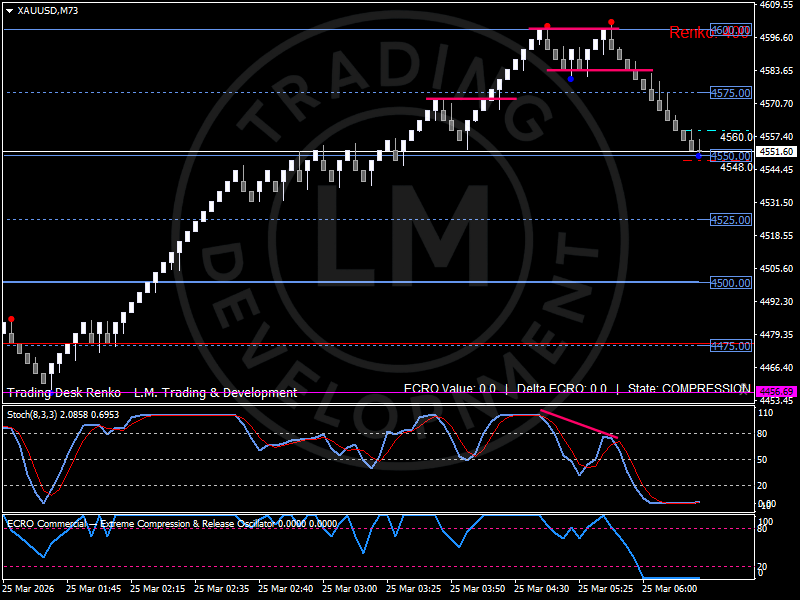
Gold is currently pivoting near $4,560, which now acts as a reference point within a rebalanced range rather than a springboard. Just below, $4,550–$4,551 offers the first structural support; a break here would reopen the path toward $4,525, where the structure becomes fragile and reactive.
Upside resistance begins at $4,575, the zone where the prior rebound failed, making it a test of market acceptance. Above that, the low $4,580s congestion band is the next checkpoint before the broader ceiling below $4,600, where sellers previously regained control.
The structure reflects a market stabilizing after lost momentum. Stabilization has formed, but directional strength has yet to reemerge.
Internal Conditions Show Compression
ECRO is at zero, signaling full compression: prior downside momentum is exhausted, and the current recovery has not generated a new expansion phase. Price is consolidating within defined boundaries as liquidity seeks alignment. Momentum indicators confirm the market has moved from active movement into controlled stabilization, limiting extensions beyond key levels without confirmation from broader flows.
What Needs to Change for a Stronger Move
A sustained rally requires continuity: maintaining the pivot near $4,560, reclaiming the upper barrier, and transforming it into acceptance. This would rebuild structure above prior rejection zones, signaling buyer commitment. Without this, rallies remain constrained, leaving the market exposed to renewed resistance at each layer.
Gold’s challenge lies in the environment rather than the metal itself. Inflation, interest rates, and liquidity continue to govern how demand translates into flows. Until that balance shifts, directional moves will struggle to sustain.
Final Read
Gold has exited active selling pressure and entered a stabilization phase. Both price structure and internal indicators reflect recalibration. Control has not yet returned. Compression dominates, keeping price within a range while direction remains unresolved. The next move will depend on flows re-establishing continuity above previously rejected levels.
Stabilization is present; leadership is still absent.
Sources: Luca Mattei
 THE ETERNAL SOVEREIGN
Leave a comment