For years, financial elites have brushed off gold as an unproductive asset—an inert yellow metal that generates no income and seems out of place in a fast-moving, digital economy. But by 2026, that long-standing view is beginning to lose credibility.
As the image of the “almighty U.S. dollar” starts to crack under the weight of a federal deficit exceeding $38 trillion—and still rising uncontrollably—gold is no longer just a hedge. It is increasingly seen as a primary escape route from a global era of fiscal excess.
The strongest argument for gold today doesn’t lie in consumer demand like jewelry, but in central bank behavior. Since the freezing of Russian reserves in 2022 following its invasion of Ukraine, a clear message has emerged. Many countries, especially in the Global South and BRICS+, are growing wary of holding U.S. Treasury assets that can be restricted or liquidated instantly.
This shift goes beyond simple de-dollarization—it signals a deep, structural reallocation of global capital. When central banks accumulate gold at record levels, they are not chasing short-term gains; they are securing financial independence. Gold stands apart as the only major asset that is not someone else’s liability.
Meanwhile, sovereign debt dynamics have moved from troubling to almost absurd. With debt-to-GDP ratios at extreme levels, major economies are stuck in a dilemma: raising interest rates enough to curb inflation risks making their debt burdens unmanageable.
As a result, real interest rates are likely to remain low or even negative—conditions that have historically favored gold. When inflation erodes the returns of supposedly “safe” government bonds, gold’s lack of yield becomes far less of a disadvantage and even appealing.
There’s a certain irony in this moment. As technology enables the creation of endless digital assets and AI-generated content, tangible assets like gold are gaining renewed appeal among both institutional and individual investors. Governments can expand debt or issue digital currencies at will, and AI can produce limitless synthetic content—but gold remains constrained by physical reality.
It cannot be created out of thin air. Annual mine production increases global supply by only about 1.5% to 2%, and the total amount of gold ever mined—around 212,000 tons—would fill just a few Olympic-sized swimming pools.
In a world marked by uncertainty, where even truth feels scarce, investors are gravitating toward something real—an asset that requires human effort, heavy machinery, and time to produce, and one that has consistently preserved value throughout history.
The bullish case for gold is not based solely on doomsday fears. It reflects a deeper issue: the erosion of sound financial systems, manageable debt levels, and trust in institutions. As that trust weakens, gold tends to rise.
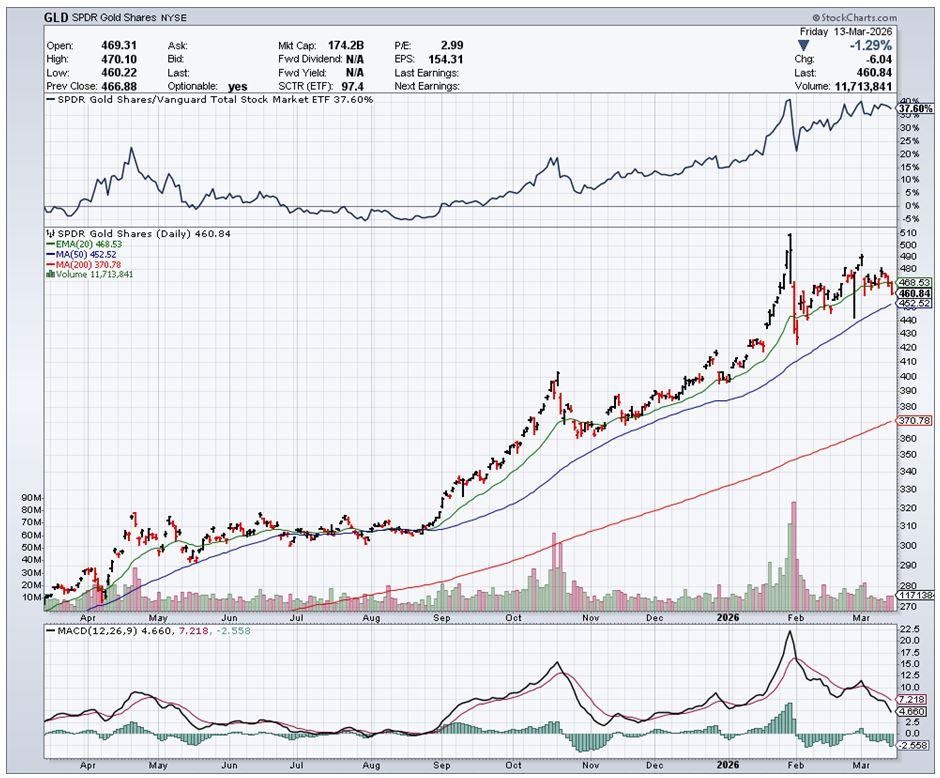
At roughly $5,060 per ounce, gold’s recent performance—illustrated through instruments like SPDR Gold Shares (GLD)—shows a powerful surge, supported by strong volume and capital inflows. This movement suggests more than simple hedging; it indicates a strategic shift toward safeguarding wealth against potential systemic shocks.
Interestingly, while technical analysts might interpret the chart as signaling a sell, such a view overlooks a key imbalance: even the largest corporations, despite their substantial cash reserves, are dwarfed by the scale of global sovereign debt.
The scale of the debt-versus-gold imbalance is striking. Companies in the S&P 500 collectively hold an estimated $2.5 to $3 trillion in cash and equivalents, according to J.P. Morgan. While that figure appears substantial, it represents just about 5% of the total debt owed by the G7 economies.
The G7—comprising the United States, Canada, the United Kingdom, France, Germany, Italy, and Japan, along with the broader European Union—sits at the center of the global financial system. The U.S. alone, with an economy valued at roughly $30–32 trillion, accounts for about 26% of global GDP, which the IMF estimates at $123.6 trillion in 2026.
Yet the U.S. national debt has climbed to $38.87 trillion as of March 2026 and continues to grow at a pace of around $7 billion per day. At this trajectory, it is expected to surpass $40 trillion within the year.
This has pushed the U.S. debt-to-GDP ratio to approximately 123%, meaning federal debt exceeds the size of the entire economy by 23%. Such levels are near post–World War II highs and far above historical norms—an indication of growing fiscal strain. Despite this, there appears to be little political momentum to curb spending, with policymakers instead signaling further expansion.
Looking beyond the U.S., the broader picture is equally concerning. Combined sovereign debt across G7 nations now stands at roughly $65 trillion, with no coordinated effort to rein in deficits or reduce spending.
If this trajectory continues, the long-term consequences for fiat currencies could be severe. A system increasingly burdened by unsustainable debt risks eventual disruption, potentially leading to a profound global financial reset. In such a scenario, gold could continue its upward trajectory, with projections pointing toward $6,000 per ounce as a plausible next milestone.
Sources: Louis Navellier
 THE ETERNAL SOVEREIGN
Leave a comment