- Gold draws safe-haven demand as tensions in the Middle East escalate further.
- Inflation concerns dampen expectations of Fed rate cuts, supporting the USD and limiting the metal’s upside.
- Traders remain cautious, avoiding aggressive positions ahead of this week’s major central bank events.
Gold (XAU/USD) ticks modestly higher in Tuesday’s Asian session but struggles to build momentum, hovering near a three-week low reached the day before. Ongoing tensions in the Middle East continue to provide some support, as the conflict shows little sign of easing. Israel has expanded its ground operations in southern Lebanon—an area where Hezbollah maintains a strong presence—keeping geopolitical risks elevated and sustaining demand for the safe-haven metal.
Now in its third week, the conflict has seen Iran target civilian infrastructure across six Gulf nations, including airports, ports, oil facilities, and commercial centers, using missiles and drones. Disruptions in the Strait of Hormuz—a critical route for about one-fifth of global oil supply—have also kept crude prices elevated. This adds to inflation concerns, potentially pushing the Federal Reserve to maintain higher interest rates for longer or even consider further tightening, which in turn limits upside for non-yielding assets like gold.
At the same time, rising geopolitical tensions have revived demand for the US Dollar following a pullback from its highest level since May 2025, further capping gains in XAU/USD. However, USD bulls remain cautious ahead of the outcome of the Federal Open Market Committee (FOMC) meeting on Wednesday. Policy decisions from other major central banks, including the ECB, BoJ, and BoE, are also expected later in the week and could drive fresh volatility in gold prices.
Gold (XAU/USD) on the 4-hour timeframe chart
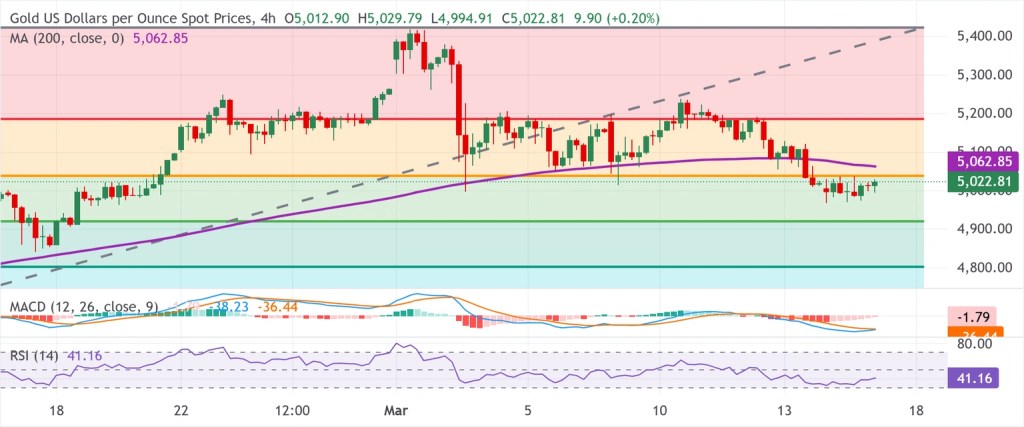
Gold appears at risk, with a break below the 200-period SMA and the 38.2% Fibonacci level still in effect
Gold’s recent drop below the 200-period Simple Moving Average (SMA) on the 4-hour chart, along with sustained trading beneath the 38.2% Fibonacci retracement of the February–March rally, continues to favor bearish momentum in XAU/USD. The Moving Average Convergence Divergence (MACD, 12, 26, 9) remains in negative territory, with the MACD line below its signal line and a bearish histogram, pointing to ongoing downside pressure. Meanwhile, the Relative Strength Index (RSI) sits around 41, tilting toward the weaker side of neutral and suggesting sellers are still in control.
On the upside, initial resistance is seen near the 38.2% Fibonacci level around $5,040, followed by the 200-period SMA close to $5,063. A decisive move above this zone would help reduce bearish pressure and potentially pave the way toward the 23.6% retracement near $5,186. On the downside, immediate support lies at the key psychological level of $5,000, with further support around the recent lows between $4,995 and $4,985. A break below this area could open the door to a deeper pullback toward the 50.0% retracement at $4,921.41. A sustained move back above the 200-period SMA would weaken the bearish outlook, while continued rejection below $5,040 keeps the focus on further declines.
Sources: Haresh Menghani
 THE ETERNAL SOVEREIGN
Leave a comment