Gold futures are hovering around $5,185, validating a decisive breakout from a multi-year consolidation range and signaling what looks like the hyperbolic stage of the ongoing bull run. Based on VC PMI modeling and Square-of-9 harmonic projections, the next key resistance zone is projected between $5,400 and $5,850.
Should upside momentum carry through the upcoming cycle window in late March, prices may stretch toward the $6,000 area by mid-April, where more substantial harmonic resistance is expected. The sharp upward angle of the moving averages reflects strong institutional participation, implying that any pullbacks are likely to represent brief consolidations within a broader bullish advance.
On the monthly continuation chart, gold futures display one of the most pronounced structural rallies in precious metals history. Following years of range-bound trade between roughly $1,700 and $2,100, gold broke out in 2024 and has since accelerated into what can be characterized as a hyperbolic expansion phase.
With prices now near $5,185—well above the primary moving-average framework—the technical backdrop confirms a robust momentum environment typical of the later stages of a long-term bull market.
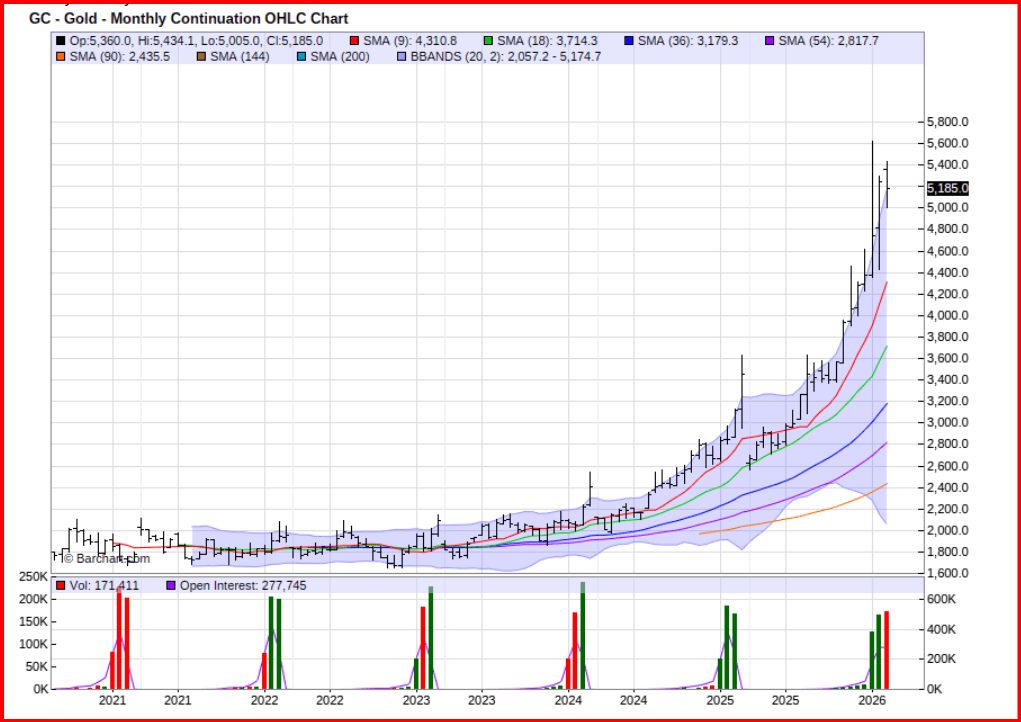
From a VC PMI mean-reversion standpoint, price action unfolds in oscillating waves around equilibrium. When the market stretches materially above its mean, it reflects powerful upside momentum—but also a rising likelihood of heightened volatility.
On the current monthly timeframe, gold is trading well above its 9-month and 18-month moving averages. Historically, such extended positioning tends to occur during periods of accelerated institutional accumulation and heightened global monetary stress, conditions that often accompany the more explosive phases of a long-term bull cycle.
Market Timing Windows
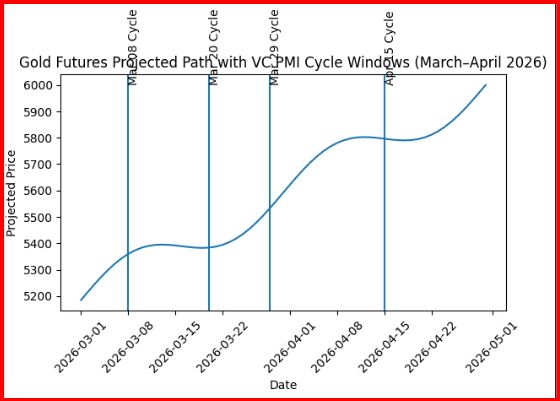
Applying the VC PMI time-cycle framework alongside harmonic rhythm analysis, the following timing windows are anticipated for March and April:
- March 7–10 – Initial volatility window where the market may pause or consolidate following the recent sharp advance.
- March 18–22 – Secondary cycle pivot zone, a period that often reveals whether the trend resumes or shifts into corrective behavior.
- March 27–31 – Key inflection window, coinciding with futures delivery dynamics and potential liquidity realignments.
- April 12–18 – Major harmonic cycle window that could generate either a short-term peak or an accelerated continuation breakout.
These timeframes should be viewed as probabilistic windows, not precise reversal dates. In hyperbolic market phases, price action often accelerates into projected cycle periods, followed by short-lived pullbacks before the broader uptrend resumes.
Square-of-9 Harmonic Resistance
Applying W.D. Gann’s Square-of-9 framework to prior breakout levels highlights the next key harmonic price objectives. Current projections indicate that gold is advancing toward a significant resistance band between $5,400 and $5,850.
Should the market maintain monthly closes above the $5,400 threshold, the Square-of-9 model opens the door to the next harmonic cluster in the $6,000–$6,300 range—closely aligned with the broader cycle window projected into April.
How price reacts at these geometric resistance zones—particularly in conjunction with the upcoming time-cycle windows—will help determine whether gold enters a temporary consolidation phase or continues its acceleration within a larger liquidity-driven advance.
Structural Interpretation
The pronounced upward slope of the moving averages confirms that gold is operating in the momentum stage of a secular bull market. Historically, such phases unfold during periods when global capital rotates toward hard assets amid currency debasement, geopolitical tension, and expanding sovereign debt burdens.
Although intermittent pullbacks are normal in strong trends, the broader structure remains constructive as long as price holds above the monthly mean zone near $4,300–$4,400, which now serves as major structural support.
Sources: Patrick MontesDeOca
 THE ETERNAL SOVEREIGN
Leave a comment