Bitcoin has fallen roughly 50% from its October 2025 peak near $126,000 and is now trading around $65,000, marking a far deeper retracement than a routine correction. This downturn reflects not just price volatility but a broader shift in the macro backdrop and crypto’s structural dynamics.
Macro Pressures Reshape the Cycle
As institutional participation has increased, Bitcoin has become more tightly linked to global financial conditions. Rather than acting as “digital gold,” it has moved in closer correlation with U.S. equities—especially technology stocks. Ongoing uncertainty about the pace of disinflation, combined with renewed tariff measures from the Trump Administration targeting Europe and Asia, has strengthened the U.S. dollar and dampened overall risk appetite. Concerns that the artificial intelligence boom may be maturing have further pressured growth assets, including crypto.
Miner Stress and Institutional Retreat
On-chain and industry data reveal mounting supply-side pressure. With the estimated average mining cost around $87,000, many miners are operating below breakeven at current price levels. To stay solvent, some have been liquidating reserves, adding persistent sell-side pressure to the market.
Institutional flows tell a similar story. Roughly $5 billion has exited Bitcoin ETFs in recent weeks, signaling a rotation into safer assets. Meanwhile, reports of operational pauses at certain established crypto platforms have revived memories of the 2022 bankruptcy wave, further unsettling sentiment.
The Crypto Fear and Greed Index remains entrenched in the 5–8 range—classified as “extreme fear”—highlighting the depth of caution across the market.
The Technical Road Ahead
For sentiment to meaningfully reset, Bitcoin must reclaim the $70,000–$78,000 zone, which now represents a critical resistance band. A sustained move above that range would signal renewed confidence and potentially mark the beginning of a recovery phase. Until then, macro headwinds, miner capitulation risks, and fragile investor psychology are likely to continue defining the tone of this cycle.
Bitcoin Technical Outlook
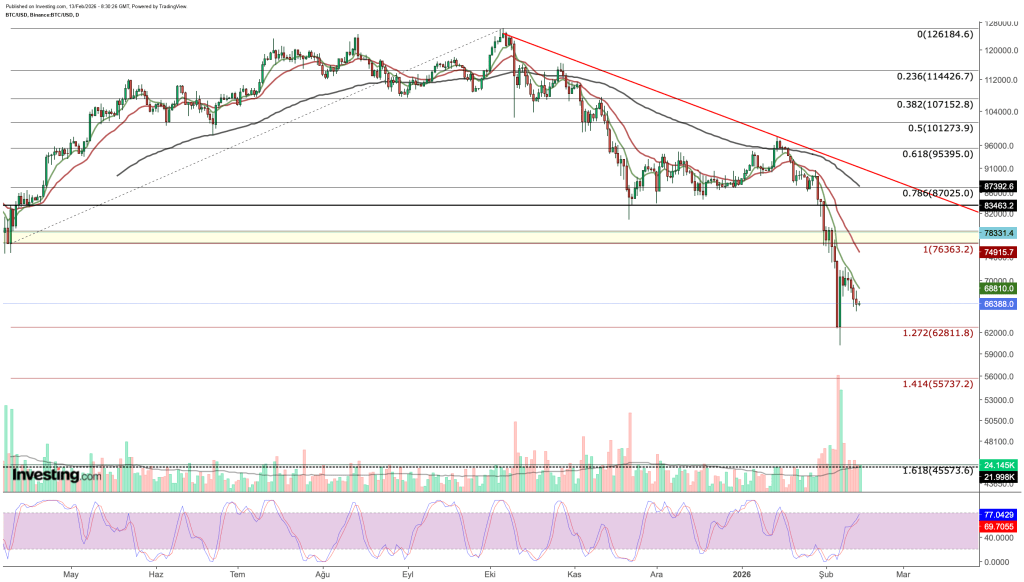
On the daily chart, Bitcoin is attempting to stabilize in a critical technical zone. After sliding to roughly $60,000 last week, price rebounded, but the recovery stalled near $70,000 as sellers re-emerged. Over the past week, Bitcoin has remained below its 8-day EMA, signaling short-term weakness and keeping the broader technical bias cautious.
The $62,800 area—aligned with the Fibonacci 1.272 extension—now stands out as key support. The earlier bounce from $60,000 suggests buyers are active in this region and view it as a potential base. However, a daily close below that level could accelerate downside pressure, exposing the next major support near $55,000, around the Fibonacci 1.414 extension.
One constructive signal comes from momentum indicators. On the daily timeframe, the Stochastic RSI is showing positive divergence: while price has continued to drift lower, the indicator has turned upward from oversold territory. This often signals waning downside momentum and can precede sharp countertrend rallies, including short squeezes or bear traps. Still, for a rebound to evolve into a durable recovery, Bitcoin must reclaim key resistance levels and short-term moving averages. Until then, the market remains delicately balanced between support and renewed selling.
Critical Resistance Levels for a Trend Reversal
A sustained recovery would first require a decisive break above the psychological $70,000 level, ideally accompanied by strong trading volume. Without volume confirmation, upside moves may lack conviction.
A more robust trend reversal signal would come from breaking the descending trendline and reclaiming the Fibonacci 1.0 level near $76,350. The broader $76,000–$78,000 band represents a major technical barrier. Unless Bitcoin can firmly establish itself above this zone, rallies are likely to remain corrective within a broader medium-term downtrend.
Is a Short Squeeze Setup Building?
Bitcoin futures funding rates are hovering around -0.006%, indicating short positioning dominates. When leverage becomes skewed heavily to one side, sharp counter-moves often follow as liquidity is cleared. Combined with the positive Stochastic RSI divergence, this creates the potential for a swift spike toward $70,000.
Zooming out, Bitcoin appears to be navigating a capitulation phase marked by ETF outflows, miner pressure, and macro uncertainty. At the same time, some technical signals hint at a cleansing process that could reset positioning.
A conservative stance would wait for weekly closes above $78,000 before declaring a structural recovery. More tactical traders may view the Stoch RSI divergence as an opportunity for a move toward $70,000, with $62,800 serving as a clear risk threshold.
As the crypto sector enters what looks like a period of corporate restructuring in early 2026, the $55,000 region could eventually be seen as a longer-term base—if stabilization holds. Until stronger confirmation emerges, disciplined risk management remains critical: reduced leverage, smaller position sizing, and strict stop-loss levels are essential in this highly volatile environment.
Sources: Günay Caymaz
 THE ETERNAL SOVEREIGN
Leave a comment