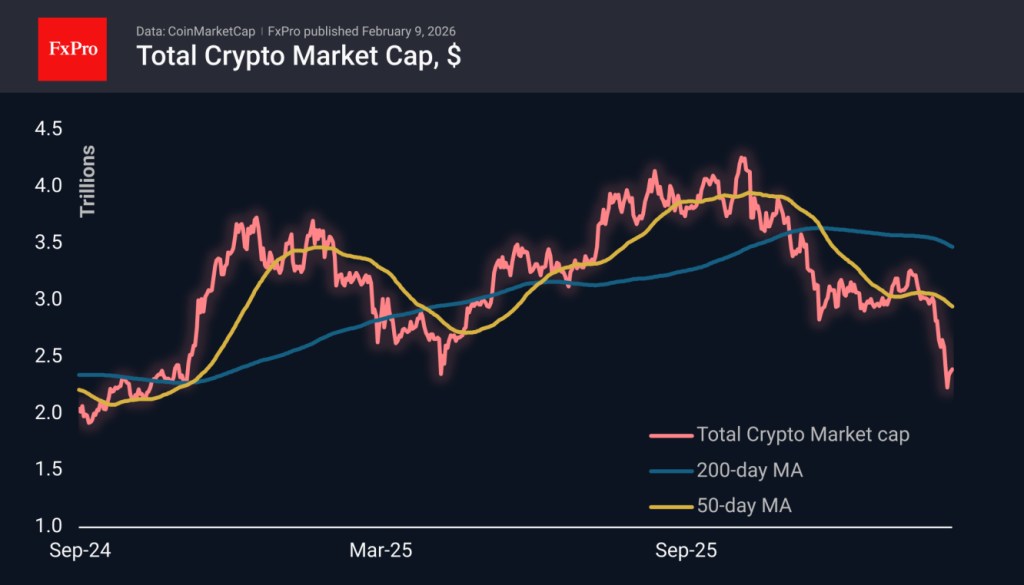
The total cryptocurrency market capitalization has fallen about 10% over the past week to roughly $2.36 trillion. Paradoxically, this also marks a 10% rebound from Friday’s lows. Despite that uptick, near-term prospects remain uncertain, as the recovery stalled over the weekend and met selling pressure around the $2.4 trillion level. This suggests the move may have been a temporary bounce within a broader decline that has yet to fully run its course.
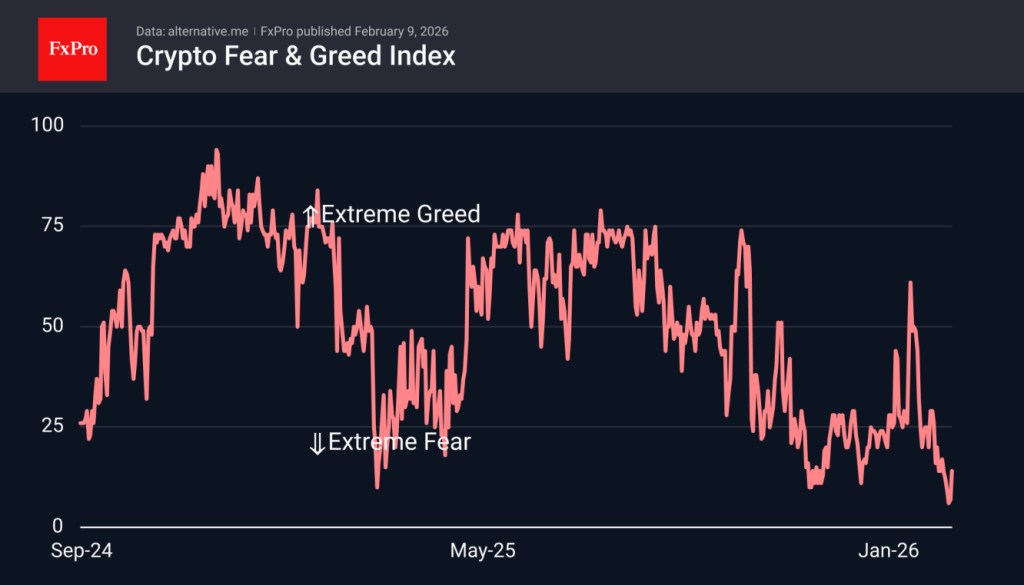
The sentiment index dropped to 6 over the weekend, matching the lows seen on June 18–19, 2022, and only falling lower once before, on August 22, 2019. By Monday, it had rebounded to 14 in line with market prices, but this remains an extremely depressed level and does not yet support confident buying.
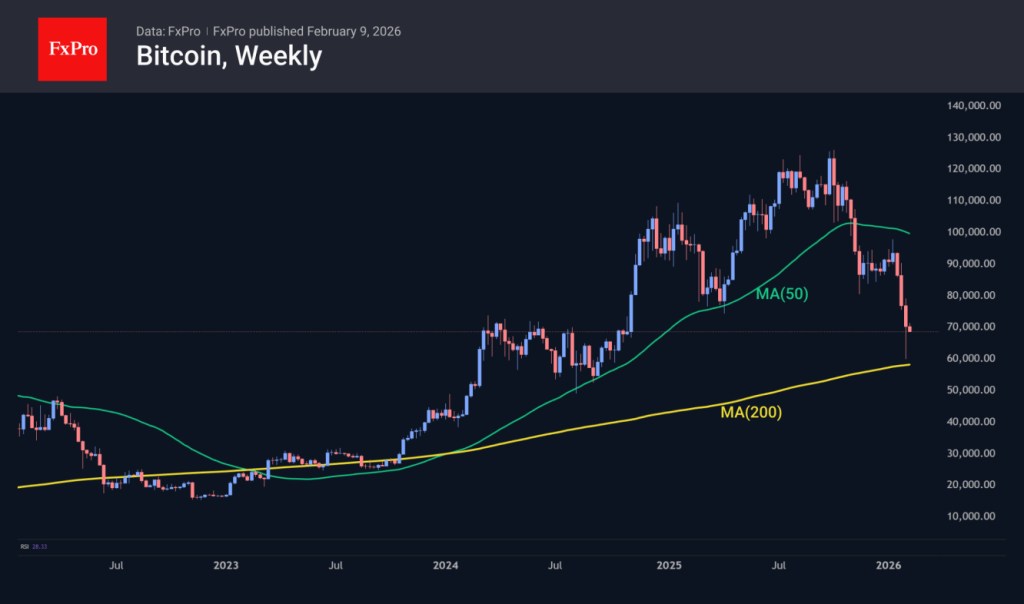
Bitcoin recovered steadily on Friday after an early sharp sell-off, but from Saturday onward it encountered strong resistance around the $71,000 level. Significant supply remains in the market from investors looking to exit on rebounds, suggesting persistent selling pressure. Under these conditions, the possibility of a fresh test of the 200-week moving average in the near term should not be ruled out.
The decline in Bitcoin prices has been accompanied by shrinking liquidity, heightened volatility, weaker risk appetite, and a stronger correlation with equity markets. CryptoQuant suggests BTC could drop to around $54,600, a level at which the market may shift from capitulation toward accumulation.
Amid the broader crypto sell-off, Strategy reported a net loss of $12.6 billion for the fourth quarter, with operating losses totaling $17.4 billion. CEO Fong Le said the company would only face debt-servicing risks in the event of an extreme Bitcoin collapse to about $8,000.
Cardano founder Charles Hoskinson disclosed unrealized losses exceeding $3 billion, while emphasizing that he has no plans to liquidate his holdings even if market conditions deteriorate further.
Bitcoin miners are increasingly shutting down operations as losses mount. Mining profitability has fallen to record lows due to declining crypto prices and higher electricity costs, with JPMorgan estimating the average cost of mining at roughly $87,000 per BTC.
Following the latest adjustment, Bitcoin’s mining difficulty dropped 11.16% to 125.86 trillion, marking the steepest decline since 2021, when China banned cryptocurrency mining.
Despite the prevailing pessimism, JPMorgan remains constructive on Bitcoin’s long-term outlook, forecasting that it could eventually reach $266,000. The bank has also recently lifted its long-term gold price forecast to $8,000–8,500.
Sources: Alexander Kuptsikevich
 THE ETERNAL SOVEREIGN
Leave a comment