Gold futures are currently trading around 4,841.7, holding steady above the VC PMI daily Buy 1 level at 4,765 and the Buy 2 support at 4,640. This price action suggests the market has entered a well-defined mean-reversion accumulation zone. It reflects the natural interaction between price and time cycles, where markets extend into extreme areas before reverting toward equilibrium.
The VC PMI daily mean at 4,905 now acts as the key price magnet. A sustained close above this level would signal the return of bullish momentum, potentially paving the way for a move toward Sell 1 at 5,030 and Sell 2 at 5,170.
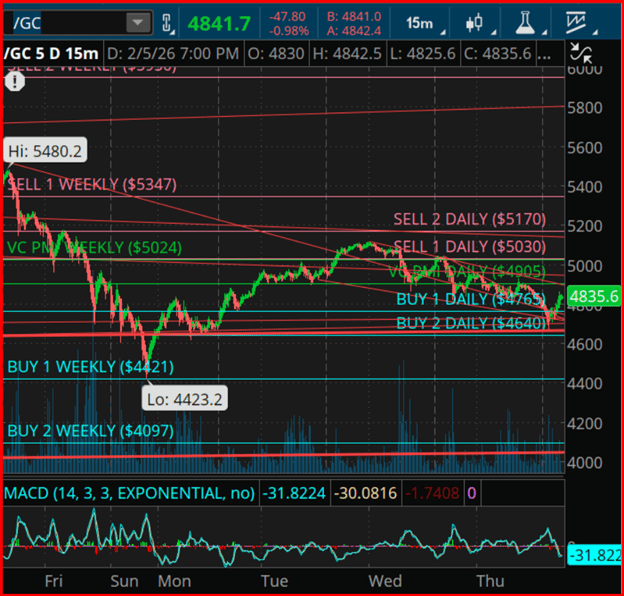
On the weekly timeframe, the VC PMI mean at 5,024 aligns closely with an upper resistance cluster and Square of 9 harmonic geometry. This confluence implies that once price establishes itself above the 4,905 mean, upside momentum could accelerate rapidly toward the 5,000–5,170 zone.
The Square of 9 framework suggests current price action is progressing through a harmonic relationship between time and price, with the next cycle window extending into mid-February. These cycle windows often mark potential inflection points, where volatility expands and directional conviction strengthens.
From a structural perspective, maintaining levels above 4,765 preserves the bullish accumulation framework and indicates that institutional demand continues to absorb selling pressure. The deeper support at 4,640 marks the lower extreme of the daily cycle. A decisive break below that level would suggest the market is not yet ready to complete its bullish phase and could prompt a retracement toward lower weekly support zones.
However, as long as price holds above the 4,640–4,765 support zone, the odds continue to favor a mean-reversion advance toward the 5,030 and 5,170 upside targets.
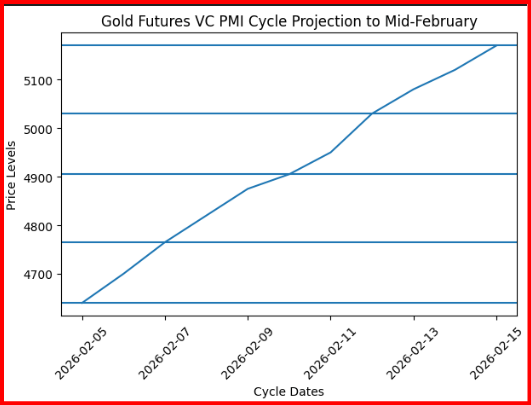
By integrating VC PMI price levels, time cycles, and Square of 9 geometry, this framework offers a structured way to identify high-probability turning points. Markets operate in recurring phases of expansion and contraction, and these tools are designed to quantify those cycles with consistency, discipline, and objectivity.
Sources: Patrick MontesDeOca
 THE ETERNAL SOVEREIGN
Leave a comment