Assessing the daily charts for gold and silver futures against a backdrop of rising trader anxiety, it is clear that the outcome of the meeting between U.S. and Iranian diplomats could soon determine the next directional move once markets receive clearer signals.
Volatility in both gold and silver futures has surged, leaving prices highly sensitive to the meeting’s outcome. Gold futures opened at $4,722.30, dipped to an intraday low of $4,671.74, and then rallied to trade near the session high around $4,907—just below immediate resistance at $4,938.55. This price action reflects mounting concern as U.S.–Iran talks begin amid fears of a potential direct conflict.
Despite the heightened tension, the situation remains unresolved. The U.S. is reportedly pressing Iran to freeze its nuclear program, dismantle its uranium stockpile, and expand discussions to include ballistic missiles, regional proxy support, and human rights issues. Iran, however, has stated that talks will be limited strictly to its nuclear program, and it remains unclear whether these fundamental differences have been bridged.
In recent weeks, President Donald Trump has warned of military action if a deal is not reached, while the U.S. has deployed thousands of troops and significant naval and air assets to the region. Iran has responded with threats of retaliation, including strikes on U.S. military targets in the Middle East and Israel.
This marks the first direct engagement between U.S. and Iranian officials since last June’s Israel–Iran conflict, during which U.S. forces struck Iran’s three primary nuclear facilities. Iran has since claimed that its uranium enrichment activities ceased following those attacks.
Meanwhile, precious metals have endured an extended selloff since last week. Initial pressure stemmed from President Trump’s nomination of Kevin Warsh as the next Federal Reserve chair, a move interpreted as less dovish and supportive of a stronger U.S. dollar. The dollar is now on track for its strongest weekly performance since early October, with soft labor data doing little to halt its advance.
Looking ahead, any indication that talks may ease tensions between the U.S. and Iran could spark renewed selling in gold and silver, even though both futures have already rebounded modestly from their intraday lows. At this stage, dissecting technical rebounds or exhaustion signals may be premature. Instead, the focus remains squarely on the diplomatic outcome and whether it ultimately de-escalates the situation—or deepens existing tensions.
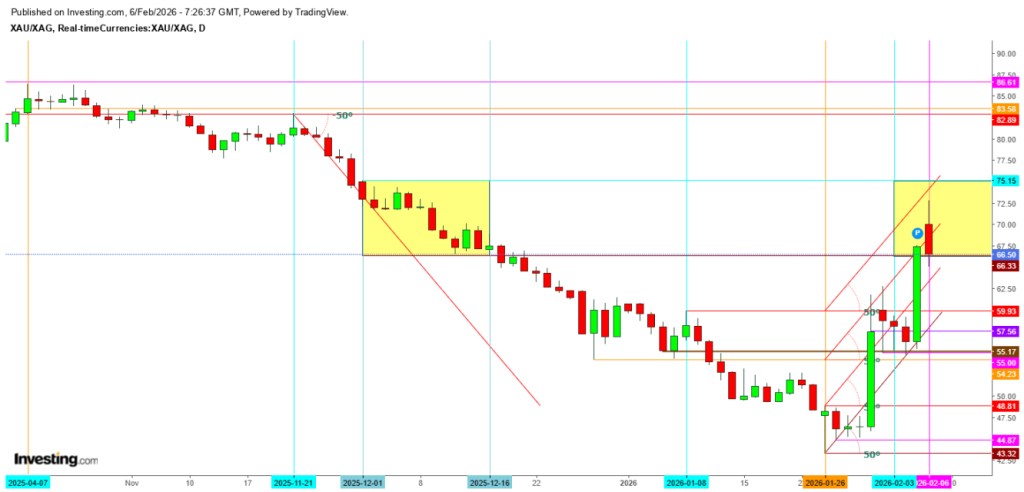
Looking at the current positioning of the spot gold–silver ratio, today’s session saw it test an intraday high of 72.77 and a low of 65.10, with the ratio currently trading around 66.39. This movement suggests that gold and silver futures may revisit price levels last seen between December 1 and 16, 2025—when gold futures were trading in the $4,207 to $4,340 range and silver futures were between $57 and $65.
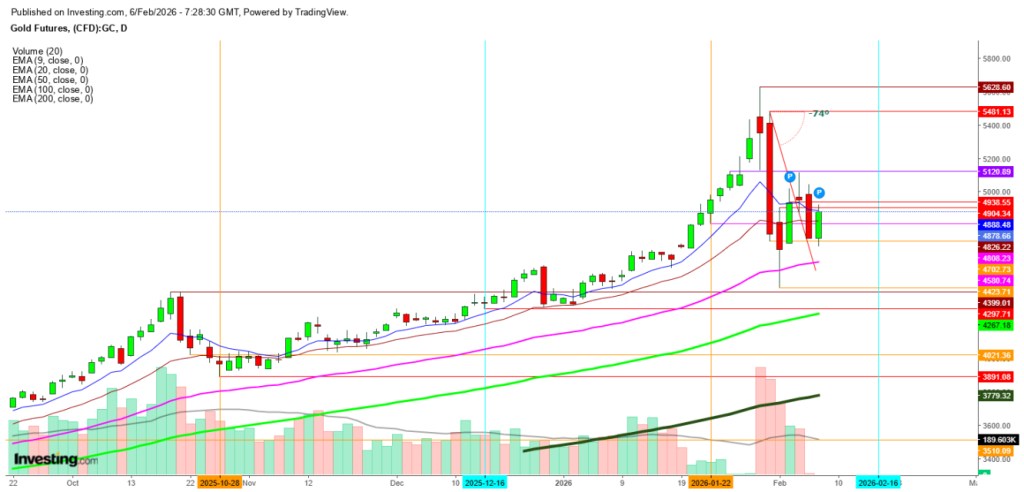
Gold futures are currently trading above the key 50-EMA support near $4,580, while remaining capped below the immediate 9-EMA resistance around $4,885, after successfully holding above the short-term 20-EMA support at approximately $4,824.
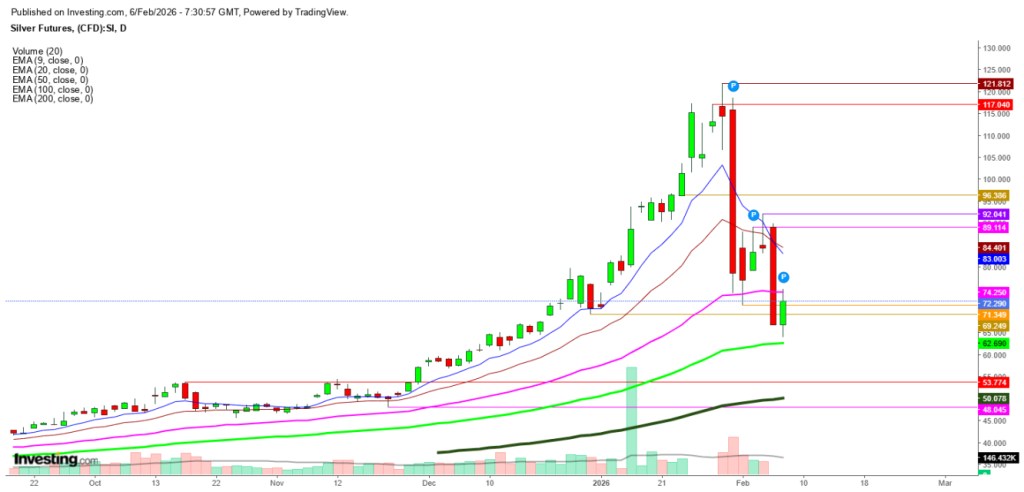
Meanwhile, silver futures are holding above the key 100-EMA support near $62.692, but continue to trade below the immediate resistance at the 50-EMA around $74.252.
In summary, any constructive outcome from the meeting could prompt renewed selling pressure across both precious metals, while renewed disagreement between the two countries may spark a bout of buying. However, any upside could remain vulnerable to fresh selling, as follow-up commentary from the U.S. President after the meeting is likely to play a decisive role in shaping market sentiment.
Sources: Satendra Singh
 THE ETERNAL SOVEREIGN
Leave a comment