Bitcoin may be extended and capable of sharp countertrend bounces, but the broader signal is clearly weakening. When market leaders begin to roll over and assets start moving in lockstep, liquidity is usually the underlying issue.
When risk assets move together, it’s rarely intentional. Dispersion has collapsed, leadership is breaking down, and liquidity is retreating to the sidelines. Volatility is no longer being absorbed—it’s being amplified.
The extent of the damage matters. The very assets that led the risk rally are now suffering the most, not because the narrative has shifted, but because capital is being withdrawn rather than reallocated. That’s how selloffs become disorderly.
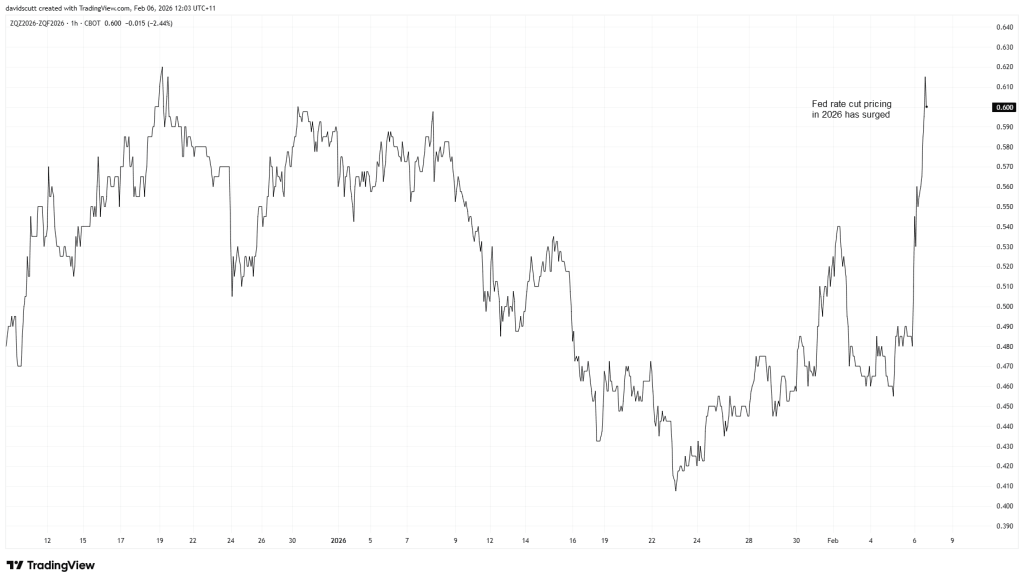
Signs of stress are already emerging in rates markets. Expectations for Federal Reserve easing this year have surged from 41 basis points to 61 basis points in just a few days—nearly a full rate cut being priced in within a week. Markets don’t make that kind of adjustment unless financial conditions are tightening rapidly.
Bitcoin is deeply stretched and prone to sharp countertrend rallies, but being oversold does not mean the downside is finished. This feels like the phase where correlations converge, risk assets move as one, and capital preservation takes precedence.
BTC/USD Price Action Deteriorates Sharply
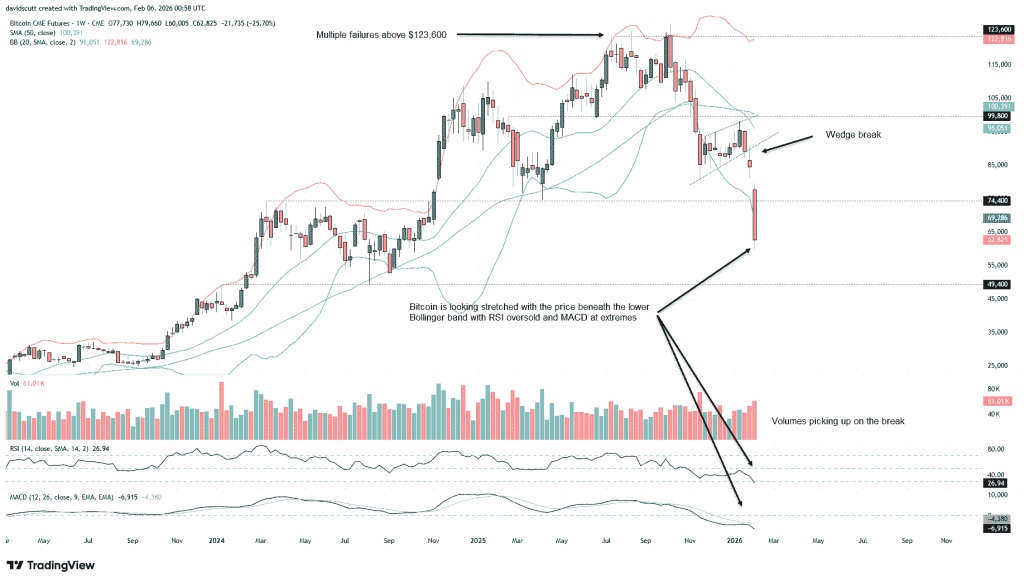
My long-held view is that bitcoin’s price is ultimately driven by its own price action. Whatever the underlying catalysts, the market repeatedly failed to break above the $123,600 level in the second half of last year, with four separate weekly rejections at that resistance. That ceiling capped the advance and set the stage for a pullback toward the $99,800 support area, before price eventually slipped below the 50-week moving average—a level that had consistently provided support throughout last year’s uptrend.
From there, downside momentum intensified. Bitcoin broke decisively through the $99,800 support and then consolidated within a rising wedge, a bearish continuation pattern, before breaking down last week on a clear surge in volume. The move below $74,400 triggered a sharp acceleration lower, pointing to forced liquidations of long positions rather than orderly selling.
So far, price has rebounded from around $60,000, which is not surprising given how stretched conditions have become. Bitcoin remains well below the lower Bollinger Band, RSI is deeply oversold, and MACD is at extreme levels by historical standards. A rebound toward $74,400 is therefore quite possible, but unless that level is decisively reclaimed, any rally is likely to be sold into.
On the downside, there is limited meaningful support below $60,000 until roughly $49,400—a level that served as both support and resistance during parts of 2024.
Sources: David Scutt
 THE ETERNAL SOVEREIGN
Leave a comment