- Gold comes under renewed selling pressure as resurging inflation concerns push US Treasury yields higher, reducing the appeal of the non-yielding metal.
- However, fading expectations of additional Federal Reserve rate hikes continue to limit upside momentum in the US Dollar, which could help cushion gold’s downside in the near term.
- From a technical perspective, price action remains biased to the downside, with chart signals favoring bearish traders and suggesting the potential for further declines.
Gold (XAU/USD) remains under modest selling pressure during Tuesday’s European session, though prices continue to hold above the $4,100 level. Renewed tensions in the Strait of Hormuz have pushed crude oil prices higher, fueling concerns that elevated energy costs could reignite inflationary pressures. As a result, US Treasury yields have moved higher, lending support to the US Dollar and reducing demand for the non-yielding precious metal for a second consecutive day.
Geopolitical risks remain elevated after Iran reaffirmed its intention to impose fees on vessels passing through the Strait of Hormuz, arguing that the charges are linked to security oversight and environmental protection rather than transit tolls. Adding to market concerns, an oil tanker was reportedly hit by an unidentified projectile while navigating the strategic waterway, highlighting the fragility of the current US-Iran ceasefire arrangement and helping keep oil prices supported.
At the same time, softer-than-expected US labor market data has reduced expectations for additional Federal Reserve tightening. Following June’s weaker Nonfarm Payrolls report, markets have scaled back forecasts for future rate increases, with traders now pricing in between zero and one Fed hike in 2026, compared with expectations for up to two hikes previously. The shift has limited the US Dollar’s upside and helped prevent a deeper decline in gold prices.
Additional economic data offered little fresh direction. The US ISM Services PMI slipped to 54.0 in June from 54.5 previously, matching market expectations and failing to provide meaningful support for the Greenback.
Looking ahead, investors are likely to remain cautious ahead of Wednesday’s FOMC Minutes, which could provide further insight into the Federal Reserve’s policy outlook. Until then, geopolitical developments and movements in Treasury yields are expected to remain the primary drivers of both the US Dollar and gold prices. Given the mixed fundamental backdrop, traders may prefer to wait for stronger confirmation before concluding that gold’s recent rebound from last week’s year-to-date low has fully lost momentum.
Gold Daily Chart
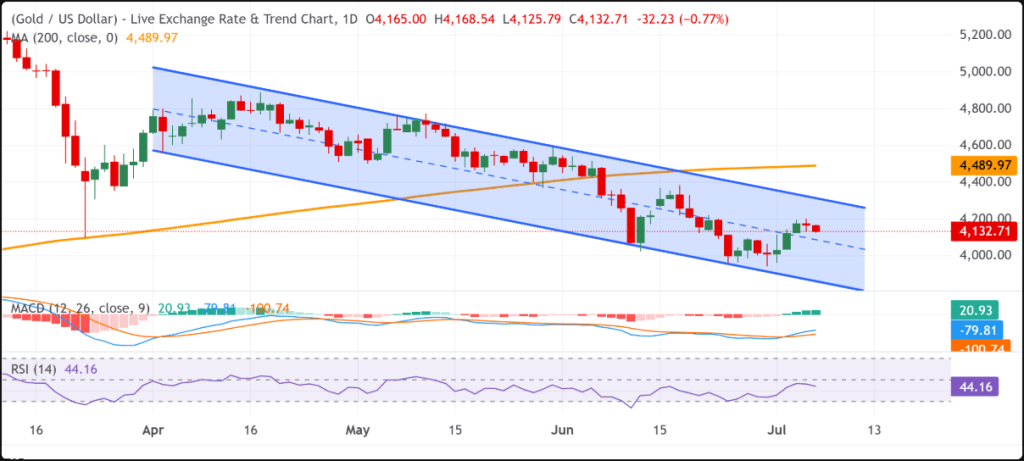
Gold remains biased to the downside in the near term, with XAU/USD continuing to trade below its 200-day Simple Moving Average (SMA) at $4,489.97 and within a well-defined descending channel. A decisive break below the $4,100 support zone could trigger an acceleration of intraday selling pressure and expose lower technical levels.
That said, momentum indicators show some signs of stabilization. The MACD has crossed into positive territory, with the MACD line moving above the signal line and the positive histogram widening, indicating improving bullish momentum. However, the signal remains insufficient to negate the broader bearish structure. Meanwhile, the RSI stands at 44.16, below the neutral 50 threshold, suggesting that bearish conditions still prevail despite the recent rebound.
On the downside, the $4,100 level serves as the first line of defense for bulls. A sustained move below this threshold could pave the way for a test of the descending channel support near $3,844.34, where stronger buying interest may emerge.
On the upside, initial resistance is located near the upper boundary of the descending channel around $4,296.64. A break above this level would shift focus toward the 200-day SMA at $4,489.97, followed by a more significant resistance zone near $4,572.41. Until these barriers are cleared, rallies are likely to be viewed as corrective within the broader downtrend.
 THE ETERNAL SOVEREIGN
Leave a comment