- Gold attracted dip-buying during Friday’s Asian session, ending a two-day losing streak.
- Declining US Treasury yields weighed on the US Dollar, helping support the precious metal as safe-haven demand increased.
- However, inflation concerns have reduced expectations for interest rate cuts by the Federal Reserve, strengthening the US Dollar and potentially limiting further gains in gold.
Gold (XAU/USD) moved higher during Friday’s Asian session, recovering part of the losses recorded over the previous two days. The rebound came as the US Dollar (USD) paused its three-day rally amid a modest decline in US Treasury yields, offering some support to the precious metal. In addition, escalating tensions in the Middle East have boosted safe-haven demand, encouraging traders to buy Gold near the lower end of the trading range that has persisted over the past two weeks.
Iran’s new supreme leader, Mojtaba Khamenei, warned in his first public remarks that all US military bases in the region should close immediately or face potential attacks. He also stated that Iran would continue strikes against US bases, even while expressing a willingness to maintain goodwill with neighboring countries. Meanwhile, Donald Trump emphasized that countering Iran’s “evil empire” was more important than the impact on oil prices. In fact, Crude Oil prices have been rising since the beginning of the US-Israel conflict with Iran.
At the same time, fears of supply disruptions caused by the closure of the Strait of Hormuz have increased concerns about a potential surge in inflation. This has prompted investors to scale back expectations for interest rate cuts by the Federal Reserve in 2026. Such expectations could push US bond yields and the USD higher, potentially limiting further gains for non-yielding assets like Gold.
Investors are also waiting for the US Personal Consumption Expenditures (PCE) Price Index, due later in the North American session. This key inflation indicator will play an important role in shaping expectations for the Fed’s policy outlook, especially as markets worry that the war could push consumer prices higher.
Overall, geopolitical developments remain the dominant driver for markets. However, XAU/USD still appears on track to post a second consecutive weekly loss, and the mix of supportive and restrictive factors suggests traders may remain cautious before taking strong directional positions.
XAU/USD four-hour chart
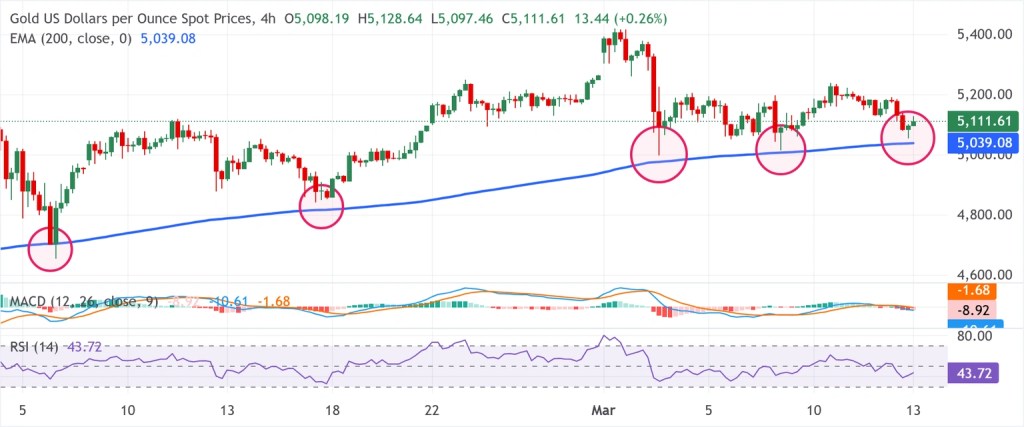
Gold continues to receive support around the 200-period EMA on the 4-hour chart.
Gold is once again rebounding from support near the 200-period Exponential Moving Average (EMA) on the 4-hour chart. This reaction keeps the broader bullish structure intact despite the recent pullback and suggests that XAU/USD bears should remain cautious.
At the same time, the Moving Average Convergence Divergence (MACD) remains below both its signal line and the zero level. However, the shrinking negative histogram suggests that bearish momentum is fading rather than signaling a fresh downside move. The Relative Strength Index (RSI), hovering around 44, remains below the 50 midpoint but is well above oversold territory, indicating that the current move may be more of a corrective phase within a broader upward trend rather than a confirmed top.
In terms of levels, immediate support lies near $5,090, where recent intraday lows sit slightly above the 4-hour 200-period EMA around $5,039, creating an important demand zone. A break below this region could expose stronger support near $5,000.
On the upside, initial resistance is seen around the recent swing high near $5,160. A sustained move above this level could pave the way toward $5,200, followed by the late-stage peak near $5,230.
A recovery above the $5,160–$5,200 area would likely push the MACD back toward the zero line and lift the RSI closer to 50, strengthening the bullish bias. Conversely, if the $5,090–$5,039 support cluster fails to hold, the 4-hour outlook could shift toward a more neutral or even bearish tone.
Sources: Haresh Menghani
 THE ETERNAL SOVEREIGN
Leave a comment