Gold prices are stabilizing near a key resistance area as global financial markets position ahead of the latest U.S. Consumer Price Index (CPI) report. The inflation data due later in the session is expected to be one of the week’s most important macroeconomic events, with the potential to influence expectations for Federal Reserve policy, real interest rates, and global asset allocation.
Across markets, investors have already begun adjusting their positions, trimming directional exposure before the data release. Precious metals have remained relatively supported, while performance across other asset classes has been more mixed, underscoring gold’s role as a defensive asset during periods of macroeconomic uncertainty.
Instead of taking aggressive new positions, many traders are adopting a wait-and-see stance as the market enters the final hours ahead of the CPI release. Such cautious positioning often leads to short-term consolidation across major assets as participants manage risk before potentially market-moving economic data.
Inflation data emerges as the key macro catalyst for markets
The upcoming U.S. CPI release is considered the most important scheduled macroeconomic event of the week, as inflation data directly shapes expectations for Federal Reserve policy, real interest rates, and the direction of the U.S. dollar. All three factors have historically played a major role in influencing gold price movements.
When inflation data comes in stronger than expected, markets often reassess how persistent price pressures may be and whether monetary policy could remain restrictive for longer. In such situations, investors tend to increase allocations to assets that help preserve purchasing power, which typically supports demand for gold and other precious metals.
Conversely, softer inflation readings can trigger the opposite reaction. If price pressures appear to be easing, investors may anticipate that the Federal Reserve will have greater flexibility to slow or pause its tightening cycle. Shifts in interest-rate expectations frequently ripple through currency markets and broader commodity positioning, which in turn affects gold price dynamics.
Because of this sensitivity, gold often enters a phase of consolidation ahead of major inflation releases as traders reduce exposure while waiting for clearer macroeconomic signals.
Recent market behavior reflects this pattern. Movements in U.S. Treasury yields and currency markets have remained relatively contained, while equity indices have shown uneven performance across different regions. These mixed signals suggest that investors are largely focused on the upcoming inflation data rather than reacting to short-term fluctuations in individual markets.
Precious metals stay supported amid cautious market positioning
Within the broader metals complex, gold continues to act as the anchor asset guiding investor flows. While silver and other metals have shown greater short-term volatility, gold remains the primary reference point for portfolio allocation during periods of macroeconomic uncertainty.
Demand for precious metals has stayed relatively stable even as other commodity sectors display more volatile price movements. Energy markets, in particular, have recently experienced sharp swings, underscoring a growing divergence between the behavior of industrial commodities and defensive assets.
This divergence indicates that investors are reassessing broader macro risks rather than simply reacting to individual commodity price fluctuations. With inflation expectations and the outlook for monetary policy still uncertain, capital flows are increasingly being directed toward assets that can help preserve value during periods of financial instability.
Technical structure shows price compression below resistance
From a technical standpoint, gold is currently trading within a consolidation range just below its recent highs. The Renko chart highlights a resistance zone around the $5,225 level, where several attempts to extend the rally have stalled in recent sessions.
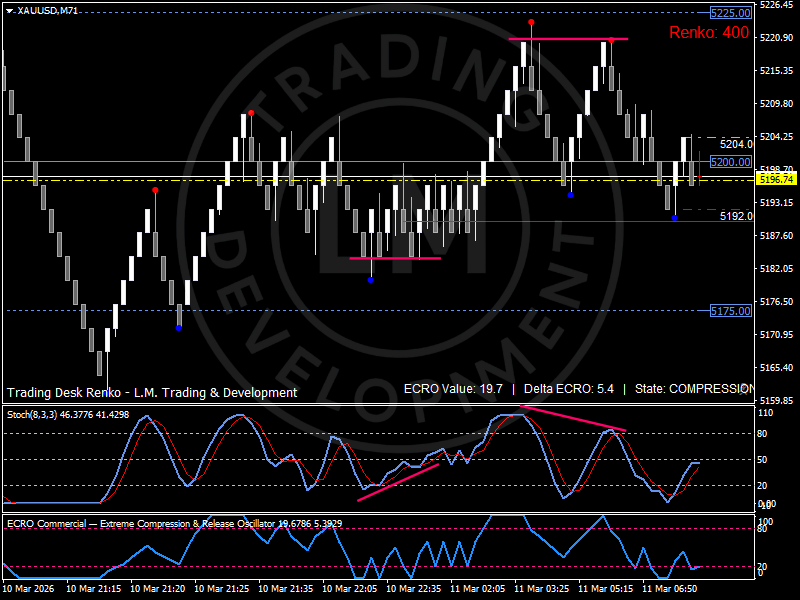
After testing this resistance, price action pulled back and entered a compression phase around the $5,200 region. This level has repeatedly acted as a short-term equilibrium point, where buying interest has emerged to stabilize the market.
Additional support is visible near $5,190, which has served as a secondary defense area during recent pullbacks. The proximity of these levels suggests that gold is currently moving within a relatively narrow range while awaiting fresh macroeconomic catalysts.
Momentum indicators also indicate that the market is rebuilding directional energy rather than entering a prolonged reversal. Oscillators have retreated from overbought territory and are stabilizing as price consolidates ahead of the upcoming U.S. CPI release.
Meanwhile, the ECRO indicator on the chart signals a compression phase, suggesting that volatility is temporarily contracting as the market digests recent price movements. Such compression patterns often appear before major macro events, as traders reduce risk exposure ahead of potentially market-moving economic data.
CPI release may determine gold’s next directional move
The upcoming inflation report represents a pivotal moment for gold markets.
If the CPI data confirms that inflationary pressures remain persistent, investors may increase allocations to precious metals as a hedge against potential monetary instability and declining purchasing power. Such an outcome could allow gold to challenge the resistance zone near recent highs and potentially reignite bullish momentum.
A sustained move above the $5,225 region would indicate that buyers are regaining control of the trend and could open the door for further upside across the precious metals complex.
However, if the inflation data comes in below expectations, markets may interpret the result as a sign that price pressures are gradually easing. In that scenario, gold could enter a deeper consolidation phase as investors adjust expectations for monetary policy and interest rates set by the Federal Reserve.
For now, gold remains positioned near a key technical threshold as markets await confirmation from macroeconomic data. The CPI release will likely determine whether the current consolidation evolves into a renewed bullish advance or develops into a broader pause within the ongoing precious metals trend.
Sources: Luca Mattei
 THE ETERNAL SOVEREIGN
Leave a comment