Oil markets are holding near the top of their recent trading band as participants factor in an added layer of logistical risk to global energy supply chains.
Crude has rebounded toward the 76–77 zone after strong buying interest emerged around 72, where support formed amid renewed tensions surrounding the Strait of Hormuz. Concerns over tanker traffic and potential shipping bottlenecks prompted buyers to step in aggressively at that level.

Although the market has not yet entered a full volatility breakout, recent price action indicates that crude is beginning to price in a geopolitical premium—driven less by outright production losses and more by uncertainty surrounding transportation routes.
At this stage, oil appears to be recalibrating to elevated logistics risk rather than responding to an immediate supply shock.
Hormuz Strains Redirect Market Focus to Supply Chain Risk
Recent events surrounding the Strait of Hormuz have underscored that energy security depends not only on production levels, but also on the reliability of transport routes.
Approximately one-fifth of the world’s traded crude moves through this narrow passage linking the Persian Gulf with the Indian Ocean. Even limited interruptions to traffic through the corridor can quickly spill over into freight markets, insurance costs, and tanker availability.
Signs of mounting congestion and heightened caution among tanker operators have already driven freight rates higher, while insurers are reassessing war-risk premiums for ships crossing the region.
Such bottlenecks may not immediately eliminate physical supply, but they can slow the circulation of oil through global networks. In commodity markets, logistical slowdowns frequently manifest as increased price volatility.
Physical Flows Matter as Much as Production
The current backdrop highlights a familiar theme in oil markets: disruptions to transportation networks can tighten supply perceptions even when overall output remains steady.
When tanker routes are constrained, ships may need to reroute or wait offshore, effectively extending supply chains and temporarily shrinking available shipping capacity. That dynamic can create pockets of tightness at key delivery hubs, even if global stockpiles appear sufficient on paper.
In recent trading sessions, this logistical dimension has become a more influential force in price formation. Market participants are increasingly monitoring tanker movements, port congestion, and freight costs as real-time signals of stress within the physical crude system.
Consequently, oil is now trading not just on traditional supply-demand fundamentals, but also on the durability and flexibility of the infrastructure responsible for moving those barrels worldwide.
Oil has staged a decisive rebound from the 72 region, marking a notable shift in short-term structure.
From a technical standpoint, the Renko pattern reflects a clear momentum transition following the recent pullback. The 72 area emerged as a strong demand zone, where buyers stepped in forcefully after a run of declining bricks signaled waning downside pressure. That reversal sparked a steady advance, lifting crude back toward the top of its near-term trading range.
Support has now rotated higher, clustering in the 75.0–74.7 band. This zone has functioned as a pivot throughout the latest consolidation phase and represents the first layer of defense should prices retrace.
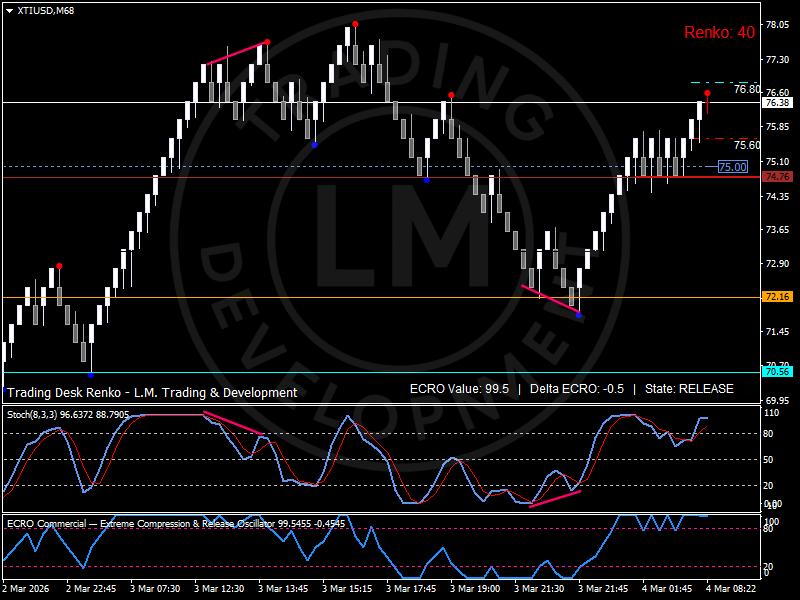
Beneath current levels, the more meaningful structural support remains around 72.1, which formed the foundation of the latest corrective phase.
On the upside, the 76.3–76.8 range is shaping up as a key resistance corridor. Multiple rallies have stalled in that area, indicating that market participants are still weighing whether the prevailing geopolitical risk premium is strong enough to fuel a sustained breakout.
For now, the broader pattern appears to reflect orderly consolidation after a sharp rebound, rather than the early stages of a renewed bearish trend.
Momentum Signals Indicate a Mature Expansion Phase
Momentum metrics reinforce the view that crude is moving out of a compression environment and into a more developed directional cycle.
The ECRO profile remains elevated, hovering near the top of its historical range. This typically characterizes conditions where volatility has already expanded and the market is consolidating those gains, rather than initiating a fresh breakout. Meanwhile, stochastic momentum has rebounded toward its upper boundary after briefly easing during the recent pullback.
Together, these signals imply that upside pressure remains intact, though the market may need additional consolidation before launching its next impulsive move. In essence, the current hesitation near resistance appears to reflect constructive digestion of prior gains, not a sign of trend exhaustion.
Freight Markets Could Provide the Next Major Signal
Looking ahead, shipping conditions in the Persian Gulf are likely to remain a critical variable for oil markets.
If tanker congestion worsens or freight rates continue climbing, traders may begin assigning a higher logistical risk premium to crude. Transportation disruptions typically ripple through the system gradually, meaning their pricing impact often builds over time rather than materializing as a single abrupt shock.
On the other hand, if shipping activity stabilizes and geopolitical tensions ease, a portion of the recently embedded premium could unwind. In that case, crude would likely shift back to trading primarily on macroeconomic drivers such as global demand expectations, currency fluctuations, and inventory trends.
For now, however, freight dynamics remain a central component of the oil narrative.
Outlook
Crude is navigating a landscape shaped as much by transportation risk as by traditional supply fundamentals. The rebound from the 72 area reinforces the view that buyers are still active on pullbacks, while the consolidation around 76 indicates the market is assessing whether current geopolitical risks justify a sustained breakout.
As long as prices remain above the 75–74.7 support zone, the near-term technical structure stays constructive. A clear push above 76.8 would signal renewed upside momentum and could pave the way for a broader expansion phase. Conversely, a decisive break below 74.7 would likely shift crude back into a wider consolidation pattern.
At present, price action reflects a market recalibrating to elevated transportation risk rather than responding to a structural collapse in supply.
Sources: Luca Mattei
 THE ETERNAL SOVEREIGN
Leave a comment