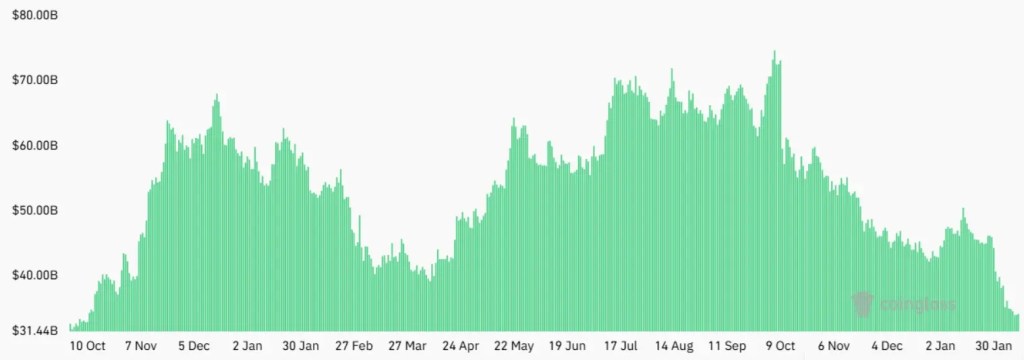
Total Bitcoin futures open interest has fallen to $34 billion as of Thursday, marking a 28% drop over the past month. However, this decline appears largely driven by price effects rather than a reduction in leverage. When measured in Bitcoin terms, open interest remains broadly unchanged at 502,450 BTC, indicating that underlying demand for leveraged exposure is still intact.
Over the past two weeks, forced liquidations have reached $5.2 billion, contributing significantly to the contraction in nominal dollar terms. Meanwhile, options markets show a 22% bearish skew, and funding rates continue to stay below the 12% threshold, suggesting that sentiment remains cautious but not excessively overheated.
Bitcoin Diverges from Traditional Markets
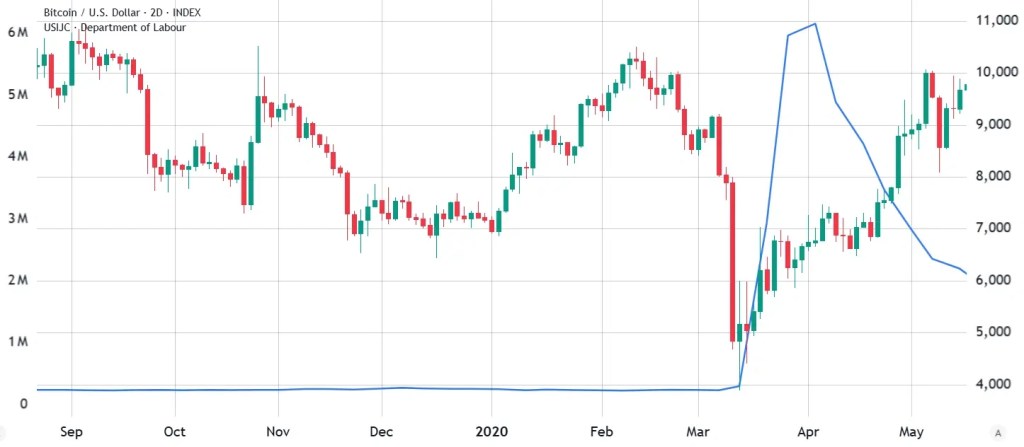
Bitcoin has declined 28% over the past month, even as gold surged back above the $5,000 psychological threshold and the S&P 500 remains just 1% shy of its record high. This growing divergence has prompted investors to question what is driving crypto’s relative weakness. One possible explanation lies in softer US labor data, with the economy adding only 181,000 jobs in 2025—falling short of expectations.
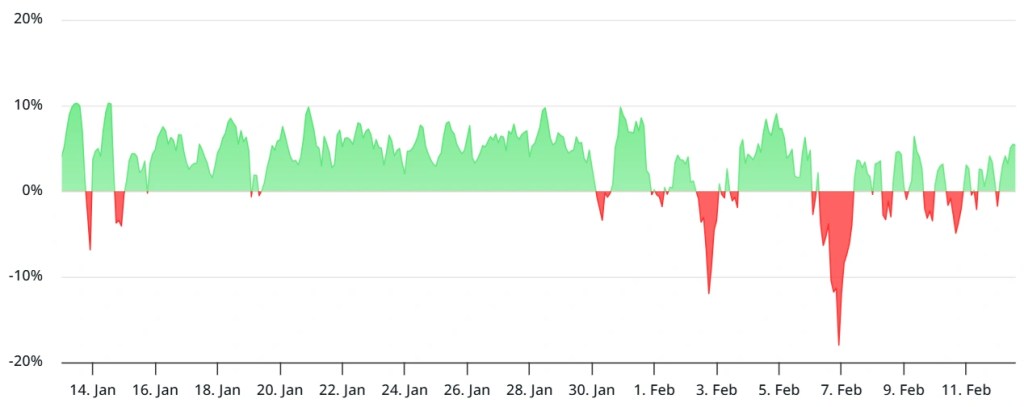
In derivatives markets, sentiment remains cautious. The annualized funding rate on Bitcoin futures has stayed below the neutral 12% benchmark for four straight months, reflecting persistent risk aversion. Options markets show even stronger defensive positioning, as the delta skew on Deribit climbed to 22%. This suggests traders are paying a notable premium for protective put options. Under typical conditions, the skew fluctuates between -6% and +6%, signaling more balanced sentiment.
Despite the bearish tone in derivatives, institutional participation appears steady. US-listed Bitcoin ETFs are recording average daily trading volumes of $5.4 billion, challenging narratives of fading institutional interest. Ultimately, Bitcoin’s near-term rebound may hinge on clearer signals about the direction of the US labor market and broader macroeconomic stability.
Sources: Isai Alexei
 THE ETERNAL SOVEREIGN
Leave a comment