A large ETH liquidation on Hyperliquid triggered a leverage-driven cascade, sending total crypto liquidations above $2.5 billion in 24 hours.
What to know:
- More than $2.5 billion in crypto positions were liquidated over 24 hours, including a single $222.65 million ether position on the Hyperliquid exchange.
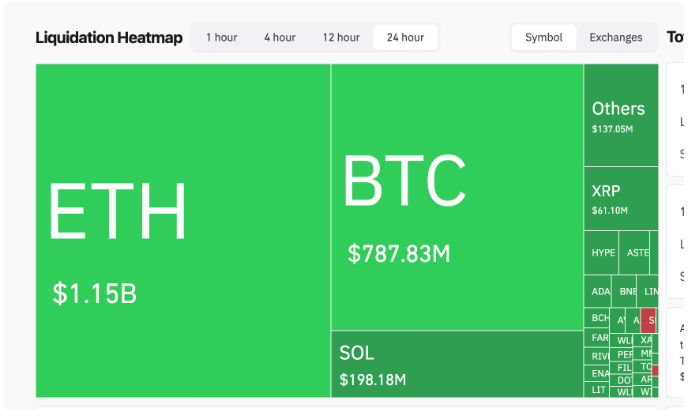
- Ether led the sell-off, with over $1.15 billion in liquidations as prices dropped by as much as 17%, followed by roughly $788 million in bitcoin and nearly $200 million in Solana.
- The liquidation wave was heavily skewed toward long positions and amplified by thin market liquidity, highlighting how leverage can fuel cascading price declines and sudden market reversals.
One trader suffered losses exceeding $220 million on an ether position as a renewed wave of forced liquidations rippled through crypto markets, driving total liquidations over the past 24 hours to nearly $2.6 billion.
The largest individual liquidation took place on decentralized derivatives exchange Hyperliquid, where an ETH-USD position valued at $222.65 million was erased, according to data from CoinGlass.
The sell-off unfolded as ether fell by as much as 17% over the past 24 hours, dragging down bitcoin and other major tokens in a thinly traded market.
In total, 434,945 traders were liquidated during the period, with losses overwhelmingly concentrated in long positions. About $2.42 billion of the $2.58 billion in total liquidations came from bullish bets, while short positions accounted for just $163 million.
Hyperliquid suffered the most severe impact, logging $1.09 billion in liquidations — almost entirely from long positions — representing more than 40% of total losses across exchanges. Bybit followed with $574.8 million, while Binance recorded roughly $258 million in liquidations.
Ether absorbed the bulk of the damage, with more than $1.15 billion in ETH positions wiped out over 24 hours. Bitcoin saw about $788 million in liquidations, and nearly $200 million in Solana positions were erased, according to liquidation heatmap data.
Liquidations happen when leveraged positions are automatically closed after prices move beyond a trader’s margin limits. These forced exits often lock in large losses and can amplify price swings by setting off cascading sell-offs during volatile periods.
Market participants track liquidation data to assess positioning and sentiment. Heavy long liquidations can point to panic-driven bottoms, while large short liquidations may signal the start of a squeeze. Sudden spikes also highlight overcrowded trades and areas where reversals may emerge.
When combined with open interest and funding rate data, liquidation metrics can help identify potential entry and exit points, particularly in overleveraged markets vulnerable to abrupt flushes or sharp rebounds.
Such liquidation-driven moves have become increasingly frequent during low-liquidity conditions, where relatively modest price moves can ripple through derivatives markets and trigger outsized reactions.
Sources: Coindesk
 THE ETERNAL SOVEREIGN
Leave a comment