
Last Updated on 27/05/2026
According to Swissblock, Bitcoin (BTC) has entered a high-risk zone as institutional demand continues to weaken and spot Bitcoin ETFs record rising outflows. The growing selling pressure comes amid broader market uncertainty, pushing BTC into a more vulnerable position.
Against this backdrop, Bitcoin price has fallen toward the $76,000 level following the latest U.S. military strike on Iran. Several key market indicators are now flashing warning signals as BTC struggles to regain momentum above the $78,000 resistance area.
Swissblock’s Risk Index Signals Rising Market Stress
Swissblock has warned that Bitcoin is slipping further into a high-risk zone, with its proprietary risk index highlighting increasing pressure across the broader crypto market. According to the firm, bullish momentum is fading rapidly, while institutional demand — including purchases from major players such as Strategy — has largely stalled.
At the same time, Bitcoin’s volatility remains elevated, adding to concerns over market stability. Swissblock noted that BTC is now entering a fragile phase that could be vulnerable to sharp and sudden price declines. The firm also emphasized that weakening institutional participation and deteriorating investor confidence are contributing to the growing downside risk.

Analysts also noted that current market conditions differ sharply from the strong rally seen earlier this year. At that time, steady spot Bitcoin ETF inflows helped fuel bullish momentum and supported higher prices. Now, however, the market is witnessing the opposite trend, with persistent outflows weighing on sentiment and weakening demand. As a result, caution has grown among both short-term traders and long-term Bitcoin holders.
Glassnode Reports Continued ETF Outflows
On-chain analytics firm Glassnode has reported persistent outflows from Bitcoin investment products, signaling weakening institutional appetite. According to the firm, spot Bitcoin ETFs have experienced several consecutive days of sizable withdrawals, adding further pressure to the broader crypto market.

Glassnode noted that institutional demand for Bitcoin has weakened significantly compared with previous months, with spot Bitcoin ETFs recording near-daily outflows over the past two weeks. Investors appear to be reducing their exposure as global financial markets become increasingly uncertain and volatile.
These persistent ETF outflows are particularly important because institutional inflows were a major driver behind Bitcoin’s powerful rally earlier this year. Strong demand from spot Bitcoin ETFs helped BTC climb to fresh highs, reinforcing bullish market sentiment. However, if ETF demand continues to deteriorate, analysts warn that Bitcoin could face additional selling pressure in the near term.
Bitcoin Slides After U.S. Strikes on Iran
The crypto market came under renewed pressure this week as escalating geopolitical tensions weighed heavily on investor sentiment. Bitcoin (BTC) declined amid expectations and subsequent reports of U.S. military strikes targeting Iranian assets in the Middle East. As global risk appetite deteriorated, investors shifted capital toward traditional safe-haven assets, triggering fresh selling across risk-sensitive markets.
Geopolitical uncertainty often sparks sharp reactions in the cryptocurrency market, and the latest developments have intensified caution among traders. With investors reducing exposure to risk assets such as Bitcoin, BTC price came under significant pressure and moved lower as market uncertainty deepened.
Bitcoin Struggles to Reclaim $78,000
Bitcoin (BTC) remains under pressure below the key $78,000 resistance zone, with multiple recovery attempts failing throughout the week. Each time BTC approached higher levels, sellers quickly regained control as market sentiment weakened amid reports of U.S. military strikes in the Middle East.
The continued risk-off mood has limited bullish momentum, keeping Bitcoin trapped in a fragile technical position. According to CoinMarketCap, BTC recently fell toward the $76,500 area as traders reacted to rising geopolitical uncertainty and persistent ETF outflows.
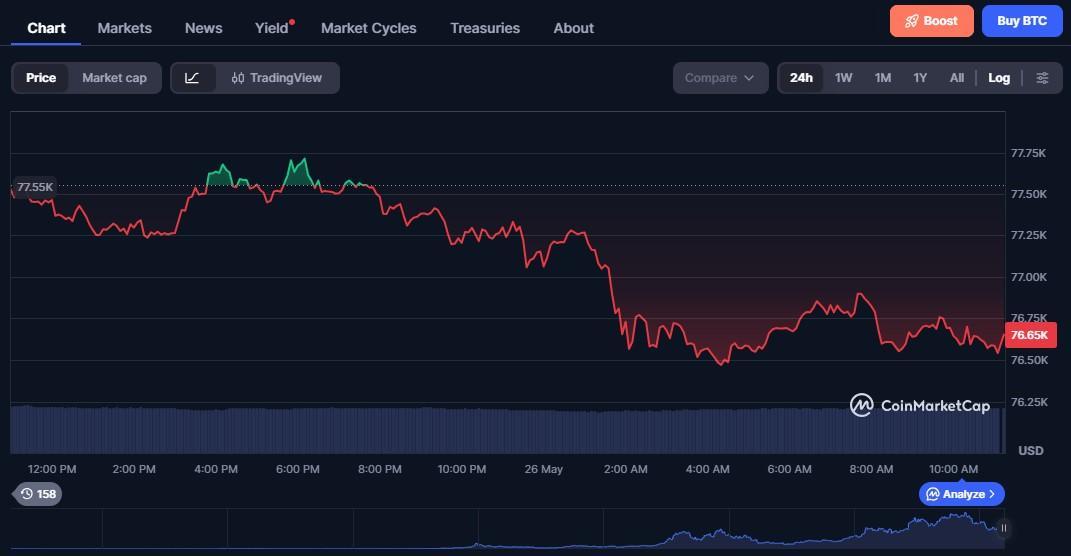
For Bitcoin to regain bullish momentum, analysts believe stronger institutional buying will be necessary to offset the recent wave of ETF outflows and weakening market sentiment. Without renewed demand from large investors, BTC could continue trading sideways or extend its decline in the near term.
Market watchers also note that Bitcoin’s support in the mid-$75,000 region remains critical for short-term price stability. A sustained break below that area could trigger additional downside pressure, while holding above it may help BTC stabilize as traders assess broader macroeconomic and geopolitical risks.
Technical Indicators Continue Signaling Bitcoin Weakness
Technical indicators currently suggest that bearish pressure remains dominant for Bitcoin (BTC). Data from Investing.com shows that most major moving averages are still flashing “Strong Sell” signals, reflecting weak market sentiment and continued downside momentum.
The Relative Strength Index (RSI) also remains below neutral territory, indicating that bullish momentum has yet to recover. Meanwhile, MACD indicators continue to generate sell signals, reinforcing the negative short-term outlook for BTC.
Both short-term and long-term moving averages continue to point toward further downside risk, while several Bitcoin oscillators are gradually moving into oversold territory. Analysts believe stronger buying activity from Bitcoin bulls will be needed to stabilize the market and prevent BTC price from extending its decline further.
Leave a Reply