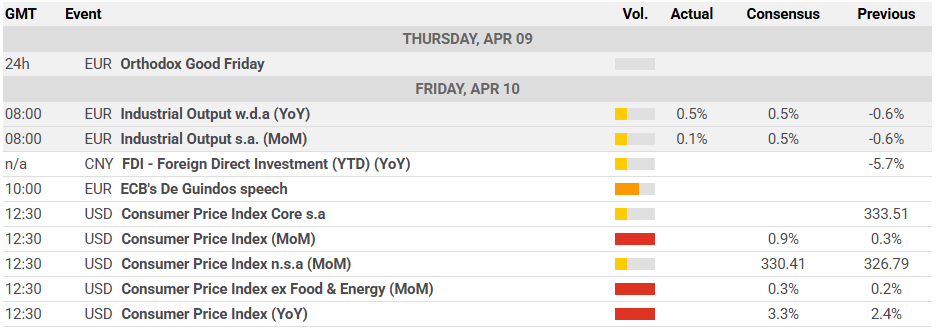
GBP/USD slipped slightly after four consecutive sessions of gains, remaining under pressure below the 1.3450 level during Friday’s European trading hours. The pair weakened as the US Dollar held steady amid cautious market sentiment, driven by concerns ahead of the US-Iran peace negotiations. Investors are now focused on the US Consumer Price Index report scheduled for release later in the North American session.
Technical Outlook for GBP/USD
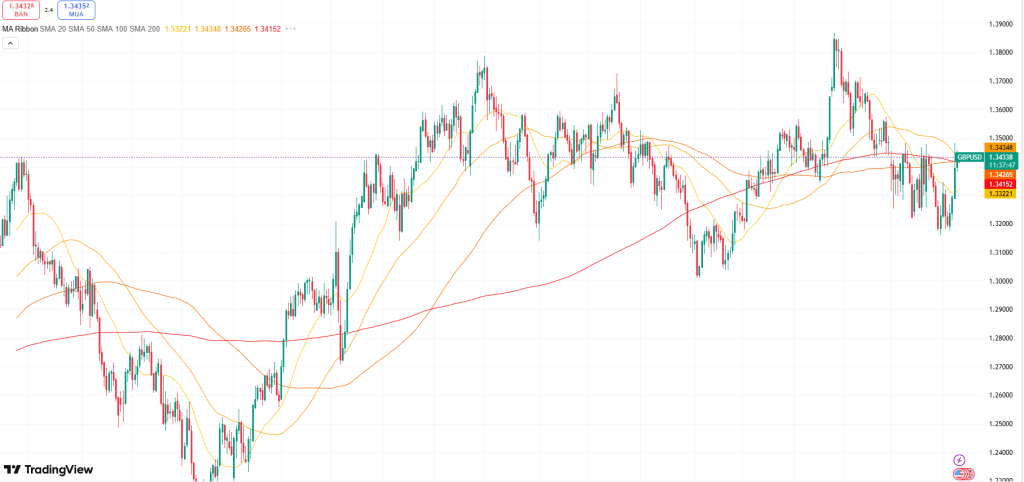
The short-term outlook for GBP/USD has shifted slightly bullish, with the pair maintaining its position just above the 38.2% Fibonacci retracement of the January–March decline. Price action is currently challenging the downward-sloping 200-day Simple Moving Average around 1.3415 from below, indicating early signs of buying interest near this key long-term level. Momentum indicators are also improving, as the MACD line has crossed above its signal line and is moving back toward the zero line, while the RSI at 55 reflects moderate bullish momentum without overbought pressure.
On the upside, immediate resistance is seen at the 50% retracement level of 1.3505. A daily close above this level would reinforce the bullish bias and pave the way toward the 61.8% Fibonacci retracement at 1.3588. On the downside, initial support lies at the 38.2% retracement near 1.3422, closely aligned with the 200-day SMA at 1.3415; a break below this zone would expose the next support at the 23.6% retracement around 1.3319. Overall, as long as GBP/USD remains above the 1.3415–1.3422 support area, the near-term bias continues to favor further recovery toward the mid-1.3500 region.
Fundamental Analysis Summary
Market sentiment remains fragile and risk-averse as geopolitical tensions persist. Israel continues military operations against Hezbollah, although Prime Minister Benjamin Netanyahu indicated that direct negotiations with Lebanon are expected to begin soon. At the same time, US President Donald Trump stated that American forces will remain stationed near Iran until full compliance with the agreement is achieved.
On the diplomatic front, US Vice President JD Vance, along with senior envoys Steve Witkoff and Jared Kushner, is scheduled to hold talks in Pakistan this weekend regarding a potential long-term arrangement with Iran. Meanwhile, Iranian Foreign Ministry spokesperson Esmaeil Baghaei said that any negotiations to end the conflict depend on US adherence to its ceasefire obligations. He further argued that these commitments include a ceasefire in Lebanon, a condition the US and Israel dispute.
Separately, Bank of England Governor Andrew Bailey warned that the Iran conflict could trigger risks reminiscent of the 2008 financial crisis, pointing to potential contagion from stress in the largely opaque $3 trillion private credit market. He cautioned that such vulnerabilities could spill over into already fragile global markets strained by energy shocks and rising debt pressures, according to The Telegraph.
 THE ETERNAL SOVEREIGN
Leave a comment