The Federal Reserve is navigating one of its toughest policy backdrops in years as the conflict with Iran unsettles global energy markets and clouds the outlook for both inflation and growth.
Heightened geopolitical volatility is forcing policymakers into a difficult balancing act: tightening too much could push the economy into recession, while easing prematurely risks fueling inflation again. For now, the most prudent approach appears to be holding rates steady until incoming data provide clearer direction on policy.
Cleveland Fed President Beth Hammack reinforced this stance in a recent AP interview, indicating a preference to keep rates unchanged “for quite some time.” However, she acknowledged flexibility, noting that rate cuts could be warranted if the labor market weakens משמעותfully, while further hikes may be needed if inflation remains persistently above target.
Meanwhile, the Treasury market has shifted its expectations. After a prolonged period of dovish positioning, investors are now assigning a higher probability to near-term rate hikes. This shift is evident in the policy-sensitive 2-year Treasury yield—around 3.84% as of April 6—trading above the median effective Fed funds rate of 3.64%, signaling a renewed tilt toward a more hawkish outlook for the first time since 2022.
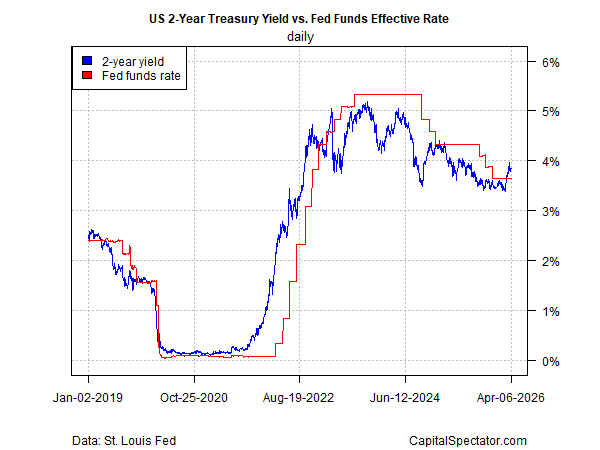
The outlook for inflation and economic growth remains uncertain, with rising concern that risks may tilt toward higher prices, slower growth—or both.
IMF Managing Director Kristalina Georgieva warned that “all roads now lead to higher prices and weaker growth,” highlighting a global environment marked by heightened uncertainty. Speaking to Reuters, she pointed to multiple risk factors—including geopolitical tensions, rapid technological change, climate disruptions, and shifting demographics—and stressed the need for vigilance even after the current shock passes.
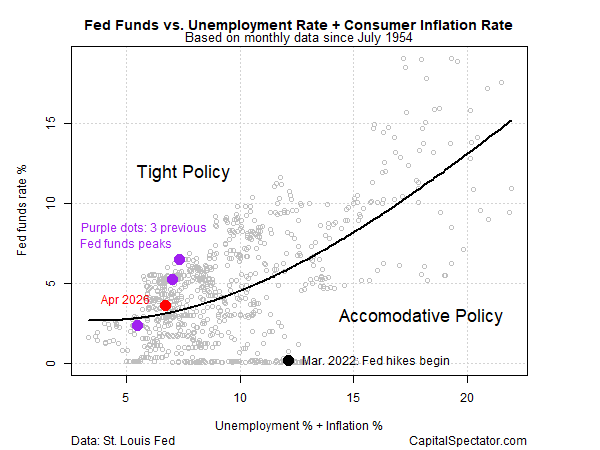
Against this backdrop, the Federal Reserve’s policy stance remains slightly restrictive. Based on a basic model incorporating unemployment and year-over-year CPI changes, current settings still lean tight, giving the central bank room to remain patient. This supports a wait-and-see approach, allowing policymakers to assess incoming data before making any decisive shifts.
Chicago Fed President Austan Goolsbee signaled that an interest rate increase may be approaching. When asked to assess economic risks on a color scale—from crisis-level red to optimistic green—he described the outlook as “at least orange,” suggesting conditions are concerning and far from ideal. Recent movements in the Treasury market appear to reflect a similar level of caution.
However, because inflation and broader economic data tend to lag, the Federal Reserve is likely to remain patient while it evaluates how the economy responds to the conflict with Iran. The difficulty lies in not delaying too long, as inflation or slowing growth could outpace policy actions, forcing the Fed into a reactive stance. This scenario echoes its delayed response during the 2021–2022 inflation surge—an error policymakers are keen to avoid repeating.
At the same time, moving too quickly carries its own risks, potentially worsening inflationary pressures or hindering growth. Ultimately, the Fed’s task is less about identifying a perfect policy and more about staying flexible in an unpredictable environment. One thing is clear: whenever the next policy move comes, it will be made amid significant uncertainty.
Sources: James Picerno
 THE ETERNAL SOVEREIGN
Leave a comment