President Donald Trump appears to be effectively controlling the pace and direction of the conflict, a point echoed by U.S. Defense Secretary Pete Hegseth. For traders, this concentration of decision-making power is not entirely unfamiliar, as markets have grown accustomed to navigating policy shocks driven by Trump. In theory, when authority is concentrated in a single figure, it could narrow the range of possible outcomes.
In practice, however, the opposite may be happening. During most geopolitical crises, markets assess risks through institutional processes—cabinet deliberations, coalition coordination, and diplomatic negotiations. These structures allow traders to gradually build probability models for how events may unfold. This time, while the decision-making framework appears more centralized, the range of potential outcomes seems broader. When the decision loop runs through a single, highly unpredictable leader, markets struggle to rely on consistent messaging. Instead of clarity, price action begins to reflect personality, tone, and mood.
As a result, global financial markets are being influenced not only by economic fundamentals but also by political rhetoric and timing. Traders find themselves constantly reacting to headlines—whether from press briefings or social media—because a single comment can shift market positioning more quickly than traditional macroeconomic analysis.
This dynamic defined one of the week’s most chaotic trading sessions. Market movements were not driven by earnings revisions, macroeconomic releases, or the typical interaction between bond and equity markets. Instead, crude oil became the central driver of market sentiment, with every headline emerging from the Strait of Hormuz quickly rippling across equities, currencies, and safe-haven assets. When volatility spikes in energy markets, it rarely remains confined to commodities. Oil remains a critical component of the global economic system, meaning fluctuations in its price often transmit shocks across multiple asset classes.
The Asian trading session initially opened with cautious optimism. After Trump suggested the conflict might be approaching some form of resolution, crude prices moved sideways, well below the sharp volatility seen previously. For a short period, it appeared that markets might return to pricing economic fundamentals rather than reacting to geopolitical developments.
That sense of calm proved short-lived. Hegseth later warned that Tuesday could become the most intense day of strikes in the conflict. At that point, markets quickly reassessed the situation, realizing that the earlier calm might have been only a temporary pause before further escalation. As a result, the geopolitical risk premium rapidly returned to oil prices.
For traders, the oil market has effectively become the roulette ball—bouncing unpredictably as new headlines hit the market. The result is a trading environment that feels less like a traditional price discovery process and more like a casino table, with participants watching the wheel spin and trying to anticipate where the next move will land.
Follow the bouncing barrel
Overnight: After Donald Trump delivered a quasi “all-clear” tone the previous day, oil prices moved sideways during overnight trading, remaining well above the sharp lows seen during the earlier selloff.
09:00 ET: Reports that the International Energy Agency was convening a meeting to discuss the possibility of a coordinated Strategic Petroleum Reserve (SPR) release pushed crude prices lower.
12:45 ET: U.S. Energy Secretary Chris Wright posted on social media that the U.S. military had escorted an oil tanker through the Strait of Hormuz, triggering a sharp drop in oil prices.
13:10 ET (approx.): Wright deleted the post shortly afterward. Journalists cited sources denying the escort operation, while Islamic Revolutionary Guard Corps officials also rejected the claim—prompting oil prices to rebound.
13:25 ET: CBS News reported that U.S. intelligence believed Iran may be laying mines in the Strait of Hormuz, sending crude prices sharply higher.
14:00 ET: White House Press Secretary Karoline Leavitt confirmed there had been no tanker escort, which helped extend the upward move in oil.
14:20 ET: The International Energy Agency concluded its meeting without announcing any coordinated SPR release, allowing oil prices to climb further.
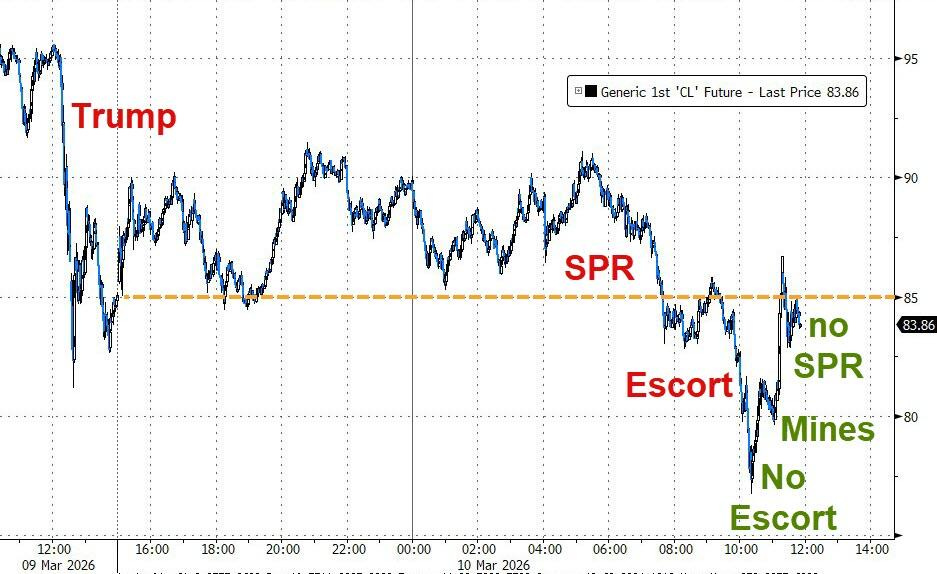
By the closing bell, the overall result appeared deceptively calm. West Texas Intermediate crude oil settled around $85 a barrel—technically lower than the previous close but essentially unchanged from levels seen when equities finished trading the day before. Anyone focusing only on the closing price would miss the real story. The session itself demonstrated how modern markets behave when geopolitics drives price action and information arrives in fragments rather than through formal policy announcements.
The options market, however, reveals the deeper dynamic. Volatility in crude rose again, and the skew in pricing has become pronounced. Investors are paying the largest premiums in years for call options on WTI futures relative to puts—an indication that traders remain uneasy about potential upside risks tied to disruptions in the Strait of Hormuz. In effect, the derivatives market is insuring against the possibility that the next headline could remove additional barrels from global supply. In an environment where tanker movements slow and supply routes tighten, the real threat is not yesterday’s price spike but the next one.
That anxiety is grounded in fundamentals. If disruptions in the Gulf expand—or simply persist longer than expected—oil prices would likely rise as more Middle Eastern supply faces shutdown risks and potential force majeure declarations. Even with diversion pipelines and strategic reserves acting as buffers, the scale of possible disruption clashes with a global market that still consumes more than 100 million barrels per day. While daily trading may appear dominated by headlines, the underlying arithmetic of missing supply continues to shape market expectations.
The uncertainty also spilled directly into equity markets. When crude prices fell earlier in the session, stocks briefly rallied as inflation concerns eased and interest-rate-sensitive sectors found support.
However, Asian and European equities remain particularly vulnerable because both regions are major energy importers. Markets have become highly sensitive to Brent crude oil once it moves above the $85 level. That threshold is deeply embedded not only in trader psychology but also within automated trading systems that now dominate market flows. When crude rises above that zone, systematic strategies, energy sensitivity models, and macro-risk algorithms often trigger a reflexive reaction, amplifying the feedback loop between oil and equities. In practical terms, the relationship becomes mechanical: higher oil prices tend to pressure Asian equities, while cooling crude prices allow stocks to stabilize.
Even in U.S. markets, the environment is not ideal for absorbing shocks. According to the Delta One desk at Goldman Sachs, liquidity conditions remain relatively thin. Depth in the S&P 500 order book sits near $4.53 million—around 25% below the 20-day average—while overall market trading volumes are also roughly 25% lower than typical levels. This means markets are attempting to interpret large macroeconomic signals with reduced liquidity, a situation that can amplify price swings whenever oil becomes the trigger.
In effect, the broader financial system spent the session taking cues from the crude market. When oil moves sharply, equity markets quickly react. While this correlation may weaken during calmer periods, it becomes dominant when the Strait of Hormuz turns into the world’s most important venue for price discovery in energy markets.
For traders, the lesson is clear. In stable environments, fundamentals dominate and models guide trading decisions. But during geopolitical crises—particularly those involving Middle Eastern energy supply—unexpected shocks become the primary driver. Information itself becomes the commodity being traded. Headlines, signals, and rumors can move prices as much as actual supply changes. When global risk perception hinges on a small number of political decisions—often shaped by figures such as Donald Trump—markets stop behaving like predictable equations and begin reacting more like mood indicators, capable of changing direction with a single statement or social media post.
Sources: Stephen Innes
 THE ETERNAL SOVEREIGN
Leave a comment