After surging in a classic speculative frenzy, silver went parabolic before collapsing in dramatic fashion. In recent weeks it has suffered some of its largest daily losses on record, echoing past episodes when extreme tops unraveled into violent crashes. Historically, such vertical “moonshots” have been followed by swift, symmetrical selloffs that wipe out a large share of prior gains—suggesting the current downturn may not yet be finished.
Silver has long attracted an intensely bullish following, especially during explosive rallies. But like all markets, its powerful upside extremes inevitably give way to sharp reversals. In mid-January, warnings emerged that silver had reached dangerously overbought levels not seen since the aftermath of the early 1980 bubble. Back then, prices plunged more than 75% within months and failed to sustainably exceed that peak for decades—underscoring the risks of vertical blow-offs.
From late October to late January, silver soared an extraordinary 149% in just over three months, logging numerous record closes. By some technical measures—such as its distance above the 200-day moving average—it reached historically rare territory, ranking among the most overbought readings in more than half a century. Comparable extremes were last seen in January 1980, during the infamous silver bubble.
Although silver often magnifies gold’s moves and has delivered strong long-term gains since the modern precious metals era began in 1971, its volatility cuts both ways. The same momentum and herd enthusiasm that fuel breathtaking advances tend to necessitate equally forceful corrections. This latest crash, following a surge to bubble-like extremes, has once again demonstrated just how unforgiving those reversals can be.
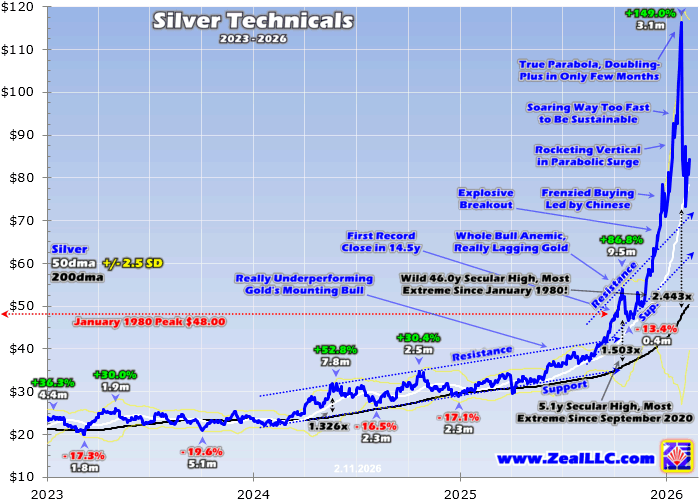
On January 30, silver plunged an extraordinary 27.5% in a single session—qualifying as a true crash by stock-market standards and marking its second-worst daily drop since 1971, just behind a 30.8% collapse in March 1980. The trigger was a sharp 10.3% fall in gold, driven largely by heavy Chinese selling, with silver amplifying that move roughly 2.7 times—consistent with its historical tendency to magnify gold’s swings. More steep losses followed, including another 16% plunge, creating a rare cluster of crash-grade declines reminiscent of the aftermath of the 1980 bubble.
While today’s rally into January 2026 was extreme—silver soared 149% in just over three months and reached one of the most overbought readings in more than five decades—it still fell short of the blow-off top seen in 1980. Back then, silver ultimately cratered nearly 77% in just over two months. Although a repeat of that magnitude appears unlikely, the recent 36.9% drop in only six trading days may not be sufficient to fully unwind the speculative excess. Simply returning to pre-mania levels would require far deeper losses.
Historical precedent suggests silver’s largest crash days rarely mark final bottoms. Except for a brief climax in March 1980, most 10%+ down days since 1971 have occurred early or mid-way through major selloffs, not at their end. Episodes in 2006, 2008, 2011, 2013, and 2020 all saw further grinding declines after dramatic crash sessions. Sharp bounces often follow panic selling, but sustained weakness is typically needed to shift herd psychology from greed to fear.
In speculative manias, fundamentals play little role in driving parabolic advances or subsequent collapses. Supply and demand rarely change fast enough to justify such extremes; sentiment and momentum dominate. Arguments about structural demand—such as AI-related usage—cannot rationalize silver doubling in a few months. That surge was largely fueled by speculative fervor, especially heavy Chinese buying, which has now reversed.
The broader lesson is that silver’s recent crash likely marks the early stages of a deeper rebalancing rather than its conclusion. After reaching near half-century overbought extremes, a proportionally large and sustained correction may be required to normalize sentiment. Historically, silver has tended to grind considerably lower after initial crash days, suggesting this reckoning may still have further to run.
Sources: Adam Hamilton
 THE ETERNAL SOVEREIGN
Leave a comment