- EUR/USD drops 0.75% as Kevin Warsh’s Fed nomination lifts US yields and fuels Dollar demand.
- Hot US producer inflation reinforces expectations for a steady Fed, pushing Treasury yields above 4.25%.
- Solid German and Eurozone GDP figures fail to counter Dollar strength driven by policy repricing.
EUR/USD slid 0.75% in the North American session as broad US Dollar strength followed Trump’s mildly hawkish Fed nominee and an inflation report supporting a steady-rate stance. The pair was trading at 1.1882 at the time of writing, down from a session high of 1.1974.
Euro sinks below 1.19 as hawkish Fed leadership signals and sticky inflation crush rate-cut hopes
Kevin Warsh has been named by President Trump as the next Chair of the Federal Reserve, confirming rumors that surfaced late Thursday. Financial markets reacted swiftly, sending precious metals sharply lower while the US Dollar climbed nearly 1%, as measured by the US Dollar Index (DXY), which tracks the greenback against six major peers. The DXY is on course to close above the 97.00 mark.
US Treasury yields also advanced, with the 10-year yield rising toward 4.25%. Meanwhile, US producer-side inflation edged higher, moving further away from the Federal Reserve’s 2% target and reinforcing the case for keeping interest rates unchanged. In addition to the December Producer Price Index (PPI) release, comments from Federal Reserve officials remained in focus.
Separately, breaking news reported that the US Senate reached an agreement to pass a government funding package later tonight, averting a potential shutdown, according to Politico.
Rising Treasury yields suggest investors see reduced odds that Warsh would pursue aggressive rate cuts to appease the White House. At the time of writing, the US 10-year Treasury yield was up around 1.5 basis points at 4.247%.
In Europe, Germany’s economy expanded by 0.4% year-on-year, beating expectations. However, stronger-than-forecast GDP readings for Germany and the Eurozone, along with an uptick in German inflation, failed to offer meaningful support to EUR/USD.
Looking ahead, the US economic calendar will feature a batch of labor market data, speeches from Fed officials, and January ISM Manufacturing and Services PMIs. In Europe, HCOB flash PMIs for the Eurozone, Germany, and France, alongside the European Central Bank’s monetary policy meeting, could inject volatility into EUR/USD.
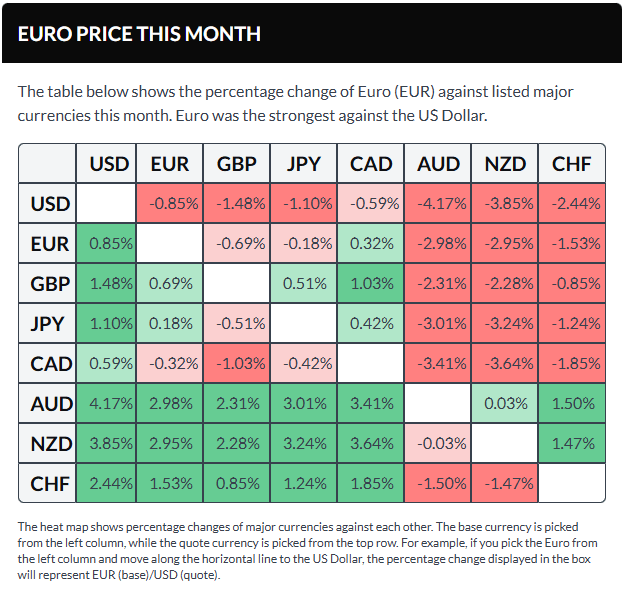
Daily market movers: Dollar comeback sends Euro tumbling
St. Louis Fed President Alberto Musalem said there is no need for further rate cuts at present, noting that the current 3.50%–3.75% policy range is broadly neutral. He added that easing would only be warranted if the labor market weakens significantly or inflation falls materially.
Fed Governor Stephen Miran backed Kevin Warsh as a strong candidate for Fed Chair, attributing the recent rise in producer prices largely to housing costs and portfolio management fees. Meanwhile, Fed Governor Christopher Waller said the labor market remains soft despite steady growth, arguing inflation would be closer to 2% without tariffs, which he said are keeping price growth near 3%. Waller added that policy should be closer to neutral, around 3%.
Atlanta Fed President Raphael Bostic called for patience, stressing that interest rates should remain somewhat restrictive. He warned that the full inflationary impact of tariffs has yet to be felt and expects price pressures to persist.
US producer inflation data reinforced the cautious tone. The Producer Price Index (PPI) held steady at 3.0% YoY in December, missing expectations for a slowdown to 2.7%. Core PPI accelerated to 3.3% YoY from 3.0%, defying forecasts for a decline and highlighting ongoing upstream price pressures.
In Europe, EU GDP grew 1.4% YoY in Q4, unchanged from Q3 but above expectations. Germany’s economy expanded 0.4% YoY, beating forecasts and improving from the prior quarter. German inflation, measured by the HICP, edged up to 2.1% in January from 2.0%, remaining within the ECB’s target range.
Technical outlook: EUR/USD uptrend under threat after break below 1.1850
The EUR/USD technical outlook suggests the uptrend is under threat after the pair failed to sustain gains above the 2025 high at 1.1918, accelerating the decline below 1.1850. The Relative Strength Index (RSI) has turned mildly bearish, indicating a shift in momentum that could open the door to further downside.
On the downside, initial support is seen at 1.1800. A decisive break below this level could expose the 20-day simple moving average (SMA) at 1.1743.
On the upside, immediate resistance stands at 1.1900. A move back above this level would bring 1.1950 into focus, followed by the yearly high at 1.2082.
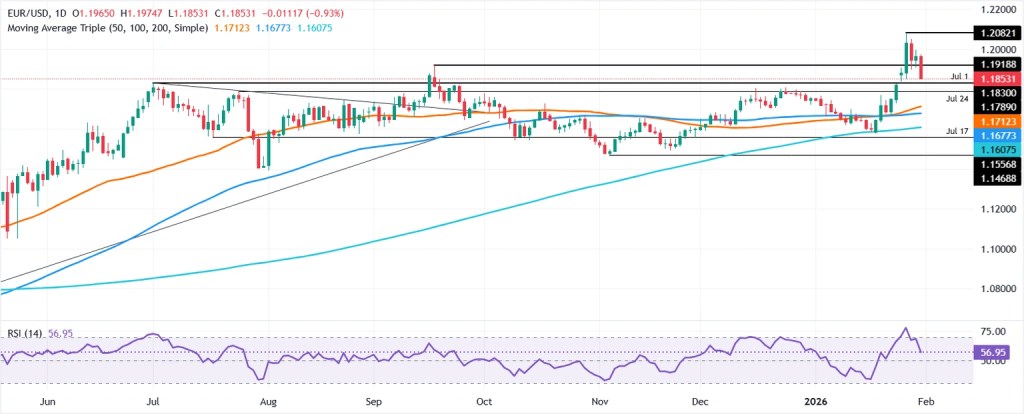
EUR/USD Daily Chart
Sources: Fxstreet
 THE ETERNAL SOVEREIGN
Leave a comment