- The Japanese yen edged lower after softer-than-expected Tokyo CPI data dampened expectations for an imminent Bank of Japan rate hike.
- Persistent fiscal challenges and political uncertainty continued to pressure the currency, although fears of official intervention helped limit losses.
- Meanwhile, concerns over the Federal Reserve’s independence could restrain any rebound in the U.S. dollar and cap gains in the USD/JPY pair.
The Japanese yen (JPY) came under renewed selling pressure during Asian trading on Friday after data showed consumer inflation in Tokyo, Japan’s capital, slid sharply to a near four-year low in January. The weaker inflation reading reduces urgency for the Bank of Japan (BoJ) to move toward near-term rate hikes. In addition, concerns over Japan’s fiscal outlook, linked to Prime Minister Sanae Takaichi’s reflationary agenda, along with political uncertainty ahead of the February 8 snap election, continue to weigh on the currency. Coupled with modest U.S. dollar (USD) strength, these factors pushed USD/JPY toward the 154.00 level and the key 100-day Simple Moving Average (SMA) resistance.
That said, expectations of coordinated intervention by U.S. and Japanese authorities to support the yen may discourage aggressive bearish positioning. At the same time, lingering trade uncertainty stemming from President Donald Trump’s tariff threats and broader geopolitical risks is tempering risk appetite, as reflected in the cautious tone across equity markets, which could help limit downside in the safe-haven JPY. Meanwhile, the USD may struggle to gain sustained traction amid expectations of further Federal Reserve rate cuts and ongoing concerns over the central bank’s independence, potentially capping further upside in USD/JPY.

Japanese yen comes under pressure from soft Tokyo CPI, fiscal concerns and political uncertainty
A government report released earlier on Friday showed that Tokyo’s headline Consumer Price Index (CPI) fell to 1.5% in January from 2.0% previously, marking its lowest level since February 2022. Core inflation, which strips out fresh food prices, also softened to 2.0% from 2.3% in December, while a broader measure excluding both food and energy eased to 2.4% from 2.6% the month before.
The data signals easing demand-driven inflation pressures and diminishes the urgency for further monetary tightening by the Bank of Japan, following its December rate hike that lifted the policy rate to 0.75%, the highest level in three decades.
Meanwhile, concerns over Japan’s fiscal outlook persist as Prime Minister Sanae Takaichi has anchored her snap election campaign on expanded stimulus measures and pledged to suspend the consumption tax on food, raising questions about fiscal sustainability.
Adding another layer of complexity, reports of an unusual rate check by the New York Federal Reserve last Friday, following a similar move by Japan’s Ministry of Finance, have fueled speculation about potential coordinated U.S.-Japan intervention to curb yen weakness.
On the geopolitical front, U.S. President Donald Trump announced plans on Thursday to decertify all Canada-made aircraft and threatened to impose 50% tariffs unless U.S.-built Gulfstream jets receive certification in Canada. The move marks a fresh escalation in U.S.-Canada trade tensions.
These developments, alongside rising U.S.-Iran frictions and the prolonged Russia-Ukraine conflict, could help limit downside pressure on the safe-haven yen. The United States continues to deploy warships and fighter jets across the Middle East, while Secretary of War Pete Hegseth stated that Washington stands ready to act decisively under President Trump’s directives.
Russia has also reiterated its invitation for Ukrainian President Volodymyr Zelensky to travel to Moscow for peace talks, although prospects for a deal remain slim amid deep divisions between the two sides.
Meanwhile, the U.S. dollar received a modest boost amid speculation that Kevin Warsh may be appointed as the next Federal Reserve chair, lending additional support to the USD/JPY pair. President Trump is expected to announce his choice for Fed chair on Friday morning.
Looking ahead, traders will take further cues from the release of the U.S. Producer Price Index (PPI), which, alongside comments from Federal Reserve officials, is likely to influence dollar demand and provide direction for USD/JPY into the weekend.
USD/JPY bulls look for a sustained break above the 100-day SMA before adding new positions
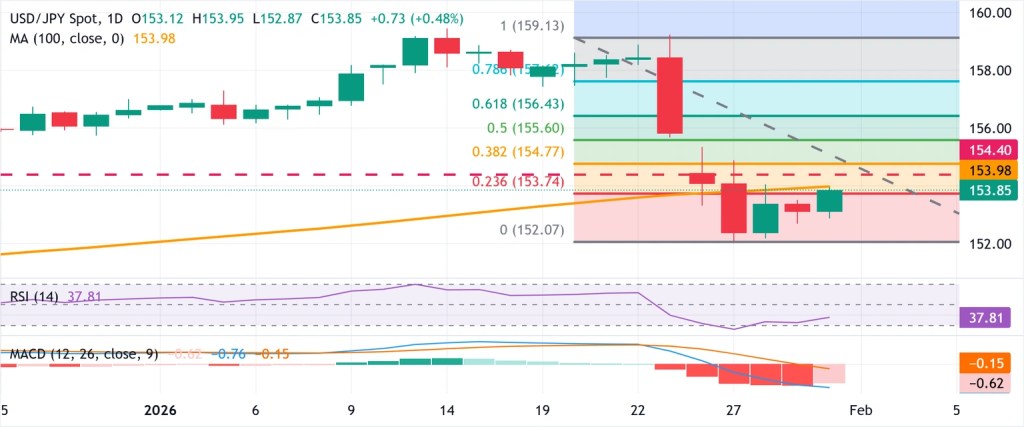
The 100-day Simple Moving Average (SMA) continues to trend higher and is currently located near 153.98, with USD/JPY trading just below this level. This keeps near-term sentiment on the heavy side, despite the broader uptrend suggested by the rising trend filter. A sustained move back above this dynamic resistance would help steady the short-term outlook.
Momentum indicators show tentative signs of stabilization. The Moving Average Convergence Divergence (MACD) remains in negative territory, although its recent narrowing points to fading downside pressure. Meanwhile, the Relative Strength Index (RSI) stands at 37.81, below the neutral 50 mark but rebounding from oversold levels, indicating that bearish momentum is beginning to ease.
On the upside, the 38.2% Fibonacci retracement of the 159.13–152.07 decline, located at 154.77, is likely to act as initial resistance. A daily close above this level would enhance the recovery setup and open the door to further gains as momentum improves. Conversely, failure to break above this barrier would keep rebounds limited and reinforce a cautious near-term bias.
Sources: Fxstreet
 THE ETERNAL SOVEREIGN
Leave a comment