USD/JPY’s recent dip has left it caught between firm uptrend support and growing concerns about potential intervention as it approaches the 160 mark. Traders now face a key question: does this bearish signal point to a deeper correction, or is it merely a temporary pause in the broader rally?
- Pullback brings USD/JPY toward key support around 159
- Intervention fears resurface near the 160 threshold
- Attention shifts to the RBA decision and upcoming JGB auction
Reversal Highlights Tension Within the Uptrend
USD/JPY fell sharply on Monday, though the drivers behind the move were not particularly compelling.
The decline coincided with a sudden pullback in the US dollar and a drop in Treasury yields, despite a lack of meaningful new macro developments. At the same time, crude oil prices reversed earlier gains even as no additional countries committed to joining the United States in protecting tanker routes through the Strait of Hormuz. Given how energy supply concerns have recently underpinned the dollar, this suggests the move was more about positioning adjustments than a shift in the broader macro outlook.
For USD/JPY, the timing stands out. Japan’s finance minister, Satsuki Katayama, signaled readiness to take “decisive action” to curb excessive currency volatility as the pair neared 160. Considering Japan’s track record of intervening or conducting rate checks around this level, such remarks likely prompted traders to scale back long positions, accelerating the pullback.
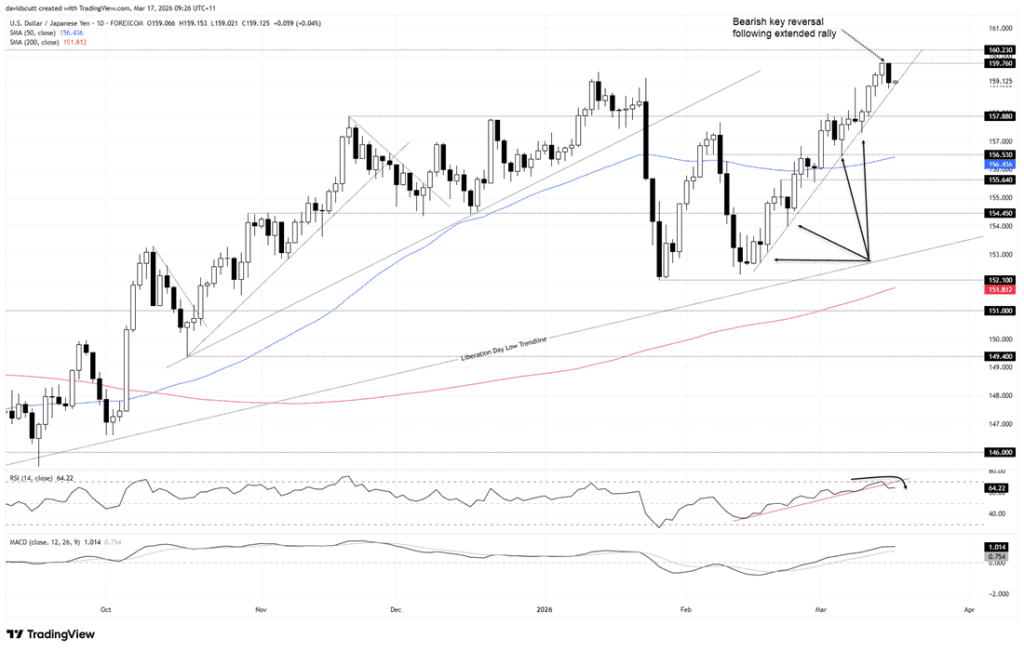
A single bearish reversal candle is rarely enough to shift the narrative—especially when it appears without a clear fundamental catalyst. Without follow-through selling, Monday’s move in USD/JPY is more likely to be seen as a pause rather than confirmation of a broader trend reversal.
Technically, the pair is at a crossroads.
USD/JPY is now testing uptrend support drawn from the January lows, while hovering just above the 159.00 zone—a level that previously acted as strong resistance before being broken last week.
At the same time, momentum is starting to fade. The RSI (14) has broken its upward trajectory, and the MACD is flattening and drifting back toward its signal line after a prolonged climb. When this kind of momentum deterioration shows up at key support, it typically forces a decisive move.
So the setup boils down to two scenarios:
- A continuation of selling that breaks trend support, opening the door for a deeper pullback toward 157.88
- Or a defense of the uptrend, despite rising risks of Japanese intervention as price nears the psychologically important 160 level
Recent price action has largely been driven by sentiment around energy supply disruptions. The United States benefits from relative energy independence, while Japan—heavily reliant on imports—tends to see its currency weaken when oil prices surge. However, Monday’s reversal in crude oil hints that this geopolitical tailwind for the dollar may be fading.
Macro catalysts could now take the lead.
The upcoming policy decision from the Reserve Bank of Australia (RBA) may influence broader G10 currency flows. Markets are pricing only about a 62% chance of a 25bps hike, but if delivered, it would reinforce the divergence between a potentially easing Federal Reserve and other central banks that may still tighten—potentially pressuring the US dollar.
On the flip side, if the RBA holds rates steady, it could signal broader caution among central banks, which may end up supporting the dollar instead.
Bond markets also matter here.
20-year government bond auctions in both Japan and the US could offer additional clues. Demand for Japanese government bonds is particularly important—weak demand may reignite yen weakness, while strong bidding could stabilize sentiment and lend support to the currency.
In short, USD/JPY is no longer just a technical story. It’s sitting at the intersection of fading momentum, intervention risk, and shifting macro drivers—making the next move especially pivotal.
Sources: Michael Kramer
 THE ETERNAL SOVEREIGN
Leave a comment