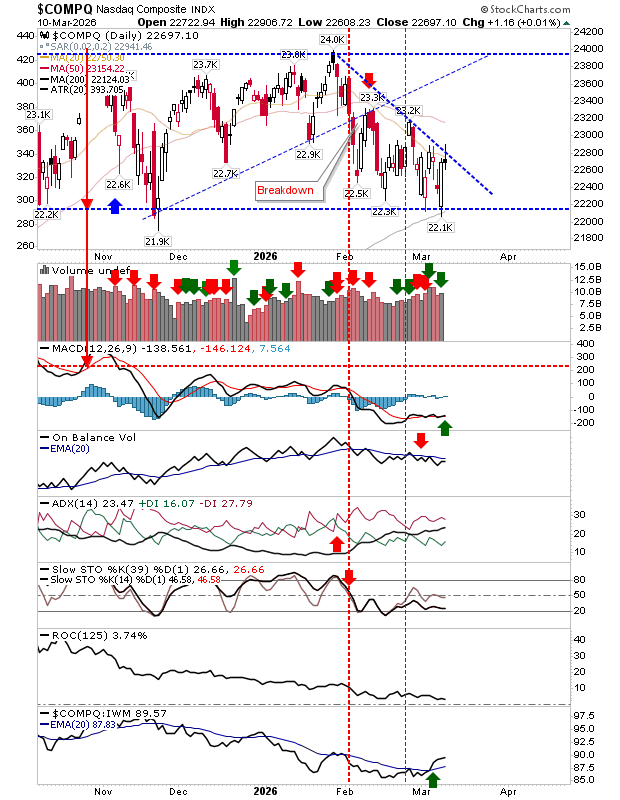
Markets appear to be reflecting the uncertainty surrounding developments in the Middle East, showing the same kind of indecision that currently characterizes the U.S. administration’s approach to the region. While headlines emphasize sharp declines, actual price action has been more mixed. The Nasdaq Composite has been particularly resilient, even as concerns about a potential AI bubble add pressure to the technology sector.
On the technical side, a declining resistance line drawn from January now intersects near Tuesday’s closing level. This area could present a potential short setup, with risk management defined by a stop placed on a close above Tuesday’s sharp spike high.
Although there is a weak buy signal present, several other indicators remain bearish. This cautious outlook persists despite the Nasdaq’s recent surge in relative performance compared with the Russell 2000, often tracked through the iShares Russell 2000 ETF.
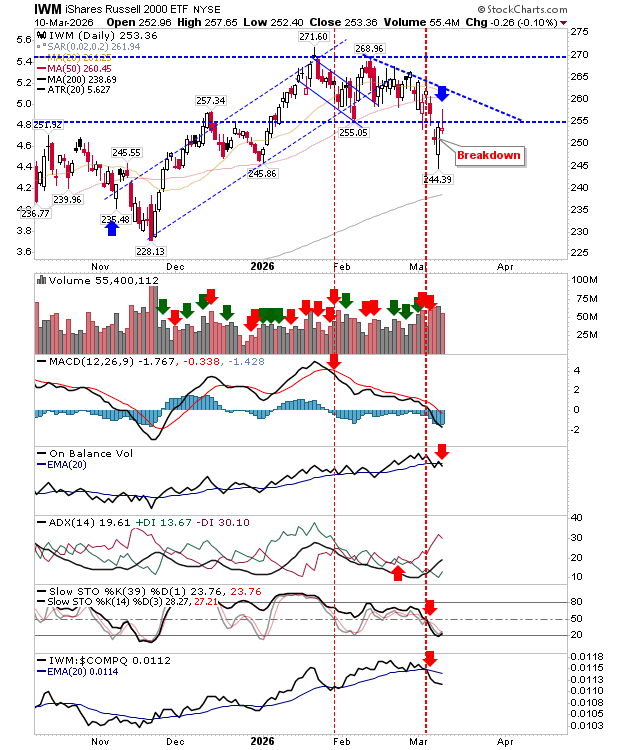
After Monday’s bullish engulfing pattern in the Russell 2000, the market followed with a “gravestone doji” formation, suggesting a potential loss of upward momentum. However, the signal carries somewhat less weight because the index is not currently in overbought territory.
Even so, the pattern may present a shorting opportunity, particularly after the index failed to secure a close above the $255 level. A prudent risk management approach would place stops on a high-volume move above $258.
The iShares Russell 2000 ETF—often used as a trading proxy for the index—could reflect similar technical dynamics as traders watch for confirmation of either renewed weakness or a recovery attempt.
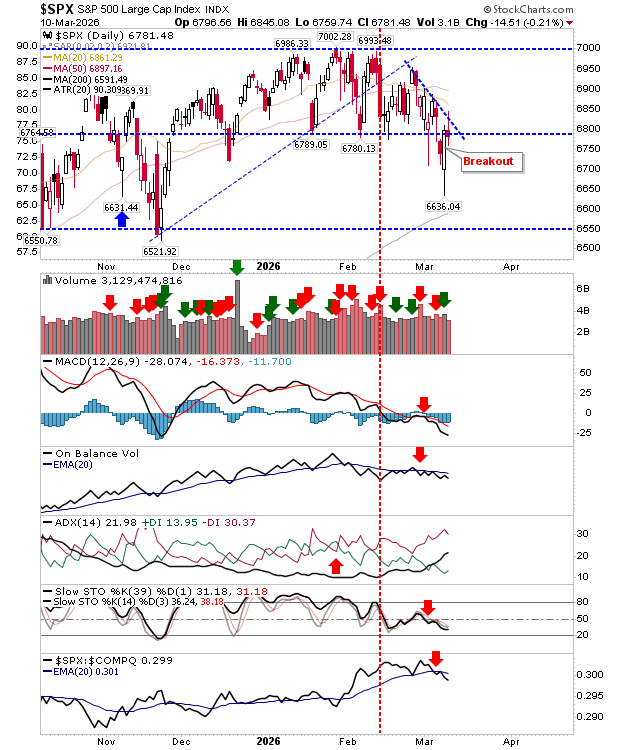
The S&P 500 ended the session with an indecisive spinning top candlestick at what had previously been support but now appears to be acting as resistance. This shift suggests the market is struggling to establish a clear directional bias.
Resistance within the broader trading range is now relatively well defined, and a move back toward Monday’s candlestick range appears possible in the near term. While a deeper pullback toward the 200-day moving average cannot be ruled out, the broader picture points toward the development of a wider consolidation range.
In this evolving structure, 6,550 is emerging as a potential new support level, reinforcing the likelihood that the index may continue trading within an expanded range rather than entering a sustained trend in the immediate term.
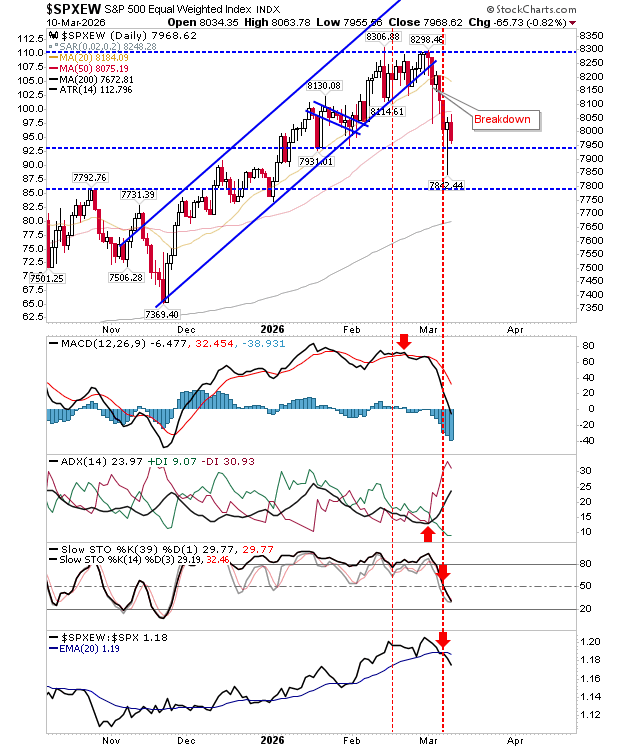
The S&P 500 Equal Weight Index moved close to the 7,800 support level, which could develop into the next key floor for the emerging trading range.
Technical indicators remain broadly negative, although the index has not yet reached oversold territory. A further decline toward the 7,800 level would likely push momentum indicators into an oversold condition, potentially setting up the conditions for a short-term stabilization or rebound.
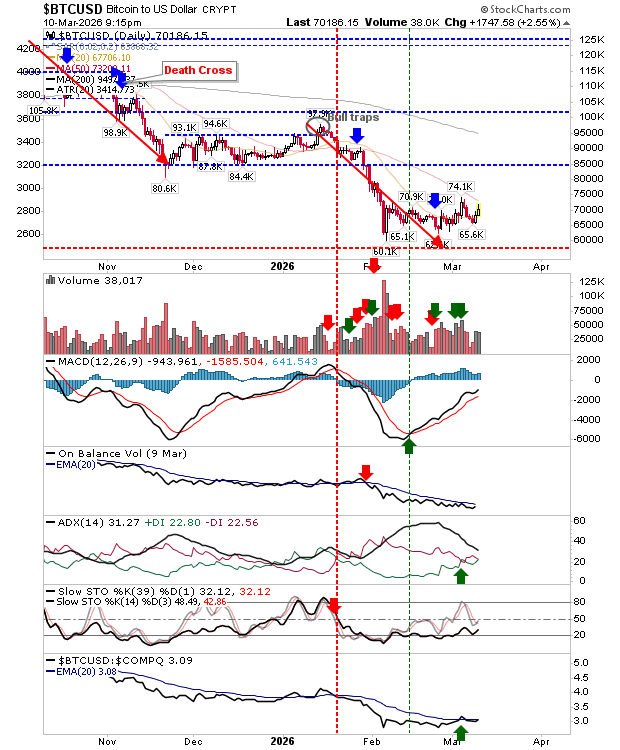
Among potential long opportunities, Bitcoin stands out. What initially appeared to be a potential bull trap is now developing into a test of the 50-day moving average, a level that could determine the next directional move.
If Bitcoin manages to break above this moving average, it could open the path toward the 200-day moving average and potentially a move toward the $85,000 level. While technical signals remain mixed, the MACD has managed to maintain a modest buy signal, suggesting that bullish momentum has not fully faded.
Notably, the cryptocurrency has already fallen roughly 50% from its peak last year. Given the magnitude of that correction, the balance of probabilities may now favor further upside if key technical resistance levels begin to give way.
Traders currently face a mixed set of opportunities across major markets. On one side, several leading equity indices—such as the S&P 500, Nasdaq Composite, and Russell 2000—are presenting potential short setups as technical resistance levels come into play.
On the other side, Bitcoin is shaping up as a possible long trade if it can push through key moving-average resistance and build bullish momentum.
In short, the market currently offers both bearish equity setups and a bullish crypto opportunity—leaving traders to decide which side of the risk spectrum they want to engage.
Sources: Declan Fallon
 THE ETERNAL SOVEREIGN
Leave a comment