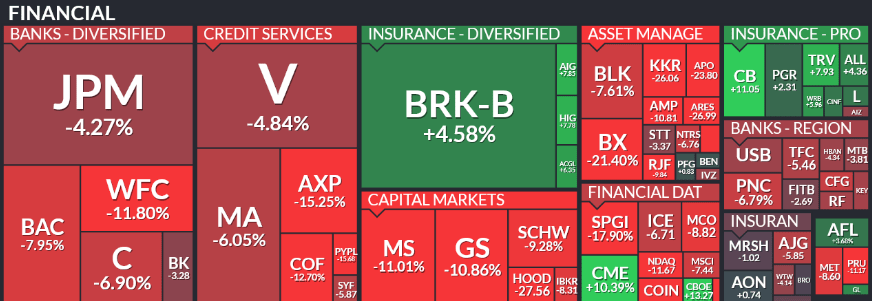
The heatmap below, via Finviz, highlights one-month returns across the S&P 500 financial sector. Notably, Berkshire Hathaway (NYSE: BRK.B) and several insurers have posted gains, while most other financial names have lagged. For comparison, the broader index declined 2.80% over the same stretch. Three key forces appear to be weighing on the group:
Yield Curve Pressure:
Banks typically fund themselves through short-term deposits and CDs while extending longer-term loans. As a result, the slope of the yield curve directly affects net interest margins. Recently, the curve has flattened by roughly 25 basis points, compressing margins and dampening earnings prospects.
Credit Concerns:
As discussed in Monday’s commentary, stress is building in the private credit market due to rising loan losses and potential fraud. Major institutions such as Goldman Sachs and Morgan Stanley are significant participants in that space. Turbulence in private credit is now spilling over into banks and brokers more broadly. At the same time, consumer delinquencies are trending higher, adding to sector-wide risk.
Credit Card Competition:
Payment leaders Visa (NYSE: V) and Mastercard (NYSE: MA), long viewed as possessing durable competitive advantages, are facing mounting competition from lower-cost payment alternatives. Real-time payment rails, account-to-account transfers, and fintech platforms are increasingly bypassing traditional card networks and their interchange fees. Investors are beginning to question the sustainability of their pricing power.
Taken together — margin compression, mounting credit risks, and intensifying payment competition — the financial sector currently lacks a compelling catalyst for sustained outperformance.
Key Things to Monitor Today
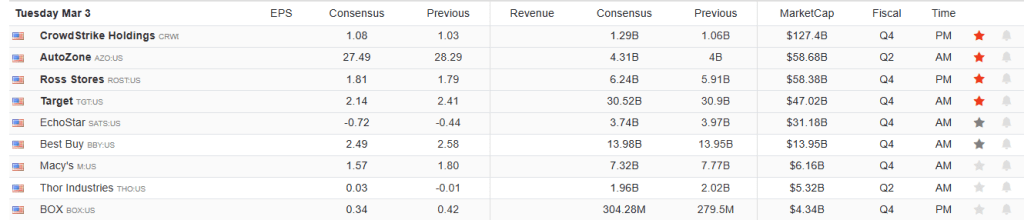
Earnings
Economy
No major economic data releases today.
Financial Stocks Are Losing Momentum
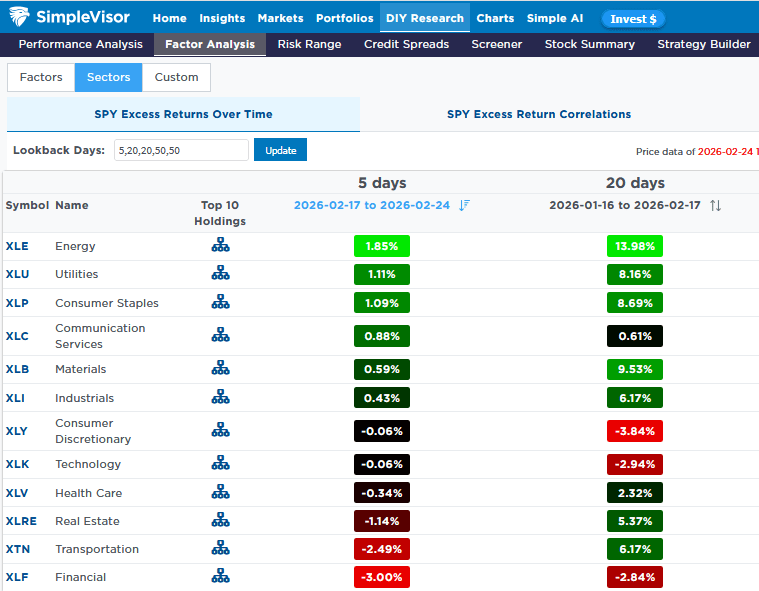
Building on the opening section, the financial sector has been the weakest performer over the past five days. The first chart highlights that it has lagged the S&P 500 by 3.00% during that span, following an additional 2.84% underperformance in the preceding 20-day period.
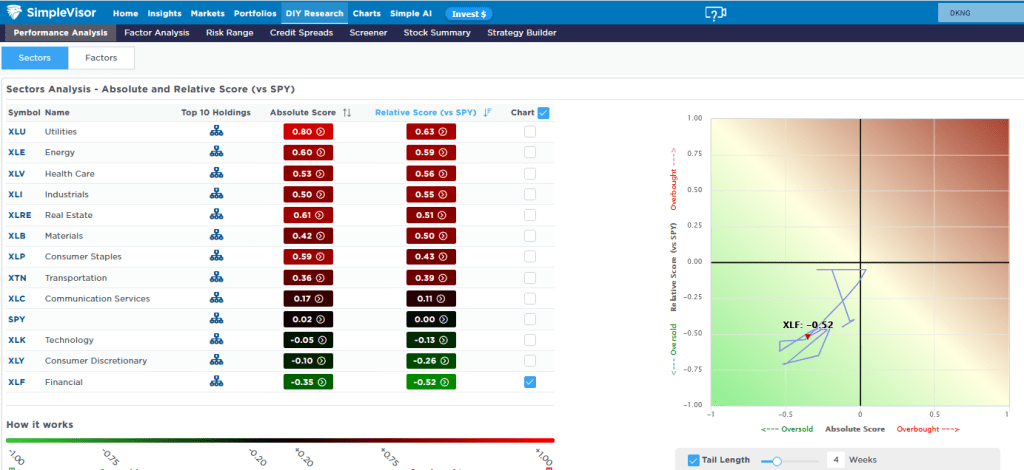
The second chart shows that the Financial Select Sector SPDR Fund (XLF) continues to churn in the lower-left quadrant, indicating that both its absolute technical score and its relative strength versus the S&P 500 remain in oversold territory.
As noted earlier, three primary factors are pressuring the financial sector, and there is no clear near-term fundamental catalyst to shift the tone.
Today’s Tweet Spotlight
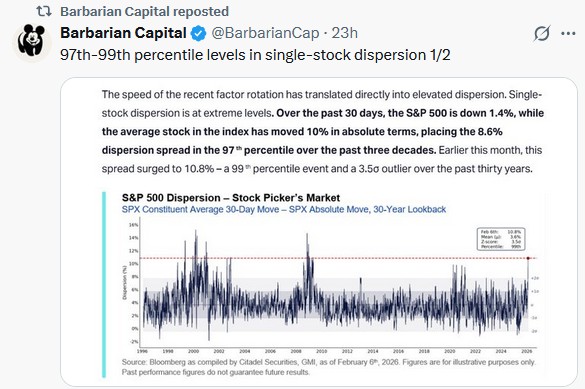
Sources: Michael Lebowitz
 THE ETERNAL SOVEREIGN
Leave a comment