The Reserve Bank of Australia’s board voted on Tuesday to raise the Official Cash Rate by 25 basis points to 3.85% from 3.60% at the conclusion of its February policy meeting, in a move widely anticipated by markets.
Overview of the RBA’s Monetary Policy Statement
The Reserve Bank Board’s policy decision was unanimous. The Board reaffirmed that it will continue to closely monitor incoming data and evolving risks when determining future policy settings.
Although inflation has fallen significantly from its 2022 peak, it rose materially in the second half of 2025. Recent data confirm a renewed strengthening in inflationary pressures, partly reflecting tighter capacity constraints and stronger-than-expected private demand. The Board judged that inflation is likely to remain above the target range for some time and therefore considered an increase in the cash rate target appropriate.

While some of the inflation pickup is expected to be temporary, demand has been growing faster than anticipated and capacity pressures are greater than previously assessed. Labour market conditions remain slightly tight, though they have stabilised in recent months. The Board reiterated its commitment to achieving price stability and full employment and stated it would take whatever action it deems necessary to meet its mandate.
There remains considerable uncertainty around the outlook for domestic activity, inflation, and the degree of monetary policy restrictiveness. The forecasts assume the cash rate rises to 3.9% by June and 4.2% by December, with higher inflation projections extending through to the end of 2027. The assumed policy tightening is expected to help restore balance between demand and supply, although the economy is currently judged to be operating above potential.
Private demand growth was much stronger than expected in late 2025, financial conditions may now be somewhat accommodative, and credit growth has accelerated, with the cash rate sitting below some estimates of neutral. The RBA significantly lifted its forecasts for business investment—partly driven by data centre expansion—as well as government spending and dwelling investment, while noting that some sector-specific demand may not persist.
GDP growth is projected at 2.3% in Q4 2025, slowing to 1.8% in Q4 2026 and 1.6% in Q4 2027. CPI inflation is forecast at 4.2% in Q2 2026, easing to 3.6% by Q4 and returning to around 2.6–2.7% by 2027–28. Trimmed mean inflation follows a similar path. The unemployment rate is expected to gradually rise to 4.3% by Q4 2026 and 4.6% by mid-2028.
Globally, economic growth in 2025 has been stronger than anticipated, with downside risks diminishing.
AUD/USD response to the RBA’s interest rate decision
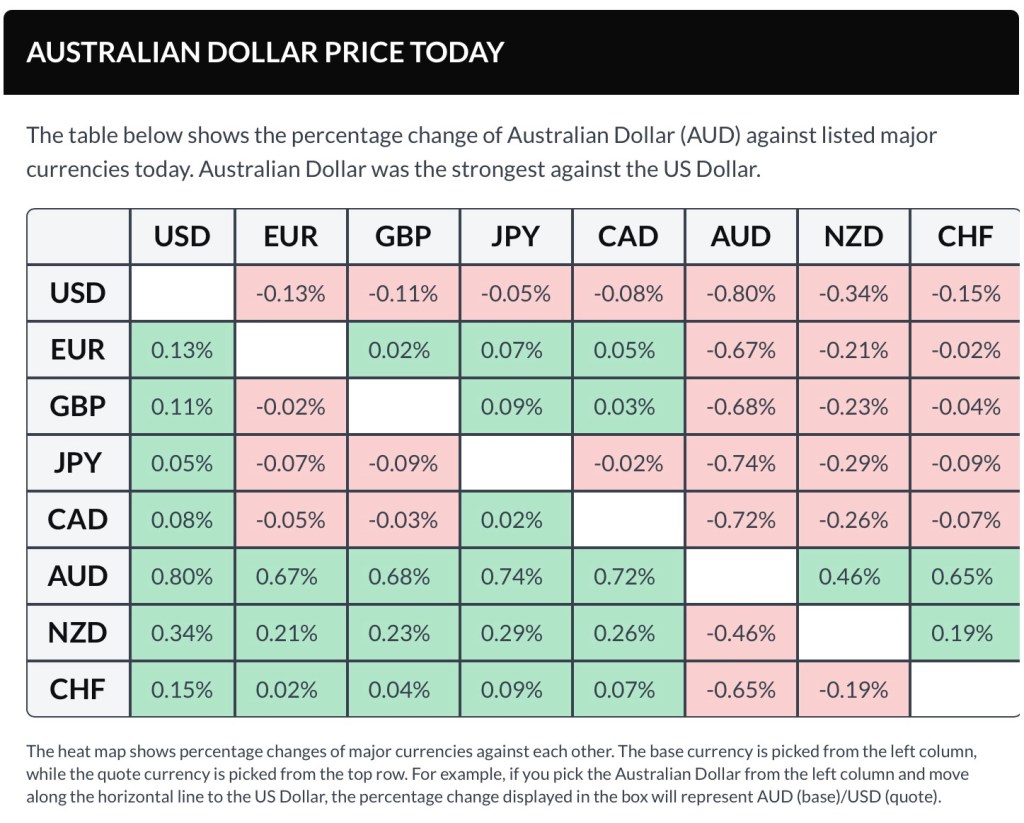
The Australian Dollar attracts renewed buying interest immediately after the RBA’s decision, pushing AUD/USD back above 0.7000. At the time of writing, the pair is up 0.75% on the day.
The following section was published on February 2 at 21:45 GMT as a preview of the Reserve Bank of Australia’s (RBA) policy announcement.
The Reserve Bank of Australia is expected to raise interest rates by 25 basis points to 3.85% in February. Comments from RBA Governor Michele Bullock and updated economic forecasts may provide guidance on the future path of rate hikes. The Australian Dollar is likely to experience heightened volatility around the RBA policy announcement.
The Reserve Bank of Australia is widely anticipated to lift the Official Cash Rate (OCR) from 3.6% to 3.85% following the conclusion of its first monetary policy meeting of 2026.
The decision is scheduled for release at 03:30 GMT on Tuesday, alongside the Monetary Policy Statement (MPS) and quarterly economic forecasts. This will be followed by a press conference with RBA Governor Michele Bullock at 04:30 GMT.
The Australian Dollar is expected to see sharp moves as markets digest the RBA’s policy decision and revised economic outlook.
RBA is set to break the global easing trend
The Reserve Bank of Australia is widely expected to deliver its first interest rate increase in more than two years at its February policy meeting on Tuesday, breaking from the global easing trend as it seeks to rein in mounting inflationary pressures.
Speaking at the press conference following the December policy decision, RBA Governor Michele Bullock stressed the central bank’s commitment to controlling inflation, stating that “the Board will do what it needs to do to get inflation down.” She added that if incoming data showed inflation was not easing, it would be taken into account at the February meeting.
Data released by the Australian Bureau of Statistics (ABS) last Wednesday showed inflation accelerating, with the monthly Consumer Price Index (CPI) rising to 3.8% in December from 3.4% in November, exceeding market expectations of a 3.6% increase.
Core inflation also surprised to the upside, as the trimmed mean CPI — the RBA’s preferred underlying inflation gauge — climbed 0.9% quarter-on-quarter in the fourth quarter, above forecasts of a 0.8% rise.
In response to the stronger inflation data, money markets lifted the implied probability of a February rate hike to 73%, up from 60% previously, according to Reuters.
Australia’s four major banks — ANZ, Westpac, Commonwealth Bank of Australia and National Australia Bank (NAB) — have also revised their outlooks, now expecting a 25-basis-point rate increase from the RBA in February.
Further support for a policy tightening came from the labour market. ABS data released on January 22 showed the unemployment rate unexpectedly falling to 4.1% in December from 4.3%, marking its lowest level since May. Net employment rose sharply by 65.2K after declining by 28.7K in November.
How will the RBA’s decision affect AUD/USD?
The Australian Dollar faces two-way risks against the US Dollar in the run-up to the RBA policy decision.
AUD/USD could end its recent correction and regain upside momentum if Governor Michele Bullock’s remarks and updated economic forecasts indicate that further rate increases remain likely in the months ahead.
On the other hand, the pair may extend its pullback should Governor Bullock temper expectations for additional tightening, particularly if inflation projections appear stable.
Dhwani Mehta, Asian Session Lead Analyst at FXStreet, outlines the key technical levels to watch following the policy announcement.
“AUD/USD is trading below the 0.7000 mark ahead of the RBA rate decision, consolidating after a pullback from a three-year high of 0.7094 reached on Thursday. The 14-day Relative Strength Index (RSI) has retreated from overbought conditions and is now testing the 60 level, indicating that the broader bullish bias remains intact.”
Mehta adds, “The pair could reverse higher and embark on a fresh uptrend toward the 0.7050 psychological level if the RBA delivers a hawkish rate hike. Further resistance is located at the 2026 high of 0.7094, followed by the February 2023 peak at 0.7158. Conversely, a dovish outcome could see AUD/USD probe the 0.6900 region. A decisive break below this area may open the door to further losses toward the 0.6850 psychological level, with the 0.6800 round figure acting as the final support for buyers.”
Sources: Fxstreet
 THE ETERNAL SOVEREIGN
Leave a comment