This move would likely complete a broader irregular expanded flat formation, labeled red W-iv, made up of green waves W-a, W-b, and W-c. These waves collectively form a 3-3-5 structure (gray a, b, c – a, b, c – i, ii, iii, iv, v), unfolding near the 50% retracement level of the entire red W-iii. From this zone, red W-v could begin, with upside potential extending to at least $164K, thereby fulfilling the first condition outlined above.
In our previous update, we highlighted three key observations on Bitcoin (BTC), spanning both long-term and short-term perspectives.
- Bitcoin posted a negative close in 2025, marking a disappointing year for the asset. Still, historical patterns—albeit based on limited data—show that BTC has never finished lower for two years in a row. With 2024 ending in positive territory, this suggests that the period from 2026, and potentially through 2028, could be bullish.
- That said, similar to conditions seen in 2015 and as outlined in earlier analysis, the risk of a deeper pullback cannot be dismissed. Bitcoin may still print a lower low near the upper band of long-term support, around $69K–$73K, before a sustained upside move takes hold.
- To confirm renewed bullish momentum, BTC must break above the December 9 high at $94,617, which would open the door to a potential third wave advance. As a result, bullish warning levels have been revised to $91,483, $90,327, $88,410, $86,704, and $84,424. Each successive break below these thresholds raises the probability by roughly 20% that BTC will revisit the low-to-mid $70K range before attempting another rally.
These observations matter because they provide the framework for both current market behavior and likely future developments. Bringing the analysis up to date, Bitcoin broke above the $94,617 level on January 13, but managed to stay above it for only four days before slipping back to around $88,000. This proved to be a false breakout, invalidating the impulsive path we had been monitoring. At the same time, the third warning level has now been breached, raising the probability to 60% that the broader uptrend has ended. As a result, we have promoted our alternative bearish Elliott Wave count to the primary scenario. See Figure 1 for details.
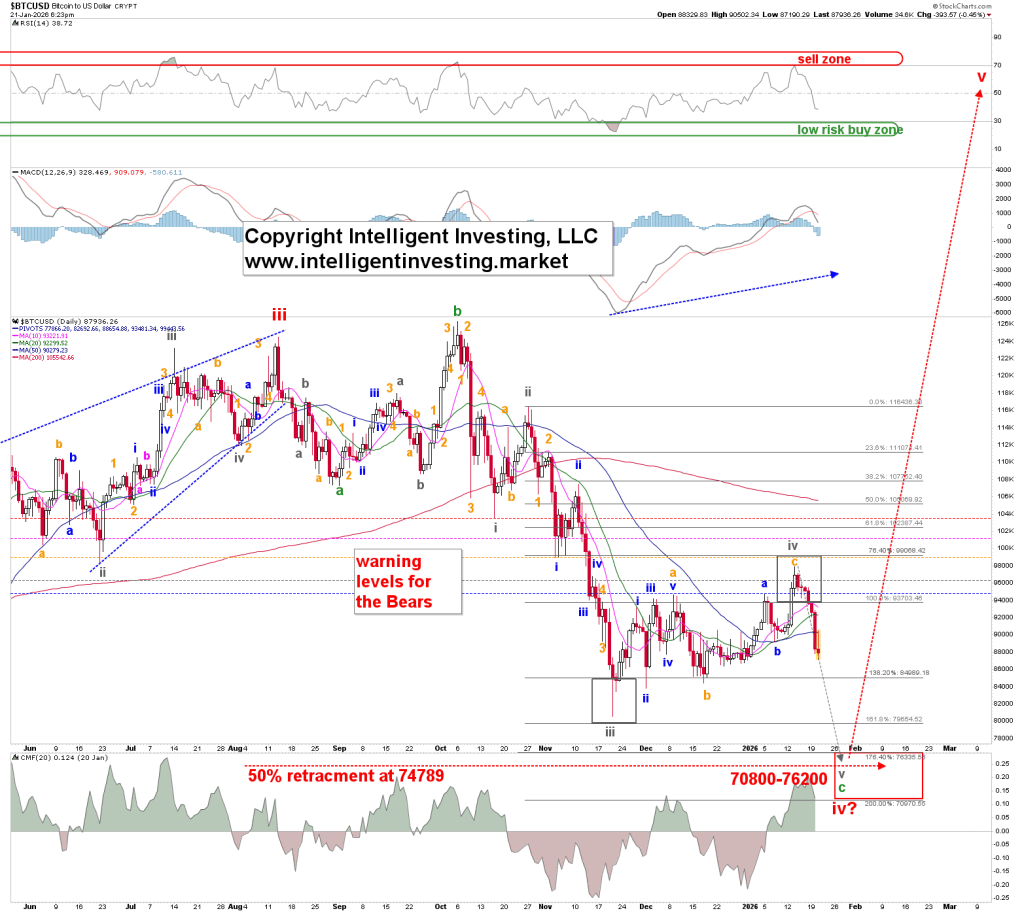
Figure 1. Bitcoin’s intermediate-term Elliott Wave count since June 2025.
The failed breakout strongly points to the January 14 peak at $97,943 as the termination of orange Wave-c within gray W-iv. Notably, Wave-c was nearly equal in length to the same-degree orange Wave-a that topped at $94,617, measuring 13,519 versus 14,055 points—a textbook relationship.
In classical Elliott Wave analysis, a third wave typically extends to the 138.2%–161.8% projection of the first wave, measured from the second wave. On November 21, Bitcoin’s low at $80,562 came close to the 1.618 extension of the gray W-i low from October 17, measured from the gray W-ii high on October 27 at $79,654. Following W-iii, waves W-iv and W-v are expected, with W-iv commonly retracing into the 76.4%–100% extension zone, and W-v subsequently targeting the 176.4%–200.0% extension zone.
The January 14 gray W-iv high occurred almost precisely at the 76.4% level—$97,943 versus a projected $99,068—keeping the structure technically sound. To date, Bitcoin’s price action appears to be unfolding as a downward impulse. In addition, W-ii formed a zigzag while W-iv developed as an expanded flat, satisfying the rule of alternation. Accordingly, provided BTC remains below the January 14 high at $97,943, we anticipate a move toward the 176.4%–200.0% Fibonacci extension area between $76,335 and $70,970 for gray W-v, fulfilling conditions 2) and 3) outlined earlier.
Completion of gray W-v would likely also conclude a broader irregular expanded flat, labeled red W-iv, composed of green waves W-a, W-b, and W-c. Together, these form a 3-3-5 structure (gray a, b, c – a, b, c – i, ii, iii, iv, v), unfolding near the 50% retracement of the entire red W-iii. From that base, red W-v could then begin, with upside potential extending to at least $164K, satisfying condition 1) from the list above.
Sources: Arnout ter Schure
 THE ETERNAL SOVEREIGN
Leave a comment