U.S. employment figures reinforce the Federal Reserve’s cautious stance on monetary policy. Meanwhile, Europe’s economic growth remains sluggish, but policymakers appear comfortable with the current pace. As demand for the U.S. Dollar stays strong, the EUR/USD pair has potential to continue its downward move toward the 1.1470 level.
The EUR/USD pair opened the year on a weak note, declining for the second week in a row to hover near 1.1640, marking its lowest level in a month. The US Dollar gained strength across the foreign exchange market, supported by geopolitical tensions and robust US employment figures.
Geopolitical Unrest Drives Financial Markets Early in 2026
On Saturday morning, the world learned that U.S. President Donald Trump had executed a precise military operation in Venezuela, capturing then-President Nicolás Maduro and his wife, Cilia Flores, and transporting them to the United States to face charges related to narco-terrorism. Delcy Rodriguez, Maduro’s Vice-President, has now taken control of Venezuela. Although there was initial criticism of Trump’s actions, Rodriguez quickly shifted her stance and expressed willingness to cooperate with the U.S.
President Donald Trump did not hide his motives for the U.S. military action in Venezuela. At a press conference following the operation that removed Nicolás Maduro from power, Trump said the United States would exercise control over Venezuela and its oil resources and warned of further measures if the Venezuelan government resisted. He described a future “transition” for the country’s governance, but did not outline specific plans for democracy or civilian rule.

In the days after the raid, international tensions gradually eased, but the situation remained unresolved. One clear strategic factor behind the U.S. intervention was limiting Venezuela’s oil ties with major global powers, including Russia and China — a goal linked to broader geopolitical rivalry.
Meanwhile, Russia carried out a significant missile strike on Ukraine early on Friday, shortly after Ukraine and its European partners agreed on elements of postwar security guarantees. The attack was widely interpreted as Russian President Vladimir Putin challenging Western support for Kyiv and signaling that sanctions, including restrictions on Russian oil, would not deter Moscow’s military actions.
In addition, Trump reignited controversy with comments about Greenland, an autonomous territory of Denmark. He argued that the U.S. needs Greenland for national security reasons and suggested Washington might pursue control of the island — a stance that drew criticism from European leaders and sparked fears of future U.S. territorial ambitions.
Europe Maintains Ongoing Stability
News from Europe has had little impact on the Euro (EUR), which is understandable given the Eurozone’s fragile yet steady stability, with ongoing growth, manageable inflation, and no significant employment concerns.
Eurostat reported that the seasonally adjusted unemployment rate in the Euro area stood at 6.3% in November, slightly down from 6.4% in October 2025 but up from 6.2% in November 2024. The broader EU unemployment rate remained stable at 6.0% in November 2025 compared to October, though it rose from 5.8% a year earlier.
The Hamburg Commercial Bank (HCOB) released the final December figures for the Eurozone’s Services and Composite Purchasing Managers’ Indexes (PMIs). The data showed a twelfth consecutive monthly increase in private sector activity, with the Composite PMI at 51.5, down from 52.8 in November. Services output also declined to 52.4 from 53.6, marking three-month lows for both indicators.
Regarding inflation, Germany’s preliminary December Harmonized Index of Consumer Prices (HICP) increased 2% year-over-year, lower than November’s 2.6% and below the 2.2% forecast. Monthly inflation rose by 0.2%, half the expected 0.4%. The Eurozone’s overall HICP inflation matched expectations at 2% annually, with a 0.2% monthly rise following November’s 0.2% decline.
Germany reported mixed figures for November, with retail sales falling 0.6% while industrial production saw a modest 0.8% increase.
On monetary policy, European Central Bank (ECB) Vice President Luis de Guindos told Bloomberg that current interest rates are appropriate as inflation targets have been met, though uncertainty remains high. This aligns with the ECB’s current stance: pausing rate changes while maintaining vigilance.
U.S. Employment and Economic Growth Update
The U.S. macroeconomic calendar was busy with key data mostly signaling progress. The Institute for Supply Management (ISM) reported December Manufacturing PMIs, showing a contraction in manufacturing output as the index fell to 47.9 from 48.2 in November, below expectations of 48.3. However, the Employment Index improved slightly to 44.9 from 44, while the Prices Paid Index remained steady at 58.5. Meanwhile, the Services PMI rose to 54.4 from 52.6, with the employment sub-index increasing to 52 from 48.9 and the Prices Paid Index easing to 64.3 from 65.4.
The trade deficit narrowed sharply to $59.1 billion in October, down from $78.3 billion, reflecting the impact of Trump’s policies.
Employment data was mostly positive. The ADP report showed private sector job growth of 41,000 in December, a bit below the expected 47,000 but an improvement over November’s revised -29,000. The JOLTS report recorded 7.146 million job openings at November’s end, down from 7.449 million in October. Job cuts announced in December dropped 50% from November to 35,553, the lowest monthly total since July 2024.
The December Nonfarm Payrolls (NFP) report showed 50,000 new jobs added, below the 60,000 forecast, while the unemployment rate fell to 4.4%, better than the anticipated 4.5%. November’s payrolls were revised down to 56,000 from 64,000. This data put some short-term pressure on the USD but did not alter the Federal Reserve’s cautious monetary policy.
The Fed cut interest rates by 25 basis points in December as expected, signaling the possibility of one more cut in 2026—less than markets hope but consistent with a cautious stance focused on employment. Market watchers anticipate at least two rate cuts this year, especially with Chairman Jerome Powell’s term ending in May and a likely replacement aligned with Trump’s preference for more aggressive easing. Still, no immediate Fed action is expected in the first meeting of 2026.
What’s coming up next on the agenda?
In the days ahead, attention will turn to U.S. inflation data, with the December Consumer Price Index (CPI) scheduled for release on Tuesday, followed by the Producer Price Index (PPI) for October and November on Wednesday. November Retail Sales data will also be published on Wednesday. These reports are expected to influence the Federal Reserve’s future policy decisions and, consequently, the direction of the U.S. Dollar.
EUR/USD technical analysis
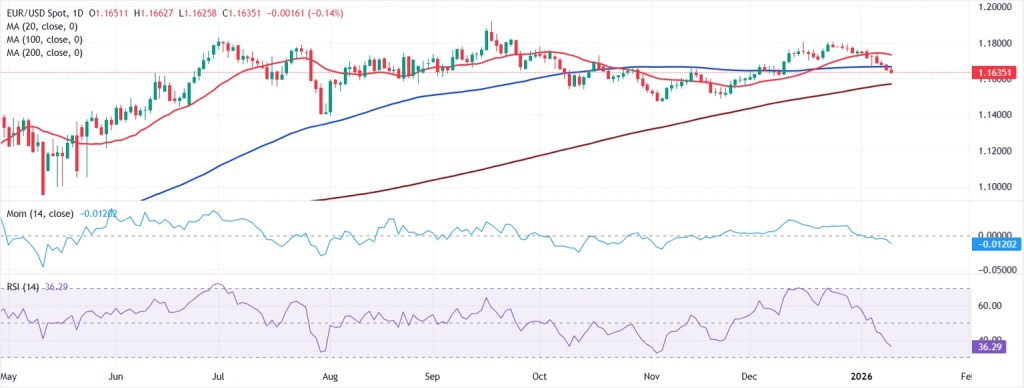
From a technical standpoint, the daily chart shows a bearish outlook for EUR/USD with potential for further decline. The 20-day Simple Moving Average (SMA) is trending downward but still sits above the 100- and 200-day SMAs, indicating weakening short-term momentum. The price remains below the 20-day and 100-day SMAs at 1.1733 and 1.1666 respectively, while the rising 200-day SMA at 1.1571 acts as support. The Momentum indicator has dropped below its midpoint, maintaining strong bearish momentum, and the Relative Strength Index (RSI) is falling toward 36, suggesting lower prices ahead. A close above the 100-day SMA at 1.1666 could relieve some selling pressure and target the 20-day SMA at 1.1733, but failure to break this resistance leaves the pair vulnerable to test the 200-day SMA support at 1.1571.
On a broader scale, the weekly chart also points to continued bearishness. The pair trades beneath the flattened 20-week SMA near 1.1665, with upside limited by this level. The 100- and 200-week SMAs are rising at 1.1085 and 1.0856 but remain far below the current price, so they are less relevant short term. The Momentum indicator on the weekly chart has turned downward but stays within neutral territory, while the RSI is declining around 52.
If the pair falls below the key 1.1600 level, the next significant support lies near 1.1470, a major long-term pivot. Overall, bears will maintain control as long as EUR/USD stays below the 1.1740-1.1750 resistance zone.
Sources: Fxstreet
 THE ETERNAL SOVEREIGN
Leave a comment