Tag: market

  • Why the Next Recession Could Trigger a Depression

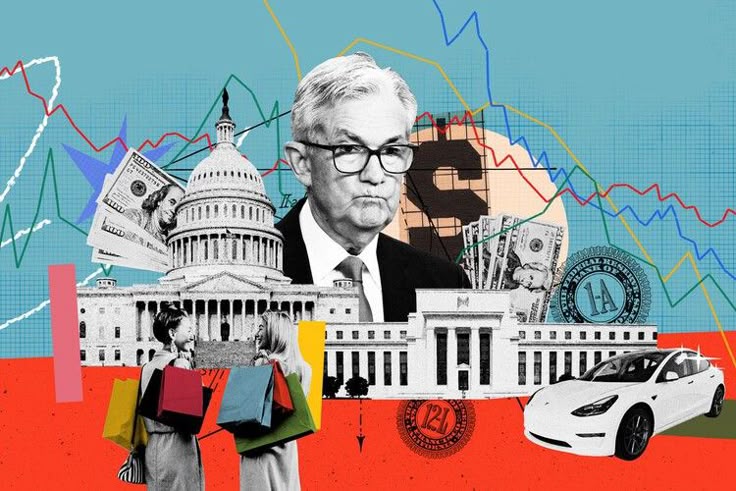
    Narrative control functions by offering ready-made answers to every doubt or challenge. At its core, the prevailing narrative claims that the Federal Reserve and the central government possess sufficient tools to quickly counter any decline in GDP—otherwise known as a recession—and steer the economy back toward growth.

    Implicit in this view is the assumption that recessions are inherently harmful, while uninterrupted expansion is inherently desirable. Few question the fact that this framework departs from true free-market capitalism. Instead, central banking and government intervention are justified as mechanisms to smooth out capitalism’s rough edges through a form of state capitalism—one that can create or borrow as much money as needed to neutralize economic disruptions, including recessions.

    What this narrative leaves out is the role recessions play as a natural and necessary part of market dynamics. Instead, it reduces economic cycles to a simplistic binary: contraction is bad, expansion is good. Yet markets are ultimately driven by human behavior—particularly fear and greed—which express themselves through borrowing and speculation. During periods of confidence, when growth appears limitless, participants take on increasing levels of debt and channel capital into progressively riskier investments in pursuit of higher returns.

    As borrowed funds flow into speculative assets, prices rise, boosting the value of collateral and enabling even more borrowing to finance further speculation. Debt, asset prices, collateral and risk-taking thus reinforce one another, creating the illusion of an endlessly self-sustaining expansion in which everyone appears to grow wealthier.

    However, this layering of debt and paper wealth carries within it two forces that eventually unwind the process: interest and risk. Every loan carries an obligation to pay interest, which compensates lenders for the risks they assume. As overall debt grows—and as investments become more speculative—debt servicing costs increase accordingly, especially for higher-risk borrowers.

    While central banks can attempt to suppress interest rates even as risk rises, their influence is inherently limited. They control only a portion of total outstanding debt and therefore cannot dominate the market entirely.

    Their role in prolonging debt expansion and speculation relies less on absorbing most new debt and more on signaling. By projecting the message that the Federal Reserve will step in to backstop losses, recapitalize lenders, and cap interest rates below market-clearing levels, policymakers encourage continued borrowing and risk-taking. This reinforces the belief that debt and speculation can keep expanding indefinitely.

    Yet signaling alone cannot solve the underlying problem. It does not increase the income required to service growing debt burdens, nor does it ensure speculative investments will deliver returns. These limitations expose the fundamental weakness of the central banking “perpetual motion” model. For most borrowers—both private and public—income does not automatically rise alongside debt. Instead, income depends on market conditions, technological change, government policy, and the broader cycle of credit expansion or contraction.

    At the level of the overall economy, what ultimately matters is total factor productivity and how its gains are distributed among workers, businesses, asset owners, and the state, which extracts revenue from each through taxation. This distribution is not fixed; it shifts with changing social, political, and financial forces.
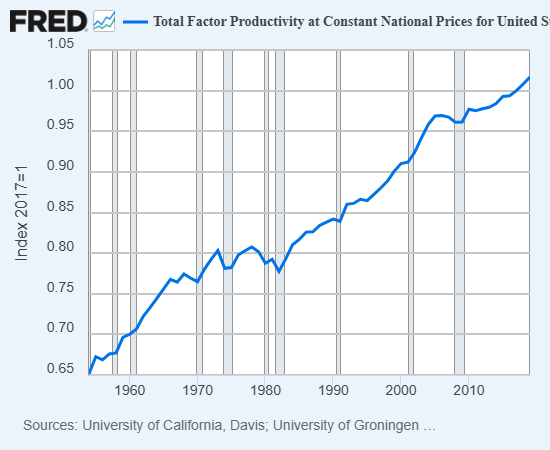
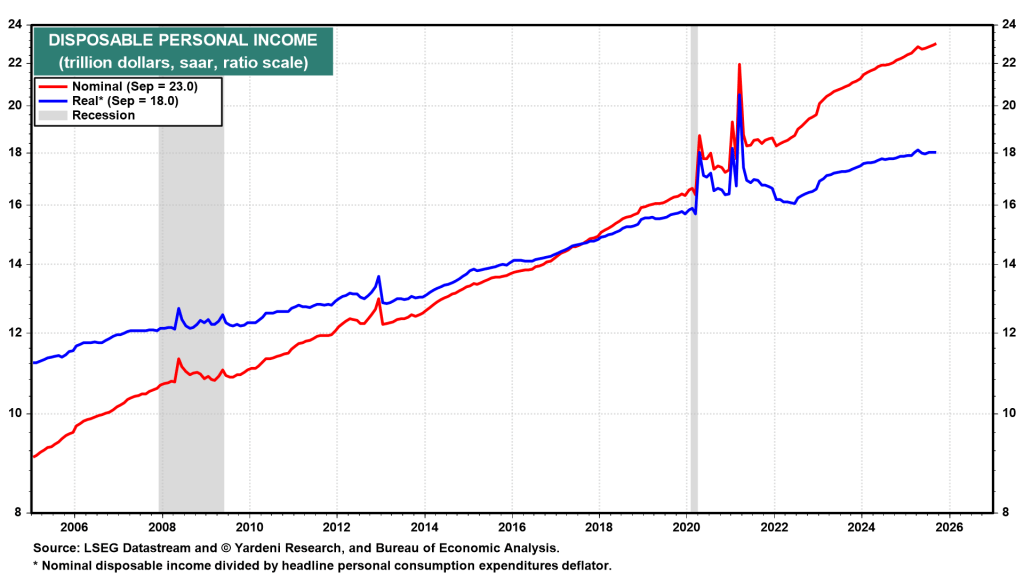
    Over the past five decades, the benefits of productivity growth have increasingly accrued to capital—corporations and asset owners—rather than to workers. As a consequence, households and small businesses are left servicing debt with a diminishing share of overall economic income. This imbalance makes additional borrowing progressively more hazardous for both borrowers and lenders alike.
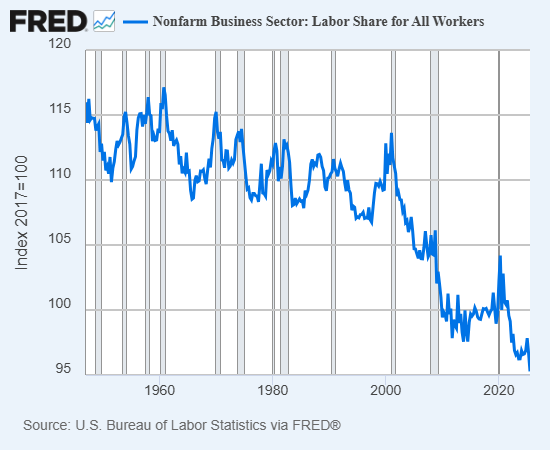
    As a growing share of economic output accrues to corporations and asset owners, their collateral values, income streams, and perceived creditworthiness strengthen. This allows them to borrow larger sums at lower interest rates than wage earners and small businesses. Greater access to cheap credit enables further asset accumulation, which in turn generates additional income—creating a self-reinforcing cycle.

    This dynamic sits at the heart of widening wealth and income inequality. Those at the top grow richer not simply because they earn more, but because they can finance income-producing assets at costs far below those faced by workers. Unlike wages, income derived from assets tends to rise alongside asset values, which can be leveraged as collateral to support even more borrowing.

    At a deeper structural level, the system becomes unstable once economic growth fails to raise household incomes enough to support higher debt servicing. The entire framework of expanding credit, collateral, and speculation then comes under strain. Asset-driven income ultimately depends on one or more of three forces: continued credit expansion, increased risk-taking in financial markets, or sustained consumer spending. These forces are tightly linked, as any slowdown in borrowing, investing, or spending eventually undermines the ability to service debt and brings the credit cycle to a halt.

    Because debt inherently carries default risk, an economic model reliant on ever-expanding borrowing also amplifies systemic vulnerability—particularly when household incomes stagnate while debt levels and interest obligations continue to rise.

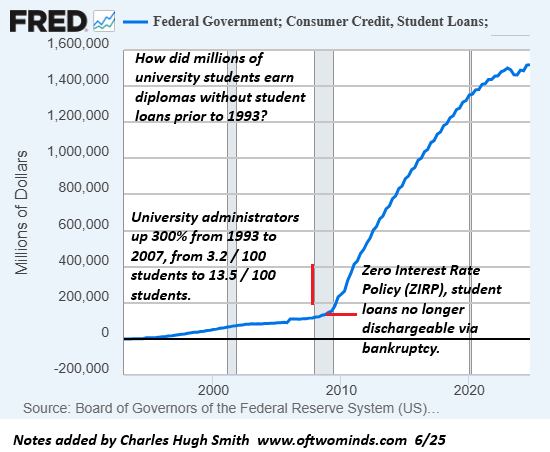
    With the share of output flowing to wages declining for decades, households have increasingly relied on borrowing to sustain consumption. Before the 2000s, student debt was relatively limited; today it totals trillions of dollars. Auto loans and credit card balances have also surged, alongside less visible forms of leverage such as installment-based financing and other shadow-banking channels that are often underreported.
    Speculative investments carry intrinsic risk, as there is no guarantee they will generate returns. When such speculation is financed through borrowing, failure does not only harm the investor—it also inflicts losses on the lender, as both sides are exposed when the bet collapses.

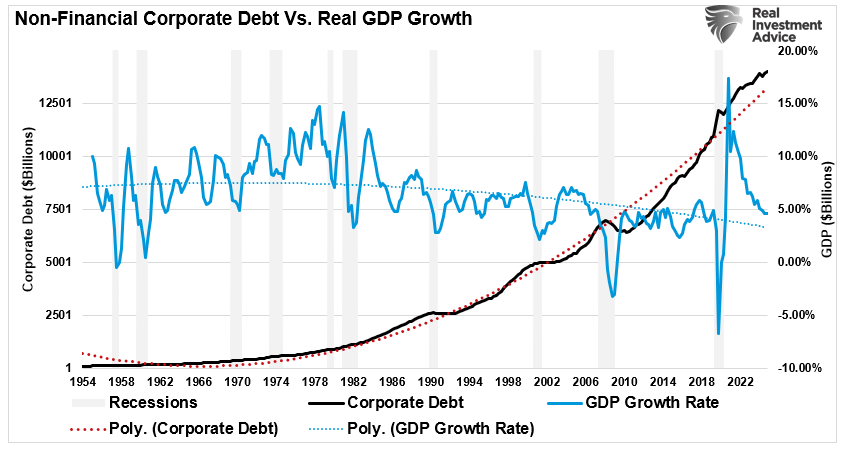
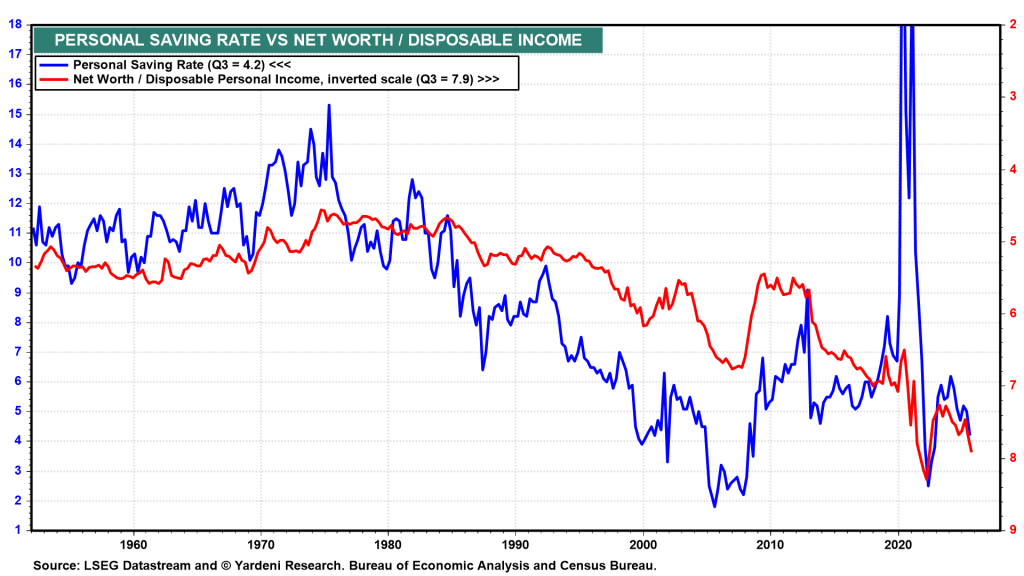
    Taken together, stagnant income growth, rising reliance on debt to sustain consumption, and increasingly risky, debt-backed speculation have produced an economy dependent on credit-driven asset bubbles. Growth now hinges on the continual expansion of debt to support spending and fuel speculative activity that inflates asset prices, thereby boosting collateral values and enabling even more borrowing.
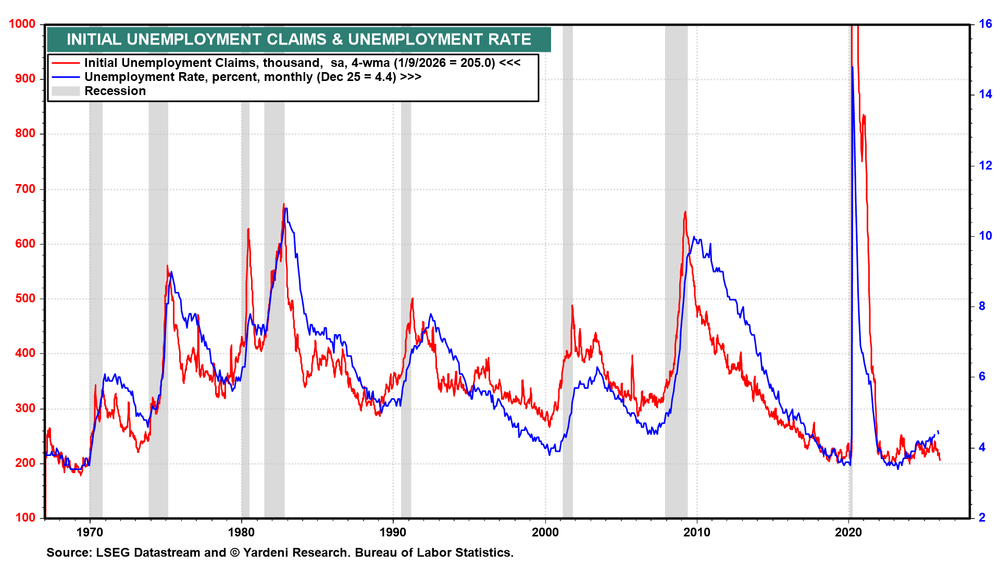
    When income growth can no longer keep pace with rising debt obligations, defaults begin to ripple through the system. Households fall behind on rent, auto loans, student debt, credit cards, and mortgages, triggering a collapse in consumer spending. The resulting strain spreads to lenders and employers, who respond by tightening credit, cutting back borrowing, and laying off workers—further eroding income across the economy.

    Speculative investments that appeared viable during the expansion unravel as credit conditions tighten. Lenders withdraw from riskier loans, household demand dries up, and asset prices fall as investors rush to sell risk assets in order to raise cash and reduce leverage. Collateral values deteriorate rapidly, amplifying losses.

    Economies dependent on credit-fueled asset bubbles function as tightly interconnected systems. Any decline in income or asset prices, any increase in interest rates, any reduction in available credit, or any erosion of collateral feeds back into the broader structure. These shocks reinforce one another, creating a downward spiral marked by defaults, layoffs, and falling valuations.

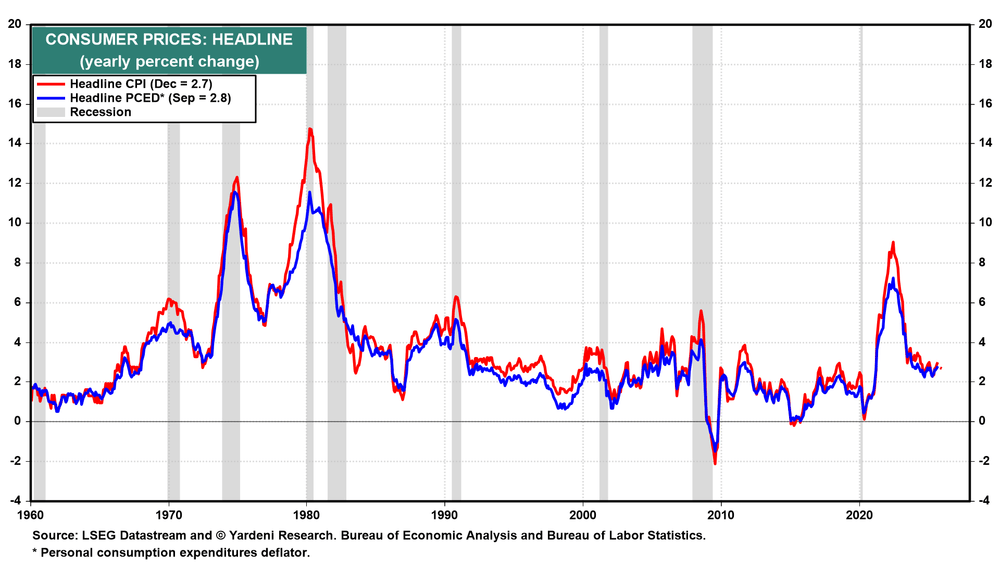
    In an economy already saturated with debt, policy stimulus no longer produces real growth; instead, it fuels inflation, which constrains central banks’ ability to respond. Once markets lose confidence in the belief that policymakers will always step in to backstop losses, both speculation and the borrowing that sustained it begin to dry up. As the flow of new, credit-funded investment slows, asset prices enter a self-reinforcing decline.

    In a credit-asset-bubble-dependent system, this inevitable unwinding is often perceived not as a structural outcome, but as a sudden and unforeseen crisis.
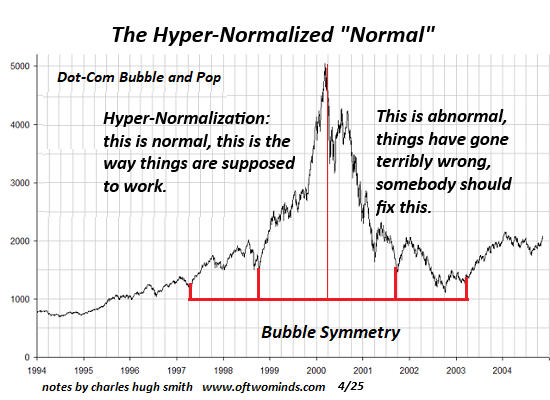
    In an economic system that permits recessions to purge unsustainable debt and excess speculation, the bursting of credit-driven asset bubbles is seen as a natural and unavoidable process rather than an aberration.
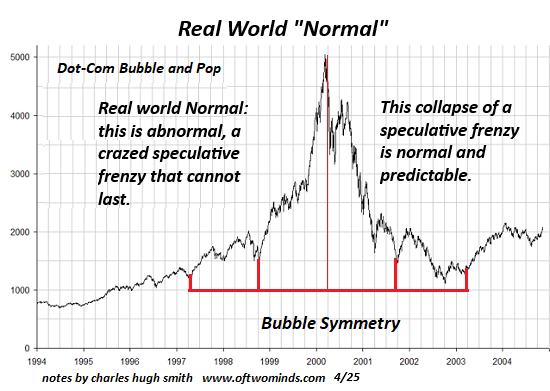
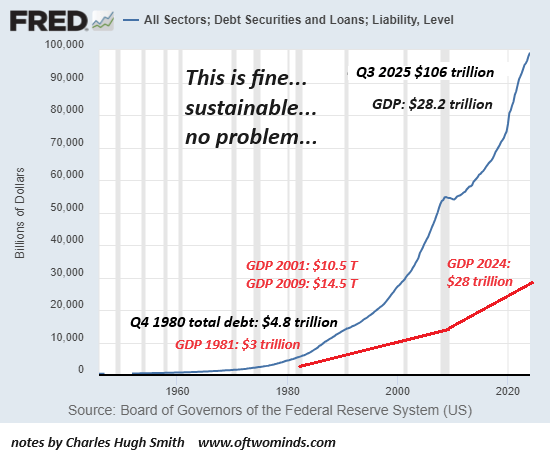
    Few recognize two critical realities: first, the last true recession that meaningfully purged excess debt, leverage, and speculation occurred in 1980–82—more than four decades ago; second, the shock absorbers that enabled recovery back then no longer exist. In 1980, total debt stood at roughly 150% of GDP. Today, it is closer to three times GDP. This makes debt-driven expansion unworkable: borrowers are already struggling to service existing obligations, let alone take on more.

    Nor can the Federal Reserve rescue the system simply by cutting rates to zero. The Fed holds only a small fraction of the roughly $106 trillion in outstanding debt; its primary influence is psychological, signaling that risk is low. In reality, risk continues to rise as debt burdens, interest costs, leverage, and speculation compound.

    A repeat of the 2008-style bailout is equally implausible. Then, the system was stabilized by recapitalizing the financial sector—the engine of new credit creation. Today, however, the economy is saturated with debt, incomes have stagnated, and borrowers lack the capacity to sustain additional leverage. Meanwhile, housing and financial asset bubbles have expanded to historically fragile extremes.

    This is why a recession that finally cleanses excess debt and speculation would leave behind an economy unable to rebound. The current system depends entirely on debt, leverage, and speculative excess not just for growth, but for basic stability. Once that structure collapses—as all bubbles eventually do—the confidence, signaling, and perceived wealth that sustained it will vanish as well.

    Proposals to “save” the system by shifting fiat money into gold or cryptocurrencies offer no escape. The debt itself—and the income required to service it—would also be carried over, leaving the underlying dynamics unchanged. The collapse of credit-driven asset bubbles, and the economic activity built upon them, would still unfold.

    For this reason, the next recession is likely to trigger a full-scale breakdown of a credit-asset-bubble-dependent economy. While policymakers may attempt to reflate another bubble as a solution, such an approach will no longer be sustainable. A durable recovery would instead require restructuring the economy around real productivity gains that are broadly shared, rather than concentrated among asset holders.

    This transition will be slow and painful. Those who benefited most from the bubble economy will resist losing both extraordinary returns and their disproportionate share of gains. Yet neither can be preserved. The adjustment will demand time, sacrifice, and large, long-term investment in genuinely productive assets.

    Ultimately, the systemic risks embedded in a credit-asset-bubble economy cannot be eliminated—only disguised or shifted elsewhere. These temporary fixes allow the bubble to grow larger, but the cost is borne by society at large when the system’s internal dynamics inevitably bring it crashing down.

    Sources: Charles Hugh Smith
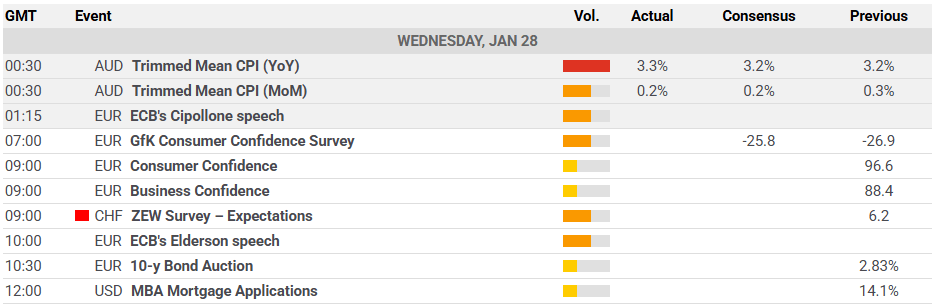
  • EUR/USD remains on course toward 1.2000

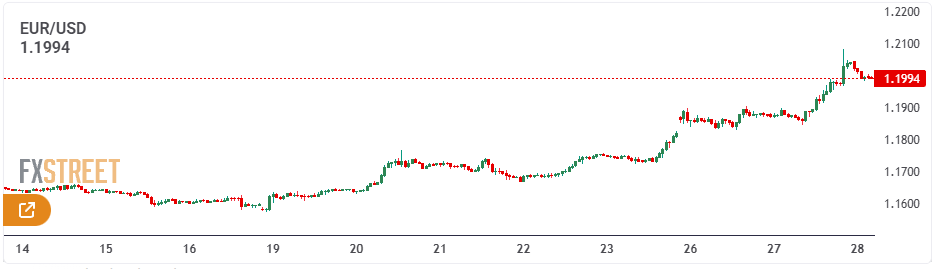
    EUR/USD extended Monday’s positive momentum, pushing closer to the key 1.2000 level and reaching highs not seen since June 2021. The latest advance reflects continued selling pressure on the U.S. dollar, supported by a constructive risk backdrop and renewed investor focus on potential tariff-related risks stemming from the White House.

    Macro & Fundamental Overview

    EUR/USD’s bullish momentum remains firmly intact, closely mirroring persistent selling pressure on the U.S. dollar, which continues to be weighed down by concerns over trade policy, questions surrounding the Federal Reserve’s independence, and renewed shutdown risks.

    The pair extended its advance for a fourth straight session on Tuesday, edging closer to the pivotal 1.2000 level for the first time since June 2021.

    The latest leg higher reflects a further deterioration in the dollar’s outlook amid revived trade tensions and geopolitical uncertainty, all ahead of the Federal Reserve’s interest rate decision due on Wednesday.

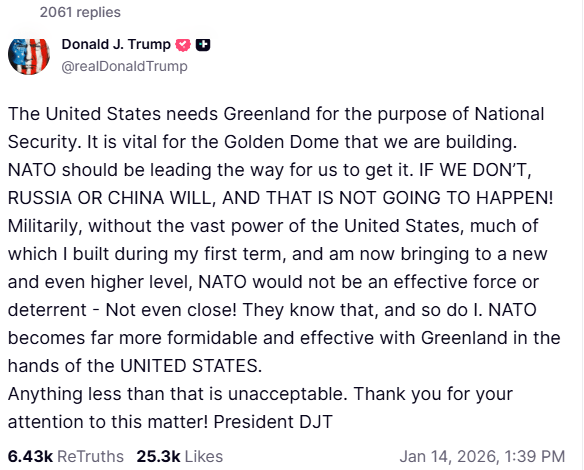
    Meanwhile, sentiment surrounding U.S.–European Union trade relations has improved after President Donald Trump softened his rhetoric last week regarding potential tariffs tied to the Greenland dispute. Markets have interpreted this shift positively, boosting risk appetite and lending support to the euro alongside other risk-sensitive currencies.

    By contrast, the U.S. dollar continues to underperform. The Dollar Index (DXY) remains under heavy pressure, extending its decline toward the 96.00 area — levels last seen in late February 2022.

    The FED: Rates on hold, politics in focus

    The Federal Reserve delivered its widely anticipated December rate cut, but the key signal came from its messaging rather than the policy action itself. A divided vote and Chair Jerome Powell’s measured language suggested that additional easing is far from assured.

    The Fed begins its two-day policy meeting today, with markets largely expecting rates to remain unchanged when the decision is released on Wednesday.
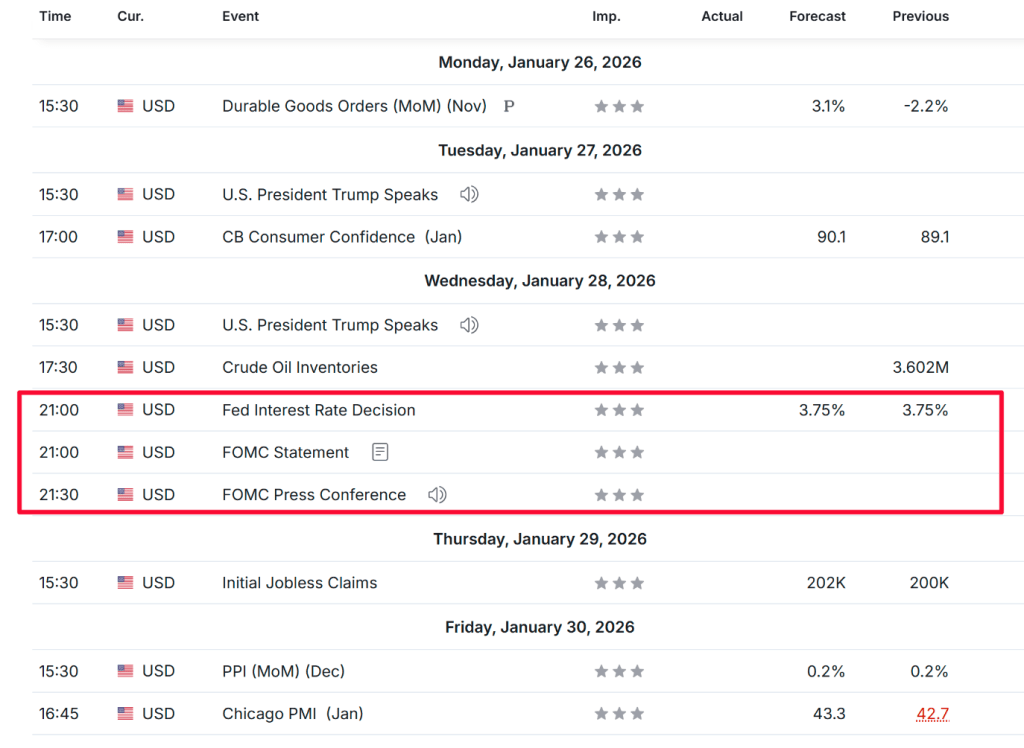
    However, monetary policy may not be the primary focus this time. Market attention has increasingly turned to questions surrounding the Fed’s independence after reports earlier this month of a Justice Department investigation involving Chair Powell.
    Compounding the uncertainty, President Trump has indicated that an announcement on his nominee for the next Fed Chair could be imminent, keeping scrutiny on the central bank well beyond the outcome of this week’s meeting.

    ECB urges patience, not complacency

    The European Central Bank left interest rates unchanged at its December 18 meeting, adopting a more measured and patient tone that has pushed expectations for near-term rate cuts further into the future. Modest upward revisions to growth and inflation projections helped underpin this approach.
    Minutes from the meeting, released last week, showed policymakers saw little immediate need to adjust policy. With inflation hovering near target, the ECB has room to remain patient, while still retaining flexibility should risks materialize.
    Governing Council members emphasized that patience does not equate to complacency. Monetary policy is viewed as appropriately calibrated for now, but not on autopilot. Markets appear to have absorbed this message, currently pricing in just over 4 basis points of easing over the coming year.

    Positioning remains constructive, but confidence has softened

    Speculative positioning remains tilted toward the euro, although bullish conviction appears to be easing.

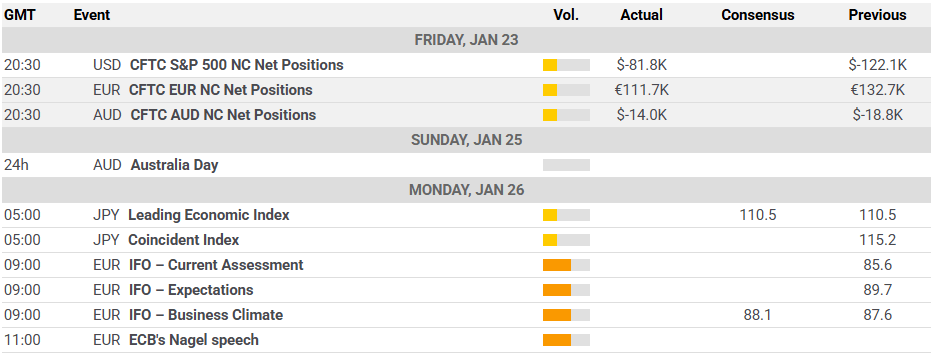
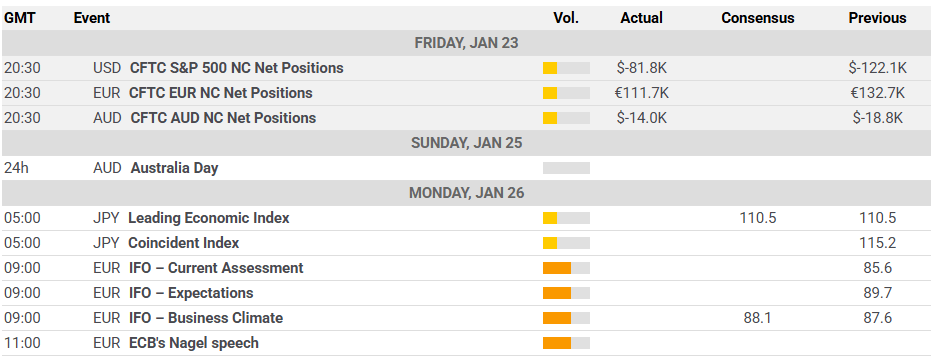
    CFTC data for the week ended January 20 show non-commercial net long positions declining to a seven-week low of around 111.7K contracts. At the same time, institutional participants also reduced short positions, which now stand near 155.6K contracts.

    Meanwhile, open interest slipped to approximately 881K contracts, breaking a three-week streak of increases and suggesting that market participation may be thinning alongside fading confidence.

    Key Events Ahead

    Near term: The FOMC meeting is set to keep attention firmly on the U.S. dollar, while flash inflation data from Germany and preliminary GDP readings for the euro area will dominate the regional data calendar later in the week.

    Risk: A more hawkish-than-expected outcome from the Fed could quickly tilt momentum back in favor of the dollar. In addition, a clear break below the 200-day simple moving average would increase the risk of a deeper medium-term correction.

    EUR/USD Technical Outlook

    EUR/USD continues to exhibit a firm bullish bias, trading at levels last seen in mid-2021 while gradually shifting focus toward the key 1.2000 psychological handle.

    On the downside, initial support is located at the 2026 low of 1.1576 (January 19), reinforced by the closely watched 200-day simple moving average. A more pronounced correction could open the door to the November 2025 trough at 1.1468, followed by the August base at 1.1391.

    Momentum indicators remain broadly supportive of further gains, although elevated conditions may challenge the immediate upside. The Relative Strength Index is hovering near 75, pointing to overbought territory, while an Average Directional Index reading above 26 confirms the presence of a well-established trend.

    Bottom Line

    For the time being, EUR/USD continues to be influenced primarily by U.S.-centric developments rather than euro area dynamics.

    Absent clearer signals from the Federal Reserve on the extent of potential policy easing, or a more compelling cyclical recovery in the eurozone, any additional upside is likely to unfold in a steady, incremental manner rather than marking the beginning of a decisive breakout.

    Sources: Fxstreet

  • Gold hits new record above $5,200 as Fed decision looms

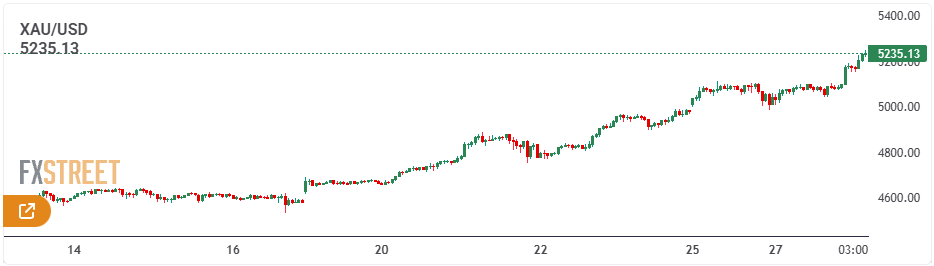
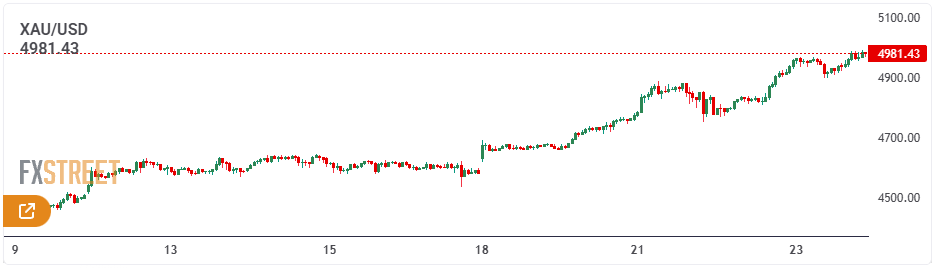
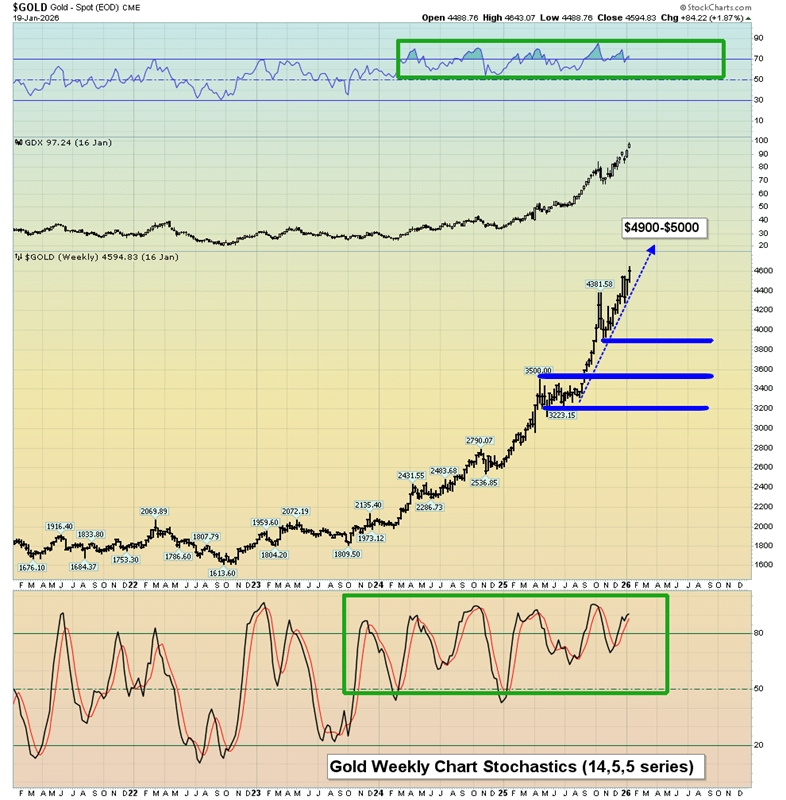
    Gold prices climbed toward a fresh record near $5,220 during Asian trading on Wednesday, extending gains on a weaker U.S. dollar, persistent geopolitical tensions and ongoing economic uncertainty. Investors are now awaiting the Federal Reserve’s interest rate decision later in the day for further direction.

    Fundamental Analysis Overview

    Expectations of further policy easing by the U.S. Federal Reserve, persistent selling pressure on the U.S. dollar, continued central bank purchases, and record inflows into exchange-traded funds have provided strong support for gold prices.

    Although U.S. President Donald Trump stepped back from a tariff threat after saying a framework agreement had been reached on a future Greenland deal with NATO, the brief episode raised concerns about the reliability of global alliances. These doubts, combined with the prolonged Russia–Ukraine conflict, continue to fuel safe-haven demand for gold. Russia launched another large-scale drone and missile assault on Ukraine during the second day of U.S.-mediated peace talks in Abu Dhabi over the weekend, which concluded without an agreement. While trilateral discussions are set to resume on February 1, expectations for a breakthrough in the nearly four-year conflict remain low, keeping geopolitical risks elevated.

    Further weighing on market sentiment, Trump warned on Saturday that the U.S. could impose a 100% tariff on Canada should it proceed with a trade agreement with China. The possibility of renewed tensions over Greenland and other unpredictable policy moves from the Trump administration has undermined confidence in the U.S. dollar. As a result, the Dollar Index (DXY) has fallen to its lowest level since September 2025, pressured further by market expectations that the Fed could cut rates twice more in 2025. This environment continues to favor non-yielding assets such as gold, particularly as attention turns to the two-day FOMC meeting that began on Tuesday.

    The Federal Reserve is set to announce its policy decision on Wednesday and is widely expected to keep interest rates unchanged. As such, investor focus will center on the accompanying statement and Fed Chair Jerome Powell’s press conference for signals on the future policy path. Any guidance on the timing and pace of potential rate cuts will be critical in shaping near-term dollar movements and determining gold’s next directional move. In the shorter term, U.S. Durable Goods Orders data due later Monday could generate trading opportunities during the North American session.

    On the demand side, the People’s Bank of China extended its gold-buying streak for a fourteenth consecutive month in December. Other emerging market central banks, including those of Poland, India, and Brazil, were also active buyers in late 2025 and early 2026. Meanwhile, global investment demand through gold ETFs rose 25% in 2025, with total holdings increasing to 4,025.4 tonnes from 3,224.2 tonnes a year earlier. Assets under management climbed to $558.9 billion, reinforcing gold’s bullish case and supporting expectations for a continuation of the well-established uptrend amid a favorable fundamental backdrop.

    XAU/USD Technical Outlook

    The rising channel originating from $4,464.07 continues to support the broader uptrend, with upside currently constrained near $5,101.21. The MACD remains in positive territory, although the histogram is starting to narrow, indicating fading momentum even as the MACD line stays above the signal line. Meanwhile, the RSI is elevated around 78, signaling overbought conditions that may limit near-term gains and favor consolidation near the upper boundary of the channel.

    Should prices fail to break decisively above the channel top, a corrective move toward support at $4,934.92 could develop. Further contraction in the MACD histogram would strengthen the case for a pullback, while a downturn in the RSI from overbought levels would point to mean reversion within the channel. On the other hand, if bullish momentum persists and MACD remains supportive, the prevailing uptrend would stay intact, maintaining the upside bias defined by the ascending channel.

    Sources: Fxstreet

  • Gold surges to a record above $5,200 an ounce as safe-haven demand rises and the dollar weakens

    Gold prices climbed to a record above $5,200 an ounce on Wednesday, supported by robust safe-haven demand and persistent weakness in the U.S. dollar. Other precious metals also stayed firm, with silver and platinum trading near recent record highs.

    Spot gold edged lower to $5,179.41 an ounce by 19:55 ET (00:55 GMT) after briefly touching a record peak of $5,202.06. Meanwhile, April gold futures jumped 1.8% to $5,215.46 an ounce.

    Safe-haven demand remained strong after U.S. President Donald Trump said a second armada was heading toward Iran, while expressing hope that Tehran would agree to a deal with Washington.

    Gold’s rally this year has been largely driven by uncertainty surrounding U.S. policy, with heightened geopolitical tensions fueled by developments in Venezuela and a dispute over Greenland.

    A weaker dollar also provided support to gold and broader metals markets, as investor concerns grew over elevated fiscal spending and the Federal Reserve’s independence under the Trump administration. Policy uncertainty pushed the dollar to multi-year lows earlier this week.

    Trump said on Tuesday that he was close to naming a successor to Fed Chair Jerome Powell, adding that interest rates would decline under new leadership. Ongoing friction between the White House and the Federal Reserve has further underpinned gold prices, as markets remain wary of political pressure on the central bank.

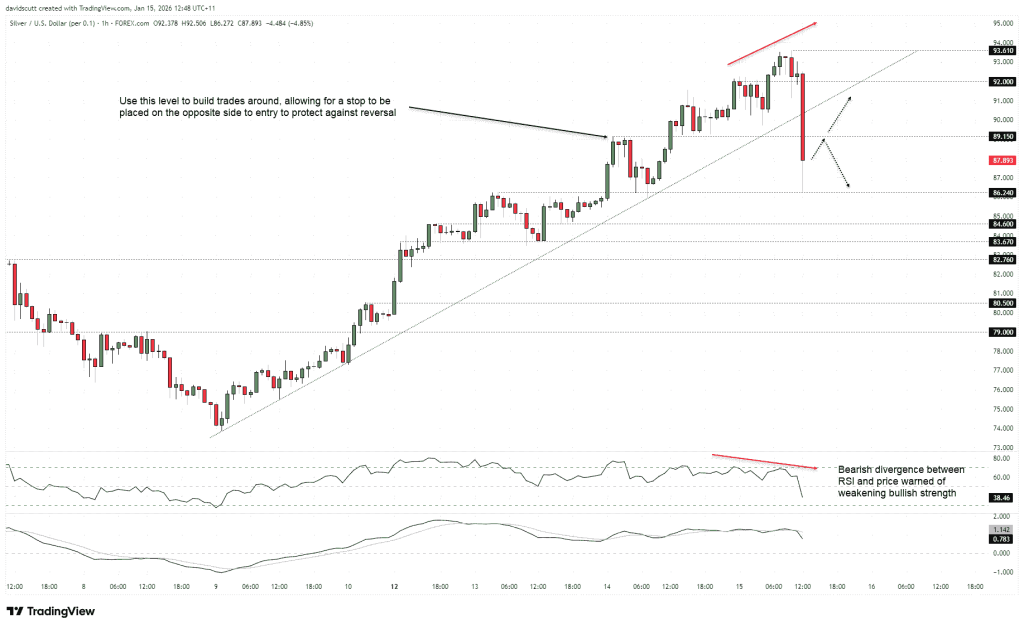
    Elsewhere in metals markets, spot silver gained 1.2% to $113.4325 an ounce, while spot platinum climbed 0.6% to $2,669.61. Both were trading near record levels.

    Sources: Investing

  • US futures stayed stable with attention focused on the Federal Reserve meeting and earnings reports from megacap firms

    U.S. stock index futures were largely unchanged late Tuesday as investors remained cautious ahead of the Federal Reserve’s interest rate decision and a busy earnings schedule featuring major technology leaders.

    S&P 500 futures edged up 0.1% to 7,017.50, while Nasdaq 100 futures rose 0.3% to 26,155.75 by 20:10 ET (00:10 GMT). Dow Jones futures were flat at 49,154.0.

    S&P 500 closes at a record as Dow edges lower on Medicare concerns

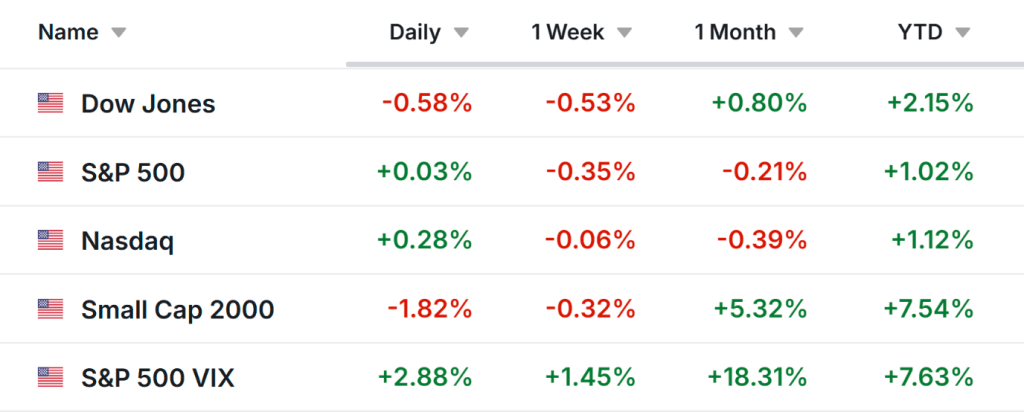
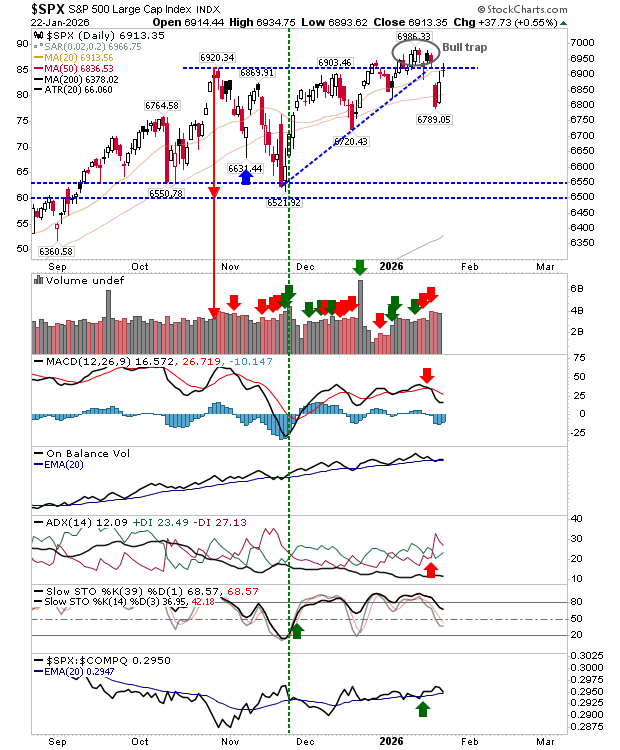
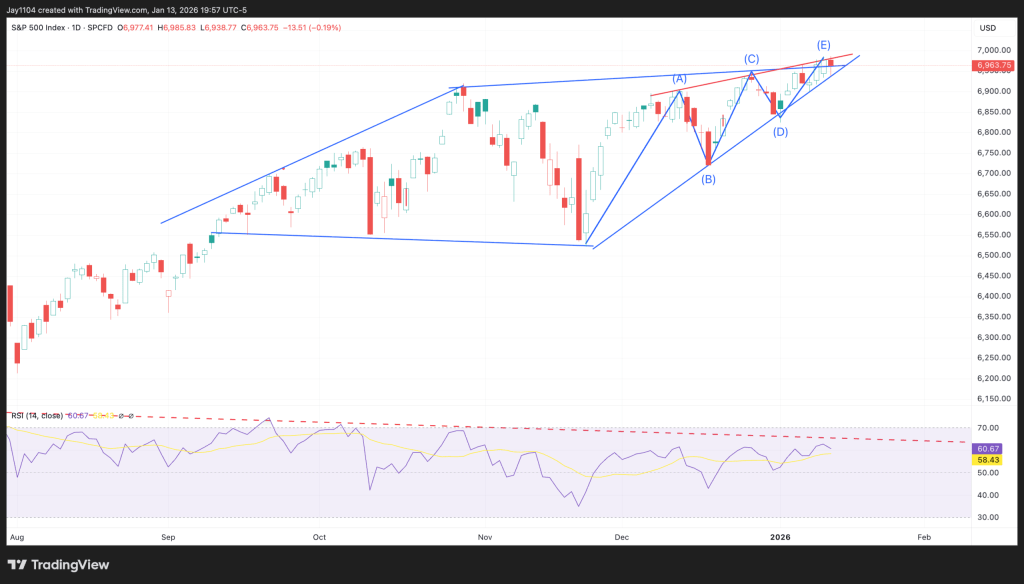
    During Tuesday’s regular session, the S&P 500 climbed 0.4% to a record closing high, extending its advance as investors rotated back into growth stocks and responded positively to broadly solid earnings results. Gains in technology shares led the move, pushing the benchmark to a fresh peak.

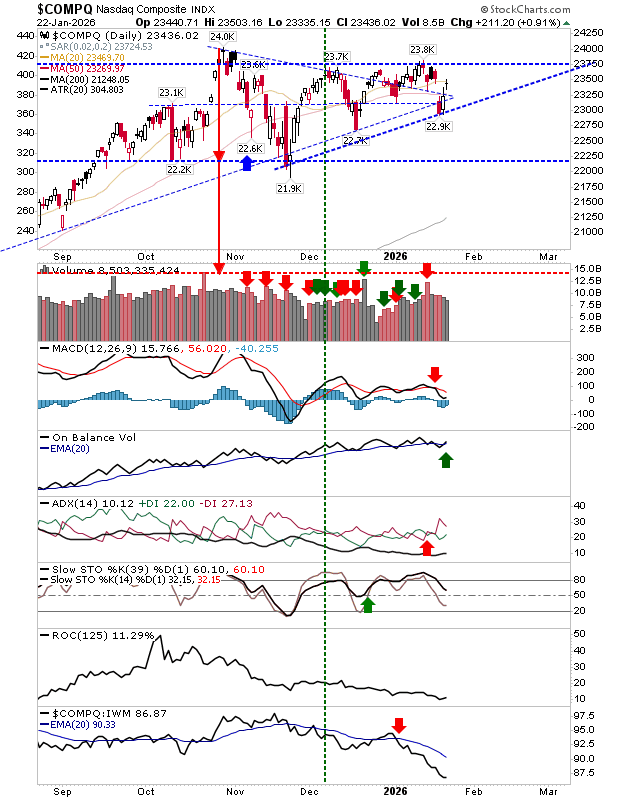
    The Nasdaq Composite jumped 0.9%, driven by strength in megacap stocks.

    Meanwhile, the Dow Jones Industrial Average fell 0.8%, weighed down by steep declines in healthcare and insurance shares. Major health insurers came under pressure after the U.S. government released a Medicare Advantage payment plan that the market perceived as less favorable than anticipated.

    Markets focus on Fed decision and megacap earnings

    Investor focus has shifted squarely to the Federal Reserve, which kicked off its two-day policy meeting on Tuesday. The central bank is widely expected to leave interest rates unchanged when it delivers its decision on Wednesday, with markets pricing in a pause as policymakers assess easing but still-elevated inflation alongside signs of steady economic growth and a resilient labor market.

    Close attention will be paid to Fed Chair Jerome Powell’s remarks for indications on how long rates may remain at current levels and when eventual cuts could begin.

    “The key will be any dissent and the Fed’s communication, particularly around questions of central bank independence,” ING analysts said, adding that the decision will also be overshadowed by President Trump’s upcoming nomination of a new Fed chair.

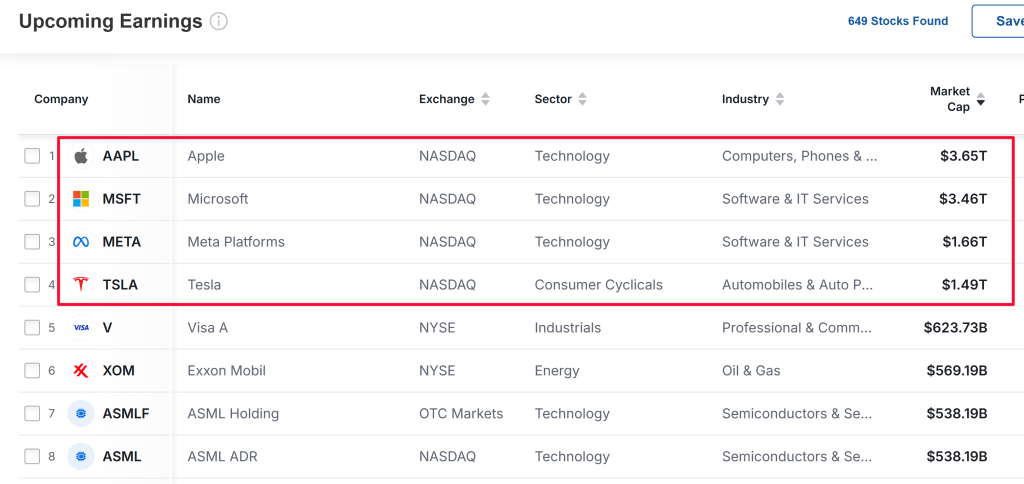
    Corporate earnings are another major catalyst this week, with four members of the so-called “Magnificent Seven” technology group set to report. Tesla, Meta Platforms and Microsoft are scheduled to post results on Wednesday, followed by Apple on Thursday.

    Given their heavy weighting in major equity indexes, guidance from these companies on artificial intelligence investment, cloud demand and consumer trends is expected to play a key role in shaping near-term market direction.

    Sources: Investing

  • Morning Bid: Markets shrug off tariff threats

    President Donald Trump once again surprised markets by announcing an increase in tariffs on South Korea to 25% from 15%, citing Seoul’s failure to implement a trade agreement reached last July. The move targets sectors such as autos, lumber, and pharmaceuticals, yet South Korean equities ended up surging 2% to fresh record highs. The KOSPI initially slid more than 1%, but the dip quickly attracted buyers seeking exposure to Asia’s strongest-performing equity market of 2025.

    With South Korea’s industry minister set to travel to Washington, investors appear to be betting on a negotiated climbdown, reviving the popular “TACO” trade—Trump Always Chickens Out. Few are surprised that Seoul has been reluctant to commit massive U.S. investments while the risk of abrupt tariff threats remains a defining feature of the administration.

    Tariff uncertainty also boosted demand for precious metals, pushing gold and silver back toward record levels. Gold rose 1% to $5,063 an ounce, while silver jumped 5% to $109 an ounce.

    Asian equities were broadly firmer, supported by optimism that blockbuster earnings from the U.S. “Magnificent Seven,” beginning with Meta, Microsoft and Tesla later this week, will help sustain the global equity rally into 2026. MSCI’s Asia-Pacific index excluding Japan climbed 1% to a new high, while Japan’s Nikkei added 0.7%, even as the yen hovered near a two-month peak—normally a headwind for exporters.

    European equities are poised for a firmer open, with EURO STOXX 50 futures up 0.3%. U.S. futures are also higher, as Nasdaq futures climb nearly 0.6% and S&P 500 futures rise 0.3%. The global economic calendar remains relatively quiet ahead of Wednesday’s Federal Reserve policy decision, at which interest rates are widely expected to be left unchanged. Nevertheless, the meeting is likely to be dominated by the Justice Department’s investigation into Fed Chair Jerome Powell, adding extra scrutiny to his post-meeting press conference. Any indication that Powell may choose to remain on the Fed’s board after his term ends in May—a move permitted under Fed rules—could provoke an unpredictable reaction from President Trump.

    Sources: Reuters

  • Five key market themes to watch in the coming week

    A crucial Federal Reserve interest rate decision is set to dominate attention this week, especially after news of a criminal investigation into Chair Jerome Powell heightened concerns about the central bank’s independence. At the same time, several major technology firms are scheduled to release quarterly earnings, with investors watching closely for evidence that heavy investments in artificial intelligence are beginning to pay off. Adding to market uncertainty, President Donald Trump has issued a renewed tariff threat against Canada, keeping geopolitical risks firmly in focus.

    Fed decision ahead

    This week’s agenda is expected to be led by the Federal Reserve’s interest rate decision on Wednesday, following a two-day policy meeting focused on setting borrowing costs as the U.S. economy remains broadly resilient. While employment—previously a key driver of rate cuts in 2025—appears stable amid subdued hiring and limited layoffs, inflation has held steady but remains above the Fed’s 2% target. Some analysts caution that economic growth is becoming increasingly “K-shaped,” with stronger performance among higher-income households and corporations, while lower-income earners face rising living costs. Against this backdrop, the Fed is widely expected to leave rates unchanged at 3.5%–3.75%, with CME FedWatch indicating that the next rate cut is unlikely before June.

    Attention shifts to who could replace Powell

    January’s Federal Reserve meeting takes place amid repeated calls from President Trump for swift and aggressive rate cuts to stimulate economic growth, alongside his criticism of officials for resisting such moves. Long-standing concerns over the Fed’s political independence intensified earlier this month after the Justice Department launched a criminal investigation into Chair Jerome Powell. In an unusual public response, Powell condemned the probe, characterizing it as an attempt to pressure monetary policy in line with the White House’s preferences.

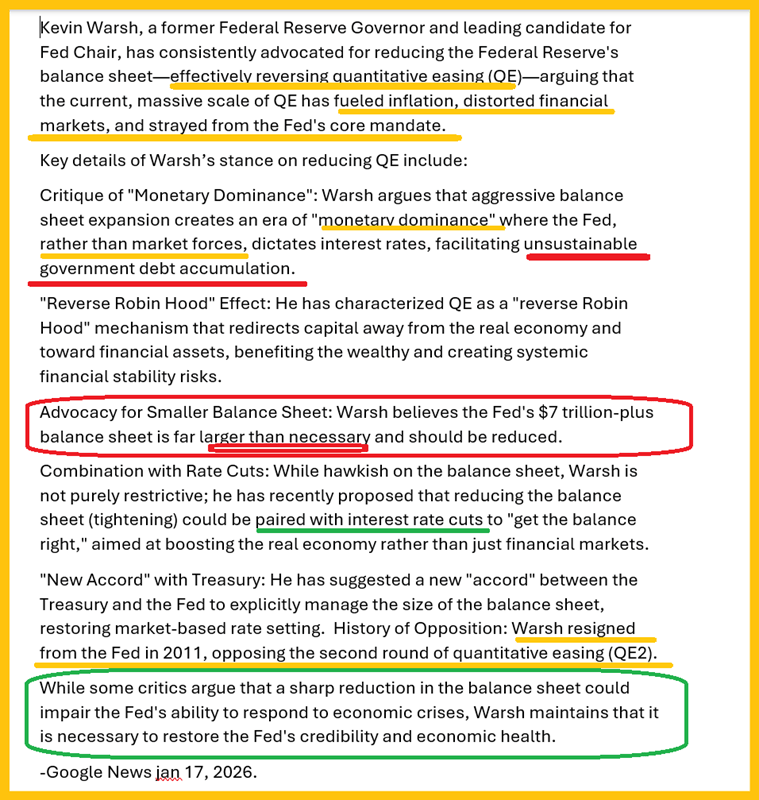
    Appointed during Trump’s first term, Powell now has only a few months remaining as Fed chair, and markets are closely watching whether tensions with the administration could influence his decision to remain on the Fed’s rate-setting board after his term ends. Adding to the uncertainty is the question of who will succeed him. Prediction markets currently favor BlackRock executive Rick Rieder as the leading contender, overtaking former Fed Governor Kevin Warsh, while Trump has suggested he has narrowed his choice to a single candidate.

    Major tech earnings in the spotlight

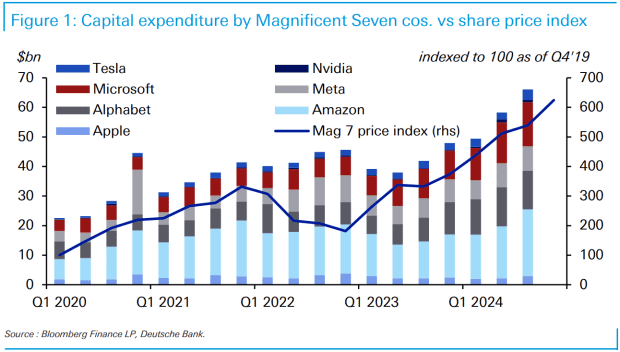
    The earnings calendar this week will be dominated by results from major technology companies, including Meta Platforms, Microsoft, and Apple. Driven partly by excitement over advanced artificial intelligence applications, these firms have led equity markets in recent years. Their push to secure leadership in the AI race has prompted a sharp rise in capital spending, particularly on data centers and the semiconductors required to support AI workloads. While investors have largely been willing to overlook these heavy investments, expectations for meaningful revenue returns are now rising, with analysts describing 2026 as a “prove-it” year for big tech. This wave of earnings may provide the first clues as to whether those expectations are being fulfilled.

    ASML to report

    In Europe, attention will turn to ASML, the world’s leading supplier of chipmaking equipment, which is due to report earnings on Wednesday. The Dutch group’s market capitalization crossed the $500 billion mark earlier this month after key customer TSMC announced larger-than-expected capital spending plans to meet surging demand for AI chips. This milestone has cemented ASML’s position as Europe’s most valuable company, with analysts watching closely to see whether the AI boom can further accelerate its growth. However, ASML has so far issued a cautious outlook for the year ahead, with sales projected at best to remain flat, prompting concerns that the pace of new fab construction may be trailing the rapid expansion in AI-driven demand.

    New tariff threat from Trump rattles markets

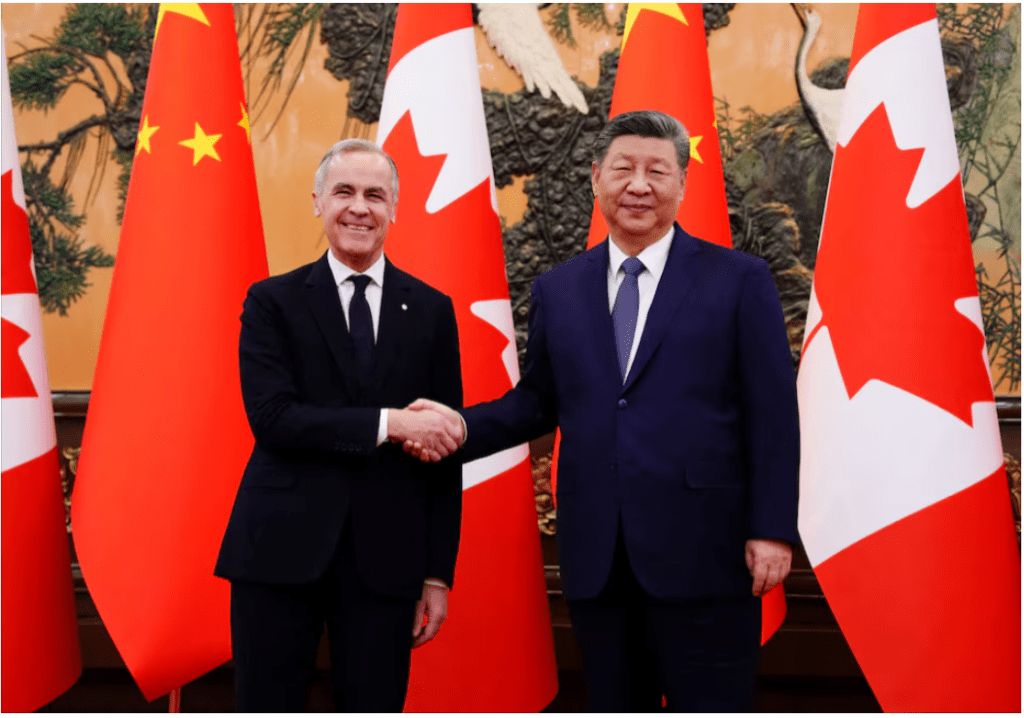
    After seemingly backing away from earlier claims that he would impose punitive tariffs on several European countries unless the United States was permitted to buy Greenland, President Trump issued a fresh trade warning over the weekend, saying he would levy a 100% tariff on Canadian imports if Ottawa were to strike a trade agreement with China. In social media posts, Trump cautioned that Prime Minister Mark Carney—who recently visited China for trade discussions and spoke in Davos about the need for smaller economies to push back against coercion by global powers—could put Canada at risk by pursuing closer ties with Beijing.

    Trump warned that China would severely damage Canada’s economy and society, stating that all Canadian goods entering the U.S. would face a 100% duty should such a deal be reached. Carney responded that Canada has no plans to seek a free trade agreement with China, stressing that Ottawa remains committed to its obligations under the USMCA and would consult both the U.S. and Mexico before pursuing any new trade arrangements. Analysts at Vital Knowledge noted that while the likelihood of the tariff threat being enacted appears low, Trump’s repeated and abrupt warnings are gradually weighing on investor sentiment.

    Sources: Investing

  • OCBC has raised its 2026 gold price forecast to $5,600 per ounce, citing increasing demand for safe-haven assets.

    OCBC has raised its end-2026 gold price target to $5,600 per ounce from $4,800, citing recent sharp gains and enduring structural demand rather than a shift in its core market view. Gold has climbed about 17% so far in 2026 and has stayed elevated despite periodic pullbacks.

    The bank said prices are now supported less by isolated event risks and more by a prolonged environment of uncertainty that is driving diversification into non-sovereign assets. OCBC highlighted a persistent pricing premium that cannot be fully accounted for by traditional factors such as yields, the US dollar, ETF flows, volatility, or policy uncertainty. This premium reflects a geopolitical and uncertainty component increasingly embedded in gold prices, fueled by ongoing geopolitical tensions, policy unpredictability, and concerns over confidence in the dollar. OCBC added that the broader uptrend remains intact, underpinned by structural geopolitical risks, accommodative monetary conditions, and continued support from official sector and ETF demand.

    Sources: Investing

  • Bullish and Bearish Scenarios for US Stocks in 2026

    The year ahead offers a clear divide between bullish and bearish outcomes for investors. Will 2026 deliver another period of above-average returns, or mark a turning point toward disappointment? Optimists contend that the foundations for a sustained rally remain intact. A robust technology cycle, heavy corporate investment, and supportive policy settings all suggest further upside. Pessimists, however, warn that key growth drivers are losing momentum, market leadership has become uncomfortably narrow, and underlying economic stress is increasingly evident.

    After a strong 2025, investors are entering a shifting market environment. Liquidity is still plentiful, but concerns over stretched valuations, labor-market pressure, and consumer resilience are mounting. Much hinges on how long optimism can outweigh economic realities, and whether expected gains from artificial intelligence and capital spending arrive quickly enough to counteract the drag from debt burdens, interest costs, and widening inequality.

    Sentiment remains broadly constructive, though far from unanimous. Equity strategists are split, while bond markets reflect expectations of rate cuts alongside rising recession risk. Fiscal stimulus may postpone a downturn, but it also exacerbates longer-term imbalances. For investors, the central challenge is maintaining objectivity. Both the bullish and bearish narratives are credible, and timing will be decisive. In fact, 2026 could validate elements of both cases, making adaptability the most valuable strategy.

    Below, we examine the bullish and bearish scenarios for 2026 in detail, assessing the macroeconomic and market forces behind each view. By translating these dynamics into practical portfolio considerations, investors can prepare for either outcome. Ultimately, success in 2026 will hinge less on forecasting accuracy and more on disciplined risk management.

    The Bullish Case

    The bullish thesis rests on several core pillars: a fresh surge in technology-led investment, accommodative fiscal policy, improving liquidity conditions, and the ongoing strength of both corporate balance sheets and consumer activity. Together, these forces have propelled markets higher, and proponents argue they will continue to support gains through 2026.

    Central to the bull case is the rise of a potentially transformative technology cycle driven by artificial intelligence and large-scale infrastructure upgrades. Unlike earlier tech booms fueled primarily by optimism, this cycle is already translating into substantial capital spending. The so-called “Magnificent Seven” have collectively pledged over $600 billion toward data centers, semiconductor capacity, and AI-related services. This investment is rippling across software, energy, and industrial supply chains. Should the anticipated productivity improvements materialize, corporate earnings could accelerate, providing fundamental support for elevated valuations.

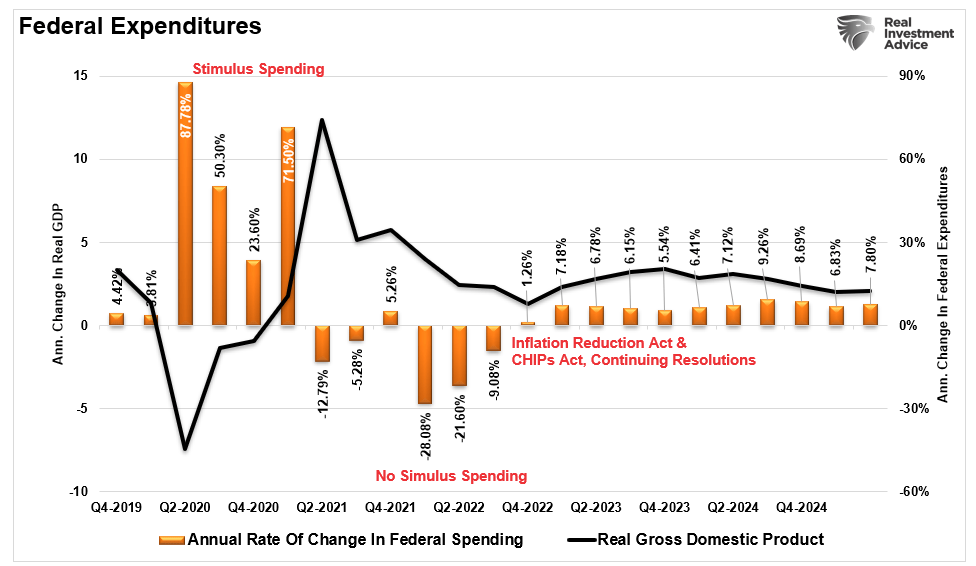
    Fiscal policy is also positioned to support growth. Under a Trump-led administration, proposed tax cuts and direct transfers are expected to bolster both corporate activity and consumer spending. While $2,000 stimulus checks may not appear dramatic on their own, they can meaningfully lift short-term consumption and provide relief to small businesses. When paired with income tax reductions, these initiatives create a favorable backdrop for GDP growth and market sentiment. As recent history shows, following the 2022 market correction and widespread recession concerns, ongoing fiscal support has continued to play a stabilizing role in economic expansion.

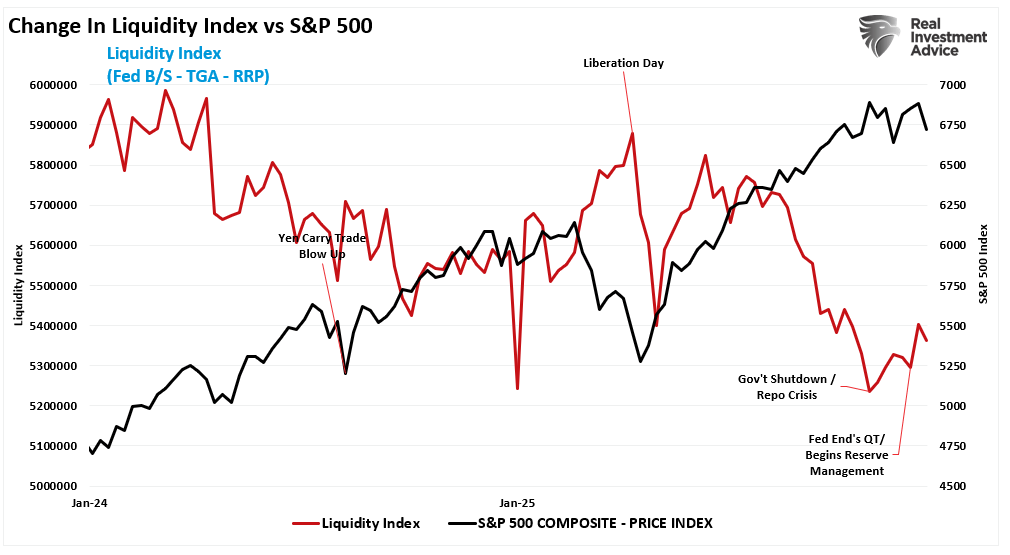
    The monetary environment is also turning more supportive for bulls. Quantitative tightening concluded in December 2025, and the Federal Reserve has since shifted toward what many describe as “QE Lite,” combining rate cuts with monthly purchases of roughly $40 billion in short-term Treasuries. Officially framed as “reserve management,” the objective is to maintain ample liquidity within the financial system. As interest rates decline, credit conditions are likely to loosen, providing a favorable backdrop for risk assets. Rising liquidity has historically supported higher equity valuations, with technology and growth stocks typically benefiting the most from this dynamic.

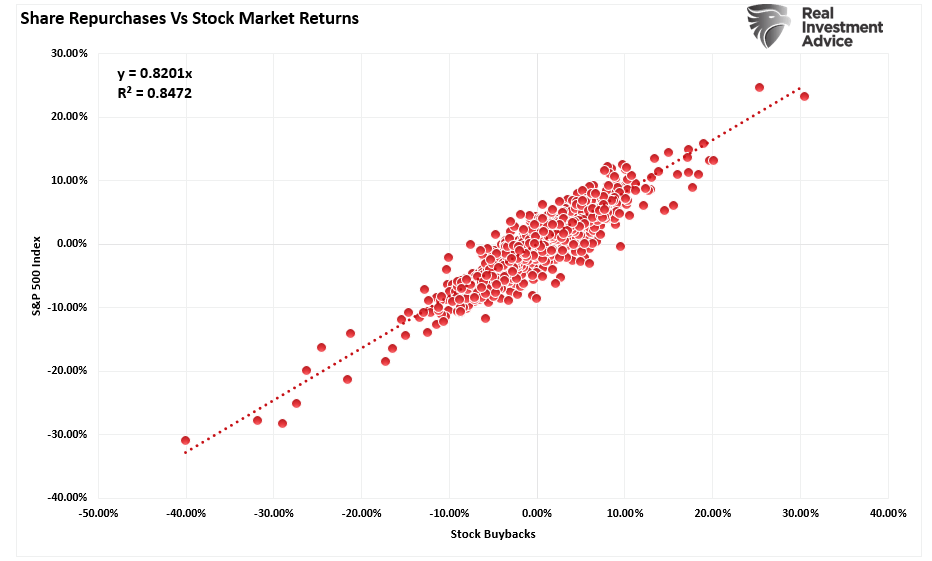
    Corporate actions further reinforce the bullish narrative. Share buyback authorizations are projected to reach a new record of more than $1.2 trillion in 2026. Although often framed as a “capital return strategy”—a characterization that misses the point—buybacks have shown a strong correlation with equity market performance. Notably, since 2000, corporate repurchases have accounted for nearly all net equity demand, underscoring their outsized influence on stock prices.

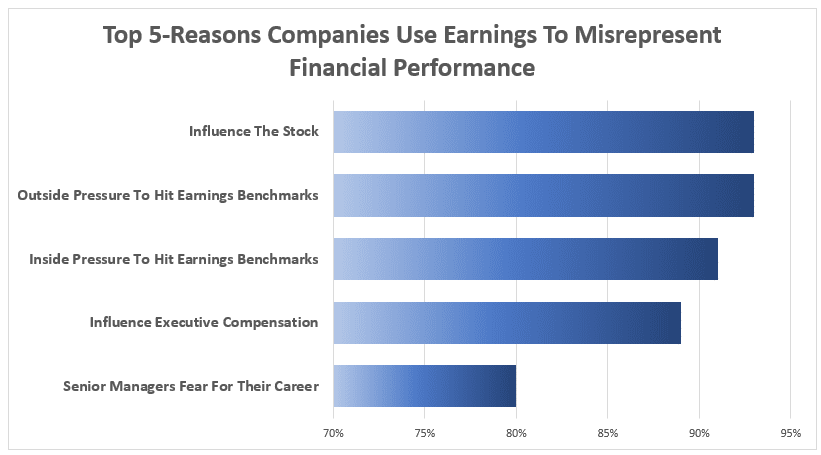
    Importantly, the notion that buybacks signal management’s confidence in future earnings is misleading. In practice, repurchases are frequently used as a form of financial engineering to boost per-share results and beat Wall Street expectations. This dynamic is likely to intensify in 2026, further supporting reported earnings growth and reinforcing the bullish case.

    Finally, deregulation tied to the so-called “Big Beautiful Bill” is expected to relax capital requirements for banks, enabling them to hold a greater amount of collateral. While this should support the Treasury market, it also expands overall lending capacity. Much of that capacity is likely to flow into leverage for hedge funds and Wall Street trading desks, as looser regulatory constraints encourage greater risk-taking.

    The bullish thesis ultimately rests on a reinforcing feedback loop: innovation spurs capital investment, rising investment lifts earnings, policy measures inject liquidity, and investors respond by increasing risk exposure. As long as each link in this chain remains intact, the upward trend can persist.

    The Bearish Case

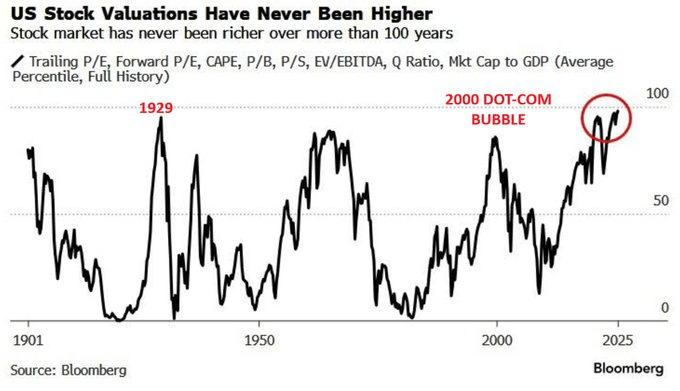
    The bearish case starts with a key observation: many of the forces that powered the 2025 rally are now fading or already fully reflected in prices. Elevated valuations, softening economic data, and rising speculative excesses suggest that current market momentum may be masking deeper structural vulnerabilities. With that in mind, it is worth examining several of these risks more closely.

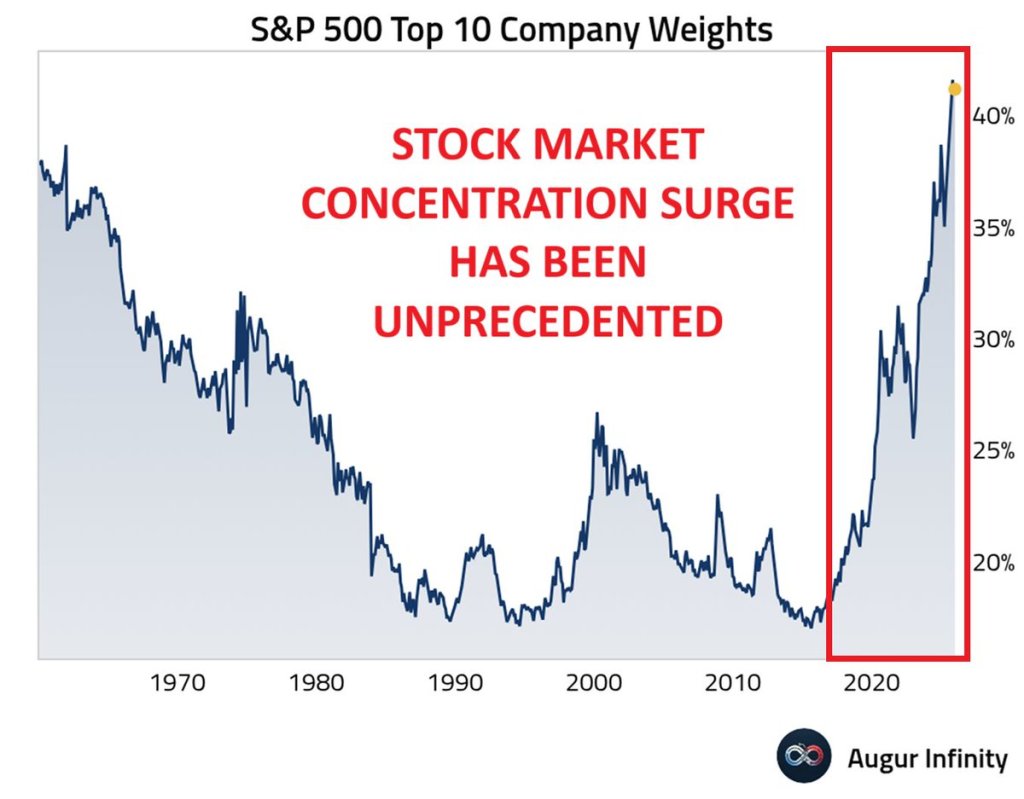
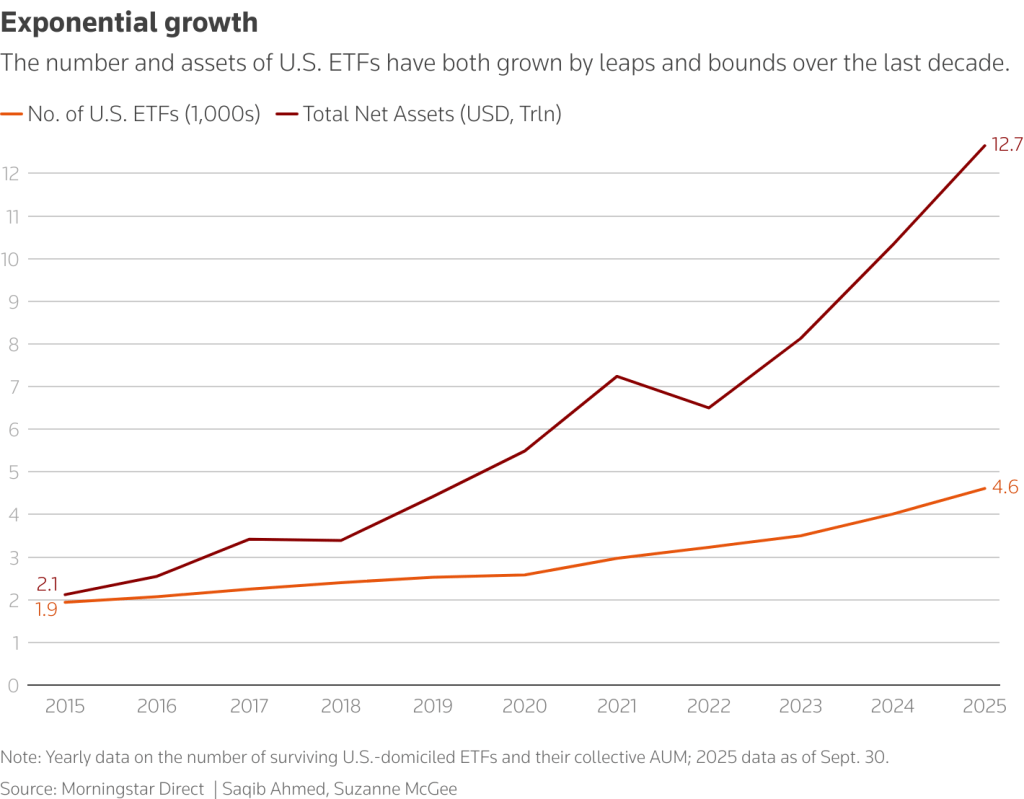
    One of the most visible concerns is market concentration. In 2025, the bulk of equity gains came from just 10 companies on a market-capitalization-weighted basis, a dynamic amplified by the continued shift into passive ETF investing.

    Passive investing has evolved from a niche approach into the dominant force shaping equity markets. Index funds and ETFs now represent more than half of U.S. equity ownership. Because these vehicles allocate capital according to market capitalization rather than valuation, fundamentals, or business quality, the largest companies attract a disproportionate share of inflows. This has created a powerful feedback loop in which rising prices draw in more capital, and those inflows, in turn, push prices even higher.

    This narrow leadership is inherently fragile. Should investor flows into ETFs reverse, a disproportionate share of selling—roughly 40%—would be concentrated in the same 10 stocks. History shows that when market performance depends on a small handful of names, volatility tends to increase and drawdowns can be sharp.

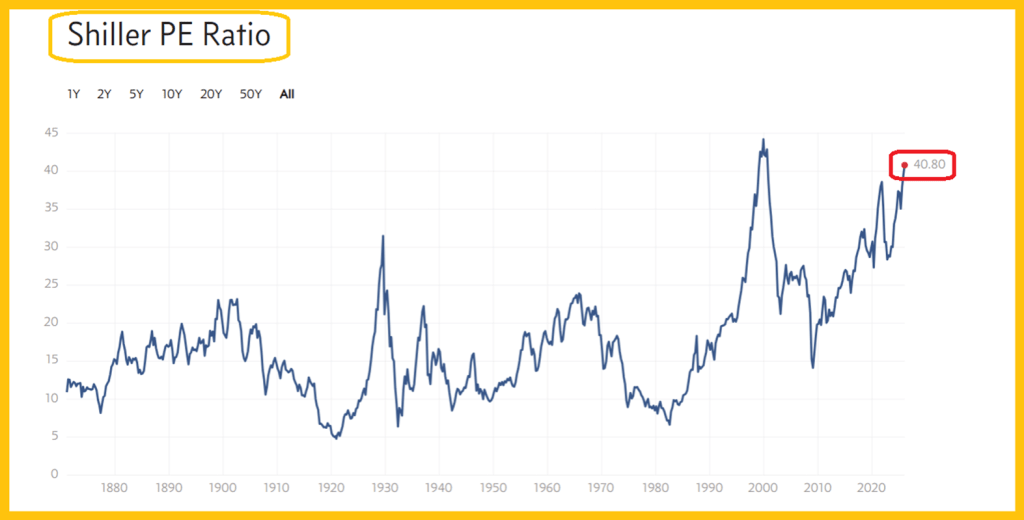
    Valuations present another clear risk. Price-to-earnings multiples on the S&P 500 remain near cycle peaks, leaving little room for error. Growth assumptions are ambitious, and even modest earnings disappointments could trigger a meaningful repricing. While enthusiasm around AI has driven a surge in investment, much of this spending is circular—companies are investing in AI largely to produce and sell AI-related products. That dynamic may prove self-limiting over time, particularly if end demand weakens or costs begin to outstrip returns.

    A significant portion of the current investment cycle is also being financed with debt, as companies borrow to fund capital spending, repurchase shares, and sustain dividend payouts. If interest rates remain high or credit conditions deteriorate, rising debt-servicing costs could quickly erode earnings gains.

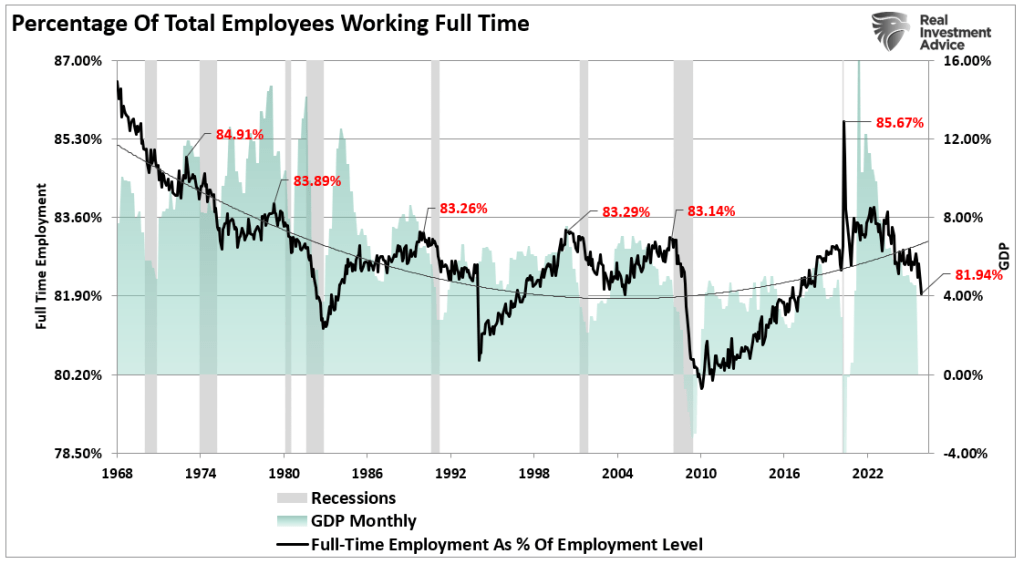
    The broader economic risk is that the reallocation of capital toward technology and automation could sideline large segments of the workforce. While the buildout of data centers may employ thousands during construction, only a fraction of those jobs—perhaps a few hundred—remain once operations begin. Over time, this dynamic could weigh on employment growth, increase the risk of demand destruction, and may already be showing early warning signs.

    This dynamic underpins the concept of a “K-shaped economy.” While high-income households and asset owners continue to prosper, lower-income consumers are facing increasing strain. Consumption patterns are diverging as financially pressured households cut back, leaving the top 20% of earners responsible for nearly half of total consumer spending. Signs of stress are already emerging, with rising auto loan and credit card delinquencies, stagnant real wages for many workers, and persistently high costs for housing and essential goods.

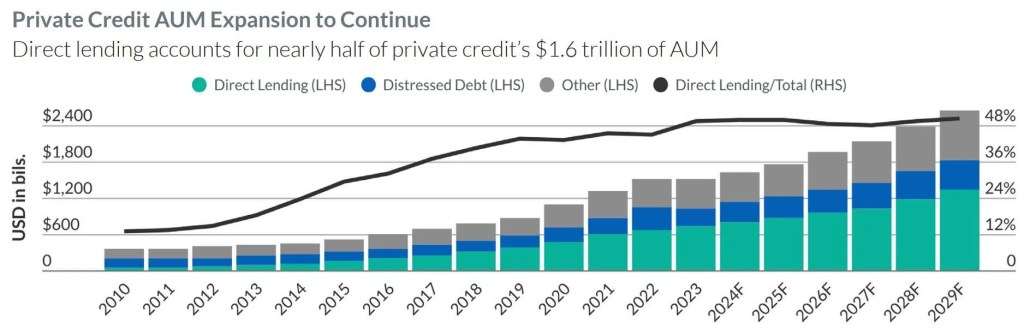
    At the same time, risks within the credit system—particularly in private markets—are growing. Private credit has expanded rapidly in recent years, yet limited transparency makes it difficult to fully assess systemic vulnerabilities. Regulators have begun to pay closer attention, and default rates in middle-market lending are climbing. Should these stresses intensify, the fallout could extend across banks, hedge funds, and pension portfolios.

    The bearish argument is not one of an imminent crash, but of growing fragility. Beneath the headline gains, the market appears increasingly exposed to earnings disappointments, tighter credit conditions, and weakening consumer demand.

    The key takeaway is that 2026 may validate elements of both the bullish and bearish narratives. Preparation, rather than prediction, will be essential.

    Navigating Whatever Comes Our Way

    Investors should treat 2026 as a year in which both the bullish and bearish narratives may ultimately be validated. In the first half, bullish momentum is likely to persist, supported by strong sentiment, ample liquidity, and continued growth in corporate investment. Optimism around AI, fiscal support, and a potential pause in monetary tightening could propel equity indexes higher.

    By the second half, however, underlying vulnerabilities may begin to surface. Elevated valuations increase sensitivity to earnings disappointments, while widening economic inequality could weigh on the outlook for consumer demand and corporate revenues. Should these pressures intensify, market sentiment could shift rapidly.

    Navigating such a divided year will require a tactical approach—participating in early upside while avoiding excessive exposure to risks that may materialize later in the year.

    Early 2026: Participate in Momentum, but Manage Exposure

    • Overweight sectors poised to benefit from capital spending and ample liquidity, including technology, industrials, and energy.
    • Prioritize high-quality growth companies with durable earnings and strong cash-flow generation, rather than momentum-driven narratives.
    • Implement trailing stop-loss strategies to protect gains if market sentiment shifts.
    • Use periods of volatility to add selectively, while scaling back position sizes as valuations become more stretched.
    • Avoid excessive concentration in AI-related stocks, even during strong rallies, as crowding increases dispersion and downside risk.

    Mid-to-Late 2026: Emphasize Defense and Cash-Flow Stability

    • Gradually rotate toward defensive, value-oriented sectors such as healthcare, consumer staples, and utilities.
    • Increase exposure to dividend-paying companies with strong balance sheets and resilient cash flows.
    • Raise cash allocations or shift into short-duration Treasuries to preserve flexibility.
    • Allocate selectively to high-quality credit while reducing exposure to private credit and high-yield debt.
    • Monitor consumer credit conditions, labor-market trends, and bank earnings for early signs of financial stress.

    Throughout the Year: Maintain Discipline and Objectivity

    • Adhere to valuation discipline regardless of shifts in market narratives.
    • Keep portfolios well diversified to withstand both volatility and sector rotation.
    • Let data—not headlines—drive allocation decisions.
    • Rebalance regularly, particularly if strong first-half performance leads to excessive concentration in certain sectors.

    In 2026, tactical flexibility, risk awareness, and discipline are likely to matter more than adopting a purely bullish or bearish stance. It is a year in which both camps could be partially wrong. Markets rarely move in straight lines, but a sound investment process should remain consistent throughout.

    The year ahead is likely to test investors with heightened volatility, as both the bullish and bearish arguments carry real weight. A new technology cycle may generate genuine economic momentum, yet it also introduces risks tied to elevated valuations, debt-fueled growth, and widening inequality. With markets effectively pricing in near-perfection, history suggests outcomes often fall short of expectations.

    Whether 2026 delivers further gains or a sharp correction, performance will hinge on effective risk management. Avoid anchoring to any single narrative. Let data guide decisions, respect your signals, and remain willing to adjust as conditions evolve.

    Ultimately, the objective is not to chase short-term returns, but to endure—and compound—across full market cycles.

    Sources: Real Investment Advice

  • Japanese yen bulls grow more cautious as fiscal concerns and political uncertainty weigh on sentiment.

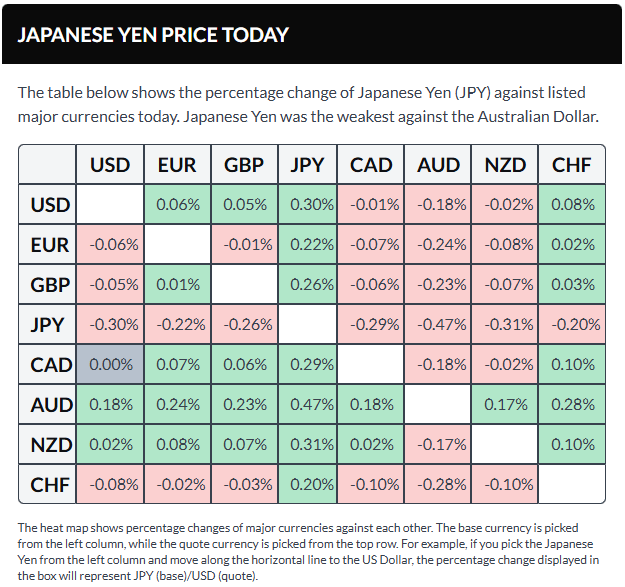
    The Japanese yen finds it hard to build on recent strong gains as worries over Japan’s fiscal position persist. However, a relatively hawkish Bank of Japan stance and concerns about potential currency intervention could continue to support the yen. Meanwhile, the US dollar remains near a four-month low on expectations of Fed rate cuts, helping to limit upside in USD/JPY.

    The Japanese yen comes under modest selling pressure during Tuesday’s Asian session, pulling back further from its strongest level against the US dollar since November 2025, reached a day earlier. Sentiment toward the yen remains fragile as investors worry about Japan’s fiscal outlook, driven by Prime Minister Sanae Takaichi’s expansive spending proposals and tax cut plans. A broadly upbeat mood in equity markets, along with domestic political uncertainty ahead of the snap election scheduled for February 8, is also weighing on the safe-haven currency.

    However, downside pressure on the yen may be limited by expectations that Japanese authorities could intervene to prevent excessive weakness, especially given the Bank of Japan’s relatively hawkish stance. Meanwhile, the US dollar stays near a four-month low as markets price in two additional Federal Reserve rate cuts this year. The ongoing “Sell America” theme further dampens demand for the greenback, which should help restrain USD/JPY movements as investors turn their attention to the key two-day FOMC meeting beginning later today.

    Japanese yen bears remain cautious as intervention speculation offsets political uncertainty.

    Japan’s already stretched public finances have come under sharper scrutiny following Prime Minister Sanae Takaichi’s campaign pledge to suspend the sales tax on food items ahead of the snap lower house election on February 8. Concerns over the country’s fiscal outlook have been a major driver behind the recent jump in long-dated Japanese government bond yields, which raises debt servicing costs and, in turn, limits the Japanese yen’s upside.

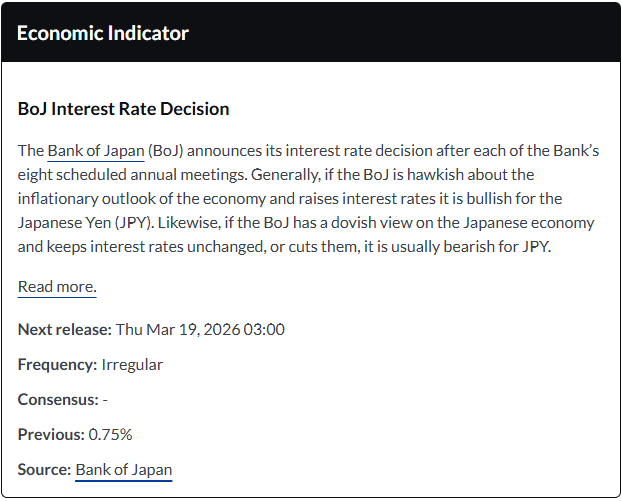
    Data released earlier on Tuesday showed a slowdown in wholesale inflation, with the Producer Price Index rising 2.4% year-on-year in December, down from 2.7% in November. Additional figures indicated that the Corporate Service Price Index increased 2.6% YoY, slightly lower than the previous reading. Overall, the data offered little to challenge the Bank of Japan’s tightening trajectory and had a limited impact on the yen.

    The BoJ recently raised its economic and inflation forecasts while keeping short-term rates unchanged at the conclusion of its two-day meeting last Friday, signaling its readiness to continue gradually lifting still-low borrowing costs. This stance contrasts sharply with expectations for a more dovish US Federal Reserve, leaving the US dollar under pressure near a four-month low and lending support to the yen amid fears of possible official intervention.

    Reinforcing this view, Prime Minister Takaichi said on Sunday that authorities are prepared to take action against speculative and highly abnormal market moves, following rate checks by Japan’s Ministry of Finance and the New York Fed on Friday. Still, traders appear reluctant to take aggressive positions ahead of the two-day FOMC meeting beginning today, which is expected to be a key driver for the US dollar and the USD/JPY pair in the near term.

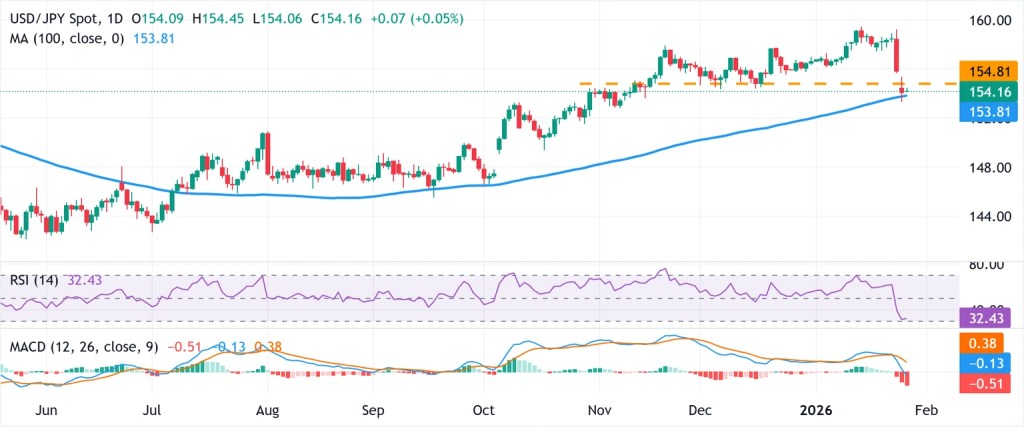
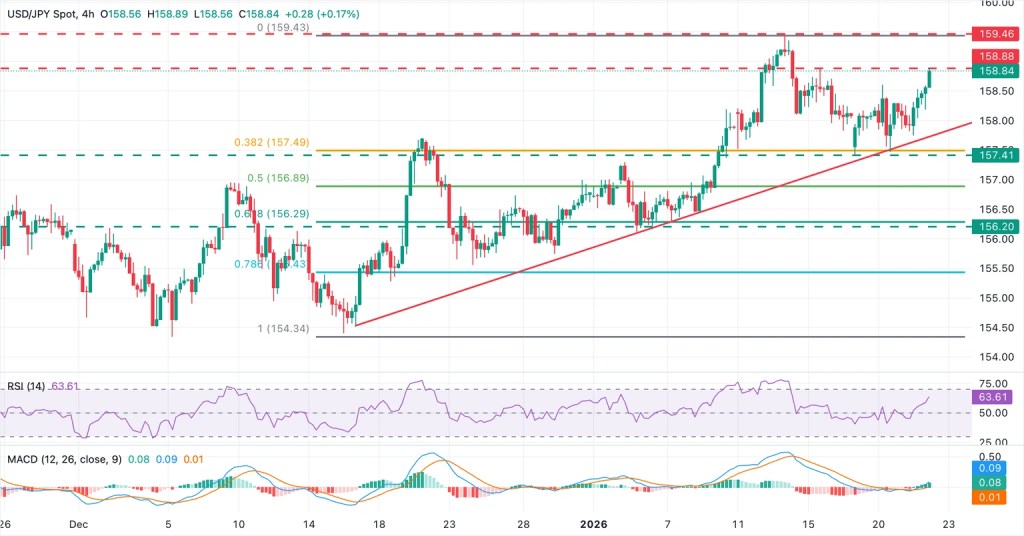
    USD/JPY needs to establish a sustained break below the 100-day SMA to strengthen the case for further downside.

    The USD/JPY pair showed signs of resilience below its 100-day Simple Moving Average (SMA) on Monday, although it continues to trade beneath the 154.75–154.80 horizontal support zone. The MACD histogram has moved further into negative territory, with the MACD line below the signal line, reflecting bearish momentum that remains below zero. Meanwhile, the RSI stands near 32, close to oversold territory, suggesting that the downside move may be becoming stretched.

    A daily close below the 100-day SMA at 153.81, which currently provides near-term support, would give bears greater control. In contrast, sustained trading above this level would keep the broader bias supported by the rising SMA. Signs of stabilization would include a flattening MACD histogram and a move back toward the zero line, while an RSI rebound toward 50 would improve the overall tone. On the other hand, a dip below 30 on the RSI would increase the risk of deeper losses.

    Sources: Fxstreet

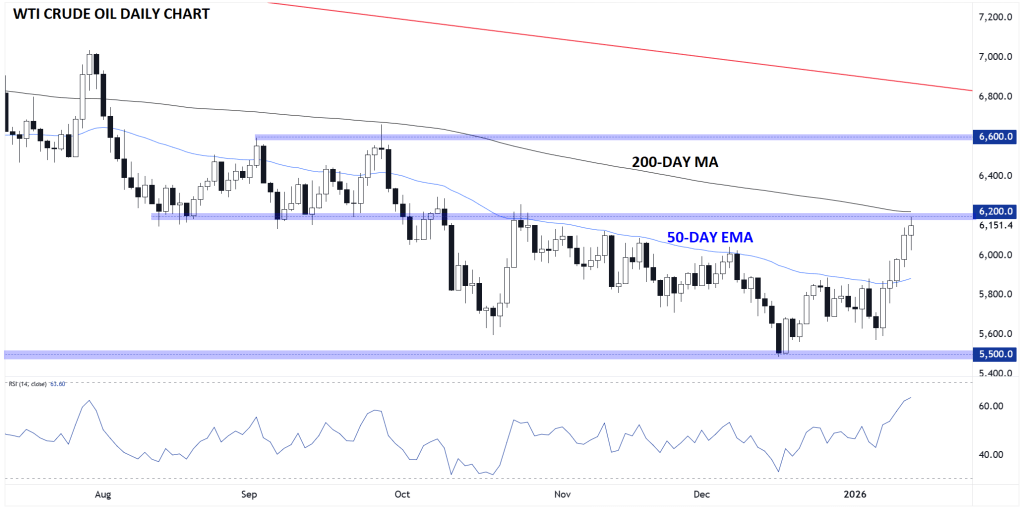
  • Oil prices slip as markets weigh US-Iran tensions and winter-related supply disruptions.

    Oil prices edged lower in Asian trading on Tuesday as markets focused on rising US-Iran tensions, while also monitoring potential supply disruptions caused by extreme winter weather in the United States.

    Crude had gained in recent sessions on fears that tensions with Iran could disrupt supply, while a severe snowstorm in the US was estimated to have shut in up to 2 million barrels of oil production over the weekend.

    However, expectations of tighter supply were tempered after Kazakhstan signaled it would resume production at the Tengiz oil field, its largest producing asset.

    Brent crude futures for March slipped 0.6% to $65.22 a barrel, while West Texas Intermediate futures fell 0.5% to $60.33 a barrel by 21:20 ET (02:20 GMT).

    Iran tensions, US weather disruptions in focus

    A US aircraft carrier and several destroyers were seen arriving in the Middle East over the weekend. President Donald Trump said last week that an “armada” was headed toward Iran, though he expressed hope it would not be used.

    The deployment followed Trump’s warnings to Iran over the killing of protesters during recent nationwide demonstrations, although unrest has eased in recent weeks and his rhetoric toward Tehran has softened.

    Meanwhile, a severe snowstorm in the US caused widespread disruptions, halting oil production and straining the power grid, with markets closely watching whether prolonged outages could further tighten crude supplies.

    Kazakhstan signals plans to resume production at the Tengiz oil field.

    Kazakhstan said on Monday it will resume output at the Tengiz oil field after a fire and power outage halted production. However, Reuters reported that initial volumes are expected to be limited, as the country has yet to lift a force majeure on CPC Blend exports.

    Kazakhstan is the world’s 12th-largest oil producer and a member of OPEC and its allies. The group is expected to keep production levels unchanged at its February 1 meeting, after steadily increasing output through 2025 before announcing a pause late last year to curb prolonged weakness in oil prices.

    Sources: CNBC

  • Bitcoin price remains subdued near a one-month low as Fed caution and liquidation pressures weigh on sentiment.

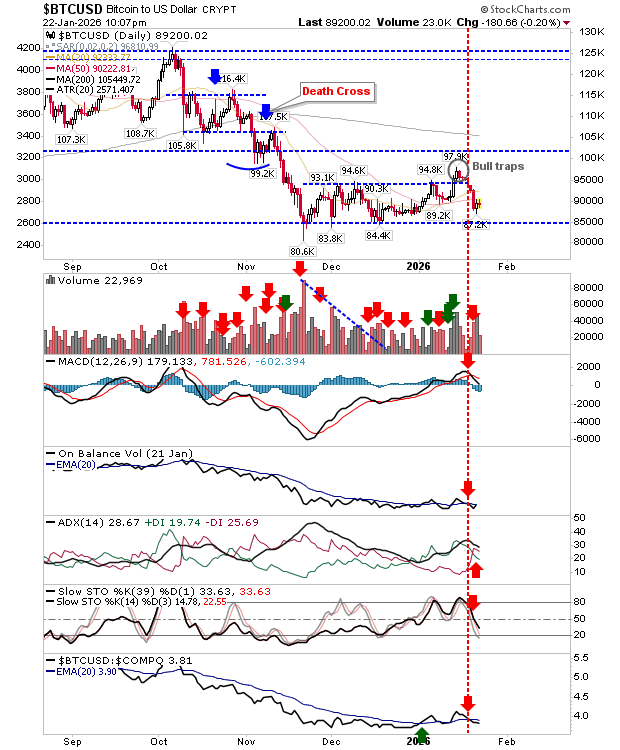
    Bitcoin hovered near one-month lows on Monday, extending last week’s sharp losses as investors stayed cautious ahead of the Federal Reserve’s policy meeting and amid heavy liquidations in leveraged crypto markets.

    The world’s largest cryptocurrency was last down 0.7% at $88,081 as of 09:36 ET (14:36 GMT).

    Bitcoin has fallen more than 6% over the past week, pressured by a broader risk-off mood driven by uncertainty over global monetary policy, volatility in US Treasury yields, and sharp swings in foreign exchange markets.

    Crypto markets remain under pressure as heavy liquidations and Federal Reserve caution weigh on sentiment.

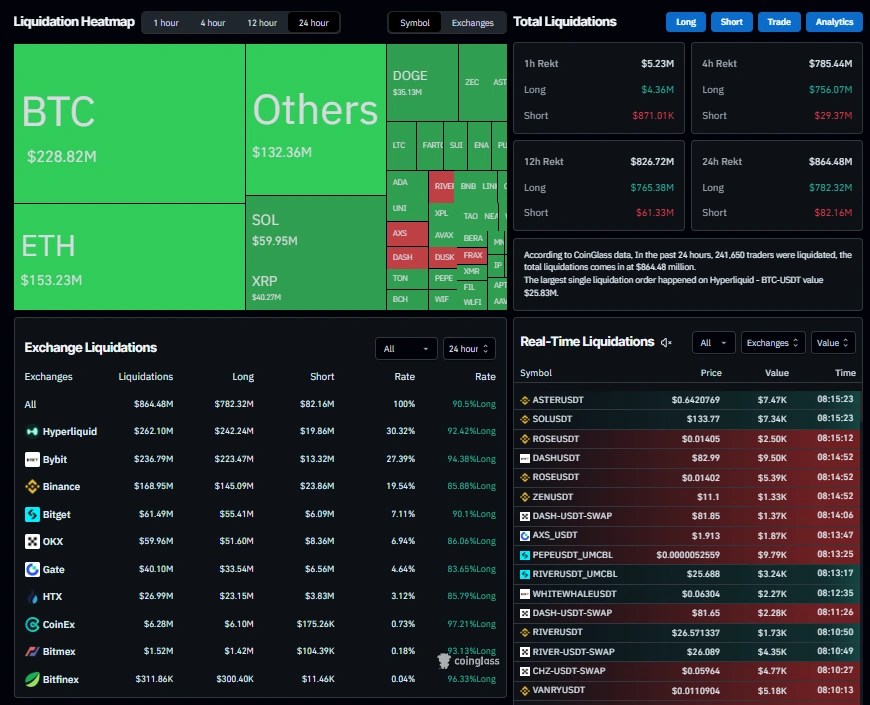
    Last week’s selloff was intensified by forced liquidations in derivatives markets, where highly leveraged positions were rapidly unwound. Market data shows more than $1 billion in leveraged crypto positions were liquidated, with long Bitcoin trades making up most of the losses, amplifying the downward price move.

    Bitcoin had surged earlier this year on hopes of easier US monetary policy and steady inflows into spot ETFs, but sentiment has since turned cautious as investors reassess the interest-rate outlook and cut risk exposure amid volatility in currency and bond markets.

    Focus now shifts to the Federal Reserve’s two-day policy meeting ending Wednesday. While rates are expected to remain unchanged, markets will watch Chair Jerome Powell’s comments closely for signals on the timing and extent of potential rate cuts later this year.

    Investors are also watching signals on liquidity conditions and the Fed’s balance sheet, both key drivers for crypto markets.

    Adding to the uncertainty, traders are awaiting US President Donald Trump’s expected announcement of his nominee for the next Federal Reserve chair, an appointment that could shape future monetary policy, especially if the new leadership is viewed as more dovish or closely aligned with the administration’s economic agenda.

    Strategy increases its Bitcoin holdings with a $264 million purchase.

    Strategy said it bought 2,932 more Bitcoins for about $264 million between Jan. 20 and Jan. 25, paying an average price of $90,061 per coin, according to a regulatory filing released Monday.

    The purchase raises the company’s total Bitcoin holdings to 712,647 tokens, valued at roughly $62.5 billion.

    Led by Michael Saylor, the firm has accumulated its Bitcoin position at an average cost of $76,037 per coin, bringing total investment to about $54.2 billion, including related expenses.

    Crypto price today: Altcoins remain weak

    Most altcoins stayed under pressure on Monday, extending losses amid cautious sentiment. Ethereum slipped 0.4% to $2,916.08, while XRP rose 1.5% to $1.91. Solana fell 1.8%, with Cardano and Polygon largely flat. Among meme tokens, Dogecoin edged up 0.3%, while $TRUMP declined 1%.

    Sources: Investing

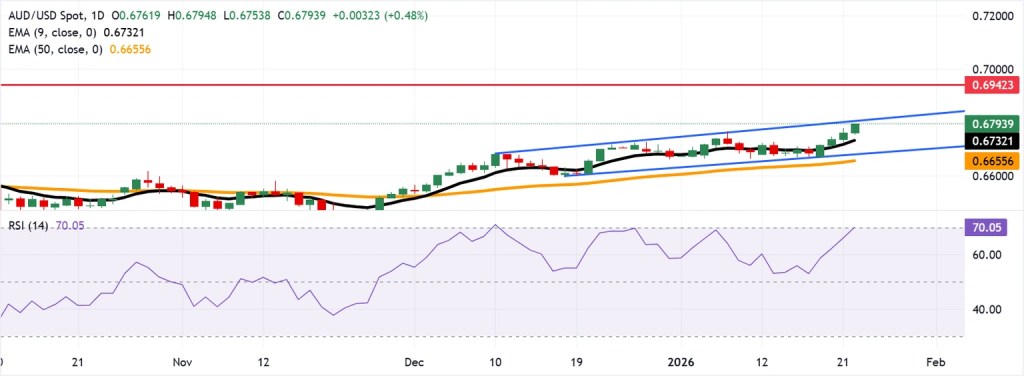
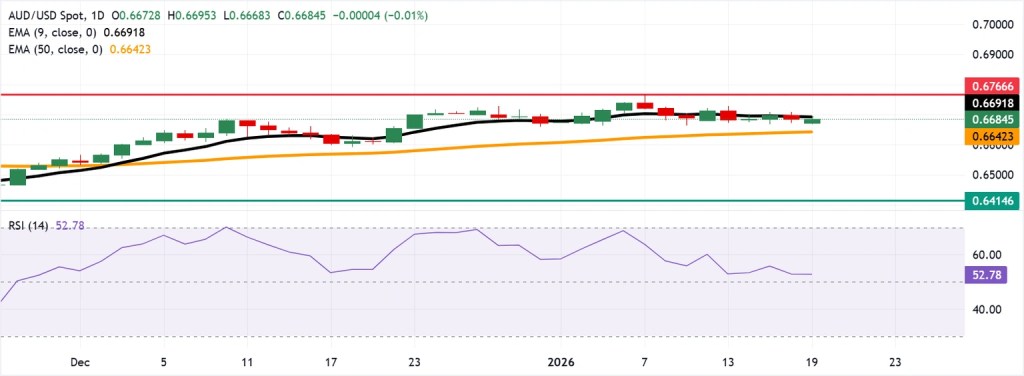
  • AUD/USD holds above 0.6900, hovering near a 16-month high.

    AUD/USD hovers near its 16-month high of 0.6940, supported by rising Australian three-year bond yields at 4.27%, while a weaker US Dollar amid political uncertainty and shutdown risks adds to the upside.

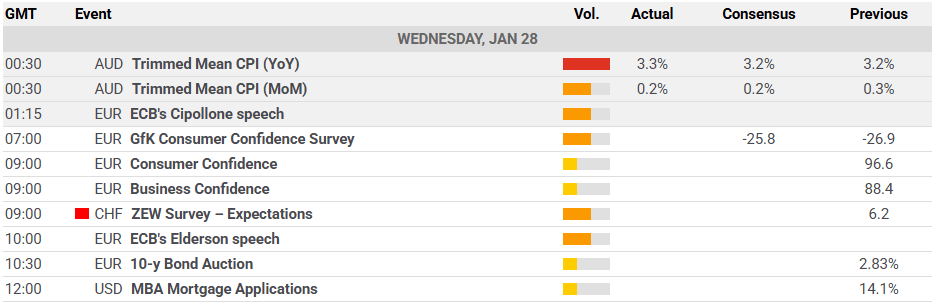
    AUD/USD is holding near its 16-month high of 0.6940 set in the prior session, trading around 0.6920 during Tuesday’s Asian hours, as markets await Australia’s December CPI data on Wednesday for fresh cues on the RBA’s policy outlook.

    The Australian Dollar is underpinned by higher government bond yields, with the policy-sensitive three-year yield climbing to 4.27%, its highest since November 2023, supported by confidence in Australia’s strong credit rating and the RBA’s relatively hawkish stance.

    Australia’s strong PMI and employment data have strengthened expectations of tighter RBA policy. While inflation has eased from its 2022 peak, recent figures point to renewed upward pressure, with headline CPI slowing to 3.4% YoY in November but still above the RBA’s 2–3% target range.

    AUD/USD may find further support as the US Dollar weakens on rising political uncertainty, with the risk of a partial US government shutdown ahead of the January 30 funding deadline after Senate Democratic leader Chuck Schumer vowed to oppose a key funding bill.

    Market caution is also heightened by uncertainty around the Federal Reserve, after President Donald Trump said he would soon name a successor to Fed Chair Jerome Powell, raising speculation over a more dovish policy stance. Attention now turns to Wednesday’s Fed decision.

    Sources: Minimarkets

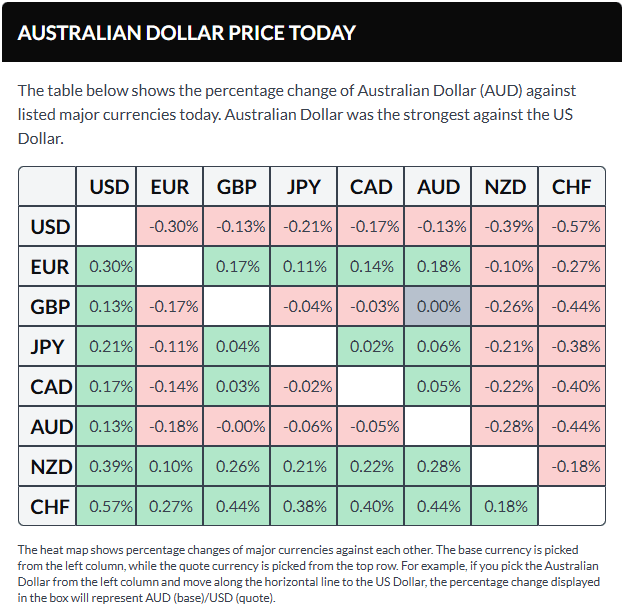
  • The US Dollar Index edged lower toward 97.00 amid Fed uncertainty and US shutdown concerns

    The US Dollar Index stays under pressure near 97.00 in Tuesday’s Asian session as concerns over Fed independence grow ahead of expectations that rates will remain unchanged at Wednesday’s meeting.

    The US Dollar Index (DXY) weakened toward 97.00 in Asian trading on Tuesday, with investors awaiting the US ADP Employment Change and Consumer Confidence data later in the day.

    Concerns over the Federal Reserve’s independence have pushed the DXY to its lowest level since September 18, 2025, after President Donald Trump said he would soon name a successor to Fed Chair Jerome when his term ends in May. According to Reuters, betting markets see BlackRock executive Rick Rieder as the leading candidate.

    Tim Duy, chief US economist at SGH Macro Advisors, noted that the actions of the next Fed chair cannot be separated from broader economic conditions or their influence on other FOMC members.

    Adding to the USD’s downside risks are fears of a US government shutdown, with Senate Democratic leader Chuck Schumer pledging to block a funding bill that includes Homeland Security appropriations. Lawmakers face a January 30 deadline to avoid a partial shutdown.

    Meanwhile, the Fed is widely expected to keep rates unchanged at Wednesday’s meeting after three straight cuts late in 2025. Markets will focus on the press conference for signals on the economic outlook and future rate path, with any hawkish tone potentially limiting near-term USD losses.

    Sources: Fxstreet

  • Wall Street futures were mixed as health insurers slipped ahead of the Fed meeting

    U.S. stock index futures showed minimal movement on Monday night, with Dow futures edging lower after a policy proposal from the Trump administration, as investors stayed cautious ahead of an important Federal Reserve decision and major tech earnings.

    S&P 500 futures hovered near flat at 9,982.0, while Nasdaq 100 futures rose 0.2% to 25,898.2 by 19:54 ET (00:54 GMT). Meanwhile, Dow Jones futures slipped 0.3% to 49,409.0.

    Wall Street ended higher, with the Dow up 0.6%, the S&P 500 gaining 0.5%, and the Nasdaq rising 0.4%.

    The Trump administration proposed flat-rate payments for Medicare Advantage.

    Dow futures edged lower after major health insurers slumped in late trading, following a Trump administration proposal to keep Medicare Advantage payment rates nearly flat, below market expectations. Shares of UnitedHealth, Humana, and CVS fell sharply on concerns that weaker reimbursement growth would squeeze margins amid rising medical costs. Separately, President Trump announced a hike in tariffs on South Korean imports to 25%, citing Seoul’s failure to ratify a trade deal.

    Investors await the Fed decision and key megacap earnings.

    Markets are in wait-and-see mode ahead of the Fed meeting, with rates expected to stay unchanged and focus on signals about future cuts. Attention is also on earnings from the “Magnificent Seven,” with results from Microsoft, Meta, Tesla, and Apple likely to shape sentiment, especially around AI investment, demand trends, and margins.

    Sources: Investing

  • Rate-Cut Expectations Waver as Conflicting Macro Signals Emerge

    Wednesday brings the FOMC meeting and Chair Powell’s press conference, and it wouldn’t be surprising if President Trump chose that moment—ideally around 2:30 p.m. ET—to announce his pick for the next Fed chair. Such timing would dominate headlines, catch financial media off guard, and inject maximum uncertainty into markets.

    That said, the Fed is not expected to cut rates at this meeting, which should keep the event relatively uneventful. In the bigger picture, what the Fed does between now and May may prove less important, particularly if a new chair is appointed and moves quickly toward easing.

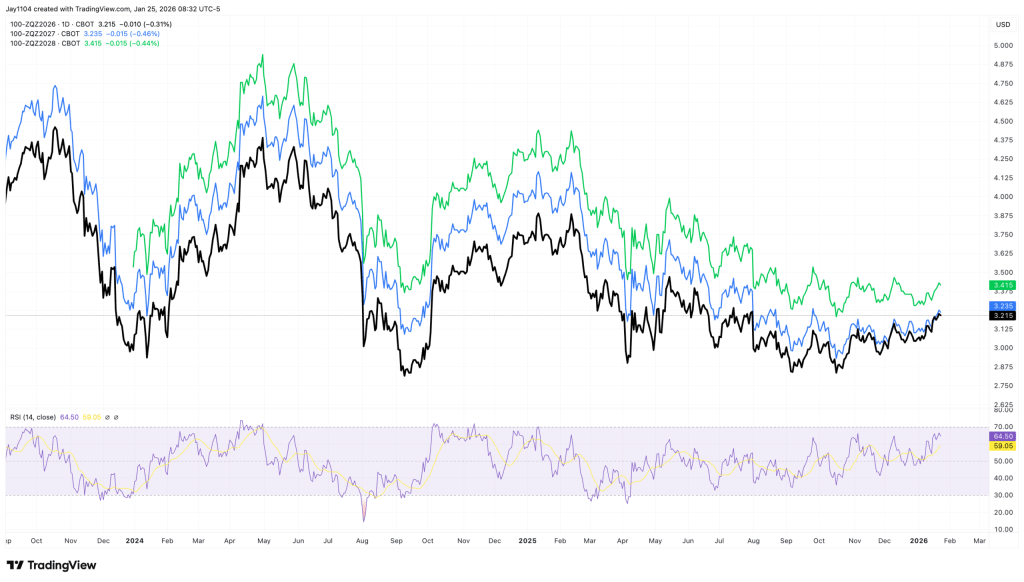
    Markets appear to be dialing back expectations for aggressive rate cuts. Current pricing suggests the fed funds rate settles near 3.25% by December, with little additional easing beyond that. To meaningfully shift those expectations, the nominee would likely need to be notably dovish—something markets already anticipate, given the widespread assumption that Trump will select a policy-leaning accommodator.

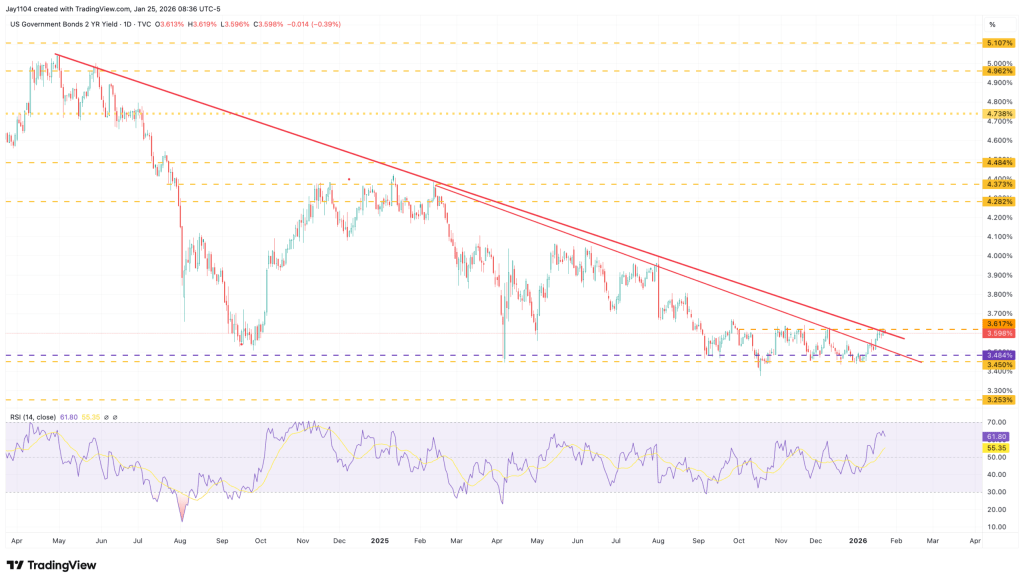
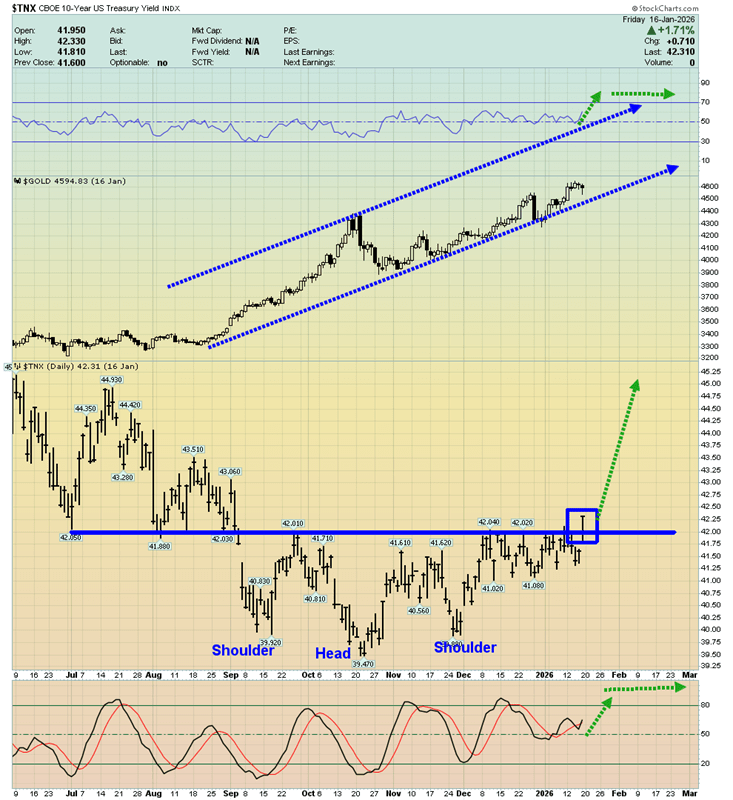
    As a result, the risk of a breakout in the 2-year Treasury yield appears increasingly credible, with initial resistance near 3.62%. Beyond that, a move back toward the 4% level cannot be ruled out. From a technical perspective, the setup supports this view: the 2-year yield has formed multiple bottoms in recent months, and the RSI has begun to turn higher, signaling building upside momentum.

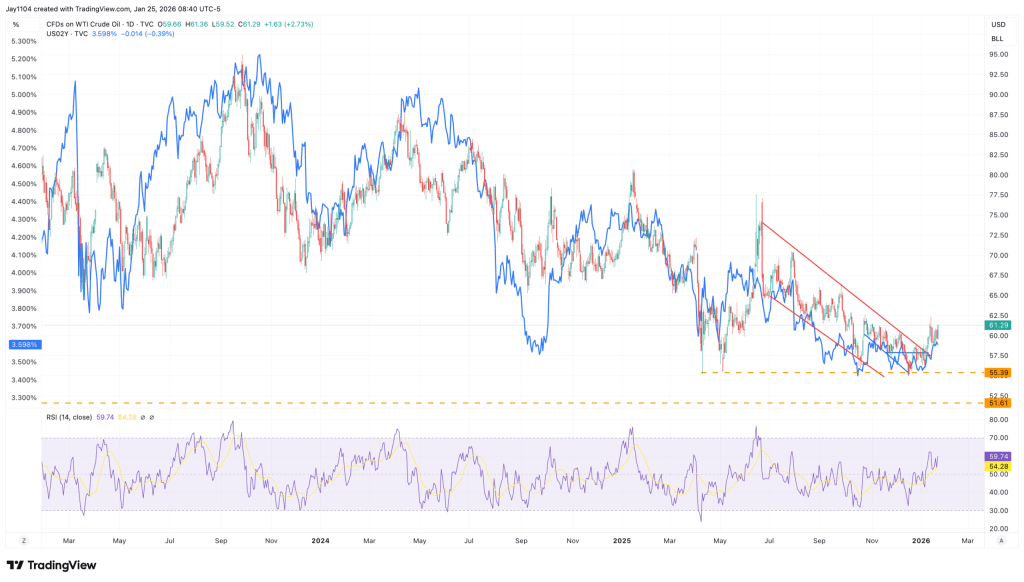
    The direction of the 2-year yield may ultimately be more closely linked to oil prices. With inflation still hovering near 3% and crude having fallen to around $60 from highs in the $120s, the message is clear: a rebound in oil prices could quickly reignite inflation pressures. That dynamic likely explains why the price action in oil and the 2-year yield charts has begun to look strikingly similar.

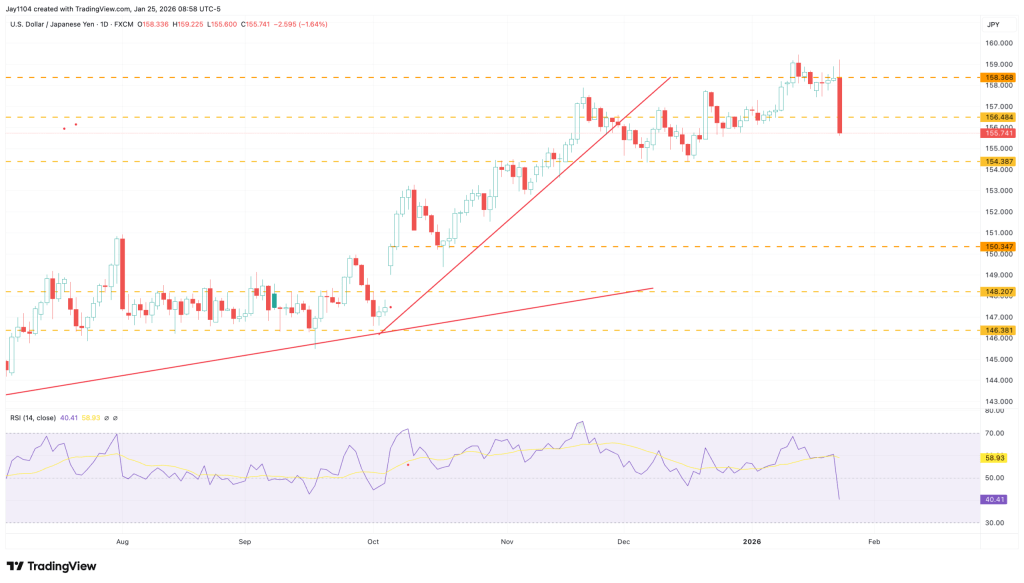
    The Bank of Japan once again chose to kick the can down the road, leaving rates unchanged and, in my view, offering little in the way of a clear policy roadmap. The yen’s strength on Friday appeared to be driven solely by reports of a possible “rate check” by the New York Fed on behalf of the U.S. Treasury—widely interpreted as a warning signal that currency intervention could be imminent. Perhaps the strategy is to keep markets stable until after the snap election in February. It’s hard to say, but it should be telling to see how markets react once Japan reopens on Monday.

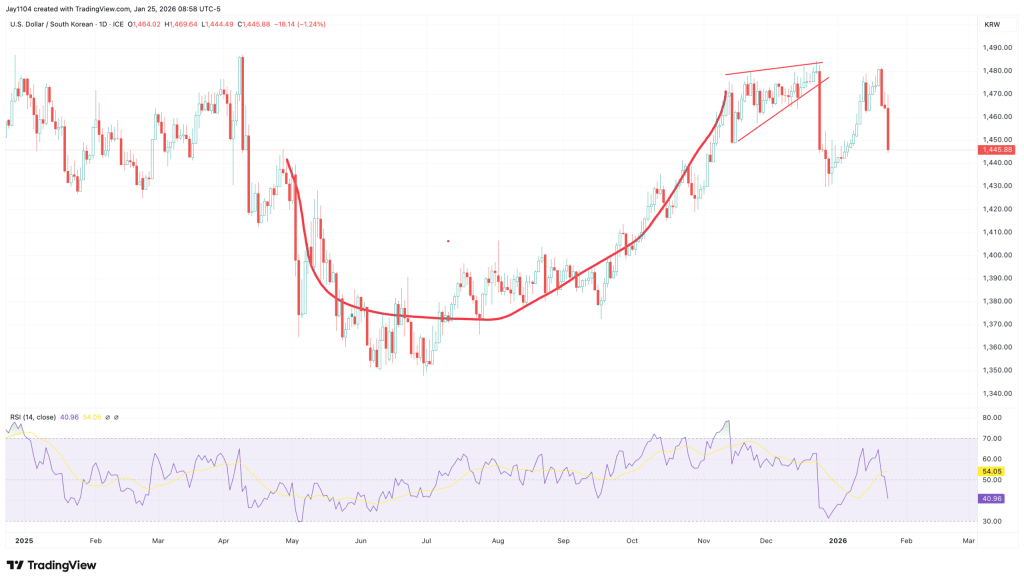
    The Korean won also strengthened notably against the U.S. dollar on Friday. In recent weeks, there has been growing chatter that the KRW had become excessively weak, so it’s likely the currency took the developments around the yen as a warning signal and moved to reprice accordingly.

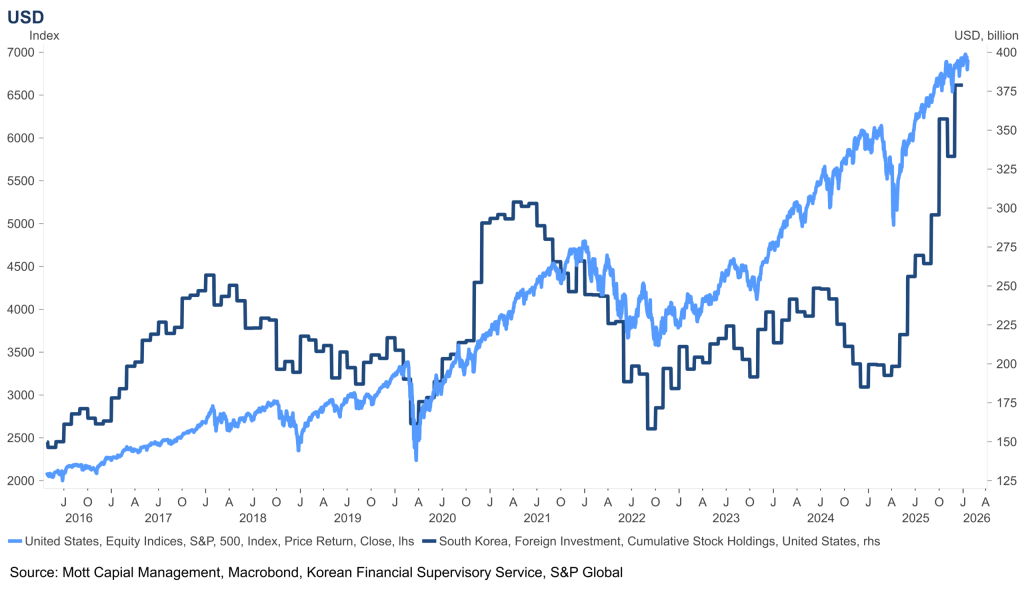
    The Korean won likely matters more than many investors realize, given the sizable exposure South Korean investors have built up in U.S. equities. That dynamic is probably one of the reasons the KRW has weakened so significantly in the first place—buying U.S. stocks requires selling won for dollars.

    If the KRW begins to strengthen from here, it could start to put pressure on that trade. For investors who are unhedged on the currency side, a stronger won increases the risk of FX-related losses on their U.S. equity holdings, potentially prompting position adjustments.

    Of course, this week also brings major earnings reports from Microsoft, Apple, Tesla, and Meta. From what I can see, all four stocks are currently sitting in positive gamma with positive delta positioning. Implied volatility typically builds into earnings because of the event risk, which sets up a familiar dynamic: unless a company delivers truly blowout results, the reaction can easily turn into a sell-the-news move. Once earnings are released, implied volatility collapses and hedges are unwound as delta decays, potentially putting pressure on the shares.

    Sources: Michael Kramer

  • Gold’s Rally Increasingly Hinges on China as U.S. Buying Loses Momentum

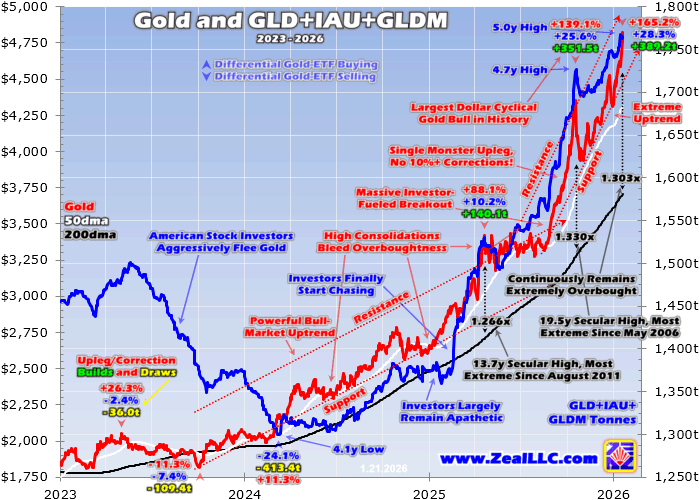
    Gold’s record-setting bull market has resumed its charge—but under a new set of drivers. Aggressive buying from China has increasingly taken over from gold’s traditional engines of demand, namely U.S.-based gold ETFs and futures traders. With American participation fading, gold’s ability to hold lofty levels now rests heavily on sustained Chinese demand. This shift has helped gold remain elevated, postponing the corrective phase typically required to rebalance overheated markets.

    Between late July and mid-October 2025, gold surged an extraordinary 32.9% in just 2.7 months. During that stretch, the metal logged 24 record closes—roughly three-sevenths of all trading days—while its strongest gains were spread relatively evenly across the calendar. At the time, U.S. investors were aggressively piling into gold, providing powerful upside momentum.

    That enthusiasm was clearly reflected in holdings of the world’s largest gold ETFs—SPDR Gold Shares (GLD), iShares Gold Trust (IAU), and SPDR Gold MiniShares (GLDM). According to the World Gold Council’s Q3’25 data, these three vehicles together accounted for more than three-sevenths of all gold held by global ETFs. During the rally, their combined bullion holdings jumped 10.9%, or 169.4 metric tons, helping propel gold to around $4,350 by mid-October and pushing technical conditions to extreme levels.

    At its peak, gold was trading 33% above its 200-day moving average—ranking among the most overbought readings since 1981. The bull market had delivered gains of 139.1% over 24.5 months without a single correction exceeding 10%, making it the largest cyclical gold bull ever in U.S. dollar terms since the gold standard was abandoned in 1971. Historically, such excesses have almost always been followed by sharp pullbacks.

    A correction initially appeared to be unfolding, with gold dropping 9.5% into early November—its steepest decline of the cycle and close to formal correction territory. Then the pattern abruptly changed.

    Since mid-October, gold has climbed another 10.9% over roughly three months, yet this time without meaningful participation from U.S. investors. ETF holdings at GLD, IAU, and GLDM rose just 2.2% (37.8 tons), less than one-quarter of the prior buildup—and all of that increase occurred only in the past month. Those holdings didn’t even recover their mid-October peak until mid-December, shortly before gold began printing fresh record highs.

    Gold’s ability to avoid a deeper correction despite some of the most extreme overbought conditions in decades raised questions. Normally, such excesses demand a reset in sentiment and positioning. Since U.S. investors were not driving the rebound, another source of demand had to be absorbing supply.

    Clues emerged in the timing of gold’s strongest advances. Since mid-October, nearly all of gold’s gains have occurred on Mondays—a striking anomaly given that Mondays have historically been gold’s weakest trading day. Major upside moves were logged on November 10, November 24, December 22, January 5, January 12, and again this week following a Monday market holiday. Collectively, these few sessions accounted for the vast majority of gold’s rally since October.

    Closer inspection revealed that most of these gains occurred overnight during Asian trading hours—well before European or U.S. markets opened. In other words, Chinese traders were responsible for driving price action when the rest of the world was largely inactive. These sessions effectively became “China Mondays,” periods when Chinese market flows dominated global pricing due to minimal competing liquidity.

    Because China is uniquely active during the late Sunday-to-early Monday window, its influence on gold prices during that time is disproportionate. On other weekdays, extended trading hours in Western markets dilute that impact. The clustering of gains during these windows strongly suggests that China has become the primary marginal buyer supporting gold at record levels.

    Until U.S. investors re-engage meaningfully, gold’s resilience at these heights will depend largely on whether Chinese demand remains strong enough to keep the rally alive.

    China’s influence on Sunday-night trading is further magnified by the weekend effect. Weekends represent the longest stretch when traders are unable to react to new, market-moving developments. As a result, many participants square positions and shut down algorithmic trading systems ahead of the weekend. Meanwhile, algorithms that remain active into early Monday often have a backlog of news to process, which can intensify price moves during thin overnight liquidity. This dynamic can significantly amplify China-driven buying in gold.

    Before delving further into China’s growing dominance in the gold market, it’s useful to look at how dramatically conditions shifted around gold’s mid-October peak. In the months leading up to that high, heavy share buying in GLD, IAU, and GLDM was the primary force behind gold’s explosive rally. Since then, demand from U.S. equity investors has been largely muted. Even so, gold has managed to surge back into extreme overbought territory—an outcome that underscores how unusual and China-dependent this phase of the rally has become.

    China’s dominance during Sunday-night trading is reinforced by the structure of weekends themselves. Weekends are the longest periods when traders cannot respond to new, market-moving information. As a result, many participants flatten positions and shut down algorithmic systems before markets reopen. Meanwhile, algorithms that remain active into early Monday often need to process a backlog of news, which can magnify price movements in thin overnight liquidity. This dynamic amplifies China-driven gold buying when global participation is minimal.

    Before exploring China’s growing grip on gold prices further, it helps to contrast the months before and after gold’s mid-October peak. In the run-up to that high, aggressive share buying in GLD, IAU, and GLDM was the dominant force behind gold’s explosive advance. Since then, U.S. stock investor demand has been largely muted—yet gold has still surged back into extreme overbought territory, underscoring how unusual and externally driven this rally has become.

    While American equity investors were slow to chase this China-led surge until recently, U.S. gold-futures speculators jumped in aggressively. Futures positioning is reported weekly, and in late November—just after gold’s second “China Monday” surge—total speculative long positions stood at 307,000 contracts. Over the following seven weeks, that figure ballooned. By the January 13 Commitments of Traders report, total spec longs had risen to 362,400 contracts—an increase equivalent to roughly 172 metric tons of gold. That dwarfed the roughly 52-ton increase in GLD, IAU, and GLDM holdings over the same period, meaning futures traders significantly amplified China-driven momentum.

    However, futures-driven buying power is limited and quickly exhausted. Gold futures allow extreme leverage—often 20x to 25x—which dramatically restricts the pool of participants willing to assume such risk. Assessing speculative positioning within its historical range provides insight into whether traders are more likely to add exposure or begin selling.

    As of mid-January, speculative long positions were already 58% into their bull-market range, while shorts were just 6% in. The most bullish setup occurs when longs are near the bottom of their range and shorts are near the top, leaving ample room for buying. The current configuration is far closer to the opposite—suggesting diminishing upside fuel from U.S. speculators.

    That leaves gold’s ability to continue defying a necessary corrective phase largely dependent on China. Unfortunately, reliable, consistent data on Chinese gold markets is scarce, especially in English. Even if such data were available, it would require extensive historical analysis to establish meaningful relationships with price behavior.

    Still, anecdotal evidence is abundant. Major financial publications regularly report frenzied gold buying in China. Silver’s recent parabolic surge—largely driven by Chinese demand—appears to have spilled over into gold, fueling enthusiasm both domestically and globally. Without transparent data, Western analysts are left guessing how long this demand can persist.

    Cultural factors may offer some clues. In Western markets, gold had long been dismissed as outdated, resulting in minimal portfolio allocations for years. In contrast, gold has always held deep cultural significance in China. Chinese investors therefore began this cycle with far greater enthusiasm, potentially making them more willing to buy aggressively and stay invested longer.

    Capital controls also play a role. Chinese investors have limited avenues to diversify wealth outside the domestic financial system, while gold and silver offer a rare escape from policy risk. Additionally, Chinese culture places a stronger emphasis on wealth accumulation and status—traits that can fuel speculative behavior.

    These dynamics make China uniquely susceptible to a speculative gold mania. Evidence increasingly suggests one is underway, reinforced by the repeated “China Monday” surges. Yet Chinese markets remain opaque. Financial transparency is limited, economic data series have been quietly discontinued when trends turn unfavorable, and even official gold reserve figures from the People’s Bank of China are widely viewed with skepticism.

    For example, China reported identical gold reserves for more than six years before suddenly announcing a 57% jump in a single month—an implausible scenario. Many analysts believe China has accumulated far more gold than officially disclosed for years. If official reserve data lacks credibility, confidence in broader market transparency is equally questionable.

    That uncertainty is unsettling. History shows that speculative manias eventually end in sharp, symmetrical collapses once buying power is exhausted. Whether China’s gold frenzy lasts months—or reverses abruptly—is unknowable.

    What is clear is that gold’s recent breakout has been almost entirely driven during Chinese trading hours. Since December 19, gold has climbed roughly $487, yet nearly all of those gains occurred on just four “China Mondays.” This concentration of upside is highly abnormal and inherently risky.

    Chinese markets have repeatedly demonstrated how quickly sentiment can flip once fear takes hold. Any government action—such as curbing speculative activity—could trigger rapid selling. Without strong participation from U.S. investors or futures traders to absorb that supply, gold could fall sharply.

    In short, Chinese trading has seized control of the gold market. After peaking at extreme overbought levels in mid-October, gold required a corrective reset. That process was prematurely halted by surging Chinese demand. With U.S. participation limited and futures buying power fading, gold’s current position is precarious. If Chinese enthusiasm wanes or policy shifts intervene, a forced and potentially violent rebalancing could follow.

    Sources: Adam Hamilton

  • One Stock to Buy and One Stock to Sell This Week: Apple and Starbucks

    This week’s spotlight will be on the Fed’s FOMC meeting, Chair Powell’s press conference, major Big Tech earnings, and the looming U.S. government shutdown deadline. Apple is set to report earnings after Thursday’s close, with expectations rising for a beat-and-raise quarter. Meanwhile, Starbucks looks like a sell, as profit growth continues to slow and a weaker outlook is anticipated.

    The stock market finished Friday on a mixed note, as both the S&P 500 and Nasdaq Composite recorded their second consecutive weekly declines.

    The Dow Jones Industrial Average slipped 0.5% for the week, while the S&P 500 edged down about 0.4%. The tech-heavy Nasdaq fell by less than 0.1%, and the small-cap Russell 2000 lost 0.3%.

    Looking ahead, the coming week is set to be a blockbuster, packed with potential market catalysts. Investors will be watching a crucial Federal Reserve policy meeting alongside a wave of earnings from major technology companies.

    The Fed is widely expected to hold interest rates steady on Wednesday, though markets could see volatility as Chair Jerome Powell addresses the media in his post-meeting press conference.

    Other key economic releases on the calendar include durable goods orders on Monday and The Conference Board’s Consumer Confidence Index for January on Tuesday. Friday will also bring the release of the December producer price index.

    At the same time, earnings season ramps up sharply, with four members of the “Magnificent Seven” set to report this week. Microsoft (NASDAQ:MSFT), Tesla (NASDAQ:TSLA), and Meta Platforms (NASDAQ:META) are scheduled to announce results Wednesday evening, followed by Apple (NASDAQ:AAPL) after the close on Thursday.

    These mega-cap names will be joined by a long list of other major companies, including IBM (NYSE:IBM), ASML (NASDAQ:ASML), SanDisk, Exxon Mobil (NYSE:XOM), Chevron (NYSE:CVX), Visa (NYSE:V), Mastercard (NYSE:MA), American Express (NYSE:AXP), SoFi Technologies (NASDAQ:SOFI), UnitedHealth Group (NYSE:UNH), Boeing (NYSE:BA), UPS (NYSE:UPS), Caterpillar (NYSE:CAT), General Motors (NYSE:GM), Verizon (NYSE:VZ), AT&T (NYSE:T), Starbucks (NASDAQ:SBUX), American Airlines (NASDAQ:AAL), RTX (NYSE:RTX), and Lockheed Martin (NYSE:LMT).

    Adding to the uncertainty, Congress faces a Friday deadline to fund the government once again, with the risk of a prolonged shutdown looming.

    No matter how markets ultimately move, I outline below one stock that could attract strong buying interest and another that may face renewed downside pressure. Keep in mind, this outlook is strictly for the week ahead, from Monday, January 26 through Friday, January 30.

    Stock to Buy: Apple

    Apple is scheduled to report earnings after the market closes on Thursday, with conditions lining up for a possible upside surprise. Wall Street is increasingly calling for a beat-and-raise quarter, as consensus forecasts point to double-digit revenue growth fueled by steady iPhone demand and continued expansion in services.

    Options markets are pricing in a post-earnings move of roughly plus or minus 4%. Meanwhile, earnings expectations have turned more optimistic, with profit estimates revised higher 21 times in recent weeks versus just three downward revisions, according to InvestingPro data—underscoring the growing bullish sentiment surrounding Apple’s results.

    Apple is expected to post adjusted earnings of $2.67 per share, representing an 11.2% increase from a year ago, while revenue is projected to climb 10.6% year over year to $137.5 billion. Analysts are looking to the iPhone and Services segments to lead the charge, pointing to double-digit growth and a strong pipeline of upcoming products, including a foldable iPhone and an AI-enhanced Siri.

    With sentiment leaning bullish, the market appears positioned for a positive surprise. Price targets reaching as high as $350—implying roughly 41% upside—suggest that even a modest earnings beat could be enough to trigger a rebound in the stock.

    So far in 2026, Apple shares have struggled, falling roughly 9% year to date to finish Friday at $248.04. The decline has mirrored broader volatility across the tech sector, alongside investor concerns that Apple’s AI strategy may be lagging rivals such as Alphabet.

    That said, the recent pullback is shaping up as a potential buying opportunity. The stock is trading in deeply oversold territory, and while daily technical indicators still signal a “Strong Sell,” key support sits near $247.53 (pivot S1). A decisive move above resistance at $248.87 could open the door to a rebound toward $260 or higher, particularly if earnings guidance exceeds expectations.

    Trade Setup:

    • Entry: $248 (pre-earnings)
    • Target: $265 (gain ~7%)
    • Stop-Loss: $240 (risk ~3%)

    Stock to Sell: Starbucks

    Starbucks is set to report earnings Wednesday morning, but unlike Apple, it heads into the week on much shakier footing. The coffee chain is grappling with slowing same-store sales in core markets, intensifying competition, changing consumer spending habits, and persistent cost pressures from labor and commodities.

    Options markets are pricing in a post-earnings move of about plus or minus 6.4%, highlighting elevated downside risk. Sentiment has also turned notably bearish, with 17 of the 19 analysts tracked by InvestingPro cutting their EPS forecasts over the past three months ahead of the report.

    Wall Street is bracing for a difficult quarter, with earnings per share projected to fall 15.9% year over year to $0.59, even as revenue is expected to edge up 2.5% to $9.62 billion.

    Starbucks is also contending with intensifying competition from value-focused fast-food chains such as McDonald’s and Dunkin’, alongside pressure from local coffee shops. At the same time, its China growth narrative—once a major upside driver—has increasingly become a source of investor concern.

    Looking ahead, expectations are building that CEO Brian Niccol may caution about continued near-term weakness, citing softer customer traffic, higher operating costs, and lingering uncertainty around the company’s turnaround efforts.

    So far in 2026, Starbucks has been one of the stronger performers, climbing roughly 16% year to date and closing Friday at $97.62. However, the technical setup suggests the stock may be overextended heading into earnings.

    Key pivot support lies near $96.25, with resistance around $97.84. A downside break below support could open the door to a pullback toward the $90 level if earnings or guidance disappoint.

    Trade Setup:

    • Entry: $98 (pre-earnings)
    • Target: $90 (gain ~8%)
    • Stop-Loss: $103 (risk ~5%)

    Sources: Jesse Cohen

  • When will the German IFO Survey be released, and what impact could it have on the EUR/USD exchange rate?

    Overview of the German IFO Survey

    Germany’s IFO Institute is set to release its January Business Survey on Monday at 09:00 GMT.

    The headline IFO Business Climate Index is forecast to edge up to 88.1 in January, from 87.6 in December. In the previous release, the Current Assessment Index stood at 85.6, while the Expectations Index came in at 89.7.

    How might the German IFO Survey influence the EUR/USD exchange rate?

    EUR/USD could trade sideways if the German IFO Business Survey meets expectations, as heightened safe-haven demand continues to cap upside momentum despite the pair opening with a gap higher. Meanwhile, the Euro may hold relatively steady after Eurozone PMI figures signaled weakness in the services sector in January, reinforcing expectations that the European Central Bank (ECB) will keep interest rates unchanged. Earlier data from Germany was more constructive, with the Services PMI exceeding forecasts and remaining in expansionary territory, while the Manufacturing PMI showed improvement but stayed below the 50 threshold.

    The pair comes under pressure as the US Dollar regains intraday strength, supported by rising risk aversion linked to trade and geopolitical concerns. US President Donald Trump warned of potential 100% tariffs on Canadian imports should Ottawa pursue a trade agreement with China. Canadian Prime Minister Mark Carney clarified that Canada has no intention of negotiating a free trade deal with Beijing. Trump also noted that a US aircraft carrier strike group is en route to the Middle East amid escalating tensions with Iran.

    From a technical perspective, EUR/USD pulls back after opening at four-month highs and is trading near 1.1860 at the time of writing. Despite the dip, the broader bullish structure remains intact, with the 14-day Relative Strength Index (RSI) hovering around 69.00, indicating strong—though stretched—momentum. The pair could attempt a retest of the four-month peak at 1.1897, close to the key psychological resistance at 1.1900. On the downside, immediate support is seen at the nine-day Exponential Moving Average (EMA) near 1.1739.

    Sources: Fxstreet

  • Gold climbs to a fresh record above $5,000 an ounce as investors seek safe havens

    Gold vaulted above the psychological $5,000-per-ounce threshold on Monday, building on last week’s explosive rally as investors flocked to the traditional safe haven amid escalating geopolitical risks.

    Spot gold climbed 1.1% to a fresh all-time high of $5,035.83 per ounce by 18:52 ET (00:52 GMT), while U.S. gold futures also advanced 1.1% to a record $5,074.71 per ounce.

    The precious metal surged more than 8% last week, repeatedly setting new highs, and is now up nearly 17% year-to-date.

    The broader precious metals complex also strengthened. Silver jumped over 2% to a record $106.56 per ounce, while platinum edged higher to a new peak of $2,798.46 per ounce.

    Gold has climbed sharply since the beginning of the year, supported by geopolitical tensions, expectations of looser U.S. monetary policy later in 2026, and continued buying from central banks and investors hedging against market volatility.

    Geopolitical tensions, Trump tariff threats lift gold

    A key catalyst behind gold’s sharp rally this month has been mounting friction between the United States and its NATO partners over Greenland, a dispute that has rattled global markets.

    President Trump’s comments on U.S. strategic ambitions in the Arctic have further strained transatlantic ties, fueling fears of wider diplomatic and economic repercussions.

    Adding to those geopolitical pressures, Trump escalated trade tensions with Canada over the weekend, warning of a 100% tariff on Canadian imports should Ottawa move forward with a trade agreement with China.

    Trump said on his social media platform that Canada could serve as a “drop-off port” for Chinese goods entering the United States, warning that Beijing would “eat Canada alive” if the agreement proceeds.

    Fed rate decision in focus

    Gold has also found support from expectations around U.S. monetary policy. The Federal Reserve is set to wrap up its policy meeting on Wednesday, with markets broadly expecting officials to leave interest rates unchanged.

    Although a hold decision is largely priced in, investors will closely examine the Fed’s statement and remarks from Chair Jerome Powell for signals on the timing and pace of potential rate cuts later this year.

    Gold typically benefits from lower interest rates, which reduce the opportunity cost of holding non-yielding assets.

    “Both the data and Chair Powell’s strong defence of central bank independence suggest there is little chance of a Fed rate cut on January 28,” ING analysts said in a note.

    “Attention will instead turn to President Trump’s forthcoming nomination for the next Fed chair, upcoming economic data, and whether that nominee can steer the committee toward additional rate cuts,” they added.

    Sources: Reuters

  • Five major analyst AI calls: Microsoft upgraded, Arm downgraded; Google raised to Strong Buy

    Jefferies says Microsoft’s recent pullback presents an attractive entry opportunity

    Jefferies analyst Brent Thill wrote this week that the recent pullback in Microsoft Corporation (NASDAQ: MSFT) shares has created an attractive buying opportunity. He highlighted the company’s expanding backlog, deepening AI partnerships, and continued strength in cloud computing as the foundations of a robust multi-year growth outlook among large-cap technology names.

    Thill noted that the stock has declined about 18% since the first fiscal quarter, despite Microsoft disclosing roughly $250 billion in commitments to OpenAI and an additional $30 billion linked to Anthropic. He added that Microsoft’s current valuation—around 23 times calendar-year 2027 earnings—now trades below that of Amazon and Google, even though Microsoft offers what he sees as superior earnings visibility.

    According to Thill, Microsoft’s record level of contractual commitments is the primary catalyst for buying at current prices. He expects second-quarter remaining performance obligations to show the largest sequential increase on record, driven largely by the OpenAI and Anthropic agreements, which he says provide “unprecedented multi-year demand visibility.”

    Azure remains a central source of upside. Thill described Azure demand as constrained by supply rather than demand, noting that Microsoft plans to double its data-center capacity over the next two years. After beating Azure revenue guidance for three straight quarters, he believes that execution on new capacity alone could push results above consensus expectations for both fiscal second-quarter Azure performance and full-year 2026 forecasts.

    The analyst also pointed to accelerating AI monetisation from Copilot and other first-party products. With Azure representing roughly 30% of total revenue, he said sustained outperformance in the cloud business could push overall revenue growth into the high-teens.

    Although Thill acknowledged ongoing capacity constraints and elevated capital expenditures, he believes Microsoft is well positioned to generate meaningful upside to both revenue and earnings through fiscal 2026.

    Analyst upgrades Google to Strong Buy as AI stack accelerates

    Earlier this week, Raymond James upgraded Google parent Alphabet (NASDAQ: GOOGL) to Strong Buy, arguing that the company is entering a phase in which its AI stack is “shifting into high gear,” creating the conditions for meaningful upward revisions to medium-term forecasts.

    Analyst Josh Beck said updated bottom-up analysis across Search and Google Cloud Platform (GCP) led him to raise his 2026 and 2027 estimates, with his 2027 revenue projection now exceeding broader Street expectations. He believes Alphabet is “entering a cycle of strengthening AI stack momentum and upward estimate revisions that could produce one of the highest-quality top-line AI acceleration stories in the public markets.”

    Beck added that in 2026, the AI stack narrative and related forecast upgrades are likely to become the primary performance drivers among mega-cap internet stocks, rather than a simple mean-reversion trade.

    Within Cloud, Beck projects GCP revenue growth of 44% in 2026 and 36% in 2027, ahead of consensus. He attributes this to strong momentum in infrastructure and platform services, underpinned by large-scale TPU and GPU deployments and increasing adoption of the Gemini API and Vertex AI.

    By the end of 2027, Beck estimates that GCP could generate approximately $25 billion in annualised revenue from TPUs, around $20 billion from GPUs, about $10 billion from the Gemini API, and roughly $2.5 billion from Vertex AI.

    In Search, Beck projects revenue growth of 13% in both 2026 and 2027—above broader Street expectations—as softness in core search is offset by the expanding adoption of AI Overviews, AI Mode, and Gemini. He expects AI-driven queries to drive stronger cost-per-click growth as improved context and conversion rates enhance monetisation.

    Stifel starts Micron at Outperform, citing a multi-year memory market upturn

    Brokerage firm Stifel initiated coverage of Micron Technology with an Outperform rating, arguing that the memory industry is entering a multi-year upcycle driven by structural AI demand and persistently tight supply conditions.

    Stifel believes Micron is well positioned to benefit from rising average selling prices and a favorable mix shift toward higher-margin products, as memory increasingly becomes a critical constraint within AI systems. “Access to memory has emerged as a key bottleneck in AI racks and systems, boosting demand for higher-performance, higher-bandwidth memory solutions,” the firm said.

    With supply expected to remain constrained through 2027, Stifel sees an environment supportive of sustained pricing power and margin expansion. Against this backdrop, the firm expects Micron to capture significant ASP growth and expand margins, forecasting non-GAAP EPS growth of more than 275% over the next two years.

    High-bandwidth memory (HBM) is central to Micron’s growth thesis, according to Stifel. As AI models become more complex and require faster access to larger data sets, next-generation chips are incorporating more HBM, increasing memory’s share of overall AI infrastructure spending. As the industry’s number-two player, Micron is expected to see HBM revenue grow 164% in fiscal 2026 and a further 40% in fiscal 2027, with DDR and QLC NAND also benefiting from AI-driven demand.

    Stifel also highlighted several risks, including the potential re-emergence of Samsung as a more formidable HBM competitor, elevated capital spending that could shift value toward equipment suppliers, a possible easing in DRAM supply-demand dynamics, and the risk that chipmakers design their own base logic dies.

    On valuation, Stifel noted that Micron trades at roughly 9.7 times calendar 2026 earnings, modestly below historical averages. “While valuation increasingly reflects significant growth expectations, we believe the shares can continue to perform on the back of a multi-year, AI-driven product cycle characterized by tight supply,” the firm concluded.

    Mizuho says Arm selloff presents a buying opportunity

    Mizuho analyst Vijay Rakesh said investors should take advantage of the recent pullback in Arm Holdings shares to build positions, arguing that market concerns around handset demand have become excessively pessimistic.

    Arm’s stock has declined roughly 30% since November, even as the Philadelphia Semiconductor Index has risen about 10%. Rakesh described the selloff as “overdone,” adding that Mizuho would “be buyers of ARM on the approximately 30% pullback.”

    According to Rakesh, Arm’s growth drivers extend well beyond smartphones. While mobile royalties account for about 50% of revenue, he noted that Arm has historically outpaced handset market growth and is projected to expand at annual rates of 7% to 31% between 2021 and 2027.

    A key catalyst is the ongoing transition to Arm’s v9 architecture, which delivers roughly double the average selling price per core compared with v8, providing a structural uplift to royalty revenue. Rakesh also highlighted rising interest in custom silicon, noting that potential ASIC and CPU ramps in 2027 and 2028 could contribute more than $1 billion in incremental revenue.

    He further pointed to opportunities tied to AI-focused custom chips, including a potential training and inference ASIC associated with OpenAI and SoftBank. That initiative alone, he said, could conservatively generate around $1 billion in revenue during the 2027–2028 period.

    Beyond mobile, Arm is gaining traction in data centers as hyperscalers increasingly adopt its architectures. Rakesh cited platforms such as AWS Graviton, Microsoft Cobalt, Meta’s planned CPU, and Nvidia’s Grace and Vera as evidence of a growing custom silicon customer base and an improving royalty mix.

    Rakesh reiterated Mizuho’s Outperform rating and $190 price target, saying Arm remains “well positioned as the broadest global semiconductor platform.”

    Morgan Stanley grows more positive on European semiconductor stocks

    Morgan Stanley upgraded the European semiconductor sector to Overweight this week, arguing that the group offers an attractive environment for selective stock picking as diversification inflows gather pace, valuation dynamics improve, and semiconductor equipment companies stand to benefit from the next phase of the AI capital expenditure cycle.

    The firm’s strategists noted that European equities are attracting increased diversification inflows while beginning to emerge from a long-standing valuation discount to U.S. markets. Within this context, semiconductors stand out as a sector where strengthening bottom-up fundamentals are increasingly driving top-down performance. Morgan Stanley said its preferred expression of this view remains analyst-led stock selection rather than broad factor exposure.

    “While European equities already appear highly idiosyncratic, we see further scope for stock-level dispersion in Europe to rise toward cycle highs,” the strategists wrote.

    The upgrade is anchored in the semiconductor equipment segment. Morgan Stanley highlighted ASML as the dominant contributor to European Top Picks performance year to date, accounting for more than half of weighted gains. ASML also represents roughly 80% of the MSCI Europe Semiconductors and Semiconductor Equipment index.

    Looking ahead, the bank said risks in the AI investment cycle are shifting away from demand and toward execution and transition. “For 2026, the key risk in the AI capex cycle is execution and transition, not demand,” the strategists wrote, arguing that this dynamic favors European semiconductor equipment exposure—particularly companies tied to extreme ultraviolet lithography.

    Morgan Stanley expects upcoming order intake to confirm higher foundry and memory capital spending through 2027, alongside stronger-than-expected demand from China.

    From a portfolio construction standpoint, the firm said it adjusted its sector model to reflect improving earnings momentum and broader price-target revisions for European semiconductors, while neutralising accrual factors and reducing China exposure. These changes lifted the sector to second place in Morgan Stanley’s internal rankings, just behind banks.

    At the stock level, ASML and ASM International remain Morgan Stanley’s Top Picks, with BE Semiconductor Industries also highlighted as an Overweight-rated beneficiary of the same themes.

    Sources: Investing

  • Could 2026 mark the long-anticipated breakthrough for Tesla’s Semi truck?

    When Tesla introduced the Semi in 2017, it billed the vehicle as a game-changer for the heavy-duty trucking industry. Almost ten years on, however, only a limited fleet is in operation. Repeated production delays and Tesla’s focus on higher-visibility ventures such as passenger cars, AI, and robotics have kept the Semi on the sidelines. Still, 2026 could prove to be the decisive year in determining whether the truck can evolve from a pilot project into a viable commercial offering.

    Worldwide sales of heavy-duty trucks reached roughly 2.8 million units in 2024, including about 400,000 in the U.S. Yet electrification in the Class 8 segment remains minimal, as fleet operators tend to prioritise total cost of ownership over branding or technological novelty.

    Tesla argues that the Semi offers a strong economic proposition, citing a claimed 500-mile range from an approximately 850 kWh battery, ultra-fast charging rates of up to 1.2 MW, and significantly lower energy and maintenance costs compared with diesel alternatives. Elon Musk has repeatedly characterised demand as “ridiculous” and the business case as a “no-brainer” for fleet operators.

    On paper, momentum appears to be building. Filings associated with California’s electric-truck incentive programme indicate that nearly 900 Semis were applied for in 2025—more than any traditional truck manufacturer has historically secured. Early customers, including DHL and RoadOne, report performance exceeding expectations and have signalled intentions to expand their fleets once mass production begins.

    Execution risks, however, remain substantial. Tesla is aiming for annual output of up to 50,000 units from its Nevada facility by the end of 2026, a lofty target given that the entire U.S. day-cab tractor market totals fewer than 100,000 units per year. Additional concerns include battery supply constraints following a significant writedown by a major 4680-cell supplier, while drone footage suggests the Nevada production line is not yet fully installed.

    Bernstein analysts also caution that, based on current assumptions, the Semi’s total cost of ownership may still marginally exceed that of best-in-class diesel trucks.

    For established manufacturers such as Daimler, Volvo, and Paccar, Tesla’s influence is unlikely to be felt immediately. Diesel-powered trucks continue to dominate the market, and the electrification of long-haul freight is expected to progress gradually.

    However, if Tesla succeeds in scaling production in 2026, the Semi could alter industry perceptions, prompting increased investment and putting pressure on margins within one of the sector’s most important profit pools.

    Sources: Investing

  • Micron and Nvidia Sit at the Top of AI Stocks

    Micron (MU) is a global leader in advanced memory and storage technologies, playing a critical role in converting data into actionable intelligence. The stock has surged amid the AI-driven rally, as Micron’s products have become an essential component of AI infrastructure, particularly in addressing persistent memory bottlenecks.

    The shares also highlight the effectiveness of the Zacks Rank framework. In August of last year, Micron was upgraded to the highly sought-after Zacks Rank #1 (Strong Buy) following upward revisions to earnings estimates, a shift that has since been accompanied by a strong and sustained rally in the stock price.

    As illustrated above, the Zacks Rank may also have helped mitigate downside risk last March.

    Why Micron Shouldn’t Be Overlooked

    Micron delivered outstanding results in its latest earnings report, surpassing consensus expectations on both revenue and earnings, driven by rapidly accelerating demand tied to AI workloads. Revenue surged more than 55% year-over-year to a record high, while adjusted EPS jumped an impressive 185%.

    The company’s cash-generation profile also strengthened significantly amid the favorable demand backdrop. Operating cash flow reached a record $8.4 billion during the period, sharply exceeding the $5.7 billion generated in the same period last year.

    The positive momentum appears set to continue, with Micron’s Q2 guidance pointing to new records across revenue, margins, earnings, and free cash flow. In short, Micron plays a critical role in enabling the AI boom, as memory capacity remains a key bottleneck in advanced systems. This strategic positioning places the company in a strong overall stance and helps shield it from concerns about being an AI “also-ran” or laggard.

    As illustrated below, Micron’s revenue has surged sharply in recent periods, reinforcing the strength of the current demand environment. The company’s top-line trajectory mirrors that of NVIDIA (NVDA – Research Report), widely regarded as the flagship beneficiary of the broader AI trade.

    Micron vs. NVIDIA

    While many AI-linked companies are likely to come under increased scrutiny in 2026, Micron represents a far more straightforward beneficiary of the broader infrastructure buildout. Memory remains a key bottleneck in AI systems, and MU has been capitalizing meaningfully on this constraint. The company recently announced its exit from the consumer memory segment, further underscoring its strategic focus on maximizing revenue from large-scale enterprise and data-center customers.

    Micron noted that “AI-driven growth in the data center has led to a sharp increase in demand for memory and storage,” adding that the decision to wind down its Crucial consumer business was made to improve supply allocation and support for larger, strategic customers in faster-growing markets.

    Overall, Micron stands out as one of the most compelling AI-related investment opportunities, drawing a clear parallel with NVIDIA. While NVIDIA dominates the GPU side of AI computing, Micron plays an equally critical role by supplying the high-performance memory required for those GPUs to operate efficiently.

    Turning to NVIDIA, the company once again delivered a double beat versus consensus in its latest, record-setting earnings report. Revenue reached $57 billion, up 62% year-over-year, alongside a 67% surge in earnings per share. Data Center revenue climbed to $51.2 billion, representing a robust 66% annual increase and comfortably exceeding consensus expectations of $49.1 billion.

    For investors looking to capitalize on the AI infrastructure buildout, both Micron (MU – Research Report) and NVIDIA (NVDA) stand out as premier choices, with each currently holding the highly sought-after Zacks Rank #1 (Strong Buy).

    Sources: Zack Investment

  • GBP/USD rises to four-month highs around 1.3600

    GBP/USD is extending its strong weekly rally and is edging closer to the 1.3600 handle on Friday, marking fresh four-month highs. The pair’s upside momentum is being fueled by a deepening decline in the US Dollar, while supportive UK economic data further reinforces the bullish trend.

    Fundamental Analysis Overview

    The latest PMI data signaled a strong expansion in overall business activity, driven by a notable pickup in both manufacturing and services. The Composite PMI surged to 53.9 in January from 51.4 in December, comfortably surpassing market expectations of 51.7.

    The Services PMI climbed to 54.3, exceeding both the forecast of 51.7 and the previous reading of 51.4, while the Manufacturing PMI also improved markedly, rising to 51.6 from 50.6.

    In addition, UK Retail Sales rebounded in December after two consecutive monthly declines. Data from the Office for National Statistics (ONS) showed that Retail Sales, a key gauge of consumer spending, increased by 0.4% month-over-month, defying expectations for a 0.1% contraction.

    On a year-on-year basis, consumer spending rose sharply by 2.5%, well above the consensus forecast of 1% and up from a revised 1.8% in November (previously reported at 0.6%).

    The stronger-than-expected Retail Sales figures are likely to reduce market expectations for near-term interest rate cuts by the Bank of England (BoE).

    Looking ahead, the UK economic calendar is relatively light next week, leaving broader market sentiment and expectations surrounding the BoE’s February policy decision as the primary drivers of Pound Sterling performance.

    GBP/USD Technical Outlook

    GBP/USD is trading around 1.3437 at the time of writing. The 20-day Exponential Moving Average is hovering near 1.3439, with price currently testing this dynamic resistance. A daily close above the moving average would strengthen near-term momentum. The Relative Strength Index (RSI) stands at 52, edging higher but still signaling broadly neutral momentum.

    Using the move from the 1.3780 peak to the 1.3006 trough, the 50% Fibonacci retracement at 1.3393 continues to act as a hurdle on rebounds, while the 61.8% retracement at 1.3485 limits upside potential. A decisive break above the latter would suggest the broader bearish bias is losing strength and could pave the way for a deeper recovery, whereas rejection at that level would likely keep the pair confined to a range.

    Sources: Fxstreet

  • Gold gains momentum, nearing the $5,000 mark

    Gold prices remain firmly in an uptrend and are poised to test the key $5,000 per troy ounce level on Friday. The precious metal’s strong rally accelerates amid mounting US Dollar weakness and mixed US Treasury yields across the curve.

    Fundamental Analysis Overview

    Expectations of additional monetary easing by the US Federal Reserve (Fed) continue to support demand for the non-yielding yellow metal, even as geopolitical risks have eased following US President Donald Trump’s reversal on Greenland. The bullish momentum also appears largely undeterred by extremely overbought short-term technical conditions, reinforcing the view that Gold’s path of least resistance remains upward.

    On Wednesday, Trump announced the cancellation of planned tariffs on European allies related to US control over Greenland, after reaching a preliminary framework with NATO leaders on future Arctic security cooperation. He also dismissed the possibility of taking Greenland by force, encouraging risk appetite. However, the positive market response proved short-lived, as dovish Fed expectations dominated, outweighing Thursday’s US economic data and pushing the US Dollar (USD) back toward its lowest level since January 6, last seen earlier this week.

    Data from the US Bureau of Economic Analysis showed that final third-quarter GDP growth came in at 4.4%, marginally above the previous estimate of 4.3% and notably stronger than the 3.8% expansion recorded in the prior quarter. Meanwhile, the Core Personal Consumption Expenditures (PCE) Price Index — the Fed’s preferred inflation measure — rose 2.8% year-on-year in November, up from 2.7%, while the monthly increase remained steady at 0.2%.

    Further weighing on the USD, the US Department of Labor reported that initial jobless claims edged up by 1,000 to 200,000 for the week ending January 17, below market expectations of 212,000. Despite the better-than-expected figure, the data failed to offer meaningful support to the greenback amid the broader de-dollarization trend. Investors now turn their attention to upcoming flash PMI releases for insight into global economic conditions, which could influence risk sentiment and shape Gold’s trajectory as it heads toward solid weekly gains.

    XAU/USD Technical Analysis

    The broader uptrend remains supported by an ascending channel originating from $3,805.69, with XAU/USD now having decisively broken above the channel’s upper boundary around $4,742.80. The Moving Average Convergence Divergence (MACD) remains firmly above the zero line and continues to trend higher, indicating strengthening bullish momentum. Meanwhile, the Relative Strength Index (RSI) stands at 81.25, deep in overbought territory, which may limit immediate upside as momentum becomes stretched.

    That said, a sustained hold above the former channel ceiling opens the door for a continuation of the rally toward new highs. On the downside, initial support is seen near the ascending channel’s lower boundary at $4,437.79 should prices consolidate. A flattening MACD would point to fading upside momentum at elevated levels, while a pullback in RSI toward the 70 mark would help ease overbought conditions and reinforce trend stability. A failure to defend the breakout zone could trigger a move back into the previous range, whereas continued momentum would keep bullish control intact.

    Sources: Fxstreet

  • Apple: Price Drop Might Be Excessive as Earnings Near

    Shares of Apple (NASDAQ: AAPL) have come under sustained selling pressure, with the stock now trading around $245—nearly 15% below the record high reached just last month. The decline has been largely one-way, which is notable given Apple’s reputation as one of the market’s most reliable large-cap names. Broader market conditions have also weighed on the stock, as escalating geopolitical tensions have fueled a sharp risk-off move across equities in recent days.

    What makes the current situation particularly striking is how stretched Apple’s technical signals have become. The stock’s relative strength index (RSI) has fallen into deeply oversold territory this month, currently hovering near 18—its lowest level since September 2008. Such an extreme reading suggests that selling may have been excessive and overly rapid, especially with the company’s earnings report scheduled for next week.

    Understanding the Setup as Apple Heads Toward Earnings

    An RSI reading this depressed would draw attention for any stock, especially one like Apple. With the company heading into a closely watched earnings report next week, the setup becomes even more compelling.

    Apple has a well-established history of beating analysts’ expectations on a quarterly basis, and viewed through that lens, the current situation raises an important question. After such an aggressive sell-off, is it possible that the market has already priced in a worst-case outcome?

    Apple’s Fundamentals Still Strengthen the Bullish Case

    From a business perspective, Apple’s recent share price performance appears increasingly out of step with its underlying fundamentals. The company’s consistent ability to exceed earnings expectations is something few of its peers can rival. Gross margins remain solid, and its ecosystem-based model continues to deliver dependable cash flows.

    Apple’s approach to returning capital also offers a meaningful buffer for investors considering an entry. A sizable share repurchase program alongside steady dividend growth means management is a regular buyer of its own stock during periods of weakness. While this doesn’t eliminate the risk of sharp pullbacks, it often helps prevent negative sentiment from persisting for long.

    That said, the concerns driving the sell-off cannot be ignored. iPhone shipment volumes have softened, and the stock’s valuation is near the upper end of its recent range. These factors help explain investor caution, but they fall short of fully justifying the speed and magnitude of the recent decline.

    Analyst Confidence Grows Ahead of Apple’s Earnings

    The case for buying the dip is reinforced by steadfast analyst support for Apple. This week, Evercore added the stock to its tactical outperform list ahead of next week’s earnings, reflecting confidence that the company will deliver results above expectations.

    Recent analyst commentary has focused on the composition of iPhone sales, with higher-end models reportedly making up a greater share of demand. This trend supports both average selling prices and margins. Meanwhile, services revenue is expected to continue providing a stable source of growth, helping to cushion any weakness in hardware volumes.

    Evercore set a new price target of $330 for Apple, implying roughly 35% upside from current levels, and that still isn’t the most optimistic view on the Street. Wedbush released a bullish update last week, assigning a $350 price target and further supporting the argument that the market’s reaction has been excessive. With momentum already deeply washed out, even a modest beat on revenue or earnings could be enough to spark a meaningful shift in sentiment.

    Apple’s Risk/Reward Looks Compelling at Current Prices

    None of this suggests Apple is without risk. Next week’s earnings will carry more weight than usual, and a true disappointment could drive the stock lower—particularly if geopolitical tensions intensify.

    That said, the risk/reward profile is becoming increasingly asymmetric. This is the most oversold Apple has been in nearly two decades, and for a company with its balance sheet strength, margin profile, and history of delivering shareholder returns, it’s difficult to ignore the appeal of buying at these levels.

    Sources: Market Beat

  • Stocks and Crypto Climb, Yet S&P 500 and Bitcoin Still Face Bull Traps

    Markets managed to rebound after Tuesday’s sell-off, but the bounce—despite attracting attention—fell short of fully recouping the earlier losses. More importantly, a significant “bull trap” remains in place for the S&P 500. Technical signals for the index continue to be mixed, with momentum indicators such as stochastics failing to move back into overbought territory—a key condition needed to support a sustained rally.

    Bitcoin faces more significant challenges. Yesterday’s rise alone is far from sufficient to undo what was beginning to resemble the formation of a right-hand base. That said, this still appears to be the early stages of building a new base and could represent an attractive buying opportunity for investors willing to hold through what may be a year-long process, potentially targeting a move toward $125K. For now, technical indicators remain net bearish, and a break below $85K would invalidate any bullish outlook.

    The Nasdaq has mounted a counter-trend bounce following the breakdown, but the symmetrical triangle pattern has already resolved, meaning attention now shifts to identifying new support and resistance levels. There is still a potential bullish scenario if price action evolves into a bullish ascending triangle.

    On the other hand, the Russell 2000 shows the potential to form a bearish “evening star” pattern, though this would require a gap lower today. Setting that possibility aside, the index remains firmly in rally mode and is far from any “bull trap” conditions. Overall, technical indicators are net bullish.

    For today, bulls may want to focus on Bitcoin, while bears should monitor the Russell 2000 for signs that a bearish “evening star” pattern could emerge.

    Sources: Declan Fallon

  • Ueda Speech: BoJ Governor addresses the policy outlook following an anticipated interest rate hold

    Bank of Japan (BoJ) Governor Kazuo Ueda is speaking at a press conference, outlining the rationale for keeping the benchmark interest rate unchanged at 0.75% at the January policy meeting.

    Key takeaways from the BoJ press conference

    Japan’s economy is showing a moderate recovery and is expected to continue growing at a steady pace.

    The government’s economic stimulus package has improved the overall outlook.

    Underlying inflation is projected to rise gradually and move closer to the 2% target.

    Board members Takata and Tamura suggested revisions to the outlook report.

    The BoJ will continue to raise interest rates if economic and price projections are realized.

    Lending rates tied to the BoJ’s policy rate are already trending higher.

    Financial conditions remain accommodative despite the December rate hike.

    Foreign exchange movements are influenced by multiple factors.

    The governor refrained from commenting on specific yen levels but emphasized close monitoring of FX developments.

    Government bond yields are increasing at a rapid pace.

    The BoJ stands ready to conduct bond-buying operations flexibly in exceptional circumstances.

    Measures may be taken to support stable yield formation when necessary.

    Currency movements, particularly the yen, may be having a stronger impact on prices.

    Greater attention will be paid to foreign exchange trends going forward.

    The rise in long-term yields is partly influenced by end-of-fiscal-year factors.

    Price developments in April will be an important consideration when assessing the timing of future rate hikes.

    The section below was published at 3:35 GMT on January 23 to cover the Bank of Japan’s monetary policy announcement and the initial market reaction.

    The Bank of Japan (BoJ) board voted to keep the short-term policy rate unchanged at 0.75% at the conclusion of its two-day monetary policy meeting on Friday, a move that was widely expected.

    As a result, borrowing costs remain at their highest level in roughly three decades.

    Key takeaways from the BoJ’s policy statement

    Japan’s economy is expected to continue a moderate recovery.

    Consumer inflation is likely to pick up gradually.

    The virtuous cycle in which wage growth and inflation reinforce each other is expected to be sustained.

    The output gap is projected to improve over time and expand at a moderate pace.

    Medium- to long-term inflation expectations are seen rising gradually.

    No major imbalances are observed in Japan’s financial activity.

    The overall financial system remains stable.

    Firms’ moves to pass higher wages on to selling prices could strengthen more than previously anticipated.

    The recent increase in food prices, including rice, mainly reflects temporary supply-side factors.

    Significant uncertainty surrounds the global economic outlook, particularly due to trade policies that could push up import prices through supply-side channels.

    Trade measures announced so far may weigh on global economic growth.

    Regarding the US economy, close attention is needed on how tariffs could affect employment and income via weaker corporate profits.

    High uncertainty persists around China’s economic outlook, especially the future pace of growth.

    A sharp rise in import prices could further reinforce households’ cautious stance on spending.

    Current trade policies could lead to a shift in the long-term trend of globalisation.

    The Board raised its median real GDP growth forecast for fiscal 2025 to +0.9% from +0.7% in October.

    The fiscal 2026 median growth forecast was revised up to +1.0% from +0.7%.

    The fiscal 2027 median growth forecast was lowered to +0.8% from +1.0%.

    BoJ’s Quarterly Outlook Report: Key Highlights

    The Board kept its median core consumer price index forecast for fiscal 2025 unchanged at +2.7%, the same as in October.

    The median real GDP growth forecast for fiscal 2025 was revised up to +0.9% from +0.7% in October.

    Real interest rates remain at significantly low levels.

    Risks to the economic outlook are assessed as roughly balanced.

    The impact of foreign exchange volatility on prices has become more pronounced than in the past, as firms are more willing to raise prices and wages.

    Core consumer inflation is expected to slow to below 2% during the first half of this year.

    Companies’ efforts to pass higher wages on to selling prices could strengthen more than anticipated.

    Japan’s economy is projected to continue a moderate recovery.

    Market reaction following the BoJ policy announcements

    USD/JPY climbed further toward 158.60 in an immediate reaction to the Bank of Japan’s (BoJ) decision to keep interest rates unchanged, rising 0.11% on the day.

    The section below was published at 23:00 GMT on January 22 as a preview of the Bank of Japan’s interest rate decision.

    • The Bank of Japan is widely expected to leave interest rates unchanged at 0.75% on Friday.
    • The central bank is likely to wait and assess the effects of December’s rate hike before considering further tightening.
    • February’s general elections introduce an additional layer of uncertainty to the BoJ’s monetary policy outlook.

    The Bank of Japan (BoJ) is widely expected to keep its benchmark interest rate unchanged at 0.75% following the conclusion of its two-day monetary policy meeting next Friday.

    The Japanese central bank raised interest rates to their highest level in three decades in December and is now likely to keep policy unchanged on Friday to better evaluate the economic impact of earlier hikes.

    BoJ Governor Kazuo Ueda is expected to reaffirm the bank’s commitment to continued policy normalisation. As a result, investors will closely scrutinise his press conference for clues on the timing and extent of the next phase of the tightening cycle.

    What to anticipate from the Bank of Japan’s interest rate decision?

    The Bank of Japan is broadly expected to leave interest rates unchanged in January while signaling the possibility of further tightening if economic conditions unfold as projected.

    In December, the BoJ raised rates by 25 basis points to 0.75%, and the meeting minutes showed that some policymakers favor additional tightening, noting that real interest rates remain sharply negative once inflation is taken into account.

    Markets, however, have ruled out consecutive rate hikes, especially following Prime Minister Sanae Takaichi’s surprise call for snap elections and her proposal to suspend food and beverage taxes for two years to ease the burden on households amid rising inflation.

    While the implications of these political developments for monetary policy remain uncertain, the BoJ has emphasized a cautious, gradual normalization of policy, aiming to withdraw stimulus without undermining economic growth. As a result, the central bank is likely to wait for greater political clarity and for the effects of past rate increases to become clearer before moving again.

    Meanwhile, the yen has weakened steadily amid speculation surrounding the snap election. This raises the question of whether the currency’s depreciation will push the BoJ to adopt a firmer stance on monetary tightening.

    How might the Bank of Japan’s monetary policy decision influence the USD/JPY exchange rate?

    Markets have fully priced in a Bank of Japan rate pause on Friday, but the central bank will need to clearly signal further monetary tightening to curb the Yen’s ongoing weakness.

    Yen sellers have eased off in recent days, helped by broad US Dollar softness linked to the EU–US trade dispute following President Donald Trump’s threats over Greenland. Even so, USD/JPY is still up roughly 0.7% year to date and remains close to last week’s 18-month peak around 159.50.

    Investors are also concerned that Prime Minister Takaichi could secure stronger parliamentary backing after the elections, allowing her to push ahead with expansionary fiscal policies such as higher spending and tax cuts. This has heightened worries about Japan’s already stretched public finances, driving the Yen lower and pushing long-term government bond yields to record highs amid fears of a potential fiscal crisis.

    Meanwhile, recent remarks from BoJ Governor Ueda have reinforced the bank’s cautious tightening stance, suggesting Japan is transitioning toward a more sustainable inflation environment where wages and prices rise together. For the Yen’s recent, still-fragile rebound to continue, markets will need clearer evidence that interest rate hikes are on the horizon.

    USD/JPY 4-Hour Chart

    From a technical standpoint, FXStreet analyst Guillermo Alcalá views USD/JPY as undergoing a bearish correction, with an important support zone just above 157.40. He notes that while the pair has pulled back from recent highs, Yen buyers would need to push it below the 157.40–157.60 support area to invalidate the short-term bullish structure and open the door to a move toward the early-January lows near 156.20.

    A cautious or non-committal message from the BoJ would likely disappoint markets and weaken the Yen. In that scenario, Alcalá expects USD/JPY to climb to new long-term highs. He points out that technical signals are improving, with the 4-hour RSI rebounding from the 50 level, indicating strengthening bullish momentum. At the time of writing, the pair is challenging resistance around 158.70 (the January 16 high), which stands as the final hurdle before the 18-month peak close to 159.50.

    Sources: Fxstreet

  • UK retail sales rise 0.4% MoM in December, beating -0.1% forecast

    UK retail sales increased by 0.4% month-on-month in December, rebounding from a 0.1% decline in November, according to data released Friday by the Office for National Statistics.

    Markets had expected retail sales to fall by 0.1% during the month. Core retail sales, which exclude auto fuel, rose 0.3% month-on-month in December, reversing a revised 0.4% decline previously reported. The reading exceeded market expectations for a 0.2% fall.

    On an annual basis, UK retail sales increased 2.5% in December, up from a revised 1.8% previously and above the consensus forecast of 1.0%. Annual core retail sales also strengthened, climbing 3.1% compared with a revised 2.6% gain earlier, outperforming expectations of a 1.4% rise.

    Market response to the UK Retail Sales data

    The positive UK Retail Sales report has failed to lift the Pound Sterling, with GBP/USD down 0.06% on the day, trading at 1.3488 at the time of writing.

    The following section was published on January 23 at 5:11 GMT as a preview of the UK Retail Sales report.

    Overview of UK Retail Sales

    The UK calendar features the release of the December Retail Sales figures from the Office for National Statistics (ONS) on Friday at 07:00 GMT.

    Retail Sales are forecast to edge down by 0.1% month-on-month in December, following an identical 0.1% decline in November. On a yearly basis, sales are expected to increase by 1%, slightly higher than the previous 0.6% rise.

    Core Retail Sales, which exclude motor fuel, are also projected to slip by 0.2% MoM, in line with the prior reading, while annual growth is anticipated to improve to 1.4% from 1.2% in November.

    How might UK retail sales influence the GBP/USD exchange rate?

    The GBP/USD pair could show little reaction even if UK Retail Sales for December exceed expectations, as markets largely anticipate the Bank of England to maintain a cautious, gradual easing stance despite stronger price pressures seen in December. Attention is likely to shift instead to the preliminary January S&P Global PMI readings from both the UK and the US, scheduled for release later in the day.

    Sterling may find support if the US Dollar weakens amid rising risk aversion linked to geopolitical tensions. Earlier, US President Donald Trump threatened tariffs on European nations opposing his Greenland initiative, but later eased his stance after reaching a NATO framework agreement that opened the door to a potential deal.

    From a technical perspective, GBP/USD is holding firm after climbing more than 0.5% in the previous session, hovering near the 1.3500 level at the time of writing. The pair could aim for the three-month peak at 1.3562 as the next resistance. On the downside, initial support is seen at the nine-day EMA around 1.3451, followed by the 50-day EMA near 1.3398.

    Sources: Fxstreet

  • Bitcoin slips to $89.5K, weekly losses loom amid weak crypto demand

    Bitcoin declined on Friday, rounding out a weak week as easing tensions between the U.S. and Greenland, along with a major purchase by Strategy, failed to revive demand for cryptocurrencies.

    Risk appetite during the Asian session was further constrained by a Bank of Japan meeting and warnings from U.S. President Donald Trump about possible military action against Iran.

    Safe-haven assets such as gold and other precious metals surged to record highs amid rising demand for physical stores of value, while Bitcoin largely underperformed compared with bullion. The world’s largest cryptocurrency slipped 0.5% to $89,517.3 by 00:53 ET (05:53 GMT).

    Bitcoin on track for 5% weekly drop, ignores positive signals

    Although Bitcoin posted modest gains earlier this week after Trump softened his stance on Greenland, the world’s largest cryptocurrency quickly reversed direction, drifting back toward one-month lows.

    Bitcoin was on course for a roughly 5% weekly decline, finding little support from Strategy Inc. (NASDAQ:MSTR) despite the company’s disclosure of a $2.1 billion Bitcoin purchase.

    In recent months, Strategy has also become a source of concern for the market, as investors questioned the long-term sustainability of its Bitcoin treasury strategy, particularly amid Bitcoin’s continued price underperformance.

    Bitcoin and the broader crypto market were further pressured by delays to a long-anticipated crypto regulation bill, after leading U.S. exchange Coinbase Global Inc. (NASDAQ:COIN) opposed the legislation in its current form.

    Retail demand for Bitcoin remained subdued, as strong performance in technology stocks—driven by enthusiasm around artificial intelligence—absorbed much of the available investment capital.

    The Coinbase Bitcoin Premium Index, which tracks the difference between Bitcoin’s U.S. price on Coinbase and the global average, has shown Bitcoin trading at a near-persistent discount in the U.S. since mid-December, signaling continued weakness in retail interest within the world’s largest crypto market.

    Crypto prices today: Altcoins slide, headed for sharp weekly losses

    Broader cryptocurrency prices declined alongside Bitcoin and were on track for significantly steeper losses this week.

    Ether, the world’s second-largest cryptocurrency, dropped 2.4% to $2,946.35 and was heading for an 11.2% weekly decline. XRP fell 1.5%, while BNB slipped 0.1%, with both tokens set to post weekly losses of around 6% to 8%.

    Solana and Cardano each declined 1.5% and were down roughly 10% for the week. Among memecoins, Dogecoin fell 1.3%, while $TRUMP eased 0.9%.

    Sources: Investing UK

  • Gold prices surge to record highs amid Trump–Iran tensions; $5,000 per ounce within reach

    Gold prices climbed to an all-time high during Asian trading on Friday, edging closer to the widely monitored $5,000-per-ounce mark after U.S. President Donald Trump said American ships had been deployed toward Iran, boosting demand for safe-haven assets.

    Silver and platinum also reached record levels on Friday. Although precious metals eased slightly after Trump announced a trade agreement involving Greenland, continued uncertainty over the deal and heightened tensions with Iran sustained investor demand for safe havens.

    Spot gold climbed as much as 0.7% to a new record of $4,967.48 an ounce, while February gold futures advanced more than 1% to $4,969.69 per ounce.

    Spot silver surged almost 3% to an all-time high of $99.0275, and spot platinum gained nearly 1% to reach a record peak of $2,692.31 per ounce.

    Trump says a large U.S. naval “armada” is being sent toward Iran as tensions escalate

    Speaking to reporters aboard Air Force One on Thursday night, Trump said the United States had dispatched a naval fleet toward Iran, warning Tehran against harming protesters or resuming its nuclear program.

    “We have an armada moving in that direction, and hopefully it won’t need to be used,” Trump said, adding that he would prefer to avoid any escalation. According to reports, a U.S. aircraft carrier along with several destroyers is expected to arrive in the Middle East in the coming days.

    Earlier in January, Trump had warned Tehran against the killing of protesters as Iran faced nationwide demonstrations against the Nezam.

    However, although he later softened his tone toward Iran, Trump’s remarks on Thursday reignited concerns about the possibility of U.S. military intervention in the Middle East.

    Gold and metals post strong start to 2026

    Metal markets surged through January as escalating geopolitical risks drove investors toward physical safe-haven assets. A U.S. military move into Venezuela early in the year, along with Trump’s threats related to Greenland, boosted demand for low-risk investments.

    So far in 2026, spot gold has risen nearly 15%, while silver has jumped close to 39% and platinum has gained about 21%.

    A weaker U.S. dollar has also supported metal prices, as mixed economic signals fueled expectations that the Federal Reserve will cut interest rates later this year. The Fed is set to meet next week and is widely expected to keep rates unchanged for now.

    Trump’s criticism of the Fed further lifted safe-haven demand, alongside growing concerns about worsening fiscal conditions in developed economies, particularly Japan. Sharp sell-offs in Japanese and U.S. government bonds in recent weeks have prompted investors to rotate into gold.

    Sources: Investing

  • 5 Stocks That Could Profit from Increased US-NATO Tensions Over Tariffs and the Greenland Issue

    Geopolitical tensions are rising as President Trump moves ahead with threats to levy tariffs on eight NATO allies while continuing his push regarding Greenland. Although overall markets have weakened, these frictions may spur higher defense budgets, accelerated resource reshoring, and expanded infrastructure investment. Below, we identify five U.S.-based companies that stand to gain from the intensifying U.S.–NATO standoff.

    As tensions between the U.S. and NATO escalate over fresh tariffs and Greenland’s strategic resource base, defense, mining, and industrial shares appear well positioned for a strong upswing. Against this backdrop, five companies stand out—Lockheed Martin (NYSE:LMT), RTX (NYSE:RTX), Critical Metals (NASDAQ:CRML), Teck Resources (NYSE:TECK), and Caterpillar (NYSE:CAT). Each is set to benefit from increased U.S. defense spending, intensifying competition for Arctic resources, and ongoing efforts to shift supply chains away from Europe and China.

    Lockheed Martin: A Leader in Arctic Defense Capabilities

    Lockheed Martin appears to be among the primary beneficiaries of rising U.S.–NATO tensions, particularly as Greenland’s strategic value elevates the need for enhanced Arctic defense capabilities. The company’s advanced military platforms and surveillance systems are well suited to the region’s demanding operational environment.

    Its F-35 fighter aircraft, along with missile defense and radar solutions such as the “Golden Dome,” play a central role in Arctic security, where Greenland’s geographic position strengthens U.S. monitoring capacity and deterrence against potential Russian and Chinese advances.

    So far in 2026, Lockheed Martin’s shares are up roughly 19% year to date, supported by President Trump’s proposed $1.5 trillion defense budget for 2027, which points to expanded procurement activity. In periods of sustained geopolitical strain, investors typically favor companies with stable revenues and long-term contracts. Against this backdrop, Lockheed’s robust order backlog, strong free cash flow generation, and reliable dividend profile position it as a traditional “geopolitical hedge” stock.

    RTX: Rising Demand Across Aerospace and Missile Systems

    RTX, formerly known as Raytheon, stands out as a key beneficiary due to its broad defense technology portfolio tailored to the demanding requirements of Arctic environments. The company’s missile defense and advanced radar solutions are central to securing and monitoring strategically vital regions such as Greenland.

    In particular, RTX’s Patriot missile defense system is regaining prominence as governments prioritize battle-tested platforms capable of operating in extreme climates while defending against increasingly sophisticated threats.

    RTX shares are up about 7% year to date in 2026, following a strong 60% advance in 2025, with a record backlog of $251 billion underpinning continued momentum.

    Looking ahead through the rest of 2026, RTX remains attractive amid rising orders from the Middle East, its inclusion in leading defense-focused ETFs, and expectations for roughly 20% earnings growth.

    Critical Metals: Unlocking Greenland’s Rare Earth Potential

    Critical Metals controls the Tanbreez project in Greenland, the largest non-Chinese rare earth deposit globally, directly linking the company to U.S. strategic resource objectives. Heightened geopolitical tensions could accelerate Washington’s push to secure access to these materials, which are essential for defense systems, missile technologies, and electric vehicles—reducing reliance on China and enhancing CRML’s strategic importance.

    In addition, the company’s proprietary rare earth processing capabilities and its focus on North American operations position it to benefit from government initiatives aimed at strengthening domestic critical-materials supply chains and expanding strategic mineral stockpiles.

    CRML shares have surged nearly 150% so far in 2026, propelled by strong high-grade drilling results and regulatory approval for its pilot processing plant in Greenland.

    While the stock carries elevated risk, it offers substantial upside potential this year, with the possibility of capturing up to 50% of the Western rare earth supply. Despite ongoing volatility, secured offtake agreements and heightened U.S. national security priorities support the bullish case, with the stock still trading at an estimated 22% discount to net present value.

    Teck Resources: A Global Metals and Mining Leader

    Teck Resources is a leading diversified mining company with significant exposure to steelmaking coal, copper, zinc, and other essential industrial metals. While its operations are not exclusively Arctic-centric, Teck’s asset base firmly places it within the strategic raw materials space that underpins infrastructure development, defense manufacturing, and the global energy transition.

    Should 2026 be marked by robust commodity demand, sustained decarbonization spending, and intensifying geopolitical rivalry, diversified miners such as Teck are well positioned to benefit from favorable pricing dynamics and rising shipment volumes.

    TECK shares are up roughly 5% year to date, notching fresh 52-week highs as copper prices rally and investors rotate into the materials sector.

    Looking ahead, Teck presents a compelling copper-focused opportunity, with its merger with Anglo American set to create a top-five global producer, unlock an estimated $800 million in synergies, and benefit from AI-driven demand growth. Analyst price targets in the $80–90 range are underpinned by structural supply constraints and sustained long-term commodity demand.

    Caterpillar – Infrastructure & Arctic Expansion

    Caterpillar stands out as a key beneficiary through its portfolio of heavy machinery and construction equipment critical to Arctic infrastructure expansion, including military installations, transportation networks, and mining projects.

    Its specialized cold-weather and Arctic-rated equipment gives Caterpillar a distinct advantage in supporting development across Greenland and other high-latitude regions that gain strategic relevance amid heightened geopolitical tensions.

    CAT shares are up roughly 10% year to date in 2026, building on a strong 58% gain in 2025, supported by a record backlog of $39.9 billion.

    Looking ahead, Caterpillar remains a solid hold for 2026, with earnings per share projected to grow about 20.5%, aided by continued spending under the U.S. Infrastructure Act and expanding construction tied to AI-driven data center development.

    Sources: Jesse Cohen

  • Inflation Poses Little Threat to the Stock Market

    Last week, we kicked off a broad review of the key macro forces shaping the stock market, focusing on the health of the economy and earnings expectations. The takeaway was clear: the economy appears to be in solid shape, and consensus forecasts for earnings growth this year are not just positive, but notably strong.

    Admittedly, there has been no shortage of headlines and market volatility since then. It would be reasonable to dive into geopolitical developments, market breadth, or the current state of the AI trade. However, at least for now, none of these factors have altered the market’s primary trend. With that in mind, it makes sense to continue our top-down assessment of the major macro drivers.

    Having already examined the economy and earnings, the remaining areas to address are inflation, Federal Reserve policy and interest rates, and market valuations. Let’s turn to those next.

    What Is Inflation?

    The Federal Reserve defines inflation as a sustained rise in the prices of goods and services over time, reflecting a general increase in the overall price level across the economy. Similarly, Investopedia and standard economics textbooks describe inflation as a gradual erosion of purchasing power, manifested through a broad-based increase in the prices of goods and services over time. The International Monetary Fund frames inflation as the pace at which prices rise over a given period, indicating how much more costly a representative basket of goods and services has become.

    Or, as I was taught in my very first economics class many years ago, inflation can be summed up as “too much money chasing too few goods.”

    In Focus

    There is little doubt that inflation has dominated the attention of the Federal Reserve, policymakers, consumers, and financial markets for several years. Unless one has been completely disconnected from events, it is well known that inflation surged in the aftermath of the COVID crisis, driven by trillions of dollars in government stimulus flowing into household bank accounts and severe disruptions across global supply chains.

    This surge fueled fears that the United States was heading back toward the inflationary turmoil of the 1970s—a period the Fed ultimately subdued, but only at significant cost to the economy. With the Consumer Price Index approaching double-digit territory in early 2022, such concerns were understandable.

    As the pandemic faded and supply chains normalized, inflationary pressures also began to ease. By early 2024, CPI readings had fallen back near pre-pandemic levels, when face coverings were not yet a cultural norm. The key question now is whether the inflation spike has been fully brought under control.

    While corporate pricing strategies and consumer behavior—both central drivers of inflation—are inherently difficult to forecast, it remains possible to analyze the components of the CPI and examine the historical forces that have shaped inflation trends.

    A Framework for Understanding Inflation

    Unsurprisingly, the team at Ned Davis Research Group has already taken this step. In short, there is indeed a model that addresses this—shown below.

    The upper chart shows the Consumer Price Index, which represents the inflation rate, while the lower chart displays NDR’s Inflation Timing Model. Reading the model is fairly intuitive. When the blue line rises above zero, it signals that inflation pressures are likely increasing. Historically, readings above 10 have coincided with periods when inflation was significantly above normal levels.

    The red box highlights the CPI period from late 2020 through early 2022. During that phase, the model effectively flagged the acceleration in inflation and warned that conditions were set to deteriorate. The model also performed well in the opposite direction in the fall of 2022. While widespread concern about inflation persisted, the model correctly indicated that inflation was poised to ease—and it did.

    That downtrend continued until late 2024 or early 2025, when the model briefly suggested inflation was no longer moving in the right direction. However, the signal proved temporary, as the model dropped back below the zero line by the end of 2025. Encouragingly, recent data has validated the model’s current reading, with price pressures generally moderating and the inflation rate falling back below 3%.

    Is 3% Becoming the New Inflation Norm?

    Inflation skeptics are quick to push back against my relatively calm view, pointing out that inflation remains well above the Federal Reserve’s stated 2% target. From that perspective, they argue the Fed is unlikely to turn accommodative anytime soon. While this logic is understandable, it overlooks two important points: first, the Fed operates under a dual mandate, and second, its preferred inflation gauge—core PCE—differs from the inflation measures most often highlighted in the media.

    Crucially, inflation is not the Fed’s sole concern. Maintaining a healthy labor market is equally central to its mission. As a result, the Federal Open Market Committee must carefully balance inflation pressures against broader economic conditions.

    This helps explain why the Fed has been cutting interest rates even as inflation remains above target. The labor market has shown signs of weakening, prompting policymakers to act. Equity bulls have welcomed these moves, mindful of the long-standing adage that it rarely pays to fight the Fed. With rates coming down, investors have largely aligned with the bullish camp.

    That said, it’s important to recognize that the Fed is not engaged in an aggressive stimulus campaign. Chair Jerome Powell and his colleagues are not attempting to jump-start the economy. Instead, they are seeking to bring interest rates back toward a more neutral, “normal” level—one that balances inflation with labor market stability.

    In this context, the prevailing view is that the Fed is willing to tolerate inflation running somewhat above its 2% target while it works to shore up employment conditions. From that standpoint, an inflation rate around 3% may be acceptable—for the time being.

    In Summary

    The encouraging takeaway is that history suggests a modest amount of inflation can actually be beneficial—supporting stock prices, home values, and corporate earnings. From that perspective, inflation does not appear to be a headwind for equities at present. While this may not be a classic “don’t fight the Fed” environment, the central bank is also not acting as an adversary. As a result, my view is that investors can remain on the bullish path—for now.

    Sources: David Moenning

  • AUD gains after employment figures reinforce expectations of tighter RBA policy

    The Australian dollar moved higher after stronger-than-expected employment data reinforced expectations of a tighter policy stance from the Reserve Bank of Australia. Seasonally adjusted employment in Australia increased by 65.2K in December, while the unemployment rate declined to 4.1%. Meanwhile, the U.S. dollar firmed after Bloomberg reported that President Trump would pause tariffs on European countries opposing his push over Greenland.

    The Australian dollar strengthened against the U.S. dollar on Thursday after seasonally adjusted employment data from Australia reinforced expectations of a tighter monetary policy stance by the Reserve Bank of Australia. Data from the Australian Bureau of Statistics showed employment rose by 65.2K in December, reversing a revised loss of 28.7K jobs in November and well above the market forecast of a 30K increase. Meanwhile, the unemployment rate fell to 4.1% from 4.3%, beating expectations of 4.4%.

    Sean Crick, head of labour statistics at the ABS, noted that a rise in employment among people aged 15–24 helped lift overall employment levels and contributed to the drop in the unemployment rate. Meanwhile, the International Monetary Fund has called on the RBA to proceed cautiously, pointing out that inflation has remained above the Bank’s 2%–3% target range for an extended period, despite headline CPI easing faster than expected in November.

    U.S. dollar rises as Trump eases tariff threats against Europe

    The U.S. Dollar Index (DXY), which tracks the greenback against six major currencies, was steady after posting modest gains in the previous session, trading around 98.80 at the time of writing. The dollar found support after Bloomberg reported on Wednesday that President Donald Trump said he would step back from imposing tariffs on goods from European countries opposing his bid to take control of Greenland. Earlier, Trump had insisted there was “no going back” on his ambitions for Greenland and had threatened to impose new 10% tariffs on eight European Union nations.

    Trump also stated that the United States and NATO had “established the framework of a future deal on Greenland,” though he provided no details, leaving the scope and substance of the proposed agreement unclear.

    U.S. labor market data has pushed expectations for further Federal Reserve rate cuts back to June, with Fed officials signaling little urgency to ease policy until there is clearer evidence that inflation is moving sustainably toward the 2% target. Morgan Stanley analysts revised their 2026 outlook, now projecting one rate cut in June and another in September, compared with their earlier expectations for cuts in January and April.

    In Asia, the People’s Bank of China announced on Tuesday that it would keep its Loan Prime Rates unchanged, with the one-year and five-year LPRs remaining at 3.00% and 3.50%, respectively. Developments in China remain important for the Australian dollar, given the close trade relationship between the two economies.

    China’s industrial production grew 5.2% year-on-year in December, accelerating from 4.8% in November, supported by resilient export-led manufacturing. However, retail sales increased just 0.9% year-on-year, falling short of expectations of 1.2% and slowing from November’s 1.3%.

    In Australia, the TD-MI Inflation Gauge rose to 3.5% year-on-year in December from 3.2%, while monthly inflation jumped 1.0%, the fastest pace since December 2023 and a sharp acceleration from 0.3% in the previous two months.

    RBA policymakers acknowledged that inflation has eased significantly from its 2022 peak, but recent data points to renewed upward pressure. Headline CPI slowed to 3.4% year-on-year in November, the lowest level since August, yet remains above the RBA’s 2–3% target range. Trimmed mean CPI edged down to 3.2% from 3.3% in October.

    The RBA assessed that inflation risks have modestly tilted to the upside, while downside risks—particularly from global factors—have eased. Policymakers expect only one additional rate cut this year, with underlying inflation projected to stay above 3% in the near term before easing toward around 2.6% by 2027.

    Australian dollar tests the 0.6800 level near the top of its ascending channel

    AUD/USD was trading near 0.6790 on Thursday. Daily chart signals show the pair continuing to climb within an ascending channel, reflecting a sustained bullish bias. The nine-day exponential moving average remains above the 50-day EMA, with prices holding above both indicators, reinforcing the positive momentum and keeping upside pressure intact. Meanwhile, the 14-day Relative Strength Index stands at 69.93, close to overbought territory, suggesting momentum is becoming stretched.

    The pair is currently challenging immediate resistance at the psychological 0.6800 level, followed by the upper boundary of the ascending channel near 0.6810. A decisive break above the channel could open the door to 0.6942, marking the highest level since February 2023.

    On the downside, initial support is seen at the nine-day EMA around 0.6732. A move below this short-term support would undermine bullish momentum, bringing the lower boundary of the ascending channel near 0.6680 into focus, ahead of the 50-day EMA at 0.6656.

    AUD/USD: Daily Chart

    Sources: Fxstreet

  • Oil prices hold steady as Greenland tariff concerns ease; US crude inventories in focus

    Oil prices were largely flat in Asian trade on Thursday as U.S. President Donald Trump eased tariff threats related to Greenland. Market participants also weighed an increase in U.S. crude inventories alongside recent supply disruptions. At 22:07 ET (03:07 GMT), March Brent futures inched up 0.1% to $65.31 a barrel, while WTI crude rose 0.2% to $60.74. Both benchmarks have posted modest gains over the past two sessions, underpinned by supply concerns after OPEC+ member Kazakhstan suspended production at the Tengiz and Korolev oilfields on Sunday.

    Trump retreats from tariff threats against Greenland

    Market sentiment improved after President Trump unexpectedly softened his position on Greenland on Wednesday, stepping back from threats to impose tariffs on European countries as leverage to annex the Danish territory. He ruled out the use of force and indicated that a framework for a potential deal was emerging, easing concerns over a sharp escalation in U.S.–EU tensions that could have pressured global growth and energy demand. The de-escalation supported broader risk appetite, although oil markets remained cautious amid mixed supply and demand signals.

    U.S. crude inventories increase again, API data shows

    The American Petroleum Institute (API) reported that U.S. crude stockpiles increased by 3.04 million barrels in the week ending Jan. 16, following a build of more than 5 million barrels the previous week. Gasoline inventories surged by 6.21 million barrels, signaling weaker demand, while distillate stocks—including diesel and heating oil—slipped by 33,000 barrels.

    On the demand front, oil prices drew some support after the International Energy Agency raised its forecast for global oil demand growth in 2026 on Wednesday. Despite the upward revision, the IEA continues to expect the oil market to remain in a substantial surplus through 2026.

    Sources: Investing

  • Trump’s Greenland Push Signals a New Arctic Power Struggle

    Roughly $700 billion is the price tag now being discussed for a potential acquisition of Greenland, according to recent reports.

    Skepticism is warranted. A transaction of that magnitude seems highly unlikely, particularly given that it would exceed half of the U.S. Defense Department’s entire 2024 budget. Public sentiment also appears far from supportive, despite President Donald Trump’s assertion that “anything less than full U.S. control of Greenland is unacceptable.”

    Polling suggests little domestic support in the United States for the idea, whether pursued diplomatically or by force. A recent YouGov survey found that just 13% of Americans support compensating Greenland’s residents to join the U.S., while only 8% favor acquiring the island through military means.

    Sentiment in Greenland is similarly resistant, with an overwhelming majority unwilling to leave the Danish realm, and opposition across Europe—particularly in Denmark—remains firm.

    That said, dismissing Greenland’s significance altogether would be a mistake.

    Why Greenland Matters—Even Without a Sale

    Positioned between North America, Europe, and Russia, Greenland hosts the Pituffik Space Base, a critical site where the U.S. Space Force monitors potential threats traversing the Arctic and the North Pole.

    This role has grown increasingly significant as Arctic ice continues to recede. Satellite data show that summer sea ice has been declining by more than 12% per decade—roughly 33% since 1984—opening new shipping routes and reshaping both military and commercial dynamics. As I noted last year, the Arctic is becoming not only more accessible, but also more investable.

    Denmark clearly recognizes Greenland’s growing importance. The kingdom has pledged more than $4 billion toward Arctic and North Atlantic defense through 2033, coordinating closely with NATO allies. Danish and allied air, naval, and ground forces are increasing their presence on and around the island, with exercises focused on protecting critical infrastructure and conducting fighter operations in Arctic conditions. At the same time, Denmark’s Chief of Army Command, Peter Boysen, has openly discussed the need for a stronger boots-on-the-ground posture.

    The Tough Realities of Developing Greenland

    Greenland’s resource base adds another layer of significance. The island holds substantial deposits of iron ore, copper, zinc, graphite, tungsten, and other minerals.

    Most attention, however, centers on rare earth elements (REEs)—critical materials used in technologies ranging from smartphones and fighter jets to missile guidance systems. According to the Center for Strategic and International Studies (CSIS), Greenland currently ranks eighth worldwide in proven rare earth reserves, with the potential to climb higher as exploration continues.

    From a miner’s perspective, the resource potential looks compelling. In reality, however, development would be slow, complex, and highly capital-intensive.

    Greenland spans an area roughly three times the size of Texas, yet it has fewer than 100 miles of roads—and none connect one town to another. Energy infrastructure is sparse, transportation costs are steep, and many mineral deposits are associated with uranium, which Greenland prohibited from mining in 2021 following strong local opposition.

    In this sense, Greenland is often mischaracterized in much the same way as Venezuela. Both are portrayed as resource-rich prizes ready for rapid exploitation—rare earths in Greenland’s case, oil in Venezuela’s—but the reality is that unlocking these assets would require billions of dollars and many years of sustained investment. Illustrating the challenge, Wood Mackenzie notes that only 25 hydrocarbon exploration wells have ever been drilled in Greenland, none of which have resulted in commercial success. Neither region should be viewed as a quick path to easy riches.

    China’s Efforts to Establish a Presence in Greenland Have Fallen Short

    China is well aware of Greenland’s strategic and resource significance. Over the past decade, Beijing has sought to establish a presence through airport construction proposals, infrastructure investments, scientific research initiatives, and other channels.

    Most of these efforts, however, have been blocked on national security grounds by either Denmark or the United States. In 2016, for example, a Chinese mining firm’s attempt to purchase a former U.S. naval base in Greenland was stopped. Two years later, China’s state-owned China Communications Construction Company (CCCC) pursued a $550 million contract to expand several Greenlandic airports, but then–U.S. Secretary of Defense James Mattis successfully urged Denmark to withdraw the bid.

    So What’s Driving Trump’s Interest in Greenland?

    Having said all that, why does President Trump want Greenland so badly (other than as retribution for not being awarded the Nobel Peace Prize)?

    He insists it’s for national security, but, as I mentioned earlier, the U.S. military already has broad access to the island, as spelled out in the 1951 agreement signed by the U.S. and Denmark.

    Further, Greenland is under the protection of NATO, of which the U.S. is a member. If Russia or China tried to attack it, Article 5 of the treaty would be triggered, activating NATO forces.

    Recent reporting suggests that some of Trump’s wealthiest backers see Greenland not as a military outpost or mining play, but as a blank slate. According to Reuters, influential tech investors—including Peter Thiel and Marc Andreessen—have pitched the idea of turning parts of Greenland into a so-called “freedom city,” offering a low-regulation, quasi-autonomous hub for next-gen technologies.

    Another explanation? Trump’s reaffirmation of the Monroe Doctrine, which the White House has dubbed the “Trump Corollary” or “Donroe” Doctrine. As stated in the president’s December 2 proclamation, the “American people—not foreign nations nor globalist institutions—will always control their own destiny” in the Western Hemisphere. Denmark, notably, sits in the Eastern Hemisphere.

    Japan’s Gold Reserves Reach a New Record High

    To conclude, central banks worldwide continue to accumulate gold as a means of supporting their currencies and reducing reliance on the U.S. dollar.

    While emerging markets have driven the bulk of gold purchases over the past decade, several advanced economies have also increased their holdings. According to The Kobeissi Letter, Japan’s gold reserves reached a new record in 2025, rising to approximately $120 billion—an increase of roughly 60% compared with the previous year.

    According to data from the World Gold Council (WGC), Japan now holds the world’s ninth-largest gold reserves, excluding the International Monetary Fund.

    As I’ve noted previously, the actions of major institutions underscore a clear recognition of the value of hard assets like gold. For that reason, I continue to advocate allocating around 10% of a portfolio to gold, divided evenly between physical bullion and high-quality gold mining equities, with positions rebalanced annually.


    All views expressed and information provided are subject to change without prior notice and may not be suitable for all investors. Links provided may direct you to third-party websites; U.S. Global Investors does not endorse and is not responsible for the accuracy or content of these external sources.

    Sources: Frank Holmes

  • Gold: How Rising War Risks and Debt Strains Could Drive Prices Toward $20,000

    The modern state increasingly rests on three foundations: debt, fiat currency, and coercive power. Concepts such as “national security” and “critical minerals” have become the latest government talking points, widely promoted and readily accepted by the public. Meanwhile, personal preparedness—once a priority during health crises—has faded from focus, even as harmful consumer habits and ultra-processed foods continue to be normalized and aggressively marketed.

    Political leaders often project strength through military posturing and geopolitical confrontation while avoiding personal sacrifice, financing these actions primarily through expanding debt and currency creation. In several regions, power structures are maintained through force, information control, and repression rather than genuine legitimacy or accountability.

    Across parts of the world, regimes with deeply troubling records are frequently rebranded as sources of “stability” when it suits geopolitical or economic interests, particularly in energy and resource markets. This pattern underscores a broader contradiction: governments race to announce ambitious initiatives and sweeping strategies, yet largely ignore the importance of real savings and sound money.

    Against this backdrop, a growing share of the global population—particularly in Asia, along with a minority of investors in the West—has turned toward long-term wealth preservation through tangible assets such as gold and silver. For those already positioned this way, the erratic behavior and short-term thinking of governments is more a source of frustration than fear.

    Gold is the currency of independent citizens. While the U.S. dollar is technically due for its fifth cyclical rebound against gold in the past 50 years, that does not mean it must happen immediately—and when it does…. Gold-focused savers should stay prepared to add to their gold holdings—and silver as well.

    On the weekly chart, gold appears technically overbought, yet its price behavior is beginning to resemble the equity market’s powerful advance in the mid-1990s. Momentum indicators such as RSI and Stochastics are finding support near the 50 level before pushing above 70 and remaining elevated for extended periods—an indication of strong, persistent trends rather than imminent reversals.

    Against a backdrop of rising debt, expanding fiat issuance, and escalating geopolitical risks, prominent gold investors such as Pierre Lassonde have projected that gold prices could approach the $20,000 level in the years ahead.

    From a portfolio-management perspective, selectively taking profits—up to roughly 30% in many cases—can be prudent, not as a call on a fiat-denominated price peak, but as a way to build liquidity. That capital can then be redeployed during the next meaningful pullback, which is likely to occur at price levels well above today’s.

    Psychologically, sharp corrections can be challenging, particularly for investors without available cash. Maintaining some dry powder through partial profit-taking enables investors to add to gold, silver, and mining positions when opportunities arise—this is the primary rationale for trimming exposure now.

    Fundamentally, the case for gold remains exceptionally strong. Recent statements suggesting potential military actions involving NATO allies underscore the degree of geopolitical uncertainty. Even without direct conflict, such rhetoric alone could propel gold significantly higher against fiat currencies. In the event of an actual escalation, price moves of $2,000 per ounce—or more—could unfold rapidly.

    The Shiller (CAPE) ratio—an inflation-adjusted price-to-earnings measure for the S&P 500—highlights the extreme valuation levels currently embedded in U.S equities.

    If U.S. policymakers continue to pressure European allies through aggressive tariff measures while openly discussing military options, the resulting backlash could be severe. At some point, a tipping point may be reached, prompting European governments and institutions to rapidly reduce exposure to U.S. government bonds and U.S. equities.

    Such a scenario would carry profound risks. Asset freezes or retaliatory measures could follow, severely disrupting global financial markets. Under those conditions, gold could experience explosive upside moves, potentially rising by thousands of fiat-denominated dollars in very short order. At the same time, forced selling from Europe could trigger a rapid collapse in U.S. equity markets, with a speed and scale rivaling—or even exceeding—historic market crashes.

    The broader takeaway is that gold increasingly functions as a form of sovereign money for billions of individuals, particularly across Asia, who already view it as a long-term store of value. As pressures build on systems dominated by fiat currency, debt expansion, and coercive policy tools, the resilience of those systems may be tested. Should confidence fracture, the adjustment—especially in the U.S.—could be both abrupt and far-reaching.

    Turning to the 10-year Treasury yield chart, the recent upside breakout carries profound implications for both the U.S. government and gold. For years, the notion of unlimited quantitative easing was promoted as a sustainable solution, but that framework was always unrealistic. Instead, it appears to be giving way to a regime of persistently higher interest rates—and, in parallel, steadily rising fiat-denominated gold prices.

    This shift reflects a deeper issue: confidence in governments and their currencies is eroding. As debt burdens expand and monetary credibility weakens, markets are beginning to price in a structural change rather than a temporary cycle. In that environment, higher yields and higher gold prices are not contradictions but complementary signals of systemic stress.

    The loss of trust in fiat-based systems is no longer a distant risk; it is an active force shaping global markets—and one that is likely to persist.

    While a new Federal Reserve chair has yet to be appointed, the leading candidate, Kevin, is known to favor aggressive quantitative tightening and has openly described equity markets as severely overvalued. To restore credibility in the U.S. government, its bond market, and the dollar, a substantial and sustained QT program would likely be required.

    What I continue to regard as one of the most significant base formations in market history is the inverse head-and-shoulders pattern on the CDNX. I have long argued that a breakout from this structure would likely coincide with a major move higher in long-term interest rates, and recent developments suggest that this scenario is unfolding decisively.

    My long-term objective for the CDNX stands at 10,000, and well before that level is reached, many junior resource stocks could deliver outsized returns—potentially achieving multi-hundred- or even thousand-fold gains.

    Another chart I encourage investors to monitor closely is the GDX-to-gold ratio. Of particular note is the 14,3,3 Stochastics oscillator at the bottom of the chart. As the upside breakout gains traction and the rally develops, this momentum indicator could remain in overbought territory not merely for months or years, but potentially for an extended secular period.

    The broader takeaway is clear: Markets appear to be entering a new phase—one defined by a sustained gold bull cycle. In this environment, informed and disciplined investors stand to benefit the most, as capital increasingly shifts toward real assets and away from fiat-based complacency.

    Sources: Stewart Thomson

  • Buy Gold and Data Center Stocks as Markets Respond to Global Uncertainty

    I’m not concerned about a negative market reaction at the open tied to headlines about President Trump’s interest in Greenland, as my exposure to gold stocks provides protection. Gold is surging today as a classic safe haven, offering an oasis amid uncertainty. There are always opportunities in the market, and some assets move counter to broader market swings—gold being a prime example. Among the gold names I favor are Kinross Gold, Agnico Eagle Mines, Alamos Gold, Coeur Mining, Caledonia Mining, Eldorado Gold, Idaho Strategic Resources, New Gold, OR Royalties, and SSR Mining.

    I also view any pullback in high-quality technology stocks—particularly those linked to data centers and semiconductors—as a buying opportunity. Investors should not be distracted by short-term volatility or headline noise, as the U.S is simply reaffirming its global leadership position. Preferred names in the semiconductor and data center space include Bloom Energy, Power Solutions International, Comfort Systems, Vertiv Holdings, EMCOR Group, GE Vernova, and Ubiquiti.

    Meanwhile, rising geopolitical uncertainty has given so-called bond vigilantes an opening to push global bond yields higher. Japan, the UK, and France remain especially vulnerable due to demographic headwinds that could constrain their ability to service government debt. U.S. Treasury yields have also moved higher, but for fundamentally stronger reasons: higher real rates, solid economic growth, and more favorable demographics relative to other developed economies. As global markets adjust to the reality of President Trump’s long-term ambitions, I expect the U.S dollar to strengthen and the 10-year Treasury yield to retreat toward 3.5% from its recent level near 4.3%.

    The World Economic Forum is getting underway this week in Davos, Switzerland, with BlackRock CEO Larry Fink serving as an interim co-chair. Given BlackRock’s recent shift away from ESG and other themes long promoted at Davos, it remains to be seen whether Fink will face criticism from fellow participants. President Trump is scheduled to address the forum on Wednesday, where he is expected to outline his vision for global peace and prosperity, while also stressing the need for the U.S. to confront what he describes as destabilizing forces, including the Iranian regime.

    California Governor Gavin Newsom is also expected to speak in Davos, where he plans to argue that President Trump’s economic agenda has underperformed—an argument that may prove difficult amid reports of roughly 5% GDP growth.

    Heightened controversy surrounding the U.S. push to purchase Greenland from Denmark has effectively turned Davos into an emergency diplomatic gathering, with President Trump set to hold meetings with NATO allies. Italian Prime Minister Giorgia Meloni has offered to help mediate the Greenland discussions. Meanwhile, Trump has publicly criticized French President Emmanuel Macron and reportedly disclosed private communications in an attempt to highlight France’s handling of Syria. Known for his confrontational negotiating style, President Trump’s approach is likely to draw close scrutiny as European leaders assess how to respond.

    Sources: Louis Navellier

  • Top Crypto Losers: Monero, Hyperliquid, and Morpho test critical support levels following sharp sell-offs

    • Monero hovers near the key psychological $500 support after plunging 20% on Tuesday.
    • Hyperliquid is testing an important support level following a roughly 18% drop over three consecutive days.
    • Morpho edges toward the $1 mark as an 11% decline on Tuesday reinforces bearish pressure.

    Monero (XMR), Hyperliquid (HYPE), and Morpho (MORPHO) are among the worst performers on Wednesday, as the broader cryptocurrency market records more than $1 billion in liquidations over the past 24 hours. From a technical standpoint, all three tokens are pressing key support levels following steep losses logged on Tuesday.

    The downturn mirrors the sharp gap lower in US equities on Tuesday, driven by renewed tariff threats, looming court rulings, escalating geopolitical risks, and turbulence in Japan’s bond market.

    Monero faces the risk of slipping below the $500 level

    Monero is hovering near the $500 mark at the time of writing on Wednesday, with this psychological level limiting further downside after a sharp 20% sell-off the day before. Additional support may emerge at the 50-day Exponential Moving Average (EMA) around $484, followed by the 100-day EMA near $432, levels that would help maintain the broader bullish structure.

    On the daily chart, the Moving Average Convergence Divergence (MACD) shows widening negative histograms, as the MACD line has crossed below the signal line and both indicators remain in negative territory, pointing to increasing bearish pressure.

    Meanwhile, the Relative Strength Index (RSI) stands at 47.55, indicating a loss of bullish momentum.

    XMR/USDT daily logarithmic chart.

    On the upside, a sustained close above the 20-day EMA at $542 could extend the XMR rebound, targeting the $600 round figure.

    Hyperliquid rebounds from a key support level

    Hyperliquid is trading above $21 at the time of writing on Wednesday after suffering an 11% decline on Tuesday. The exchange token is up around 2% on the day, suggesting a short-term rebound following a roughly 18% drop over the past three sessions.

    The Moving Average Convergence Divergence (MACD) continues to flash a sell signal triggered by Monday’s bearish crossover, with both signal lines pushing deeper into negative territory and red histograms widening. Meanwhile, the Relative Strength Index (RSI) sits at 35, hovering near oversold levels and underscoring persistent downside pressure.

    Should HYPE register a daily close below the October 10 low at $20.82, price action could extend toward the S1 Pivot Point at $19.70, increasing the risk of further losses.

    HYPE/USDT daily price chart.

    However, a sustained rebound from the $20 level may face immediate resistance at the 20-day EMA near $24.52.

    Morpho’s short-term recovery after a bearish slide

    Morpho is edging about 2% higher at the time of writing on Wednesday, following a steep decline of roughly 20% over the past six days. The token continues to trade below its 20-, 50-, and 200-day Exponential Moving Averages (EMAs), all of which are trending lower, reinforcing the prevailing bearish bias.

    Immediate support is located at the December 28 low near $1.08. A break below this level could accelerate losses beneath the psychological $1 threshold, with the S1 Pivot Point at $0.94 emerging as the next downside target.

    In line with Hyperliquid, the Moving Average Convergence Divergence (MACD) indicator has turned bearish, with the MACD line drifting toward zero as the negative histogram expands, pointing to strong downside momentum.

    Meanwhile, the Relative Strength Index (RSI) has fallen to 40, slipping decisively below the midline and signalling a sharp shift toward selling pressure, while still leaving room for further downside before oversold conditions are reached.

    MORPHO/USDT daily price chart.

    A prolonged rebound in MORPHO may encounter resistance at the 20-day EMA near $1.26, which could limit upside potential.

    Sources: Vishal Dixit

  • UK CPI seen edging higher in December

    The UK’s Office for National Statistics (ONS) is set to release December CPI data on Wednesday. Headline inflation is expected to edge up to 3.3%, while core inflation is projected to remain sticky above 3.0% year-on-year.

    The UK Office for National Statistics (ONS) is scheduled to publish December Consumer Price Index (CPI) data at 07:00 GMT on Wednesday, a release closely watched by financial markets. Economists anticipate a mild pickup in inflationary pressures.

    UK inflation remains a key consideration for the Bank of England (BoE) and is typically a significant driver of Sterling movements. With the Monetary Policy Committee (MPC) due to meet on February 5, markets largely expect policymakers to leave the bank rate unchanged at 3.75%, though this week’s inflation figures are likely to influence the guidance and tone of the decision.

    What might the upcoming UK inflation report reveal?

    Headline UK CPI is projected to tick up to 3.3% year-on-year in December, compared with 3.2% in November. On a monthly basis, inflation is expected to rebound by 0.4%, reversing the 0.2% month-on-month decline seen previously.

    Meanwhile, core inflation—which excludes volatile food and energy prices and is more closely monitored by the Bank of England—is anticipated to remain steady at 3.2% annually. Month-on-month, core CPI is forecast to rise by 0.3% after falling 0.2% in November.

    What impact will the UK CPI data have on GBP/USD?

    In December, the Bank of England’s Monetary Policy Committee narrowly voted 5–4 to reduce the bank rate by 25 basis points to 3.75%, marking its fourth cut in 2025. Although policymakers pointed to easing inflation pressures and initial signs of a softening labour market, they emphasised that any additional policy loosening would proceed cautiously.

    The December Decision Maker Panel (DMP) survey largely reinforced this outlook and failed to alter expectations around the policy path. Persistent wage pressures continue to constrain the potential for significant repricing at the short end of the yield curve.

    One-year-ahead wage growth expectations rose slightly to 3.7% from 3.6%, while actual pay growth over the past year remains in the mid-4% range. Both indicators remain well above levels consistent with a sustained return of inflation to the BoE’s target.

    Overall, the survey does little to shift sentiment and supports the argument against accelerating rate cuts. Markets currently price in just over 42 basis points of easing for the year, with the BoE widely expected to keep rates unchanged at its next meeting.

    From a technical perspective, Pablo Piovano highlights that GBP/USD is facing resistance near its yearly lows around 1.3340, recorded on January 19. A further decline could open the door to the 55-day simple moving average at 1.3309, followed by the December low at 1.3179. Conversely, if buyers regain control, the year-to-date high at 1.3567 may act as the first upside hurdle, with little resistance beyond that until the September 2025 peak at 1.3726.

    Piovano also notes that momentum indicators remain supportive, with the Relative Strength Index rebounding to around 54 and the Average Directional Index near 20, pointing to a reasonably firm underlying trend.

    Sources: Fxstreet

  • U.S. stock futures edge up following a Wall Street sell-off driven by concerns over Greenland-related tariffs

    U.S. stock index futures edged higher on Tuesday evening after Wall Street suffered sharp losses amid rising geopolitical tensions linked to President Donald Trump’s demands regarding Greenland. Netflix was a notable mover in after-hours trading, sliding nearly 5% after the streaming company issued guidance that disappointed the market.

    Futures stabilized following Wall Street’s worst session in three months, as investors grew uneasy over President Trump’s push to acquire Greenland despite resistance from European leaders. S&P 500 futures gained 0.1% to 6,838.0 by 18:27 ET, while Nasdaq 100 and Dow Jones futures also rose 0.1% to 25,152.75 and 48,727.0, respectively.

    Netflix falls after issuing a weaker-than-expected outlook; more earnings reports ahead

    Netflix Inc (NASDAQ: NFLX) fell 4.8% despite reporting December-quarter earnings that topped market expectations, as its first-quarter guidance disappointed investors. The company pointed to weakening viewership for non-branded licensed content, signaling softer demand beyond its flagship in-house programming. Netflix’s outlook for 2026 also came in below expectations.

    The results arrive amid a wave of mixed corporate earnings over the past week, particularly among major U.S. banks. The fourth-quarter earnings season continues in the days ahead, with Johnson & Johnson (NYSE: JNJ), Charles Schwab Corp (NYSE: SCHW), and Prologis Inc (NYSE: PLD) scheduled to report on Wednesday.

    On Thursday, earnings are due from Procter & Gamble (NYSE: PG), GE Aerospace (NYSE: GE), Intel (NASDAQ: INTC), Abbott Laboratories (NYSE: ABT), and Intuitive Surgical (NASDAQ: ISRG). Elsewhere in Tuesday evening trading, United Airlines Holdings Inc (NASDAQ: UAL) jumped 5% after posting strong quarterly earnings and an upbeat outlook.

    Wall Street rattled by Trump–Greenland dispute

    Wall Street’s major indexes slumped sharply on Tuesday — the first trading day after a long weekend — as investors were unnerved by escalating geopolitical tensions tied to President Donald Trump’s aggressive push over Greenland and tariff threats against several European countries. The sell-off marked one of the market’s worst sessions in months, with the S&P 500, Dow Jones, and Nasdaq all posting significant declines amid heightened risk aversion.

    Trump’s plan to pressure European allies with new tariffs in an effort to secure U.S. leverage over Greenland drew strong rejection from European leaders and amplified fears of broader trade conflict, prompting a flight from risk assets.

    On the trading day, the S&P 500 dropped about 2.1%, the Nasdaq Composite slid nearly 2.4%, and the Dow Jones Industrial Average fell roughly 1.8%. Tech and broader market stocks led the weakness, underscoring how geopolitical uncertainty can quickly sour sentiment across sectors.

    Sources: Investing

  • Week Ahead: GDP and PCE inflation take center stage before next Fed meeting

    This is shaping up to be a highly unpredictable week for U.S. and global markets, with numerous wildcard risks—largely tied to developments from the White House.

    Investors will be closely watching for any developments related to the Justice Department’s investigation into Federal Reserve Chair Jerome Powell. Attention will also turn to the Supreme Court on Wednesday, when it hears arguments concerning President Trump’s attempt to remove Fed Governor Lisa Cook.

    Trade policy remains a major wildcard, with tariff headlines likely to emerge rapidly after Trump threatened over the weekend to impose a new 10% levy on imports from eight European countries opposing his push on Greenland. The Supreme Court could also rule this week on the legality of Trump’s tariffs. Meanwhile, fresh rhetoric around Iran, renewed intrigue involving Venezuela, or actions targeting other geopolitical flashpoints could further unsettle markets.

    In Japan, the Bank of Japan is widely expected to keep interest rates unchanged on Friday. However, a weakening yen has revived speculation about possible intervention, leaving the future of the massive yen carry trade hanging in the balance. In China, fourth-quarter GDP growth slowed amid the ongoing property downturn, potentially prompting a policy response.

    All of this sets the stage for a busy week in Davos, where global leaders and policymakers are gathering, with President Trump scheduled to address the forum.

    In the United States, a slate of economic data will keep both investors and Federal Reserve officials engaged during the holiday-shortened week. A revision to third-quarter GDP could clarify whether the initially reported 4.3% growth overstated the economy’s strength or accurately reflected underlying momentum.

    Below are the key data releases this week that are most likely to shape the FOMC’s outlook ahead of its January 27–28 policy meeting.

    GDP Update: Growth Momentum in Focus

    Overall data indicate the economy stayed resilient through the final three quarters of 2025. Despite a notable slowdown in employment growth, household demand exceeded expectations, while AI-related capital investment surged. Although a modest upward or downward revision to Q3 real GDP (Thursday) is possible, Q4 real GDP is currently tracking at a strong 5.3% annualized pace (see chart).

    Personal income, consumption, and saving

    Personal income data for October and November (Thu) may reinforce the view that real disposable income growth has stalled. This likely reflects demographic effects, as retiring Baby Boomers exit the labor force and no longer generate wage income. If consumer spending remains resilient, it would suggest households—particularly retirees—are increasingly drawing on retirement savings.

    The personal saving rate (Thu) is likely to continue declining under our framework, particularly if household net worth keeps rising to record levels relative to disposable income (chart).

    PCE inflation

    The Bureau of Economic Analysis will calculate October PCE inflation (Thu) using the average of September and November CPI data. Meanwhile, the Cleveland Fed’s Inflation Nowcasting model projects headline and core PCE inflation at 2.65% y/y and 2.70% in November (chart).

    Unemployment claims

    Initial jobless claims (Thu) have declined in recent weeks, indicating that January’s unemployment rate likely edged lower from December’s 4.4% (chart).

    Sources: Yardeni

  • Silver futures enter VC PMI expansion phase, eyeing $95.40–$101.25 in January cycle

    Silver remains in a high-momentum price-discovery phase, holding above the Daily VCPMI mean in the upper $89–$90 area, signaling sustained bullish momentum across both short- and intermediate-term timeframes.

    The current structure points to strong participation on corrective pullbacks, increasing the likelihood that dips remain brief as buyers continue to defend the Daily Buy 1 and Weekly VCPMI support zones between $85 and $87.

    From a time-cycle standpoint, the dominant 30-, 60-, and 90-day harmonic cycles remain in alignment with the broader expansion phase that began in early Q4. The market is now entering a near-term inflection window projected for January 18–20, a period that historically aligns with volatility compression and subsequent directional resolution. Should price sustain closes above the Daily Sell 1 level, the probability outlook shifts toward trend continuation, with upside targets extending to the Weekly Sell 1 and Weekly Sell 2 zones.

    Square of 9 price geometry identifies $93.75, $94.80, and $95.40 as key harmonic resistance levels—rotational nodes where trend acceleration or rejection is most likely to occur. A sustained acceptance above this zone would open the technical pathway toward the $98–$101 range, aligning with the upper Weekly Sell 2 projection and longer-term cycle expansion targets.

    Conversely, failure to rotate higher through this resistance band would favor a mean-reversion move back toward the Daily VCPMI mean and the Weekly Buy 1 support zone near $81–$83.

    From a structural perspective, silver’s resilience amid elevated volatility and margin pressure continues to validate a supported trend environment, with accumulation behavior dominating corrective phases. Rising open interest and consistent closes above the Weekly VCPMI further support the view that the broader market remains positioned for higher price discovery rather than distribution.

    Looking ahead, the secondary momentum window from January 27–30 marks the next key timing convergence, where the interplay between Square of 9 resistance and cyclical factors could drive either a decisive breakout or a rotational pullback.

    Traders applying the VC PMI framework should maintain discipline, executing systematically at predefined probability levels while separating emotional bias from structured risk and money management.

    Sources: Patrick MontesDeOca

  • WTI falls under $59.50 amid easing Iran tensions and rising US – EU trade war fears

    • WTI crude prices edged lower to around $59.25 in early European trading on Tuesday.
    • Tensions surrounding Iran have eased in recent days following earlier speculation about a potential U.S. attack.
    • Market attention is now turning to developments around Greenland after President Trump threatened to escalate tariffs on eight European countries.

    West Texas Intermediate (WTI), the U.S. crude oil benchmark, was trading near $59.25 during early European hours on Tuesday. Prices edged lower as concerns over supply disruptions from Iran eased, while traders continued to assess the implications of the U.S. push to take control of Greenland.

    There were no signs of escalating tensions in Iran over the weekend, although Supreme Leader Ayatollah Ali Khamenei said that 5,000 people were killed in anti-government protests this month, according to Reuters. The easing of tensions has reduced the risk of a potential U.S. attack that could disrupt supplies from a major OPEC producer, weighing on WTI prices.

    Traders are turning their focus to the Greenland crisis after U.S. President Donald Trump said on Saturday that Washington would impose an additional 10% import tariff from February 1 on goods from Denmark, Norway, Sweden, France, Germany, the Netherlands, Finland and the United Kingdom until the U.S. is permitted to purchase Greenland.

    Trump is expected to discuss Greenland at the World Economic Forum in Davos, Switzerland, on Wednesday, while European Union leaders are set to hold an emergency summit in Brussels on Thursday. Concerns that tensions could escalate into a broader U.S.–EU trade war have weighed on market sentiment and may add selling pressure to oil prices.

    “With fears around Iran easing in recent days following rumors of a U.S. attack, market attention has shifted to the Greenland issue and the potential depth of any fallout between the U.S. and Europe, as an expanded trade conflict could weigh on demand,” said Janiv Shah, an analyst at Rystad.

    Meanwhile, the American Petroleum Institute’s (API) crude inventory report is due later on Tuesday. A larger-than-expected draw could signal stronger demand and support WTI prices, while a bigger-than-forecast build would point to weaker demand or oversupply, potentially pressuring prices lower.

    Sources: Fxstreet

  • U.S. dollar faces potential fallout from Greenland pressure

    Few analysts had a U.S. invasion of Greenland anywhere near the top of their 2026 market outlooks. President Trump’s surprise weekend tariff move has triggered a classic risk-off reaction, with gold rallying around 2%, equities down 1.0–1.5%, and the dollar coming under modest pressure. This week’s World Economic Forum in Davos is now set to become a focal point for U.S.–European diplomacy, with elevated FX volatility likely.

    USD: Too Early to Embrace the ‘Sell America’ Narrative

    Washington escalated its pursuit of Greenland over the weekend, with the threat of 10% tariffs—potentially rising to 25%—on eight European countries appearing consistent with a broader “maximum pressure” strategy to force a deal. Political commentary in Europe suggests this could mark the end of the EU’s long-standing policy of accommodation toward the U.S., with France emerging as a key advocate for deploying the EU’s Anti-Coercion Instrument, which allows for retaliatory measures spanning tariffs, taxation, and investment restrictions against coercive trade actions.

    The issue, alongside growing concerns about strains within NATO, is set to dominate the policy agenda in a week that might otherwise have focused on Ukraine. President Donald Trump is scheduled to speak at the World Economic Forum in Davos on Wednesday, followed by an EU leaders’ meeting on Thursday. A central question is whether Europe adopts China’s approach from last year—matching U.S. tariffs one-for-one—to ultimately force a de-escalation from Washington.

    Initial market reactions have been cautious but telling: gold has gapped roughly 2% higher, German DAX futures are down around 1.5%, and the U.S. dollar is marginally weaker. While U.S. cash markets are closed for the Martin Luther King Jr. holiday, S&P 500 futures are indicating losses of about 0.8%. Still, it may be premature to revive the “Sell America” narrative. As with last April’s near-50% “Liberation Day” tariff threats, investors appear reluctant to chase what often proves to be aggressive rhetoric that ultimately gives way to diplomatic negotiation.

    Nonetheless, these developments are likely to inject a degree of volatility into what has otherwise been a relatively calm investment environment. On the broader “Sell America” theme, we noted on Friday that there was little concrete evidence of meaningful de-dollarisation last year. Even in a scenario where geopolitical tensions were to escalate materially, it appears unlikely that the dollar would experience a sell-off on the scale of last year’s near-10% decline, particularly given that the buy-side was then unusually under-hedged in U.S. dollar exposure.

    Beyond the Greenland issue, this week may also bring clarity on the future leadership of the Federal Reserve. President Trump could announce his nominee to succeed Jerome Powell as Fed Chair. The dollar rallied on Friday after reports suggested Trump wants Kevin Hassett to remain at the National Economic Council, with Kevin Warsh now viewed as the leading candidate—an outcome that would be modestly supportive for the dollar if confirmed.

    Overall, U.S. economic data are likely to take a back seat to political developments in the coming days. In the near term, the dollar may probe lower levels. For DXY, gap resistance around 99.35 could cap upside, while a corrective move toward the 98.80–98.85 zone remains the mild tactical bias.

    EUR: Unwelcome Developments

    The renewed tensions surrounding Greenland and the prospect of fresh tariffs are particularly negative for European industry. This comes just as industrial confidence had begun to recover, with firms appearing to have adapted to last year’s tariff-related volatility. The latest developments are likely to sharpen the focus among European policymakers on boosting domestic demand and may even add momentum to long-delayed reforms such as the Savings and Investment Union, aimed at strengthening Europe’s capital markets and enhancing their competitiveness relative to the U.S.

    In FX markets, EUR/USD has established support just below 1.1600. Initial intraday resistance is seen near 1.1650, with scope for a move toward the 1.1690–1.1700 area if that level is cleared. Short-dated implied volatility for EUR/USD, both one-week and one-month, has edged higher, reflecting the elevated uncertainty surrounding the week ahead.

    GBP: Poised for Relative Outperformance This Week

    We believe this week’s U.K. data — November employment figures and December CPI — may offer modest support to sterling, potentially extending the short-covering rally that has been underway since late November. While EUR/GBP was initially seen as the more vulnerable cross, with downside risks toward 0.8600, early-week dollar softness could shift the bulk of the move into GBP/USD. A sustained break above the 1.3415–1.3420 zone would open scope for a move toward 1.3450–1.3460.

    That said, sterling historically underperforms during pronounced risk-off phases, and the current environment remains fluid with multiple cross-currents at play.

    Sources: Chris Turner

  • Trump’s Greenland tariff threat, China growth slowdown move markets

    Futures tied to major U.S. stock indexes fell after President Donald Trump raised the prospect of imposing tariffs as part of his push to acquire Greenland. European leaders discussed possible retaliation against the measures, which they described as a form of blackmail. Gold climbed to a fresh record high, while oil prices edged lower as traders assessed Trump’s remarks and the EU’s response. Elsewhere, China’s economic growth slowed in the fourth quarter but still met Beijing’s 2025 target.

    U.S. futures and global stocks decline

    U.S. stock futures pointed lower on Monday as investors weighed President Donald Trump’s threat to impose tariffs on several European countries until the United States is allowed to acquire Greenland.

    By 03:05 ET (08:05 GMT), Dow futures were down 404 points, or 0.8%, S&P 500 futures had fallen 66 points, or 1.0%, and Nasdaq 100 futures were off 336 points, or 1.3%.

    With U.S. cash markets closed for the Martin Luther King Jr. Day holiday, the immediate reaction to Trump’s latest tariff threat will be delayed. Risk-off sentiment has spread globally, dragging equities lower across Europe and Asia.

    ING analysts said Trump’s comments, following last year’s sweeping global tariffs, have pushed trade tensions into “an entirely new dimension,” driven less by economic considerations and more by political motives. They added that while past experience suggests caution in reacting to dramatic announcements, some of Trump’s threats over the past year have ultimately been carried out.

    Focus on Trump’s Greenland tariffs

    European leaders agreed on Sunday to intensify efforts to counter President Donald Trump’s tariff threats, with reports suggesting EU officials are considering strong retaliatory measures if the levies are imposed.

    On Saturday, Trump said he would introduce 10% tariffs on exports from eight European countries—Denmark, Sweden, France, Germany, the Netherlands, Finland, Norway and the United Kingdom—until the United States is able to acquire Greenland. He added that the tariffs would be raised to 25% if the purchase of the semi-autonomous Danish territory does not go ahead. Trump has framed the move as a national security necessity, a claim European governments have rejected, describing it as blackmail.

    Ahead of an emergency EU summit in Brussels on Thursday, member states are expected to debate a range of responses, including a potential €93 billion tariff package on U.S. imports and the possible use of the bloc’s “Anti-Coercion Instrument,” which could restrict U.S. access to investment, banking and services markets. Reuters, citing an EU source, reported that the tariff package currently has broader backing.

    Trump’s latest tariff threat has also cast doubt over the future of a U.S.–EU trade agreement reached last year, with EU officials saying they cannot approve the deal while Washington pursues control of Greenland. ING analysts said that while the outcome of the dispute remains uncertain, it underscores the lack of predictability in global trade and tariff policy.

    Gold reaches record high

    Gold prices climbed to record highs in Asian trade on Monday, nearing $4,700 an ounce, as investors rushed into safe-haven assets following President Trump’s latest tariff threat.

    Spot gold rose 1.6% to $4,667.33 an ounce by 02:26 ET (07:26 GMT), after earlier touching a record $4,690.75. U.S. gold futures also hit a new peak at $4,697.71 an ounce.

    Silver prices surged more than 4% to a fresh all-time high of $94.03 an ounce, supported by safe-haven demand as well as its role as an industrial metal.

    Oil prices edge lower

    Oil prices edged lower, giving back part of last week’s gains as markets weighed the growing risk of a trade dispute linked to Greenland. Brent crude slipped 0.1% to $59.74 a barrel, while U.S. West Texas Intermediate fell 0.1% to $55.95.

    Crude had rallied early last week on concerns that unrest in Iran could threaten oil supplies from the Middle East, a region that accounts for a significant share of global output. Much of that risk premium faded after President Trump ruled out immediate U.S. military action, leading prices to pull back before stabilizing toward the end of the week.

    China’s economy meets 2025 growth target

    China’s economy grew slightly more than expected in the fourth quarter of 2025, data released on Monday showed, as policy stimulus and a pickup in consumption helped the country meet its annual growth target.

    Gross domestic product rose 4.5% year on year in the October–December period, in line with forecasts but down from 4.8% in the previous quarter, marking the slowest pace in three years. On a quarter-on-quarter basis, GDP expanded 1.2%, marginally above expectations of 1.1%.

    The result brought full-year 2025 growth to 5%, meeting Beijing’s target. The government is widely expected to set a similar 5% growth goal again, as it continues to face heightened U.S. trade tensions, weak consumer demand and a prolonged property sector downturn.

    Sources: Investing

  • European shares fall as tariff threats loom; Greenland dispute intensifies

    European stocks dropped sharply on Monday after U.S. President Donald Trump threatened to impose economic sanctions on several countries in the region if they resist his plans to acquire Greenland.

    By 03:05 ET (08:05 GMT), Germany’s DAX was down 1.3%, France’s CAC 40 fell 1.6% and Britain’s FTSE 100 slipped 0.4%.

    Tariff threats dampen market sentiment

    President Donald Trump said over the weekend that he plans to impose tariffs on exports to the United States from eight European countries that have opposed his proposal for the U.S. to acquire Greenland. The countries affected include France, Germany and the United Kingdom, along with several Nordic and northern European nations.

    Trump said an initial 10% tariff would be introduced on Feb. 1, rising to 25% in June if no agreement is reached allowing the United States to take control of Greenland, the semi-autonomous territory of Denmark.

    The European Union has already suspended ratification of a U.S.–EU trade agreement, and media reports indicate the bloc may revive a €93 billion tariff package targeting U.S. goods. Such a move could sharply escalate tensions and increase the risk of a wider transatlantic trade conflict.

    According to IG market analyst Tony Sycamore, the latest dispute has intensified fears of NATO fragmentation and the breakdown of last year’s trade accords with European partners, pushing investors toward risk-off positioning in equities while boosting demand for safe havens such as gold and silver.

    This has put the World Economic Forum, which gets under way later in the session in Davos, squarely in focus as global leaders convene, including a large U.S. delegation led by President Trump.

    Euro zone inflation data due

    Monday’s key economic event is the release of December eurozone inflation data, particularly with U.S. markets closed for the Martin Luther King Jr. holiday. Annual eurozone CPI is expected to come in at 2.0% in December, matching the European Central Bank’s target for the first time since mid-2025, down from 2.1% in November.

    The ECB has left interest rates unchanged since ending its rate-cut cycle in June and signalled last month that it is under no immediate pressure to adjust policy, as inflation concerns have eased and growth surprised on the upside toward the end of 2025. The ECB’s next policy meeting is scheduled for early February.

    Earlier data showed China’s economic growth slowed to a three-year low in the fourth quarter, with GDP expanding 4.5% year on year, compared with 4.8% in the previous quarter.

    U.S. tech giants in focus

    The European corporate earnings calendar is thin, though UK building products group Marshalls reported full-year 2025 adjusted profit before tax in line with market expectations despite ongoing uncertainty in its end markets.

    U.S. technology heavyweights listed in Europe will also be in focus, as they could become targets of retaliatory measures by European authorities if President Trump follows through on tariff threats against European countries until the U.S. is permitted to acquire Greenland.

    Crude slips lower

    Oil prices edged lower on Monday, giving back part of the previous week’s gains as markets weighed the growing risk of a trade dispute linked to Greenland. Brent crude slipped 0.1% to $59.74 a barrel, while U.S. West Texas Intermediate fell 0.1% to $55.95.

    Prices had climbed early last week on concerns that unrest in Iran could threaten oil supplies from the Middle East, a region that represents a large share of global production. However, much of that risk premium faded after President Trump said there would be no immediate U.S. military action, triggering a pullback before prices stabilized later in the week.

    Sources: Investing

  • Bayer’s stock rose after the U.S. Supreme Court agreed to hear an appeal related to Roundup

    Bayer AG shares rose more than 7% on Monday after the U.S. Supreme Court agreed to hear the German group’s appeal in a pivotal Roundup weedkiller case, fueling optimism that a favorable decision could reduce the company’s long-standing legal burden.

    The U.S. Supreme Court said on Friday it will consider whether federal pesticide regulations override state-level failure-to-warn lawsuits when the Environmental Protection Agency has not mandated cancer warnings for glyphosate-based products.

    The case, known as Durnell, stems from an October 2023 Missouri jury ruling that found Monsanto—acquired by Bayer in 2018—did not adequately warn consumers about alleged cancer risks linked to Roundup, awarding $1.25 million in damages. Other allegations were dismissed, and the jury declined to impose punitive damages. A Missouri appeals court upheld the verdict in 2025.

    Bayer argues that permitting such claims weakens the EPA’s authority, noting the agency has repeatedly determined that glyphosate is unlikely to cause cancer in humans and has approved Roundup labeling without cancer warnings. The U.S. Solicitor General has supported Bayer’s stance, warning that the Missouri decision could allow juries to overrule federal scientific judgments.

    Investors viewed the Supreme Court’s move as a possible inflection point in litigation that has burdened Bayer’s valuation since its $63 billion purchase of Monsanto.

    Sources: Reuters

  • Passive Income

    Passive income is a form of income that is generated repeatedly and relatively steadily after an initial investment of time, effort, or capital to build a system, asset, or operating model. Unlike active income, which requires a direct exchange of time for money, passive income leverages capital, technology, intellectual property, or branding to create long-term value. While it does not mean “earning money without doing anything,” passive income reduces dependence on daily labor and provides a more sustainable and resilient financial foundation over time.

    The Benefits of Passive Income

    Financial stability and diversification

    Passive income creates a more secure financial position by ensuring that earnings continue even when active work is reduced or interrupted. This stability helps individuals and businesses better manage expenses and plan for the future.

    Relying on multiple income streams lowers overall financial risk. If one source underperforms or stops, others can continue to provide cash flow, reducing vulnerability to economic or industry-specific shocks.

    Time freedom and long-term wealth creation

    Because passive income is not directly tied to hours worked, it allows individuals to reclaim time. This time can be invested in personal growth, strategic thinking, or higher-value activities.

    Many passive income streams grow over time through reinvestment and compounding. Assets such as investments, digital products, or intellectual property can generate increasing returns without proportional effort.

    Scalability and flexibility

    Passive income models can expand without significantly increasing workload. Once systems are in place, income can grow through broader distribution, automation, or market expansion.

    With steady passive income, individuals have more freedom to change careers, start new ventures, or pursue opportunities that may not offer immediate active income.

    Financial resilience and leverage of assets

    It allows people to maximize the value of existing assets—such as capital, expertise, content, or technology—by turning them into ongoing income-generating resources.

    Reduced stress and strategic focus

    Having reliable income streams beyond active work lowers financial pressure, leading to greater peace of mind and improved decision-making.

    By reducing the need for constant operational involvement, passive income enables a shift toward long-term strategy, innovation, and sustainable growth.

    How to Create Passive Income

    Before participating in trading or investing in economic or financial markets, acquiring knowledge is essential for preparing for sustainable long-term growth, helping investors develop discipline, risk management skills, and a clear strategic mindset to navigate market volatility.

    How Can We Generate Passive Income?

    What is Stocks and Bonds?

    Stocks and bonds are two common types of investments. Stocks represent ownership in a company, meaning you benefit when the company grows through rising share prices and sometimes dividends, but you also face higher risk because prices can fluctuate. Bonds, on the other hand, are loans you give to a government or company; in return, you receive regular interest payments and get your original money back at maturity, making them generally more stable but with lower returns than stocks.

    What is high-risk investments?

    High-risk investments are investments where the chance of losing money is significant, but they offer the potential for very high returns. Their value can change rapidly due to market volatility, economic events, or speculation, and outcomes are less predictable than traditional investments. Examples include cryptocurrencies, early-stage startups, speculative stocks, leveraged trading, and some derivatives. These investments are usually suitable only for investors who can tolerate large fluctuations and afford to lose part or all of their invested capital.

  • EUR/USD climbs above 1.1600 as Europe responds to Trump’s tariff threats

    • EUR/USD edges higher toward the 1.1625 area in early European trading on Monday, as the euro finds support from signs that Europe is prepared to respond to U.S. tariff measures.
    • The move follows President Donald Trump’s announcement of a 10% tariff on goods from several European countries, prompting pushback from European leaders.
    • Meanwhile, expectations that the Federal Reserve will keep interest rates unchanged at its January meeting—amid a resilient labor market and still-elevated inflation—have weighed on the U.S. dollar, providing additional support for the pair.

    The EUR/USD pair advances to around 1.1625 in early European trading on Monday, snapping a four-day losing streak. The U.S. dollar comes under modest pressure against the euro after President Donald Trump threatened to escalate tariffs on eight European nations opposing his proposal for the United States to acquire Greenland.

    U.S. markets are closed on Monday in observance of Martin Luther King Jr. Day.

    Over the weekend, Trump announced a 10% tariff on goods from Denmark, Norway, Sweden, France, Germany, the Netherlands, Finland, and the United Kingdom, set to take effect on February 1. He added that the levy would rise to 25% in June unless an agreement is reached allowing the U.S. to purchase Greenland.

    Europe is set to respond after President Donald Trump imposed additional tariffs on key allies, with European leaders expected to convene an emergency meeting in the coming days to consider potential retaliation. Renewed concerns over a trade war and the longer-term implications of Trump’s latest move have weighed on the U.S. dollar, providing support for the EUR/USD pair.

    “While one could argue the tariffs are a threat to Europe, it is actually the dollar that is absorbing most of the impact, as markets appear to be pricing in a higher political risk premium for the U.S. currency,” said Khoon Goh, head of Asia research at ANZ.

    That said, stronger-than-expected U.S. labor market data released last week have delayed expectations for further Federal Reserve rate cuts until June, which could help cap downside pressure on the dollar. According to the CME FedWatch tool, markets are pricing in nearly a 95% probability that the Federal Open Market Committee will leave rates unchanged at its January 27–28, 2026 meeting.

    Sources: Investing

  • Top Trade Ideas for the Week: Buy GE Aerospace, Sell United Airlines

    • PCE inflation data, the start of the fourth-quarter earnings season, a Supreme Court ruling on tariffs, and the Davos World Economic Forum will all be in focus during the holiday-shortened week ahead.
    • GE Aerospace appears well positioned for an earnings-driven rally, while United Airlines may face downside pressure amid weaker results and persistent sector headwinds.

    U.S. equities slipped on Friday, ending the week with modest declines across the Dow Jones Industrial Average, S&P 500, and Nasdaq, as investors digested President Donald Trump’s latest remarks on the Federal Reserve and broader geopolitical developments.

    For the week, the Dow Jones Industrial Average slipped 0.3%, the S&P 500 eased 0.4%, and the Nasdaq Composite declined 0.7%, while the small-cap Russell 2000 gained 2% to notch another record close on Friday.

    Volatility may pick up in the week ahead as investors evaluate prospects for economic growth, inflation, interest rates, and corporate earnings against a backdrop of persistent trade and geopolitical tensions.

    Over the weekend, President Donald Trump said eight NATO member countries could face tariffs of up to 25% unless an agreement is reached allowing the United States to purchase Greenland.

    U.S. financial markets will be closed on Monday in observance of the Martin Luther King Jr. Day holiday. On the economic front, Thursday’s core PCE price index— the Federal Reserve’s preferred inflation measure—will be the key data release to watch.

    The fourth-quarter earnings season also ramps up, with results due from several high-profile companies, including Netflix (NASDAQ:NFLX), Intel (NASDAQ:INTC), United Airlines (NASDAQ:UAL), Procter & Gamble (NYSE:PG), Johnson & Johnson (NYSE:JNJ), GE Aerospace (NYSE:GE), and 3M Company (NYSE:MMM).

    Investors are additionally awaiting a U.S. Supreme Court ruling on the legality of President Donald Trump’s global tariffs, after the court declined to issue a decision last week. The justices are also set to hear arguments related to Trump’s effort to remove Federal Reserve Governor Lisa Cook.

    Attention will also turn to Davos, Switzerland, where Trump is scheduled to attend the World Economic Forum, potentially generating fresh headlines.

    Against this backdrop, regardless of broader market direction, I outline below one stock that appears positioned for upside demand and another that could face renewed downside pressure. These views are strictly short-term, covering the week ahead from Monday, January 19 through Friday, January 23.

    Top Pick: GE Aerospace Poised for Gains

    GE Aerospace is set to report earnings this week, with expectations calling for another strong quarter. Analysts are forecasting solid results, supported by robust aerospace demand and a new wave of engine orders, including Delta’s recent selection of GE’s GEnx engines for its expanding Boeing 787 fleet.

    The company is scheduled to release its fourth-quarter update before the market opens on Thursday at 6:30 a.m. ET. Options markets are bracing for heightened volatility, with implied pricing suggesting a post-earnings move of approximately ±5.2% in GE shares.

    Analysts are forecasting another strong quarter, with consensus estimates pointing to adjusted earnings of $1.44 per share, up from $1.32 a year earlier, alongside revenue growth of roughly 13% year over year to about $11.2 billion. Performance is being underpinned by structural tailwinds, including sustained demand for LEAP and GEnx engines—both of which are sold out for the remainder of the decade—as well as rising engine deliveries.

    Investor focus is expected to center as much on GE’s forward guidance as on its headline results. Recent announcements around new orders and capacity expansions have bolstered confidence in the outlook for 2026, with analysts projecting full-year earnings of approximately $7.01 per share.

    As a global leader in jet engines and aerospace systems, GE Aerospace continues to benefit from a recovery in commercial air travel and strong growth in its high-margin aftermarket services business.

    GE remains in a strong upward trend, with its share price up 78.8% over the past year and trading just 2.3% below its 52-week high. Momentum indicators continue to point higher, with technical signals flashing a “strong buy” across multiple timeframes.

    If GE delivers the anticipated double-digit revenue growth, maintains or expands margins, and provides upbeat commentary on future demand, the stock could extend its rally as investors further re-rate GE Aerospace as a high-quality, cash-generative industrial leader.

    Trade Setup:

    • Entry: $326 (pre-earnings)
    • Targets: $340 → $350 (gain ~5%-7%)
    • Stop: $315 (risk ~3%)

    Stock to Sell This Week: United Airlines

    By contrast, United Airlines is confronting increasing headwinds ahead of its fourth-quarter earnings release, scheduled for Tuesday at 4:00 p.m. ET. While the carrier has demonstrated resilience in recent quarters, consensus expectations suggest growing challenges that could result in an earnings miss or a muted market response.

    Options-implied volatility signals a potential post-earnings move of roughly ±5.9% in UAL shares, underscoring the elevated risk around the report.

    Wall Street expects the Chicago-based carrier to post earnings of $2.96 per share, down 9.2% from $3.26 a year earlier. Revenue is forecast to come in around $15.4 billion, though rising operating costs, capacity-related pressures, and lingering issues such as service disruptions and softer international performance continue to cloud the outlook.

    The broader airline industry remains challenged by ongoing operational strains, including flight delays, cancellations, and capacity constraints.

    Adding to the uncertainty, renewed tariff pressures on European routes could further complicate United’s international operations. Heightened trade tensions and the risk of retaliatory measures may weigh on the airline’s sizable transatlantic network.

    Recent technical signals reinforce the downside risk, with UAL’s one-hour indicators flashing a “strong sell” as both momentum and moving averages remain firmly tilted lower.

    Against this backdrop, the stock appears vulnerable in the week ahead. Even if headline results come in near expectations, a cautious outlook or incremental pressure on key international routes could be sufficient to push shares lower.

    Trade Setup:

    • Entry: $113.50 (pre-earnings weakness)
    • Targets: $105 → $95 (gain ~7.5%-16%)
    • Stop: $120 (risk ~5%)

    Sources: Investing

  • The global economy is increasingly constrained by a declining workforce

    Economic growth depends on population expansion and the formation of new households. While the idea of fewer people—less congestion, smaller crowds, and reduced strain on infrastructure—may seem appealing, the risks associated with population decline are often understated. Much like deflation, a shrinking population poses serious and potentially greater threats to long-term economic stability.

    Demographers use the “total fertility rate” (TFR), defined as the average number of births per woman, as a key measure of population sustainability. A TFR of at least 2.1 is required to maintain a stable population, with the additional 0.1 accounting largely for infant mortality. Although the global TFR stood at 2.24 last year, this figure masks significant regional disparities. Excluding Africa, the global fertility rate falls well below 2.0.

    In 2025, most major advanced economies reported TFRs under the replacement threshold of 2.0, underscoring the growing demographic challenge facing industrialized nations.

    No major developed economy currently records a total fertility rate above the 2.1 replacement threshold. Outside of Africa, global population growth is already in decline. Historically, from 1950 to 1970, the world’s wealthiest nations averaged more than 2.7 births per woman. Since 1995, however, that figure has fallen sharply to around 1.6, reaching a record low of approximately 1.5 during the 2020–2025 period.

    Globally, population growth remains marginally positive, driven largely by demographic expansion in Africa and rising life expectancy among older populations. However, Asia’s two largest economies—China and Japan—are experiencing population decline, a trend that constrains their long-term growth potential. More critically, shrinking cohorts of younger workers are increasingly unable to shoulder the financial burden of supporting aging populations that are living longer and often facing higher healthcare needs.

    China has formally abandoned its long-standing one-child policy, but behavioral patterns shaped by decades of enforcement have proven difficult to reverse. Today, many young couples are reluctant to have even a single child, prioritizing career advancement and higher incomes instead. Compounding the challenge, the legacy of the policy produced severe demographic distortions. Prior to 2010, widespread prenatal sex selection—driven by the desire to raise a single male “heir” to support parents in old age—led to a significant gender imbalance, with roughly 118 male births for every 100 female births between 2002 and 2008. The result is a surplus of men and a shrinking pool of potential spouses.

    In the mid-1990s, a typical Chinese household consisted of four grandparents, two parents, and one heavily relied-upon child—the so-called “young emperor.” This inverted demographic pyramid is financially unsustainable, as the burden of supporting multiple generations increasingly falls on a single income earner.

    Europe faces an even steeper demographic challenge. With an average fertility rate of just 1.4 children per woman and a comparatively generous system of old-age pensions, the region confronts mounting fiscal pressure. These constraints help explain Europe’s historical reliance on the United States for security spending—a strategy that may prove risky as President Donald Trump presses European nations to assume greater responsibility for their own defense.

    The United States remains in a stronger demographic position than Europe or much of Asia, in part because of its relatively effective assimilation of immigrants and higher rates of family formation in more conservative regions of the country. However, with the administration introducing tighter immigration restrictions and stepping up efforts to detain and deport undocumented workers, questions are emerging over whether there will be a sufficient supply of willing young workers to staff the growing number of factories being brought back onshore.

    Another structural risk embedded in these demographic trends is the growing strain on Social Security and Medicare. These programs function as intergenerational compacts, in which today’s workers finance the retirement and rising healthcare costs of the elderly. Unlike 401(k) plans or IRAs, they are not savings vehicles but largely unfunded entitlements built on historical assumptions of higher birth rates and a broad, growing workforce.

    As younger generations are increasingly less likely to marry, have children, or pursue stable, high-earning careers—instead relying more on gig-based employment—the system faces mounting pressure. These shifts raise serious concerns about the long-term sustainability of funding future benefits, particularly in a society producing fewer contributors to support the next generation of retirees.

    Sources: Investing

  • Crypto markets retreated, triggering over $800 million in liquidations as escalating EU–U.S. trade tensions fueled a risk-off mood

    • Data from CoinGlass indicate that more than $800 million in leveraged positions were liquidated across the cryptocurrency market over the past 24 hours.
    • Risk-off sentiment has intensified as European capitals weigh retaliatory tariffs of up to $101 billion against the United States, following tariff threats from President Donald Trump.
    • Long positions accounted for 90.5% of total liquidations, with the largest single event being a $25.83 million BTCUSD liquidation on Hyperliquid.

    The cryptocurrency market saw a sharp pullback on Monday, with total liquidations exceeding $800 million over the past 24 hours. The downturn was driven largely by rising risk-off sentiment, as escalating trade tensions between the European Union and the United States unsettled traders.

    Escalating trade tensions dampen demand for risk assets

    Cryptocurrency markets started the week under pressure, with Bitcoin (BTC) slipping below the $93,000 mark on Monday, dragging major altcoins—including Ethereum (ETH), Solana (SOL), and Cardano (ADA)—lower in tandem. The sell-off came amid escalating trade tensions between the United States and the European Union.

    U.S. President Donald Trump announced plans to impose tariffs on eight European countries that have opposed his proposal for the United States to acquire Greenland. The measures include a 10% levy on goods from Denmark, Sweden, France, Germany, the Netherlands, Finland, the United Kingdom, and Norway, set to take effect on February 1 and remain in place until Washington is permitted to purchase the territory.

    In response, the Financial Times reported on Sunday that EU capitals are weighing retaliatory measures, including up to €93 billion ($101 billion) in tariffs on U.S. goods or potential restrictions on American firms’ access to the European market.

    The escalating trade dispute has fueled a risk-off mood among investors, weighing heavily on high-risk assets such as cryptocurrencies. This shift in sentiment triggered widespread liquidations across the crypto market, with more than $800 million in leveraged positions wiped out over the past 24 hours, according to CoinGlass data.

    Long positions accounted for 90.5% of total liquidations, highlighting the market’s prior bullish positioning. The largest single liquidation was a $25.83 million BTCUSDT position on Hyperliquid.

    The Fear and Greed Index slipped to 44 on Monday from a high of 61 on Thursday, signaling a shift away from optimism toward a more cautious market mood.

    Sources: Fxstreet

  • Australian dollar rises after China GDP tops expectations

    • The Australian dollar advanced after the TD-MI Inflation Gauge rose to 3.5% year-on-year in December.
    • China’s GDP grew 1.2% quarter-on-quarter in the fourth quarter of 2025, accelerating from the previous quarter and exceeding market expectations.
    • Meanwhile, the U.S. dollar struggled as risk aversion intensified amid escalating uncertainty surrounding U.S.–Greenland developments.

    The Australian dollar strengthened against the U.S. dollar on Monday after Australia’s TD-MI Inflation Gauge rose to 3.5% year-on-year in December, up from 3.2% previously. On a monthly basis, inflation jumped 1.0% in December 2025, marking the fastest pace since December 2023 and a sharp acceleration from the 0.3% increases seen in the prior two months.

    AUD/USD also found support from China’s key economic data, with developments in the Chinese economy closely watched given Australia’s strong trade links with China.

    Data from China’s National Bureau of Statistics showed industrial production grew 5.2% year-on-year in December, accelerating from 4.8% in November, supported by resilient export-led manufacturing activity.

    China’s GDP expanded 1.2% quarter-on-quarter in the fourth quarter of 2025, up from 1.1% in Q3 and above the market consensus of 1.0%. On an annual basis, GDP rose 4.5% in Q4, easing from 4.8% in the previous quarter but beating expectations of 4.4%.

    Meanwhile, retail sales rose 0.9% year-on-year in December, falling short of forecasts for a 1.2% increase and November’s 1.3% reading. In contrast, industrial output exceeded expectations, rising 5.2% YoY versus estimates of 5.0% and improving from 4.8% a month earlier.

    U.S. Dollar softens amid escalating uncertainty over the U.S.–Greenland dispute

    The US Dollar Index (DXY), which tracks the Greenback against six major currencies, is under pressure and hovering near 99.20 at the time of writing. US financial markets remain closed on Monday in observance of Martin Luther King Jr. Day, resulting in thinner liquidity.

    The Dollar has come under renewed pressure amid rising risk aversion, fueled by growing uncertainty surrounding the US–Greenland dispute. Over the weekend, US President Donald Trump reiterated plans to impose tariffs on eight European nations that have opposed his proposal for the United States to acquire Greenland.

    According to Bloomberg, Trump said the US would levy a 10% tariff starting February 1 on imports from EU members Denmark, Sweden, France, Germany, the Netherlands, and Finland, as well as Britain and Norway. The tariffs would remain in place until Washington is allowed to proceed with the Greenland acquisition.

    Meanwhile, recent US labor market data have pushed expectations for additional Federal Reserve rate cuts further into the year. Fed officials have indicated limited urgency to ease policy until there is clearer evidence that inflation is sustainably returning to the 2% target.

    Reflecting this shift, Morgan Stanley revised its 2026 outlook, now projecting two rate cuts in June and September, compared with its prior forecast that anticipated cuts in January and April.

    Data from the US Department of Labor showed that Initial Jobless Claims unexpectedly declined to 198K for the week ending January 10, well below market expectations of 215K and down from the prior week’s revised 207K. The figures suggest layoffs remain subdued and the labor market continues to show resilience despite prolonged tight financial conditions.

    Inflation data offered mixed signals. Core CPI, excluding food and energy, rose 0.2% month-over-month in December, below expectations, while annual core inflation held steady at 2.6%, matching a four-year low. Headline CPI increased 0.3% MoM, in line with forecasts, leaving annual inflation unchanged at 2.7%. The data reinforced signs of easing price pressures after earlier readings were distorted by shutdown-related effects.

    In Australia, Reserve Bank of Australia (RBA) policymakers acknowledged that inflation has eased substantially from its 2022 peak, though recent data point to renewed upside risks. Headline CPI slowed to 3.4% YoY in November, the lowest level since August, but remains above the RBA’s 2–3% target range. Trimmed mean CPI edged down to 3.2% from 3.3% in October.

    The RBA noted that inflation risks have modestly shifted to the upside, while downside risks—particularly from global developments—have diminished. Policymakers currently expect only one additional rate cut this year, with underlying inflation projected to stay above 3% in the near term before easing toward 2.6% by 2027. Reflecting these expectations, ASX 30-Day Interbank Cash Rate Futures for February 2026 were trading at 96.35 as of January 16, implying a 22% probability of a rate hike to 3.85% at the next RBA policy meeting.

    The Australian Dollar approaches the 0.6700 level, facing resistance near the nine-day EMA

    The AUD/USD pair trades near 0.6680 on Monday, with daily chart signals showing consolidation around the nine-day Exponential Moving Average (EMA), pointing to a near-term neutral outlook. The 14-day Relative Strength Index (RSI) stands at 52.78, remaining above the neutral level and indicating underlying upside momentum.

    A sustained move below the short-term moving average could bring the 50-day EMA at 0.6642 into focus as initial support. Deeper declines may extend toward 0.6414, the lowest level recorded since June 2025.

    Conversely, a decisive break above the nine-day EMA at 0.6690 would strengthen the bullish case, potentially opening the way for a move toward 0.6766, the highest level since October 2024.

    AUD/USD: Daily Chart

    Sources: Fxstreet

  • EUR/JPY rises above 183.50 as EU responds to Trump’s tariff threats

    • EUR/JPY moved higher as the euro drew support from EU efforts to push back against potential U.S. tariffs on European allies.
    • President Donald Trump said tariffs would be imposed on eight European countries that have opposed his proposal involving Greenland.
    • Meanwhile, Japan’s industrial production dropped 2.7% month-on-month in November, marking its sharpest fall since January 2024.

    EUR/JPY rebounded after three consecutive sessions of losses, trading near 183.60 during Asian hours on Monday. The cross found support as the euro was buoyed by reports that European Union ambassadors agreed on Sunday to intensify efforts to deter U.S. President Donald Trump from imposing tariffs on European allies, while also preparing retaliatory measures if the duties go ahead, according to diplomats.

    On Saturday, Trump said he would impose tariffs on eight European countries opposing his proposal for the United States to acquire Greenland. He said a 10% levy would be applied from Feb. 1 on goods from Denmark, Sweden, France, Germany, the Netherlands and Finland, as well as Britain and Norway, until Washington is allowed to purchase Greenland, Bloomberg reported.

    FILE – This July 31, 2012 file photo shows the euro sculpture in front of the headquarters of the European Central Bank, ECB, in Frankfurt, Germany. The eurozone economy has finally recouped all the ground lost in the recessions of the past eight years after official figures Friday April 29, 2016. showed that the 19-country single currency bloc expanded by a quarterly rate of 0.6 percent in the first three months of the year. (AP Photo/Michael Probst, File) ORG XMIT: LON101

    Japan’s industrial production fell 2.7% month-on-month in November 2025, slightly worse than the preliminary estimate of a 2.6% decline, reversing October’s 1.5% rise and marking the steepest contraction since January 2024.

    Gains in EUR/JPY could be limited as the yen finds support from expectations of Bank of Japan rate hikes and the prospect of increased fiscal spending under Prime Minister Sanae Takaichi. The BoJ is widely expected to keep its policy rate unchanged at 0.75% this week, although markets are watching for a potential move as early as June.

    Last week, BoJ Governor Kazuo Ueda reiterated that the central bank stands ready to tighten policy if economic and inflation trends develop in line with its projections.

    Meanwhile, Finance Minister Satsuki Katayama signaled the possibility of coordinated intervention with the United States, stressing on Friday that all options—including direct market action—remain on the table to address the yen’s recent weakness.

    Sources: Fxstreet

  • Asian FX traded flat amid tariff tensions sparked by Trump over Greenland, with investors eyeing China’s Q4 GDP

    Most Asian currencies were little changed on Monday as fresh U.S. tariff threats against Europe dampened risk appetite, while markets also absorbed China’s slightly better-than-expected growth figures.

    The U.S. Dollar Index slipped 0.2% from a seven-week peak during Asian trading, while Dollar Index futures were down 0.3% as of 03:58 GMT.

    Yuan rises to a 32-month peak following China’s Q4 GDP release

    China helped temper the broader risk-off sentiment after data showed the world’s second-largest economy expanded slightly faster than expected in the fourth quarter.

    The GDP reading enabled China to achieve its official 5% growth target for 2025, providing some comfort on regional economic momentum despite ongoing worries about subdued domestic demand and stress in the property sector. The onshore yuan pair USD/CNY slipped 0.1% to its weakest level since May 2023.

    Asia FX little changed as Trump renews Greenland tariff threats

    Risk appetite weakened after U.S. President Donald Trump said he would impose tariffs on eight European countries that have opposed his proposal to acquire Greenland.

    Trump said the duties would start at 10% from Feb. 1 and increase to 25% in June if no deal is reached, reigniting concerns about escalating transatlantic trade tensions and possible spillover effects on global markets.

    Media reports indicated the European Union is considering suspending progress on an EU-U.S. trade agreement and may revive a previously proposed 93 billion euro tariff package on U.S. goods.

    France has called on the bloc to consider deploying its anti-coercion instrument against the United States, a tool designed to respond to economic pressure from external partners.

    Asian currencies mostly moved sideways, with traders remaining cautious and refraining from bold bets.

    USD/KRW ticked up 0.1%, while USD/SGD slipped 0.2%. USD/INR was little changed. AUD/USD added 0.1%.

    Japanese snap elections come into focus

    The Japanese yen strengthened against the dollar, with USD/JPY slipping 0.2% to a 10-day low, supported by safe-haven demand amid global trade uncertainty. Domestic political developments also remained in focus after reports said Prime Minister Sanae Takaichi is weighing a snap election in the coming weeks to bolster her mandate.

    “For now, the yen continues to face headwinds from election-related uncertainty, and greater clarity is unlikely before February,” MUFG analysts said in a note.

    “Over the medium term, our global team still sees the yen as having been relatively weak, and we maintain a bias for USD/JPY to trend lower, subject to election outcomes,” they added.

    Sources: Investing

  • Canada and China cut EV and canola tariffs as relations reset

    Canada and China reached a preliminary trade agreement on Friday to sharply reduce tariffs on electric vehicles and canola, pledging to dismantle trade barriers and deepen strategic cooperation during Prime Minister Mark Carney’s visit.

    On his first trip to China since 2017 by a Canadian prime minister, Carney aims to repair relations with Canada’s second-largest trading partner after the United States, following months of diplomatic outreach.

    Canada will initially permit imports of up to 49,000 Chinese electric vehicles at a 6.1% most-favoured-nation tariff, Prime Minister Mark Carney said following talks with Chinese leaders, including President Xi Jinping.

    The move marks a sharp reversal from the 100% tariff imposed on Chinese EVs in 2024 under former Prime Minister Justin Trudeau, in line with similar measures taken by the United States. China shipped 41,678 electric vehicles to Canada in 2023.

    “This restores access to levels seen before the recent trade disputes, but within a framework that offers significantly more benefits for Canadians,” Carney said, adding that the import quota would be expanded gradually to around 70,000 vehicles over the next five years.

    “To build a globally competitive electric vehicle industry, Canada must learn from innovative partners, gain access to their supply chains, and stimulate domestic demand,” Carney said, distancing himself from former prime minister Justin Trudeau’s view that tariffs were necessary to shield local manufacturers from subsidised Chinese competitors.

    Canada’s decision to ease EV tariffs runs counter to U.S. policy, drawing criticism from some members of President Donald Trump’s cabinet ahead of a planned review of the U.S.–Canada–Mexico trade agreement. However, Trump himself voiced support for Carney’s approach.

    “That’s exactly what he should be doing. Signing trade deals is good for him. If you can strike a deal with China, you should take it,” Trump said at the White House.

    AGRI-FOOD PARTNERSHIP: Ontario Premier Doug Ford denounces the deal.

    “The federal government is effectively opening the door to a surge of low-cost Chinese-made electric vehicles without firm assurances of comparable or timely investment in Canada’s economy, auto industry, or supply chains,” Ford said in a post on X.

    China imposed retaliatory tariffs in March on more than $2.6 billion worth of Canadian agricultural and food exports — including canola oil and meal — in response to tariffs introduced by Trudeau. Additional duties on canola seed followed in August.

    As a result, China’s imports of Canadian goods fell by 10.4% in 2025.

    Under the new agreement, Canada expects China to cut tariffs on canola seed to a combined rate of around 15% by March 1, down from 84%, Carney said. He added that discriminatory tariffs on Canadian canola meal, lobsters, crabs and peas are also expected to be lifted from March 1 through at least the end of the year.

    Canadian canola futures climbed.

    The agreements are expected to generate nearly $3 billion in export orders for Canadian farmers, fishers and food processors, Carney said.

    China’s Ministry of Commerce said it would adjust anti-dumping duties on canola and lift anti-discrimination measures on certain Canadian agricultural and seafood products, citing Canada’s decision to lower tariffs on electric vehicles.

    Carney added that President Xi Jinping had agreed in principle to grant visa-free travel for Canadians visiting China, though further details were not provided.

    In a statement released by state-run Xinhua, the two countries said they would resume high-level economic and financial talks, expand trade and investment, and deepen cooperation in sectors including agriculture, oil, gas and green energy.

    Carney said Canada plans to double the size of its power grid over the next 15 years, creating potential opportunities for Chinese investment, including in offshore wind projects. He also said Canada is ramping up liquefied natural gas exports to Asia, with annual production set to reach 50 million tonnes by 2030, all of which will be shipped to Asian markets.

    Carney says China has become “more predictable”

    Given the growing complications in Canada’s trade relationship with the United States, it is unsurprising that Carney’s government is seeking to strengthen trade and investment ties with Beijing, which offers a vast market for Canadian agricultural exports, said Even Rogers Pay of Beijing-based consultancy Trivium China.

    U.S. President Donald Trump has imposed tariffs on certain Canadian goods and has even suggested that the longtime U.S. ally could become America’s 51st state. China, which has also been targeted by Trump’s tariffs, is eager to deepen cooperation with a G7 country traditionally seen as part of the U.S. sphere of influence.

    Asked whether China had become a more predictable and reliable partner than the United States, Carney said recent engagement with Beijing had delivered greater clarity and tangible outcomes. “Looking at how our relationship with China has evolved in recent months, it has become more predictable, and we are seeing results from that,” he said.

    Carney added that he had also discussed Greenland with President Xi Jinping, saying the two leaders found their views broadly aligned. Trump has recently revived his claim to the semi-autonomous Danish territory, prompting NATO members to push back against U.S. criticism that Greenland is insufficiently defended.

    Analysts said the warming of ties between Canada and China could alter the political and economic backdrop of Sino-U.S. competition, though Ottawa is unlikely to shift decisively away from Washington.

    “Canada remains a core U.S. ally and is deeply integrated into American security and intelligence systems,” said Sun Chenghao, a fellow at Tsinghua University’s Centre for International Security and Strategy. “A strategic realignment away from Washington is therefore highly unlikely.”

    Sources: Reuters

  • The Takaichi trade is under pressure from rising inflation, a weaker yen, and higher yields

    The recent rally in Japanese equities, sparked by Prime Minister Sanae Takaichi’s announcement of a snap election, could lose momentum if she ultimately achieves her political objectives, as increased fiscal spending risks stoking inflation and pushing up government borrowing costs.

    Japan’s Topix index jumped over 4% this week, marking its strongest advance since July, as investors revived the so-called “Takaichi trade,” betting on heavier government expenditure. Takaichi is seeking to strengthen her grip on power by expanding her party’s seat count, which would give her greater latitude to pursue expansionary economic policies.

    Market participants believe Takaichi could follow in the footsteps of her mentor, former Prime Minister Shinzo Abe, whose stimulus-driven Abenomics era propelled asset prices. She has identified sectors such as artificial intelligence, semiconductors, defense, space, and content industries as key targets for investment.

    Although Japanese equities are once again following a familiar pattern of rallying ahead of Lower House elections, sustained upside may hinge on the specifics of Takaichi’s fiscal agenda. Meanwhile, bond investors are demanding higher yields to compensate for holding Japanese government debt, even as global bond yields ease.

    “Rising break-even inflation rates suggest the market is pricing in looser, more inflationary policies after the election, with inflation staying above the Bank of Japan’s target for longer,” said Aninda Mitra, head of Asia macro and investment strategy at BNY Investments.

    Economists anticipate that Japan’s consumer inflation will ease to below 2.0% this year — falling under the Bank of Japan’s target for the first time in five years — helped in part by reductions in gasoline taxes and other regulated prices.

    However, the yen’s decline to a more than one-year low of 159.45 per dollar on Wednesday, and to its weakest level since 1992 on a trade-weighted basis, has reignited inflation worries. The currency’s weakness is also eroding its traditional support for exporter stocks. Pressure on the yen has intensified as Takaichi’s dovish stance on monetary policy is seen as constraining the BOJ’s ability to raise interest rates swiftly.

    “The yen is the biggest risk factor for Takaichi,” said Chisa Kobayashi, Japan equity strategist at UBS SuMi TRUST Wealth Management. “Further depreciation could push inflation higher, dampen consumer spending, and eventually weaken voter backing.”

    Neil Newman, head of strategy at Astris Advisory Japan, said a Takaichi election victory could drive another 5% rise in the Nikkei 225 Stock Average. “With the government planning targeted investments in strategic sectors, a surge in capital expenditure is likely,” he said.

    Despite Takaichi’s strong approval ratings, which have led many investors to expect a comfortable win, some analysts are growing more cautious after Komeito — previously a junior coalition partner of the Liberal Democratic Party — shifted toward cooperation with the main opposition party.

    As a result, the election outcome has become increasingly uncertain, said Shinichi Ichikawa, senior fellow at Pictet Asset Management Japan.

    “The one thing that’s clear is that both camps will be compelled to campaign on bold spending promises to attract voters,” he said.

    Sources: Bloomberg

  • Bitcoin trades sideways while Dash leads gains in a subdued crypto market

    Volatility across major CoinDesk indices stayed low, with bitcoin maintaining its position above the key $94,500 breakout level despite limited price movement. Dash (DASH) led the market, climbing 15% on the day and pushing its weekly gain to 141% as most other altcoins cooled. Meanwhile, altcoins showed relative strength against major cryptocurrencies, with the CoinDesk 80 Index ticking higher as traders waited for new catalysts from U.S. markets and global political developments.

    Crypto market volatility slowed sharply on Friday, with all major CoinDesk indexes moving less than 1% since midnight UTC. The subdued action comes as Bitcoin continues to trade above the key $94,500 level, which it broke earlier this week after months of range-bound movement.

    Zcash, APT, and Polygon (POL) each recorded slight losses, while Dash—a privacy-focused payments token—continued its strong start to the year, climbing 15% and extending its weekly gain to 141%. The market is now looking for its next catalyst as political unrest in Iran and Venezuela revives crypto’s “safe-haven” narrative, highlighted by the divergence between digital assets and U.S. equities, which underperformed BTC and ETH this week.

    Derivatives market positioning

    Exchanges have unwound nearly $240 million in leveraged crypto futures positions. Total futures open interest across the market has eased to $143 billion from $146 billion, signaling a cooling in demand for leveraged trading.

    Bitcoin’s volatility slump persists. Volmex’s 30-day implied volatility now reflects an average daily move of about 2.5% over the next month. Ethereum’s 30-day implied volatility has also fallen, reaching its lowest level since early 2024.

    ZEC saw futures open interest drop 14% in 24 hours, contributing to capital outflows across most major tokens, including bitcoin, ether, solana, and XRP. In contrast, Monero stood out with an 8% increase in open interest.

    ZEC’s annualized funding rates plunged to -50%, indicating strong demand for bearish, short positions. This also suggests that downside bets may be becoming crowded, a setup that can often precede a potential short squeeze.

    In the options market, block trades showed a large short position in bitcoin’s $112,000 call expiring on February 6. This may have been paired with a long spot position as part of a covered call strategy to generate additional yield. For Ethereum, block flows leaned toward the iron condor strategy, which is typically used to benefit from a range-bound price environment.

    Crypto token overview

    DASH once again took the lead on Friday, climbing over 15% since midnight UTC, even as most of the altcoin market stayed subdued following an earlier rally at the start of the week. This could be a constructive signal for the broader altcoin space, as DASH had also been the first mover during Asian trading on Tuesday, hours before the wider market broke higher.

    XTZ also displayed strength, advancing 8.3% from a morning low of $0.57 to $0.62. The CoinDesk 80 Index (CD80), which tracks a broader range of altcoins, is up 0.68% since midnight, while the CoinDesk 20 (CD20) is largely flat—suggesting relative outperformance among altcoins as major tokens move sideways.

    Traders are now watching the U.S. market open to see whether traditional markets might inject volatility ahead of the weekend, a period that is typically marked by lighter volume and liquidity.

    Sources: Investing

  • Trump indicates interest in placing Greenland under U.S. control, according to Standard Chartered

    European leaders are treating Trump’s comments about Greenland as a serious issue, though his ultimate objective remains unclear. They may respond by offering incentives, such as expanding the U.S. military and business footprint on the island. According to Standard Chartered economists Christopher Graham and Philippe Dauba-Pantanacce, a coordinated European approach focused on territorial sovereignty and the role of NATO will be crucial.

    Greenland dispute set to strain NATO unity

    President Trump has stated that he wants the United States to take control of Greenland on national security grounds, indicating that both economic and military tools could be employed. Any use of force would represent a fundamental challenge to NATO, as Greenland is an autonomous territory of Denmark, a member of both NATO and the EU. However, European leaders may interpret Trump’s remarks differently: some may view them literally, while others may regard them as leverage to expand the U.S. military footprint, secure access to rare-earth resources, or pressure European allies to assume a greater share of defense responsibilities.

    Europe is likely to respond through a mix of diplomatic incentives and deterrence. Possible inducements include expanding the U.S. military and commercial footprint in Greenland, potentially granting Washington a right of first refusal over third-party activity there. Europe may also push for a stronger NATO role in Greenland and across the Arctic to address U.S. security concerns and weaken the case for any takeover—while also making any hypothetical U.S. military move more complex. A unified European position will be essential, particularly in clearly communicating to the United States the military and economic consequences of any erosion of NATO.

    Sources: Fxstreet

  • Why Prediction Markets Pose a Threat to Thematic ETF Providers

    Trump has effectively set off a regime change in Venezuela. The Monroe Doctrine has suddenly become relevant again. A special forces mission in Caracas plays across social media, Nicolás Maduro is taken into U.S. custody to face trial, and Washington declares it will run the country temporarily. No lives are lost. Global attention immediately focuses on Venezuela’s massive oil reserves, drawing in major energy companies.

    Overnight, ETFs respond predictably. Defense-related funds soar, while oil services ETFs rally on expectations of rebuilding, drilling, and upgrading energy infrastructure.

    Initially, that seems reassuring for ETF providers. Thematic and sector-based strategies still appear to “work.” Despite elevated fees, retail investors’ chronically bad timing, and the tendency for funds to debut right at the top of market themes, money still pours in when major geopolitical shocks occur.

    But here’s the difficult reality. By 2026, issuers who depend on thematic ETFs will face a much tougher landscape. Not because their products stop being relevant, but because a newer, more direct alternative is quietly overtaking them: Prediction markets.

    I say this frankly as someone inside the ETF business who is seeing investor habits evolve in real time, particularly among those under 30. Across social platforms, younger millennials and Gen Z investors are bypassing thematic ETFs entirely and placing their macro bets through prediction markets instead.

    Understanding Prediction Markets

    A prediction market is a marketplace where people buy and sell contracts based on the outcome of a clearly defined event. These contracts usually pay out either $1 if the event happens or $0 if it doesn’t. Their prices move beforehand as expectations change.

    Polymarket and Kalshi are currently two of the biggest platforms. Although their legal frameworks and back-end systems vary, they function in much the same way. Users can trade contracts on issues such as whether a government decision will be made, if interest rates will be reduced by a set deadline, or whether a geopolitical conflict will intensify. When the result is known, the contracts settle automatically.

    Most of these platforms operate with or alongside crypto, enabling fast account setup, funding, and settlement. More significantly, they remove extra layers of indirection. Instead of buying securities that represent a theme, users wager directly on the outcome of the event itself.

    Why Prediction Markets Could Undermine Thematic ETFs

    Prediction markets react much more aggressively to fresh information. When a development raises the likelihood of a given outcome, contract prices can jump by double digits within moments. That speed and sensitivity is a major draw for investors.

    In the Venezuela scenario, markets tied to potential U.S. intervention rallied far more dramatically than any defense or energy-themed ETF—even those offering multiple layers of leverage. ETFs spread exposure across many companies, balance sheets, and indirect impacts. Prediction markets offer pure exposure to a single event.

    Thematic ETF investing, by contrast, requires multiple steps of inference. You begin with a headline. You estimate which sectors might benefit. You choose the companies with the most relevant exposure. You locate an ETF with a reasonable basket, verify fees and trading volume, and then hope the broader market validates your thesis.

    Prediction markets compress that whole decision chain into a single action. You find the contract and place your bet. The outcome may be all-or-nothing, and the pricing is constantly arbitraged, but the simplicity is the appeal. They make sense instantly. Gen Z especially gravitates toward speed, transparency, and the freedom to get in and out of a position without digging through fund disclosures, holdings breakdowns, or factor metrics.

    The Outlook for Thematic ETF Strategies

    This isn’t a death notice for the category. I don’t believe sector ETFs are disappearing. Low-cost, market-cap sector funds—especially those priced below 10 basis points and spanning the 11 GICS sectors—will continue to serve as essential asset-allocation building blocks.

    Major thematic ETFs should also endure. Products with over $1 billion in assets have the size, trading depth, and embedded capital gains that tend to keep investors from exiting. Momentum still works in their favor.

    Where the real pressure shows up is at the edges. Smaller thematic products—particularly those with less than $50 million, along with brand-new funds launched to chase the latest storyline—are entering a very tough competitive landscape. Their rivals are no longer just other ETFs. They’re up against prediction markets that provide quicker, simpler, and more emotionally direct ways to express a macro belief.

    If you’re running an ETF business, now might be the moment to tap the brakes. The old playbook—rolling out a stream of hyper-niche thematic funds and hoping a few gain traction—looks much less sustainable in 2026. With retail investors tiring out, fees getting squeezed, and prediction markets gaining momentum, the “launch everything and see what works” model is hitting some real limits.

    Sources: Investing

  • U.S. stock futures were steady after Wall Street broke a two-day losing streak thanks to chip gains

    U.S. stock index futures were little changed Thursday evening as strength in tech shares and a strong report from TSMC helped Wall Street break a two-session slide.

    Gains were further supported by upbeat results from Morgan Stanley and Goldman Sachs, though worries over escalating geopolitical risks in Iran limited the broader market advance.

    S&P 500 futures edged up 0.1% to 6,988.50 by 18:35 ET (23:35 GMT). Nasdaq 100 futures also gained 0.1% to 25,727.0, while Dow Jones futures ticked up to 49,670.0.

    Tech, chipmakers rise after TSMC’s bumper Q4 

    Chipmakers led Wall Street higher on Thursday after TSMC (NYSE:TSM) reported record fourth-quarter earnings and pointed to continued strong demand driven by artificial intelligence. As the world’s largest contract chip producer and a key industry barometer, TSMC surged 4.4% in U.S. trading.

    Customer NVIDIA Corporation (NASDAQ:NVDA) advanced 2.2% after its report, while competitor AMD (NASDAQ:AMD) gained 1.9%. TSMC CEO C.C. Wei noted that both the firm’s clients and their own customers are still eager to secure more semiconductors amid a major buildout of AI infrastructure.

    Wei also projected a steep increase in capital investment in 2026 as the company scales production to meet accelerating demand. Chip strength extended modestly into the wider tech sector, which had seen some profit-taking earlier in the week after sharp early January gains.

    Wall St breaks 2-day losing streak, bank stocks gain

    Wall Street’s major indexes ended a two-day slide on Thursday, helped by gains in tech stocks and upbeat earnings from several banks. Goldman Sachs Group Inc (NYSE:GS) and Morgan Stanley (NYSE:MS) jumped 4.6% and 5.8% after reporting strong December quarter results—boosting sentiment despite softer bank earnings earlier in the week.

    The results effectively kicked off the fourth-quarter earnings season, with a wave of heavyweight names set to follow. Netflix Inc (NASDAQ:NFLX), 3M Company (NYSE:MMM), and U.S. Bancorp (NYSE:USB) will release earnings on Tuesday, while Johnson & Johnson (NYSE:JNJ) is due Wednesday.

    Later in the week, Visa Inc (NYSE:V), Intel Corporation (NASDAQ:INTC), Abbott Laboratories (NYSE:ABT), and Intuitive Surgical Inc (NASDAQ:ISRG) are among many firms scheduled to report. By the close, the S&P 500 rose nearly 0.3%, the NASDAQ Composite added 0.25%, and the Dow Jones Industrial Average outperformed with a 0.6% gain fueled by bank strength.

    The three major indexes had dropped for two consecutive sessions earlier this week amid market anxiety over escalating geopolitical tensions involving Iran.

    Sources: Investing

  • Asian FX holds stable after upbeat U.S. numbers reduce chances of Fed easing; yen recovers from lows

    Most Asian currencies traded in narrow ranges on Friday, while the U.S. dollar held firm near a six-week high, supported by upbeat U.S. economic data and growing expectations that Federal Reserve rate cuts are not imminent.

    The US Dollar Index tarded largely flat during Asian hours after rising to its highest since early December overnight

    US Dollar Index Futures also traded flat as of 03:35 GMT.

    Strong U.S. data delays expectations of Fed rate cuts

    U.S. initial jobless claims unexpectedly declined to 198,000 last week, beating forecasts of 215,000 and underscoring ongoing resilience in the labor market.

    The figures strengthened expectations that the Federal Reserve will leave interest rates unchanged for a longer period, with traders now projecting the first rate reduction around the middle of the year. Remarks from multiple Fed officials overnight further contributed to the cautious sentiment.

    Policymakers indicated they may delay rate cuts at the upcoming meeting, pointing out that employment conditions remain firm while inflation pressures have yet to fully ease.

    Yen holds firm on government backing; won heads for weekly loss

    In Japan, the yen inched higher after hovering near 18-month lows, with USD/JPY slipping 0.3%. The currency gained some backing following verbal interventions from government officials aimed at curbing its rapid decline.

    “Recent headlines suggest the Bank of Japan is growing uneasy about the yen’s weakness, and BOJ policymakers now view the exchange rate as having a bigger impact on inflation,” MUFG analysts noted.

    The yen has faced persistent pressure amid rising speculation that Prime Minister Sanae Takaichi may call an early snap election as soon as next month. Markets view the prospect of a vote as negative for the currency, on expectations of looser fiscal policy and increased government spending.

    Across Asia, the South Korean won saw USD/KRW climb 0.2%, putting it on track for a gain of more than 1% this week, despite Thursday’s pullback. Brief support came earlier in the week after remarks from U.S. Treasury Secretary Scott Bessent helped bolster sentiment toward the currency.

    In China, the onshore yuan (USD/CNY) was steady, while the offshore rate (USD/CNH) inched 0.1% higher. The Indian rupee (USD/INR) and the Singapore dollar (USD/SGD) were little changed, while Australia’s AUD/USD pair added 0.1% on Friday.

    Sources: Investing

  • Economic Forecast for the United States – January 2026

    Powell’s concluding move

    Jerome Powell’s eight-year leadership at the Federal Reserve is ending amid significant challenges for the U.S. central bank and divided opinions among policymakers about the right approach to monetary policy. So, what might Powell’s last moves as Chair look like in this environment?

    The labor market is still slightly weaker than full employment. Private sector job growth has stalled recently, and although the unemployment rate dropped a bit in December, it remains above what most economists consider the long-term natural rate.

    On the inflation front, recent data are more promising. Core CPI inflation fell to 2.6% year-over-year in December from 3.1% in August. Some temporary shutdown effects may be lowering this figure by about 0.1 percentage points, and the Fed’s preferred inflation gauge, the PCE deflator, likely hasn’t improved as much. However, the overall trend for core inflation entering 2026 is clearly downward.

    Given this, the Federal Open Market Committee (FOMC) likely has room to continue guiding the federal funds rate toward a neutral level in the near term. The forecast remains two quarter-point rate cuts in March and June, with the rate then holding steady at 3.00%-3.25%.

    However, the opportunity for further rate reductions is narrowing. Fiscal stimulus from the recent One Big Beautiful Bill Act is expected to start boosting the economy by spring or summer. Additionally, tariff risks seem to be declining, which could also spur faster growth later in the year. The recent 75 basis points of rate cuts over the past three months will likely provide some support as well.

    If labor market and inflation indicators show signs of overheating in the coming months, Powell and the FOMC might opt to pause policy adjustments and leave things steady for the next Chair. This successor could face skepticism from a committee under pressure from the Trump administration. The expectation of stronger economic growth in spring and summer further supports holding rates steady.

    For now, the current forecast stands, but there is growing risk that rate cuts may be delayed or reduced compared to the baseline prediction.

    Download full US Economy Forecast report

    Sources: Wells Fargo

  • Crude Oil Outlook: WTI Climbs to Highest Levels in Over Three Months as Escalating Iran Tensions Stir Market Worries

    Oil prices are rising sharply, as WTI nears $62 and Brent crude moves up toward $66 per barrel. These increases highlight the market’s responsiveness to geopolitical tensions, despite no actual disruptions in supply. The question remains: where will prices go from here?

    Main Highlights of WTI Crude Oil

    • WTI Crude Oil prices are sharply rising amid concerns that ongoing protests in Iran might escalate and impact production or disrupt the Strait of Hormuz.
    • However, this upward pressure is balanced by underlying fundamentals and a global surplus.
    • The current price around $62 is a crucial threshold: surpassing this resistance level could pave the way for a rally toward the six-month highs near $66.

    In today’s trading environment, it can be difficult for market participants to isolate the key drivers of price action on a day‑to‑day basis. Beyond enduring themes like economic growth trajectories, inflation trends, the expansion of AI infrastructure, and sovereign debt pressures, fresh geopolitical tensions seem to emerge almost daily.

    Amid simmering issues in places like Venezuela — and speculation about other potential flashpoints — Iran has become the dominant focus for energy markets. Nationwide protests there, sparked by severe economic strains and a collapsing currency, have raised serious questions about stability in one of the world’s most influential oil‑producing countries.

    Although these demonstrations have not yet led to direct disruptions in oil output, the unrest has prompted traders to price in a growing geopolitical risk premium. Concerns about possible escalation — including the risk of broader conflict or disruption to key infrastructure such as the Strait of Hormuz, through which a large share of global seaborne oil exports transit — are contributing to recent volatility in crude prices.

    As a reminder, Iran remains a key influence on global energy markets due to both its oil production capacity and its control over the Strait of Hormuz — a vital maritime chokepoint through which nearly 20 million barrels per day of crude and petroleum products transit, representing a large share of seaborne global oil flows. Any actual or perceived threat to exports or shipping through this route can have outsized impacts on pricing and risk sentiment.

    Against this backdrop, oil prices have recently climbed, with Brent trading in the mid‑$60s and WTI previously approaching the $62 per barrel area, as traders price in geopolitical risk tied to the unrest in Iran. This reflects markets’ sensitivity to potential escalations, even though there have been no confirmed widespread production outages to date.

    However, this upside is balanced by broader market fundamentals. Global oil inventories remain substantial, and additional output from other producers — including resumed Venezuelan exports and lingering oversupply concerns — continues to temper the rally. This backdrop helps explain why prices have fluctuated and, at times, pulled back when geopolitical anxieties ease.

    Looking ahead, the future direction of crude prices is likely to hinge on developments in Iran’s domestic unrest and whether tensions translate into actual disruptions in oil production or interference with key export infrastructure such as the Strait of Hormuz. So far, most of the price appreciation has been driven by risk premium and sentiment rather than physical losses of barrels.

    If broader instability were to disrupt supply routes or exports, markets could respond with a more pronounced and sustained price surge, particularly given the strategic importance of Middle East exports to the global oil system. However, short‑term moves are also currently influenced by macro factors such as inventory data and demand signals, as well as comments from policymakers that can quickly recalibrate risk perceptions.

    Technical Analysis of Crude Oil: Daily Chart for WTI

    Looking at the technicals, WTI Crude Oil is on a five-day winning streak, climbing from the lower end of its three-month trading range between $55 and $62 up to the upper boundary. Chart-wise, the current price level is a crucial threshold: a break above the $62 resistance — which also aligns with the 200-day moving average — could open the door for further gains toward the six-month highs around $66, where it would face resistance from the longer-term bearish trend line drawn from the second half of 2023’s peak.

    Conversely, if indications emerge that the protests are easing and stability is being restored in Iran, the geopolitical risk premium currently weighing on crude prices may diminish. This could trigger a reversal, causing prices to retreat below the $60 mark. Regardless of the outcome, oil traders should closely monitor developments in Iran in the days ahead.

    Sources: StoneX

  • Silver’s Record Rally Faces Resistance Amid Surging Volatility

    After reaching record highs and recording its largest four-day gain since 2008, silver’s momentum has sharply reversed. The price broke through its uptrend support from January 9, signaling a potential deeper correction.

    Despite strong macroeconomic tailwinds, selling pressure has intensified, likely fueled by heavy retail trader activity, which has contributed to significant volatility.

    The break of the uptrend was confirmed by a three-candle bearish reversal pattern on the hourly charts and bearish divergence in the RSI (14) indicator.

    Following the trend break, silver’s price dropped sharply to a support level at $86.24 before rebounding toward $89.15. This price range has been a key area of activity recently and will be important for traders monitoring short-term movements.

    If the bullish trend has ended and the price fails to climb back above $89.15 to rejoin the uptrend, traders might consider opening short positions just below this level with a tight stop-loss above it for protection. The initial target would be support at $89.24.

    Should this support break, key downside levels to watch are $84.60, $83.67, and $82.76, all of which previously acted as short-term support or resistance during the upward move. Further declines could target $80.50 and $79 if the sell-off gains momentum.

    However, as has often been the case with silver breakouts, bearish moves tend to be short-lived, so a strong wave of dip-buying remains possible. If buyers push the price back above $89.15, it could trigger new long positions aiming first for the previous uptrend level, followed by targets at $92 and the record high of $93.61.

    While I don’t put much emphasis on the mixed signals from the RSI (14) and MACD regarding the short-term direction, the bearish divergence between RSI and price before the drop did offer an early warning that the bullish momentum was weakening. This is an important factor to consider regardless of silver’s next move.

    Sources: StoneX

  • U.K. economy bounced back in November with a 0.3% monthly increase in GDP

    The U.K. economy showed signs of recovery in November following a weak start to the fourth quarter, though economic outlooks remain uncertain.

    Data published Thursday by the Office for National Statistics revealed that the U.K.’s gross domestic product increased by 0.3% in November, rebounding from a 0.1% monthly decline in October. Year-over-year, the U.K. economy grew by 1.4% in November, up from 1.1% growth the month before.

    The manufacturing sector saw strong growth of 2.1% in November, supported by the ongoing reopening of Jaguar Land Rover’s factories as the company continues to recover from last year’s cyberattack.

    However, Michael Brown, senior research strategist at Pepperstone, cautioned that this modest growth rate does little to inspire confidence in the U.K.’s economic outlook. He pointed out that risks remain heavily skewed to the downside, and that recent government policy reversals have eroded up to two-thirds of the fiscal flexibility that Chancellor Rachel Reeves had secured in the November Budget.

    Late last year, Finance Minister Reeves increased taxes to help reduce the deficit and support higher welfare spending, but the tax hikes were less severe than initially expected.

    Reeves recently announced a £4.3 billion fund aimed at easing the impact of upcoming interest rate hikes on the hospitality sector, especially as Covid-era support ends in April and property valuations are updated.

    In December, the Bank of England cut interest rates at its final policy meeting of 2025, with expectations of further cuts this year due to forecasts of a significant slowdown in inflation. Alan Taylor, an external member of the Bank’s monetary policy committee, noted this earlier in the week.

    He added that falling energy prices and measures introduced in the autumn budget to reduce living costs should help bring inflation back to the 2% target by mid-2026.

    “Interest rates are likely to keep declining, provided my economic outlook aligns with the data, as it has over the past year,” Taylor said. British inflation eased to 3.2% in November 2025, falling more than anticipated but still above the Bank of England’s 2% goal.

    Sources: BBC

  • TSMC’s Q4 earnings exceed expectations driven by AI demand; plans significantly increased capital expenditure in 2026

    TSMC (NYSE: TSM) reported a better-than-anticipated net profit for the fourth quarter on Thursday, as the global leader in contract chip manufacturing continued to capitalize on strong demand for its advanced chips driven by artificial intelligence.

    The company also announced a significantly increased capital expenditure outlook for 2026, aiming to rapidly expand production capacity to keep up with growing AI-related demand.

    TSMC’s CFO, Wendell Huang, revealed in a post-earnings call that the company expects its capital expenditure for 2026 to range between $52 billion and $56 billion, a substantial increase from $40.9 billion in 2025.

    Huang also cautioned that TSMC’s mid- to long-term profit margins are likely to decline as the company continues expanding its production capacity, particularly in overseas locations. CEO C.C. Wei echoed these concerns, highlighting “significantly higher” capital spending and costs in the years ahead.

    For the quarter ending December 31, TSMC posted a record net profit of T$505.74 billion ($16 billion), surpassing Bloomberg’s estimate of T$467 billion and significantly up from T$374.68 billion the previous year.

    The company’s quarterly revenue, previously disclosed, rose to T$1.046 trillion ($33 billion), up from T$868.46 billion a year earlier. Huang forecasted first-quarter 2026 revenue between $34.6 billion and $35.8 billion.

    TSMC’s strong performance was driven by robust demand for its advanced chips, with its 3-nanometer products contributing over 25% of revenue from its wafer segment.

    CEO C.C. Wei indicated that the strong AI-driven demand is expected to continue in the coming years, with positive feedback from TSMC’s largest customers. He emphasized that the “AI megatrend” remains firmly in place.

    While TSMC’s high-performance computing segment continues to be its primary revenue source, the smartphone chip division’s contribution increased slightly to 32% in Q4, up from 30% the previous quarter. This growth was likely boosted by Apple Inc., which incorporated new TSMC-made chips in its iPhone 17 lineup.

    TSMC is also a crucial supplier of advanced AI processors to NVIDIA Corporation, a partnership that has significantly boosted its earnings and market value over the past two years.

    The company has benefited greatly from a surge among major tech firms to expand data center infrastructure supporting AI development, as advanced processors are vital for handling AI models’ intense computing demands.

    Last year, TSMC announced a $165 billion investment in the U.S., mainly targeting increased production capacity at its Arizona facility. This move also appears aimed at addressing the Trump administration’s push for more domestic manufacturing.

    On Thursday, TSMC signaled plans to further expand U.S. production, with a goal of allocating 20% to 30% of its overall capacity to the Arizona plant.

    TSMC is broadly seen as a key indicator of chip demand and the AI market trends.

    Sources: Investing

  • Gold prices fall back from record peaks after Trump eases Iran tensions and allays concerns about the Federal Reserve

    Gold prices declined during Asian trading on Thursday following three days of record-breaking highs, as U.S. President Donald Trump softened his position on the unrest in Iran and Federal Reserve Chair Jerome Powell eased concerns, reducing the demand for gold as a safe haven.

    Spot gold was last down 0.8% at $4,588.55 per ounce by 23:04 ET (04:04 GMT), while U.S. Gold Futures fell 0.3% to $34,594.10. In the previous session, gold reached a record peak of $4,642.72 per ounce.

    Other precious metals experienced even sharper drops, with silver plunging nearly 6% to $87.74 per ounce and platinum prices falling 4% to $2,309.52 per ounce.

    Gold retreats from highs as Trump adopts a milder approach toward Iran

    The precious metal had climbed to consecutive record highs amid concerns that escalating unrest in Iran might provoke U.S. military intervention and destabilize the Middle East, along with worries about political pressure on the U.S. Federal Reserve.

    Those fears subsided after President Trump indicated a softer approach toward Iran. He stated that he was reassured Iranian authorities would cease killing protesters and expressed his belief that there were no plans for large-scale executions at this time.

    His remarks lowered the chances of an immediate U.S. military response to the protests against the government of Supreme Leader Ayatollah Ali Khamenei, easing the geopolitical tensions that had driven gold’s recent surge.

    Trump states there is no intention to dismiss Fed Chair Powell.

    Gold prices also came under pressure after Trump attempted to ease worries about the Federal Reserve. In an interview with Reuters, he stated that he had no plans to remove Federal Reserve Chair Jerome Powell, despite ongoing investigations, which helped to alleviate investor concerns about the independence of U.S. monetary policy.

    The recent decline in gold was partly due to profit-taking following its rapid rise, which pushed prices well beyond key technical levels.

    Despite Thursday’s drop, gold remained supported by expectations of U.S. interest rate cuts later this year, ongoing geopolitical tensions, and robust central bank purchases.

    Lower interest rates generally benefit gold by decreasing the opportunity cost of holding a non-yielding asset.

    Sources: Investing

  • Kazaks warns that the ECB cannot afford to be complacent as pressure on the Fed increases risks

    ECB policymaker Martins Kazaks warned that the European Central Bank must remain vigilant as the U.S. administration’s criticism of the Federal Reserve introduces new risks to the global economic outlook. He was speaking after Fed Chair Jerome Powell was reportedly threatened with criminal charges over remarks about the renovation of the central bank’s headquarters, a move that has raised concerns about the independence of the world’s most influential monetary authority.

    Kazaks, who heads Latvia’s central bank and is a contender for the ECB’s vice presidency, said such attacks resembled the politics of emerging economies and added to growing uncertainties facing the ECB, alongside the potential for an AI-driven financial bubble and China’s assertive trade practices. He stressed that risks to both inflation and growth exist on both sides, leaving no room for complacency, and warned that weakening the Fed’s independence could ultimately hurt lower-income Americans through higher inflation and interest rates. On China, he criticized subsidies, rare-earth export limits, and exchange-rate policies that restrain the yuan’s rise, suggesting they may conflict with WTO rules, and called on Europe to respond through long-overdue reforms and, if necessary, targeted industrial policy.

    Kazaks said ECB interest rates remain appropriate, noting that euro zone inflation is showing positive signs, with even core inflation measures—excluding volatile items—moving closer to the ECB’s 2% target.

    Sources: Bloomberg

  • S&P 500: Volatility Remains Muted as Cross-Market Signals Intensify

    Today may bring another chance for the Supreme Court to issue a ruling on tariffs—we’ll know around 10:00 a.m. whether an opinion is released. The timing is notable for equities, as the S&P 500 is tightly consolidating and approaching a point where it must break in one direction. I still believe the setup looks more like a market top than the beginning of a melt-up. Technically, it could even be interpreted as a terminal diagonal triangle.

    Ultimately, the key factor is volatility, which remains extremely subdued. While Tuesday did bring a notable rise in the left-tail index to 10.7—still a relatively low level—it was higher than before. In any case, we’ll find out today which way things break.

    For now, interest rates seem stuck in place, with neither strong nor weak economic data moving the long end of the curve. Even the CPI report—despite undershooting on core inflation—failed to budge the 30-year yield. The setup still resembles a bull flag, but at the moment, there’s little follow-through.

    If you’re looking for rising yields, Japan is where to focus. The 10-year JGB continues its steady ascent and is now around 2.17%. Based on the wedge pattern and a forward projection, the yield could push toward 2.25%.

    On Tuesday, USD/JPY broke out, climbing past the 159 resistance level. Currently, the market seems to be focusing more on Japan’s fiscal spending plans than on interest rate differentials. A move up to 162 is looking more and more probable.

    Software stocks took a severe hit. Shares of Salesforce (NYSE:CRM), ServiceNow (NYSE:NOW), and Workday (NASDAQ:WDAY) were heavily battered. Notably, ServiceNow has fallen back to its 2021 highs, which also align with the lows seen in April 2025.

    Workday’s performance is actually even more troubling.

    Salesforce seems to be holding up better than the others, but that’s not exactly reassuring. It looks like the market fears these companies might get disrupted or cannibalized by AI. Honestly, the charts across the board look pretty bleak.

    Sources: Mott Capital Management

  • The US Dollar Could Gain Strength Following the Fed’s Turmoil

    Yesterday, the US CPI came in weaker than anticipated, supporting our prediction of a Fed rate cut in March. However, we expect the market to take a few more weeks before fully embracing this outlook. The US dollar could recover more than its recent losses, possibly driven by a hawkish stance following the Powell criminal investigation. In the meantime, we’ll continue to watch the Japanese yen closely today, along with developments in the Greenland discussions.

    USD: We Maintain a Short-Term Optimistic Outlook

    US inflation came in softer than consensus and well below our expected 0.4% month-on-month core reading. Yet, yesterday’s market reaction actually reinforced our short-term positive outlook on the dollar: despite the weak CPI data, Fed rate expectations barely shifted, and the dollar quickly regained strength.

    This may partly be due to market caution in over-interpreting the CPI figures amid ongoing shutdown-related distortions. It also indicates that concerns about the Fed’s independence are diminishing, helped by expectations that the criminal probe into Chair Powell may not advance much further and opposition from some GOP lawmakers. We believe there’s a fair chance the dollar will ultimately come out stronger from this situation, as Powell might adopt a more firmly hawkish stance to assert Fed independence.

    Additionally, the key message from yesterday’s CPI report is the continued softness in goods prices, highlighting how limited the tariff effects on inflation have been. Several tariff-sensitive categories remained weak, including appliances (-4.3% MoM), furniture (-0.4%), new vehicles (0.0%), and video and audio equipment (-0.4%). This clear trend suggests US retailers are still squeezing their margins. Overall, this strengthens our confidence in a Fed rate cut in March, although it may take time for markets to fully accept this outlook.

    Today, focus shifts to November’s PPI, with core PPI expected to rise by 0.2% month-on-month, and retail sales, which are anticipated to remain fairly strong. A busy lineup of Fed speakers—including Paulson, Miran, Kashkari, Bostic, and Williams—will be closely watched for any subtle hawkish signals in support of Powell and the Fed’s independence.

    Additionally, the Supreme Court is expected to issue a ruling on tariffs today, likely unfavorable. If that happens, significant noise from the Trump administration is expected, though markets are unlikely to be caught off guard. Our baseline expectation is for a mildly positive reaction in the dollar.

    EUR: Greenland Discussions Likely to Have Limited Market Impact

    A US delegation, including JD Vance and Marco Rubio, is scheduled to meet today with officials from Denmark and Greenland. So far, US threats related to Greenland have had minimal impact on markets—limited mostly to some movements in EUR/DKK forwards—meaning there’s little risk premium to be unwound even if the talks lead to a cooperative outcome. Nevertheless, any progress could help eliminate a lingering geopolitical “black swan” risk for European currencies.

    There seems to be potential for an agreement, likely based on the US abandoning any claims of “ownership” over Greenland—a stance firmly rejected by both Denmark and Greenland—in exchange for enhanced economic partnerships and a greater US military presence.

    Positive headlines from the talks might ease the EUR/USD’s recent decline slightly, but we still expect the pair to approach 1.1600 in the near term.

    JPY: Approaching the 160 Level for a Key Test

    The USD/JPY rally shows no signs of slowing. Rising speculation about snap elections is bringing back a political risk premium, giving another push to test Japan’s currency tolerance band. Meanwhile, ongoing diplomatic tensions between Japan and China are adding more momentum to the move.

    On Monday, we viewed 160 as a key upside target. While intervention concerns may slow the rally near that level, it increasingly looks like 160 will eventually be tested. Recall that in July 2024, Japan allowed the pair to surpass 160 and only intervened when it neared 162. Pinpointing the exact intervention level is tricky, but since the BoJ hasn’t acted sooner, it’s reasonable to expect they’ll wait until the pair exceeds 160.

    For context, the first intervention on July 11, 2024, led to a 1.8% drop in USD/JPY. Interestingly, back then, CFTC net non-commercial positions on the yen were at -52% of open interest, whereas now they are 3% net-long, despite spot price action suggesting otherwise.

    The crucial question is whether FX interventions alone can sustain a USD/JPY recovery. Historically, they haven’t. In 2024, interventions curtailed short-term gains but the subsequent USD/JPY decline was driven mainly by a sharp 50bp drop in US 2-year swap rates over the next month. That scenario seems unlikely now, and with snap election risks ongoing, markets remain hesitant to price in a BoJ rate hike before summer.

    Sources: ING

  • Strategy Acquires $1.25 Billion Worth of Bitcoin, Largest Buy Since July

    Michael Saylor’s Strategy Inc. purchased nearly $1.25 billion worth of Bitcoin, marking its largest acquisition of the cryptocurrency since July.

    Between January 5 and 11, the former MicroStrategy acquired 13,627 BTC, according to a regulatory filing on Monday. Most of these recent purchases were funded by proceeds from at-the-market sales of its Class A common stock.

    This move follows the company’s disclosure last week of a $17.44 billion unrealized loss in Q4, due to the decline in Bitcoin’s value. New accounting rules require the firm to report the fair value of its Bitcoin holdings in earnings, causing significant fluctuations between profits and losses. Bitcoin dropped 24% in the last quarter of 2025—the largest decline since Q2 2022.

    The substantial loss comes at a critical juncture for the dot-com-era software company turned Bitcoin proxy, which now holds a cryptocurrency portfolio valued at about $62 billion. Investor confidence has waned in the treasury-company model pioneered by Strategy’s co-founder and chairman, Saylor, over five years ago. Despite outperforming benchmark stock indexes initially, the company’s shares fell 48% in 2025.

    The decline in Strategy’s share price has raised concerns that the company might need to sell Bitcoin to cover future expenses like growing dividends and interest payments, given that the cryptocurrency generates no income and the software division produces minimal positive cash flow. To alleviate these worries, Strategy created a cash reserve by selling common shares on December 1, which amounted to $2.25 billion as of January 4.

    As of 10:10 a.m. in New York on Monday, Strategy’s shares remained relatively steady at around $158. Bitcoin also showed little movement, trading near $90,700.

    Sources: Bloomberg