So far, the economic impact of the war involving Iran has been limited for the United States. However, if the conflict continues, its consequences are expected to become more visible over time. The primary concerns are slower economic growth and rising inflation, largely due to higher energy prices. Although it is still too early to accurately gauge the full impact, the economic cost is likely to increase as the war—now approaching its first week—continues.
Because economic indicators are released with delays, the effects may not immediately appear in official data. For example, even if the conflict lasts through the end of March, its influence may be difficult to detect in the upcoming first-quarter GDP report.
The Federal Reserve Bank of Atlanta projected on March 2 that U.S. first-quarter GDP could grow by about 3.0%, representing a strong recovery from the 1.4% growth recorded in the fourth quarter. While this estimate may change before the official April 30 release, the war’s effect may remain limited since the conflict began near the end of the quarter.
Recent February data also suggests the U.S. economy remains resilient. According to ADP, private employers added 63,000 jobs, the largest monthly increase since July. At the same time, the Institute for Supply Management reported that its Services Index climbed to the strongest expansion reading in nearly four years.
The outlook for the second quarter appears more uncertain. Officials from both the U.S. and Israel have indicated the war could last several weeks, which could amplify inflation pressures and slow economic momentum. Although the full scale of these effects remains unclear, financial markets have already begun to reflect a more cautious outlook compared with expectations before the conflict began.
One noticeable shift involves expectations for monetary policy. Interest rate cuts that investors previously anticipated for June are now considered unlikely. Current market pricing suggests that September is the earliest point when a rate reduction may occur.
Earlier this week, Beth Hammack, president of the Federal Reserve Bank of Cleveland, advocated for maintaining interest rates at current levels for an extended period. She noted that economic activity appears to be strengthening in the first quarter, and uncertainty about inflation linked to the war further supports the case for holding policy steady. She emphasized the need for clearer evidence that inflation is moving toward the central bank’s target before considering rate cuts.
Meanwhile, U.S. Treasury yields have stayed relatively stable since the conflict began, remaining within the range seen in recent months. However, markets are increasingly pricing in the possibility of higher inflation. The 2-year Treasury yield, which is highly sensitive to monetary policy expectations, has risen each day this week, reaching 3.59% on Thursday.
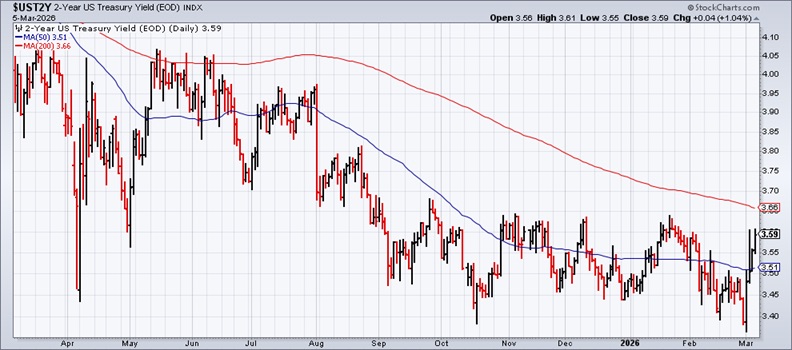
Bond yields are likely to keep rising until there are clear indications that the war is easing, even if it has not fully ended. At the moment, however, the outlook suggests the conflict could intensify in the near term rather than subside.
According to a report from the Financial Times this morning, Qatar—the world’s second-largest exporter of liquefied natural gas—warned that the war could halt energy shipments from the Persian Gulf “within days.”
Saad al-Kaabi, Qatar’s energy minister, cautioned that such a scenario could have severe global consequences. He suggested that a prolonged conflict lasting several weeks would weigh on worldwide GDP growth. Energy prices would surge across countries, supply shortages could emerge, and disruptions in production chains might occur as factories struggle to obtain necessary inputs.
Is this an exaggeration? Possibly. Yet with each passing day that the war continues and pressure on Gulf energy infrastructure grows, it becomes increasingly difficult to argue that the economic fallout will remain limited.
Sources: James Picerno
 THE ETERNAL SOVEREIGN
Leave a comment