The conflict in Iran has reshaped expectations about which sectors will benefit or struggle in the U.S. stock market, steering investment toward energy, materials, and industrial companies. How long this shift in market leadership continues will largely depend on the war’s trajectory and duration. For now, however, traditional “old-economy” stocks have regained popularity among investors.
Rising oil and natural gas prices have propelled energy stocks to the top of sector performance rankings. According to ETF data through yesterday’s close (March 4), the Energy Select Sector SPDR Fund has climbed more than 25% so far this year. In comparison, the broader market, represented by the SPDR S&P 500 ETF Trust, has delivered almost no growth, posting only a modest gain of about 0.5% in 2026.
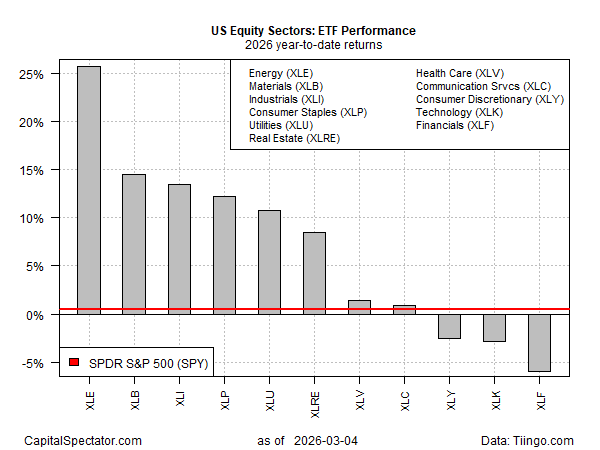
Materials and industrial stocks rank a distant second and third in sector performance this year, followed by consumer staples, utilities, and real estate. Most of the other sectors are either hovering around flat levels or showing losses. Financials have performed the worst so far, declining about 6% since the start of the year.
However, this shift in investor sentiment may not last long, depending on how the conflict develops. Many analysts believe the war could end relatively soon. If that happens, today’s leading sectors might give up their gains as investors rotate back toward themes tied to artificial intelligence and the digital economy.
That outcome remains uncertain. The joint U.S. and Israeli strike on Iran has already proven to be more than a swift, targeted operation. With the conflict now entering its fifth day, the chances of a near-term resolution appear increasingly slim.
Both the United States and Israel have indicated publicly that the conflict could extend for several weeks and may even become a prolonged war. On Wednesday, senior Pentagon officials cautioned that the situation could evolve into a longer confrontation, stressing that the fighting is “far from over.” U.S. Defense Secretary Pete Hegseth suggested the conflict might continue for up to eight weeks.
A senior Israeli military officer echoed this view, noting that preparations are being made for a conflict that could last several weeks.
How long the war continues will be a crucial factor shaping investor risk appetite and the direction of financial markets. According to Rick de los Reyes, a sector portfolio manager at T. Rowe Price, if disruptions prove brief, past experience shows that price spikes driven by geopolitical tensions often fade once uncertainty subsides. However, if production or exports are disrupted for an extended period, it could create a genuine supply shock with significant consequences for inflation, interest rate expectations, and global economic growth.
As a result, the outlook for inflation, economic activity, interest rates, and which sectors lead or lag in markets remains highly uncertain. For now, the only clear reality is that no one knows how the conflict will develop or where it will ultimately lead. While several scenarios appear plausible on paper, the eventual outcome will likely challenge many of today’s predictions once the fighting ends.
Sources: James Picerno
 THE ETERNAL SOVEREIGN
Leave a comment