Roughly $700 billion is the price tag now being discussed for a potential acquisition of Greenland, according to recent reports.
Skepticism is warranted. A transaction of that magnitude seems highly unlikely, particularly given that it would exceed half of the U.S. Defense Department’s entire 2024 budget. Public sentiment also appears far from supportive, despite President Donald Trump’s assertion that “anything less than full U.S. control of Greenland is unacceptable.”
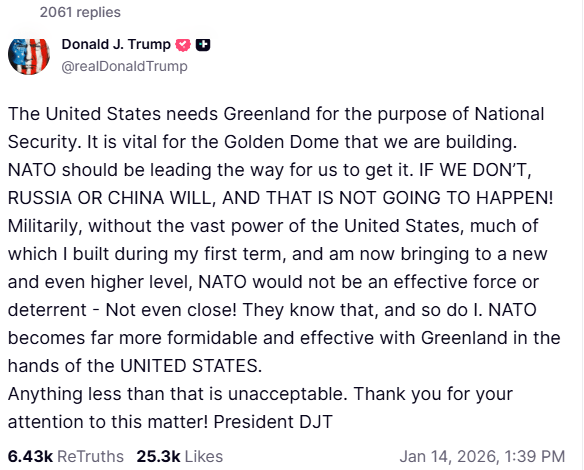
Polling suggests little domestic support in the United States for the idea, whether pursued diplomatically or by force. A recent YouGov survey found that just 13% of Americans support compensating Greenland’s residents to join the U.S., while only 8% favor acquiring the island through military means.
Sentiment in Greenland is similarly resistant, with an overwhelming majority unwilling to leave the Danish realm, and opposition across Europe—particularly in Denmark—remains firm.
That said, dismissing Greenland’s significance altogether would be a mistake.
Why Greenland Matters—Even Without a Sale
Positioned between North America, Europe, and Russia, Greenland hosts the Pituffik Space Base, a critical site where the U.S. Space Force monitors potential threats traversing the Arctic and the North Pole.
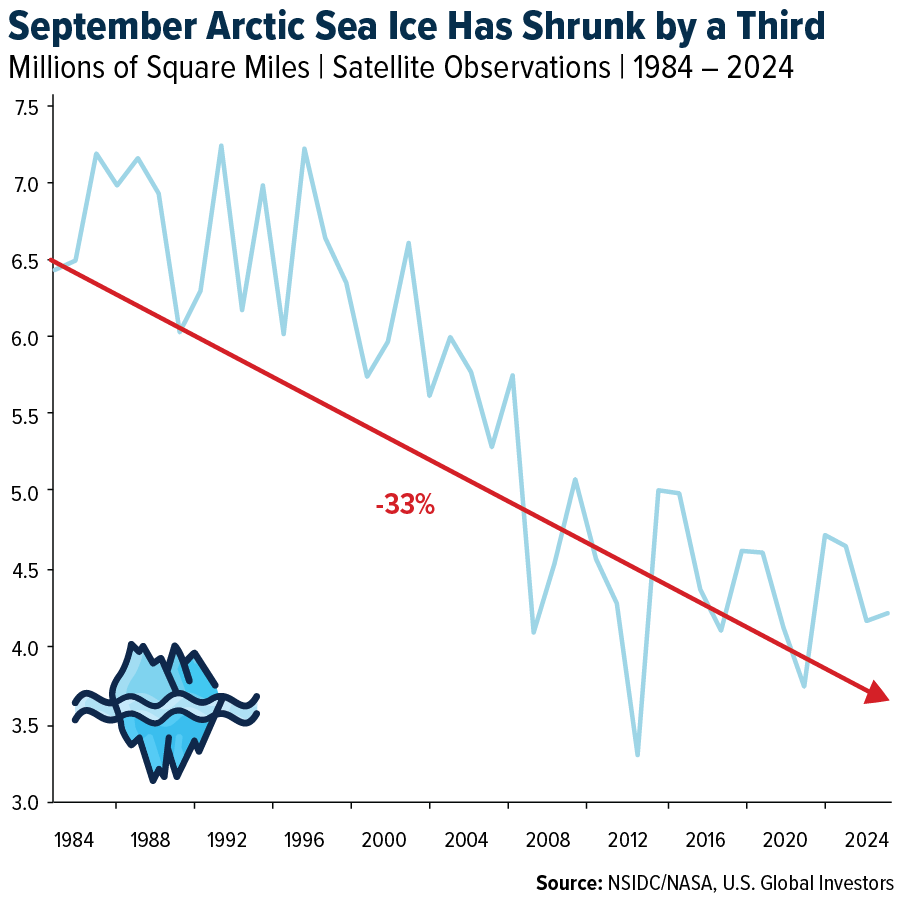
This role has grown increasingly significant as Arctic ice continues to recede. Satellite data show that summer sea ice has been declining by more than 12% per decade—roughly 33% since 1984—opening new shipping routes and reshaping both military and commercial dynamics. As I noted last year, the Arctic is becoming not only more accessible, but also more investable.
Denmark clearly recognizes Greenland’s growing importance. The kingdom has pledged more than $4 billion toward Arctic and North Atlantic defense through 2033, coordinating closely with NATO allies. Danish and allied air, naval, and ground forces are increasing their presence on and around the island, with exercises focused on protecting critical infrastructure and conducting fighter operations in Arctic conditions. At the same time, Denmark’s Chief of Army Command, Peter Boysen, has openly discussed the need for a stronger boots-on-the-ground posture.
The Tough Realities of Developing Greenland
Greenland’s resource base adds another layer of significance. The island holds substantial deposits of iron ore, copper, zinc, graphite, tungsten, and other minerals.
Most attention, however, centers on rare earth elements (REEs)—critical materials used in technologies ranging from smartphones and fighter jets to missile guidance systems. According to the Center for Strategic and International Studies (CSIS), Greenland currently ranks eighth worldwide in proven rare earth reserves, with the potential to climb higher as exploration continues.
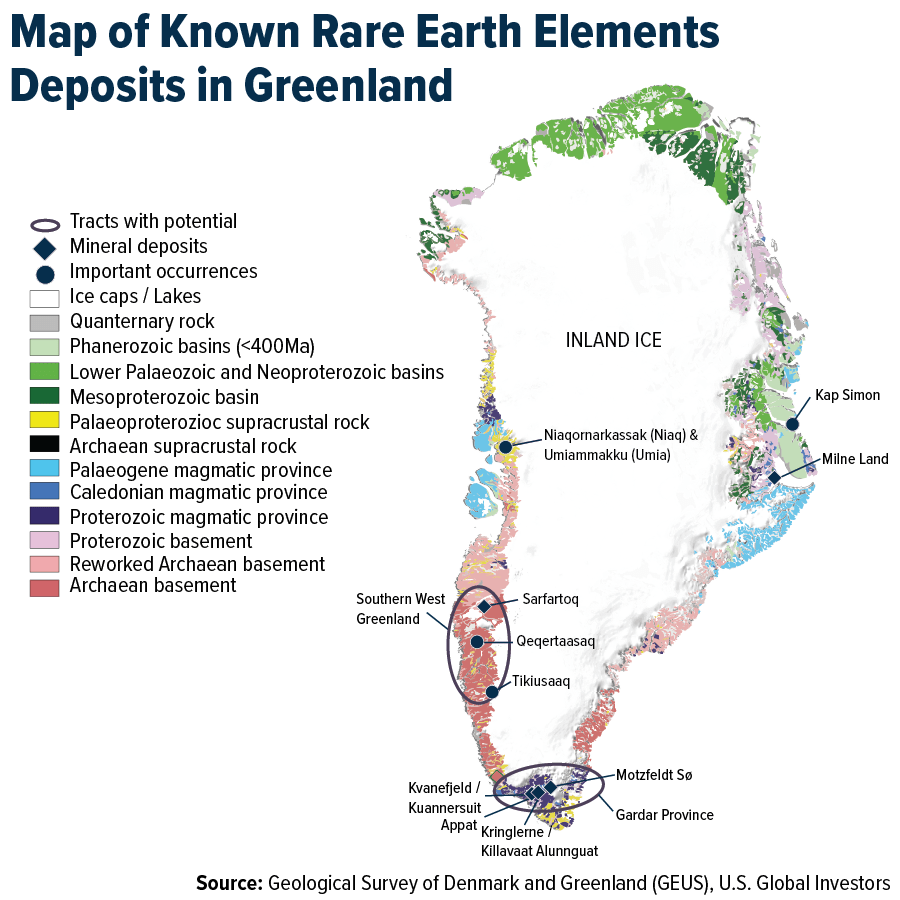
From a miner’s perspective, the resource potential looks compelling. In reality, however, development would be slow, complex, and highly capital-intensive.
Greenland spans an area roughly three times the size of Texas, yet it has fewer than 100 miles of roads—and none connect one town to another. Energy infrastructure is sparse, transportation costs are steep, and many mineral deposits are associated with uranium, which Greenland prohibited from mining in 2021 following strong local opposition.
In this sense, Greenland is often mischaracterized in much the same way as Venezuela. Both are portrayed as resource-rich prizes ready for rapid exploitation—rare earths in Greenland’s case, oil in Venezuela’s—but the reality is that unlocking these assets would require billions of dollars and many years of sustained investment. Illustrating the challenge, Wood Mackenzie notes that only 25 hydrocarbon exploration wells have ever been drilled in Greenland, none of which have resulted in commercial success. Neither region should be viewed as a quick path to easy riches.
China’s Efforts to Establish a Presence in Greenland Have Fallen Short
China is well aware of Greenland’s strategic and resource significance. Over the past decade, Beijing has sought to establish a presence through airport construction proposals, infrastructure investments, scientific research initiatives, and other channels.
Most of these efforts, however, have been blocked on national security grounds by either Denmark or the United States. In 2016, for example, a Chinese mining firm’s attempt to purchase a former U.S. naval base in Greenland was stopped. Two years later, China’s state-owned China Communications Construction Company (CCCC) pursued a $550 million contract to expand several Greenlandic airports, but then–U.S. Secretary of Defense James Mattis successfully urged Denmark to withdraw the bid.
So What’s Driving Trump’s Interest in Greenland?
Having said all that, why does President Trump want Greenland so badly (other than as retribution for not being awarded the Nobel Peace Prize)?
He insists it’s for national security, but, as I mentioned earlier, the U.S. military already has broad access to the island, as spelled out in the 1951 agreement signed by the U.S. and Denmark.
Further, Greenland is under the protection of NATO, of which the U.S. is a member. If Russia or China tried to attack it, Article 5 of the treaty would be triggered, activating NATO forces.
Recent reporting suggests that some of Trump’s wealthiest backers see Greenland not as a military outpost or mining play, but as a blank slate. According to Reuters, influential tech investors—including Peter Thiel and Marc Andreessen—have pitched the idea of turning parts of Greenland into a so-called “freedom city,” offering a low-regulation, quasi-autonomous hub for next-gen technologies.
Another explanation? Trump’s reaffirmation of the Monroe Doctrine, which the White House has dubbed the “Trump Corollary” or “Donroe” Doctrine. As stated in the president’s December 2 proclamation, the “American people—not foreign nations nor globalist institutions—will always control their own destiny” in the Western Hemisphere. Denmark, notably, sits in the Eastern Hemisphere.
Japan’s Gold Reserves Reach a New Record High
To conclude, central banks worldwide continue to accumulate gold as a means of supporting their currencies and reducing reliance on the U.S. dollar.
While emerging markets have driven the bulk of gold purchases over the past decade, several advanced economies have also increased their holdings. According to The Kobeissi Letter, Japan’s gold reserves reached a new record in 2025, rising to approximately $120 billion—an increase of roughly 60% compared with the previous year.
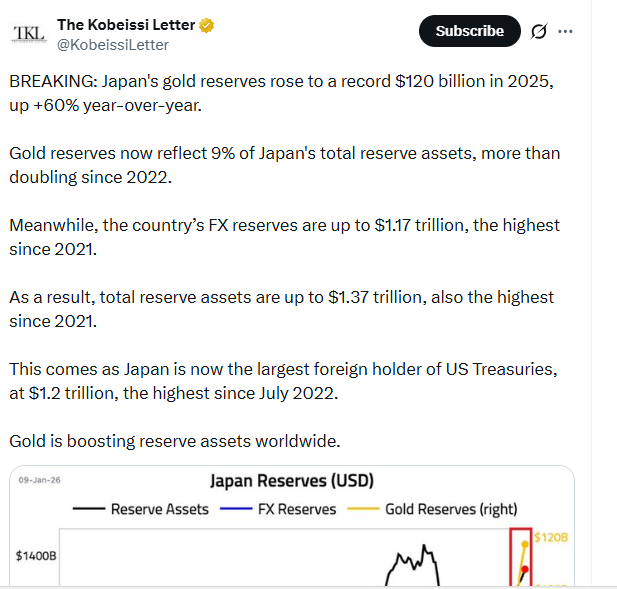
According to data from the World Gold Council (WGC), Japan now holds the world’s ninth-largest gold reserves, excluding the International Monetary Fund.
As I’ve noted previously, the actions of major institutions underscore a clear recognition of the value of hard assets like gold. For that reason, I continue to advocate allocating around 10% of a portfolio to gold, divided evenly between physical bullion and high-quality gold mining equities, with positions rebalanced annually.
All views expressed and information provided are subject to change without prior notice and may not be suitable for all investors. Links provided may direct you to third-party websites; U.S. Global Investors does not endorse and is not responsible for the accuracy or content of these external sources.
Sources: Frank Holmes
 THE ETERNAL SOVEREIGN
Leave a comment