- Japanese Yen bulls stay cautious amid fiscal concerns and a generally positive risk environment.
- Diverging expectations between the Bank of Japan and the Federal Reserve help contain further losses for the lower-yielding yen.
- Meanwhile, subdued follow-through buying of the US dollar keeps USD/JPY capped ahead of upcoming US economic data.
The Japanese Yen (JPY) remains under pressure against the US dollar during Wednesday’s Asian session, though significant depreciation remains limited. Key factors weighing on the yen include Japan’s fiscal concerns, a broadly risk-on market sentiment, and uncertainty around the timing of the Bank of Japan’s (BoJ) next rate hike.

Despite this, the BoJ is expected to continue its policy normalization, creating a notable divergence from growing expectations of additional interest rate cuts by the US Federal Reserve (Fed). This divergence helps cap gains in the US dollar and offers some support to the lower-yielding yen. Additionally, speculation about possible intervention by authorities to support the yen calls for caution among those betting on further yen weakness.
The Japanese Yen struggles to attract buyers as a mix of factors counterbalance expectations for Bank of Japan rate hikes.
- Japan’s fiscal outlook remains a concern, especially after the cabinet approved Prime Minister Sanae Takaichi’s record ¥122.3 trillion budget. Meanwhile, uncertainty persists over the timing of the next Bank of Japan (BoJ) rate hike, as expectations that energy subsidies, stable rice prices, and low petroleum costs will keep inflation subdued through 2026.
- BoJ Governor Kazuo Ueda stated on Monday that the central bank will continue raising rates if economic and price trends align with forecasts. He emphasized that adjusting monetary support will help sustain growth, and moderate, synchronized rises in wages and prices leave room for further policy tightening.
- This outlook pushed yields on Japan’s rate-sensitive two-year and benchmark 10-year government bonds to their highest levels since 1996 and 1999, respectively. The narrowing yield gap between Japan and other major economies has discouraged aggressive bearish bets on the yen, especially amid speculation of possible intervention.
- The US dollar has struggled to build on gains from the previous day due to dovish Federal Reserve expectations and concerns about the Fed’s independence under President Donald Trump’s administration. Traders are also holding back, awaiting key US economic data for clearer signals on the Fed’s rate cut trajectory.
- Wednesday’s US economic calendar includes the ADP private-sector employment report, ISM Services PMI, and JOLTS Job Openings. However, attention will largely focus on Friday’s Nonfarm Payrolls (NFP) report, which is expected to be crucial in shaping the next directional move for the dollar ahead of Tuesday’s US consumer inflation data.
USD/JPY’s mixed technical signals call for caution, with the key 156.15 confluence level serving as a crucial test for bullish momentum.
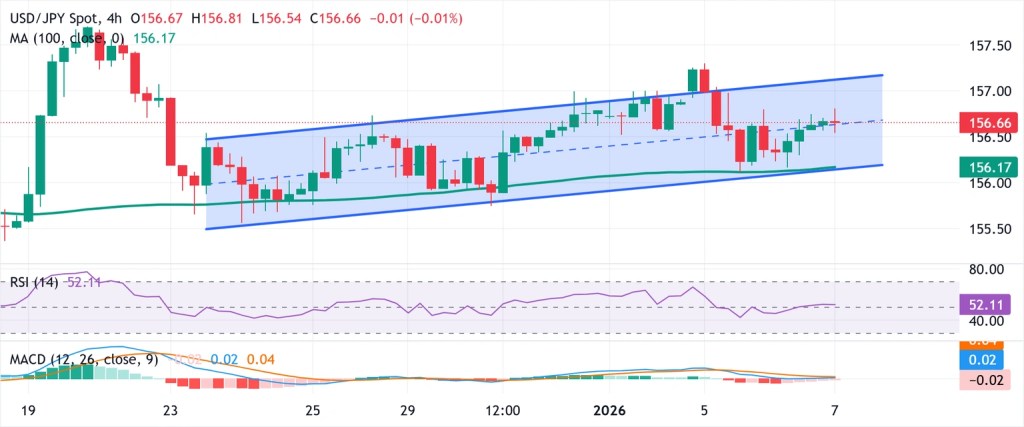
The USD/JPY pair’s overnight rally confirmed support at the 156.15 confluence zone, which combines the 100-period Simple Moving Average (SMA) on the 4-hour chart with the lower boundary of a short-term ascending channel. This level is crucial—if decisively broken, it could trigger renewed bearish momentum and open the door to deeper declines.
The Moving Average Convergence Divergence (MACD) histogram is slightly negative but contracting near the zero line, indicating weakening bearish pressure. Meanwhile, the Relative Strength Index (RSI) stands at 52, showing a neutral stance with a slight bullish bias. The rising SMA favors a buy-on-dips approach, though the subdued MACD suggests limited follow-through at this stage. RSI near the midpoint reinforces a consolidative phase within the channel.
Initial support remains at the 156.15 confluence, while resistance is positioned at 157.15—the channel’s upper boundary. A close above 157.15 could trigger further upside, whereas failure to break this level would keep USD/JPY range-bound within the rising corridor.
Sources: Fxstreet
 THE ETERNAL SOVEREIGN
Leave a comment