EUR/USD edged lower to around 1.1645 during Tuesday’s early Asian trading session as the US Dollar gained support from ongoing geopolitical uncertainty. President Trump said he had postponed a planned strike on Iran following requests from Gulf nations. Meanwhile, European Central Bank officials signaled that another interest rate hike could be needed to contain persistent inflation expectations.
EUR/USD remains under pressure near 1.1645 during Tuesday’s early Asian session as the Euro weakens against the US Dollar amid ongoing geopolitical uncertainty tied to Iran. Investors are also awaiting remarks later in the day from ECB Chief Economist Philip Lane.
US President Donald Trump stated that he had delayed a planned military strike on Iran following appeals from leaders of Qatar, Saudi Arabia, and the United Arab Emirates, noting that “serious negotiations are now taking place,” according to the BBC.
Still, market caution persists after Trump warned that the US could launch a “full, large-scale attack on Iran” at any time if negotiations fail to produce an acceptable agreement. Concerns over an extended Middle East conflict continue to support safe-haven demand for the US Dollar, weighing on the EUR/USD pair in the short term.
Meanwhile, hawkish rhetoric from European Central Bank officials may help limit losses for the Euro. ECB Governing Council member Yannis Stournaras said over the weekend that a moderate rate hike could help contain inflation without significantly harming economic growth.
A Reuters survey also showed that roughly 85% of economists expect the ECB to raise its deposit rate by 25 basis points to 2.25% in June, compared with just over half holding that view before the April policy meeting.
The US Dollar Index remains supported by growing expectations that the US Federal Reserve will maintain a more hawkish policy stance.
Meanwhile, the benchmark 10-year US Treasury yield briefly surged to 4.659% — its highest level since February 2025 — before pulling back to around 4.591%.
Geopolitical tensions also eased temporarily after President Trump postponed a planned military strike on Iran following requests from Gulf states.
The US Dollar Index (DXY), which tracks the US Dollar (USD) against a basket of six major currencies, edged higher during Tuesday’s Asian session, recovering after posting mild losses in the previous trading day and hovering near the 99.10 mark.
The Greenback found support from growing expectations that the US Federal Reserve (Fed) could maintain a more hawkish monetary policy stance. Overnight, the benchmark 10-year US Treasury yield climbed to 4.659% — its highest level since February 2025 — before easing back to around 4.591%. The spike in yields reflected investor concerns that persistently high energy prices may feed into consumer inflation, potentially forcing the Fed to keep interest rates elevated for longer.
Investors are also paying close attention to developments within the US central bank. According to Reuters, DRW Trading market strategist Lou Brien said recent market volatility has been driven by investors assessing how newly appointed Fed Chair Kevin Warsh will respond to inflationary pressures. Brien noted that markets are looking for reassurance that Warsh will uphold the Fed’s traditional policy mandate and remain independent from political influence coming from the White House.
Despite the Dollar’s strength, improving market sentiment limited safe-haven demand for the currency. Sentiment improved after US President Donald Trump announced a delay to a planned military strike on Iran. Reports indicated that Trump suspended the scheduled Tuesday attack after Persian Gulf allies urged Washington to allow more time for diplomatic negotiations. While the US administration stated it remains ready to act militarily if talks fail, officials have not provided a specific deadline for any potential action.
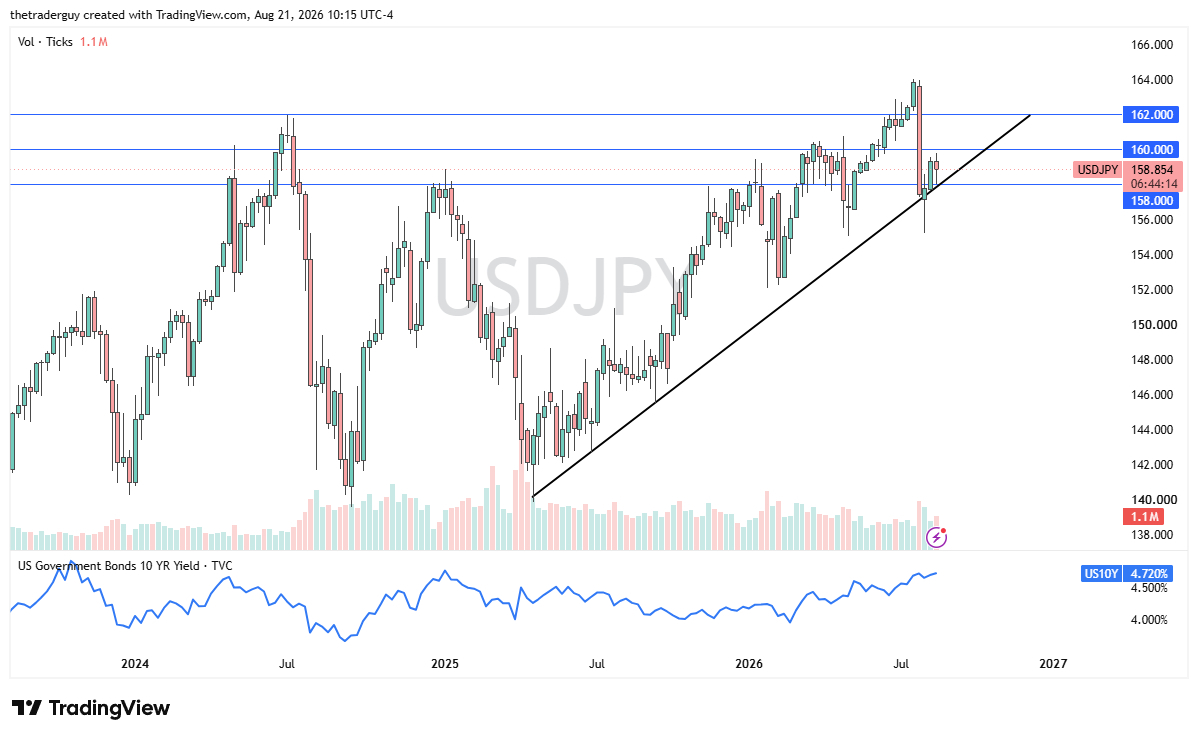
The US Dollar strengthened notably against the Japanese Yen during the week, climbing back above the key ¥158 level. The widening interest rate gap remains a primary factor driving the pair higher, as Japan continues to face limitations in tightening monetary policy too aggressively.
In many ways, this market continues to reward traders who hold US Dollars instead of Japanese Yen, largely due to the attractive yield advantage. The broader sentiment remains bullish, though traders should closely monitor the ¥160 region, as it has previously prompted intervention from Japan’s central bank.
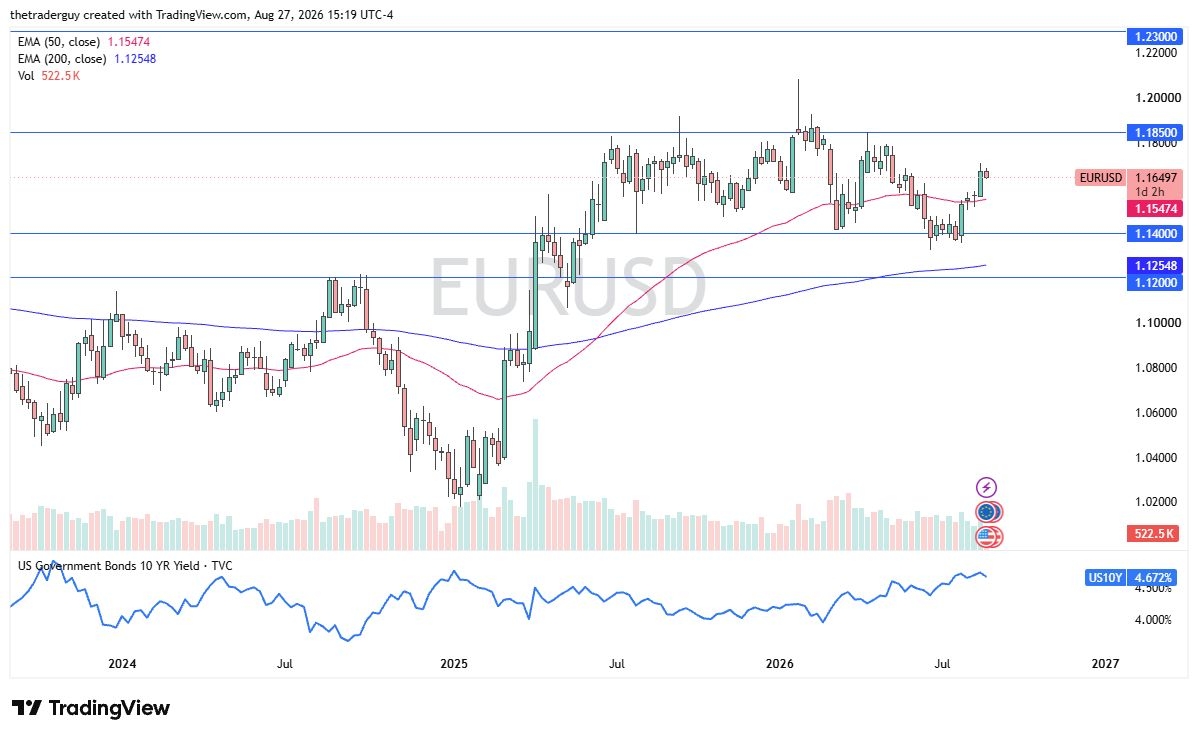
EUR/USD
The Euro fell sharply during the week and now appears likely to move toward the lower end of the broader trading range that has been in place for months. A decline toward the 1.14 level would not be surprising, as that area has served as a major support zone since around March.
In the end, persistent high interest rates in the United States continue to support the bullish outlook for the US Dollar, keeping demand for the currency strong. At the same time, markets increasingly appear to be pricing in the risk of energy-driven inflation shocks across the global economy.
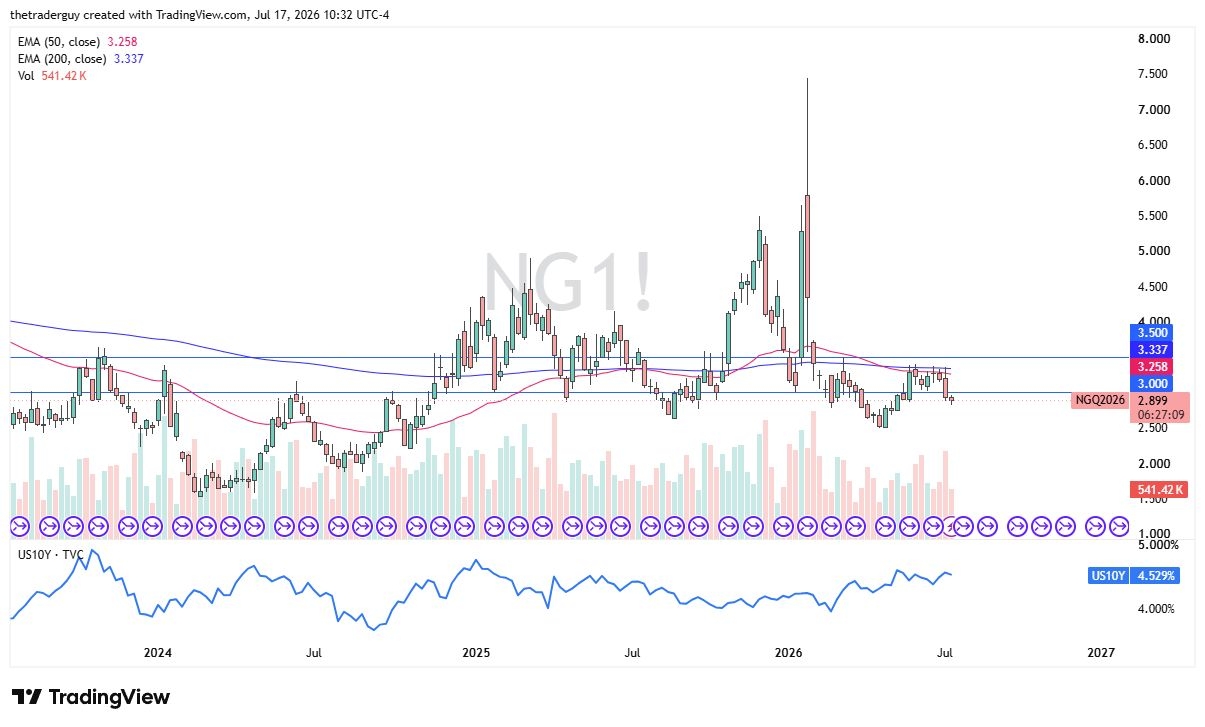
Natural Gas
Natural gas prices moved higher during the week, although the $3 level continues to stand out as a significant resistance zone. Selling into excessive bullish momentum still appears attractive, particularly if prices approach the $3 mark again.
I don’t view this as the beginning of a major or long-term move higher. Instead, it seems more like a short-term “fade the rally” setup, especially since this period of the year typically brings softer natural gas demand.
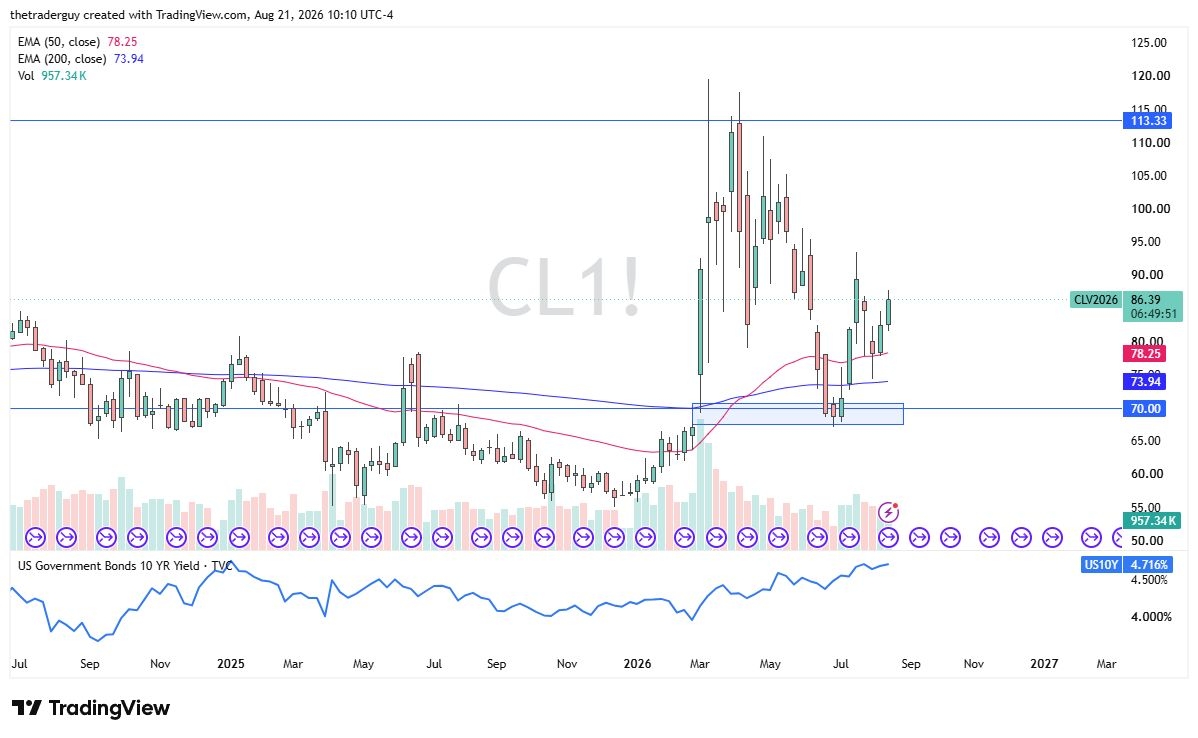
Crude Oil
The light sweet crude oil market posted strong gains during the week, although price action remains extremely volatile. That instability is likely to persist as traders continue reacting to geopolitical headlines and developments coming out of the Middle East.
Ongoing concerns surrounding energy inflation continue to shape market sentiment, with traders increasingly fearing that further economic pressure could lie ahead before conditions improve. Global markets are also beginning to feel the impact of reduced Middle Eastern oil flows, as previously stored supplies on tankers are gradually being depleted. As a result, crude oil is likely to remain a highly volatile and unpredictable market in the near term.
Bitcoin
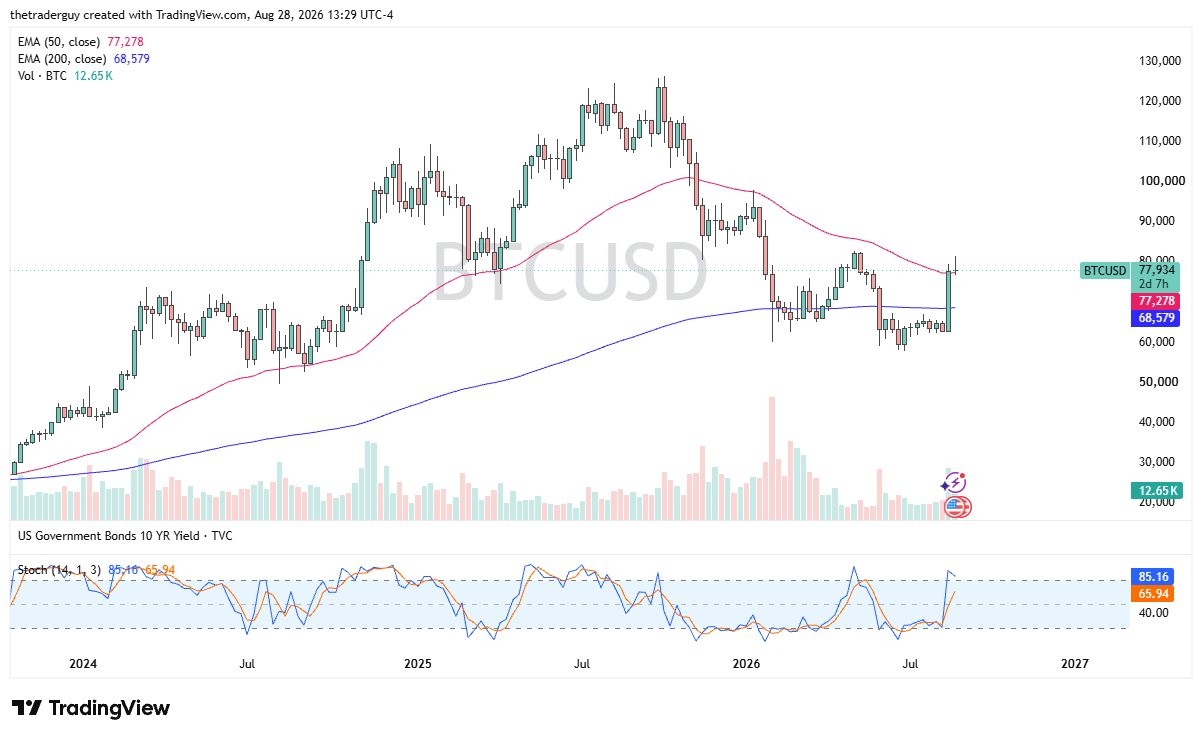
Bitcoin declined over the course of the week, but the broader bullish pressure remains intact as the market continues to test higher levels. Notably, Bitcoin showed relative strength while many other assets struggled, marking a shift from its behavior in previous periods when it often moved lower alongside broader market weakness.
Despite elevated interest rates, Bitcoin’s resilience has been difficult to ignore. Under normal circumstances, the market could have experienced a much deeper pullback months ago, yet buyers have consistently stepped in to support prices. Sometimes it is more important to focus on what the market is actually doing rather than what it is theoretically supposed to do, and right now Bitcoin still appears to be attracting buyers.
Gold
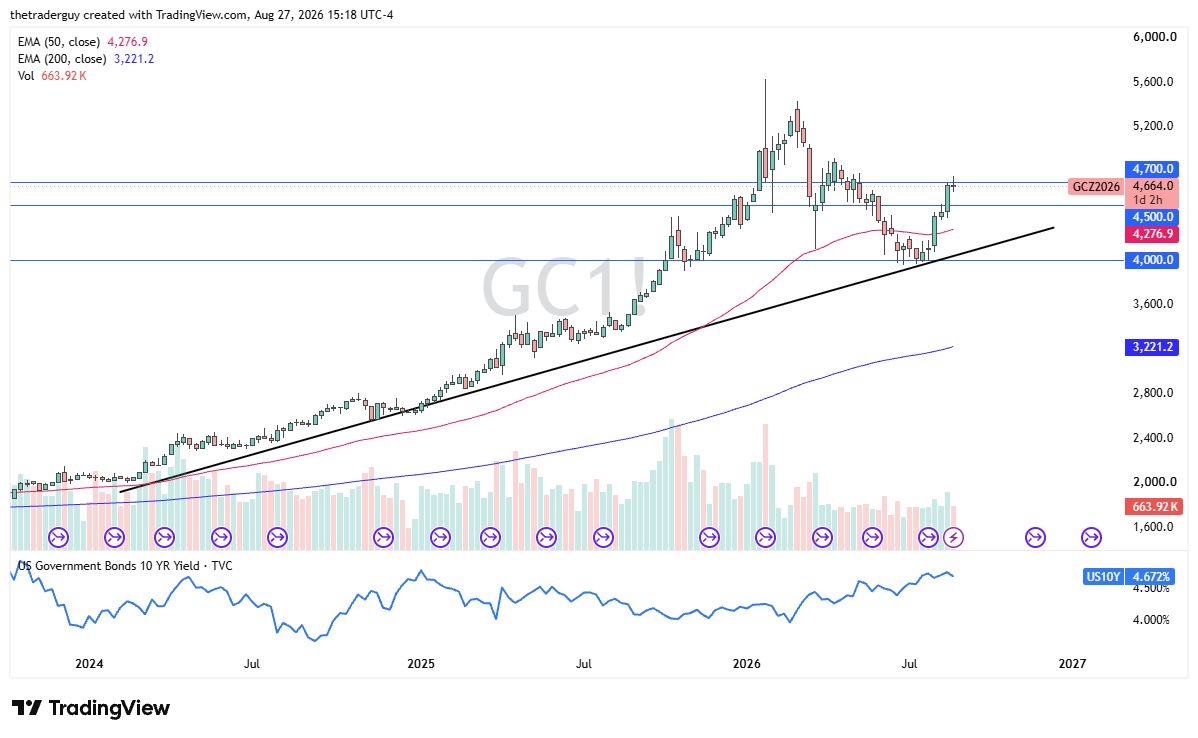
Gold prices came under heavy selling pressure during the week, and continued increases in interest rates are likely to remain a major headwind for the market. With prices now trading below the $4,600 level, attention is shifting toward the $4,500 area as the next key support zone.
A break below the $4,500 level could pave the way for a deeper decline toward the 50-week EMA. On the upside, short-term rebounds are likely to face resistance near the $4,800 region, and as long as US 10-year Treasury yields remain elevated, gold may continue to encounter selling pressure.
Silver
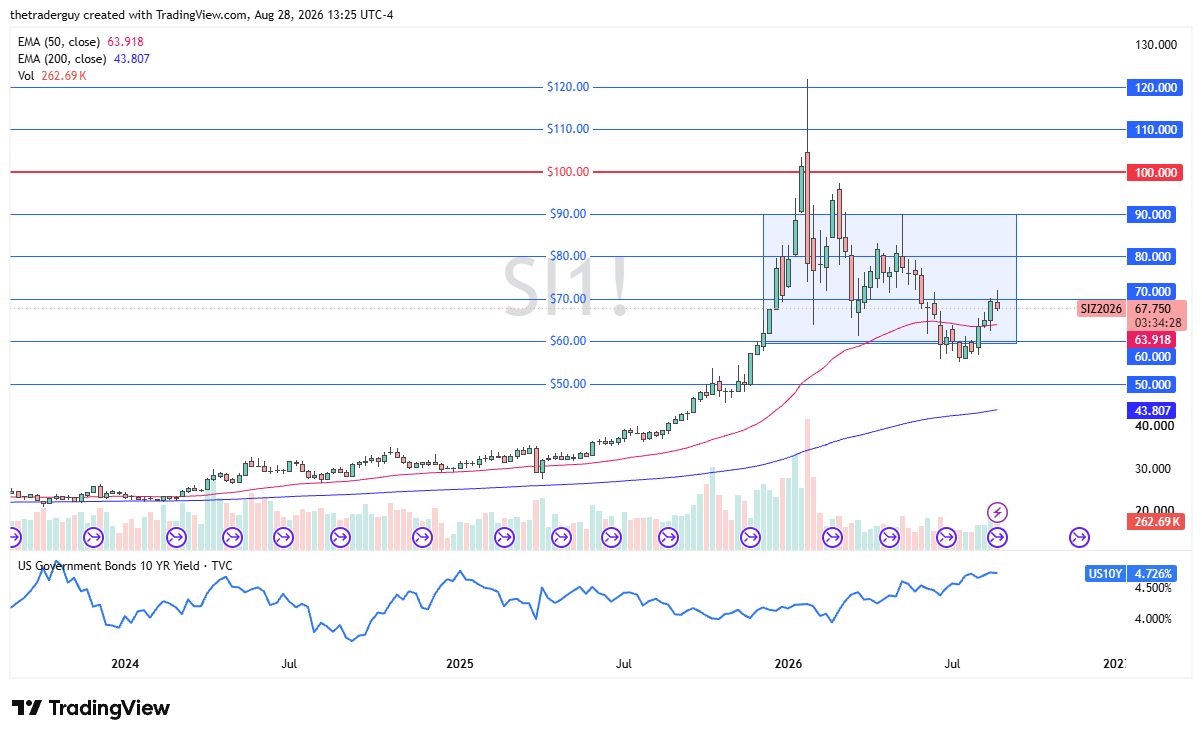
Silver endured a very difficult week after initially appearing ready for a major breakout higher. However, the $90 level once again acted as strong resistance, effectively halting the rally. Rising interest rates in the United States have continued to weigh heavily on silver prices, which has historically been a negative factor for the metal over the longer term.
Silver is now forming a very bearish-looking weekly candlestick pattern, which could signal additional downside pressure ahead. A decline back toward the $70 level would not be surprising, as that area has previously served as a major support zone. Overall, silver remains an extremely risky and volatile market at the moment.
USD/MXN
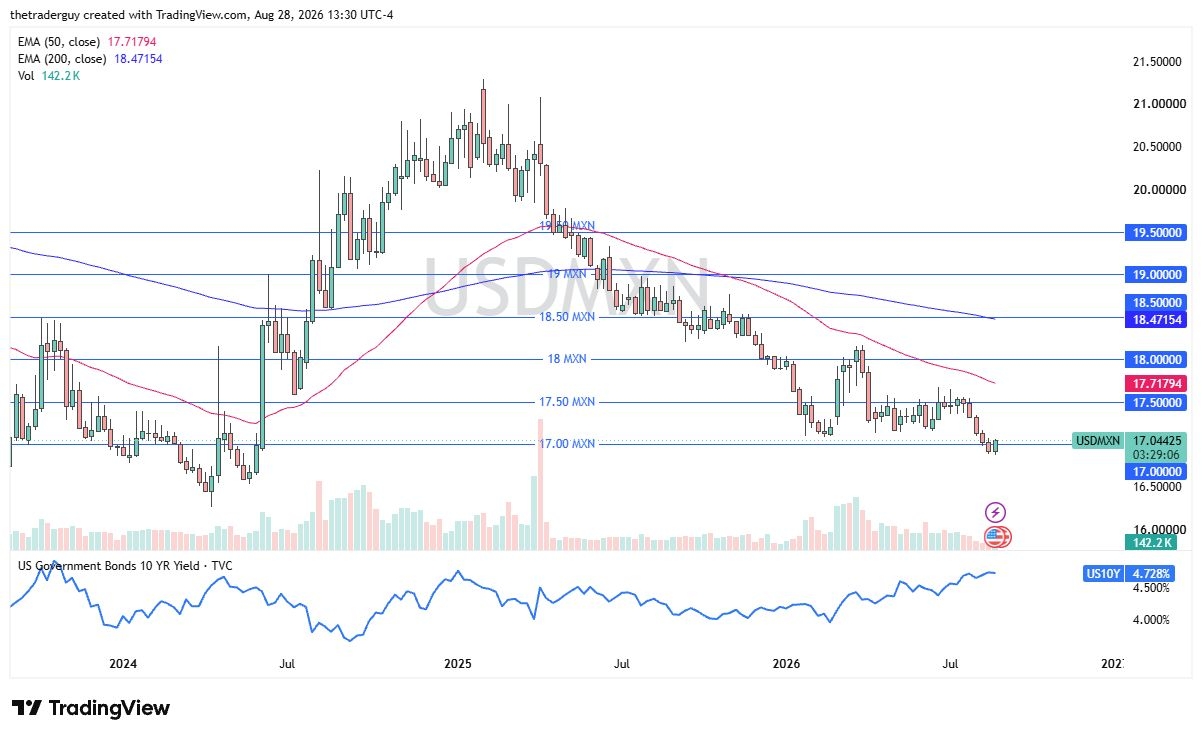
The US Dollar strengthened against the Mexican Peso during the week, although the pair remains stuck within the broader consolidation range that has been in place for some time. The 17.50 level continues to act as a major resistance barrier, while the 17.20 area underneath provides important support.
The pair is likely to remain range-bound for now, as the stronger US Dollar is being offset by the attractive interest rate differential offered by the Mexican Peso. While the Dollar has been gaining against many currencies, the yield advantage in Mexico still encourages traders to sell rallies in USD/MXN. As a result, the market may continue moving sideways until broader macroeconomic uncertainties become clearer.
EUR/USD declines further toward 1.1655 as the US Dollar continues to strengthen amid several supportive factors.
Both the US and China maintain that the Strait of Hormuz should remain open.
The Federal Reserve is expected to keep interest rates unchanged this year.
The EUR/USD pair continues its decline for a fourth consecutive session on Friday, slipping 0.15% to around 1.1653 during Asian trading hours. The pair remains under pressure as the US Dollar (USD) strengthens further after encouraging developments from Thursday’s meeting between United States (US) President Donald Trump and Chinese President Xi Jinping.
At the time of writing, the US Dollar Index (DXY), which measures the Greenback against a basket of six major currencies, is up 0.15% near 99.00, marking its highest level in two weeks.
Remarks from both Trump and Xi suggested improving trade relations between the US and China, while both leaders also emphasized the importance of keeping the Strait of Hormuz open.
The US Dollar is also drawing support from growing expectations that the Federal Reserve (Fed) will keep interest rates unchanged throughout this year.
Meanwhile, in the Eurozone, most economists surveyed by Reuters expect the European Central Bank (ECB) to implement an interest rate hike at its June policy meeting.
Technical Analysis
EUR/USD remains under pressure around 1.1653 during the Asian session, with the pair maintaining a bearish short-term outlook as it trades below the 20-day Exponential Moving Average (EMA) at 1.1710. A confirmed breakdown of the Double Top pattern after falling beneath the April 30 low at 1.1655 signals the potential for further downside extension.
Meanwhile, the Relative Strength Index (RSI) near 44 continues to point lower, suggesting bearish momentum remains active and selling pressure has not yet faded.
To the upside, the first resistance level is seen at the 20-day EMA around 1.1710. A move back above this zone could reduce near-term bearish pressure and support a broader recovery toward 1.1800. On the downside, key support levels are located at the April 8 low of 1.1589 and the April 6 low near 1.1505.
The US Dollar Index strengthened after April Retail Sales rose 0.5% month-over-month, surpassing market expectations. Meanwhile, Stephen Miran’s resignation from the Fed Board has paved the way for Kevin Warsh to take over as Federal Reserve Chair. At the same time, President Trump said US-China relations could become “better than ever,” while Chinese President Xi signaled a willingness to help ease tensions surrounding the Iran conflict.
The US Dollar Index (DXY), which tracks the US Dollar (USD) against a basket of six major currencies, extended its rally for a fifth straight session, trading near 99.10 during Friday’s Asian session.
The Greenback strengthened after the release of solid US Retail Sales data, which showed a 0.5% month-over-month increase in April, highlighting the resilience of US consumer spending despite persistently high borrowing costs.
Support for the US Dollar also came from developments within the Federal Reserve, as Stephen Miran’s resignation from the Board of Governors has opened the door for Kevin Warsh to become the next Fed Chair.
At the same time, rising inflationary pressures tied to escalating Middle East tensions have strengthened expectations that the Fed could keep interest rates elevated for longer or potentially raise them further.
Meanwhile, US President Donald Trump said on Thursday that he hopes relations with China will become “stronger and better than ever before,” adding that President Xi had offered support in helping ease tensions surrounding the Iran conflict. The improving diplomatic tone boosted market risk sentiment, which typically limits demand for the US Dollar’s safe-haven appeal.
AUD/USD eases to near 0.7250 during Thursday’s Asian trading session.
US producer inflation unexpectedly posted its sharpest increase in four years.
Donald Trump is set to meet with Xi Jinping in China for a closely watched high-level discussion.
The AUD/USD pair declines toward 0.7250 during Thursday’s Asian session as stronger-than-expected US inflation figures lend support to the US Dollar against the Australian Dollar. Investors are also keeping a close eye on the summit between US President Donald Trump and Chinese President Xi Jinping in Beijing, along with the upcoming release of US April Retail Sales data later in the day.
US producer inflation recorded its strongest annual increase in four years in April, reinforcing demand for the Greenback. According to data published by the US Bureau of Labor Statistics on Wednesday, the Producer Price Index (PPI) climbed 6.0% year-over-year, up from 4.3% previously. On a monthly basis, PPI advanced 1.4% in April after rising 0.7% in March, significantly exceeding market expectations of 0.5%.
Market participants are now turning their attention to Thursday’s US Retail Sales report. Economists forecast retail sales growth of 0.5% month-over-month in April, following a 1.7% increase in March. Stronger-than-anticipated data could further strengthen the US Dollar and weigh on the AUD/USD pair.
Meanwhile, Bloomberg reported Wednesday that Trump arrived in Beijing for an official state visit, where he is expected to meet Xi Jinping to discuss trade relations and the conflict involving Iran. The trip marks the first state visit to China by a US president in nearly a decade. Any constructive outcomes from the US-China discussions may support the Australian Dollar, given Australia’s close trade ties with China.
The US Dollar Index remained steady as President Trump’s remarks on the Middle East fueled geopolitical uncertainty and market volatility. Hotter-than-expected CPI figures reinforced expectations that the Federal Reserve may keep interest rates elevated for longer to contain persistent inflation pressures. Investors are now turning their attention to upcoming producer inflation data for further clues on how the conflict with Iran is affecting the broader US economy.
The US Dollar Index (DXY), which tracks the Greenback against a basket of six major currencies, held steady near 98.30 during Wednesday’s Asian session after posting gains over the previous two days. The US Dollar continued to draw support from escalating geopolitical tensions in the Middle East following recent remarks by President Donald Trump. Although Trump stated that Iran was “under control,” he warned that the situation would ultimately end either with a new agreement or with complete “decimation.” Meanwhile, Iranian Deputy Foreign Minister Kazem Gharibabadi reiterated that any acceptable peace deal must involve reparations, recognition of Iran’s sovereignty over the Strait of Hormuz, and the full removal of US sanctions.
Additional support for the Greenback came from stronger-than-expected US inflation data, which reinforced hawkish expectations for the Federal Reserve. Investors increasingly believe the Fed will keep interest rates elevated for longer in an effort to contain persistent inflationary pressures. According to data released by the Bureau of Labor Statistics on Tuesday, the US Consumer Price Index (CPI) rose 0.6% month-over-month in April, lifting annual inflation to 3.8%, the highest reading since May 2023. Core CPI, which excludes food and energy prices, also increased, posting a 2.8% annual gain.
With expectations for a Fed rate cut this year largely fading, markets are now pricing in the possibility of a quarter-point rate hike by December. Attention is now turning to upcoming producer inflation figures, which could offer further insight into how the ongoing conflict involving Iran is affecting the broader US economy.
USD/CAD advances as escalating Middle East tensions strengthen the US Dollar’s appeal as a safe-haven currency.
President Trump has expressed growing frustration over the lack of progress in peace negotiations, raising concerns about a possible change in the region’s conflict approach.
Meanwhile, higher oil prices provide support for the Canadian Dollar, though they also create challenges for the Bank of Canada by adding to ongoing inflation pressures.
USD/CAD edges higher after closing nearly unchanged in the previous session, hovering around 1.3690 during Tuesday’s Asian trading hours. The pair is regaining upward momentum as the US Dollar strengthens amid escalating geopolitical tensions.
Investor sentiment has shifted toward safe-haven assets following reports of worsening diplomatic conditions in the Middle East. Markets are increasingly pricing in the risk of renewed large-scale military conflict, a development that typically drives demand for the Greenback against more risk-sensitive currencies.
A CNN report published Monday stated that US President Donald Trump has become increasingly dissatisfied with the lack of progress in negotiations aimed at ending regional hostilities. Sources close to the administration indicated that Washington is now giving more serious consideration to renewed military operations. Adding to market concerns, Iranian Parliament Speaker Mohammad Bagher Ghalibaf said, according to Reuters, that Iran’s armed forces are fully prepared to respond to any future attacks, placing the already fragile ceasefire under additional pressure.
Despite broad USD strength, the Canadian Dollar continues to receive support from rising oil prices. As Canada is the largest crude supplier to the United States, the CAD tends to benefit from gains in energy markets. Concerns that escalating regional tensions could disrupt global supply flows and reduce Middle Eastern exports have pushed crude prices sharply higher, helping cap further upside in USD/CAD.
At the same time, surging energy prices are reviving inflation concerns in Canada. March inflation data already reflected the impact of volatile oil prices, with annual CPI rising to 2.4%, the highest level seen in a year. While elevated crude prices generally strengthen the CAD, they also complicate the Bank of Canada’s policy outlook. Although the BoC recently kept interest rates unchanged and suggested that energy-related inflation may remain temporary, a prolonged geopolitical conflict could eventually force policymakers to reconsider their current stance.
After reaching a peak near 1.36450 on Wednesday, GBP/USD closed the week around 1.36274. The pair has largely mirrored broader FX market movements, tracking shifts in USD-driven sentiment across different trading sessions.
With WTI crude oil volatility easing and market risk appetite improving, the US dollar has remained under mild pressure. This USD weakness has helped support GBP/USD, which continues to hold above levels seen prior to the early-March Iran-related escalation.
From a technical standpoint, the pair is now approaching territory last traded around the 16–17 February period, suggesting a potential retest of earlier resistance zones as broader sentiment and risk conditions evolve.
Dynamic Range in GBP/USD
The opening of trading for GBP/USD on Monday is likely to be shaped by prevailing market sentiment surrounding the Middle East conflict, which remains relatively calm but still fragile. Alongside this, attention may also turn to reactions from the UK local elections held late last week.
In those results, the Labour Party performed poorly, a development that reflects negatively on its current leadership and raises questions about internal stability. Market participants and financial institutions could respond to these political outcomes at the start of the week, potentially adding an additional layer of volatility to GBP/USD price action on Monday.
Although the leadership of the Labour Party may come under renewed scrutiny, it will also be important to observe whether financial institutions interpret the election outcome as validation of their existing expectations about the UK’s political trajectory.
For short-term traders, the key takeaway is that GBP/USD could see heightened volatility at the start of Monday’s session. As London markets open, price action may become more dynamic as participants react to both political developments and broader sentiment shifts.
Higher Marks in GBP/USD and Correlation Outlook
The GBP/USD may continue to trade with an upward bias in the coming sessions if broader market sentiment keeps the US dollar in a relatively weaker phase across the global FX space. Under such conditions, dollar softness would likely continue to support additional buying interest in the pound.
From a technical perspective, traders may look back toward early-February price levels as potential reference points or interim targets. However, the 1.37000 region still appears to be a more distant objective rather than an immediate trading focus.
For intraday participants, restraint remains important. Rather than chasing extended upside moves, it may be more practical to focus on nearer, more realistic price zones that sit within the day’s typical volatility range, helping to avoid exposure to sharp reversals.
There is also a case for caution around the London open, where institutional flows can introduce abrupt price adjustments, particularly as market participants reassess positioning in light of recent UK political developments.
Although the current government remains in place, market sentiment increasingly reflects speculation about potential political change ahead. Still, GBP/USD pricing is likely to remain anchored in medium-term expectations, which continue to incorporate the existing policy direction and mandate of the current administration.
GBP/USD Weekly Outlook
The current conditions shaping GBP/USD continue to create active two-way price dynamics that appeal to short-term traders. The pair offers frequent opportunities for positioning, though volatility remains a defining feature rather than a stabilizing force.
After the initial activity of Monday’s open fades, trading conditions may settle somewhat. However, market participants still need to account for the risk of sudden catalysts, including developments related to Middle East tensions and ongoing domestic political uncertainty in the UK, both of which could quickly shift sentiment.
From a technical standpoint, GBP/USD holding above the 1.36300–1.36400 area in early Monday trade would likely be viewed as constructive. Sustained stability above this zone could encourage larger market participants to maintain or extend bullish positioning in the days ahead.
That said, even institutional flows remain vulnerable to abrupt sentiment shifts. With global FX conditions still influenced by uneven risk appetite and intermittent geopolitical headlines, the market is unlikely to settle into a smooth trend environment just yet.
The US Dollar Index strengthened as rising risk aversion followed the rejection of each other’s latest peace proposals by President Trump and Iran.
President Trump dismissed Iran’s latest peace offer, describing it as “totally unacceptable.”
Meanwhile, US Nonfarm Payrolls increased by 115K in April, surpassing market expectations despite easing from March’s revised 185K gain.
The US Dollar Index (DXY), which tracks the US Dollar (USD) against a basket of six major currencies, remained firm after posting modest losses in the previous session, trading near 98.10 during Monday’s Asian session.
The Greenback continued to strengthen amid heightened risk aversion after US President Donald Trump and Iran rejected each other’s latest peace efforts aimed at easing tensions in the Middle East. According to Bloomberg, Trump dismissed Iran’s recent peace proposal on Sunday, calling it “totally unacceptable.” Meanwhile, Iranian state television cited an Iranian official as saying Tehran’s response focused on ending the conflict across all fronts, especially in Lebanon, while also addressing the security of shipping lanes through the strait, although no specifics were given regarding the reopening of the crucial waterway.
Ongoing tensions in the Middle East, along with the fragile ceasefire between the US and Iran, are likely to sustain safe-haven demand for the US Dollar, which could continue to pressure major currency pairs in the near term.
Data released by the US Bureau of Labor Statistics on Friday showed that Nonfarm Payrolls (NFP) increased by 115K in April, slowing from March’s revised 185K gain but still beating market expectations of 62K. Meanwhile, the Unemployment Rate held steady at 4.3% in April, in line with analyst forecasts.
The gold market initially pulled back during the week but later rebounded and regained strength. The $4,600 level remains a key area to watch closely, as it has repeatedly acted as both support and resistance in the past.
Gold still appears to have solid potential to gradually move higher, although interest rate markets continue to create headwinds. In this environment, gold is likely to remain volatile and range-bound in the short term. Despite that, the longer-term outlook still looks strongly bullish, and I believe the market could eventually reach the $5,000 level. However, that would likely require several supportive factors to align, including a de-escalation of tensions in the Middle East.
USD/CHF
The US dollar initially strengthened against the Swiss franc but has since pulled back quite sharply. The pair is now testing a potential support zone around the 0.7750 level. Among the major currency pairs, this is one where I still favor the US dollar over the longer term. However, falling interest rates and growing concerns that geopolitical conflicts could escalate are boosting demand for safe-haven assets like the Swiss franc.
Ironically, if geopolitical tensions ease and peace returns, interest rates in the United States may decline, but demand for the safe-haven Swiss franc would likely weaken as well. As a result, this pair is expected to remain heavily influenced by headlines and market sentiment. Over the longer term, however, I still believe USD/CHF has room to move higher.
EUR/USD
The euro initially moved lower before rebounding and showing renewed strength. However, the pair continues to face strong resistance around the 1.18 level, extending up to 1.1850. The 1.1850 zone has remained a significant area of selling pressure, keeping the market contained since the summer of last year.
Going forward, we will need to see whether EUR/USD can finally break above this resistance zone, especially since the pair has attempted to do so several times already. Each breakout attempt, however, has been met with heavy selling pressure that quickly pushes the market back down. For now, I suspect the broader trading range will continue to hold.
BTC/USD
Bitcoin moved higher during the week but later surrendered part of its gains. Even though the latest candlestick resembles a shooting star, it is important to note that the previous candle formed a hammer pattern. This combination suggests that Bitcoin could enter a period of sideways consolidation in the near term.
A break above the $84,000 level would be a strong bullish signal and could pave the way for a much larger upward move. In the meantime, I believe short-term pullbacks will likely continue to attract buyers, with many traders viewing dips as potential buying opportunities.
USD/ZAR
If you were searching for volatility, the South African rand certainly delivered during the week. The pair initially attempted to move higher, but later turned lower as the US dollar continued to weaken. That remains the key theme in this market — traders are likely to keep selling into short-term rallies, especially as the interest rate differential continues to favor South Africa and is expected to do so for the foreseeable future.
With that in mind, I believe the market will likely drift back toward the 16.20 level over time, although the move is expected to be gradual rather than aggressive. In the end, this remains more of a carry trade environment, where traders are primarily focused on earning positive swap returns.
NASDAQ 100
The Nasdaq 100 continues to defy gravity and now appears extremely overbought. The index remains locked in a remarkably strong uptrend, but sooner or later, a sizable pullback is likely to occur — one that could catch overly aggressive or greedy traders off guard.
That said, I believe the 28,000 level will be a key area to watch, as many traders are likely to look for signs of support and renewed buying interest if the market pulls back toward that zone.
USD/MXN
The US dollar has remained weak against the Mexican peso for quite some time. The 17.50 level continues to act as a significant resistance barrier, as it has repeatedly attracted strong selling pressure in the past. Overall, the pair still appears to be trapped within a broader trading range, with support near 17.20 and resistance around 17.50.
Ultimately, I believe that if USD/MXN can break above the highs of the last two weekly candlesticks, it could open the door for a move toward the 18.00 level. However, such a rally would likely require a broader risk-off or fear-driven market environment. For now, the overall setup still appears to favor a “sell the rally” approach rather than a sustained bullish trend.
USD/JPY
The US dollar traded in a highly volatile manner against the Japanese yen throughout the week, following last week’s intervention by the Bank of Japan.
That said, the pair is beginning to form a candlestick pattern that suggests stabilization, indicating there is a genuine possibility of another move higher. A breakout above the 160.50 level — or potentially even the 162.00 region — could pave the way for fresh multi-decade highs, with resistance levels stretching back to 1990.
USD/JPY is trading in a subdued manner near 157.00 during Friday’s Asian session, extending its overnight recovery in line with the US Dollar’s rebound. However, gains remain limited as markets stay cautious about the risk of Japanese FX intervention. Investors are also holding back ahead of the US April employment report due later in the day.
USD/JPY Technical Analysis Overview
On the 15-minute chart, USD/JPY is trading around 159.62, staying above the session open at 159.36. This keeps a slight intraday bullish tone intact as price continues to edge higher within a narrow consolidation range. The Stochastic RSI is positioned near the mid-50s, indicating improving upward momentum without entering overbought territory, which suggests buyers still retain short-term control.
Immediate support is located at 159.36, the day’s open. A break below this level could trigger a deeper pullback toward earlier intraday lows. Although no major moving averages are active on this timeframe, the pattern of higher closes continues to favor buying on dips as long as the pair holds above 159.36.
On the daily chart, USD/JPY also trades at 159.62 and maintains a constructive bullish outlook. Price remains firmly above the 50-day EMA at 158.44 and the 200-day EMA at 155.10, preserving the broader uptrend structure. The Stochastic RSI has recovered toward mid-range levels, reflecting renewed upside momentum after a phase of consolidation within the ongoing bullish trend.
Key support is seen at the 50-day EMA around 158.44, where a pullback would still be consistent with the broader uptrend as long as the 200-day EMA at 155.10 holds. A daily close below the 50-day EMA would signal a potential shift toward a deeper correction, while sustained trading above current levels keeps the bullish structure intact and leaves room for another attempt at recent highs.
Fundamental Analysis Overview
Recent comments follow a series of warnings from Japan’s Ministry of Finance. Finance Minister Satsuki Katayama reiterated last week that authorities are prepared to act against excessive speculative movements in the yen. This stance has kept markets alert after recent sharp swings in USD/JPY, which many participants interpret as possible signs of official intervention.
At the same time, the Bank of Japan’s (BoJ) March meeting minutes, released on Thursday, revealed that several policymakers see room for further interest rate hikes if the energy shock from the US-Iran conflict persists and leads to broader inflationary pressures. Some members also suggested that Japan may need to gradually move away from deeply negative real interest rates.
This increasingly hawkish tone from the BoJ has strengthened expectations for a potential rate increase as early as June. However, analysts remain cautious, noting that sustained support for the yen would likely require either lower US Treasury yields or easing oil prices in addition to tighter domestic policy.
Strategists at OCBC, including Sim Moh Siong and Christopher Wong, suggest that recent USD/JPY fluctuations resemble intervention activity, with the perceived intervention threshold now around 158 rather than 160. They also note that further action could drive the pair toward the 150–155 range, though they emphasize that intervention alone may not be sufficient to change the broader trend without a stronger shift in BoJ policy.
In the US, attention is shifting to Friday’s April employment data. Forecasts point to around 60,000 new Nonfarm Payrolls, with unemployment expected to remain steady at 4.3%. Weekly Initial Jobless Claims, due earlier on Thursday, will also be closely monitored for additional labor market signals.
Meanwhile, the US Dollar Index (DXY) remains under pressure, hovering near two-month lows around 97.90. Markets continue to anticipate a more dovish Federal Reserve outlook, which is limiting the dollar’s upside potential against the yen.
GBP/USD rose to 1.3599 on Thursday, with the pound briefly touching its strongest levels since mid-February. Sterling’s advance was supported by ongoing US dollar weakness, as demand for the greenback’s safe-haven status eased amid increasing optimism over a potential US–Iran agreement.
Axios reported that the White House is nearing a framework memorandum with Iran, which could open the door to ending the conflict and beginning nuclear negotiations. Tehran is expected to respond within 48 hours, though a final deal has not yet been reached.
Meanwhile, investors are watching UK local elections closely, with polling indicating potential setbacks for Keir Starmer’s party.
On the monetary policy side, expectations for the Bank of England have been adjusted, with markets now pricing in around 50 basis points of tightening by year-end—roughly two rate hikes—down from earlier expectations of up to three increases.
Market technical review
On the H4 timeframe, GBP/USD is moving within a wide consolidation band above 1.3515, with price action currently stretching toward 1.3650. A pullback toward 1.3344 is still on the table before any further range-bound movement resumes. A decisive break to the upside would expose the 1.3650 area again, while a break lower could accelerate declines toward 1.3344. The MACD also aligns with this outlook, as the signal line remains above the zero line but is turning downward, suggesting weakening bullish momentum.
On the H1 timeframe, GBP/USD is consolidating in a tight range around 1.3615. Price has recently extended lower toward 1.3578 and is now attempting a recovery back to 1.3615 for a potential retest from below. This rebound may be short-lived, with a further decline toward 1.3565 still likely. The Stochastic oscillator supports this bearish short-term bias, with the signal line below 50 and trending down toward 20, indicating rising downside pressure.
Conclusion
The pound continues to find support from improved global risk sentiment and weaker demand for the US dollar as a safe-haven asset. However, ongoing political uncertainty in the UK, along with evolving expectations for Bank of England policy, may cap further gains. In the near term, GBP/USD is expected to remain highly reactive to geopolitical developments and shifts in broader market sentiment.
USD/JPY slips toward 156.85 in Friday’s Asian session, pressured by renewed reports of Japanese FX intervention during the May holidays. Market attention now shifts to the US April employment report, which is expected to be the key macro driver for the session.
USD/JPY weakened to around 156.85 during Friday’s Asian session as the Japanese yen gained strength after reports of another round of FX intervention by Japanese authorities. Traders also turned cautious ahead of the upcoming US April employment data.
According to Reuters, citing a familiar source, Japanese officials reportedly intervened in the FX market during the early May holiday period, following yen-buying operations on April 30. The source noted that “the intervention since the start of May was timed to coincide with the holiday period, when market liquidity was thin.”
Expectations of further intervention may continue to support the yen and weigh on USD/JPY. Japan’s top foreign exchange official Atsushi Mimura also stated on Thursday that authorities stand ready to respond to speculative currency moves across all fronts.
Attention now shifts to the US April jobs report, due later on Friday. Markets expect around 62,000 new jobs, a notable slowdown from March’s 178,000 increase, while the unemployment rate is forecast to remain unchanged at 4.3%.
Nonfarm Payrolls are forecast to increase by 62K in April, while the Unemployment Rate is expected to remain unchanged at 4.3%. The USD could face elevated volatility ahead of the weekend.
The United States Bureau of Labor Statistics is set to release the April Nonfarm Payrolls (NFP) report on Friday at 12:30 GMT, with markets closely watching the data for clues on the Federal Reserve’s interest-rate path later this year.
Economists expect the US economy to add 62K jobs in April, a sharp slowdown from March’s stronger-than-expected 178K gain. The Unemployment Rate is forecast to remain steady at 4.3%, while annual wage growth, measured by Average Hourly Earnings, is seen accelerating to 3.8% from 3.5%.
Analysts at TD Securities expect signs of stabilization in the labor market after several volatile months. They forecast payroll growth of around 80K, driven mainly by hiring in healthcare and leisure & hospitality, while government employment may decline slightly. They also expect monthly wage growth to stay modest at 0.2%.
Additional labor indicators released earlier this week painted a mixed picture. ADP reported that private-sector employment rose by 109K in April, improving from March’s revised 61K increase. Meanwhile, the Employment Index in the Institute for Supply Management Services PMI climbed to 48 from 45.2, signaling that service-sector hiring is still contracting, though at a slower pace.
What impact will the US March Nonfarm Payrolls have on EUR/USD?
EUR/USD is likely to remain highly sensitive to the upcoming US Nonfarm Payrolls (NFP) report, as investors reassess the outlook for the Federal Reserve and the broader direction of the US Dollar.
Despite the Fed’s relatively hawkish April meeting, the USD has struggled to gain traction amid improving global risk sentiment and easing geopolitical tensions in the Middle East. Comments from Fed Chair Jerome Powell reinforced a data-dependent approach, while Austan Goolsbee acknowledged that labor market conditions have softened, even if they remain broadly stable.
Markets currently expect the Fed to keep rates unchanged through the end of 2026, though traders still see some probability of either a rate hike or cut depending on incoming data. A weak NFP reading — particularly below 30K alongside a higher Unemployment Rate — could strengthen expectations for rate cuts later this year. In that scenario, the USD may weaken further, allowing EUR/USD to extend gains.
On the other hand, a stronger-than-expected payrolls figure could reduce expectations for monetary easing and help the USD stabilize. This would likely cap EUR/USD upside, although a sustained dollar rally may remain limited if risk appetite stays strong heading into the weekend.
From a technical perspective, FXStreet analyst Eren Sengezer notes that EUR/USD maintains a bullish near-term bias. The pair continues to trade above its 100-day and 200-day Simple Moving Averages, while the Relative Strength Index trends toward bullish territory.
Key resistance is seen around 1.1800–1.1810, followed by 1.1900–1.1910 and the psychological 1.2000 level. On the downside, major support stands in the 1.1710–1.1680 zone, with further downside targets at 1.1650 and 1.1560 if selling pressure intensifies.
The conclusion of Operation Epic Fury is lifting risk sentiment.
Japan is expected to keep cracking down on speculators.
The US Dollar weakened after the White House announced the end of the two-month “Operation Epic Fury” and highlighted progress in talks with Iran. Markets are interpreting the developments as a sign of easing tensions in the Middle East, triggering a selloff in Brent crude and pushing the dollar index back toward two-month lows amid improving risk sentiment.
The more optimistic backdrop could support further gains in EUR/USD, though much will depend on how quickly oil prices decline. Damage to energy infrastructure across the Persian Gulf is expected to keep Brent and WTI well above the $65–70 range seen before the conflict erupted, maintaining underlying inflationary pressure.
US services PMI data continues to point to the strongest price pressures since 2022, while futures markets are increasingly pricing in the possibility of additional Fed tightening. That complicates any effort by Kevin Warsh to deliver the aggressive policy easing sought by Donald Trump. For now, however, traders remain focused almost entirely on developments in the Middle East.
The prospect of a ceasefire has already lifted EUR/USD toward 1.1760, and the pair could extend gains if de-escalation continues. On the other hand, a collapse in negotiations or renewed friction between the US and Iran would likely trigger a reversal, especially as Washington continues expanding its military presence in the Persian Gulf despite softer rhetoric.
Meanwhile, Wednesday’s sharp drop in USD/JPY has fuelled speculation that Japanese authorities intervened in the currency market again. Tokyo appears determined to discourage speculative dollar buying during periods of USD weakness.
Gold has also surged more than 3% on hopes of easing geopolitical tensions, climbing above $4,700. Lower oil prices reduce the risk of persistent inflation and lessen pressure on central banks to tighten policy further, potentially reviving demand for gold as a debasement hedge.
Huge swings across USD/Asia as Japan’s MOF keeps intervening in USD/JPY, while Axios continues to publish reports pointing to progress on an Iran deal. It’s difficult not to view the headlines with some skepticism, but markets react sharply to every update, making them impossible to ignore. Regardless of how the probabilities around an Iran resolution are assessed, the market response has been so significant that questioning the credibility of the news flow becomes secondary.
My long USD/CHF position has taken a heavy hit as the US Dollar tumbles alongside a sharp decline in oil prices. USO, the oil ETF, is down 11% today after Monday’s attacks on the UAE had traders positioned for a bullish breakout in crude that ultimately never materialized.
There still appears to be plenty of downside room before crude finds meaningful support. I’m using USO as the reference here, though the broader oil futures curve shows a very similar setup. Fresh optimism over a potential end to active conflict in the Middle East has fueled another rally in AI capex-related names, though it hasn’t translated into stronger USD demand as Japan’s MOF remains active and concerns over stagflation-driven rate hikes from the ECB and other central banks continue to ease.
Apparently, the launch of the DRAM ETF was not the top for memory stocks after all.
SanDisk has now turned into a 35-bagger over the past year, soaring from $40 to $1,400 in just 12 months.
USD/JPY
Interesting setup in USD/JPY. My initial strategy — selling into the 157.19–157.94 area in anticipation of MOF-driven upside exhaustion — turned out to be the correct call, but I got thrown off by a competing view that nonfarm payrolls would likely surprise to the upside. In hindsight, that was probably something to focus on Thursday rather than Monday. The chart still shows the former major low zone around 157.30–157.80 acting as resistance, and the repeated interventions suggest the MOF is serious about defending the area.
Here’s the 5-minute chart. It’s hard to say with certainty that every sharp drop was driven by the MOF, but several of them likely were.
I’m staying on the sidelines for now. Going long here makes little sense regardless of one’s NFP outlook, while shorting at the bottom of the range is equally unattractive. At this point, the MOF simply needs to keep hovering above 157.50 while hoping for lower yields and softer oil prices.
With the VIX sitting at 16.4 and oil down 10%, the hawkish Trump mean-reversion trade — long oil and long USD — probably offers positive expected value. The problem is that there’s still no concrete timeline attached to the latest “deal” or MOU narrative, making risk management on long oil positions extremely difficult.
In hindsight, I was too focused on NFP too early, if it even deserved attention at all in this environment. With oil and MOF activity overwhelmingly driving FX flows, concentrating on payrolls four days ahead of the release now feels misplaced.
Extend this analysis
In recent weeks, a 50/50 barbell trade pairing semiconductors and oil has gained traction, with several bank strategists and Substack writers pitching it as a modern alternative to the traditional 60/40 stocks-and-bonds risk parity framework. In hindsight, the trade has delivered exceptional performance and offers some attractive characteristics: it largely sidesteps direct exposure to the U.S. consumer while remaining relatively resilient to stagflation pressures and tightening financial conditions.
That said, assuming the strategy will continue to work simply because it has worked recently feels like a dangerous exercise in extrapolation. Much of the enthusiasm may reflect performance chasing rather than a durable structural edge.
The following charts take a simplified approach by comparing a portfolio of 100*XLE + SOX against the Advance Research Risk Parity Index (RPARTR). I chose this particular risk parity benchmark because its data extends back to 1998, though using more sophisticated methodologies would likely produce a broadly similar picture.
The SOX+XLE barbell began outperforming after Russia’s latest invasion of Ukraine and continued to hold up even as oil prices eased post-Ukraine, largely because ChatGPT accelerated the AI capex boom. Still, after two wars and three years of markets pricing in the LLM theme, it’s difficult to argue that the trade still offers especially attractive risk/reward. Time will tell.
Traditional risk parity, meanwhile, outperformed across nearly every longer-term horizon except the past few years. The chart on the right indexes both strategies to January 1999 = 1, while the second chart highlights the performance gap between the two indexed series.
Worth keeping in mind.
Closing thoughts
EUR/USD is basically trading like oil.
Check who took the mound for the Cardinals on May 3 — Dustin May, wearing No. 3.
USD/GBP has remained under pressure since early April, driven mainly by uncertainty among central banks over how the conflict in Iran could affect inflation and energy prices. On Thursday, April 30, a fresh batch of economic data reinforced the cautious stance adopted by both the Federal Reserve (Fed) and the Bank of England (BoE).
Over the past month, the pair has fallen 2.8%, with ongoing tensions in the Middle East continuing to fuel market volatility.
While recent inflation data from both the United States and the United Kingdom drew attention, markets remained focused on the broader energy risks linked to the closure of the Strait of Hormuz, which has become a key factor behind the cautious outlook.
Energy driving USD/GBP
For currency traders, USD/GBP has increasingly behaved like a proxy for crude oil rather than reacting primarily to interest rate differentials, though energy market disruptions have also directly influenced monetary policy expectations on both sides of the Atlantic.
Over the past week, the pair has maintained a notably strong correlation with Brent crude, ranging between 0.96 and 0.97. In practical terms, this suggests that USD/GBP tends to rise alongside oil prices and fall when crude declines. Since correlations closer to 1 indicate an almost perfect relationship, the current pattern highlights the extent to which oil prices are steering movements in the pair.
Recent volatility in crude — which briefly surged nearly 7% to a four-year high of $126 per barrel — was largely triggered by reports that the US military was preparing to brief President Donald Trump on potential new actions involving Iran.
“We saw oil prices climb on fears over supply disruptions, making energy one of the few sectors to post gains,” Wealthify said in its monthly market summary. “Equity markets declined broadly, with losses across the US, Europe, the UK, and Asia, leaving investors with limited regional shelter.”
“The Federal Reserve kept rates unchanged in March, but rising oil prices and inflation concerns cast uncertainty over future rate cuts, pressuring bond prices lower. In the UK, mounting inflationary pressures alongside a softer labour market strengthened expectations that the Bank of England may keep rates elevated for longer, with the possibility of another hike later this year.”
The connection between energy markets and USD/GBP has therefore become a dominant force shaping sentiment, often overshadowing corporate earnings and other macroeconomic drivers. At the same time, interest rate expectations themselves are increasingly being influenced by the Middle East conflict, with recent central bank guidance offering key clues about the future direction of both the US Dollar and the British Pound.
Rates fuel cautious optimism
Thursday, April 30, 2026, brought a wave of central bank updates with important implications for USD/GBP.
The Bank of England (BoE) began the day by keeping its benchmark interest rate unchanged at 3.75%, while warning that the conflict in Iran could eventually trigger further inflation pressures and potentially require additional rate hikes.
The decision to hold rates passed by an 8–1 vote, though policymakers signaled that future tightening remains possible, including the prospect of more aggressive increases if inflation risks intensify.
Meanwhile, the United States released its March Personal Consumption Expenditures (PCE) Price Index data. Headline inflation came in slightly below expectations at 3.5%, versus forecasts of 3.6% from economists.
Excluding volatile food and energy prices, the Federal Reserve’s preferred core inflation measure rose 3.2%, matching market expectations and once again underscoring the uncertain influence of geopolitical tensions in the Middle East.
Additional US economic data released Thursday showed weekly jobless claims falling to 189,000 — the lowest level in more than 50 years — signaling ongoing resilience in the labor market and strengthening hopes for continued economic recovery.
While strong US labor data would normally support the Dollar against the Pound, expectations that the BoE may raise rates further are emerging as a key bullish factor for Sterling.
Markets now appear to be pricing in a more hawkish outlook for the UK, whereas sentiment in the United States is becoming comparatively more cautious despite elevated inflation linked to the Iran conflict. Although the Federal Reserve also left rates unchanged recently, several major financial institutions — including Capital One Financial, Synchrony Financial, and Marcus by Goldman Sachs — have already reduced yields on high-yield savings accounts.
These developments highlight growing differences in the monetary policy outlook between the two sides of the Atlantic, a divergence that forex traders are likely to monitor closely in the months ahead.
What’s next for USD/GBP?
The prospect of a more hawkish stance from the Bank of England, fueled by rising energy-driven inflation, could place further downward pressure on USD/GBP in the coming weeks. However, the key factor shaping the pair’s direction will remain developments surrounding the conflict in Iran and the continued closure of the Strait of Hormuz.
If the conflict drags on and keeps energy markets under strain, the BoE may be forced to respond with more aggressive rate hikes to contain inflationary pressures. In contrast, the Federal Reserve could continue facing political pressure from the US administration to lower interest rates, even as higher oil prices complicate the inflation outlook.
Against this backdrop of heightened volatility and uncertainty, a prolonged Middle East conflict could potentially drive USD/GBP toward the 0.71 level. At the same time, expectations for future US rate cuts may extend the Dollar’s broader long-term weakness against major global currencies.
The US Dollar Index softens as optimism surrounding a potential US-Iran agreement dampens safe-haven demand. Lower oil prices are also easing inflation worries, reducing expectations that the Fed will maintain a hawkish stance for longer. Meanwhile, Fed official Austan Goolsbee cautioned that inflation has picked up since the conflict began, moving further away from the central bank’s 2% target.
The US Dollar Index (DXY), which tracks the Greenback against six major currencies, is stabilizing around 98.00 during Thursday’s Asian session after declining nearly 0.5% in the previous trading day.
The US Dollar remains under pressure as optimism over a possible US-Iran agreement reduces safe-haven demand. The prospect of easing tensions has driven oil prices sharply lower, helping to ease inflation concerns and diminishing expectations that the Federal Reserve will maintain a hawkish policy stance for an extended period.
Still, Chicago Fed President Austan Goolsbee warned that inflation has failed to continue moderating toward the Fed’s 2% target and has instead accelerated since the conflict started.
According to the BBC, Iran said on Wednesday that a US proposal aimed at ending the conflict is “still being considered,” despite growing speculation that both sides could be approaching a deal. Reports suggest Washington submitted a one-page memorandum of understanding that would gradually reopen the Strait of Hormuz and ease the US blockade on Iranian ports, while discussions on Tehran’s nuclear program would take place later. However, no final agreement has yet been reached.
Meanwhile, Donald Trump told CNBC that Iran would face bombing “at a much higher level” if it refuses to accept a peace deal. In a post on Truth Social, Trump added that the US military operation known as “Operation Epic Fury” would end if Iran “agrees to give what has been agreed to.”
EUR/USD remains flat near 1.1750 as traders stay cautious over Iran’s response to the US peace proposal. Risk appetite continues to improve amid growing optimism surrounding a potential US-Iran agreement, while investors focus on upcoming remarks from ECB President Christine Lagarde and the US April Nonfarm Payrolls report for fresh market direction.
EUR/USD moves within a narrow range near 1.1750 in Thursday’s early European session as investors await Iran’s response to the US peace proposal, which includes restrictions on Tehran’s uranium enrichment activities and the reopening of the Strait of Hormuz.
Market sentiment remains broadly positive after reports suggested the US and Iran are nearing a potential agreement. Although S&P 500 futures trade little changed in Europe, the index rallied nearly 1.5% in the previous session.
Meanwhile, the US Dollar Index (DXY), which measures the Greenback against a basket of six major currencies, stays cautious around the 98.00 level.
Traders are now turning their attention to Friday’s key events, including remarks from ECB President Christine Lagarde and the US April Nonfarm Payrolls report. Both releases are expected to provide fresh signals on the future monetary policy paths of the ECB and the Federal Reserve.
EUR/USD: Technical outlook points to cautious consolidation
EUR/USD continues to consolidate near 1.1750 at the time of writing. The pair has hovered around the 20-period Exponential Moving Average (EMA), currently at 1.1708, for nearly a month, signaling a lack of clear directional momentum.
Meanwhile, the Relative Strength Index (RSI) remains trapped within the 40.00–60.00 range, highlighting ongoing market indecision.
On the downside, immediate support is seen around the 20-day EMA at 1.1708. A daily close below this level could weaken the near-term bullish outlook and trigger a deeper correction towards the April 1 peak at 1.1627. On the upside, a breakout above the May 6 high of 1.1797 may pave the way for a move towards the April 17 high near 1.1850.
Gold draws buyers for a second consecutive session as optimism over a potential US–Iran peace agreement weakens the US dollar. Easing inflation concerns also dampen expectations of aggressive Fed tightening, supporting demand for the metal, while traders await the US ADP report for fresh direction ahead of Friday’s Nonfarm Payrolls release.
Gold (XAU/USD) holds firm near a more-than-one-week high, staying above $4,650 as the European session begins on Wednesday. A broadly weaker US Dollar—pressured by growing optimism over a potential US–Iran peace agreement—has supported the metal’s rebound from Monday’s one-month low around $4,500. At the same time, falling crude oil prices are easing inflation concerns and reducing expectations of a more aggressive Federal Reserve, further boosting demand for the non-yielding asset for a second consecutive day.
On the geopolitical front, US President Donald Trump announced a temporary pause in “Project Freedom,” the military effort to escort commercial vessels through the Strait of Hormuz, to allow room for negotiations with Iran. He noted meaningful progress toward a comprehensive deal, echoing earlier remarks from Defense Secretary Pete Hegseth that the US is not seeking renewed escalation and that the ceasefire with Iran remains intact. Additionally, Secretary of State Marco Rubio confirmed the conclusion of “Operation Epic Fury,” a joint US–Israel campaign launched on February 28.
These developments have strengthened expectations of a peace agreement that could end the US-Israeli conflict involving Iran and reopen the strategically crucial strait, lifting investor sentiment while weighing on the dollar’s appeal. Meanwhile, oil prices have dropped to a one-week low, helping to curb fears of rising inflation and allowing the Fed to maintain a more cautious policy stance. Still, according to CME Group’s FedWatch Tool, markets are pricing in more than a 35% chance of a rate hike by year-end, which may limit further downside in the USD and cap gold’s near-term upside.
Given this backdrop, traders may wait for stronger follow-through buying before confirming that gold has formed a bottom near $4,500 and positioning for additional gains. Attention now turns to the US ADP private employment report later in the North American session, along with remarks from key FOMC officials and ongoing geopolitical updates. The primary focus, however, remains Friday’s closely watched US Nonfarm Payrolls report, which is expected to play a decisive role in shaping the near-term outlook for both the dollar and gold.
Gold H4
Gold bulls remain in control as long as prices hold above the 200-period SMA breakout level on the H4 chart. The metal’s solid rebound from the $4,500 region—near the 50% retracement of the March–April rally—combined with a move above $4,600, supports a bullish outlook. Prices are now approaching the 200-period SMA at $4,651.69, which serves as the next key resistance.
Momentum indicators reinforce the positive bias. The RSI sits around 59, suggesting steady strength without entering overbought territory, while the MACD histogram remains positive and continues to rise, pointing to building bullish momentum as gold tests overhead resistance.
On the downside, immediate support is located at the 38.2% Fibonacci retracement level around $4,588.83. Further declines could find buying interest near the 50% level at $4,495.62, followed by the 61.8% retracement around $4,402.41. A decisive break below this last level would invalidate the bullish setup and shift the near-term outlook back in favor of the bears.
Commerzbank’s Antje Praefcke maintains that geopolitical tensions surrounding the Iran conflict continue to be the dominant force driving EUR/USD, overshadowing upcoming US indicators such as ADP and Nonfarm Payrolls (NFP). She highlights that recent US labor data has been inconsistent and is unlikely to meaningfully influence the dollar. As a result, EUR/USD is expected to remain within its recent range unless there is a clear escalation or easing of tensions in the Middle East, which is currently acting as a cap on major price movements.
Praefcke notes that attention will still turn to incoming US macro data, beginning with JOLTS job openings—which came in somewhat soft—followed by the ADP report and the official payrolls release. While a strong ADP reading might offer the dollar modest support, a weaker NFP figure could exert downward pressure.
However, given the recent volatility and lack of clear direction in employment data, she believes these figures will likely remain inconclusive. April job growth is expected to be moderate, suggesting little chance of a decisive signal emerging. Consequently, unless there are significant surprises, the data is unlikely to drive the USD in any meaningful way.
In her view, the broader narrative remains unchanged: until there are concrete signs of either de-escalation or escalation in the Middle East conflict, other factors—including US economic data—will take a back seat. Only a clear shift in the geopolitical backdrop is likely to push EUR/USD out of its established range.
Gold edges higher with modest gains, but the broader fundamentals suggest caution for bullish traders.
Persistent inflation concerns are reinforcing expectations of more hawkish central bank policies, weighing on the metal.
Meanwhile, rising US-Iran tensions bolster the US dollar’s safe-haven appeal, adding further pressure on gold.
Gold (XAU/USD) picks up some buying interest during Tuesday’s Asian session, partially recovering from the previous day’s drop to around the $4,500 level—its lowest in over a month. However, the rebound lacks a clear fundamental driver and could fade quickly, suggesting traders should remain cautious before expecting any sustained upside. Ongoing US-Iran tensions continue to stoke inflation fears and reinforce expectations of higher interest rates, which, alongside a stronger US Dollar (USD), is likely to cap gains in the non-yielding metal.
The fragile ceasefire between the US and Iran appears close to breaking down after renewed violence in the Persian Gulf on Monday. Both the United Arab Emirates (UAE) and South Korea reported attacks on vessels in the critical shipping lane, while the UAE confirmed a fire at the Fujairah oil port following Iranian missile and drone strikes. US President Donald Trump warned that Iran would face devastating consequences if it targeted American ships escorting vessels through the region under the “Project Freedom” initiative.
These developments heighten the risk of further escalation in the Middle East, pushing crude oil prices higher and reinforcing concerns that rising energy costs could reignite inflation. This, in turn, strengthens expectations that major central banks—including the US Federal Reserve (Fed)—may adopt a more hawkish policy stance. Data from CME Group’s FedWatch Tool now shows the probability of a Fed rate hike by year-end at around 35%, up sharply from below 10% last Friday.
The outlook supports higher US Treasury yields, which continue to underpin the USD. Additionally, tensions around the Strait of Hormuz further enhance the dollar’s appeal as a global reserve currency, adding to the bearish near-term outlook for gold. As a result, any upward moves in the metal are likely to attract selling interest, and traders may prefer to wait for stronger, sustained buying before concluding that gold has formed a bottom.
Gold (XAU/USD) 4-hour timeframe chart
Gold may find it difficult to build on its intraday gains given the prevailing bearish technical structure.
From a chart standpoint, XAU/USD continues to show a short-term negative bias as it remains below the 200-period Simple Moving Average (SMA) at $4,655.02. The metal is also constrained by the 38.2% Fibonacci retracement of the March–April rally, keeping prices trapped beneath a strong resistance zone despite a slight rebound from the $4,500 region, which aligns with the 50% retracement level.
Momentum signals are still weak, with the Relative Strength Index (RSI) staying below the neutral 50 mark at 39.84 and the Moving Average Convergence Divergence (MACD) lingering in negative territory. This suggests the current recovery attempt could lose steam near the 38.2% Fibonacci level at $4,595.23. Any further upside is likely to face resistance around the 200-period SMA at $4,655.02, followed by the 23.6% retracement at $4,711.12.
On the downside, immediate support is seen near the 50% retracement at $4,501.57, ahead of the 61.8% level at $4,407.90. If selling pressure intensifies, deeper support levels come into view at $4,274.55 and $4,104.68.
GBP/USD has come under selling pressure for a third consecutive session as renewed tensions between the US and Iran continue to support demand for the US Dollar.
Higher oil prices are stoking inflation concerns and reducing expectations for Federal Reserve rate cuts, further strengthening the greenback. Meanwhile, the Bank of England’s relatively hawkish stance may provide some support to the pound, helping to cap deeper losses in the pair.
GBP/USD is extending its decline for a third consecutive day on Tuesday, though selling pressure remains limited as the pair holds above the key 1.3500 level during the Asian session. The mixed fundamental landscape suggests traders should be cautious about expecting a deeper pullback from last Friday’s peak around 1.3655–1.3660, the highest level since mid-February.
The US Dollar continues to benefit from safe-haven demand amid rising tensions between the US and Iran around the Strait of Hormuz, alongside reduced expectations for Federal Reserve rate cuts in 2026. This stronger USD is weighing on GBP/USD. However, the Bank of England’s comparatively hawkish stance offers support to the British Pound, helping to cushion further downside.
Recent developments have heightened geopolitical risks, including reports of an explosion on a South Korean-flagged vessel in the strait. Former US President Donald Trump warned of severe retaliation if Iran targets US ships, while Iran reportedly launched missile and drone attacks on the UAE following the US announcement of “Project Freedom” to assist stranded vessels.
These escalating tensions are pushing crude oil prices higher, stoking inflation concerns and reinforcing expectations of tighter monetary policy from major central banks, including the Fed. This dynamic continues to support the USD and pressure GBP/USD, although the BoE’s indication that further rate hikes may be needed if inflation persists should help stabilize the pair.
Looking ahead, traders will monitor Tuesday’s US data releases—including ISM Services PMI, JOLTS job openings, and new home sales—along with comments from FOMC officials for short-term direction. Still, attention is firmly on Friday’s Nonfarm Payrolls report and ongoing geopolitical developments, both of which are likely to drive market volatility.
The US Dollar Index trades steadily near 98.20 during Monday’s early Asian session. Donald Trump stated that the United States will assist vessels in exiting the Strait, while traders turn their focus to the upcoming US April employment report scheduled for release on Friday.
The US Dollar Index (DXY), which tracks the US Dollar against a basket of six major currencies, is hovering around 98.20 during Monday’s Asian session. It remains relatively stable as market participants evaluate ongoing geopolitical tensions in the Middle East.
US President Donald Trump announced that starting Monday, the US will assist neutral vessels stranded in the Persian Gulf by escorting them through the Strait of Hormuz. According to Bloomberg, US Navy ships will remain on standby to deter potential Iranian attacks on commercial shipping in the area.
Meanwhile, an Iranian official cautioned that any US involvement in the Strait would be viewed as a breach of the ceasefire, emphasizing that the Persian Gulf is not a place for political posturing. Traders are keeping a close watch on developments in the region, particularly any continuation of the Hormuz blockade. Escalating tensions could support the US Dollar due to its safe-haven appeal.
Attention will also turn to the upcoming US April employment report, scheduled for release on Friday. Job growth is forecast at 73,000, while the unemployment rate is expected to hold steady at 4.3%. A weaker-than-anticipated report could weigh on the DXY in the short term.
The NASDAQ 100 has delivered another strong week, but the key question now is whether it can sustain further upside momentum. Despite the gains, the market remains highly volatile and choppy, making it difficult to confidently chase prices at these elevated levels.
I believe dips will present buying opportunities that many traders will look to capitalize on, but for now, patience is essential. When a market is this strongly bullish, it can be challenging to navigate effectively.
USD/JPY
The US dollar dropped sharply against the Japanese yen on Thursday amid intervention, but overall, the market likely needs to stabilize before traders feel confident enough to start buying the dollar again.
Ultimately, the Japanese central bank has limited ability to keep the yen stable. Japan’s heavy debt burden makes it extremely difficult to sustain higher interest rates. As a result, I expect the market to reverse course and move back toward previous highs.
EUR/USD
The euro dipped early on, then rebounded, but ultimately surrendered much of its gains by the end of the week, reflecting ongoing choppy and erratic price action.
Given this setup, it appears that the 1.18 level marks the start of a significant resistance zone, likely extending up to around 1.1850. On the downside, the 1.1650 level remains a key area to watch, with a break below potentially opening the door toward 1.15.
BTC/USD
Bitcoin initially declined during the week but later rebounded, showing signs of recovery. As a result, the formation of a weekly hammer isn’t particularly surprising, given the strong resilience the market has consistently demonstrated.
It has climbed for most of the conflict, which is likely the first clear indication that something meaningful is happening beneath the surface. Bitcoin now appears to be targeting the $84,000 level, though reaching it will likely be a tough battle rather than an immediate move.
USD/CAD
The US dollar has traded in a choppy manner against the Canadian dollar this week, remaining within a well-established range. The 1.35 level continues to act as support, while the 1.3750 level serves as resistance above.
Friday saw a modest rebound from the lower end of the range, reinforcing the idea that “buy the dip” behavior may continue—at least until price breaks above the 1.3750 level. If that resistance is cleared, the upside could accelerate significantly, potentially pushing toward 1.40 over time, though such a move is unlikely to happen quickly.
Gold
Gold initially declined during the week, attempted a rebound, but then pulled back again. Overall, the $4,600 level appears to be a key area that traders will continue to watch closely.
This level has repeatedly proven significant in the past, and that’s unlikely to change anytime soon. That said, a break below the week’s low could open the door for a move down toward the $4,200 level.
Crude Oil
Crude oil has been highly volatile again this week, with markets remaining broadly noisy and unpredictable. Prices are largely being driven by the latest headlines from the Middle East, Washington D.C., and Tehran, leaving the market heavily influenced by geopolitical developments.
Given the situation, it’s nearly impossible to analyze or predict the next move in such a chaotic environment. Over the longer term, however, the only clear takeaway is that prices are likely to maintain a higher floor than they have in the past.
GBP/USD
The British pound showed strength for most of the week, though a late pullback has raised doubts about how sustainable the rally may be.
Given enough time, the market will likely make another attempt to reach the 1.37 level, though it may take a while to get there. After all, this has been a significant level over the past several months.
USD/CHF climbs as the US Dollar rebounds following the Fed’s decision to hold rates while signaling a more hawkish outlook. Morgan Stanley now anticipates no rate cuts this year, scrapping its previous expectations for reductions in September and December. Meanwhile, Switzerland’s March KOF Leading Indicator is due for release later in the day.
USD/CHF posts a third straight day of gains, hovering near 0.7920 in Thursday’s Asian session. The pair is supported by a rebound in the US Dollar, which remains firm after the Federal Reserve left interest rates unchanged but adopted a more hawkish tone amid ongoing inflation concerns.
Morgan Stanley has revised its outlook, now expecting no Fed rate cuts this year, reversing earlier projections for two 25-basis-point reductions in September and December. The shift reflects persistent inflation and signs of continued economic strength.
The Federal Open Market Committee (FOMC) voted 8–4 to keep rates within the 3.5%–3.75% range, marking the highest level of dissent since October 1992. Policymakers noted that inflation remains elevated, partly driven by rising global energy prices.
Safe-haven demand has also lent support to the Greenback. US President Donald Trump stated that the naval blockade on Iran will remain in place until a nuclear agreement is reached, rejecting calls to reopen key routes. Iran responded with warnings of retaliation, accusing Washington of using coercive tactics.
Meanwhile, Swiss data showed a slight improvement in sentiment, with the ZEW Survey Expectations rising to -30.3 in April from -35.0 in March. The March KOF Leading Indicator is scheduled for release later in the day.
EUR/USD could linger close to its eight-month low around 1.1411.
The 14-day RSI, sitting near 48, points to fading bullish momentum and a likely consolidation phase.
Near-term resistance is located at the 50-day EMA, around 1.1678.
EUR/USD continues to decline for a third straight session, hovering near 1.1660 in Thursday’s Asian trading. Technical signals from the daily chart point to a possible bearish reversal after the pair broke below its ascending channel.
The pair remains slightly below both the 50-day and nine-day EMAs, indicating that near-term upside is limited despite the recent bounce from lower levels. Meanwhile, the 14-day RSI near 48 suggests weakening bullish momentum and a tendency toward consolidation, reinforcing the idea that gains may be capped while price stays beneath these key moving averages.
On the downside, EUR/USD could revisit the eight-month low around 1.1411, last seen on March 13. Immediate resistance is found at the 50-day EMA near 1.1678, followed by the nine-day EMA around 1.1700. A move back into the ascending channel would restore bullish sentiment and open the door to a retest of the two-month high at 1.1849 (April 17), with further upside toward the channel’s upper boundary near 1.1940. A decisive breakout above this zone could pave the way for a climb toward 1.2082, the highest level since June 2021, recorded on January 27.
GBP/USD could extend gains toward the two-month peak at 1.3599.
The 14-day Relative Strength Index, hovering around 56, suggests bullish momentum while still avoiding overbought territory.
The pair is currently retesting the lower edge of its upward channel near 1.3510.
GBP/USD edges slightly higher after a mild pullback in the previous session, trading near 1.3520 during Asian hours on Wednesday. The daily chart suggests a possible bearish reversal setup as the pair sits close to the lower boundary of its ascending channel.
Despite this, the broader bias remains modestly bullish, with price holding above both the nine-day and 50-day EMAs. Their positioning below the current level points to an underlying supportive structure following the recent rally. Meanwhile, the 14-day RSI near 56 reflects constructive momentum without entering overbought territory, leaving scope for additional upside.
On the upside, GBP/USD could retest the key resistance at 1.3599, the two-month high set on April 17. A break above this level would open the path toward the upper channel boundary near 1.3869, the highest level since September 2021, last seen in late January.
On the downside, immediate support lies around the lower channel boundary at 1.3510, closely aligned with the nine-day EMA at 1.3509. A deeper decline would bring the 50-day EMA at 1.3440 into focus. A decisive break below this support cluster could trigger further losses toward 1.3159, the March 31 low, and subsequently 1.3010, a multi-month low recorded in November 2025.
AUD/USD faces selling pressure after the release of Australia’s consumer inflation data. Ongoing geopolitical uncertainty continues to support demand for the safe-haven US dollar, adding downside pressure on the pair. However, expectations of a hawkish Reserve Bank of Australia stance may help cushion losses for the Australian dollar, as markets now turn their attention to the upcoming FOMC decision.
The AUD/USD pair remains unable to break above the 0.7200 level, edging lower during Wednesday’s Asian session after the release of Australia’s consumer inflation data. Spot prices slipped toward the 0.7170 area in recent trading, although downside momentum appears limited ahead of the key FOMC policy announcement later today.
According to the Australian Bureau of Statistics (ABS), the headline CPI rose 1.4% in Q1, pushing the annual rate up to 4.1%. The Trimmed Mean CPI increased 0.3% over the quarter and 3.5% year-on-year. Despite the inflation figures coming in largely in line with expectations, the Australian dollar saw some selling pressure amid cautious market sentiment driven by ongoing geopolitical tensions.
At the same time, the data has not significantly altered expectations for a more hawkish Reserve Bank of Australia (RBA), with markets now assigning a higher probability of a 25-basis-point rate hike at the May meeting. Combined with relatively subdued US dollar movements, this helps cushion losses in AUD/USD and prevents a deeper decline. Traders, however, remain on the sidelines, awaiting clearer signals from the Federal Reserve’s policy decision.
Markets will closely monitor the FOMC statement for guidance on the Fed’s policy outlook, particularly amid concerns that rising energy prices linked to geopolitical risks could reignite inflation. Meanwhile, continued uncertainty around US-Iran relations and tensions over the Strait of Hormuz may keep demand for the US dollar supported as a safe-haven currency, potentially limiting further gains in AUD/USD and encouraging caution before positioning for a continuation of its month-long uptrend.
The US Dollar Index hovered around 98.65 in early Wednesday Asian trading, showing little change. The Fed is broadly expected to keep rates unchanged at 3.50%–3.75% at its April meeting. Market focus will then turn to Thursday’s US Q1 GDP and PCE inflation data.
The US Dollar Index (DXY), which tracks the value of the US Dollar (USD) against a basket of six major currencies, is trading around 98.65 during Wednesday’s Asian session. The index remains stable as investors await the Federal Reserve’s interest rate decision later in the day.
The Fed is widely anticipated to keep the federal funds rate unchanged at 3.50%–3.75%, a level maintained since January. This meeting may also be Chair Jerome Powell’s last before a potential transition to nominee Kevin Warsh.
Market participants will pay close attention to Powell’s post-meeting press conference for guidance on the Fed’s outlook amid ongoing economic risks. A more hawkish stance on persistent inflation could provide short-term support for the US Dollar against other major currencies.
According to Carol Kong, currency strategist at Commonwealth Bank of Australia, uncertainty remains over Powell’s future role, including whether he will step down as Chair or continue serving as a governor beyond his term.
Looking ahead to Thursday, investors will focus on the preliminary US Q1 GDP data and the Personal Consumption Expenditures (PCE) Price Index. Weaker-than-expected results from these reports could put downward pressure on the DXY.
EUR/USD Price Forecast
EUR/USD remains steady around 1.1700 ahead of upcoming Fed and ECB policy decisions, with both central banks expected to keep rates unchanged. Meanwhile, German HICP is projected to rise at a faster annual rate of 3% in April.
EUR/USD trades sideways around 1.1700 in Wednesday’s Asian session, as markets await key Fed and ECB policy decisions. Both central banks are expected to keep rates unchanged while flagging inflation risks linked to higher energy prices amid ongoing Strait of Hormuz disruptions. Investors will closely watch commentary from Jerome Powell and Christine Lagarde for signals on future policy direction. Ahead of the meetings, attention also turns to German April HICP data, expected to show inflation rising to 3% YoY from 2.7%.
EUR/USD technical outlook
EUR/USD is trading flat around 1.1700, showing a sideways bias as it continues to hover near the 20-day EMA at 1.1698, while still holding above the 38.2% Fibonacci retracement level at 1.1666.
The RSI has moved back into the 40–60 neutral zone after failing to sustain levels above 60, signaling fading upside momentum, although the broader bullish bias is still in place.
On the upside, immediate resistance is seen at the 50% Fibonacci level near 1.1745, followed by 1.1825 (61.8% retracement), then 1.1938 and the recent cycle high around 1.2082. On the downside, initial support lies at 1.1666; a break below this level could open the way toward 1.1567 (23.6% retracement) and further down to the key structural support near 1.1408.
GBP/USD edges lower to around 1.3525 during early Asian trading on Tuesday. The Fed is broadly expected to hold interest rates steady at 3.50%–3.75% at its April meeting on Wednesday, while the BoE is also anticipated to keep rates unchanged on Thursday.
GBP/USD remains under pressure, trading near 1.3525 in early Asian dealings on Tuesday as the Pound Sterling weakens against the US Dollar. Market participants are staying cautious ahead of key policy decisions from the Federal Reserve and the Bank of England later this week.
The Fed is expected to leave its benchmark rate unchanged at 3.50%–3.75%, a level maintained since January. Analysts at Deutsche Bank point to a shift in expectations toward a more hawkish Fed stance, largely driven by persistent inflation linked to rising oil prices.
Attention will turn to Fed Chair Jerome Powell’s post-meeting press conference, where any hawkish signals could boost the US Dollar and weigh further on the pair.
Meanwhile, the Bank of England is also widely anticipated to keep rates steady on Thursday. Investors will look for clues on whether the central bank is leaning toward future tightening. Economists highlight that the UK economy remains particularly exposed to higher energy costs due to its reliance on natural gas.
According to Edward Allenby, senior UK economist at Oxford Economics, the base-case scenario is for rates to remain unchanged for the rest of the year, with policymakers likely to gain clearer insight into the impact of the energy shock by the end of July.
USD/CAD ticks higher in Tuesday’s Asian trading, but gains remain restrained. Renewed uncertainty surrounding US–Iran negotiations boosts demand for the US Dollar, supporting the pair. However, firm oil prices continue to support the Canadian Dollar, limiting further upside ahead of key rate decisions from the Bank of Canada and the Federal Reserve.
USD/CAD rebounds from a slight dip in Tuesday’s Asian session, extending the previous day’s bounce from below 1.3600—its lowest level since March 12—and trades near 1.3630. However, further gains appear limited due to mixed underlying factors.
Uncertainty surrounding US–Iran peace negotiations supports the US Dollar through safe-haven demand, giving the pair some upward momentum. Reports suggest Iran has proposed reopening the Strait of Hormuz and ending the conflict while delaying nuclear talks, though skepticism remains from US President Donald Trump regarding Iran’s intentions and willingness to halt nuclear enrichment.
At the same time, ongoing disruptions in the Strait of Hormuz keep crude oil prices elevated, which supports the oil-linked Canadian Dollar and caps USD/CAD’s upside. Traders are also cautious ahead of key central bank decisions, with the Bank of Canada set to announce its policy on Wednesday, followed by the Federal Reserve’s FOMC outcome.
Markets are watching closely for signals on future monetary policy, especially as rising energy prices could reignite inflation concerns. This mixed backdrop suggests waiting for stronger confirmation before concluding that the pair’s recent downtrend has ended or positioning for a sustained recovery.
AUD/USD picks up dip-buying interest on Monday, supported by a mildly weaker US Dollar.
A hawkish stance from the RBA helps offset concerns over US–Iran tensions, lending strength to the Aussie.
Meanwhile, the technical outlook remains bullish as traders turn their attention to the upcoming FOMC decision.
AUD/USD edges higher for a second straight session after a slight dip on Monday, reaching a three-day peak near the 0.7170 level during the Asian session. However, the pair continues to trade within a well-established range seen over the past couple of weeks, suggesting that bullish traders should remain cautious for now.
The US Dollar remains under pressure, failing to attract strong demand despite ongoing tensions between the US and Iran and the stalemate over the Strait of Hormuz. Market participants appear hesitant ahead of this week’s key FOMC meeting. At the same time, a broadly positive risk sentiment weakens the Greenback’s safe-haven appeal, while the Reserve Bank of Australia’s hawkish stance provides additional support to the Aussie.
From a technical standpoint, the recent sideways movement can be viewed as a bullish consolidation phase, following the rebound from the 100-day Simple Moving Average seen in March. Momentum indicators continue to support a constructive outlook, implying that the overall bias remains tilted to the upside and reinforcing expectations of a potential breakout.
The Relative Strength Index stays above 60 without entering overbought territory, indicating ongoing buying pressure. Meanwhile, the MACD remains in positive territory, confirming that the upward move is supported by solid momentum. Still, a clear break above the 0.7185–0.7190 resistance zone is needed to validate further gains.
On the downside, any pullback is likely to be viewed as a buying opportunity, with solid support expected ahead of the 0.7100 level. A decisive drop below this area, especially if accompanied by weakening momentum indicators, could signal the start of a corrective phase within the broader uptrend.
The U.S. Federal Reserve is set to release its FOMC statement this weekend, and no changes to the Federal Funds Rate are anticipated. With that largely priced in, short-term traders are likely to shift their attention toward evolving market sentiment. This is being shaped by ongoing uncertainty surrounding the Middle East conflict, its impact on energy prices, and the increasingly delicate relationship between the EU and the U.S., which could carry broader economic implications.
As a result, the Fed’s upcoming policy remarks may take a secondary role, while financial institutions remain more focused on adjusting their medium-term outlooks in response to the uncertainties linked to the situation involving Iran.
Peaks and Troughs in a Shifting Environment
Short-term traders attempting to capture small movements in EUR/USD have found no shortage of opportunities, and this environment is likely to persist in the near term. The challenge, however, lies in identifying when prevailing market drivers will maintain their influence or abruptly reverse course. Rapidly shifting conditions have dealt heavy losses to retail Forex traders, while even large institutional players have likely felt the impact.
Although EUR/USD may appear oversold at current levels, geopolitical noise—particularly from the White House and developments involving Iran—remains elevated heading into the weekend. Early trading on Monday could face immediate pressure as global markets react. One potential support for traders is that markets already closed Friday on a cautious note, suggesting participants may be partially prepared for further volatility. Whether this leads to renewed selling in EUR/USD or a rebound driven by bargain buying remains uncertain.
Trading Gauge for the Week Ahead
A swift peace resolution in the conflict involving Iran appears unlikely in the near term. That said, the Trump administration has at times surprised global markets with unexpectedly optimistic signals, quickly shifting sentiment.
For now, the outlook offers little indication of imminent compromise, which could weigh on EUR/USD in the short term. However, before sellers become overly aggressive or bullish traders turn too pessimistic, a broader perspective is worth considering. A three-month view shows the pair still trading near the midpoint of its range.
EUR/USD has previously declined to similar levels only to rebound sharply—something traders should keep firmly in mind.
EUR/USD Weekly Outlook: Market Focus Turns to Uncertainty and Volatility
EUR/USD is expected to trade within a speculative range of 1.1610 to 1.1790.
Speculators should remain cautious about their expectations, as worst-case scenarios may already be priced in by financial institutions. This raises the possibility that EUR/USD might not revisit the lows seen in March, with the 1.1700 level potentially acting as support. However, if the pair breaks below 1.1700 early in the week, a move toward the 1.1670 support zone would not be unreasonable. Predicting near-term direction remains difficult, given the ongoing exchange of threats and rhetoric between the U.S. White House and Iran.
More broadly, the Forex market has been particularly challenging to navigate over the past two months, and these conditions are unlikely to ease soon. Rapid shifts in sentiment continue to drive sharp price swings in EUR/USD and other major currency pairs. While forming an opinion on current market dynamics is relatively straightforward, establishing a confident short-term outlook has proven far more difficult—contributing to the pronounced whipsaw price action seen in EUR/USD.
USD/JPY weakens below 159.50 during Monday’s Asian session, extending its pullback from near the key 160.00 psychological level. The pair is pressured by renewed US dollar softness and lingering fears of Japanese intervention, while a slight improvement in risk sentiment also supports the yen. Meanwhile, traders are largely looking past tensions between the US and Iran, turning their focus to this week’s monetary policy decisions from the Bank of Japan and the Federal Reserve.
Technical Analysis
Aside from a few brief knee-jerk moves, USD/JPY has been trading within a range since mid-March. Considering the recent solid rebound from the technically important 200-day EMA, this price action can still be seen as a phase of bullish consolidation, supporting a positive overall outlook.
Momentum indicators also point to a constructive setup rather than an overstretched market. The RSI sits near 57, indicating sustained upward pressure without entering overbought territory. Meanwhile, the MACD remains slightly below the zero line, suggesting only mild bearish momentum that has yet to threaten the broader uptrend.
That said, buyers should wait for a clear and sustained move above the 160.00 psychological level before targeting further upside. In the meantime, any pullbacks are likely to be viewed as corrective within the broader bullish structure, as long as USD/JPY stays above the key long-term support near 154.76. A decisive break below this level would be needed to indicate a more significant shift in trend.
Fundamental Analysis
USD/JPY extends last week’s rebound from the mid-157.00s, advancing for a fourth consecutive day on Thursday. The Japanese yen remains under pressure due to economic concerns tied to escalating Middle East tensions and expectations that the Bank of Japan may delay further rate hikes. At the same time, ongoing geopolitical uncertainty reinforces the US dollar’s safe-haven appeal, pushing the pair to a one-and-a-half-week high during the early European session.
Although US President Donald Trump announced a temporary extension of the Iran ceasefire just before its expiration, investors remain doubtful about any lasting de-escalation. Limited progress in negotiations, tensions surrounding the Strait of Hormuz, and continued friction—highlighted by the US naval blockade of Iranian ports—keep risks elevated. Iran’s chief negotiator, Mohammad Bagher Ghalibaf, stated that reopening the strategic waterway is not feasible under current conditions. These developments raise concerns about disruptions to energy supplies, posing potential strain on Japan’s economy and weighing further on the yen.
Meanwhile, reports indicate that the Bank of Japan is inclined to keep policy unchanged this month, as uncertainty over the Middle East conflict clouds the economic and inflation outlook. This adds to downward pressure on the yen, though the central bank is still expected to signal readiness to tighten policy as early as June amid rising inflation. Additionally, speculation that Japanese authorities could intervene to support the currency may limit further yen weakness and cap USD/JPY gains near the 160.00 psychological level. Even so, any meaningful pullback appears limited given the underlying strength of the US dollar.
Higher crude oil prices are also reviving inflation concerns, reducing expectations of a dovish stance from the Federal Reserve. This pushes US Treasury yields higher and continues to support the dollar, suggesting that the overall bias for USD/JPY remains tilted to the upside. Traders now turn to upcoming US data, including weekly jobless claims and flash PMI releases, though attention is likely to remain focused on developments in the US–Iran situation, which could drive further market volatility.
The US Dollar Index (DXY) edges lower, trading near 98.45 during Monday’s early Asian session.
The decline comes after Iran proposed a deal to the United States to reopen the Strait of Hormuz.
Investors are now focusing on the Federal Reserve’s interest rate decision, scheduled for Wednesday.
The US Dollar Index (DXY), which tracks the Greenback against a basket of six major currencies, is hovering around 98.45 during Monday’s Asian session. The index is under slight pressure following reports that Iran has put forward a proposal to the United States aimed at reopening the Strait of Hormuz.
According to Bloomberg, Iran’s latest proposal includes delaying nuclear negotiations while extending the ceasefire to allow both sides to work toward a more lasting resolution to the conflict. Optimism around a potential de-escalation in US–Iran tensions and broader stability in the Middle East could weigh on the US Dollar against its peers.
However, on Sunday, US President Donald Trump instructed Jared Kushner and Steve Witkoff to cancel their planned visit to Pakistan—currently mediating talks—remarking that Iran’s offer was “substantial, but insufficient.”
Meanwhile, market attention is firmly shifting to the Federal Reserve’s policy decision due on Wednesday. The central bank is widely expected to hold interest rates steady in the 3.50%–3.75% range, where they have remained since January. Analysts at Deutsche Bank suggest that any shift toward a more hawkish policy outlook—particularly if driven by sustained oil-related inflation—could provide support for the DXY.
Silver prices dropped sharply this week as interest rates remained the key driver. Ongoing uncertainty around Middle East tensions—despite some easing—continues to leave traders unsure, with no clear agreement yet between the U.S. and Iran.
The $80 level is acting as resistance; a break above it could push prices toward $90, while $70 appears to be the support floor.
Gold
Gold prices have fluctuated throughout the week, with the region just above $4,600 emerging as a key level. Similar to silver, the market has shown strong sensitivity to interest rate movements. In particular, the U.S. 10-year yield remains crucial, with the 4.30% mark acting as an important threshold. Generally, when yields rise above 4.3%, it tends to put downward pressure on gold.
EUR/USD
The euro moved erratically throughout the week, briefly testing the 1.18 level before finishing slightly lower. Overall, it remains near the upper boundary of the range it has traded in since around this time last year, so no major breakout is expected
That said, interest rates in both the United States and Germany are elevated beyond where they arguably should be, and combined with ongoing war-related news, they are creating significant market distortions. Even so, it’s notable that prices have remained within the same range for an extended period, and as we approach the upper boundary, selling pressure is beginning to re-emerge.
GBP/USD
The British pound traded within a relatively narrow range over the week, as traders weighed the potential end of the war and its implications for interest rates.
The 1.35 level stands out as a key area—not only as a major psychological round number, but also as a point many market participants are watching closely. Overall, the market appears to be searching for direction.
A break above last week’s high could open the door for a move toward the 1.3750 level. On the other hand, if the market pulls back, the 1.3350 area may become a likely target for sellers.
USD/MXN
The US dollar traded choppily against the Mexican peso during the week, testing the 17.5 level.
This zone has previously acted as both support and resistance, suggesting strong market memory. A break above 17.50 could pave the way for a move toward the 17.8 level.
A pullback from this point would likely signal continued consolidation for the US dollar between the 17 and 17.5 levels. While the interest rate differential still favors Mexico, any increase in risk aversion could boost demand for the dollar.
NASDAQ 100
The Nasdaq 100 posted another strong rally over the week, marking its fourth consecutive week of significant gains. Short-term pullbacks could present buying opportunities, especially on a bounce, for those looking to align with the upward momentum. The 26,250 level, which previously acted as resistance, is likely to serve as support if the market pulls back from here.
It’s worth noting that much of the Nasdaq 100’s movement is being driven by developments in artificial intelligence, along with ongoing headlines out of the Middle East.
BTC/USD
Bitcoin moved higher over the week, though it still faces some downward pressure. The climb appears to be gradual, with the market likely aiming toward the $84,000 level—an area that previously acted as support and may now serve as resistance.
USD/CAD
The $72,000 level remains a key area on pullbacks, where buyers may step back in and provide support to push the market higher.
The US dollar initially declined against the Canadian dollar but found support at the 200-week EMA, reversing course and forming a hammer pattern.
A break above the 1.37 level could open the way for a move toward 1.38. The interest rate differential continues to favor the US dollar, which should remain a key driver of direction.
The U.S. dollar rose on Thursday, supported by increased demand for safe-haven assets as tensions in the Middle East escalated.
Although the U.S. and Iran agreed to extend their ceasefire, continued attacks on vessels near the strategic Strait of Hormuz, along with strong rhetoric from both Washington and Tehran, dampened investor risk appetite.
By 15:56 ET (19:57 GMT), the U.S. Dollar Index, which measures the greenback against a basket of six major currencies, had gained 0.3% to 98.77.
Trump orders U.S. forces to destroy boats laying mines in the Strait of Hormuz.
Former U.S. President Donald Trump on Thursday said he had instructed the U.S. Navy to “shoot and kill” any vessels attempting to lay mines in the Strait of Hormuz. He added that American mine-clearing operations were already underway and would be intensified threefold. Meanwhile, Axios reported, citing a U.S. official, that Iran had deployed additional mines in the area.
Trump’s remarks followed escalating activity around the Strait of Hormuz, a crucial shipping route that carries about one-fifth of the world’s oil and gas. Its effective closure since the onset of the Middle East conflict has triggered what is being described as the largest oil supply disruption in history.
The U.S. military also announced it had seized an Iran-linked oil tanker, releasing footage that allegedly showed American forces boarding the vessel in the Indian Ocean. At the same time, Iran published a video appearing to show its troops taking control of a cargo ship near the strait.
Earlier, Tehran reportedly attacked three ships on Wednesday and seized two of them. Tensions have been fueled further by the ongoing U.S. naval blockade of Iranian ports and coastline, with U.S. Central Command stating that 33 vessels had been redirected since the blockade began.
Uncertainty over future negotiations between Washington and Tehran continues to weigh on markets. While both sides remain deadlocked over the strait and the blockade, the Wall Street Journal reported that mediators from Pakistan, Turkey, and Egypt are attempting to arrange talks that could take place as early as Friday. Meanwhile, Israel’s N12 News reported that Iran’s Ghalibaf had stepped down from the negotiating team following pressure from the Islamic Revolutionary Guard Corps.
Strong economic data and shifting Fed rate expectations support the dollar.
The U.S. dollar also gained support from stronger-than-expected preliminary PMI data. According to S&P Global, business activity in the U.S. picked up in April after slowing to near stagnation in March following the outbreak of conflict in the Middle East.
José Torres, senior economist at Interactive Brokers, noted that economic conditions improved slightly, with consumer demand, production, employment, and business sentiment remaining resilient despite supply chain disruptions and rising prices that continue to weigh on performance and outlook.
He added that the manufacturing sector stood out, driven by proactive inventory building in response to the Strait of Hormuz closure, as well as policy incentives introduced last year, which helped push S&P Global’s Flash PMI above expectations.
At the same time, expectations that the Federal Reserve may keep interest rates unchanged this year have strengthened. A rebound in oil prices above $100 per barrel has heightened concerns about inflation, raising the possibility that central banks could even consider rate hikes instead of cuts.
Kevin Warsh, nominated by Donald Trump to lead the Fed, told lawmakers on Tuesday that he had made no promises to lower borrowing costs and stressed the importance of the central bank’s independence, despite Trump’s repeated calls for aggressive rate cuts to support economic growth.
Meanwhile, a Reuters poll indicated that investors expect the Fed to hold off on any rate cuts for at least six months.
Eurozone output hits a 17-month low, while South Korea records robust GDP growth.
Eurozone business activity fell to a 17-month low, pushing the euro down 0.2% to $1.1687 after S&P Global data showed the private sector slipping back into contraction in April, ending 15 months of expansion. According to Chris Williamson, the region is facing mounting economic strain from the Middle East conflict, which is both dragging growth and fueling inflation, while supply shortages risk worsening the outlook further.
Meanwhile, the British pound dropped 0.3% to $1.3467, and the Japanese yen weakened with USD/JPY edging up to 159.68. The South Korean won also declined, with USD/KRW rising 0.4% to 1,483.48, despite strong data showing South Korea’s economy recorded its fastest growth in nearly six years in Q1 2026, driven largely by a surge in AI-related chip exports.
USD/JPY advances to its highest level in nearly two weeks during Thursday’s Asian session, supported by a mix of favorable factors. The Japanese Yen remains under pressure due to economic concerns linked to shipping disruptions in the Strait of Hormuz and expectations that the Bank of Japan may delay further rate hikes. At the same time, tensions between the United States and Iran over the key waterway continue to support the safe-haven US Dollar despite an extended ceasefire, providing an additional boost to the pair. Still, concerns about possible intervention limit further gains.
Technical analysis
The USD/JPY pair holds firm below the 23.6% Fibonacci retracement of the recent rally from last week’s swing low near 157.60, finding support at the 100-period EMA on the 1-hour chart. However, the Moving Average Convergence Divergence (MACD) has dipped slightly into negative territory, while the Relative Strength Index (RSI) around 48 points to neutral-to-mildly weak momentum.
Overall, momentum signals suggest that bullish strength is easing, though not enough to break the immediate intraday support near the 23.6% Fibonacci level at 159.15, which is reinforced by the 100-period EMA around 159.07. A deeper decline could bring the 38.2% retracement at 158.85 into focus, followed by additional Fibonacci support levels at 158.60, 158.36, and 158.01. If selling pressure intensifies further, the 157.57 swing low could emerge as a more significant downside support.
Fundamental Analysis
A short-term extension of the ceasefire between the United States and Iran triggers some selling pressure on the US Dollar (USD), weighing on USD/JPY. However, persistent economic concerns tied to the standoff in the Strait of Hormuz—where shipping disruptions and blockades continue despite the truce—help keep the Japanese Yen (JPY) under pressure and limit the pair’s downside.
AUD/USD advances to around 0.7155 in early Asian trading on Thursday. President Trump noted there is “no set timeline” for the Iran conflict, while Australia’s preliminary PMIs returned to expansion territory in April.
The AUD/USD pair strengthens to around 0.7155 in early Thursday Asian trading, supported by improved risk sentiment after US President Donald Trump extended the Iran ceasefire. The move has eased concerns over a renewed conflict that previously drove energy prices higher, lending support to the Australian Dollar against the US Dollar. Investors now await the preliminary S&P Global PMI data due later in the day.
Trump stated that the ceasefire extension comes at Pakistan’s request as Washington looks for a unified proposal from Iran, helping calm market tensions. However, risks persist as Iran maintains control over the Strait of Hormuz and continues hostile actions in the region. Iranian parliament speaker and chief negotiator Mohammad Bagher Ghalibaf warned that reopening the key shipping route would be “impossible” amid what he described as ongoing violations of the ceasefire by the US and Israel.
Lingering geopolitical tensions in the Middle East could still support the safe-haven US Dollar and limit further upside in the pair.
On the data front, Australia’s preliminary S&P Global PMIs showed a return to expansion in April. The Manufacturing PMI rose to 51.0 from 49.8, the Services PMI improved to 50.3 from 46.3, and the Composite PMI climbed to 50.1 from 46.6, indicating a modest recovery in business activity.
USD/CAD finds it difficult to build on the gains recorded over the past two days amid conflicting signals.
Tensions around Hormuz lend support to the safe-haven US dollar, while higher oil prices continue to bolster the Canadian dollar.
At the same time, differing policy outlooks between the Fed and the BoC are also limiting further upside in the pair.
USD/CAD eases slightly from a three-day high reached during Thursday’s Asian session but struggles to gain clear direction amid mixed fundamentals. While a temporary extension of the US-Iran ceasefire offers some relief, tensions surrounding the Strait of Hormuz continue to support the safe-haven US dollar. At the same time, higher crude oil prices lend strength to the Canadian dollar, limiting further upside in the pair.
US President Donald Trump announced on Tuesday an indefinite extension of the ceasefire with Iran just hours before its expiry, while reaffirming that the US Navy blockade of Iranian ports would remain in place. Iran, however, has made the lifting of the blockade a strict condition for resuming negotiations. Adding to tensions, Iran’s Revolutionary Guard reported firing on three vessels and seizing two in the Strait of Hormuz. These developments keep geopolitical risks elevated, helping the US dollar hold onto recent gains and offering support to USD/CAD.
Despite this, the dollar lacks strong bullish momentum as expectations for a hawkish Federal Reserve stance continue to fade, with markets increasingly pricing in a rate cut by year-end. In contrast, expectations are building for a possible rate hike by the Bank of Canada in April. Meanwhile, ongoing US-Iran tensions are pushing oil prices higher for a third consecutive day, benefiting the commodity-linked Canadian dollar and capping USD/CAD gains. This backdrop suggests caution, with traders likely waiting for stronger confirmation before calling a near-term bottom.
Looking ahead, attention turns to upcoming US data, including weekly jobless claims and flash PMI readings due later in the North American session. These releases could influence US dollar demand, while oil price movements and geopolitical developments remain key drivers, likely sustaining volatility and shaping trading opportunities for the pair.
GBP/USD could recover toward its two-month peak at 1.3599.
The 14-day RSI, hovering around 56, signals bullish momentum while remaining below overbought territory.
Nearby support is seen at the nine-day EMA, currently at 1.3493.
GBP/USD has edged lower for a third straight session, hovering around 1.3500 in Thursday’s Asian trading. Daily chart signals point to a possible bearish turn as the pair slips below its ascending channel.
Even so, the broader tone remains cautiously bullish. The pair is still holding just above the nine-period EMA and well above the 50-period EMA, suggesting underlying buying interest. Meanwhile, the 14-day RSI near 56 reflects healthy momentum without entering overbought territory, leaving scope for further gains on pullbacks.
If price re-enters the ascending channel, it could retest the two-month high at 1.3599 (April 17). A continued move higher may target the channel’s upper boundary near 1.3810, with a breakout potentially opening the door toward 1.3869, the highest level since September 2021.
On the downside, immediate support is seen at the nine-day EMA around 1.3493, followed by the 50-day EMA at 1.3427. A decisive break below these levels could shift momentum, exposing the March 31 low of 1.3159 and then 1.3010, the weakest level since April 2025.
Sterling and the euro inched slightly higher on Wednesday, as markets found reassurance in Fed Chair nominee Kevin Warsh’s Senate testimony. His remarks helped ease concerns about the Federal Reserve’s independence without significantly altering expectations for interest rates.
By 03:55 ET (07:55 GMT), GBP/USD had risen 0.16% to 1.3525, moving within a daily range of 1.3498–1.3535. Meanwhile, EUR/USD climbed 0.09% to 1.1754, staying comfortably within its session band of 1.1734–1.1763.
Appearing before the Senate on Tuesday, Warsh avoided outlining specific policy moves but strongly defended the Fed’s autonomy. Analysts noted that this was enough to prevent a Treasury-driven surge in the dollar. As a result, the greenback remained largely rangebound, with the DXY struggling to break back above 99 despite steady equity performance. The S&P 500 has advanced about 3% since the beginning of the US-Iran conflict, reducing a key support factor for a stronger dollar recovery.
According to ING, the dollar’s upside remains limited by resilient equities, as European markets have not weakened enough to push EUR/USD significantly lower. The firm expects the pair to consolidate around 1.172–1.177 in the absence of meaningful diplomatic developments, with buyers likely to emerge on dips near 1.167–1.170.
For sterling, the latest UK inflation figures brought no major surprises. Higher energy prices lifted headline CPI, while core services inflation stayed broadly unchanged, reinforcing expectations that the Bank of England will keep rates on hold next week. ING continues to anticipate that the BoE will maintain its current stance through year-end, with inflation peaking around 3.5–4%—not high enough to prompt policy tightening.
Political uncertainty still weighs on the pound, as markets monitor Prime Minister Keir Starmer’s domestic position ahead of the 7 May local elections, where Labour is expected to underperform.
Meanwhile, the broader geopolitical situation remains unsettled. President Trump announced a last-minute ceasefire extension, but tensions in the Strait of Hormuz persist, with the US blockade ongoing and new reports of an incident involving a UK container ship. Going forward, both currency pairs are likely to be driven by developments related to the conflict, oil price movements, and further signals from Fed officials.
The U.S. dollar climbed to a one-week high against major currencies on Monday, as renewed tensions between the U.S. and Iran and fading hopes for a Middle East peace agreement pushed investors toward safe-haven assets.
Washington said it had seized an Iranian cargo vessel attempting to breach its blockade, while Tehran vowed retaliation, raising fears that hostilities could flare up again. Iran also announced it would not join a second round of talks the U.S. had aimed to begin before a two-week ceasefire expires on Tuesday.
According to Charu Chanana, chief investment strategist at Saxo, the weekend escalation has brought geopolitical risk back into focus just as markets had begun to price in a potential peace dividend. She added that rising oil prices are not only an energy concern but also have broader implications for economic growth and interest rates.
The euro slipped 0.14% to $1.1746, while the British pound dropped 0.29% to $1.3479. The Australian dollar, often seen as a risk-sensitive currency, declined 0.3% to $0.7145 in early trading.
The U.S. dollar index, which tracks the currency against six major peers, stood at 98.38, near a one-week high and recovering some recent losses. Despite this rebound, the index remains down 1.5% for April, as improving risk sentiment earlier in the month had weighed on the dollar. In contrast, it surged 2.3% in March amid strong safe-haven demand following the outbreak of war.
Barclays analysts noted that investor sentiment still favors the dollar, suggesting there may be room for further downside if Middle East tensions ease. They added that any short-term market volatility could present opportunities to rebuild short dollar positions, though uncertainty remains high.
Now in its eighth week, the conflict has triggered one of the most severe disruptions to global energy supply, driving oil prices sharply higher due to the effective closure of the Strait of Hormuz, a key route for roughly 20% of global oil shipments.
The U.S. has continued its blockade of Iranian ports, while Iran has alternated between lifting and reimposing restrictions on shipping through the strategic waterway. This uncertainty pushed oil prices higher on Monday, with Brent crude rising 7% to $96.8 per barrel and U.S. West Texas Intermediate gaining over 8% to $90.74.
Nick Twidale, chief market strategist at ATFX Global in Sydney, said the Strait of Hormuz remains the central concern, and hopes for renewed negotiations before the ceasefire ends now appear unlikely. He expects risk assets to face further downward pressure in the near term.
Elsewhere, the New Zealand dollar edged down slightly to $0.5876, while the Japanese yen weakened to 159.06 per dollar, approaching the key 160 level that could prompt intervention by authorities.
Attention is also turning to the Bank of Japan’s upcoming meeting later this month. Governor Kazuo Ueda has avoided firmly signaling an April rate hike due to uncertainty from the conflict but hinted at a more hawkish stance following last week’s IMF meetings, leaving open the possibility of policy tightening by June.
In cryptocurrency markets, bitcoin fell 0.56% to $74,229.65, while ether declined 0.2% to $2,276.04.
Gold prices initially declined during the week but found solid support around the $4,600 level, allowing the market to rebound and climb back above $4,800. The easing interest rate environment in the United States remains a key driver, as gold typically moves inversely to rates—falling when rates rise and gaining when they decline.
Following Iran’s announcement that ships would be allowed to pass through the Strait of Hormuz without disruption during the ceasefire, prices moved higher again. Overall, the outlook suggests that short-term dips will continue to attract buyers, with the market likely targeting the $5,000 level—unless an unexpected negative event intervenes.
USD/CHF
The US dollar declined once more against the Swiss franc, settling near the 0.78 level by the end of the week. This pair remains particularly intriguing, as the interest rate differential continues to support the US dollar, while the Swiss National Bank has shown a clear willingness to step in if the franc strengthens excessively.
I would be watching for a buy-on-dips opportunity in the coming week, particularly if the 0.78 level holds as support. On the upside, the 0.80 level serves as a potential target, while on the downside, the 0.7650 level could act as key support.
AUD/USD
The Australian dollar posted a strong performance over the week, though Friday’s candlestick suggests it may be surrendering some of those gains, making near-term price action worth monitoring closely. Interest rate differentials continue to support the Aussie against many currencies, alongside strength in key commodities—particularly gold—that underpin its value.
The US dollar is currently under pressure as easing interest rates—driven by positive developments in the Middle East—continue to weigh on it. This trend is likely to persist, suggesting that any pullback in the Australian dollar, barring a renewed escalation in the region, could present a buying opportunity.
GBP/USD
The British pound has climbed notably over the course of the week, briefly breaking through the 1.3550 level, but it has struggled to hold above it. This is a currency pair I’ll be monitoring very closely.
I think the market is likely to remain quite noisy, with choppy price action. In the short term, it may push higher if the flow of positive news continues.
DAX
The German index posted a solid week, pushing toward the 25,000 level. This is a major round number with strong psychological importance, likely drawing a lot of attention and serving as a target. It’s also a clear level that has acted as resistance in the past.
A break above the 25,000 level could pave the way for a move toward 25,400. In the near term, any pullbacks are likely to be seen as buying opportunities, provided the news flow stays supportive. However, it’s important to watch Germany’s energy situation closely—any renewed disruption to oil supplies could have a serious negative impact.
BTC/USD
The Bitcoin market is one I’ve been following for some time, and it’s encouraging to see a breakout to the upside. With interest rates in the U.S. declining, assets like Bitcoin could begin to draw more attention. It now appears the market may be shifting direction, potentially targeting the $80,000 level, with $84,000 as the next area of interest.
Near-term dips may present buying opportunities. I’m not interested in shorting Bitcoin, as it showed strong resilience during the Middle Eastern conflict.
Silver
Silver has surged past the $80 level as U.S. interest rates have declined. Given the typical inverse relationship between rates and silver, this move doesn’t come as much of a surprise.
Keep a close watch on the U.S. 10-year yield—if it climbs back above 4.30%, it could weigh on silver. For now, though, short-term dips may still offer buying opportunities. Expect volatility, as that’s typical for silver, and be sure to manage your position size carefully.
EUR/USD
The euro climbed enough to break above the 1.18 level, but notably gave back some of those gains late on Friday. I’ll be keeping an eye on this pair, as it could start to pull back if broader euro weakness emerges.
A break above the weekly candlestick could open the door for a move toward the 1.20 level. However, if the market pulls back, we may simply remain within the broad range that dominated much of last year—something that can still offer solid trading opportunities. On the downside, the 1.17 and 1.16 levels are likely to act as support.
Gold continues to trade in a narrow range below the $4,800 mark early Friday, failing for a third straight day to hold above that level. Market participants remain cautious as they await clearer direction from upcoming US–Iran peace talks, while the metal still looks set for a fourth consecutive weekly gain.
Fundamental Overview
With the two-week US–Iran ceasefire set to expire on April 22, uncertainty around both the timing and outcome of the next round of negotiations continues to unsettle investors, keeping Gold prices fluctuating within a familiar range.
Upside momentum in Gold remains limited, pressured by the recent rebound in Oil prices amid ongoing concerns about supply disruptions tied to the US naval blockade of the Strait of Hormuz. Higher Oil prices have revived inflation fears, reinforcing expectations that major central banks—including the US Federal Reserve (Fed)—may maintain a tighter monetary policy stance.
Late Thursday, the US Central Command (CENTCOM) stated that the USS Abraham Lincoln is operating in the Arabian Sea as part of a large-scale enforcement of the blockade on Iranian ports, involving more than a dozen ships, over 100 aircraft, and around 10,000 personnel, with no reported violations so far.
Meanwhile, a modest rebound in the US Dollar from near six-week lows is adding further pressure on USD-denominated Gold.
That said, downside risks for the precious metal appear limited. A newly announced 10-day ceasefire between Israel and Lebanon has lifted hopes for a near-term de-escalation in the Middle East, reducing safe-haven demand for the US Dollar and offering some support to Gold.
Heading into the weekend, Gold remains directionless and highly sensitive to developments on the Middle East front. Thin end-of-week flows could also amplify price swings, especially amid lingering uncertainty over US–Iran negotiations and the durability of the Israel–Lebanon truce.
From a technical perspective, the daily chart setup adds another layer of intrigue, keeping traders focused on both geopolitical headlines and key chart signals for the next move.
XAU/USD Technical Overview
On the daily chart, XAU/USD is trading around $4,789.50, with price action confined between key support levels and overhead resistance. The metal remains supported above the 21-day and 100-day SMAs, near $4,646 and $4,715 respectively, but continues to struggle below the 50-day SMA at $4,897 and a descending trendline resistance around $4,792. The Relative Strength Index (14), hovering near 51, points to neutral momentum with a slight bullish tilt, indicating consolidation rather than a clear breakout as price lingers just beneath trend resistance.
At the same time, bearish signals persist in the background. A Bear Cross between the 21-day and 100-day SMAs confirmed on April 13, along with a similar crossover seen on March 25, continues to weigh on bullish prospects.
Looking higher, immediate resistance is seen at the descending trendline near $4,792. A decisive daily close above this level could pave the way toward the 50-day SMA at $4,897 as the next upside target. On the downside, initial support lies at the 100-day SMA around $4,715, followed by a broader ascending trendline zone in the mid-$4,500s, which reinforces demand ahead of the 21-day SMA near $4,646. Only a sustained break below these support layers would expose the longer-term 200-day SMA near $4,215.
USD/JPY remains confined within a well-defined ascending channel on the higher timeframe, preserving a strong bullish structure. The pair continues to post higher highs and higher lows, indicating that buyers are still firmly in control.
Attention now shifts to the 162.00 level, a key resistance zone that has previously limited upward moves. As price approaches this area once again, the setup points toward a possible breakout.
On the lower timeframe, price action is forming a tight triangle pattern, reflecting short-term consolidation and indecision. Such formations often precede a surge in volatility.
Given the prevailing uptrend, the bias favors an upside break. A decisive move above the triangle resistance could spark fresh momentum, paving the way toward the 162.00 barrier.
Key takeaway:
USD/JPY is consolidating within a triangle while maintaining a broader uptrend. A breakout to the upside would likely target 162.00, while in the meantime, price may remain compressed—but not indefinitely.
Easing tensions in the Middle East have weakened the dollar.
Meanwhile, the Bank of England is guiding rate expectations, keeping the prospect of two hikes intact.
Over the past two weeks, the US dollar has slid to its weakest level since early March, erasing nearly all the gains recorded at the onset of the Middle East conflict. With talks involving Iran expected to resume soon, and Donald Trump maintaining that the war will end shortly without the need for a ceasefire extension, geopolitical support for the greenback has faded. Alongside record highs in US equity indices, this shift has helped sustain the EUR/USD rally, as macroeconomic factors regain prominence.
At the same time, investor focus has turned toward corporate earnings and Congressional discussions over Kevin Warsh’s potential appointment as Fed Chair. Despite Trump’s assurances, a leadership change at the Fed could coincide with rising inflation driven by higher oil prices, potentially necessitating tighter monetary policy. The key question remains whether Warsh would align with the president’s stance or uphold the Fed’s independence.
Some investors are drawing comparisons to the 1970s, when an oil-driven inflation shock prompted a Fed Chair aligned with the White House to loosen policy. That decision fueled even higher inflation and entrenched expectations, leading to a sharp decline in the US dollar. Only after a change in leadership and aggressive rate hikes—despite a recession—did the dollar begin a sustained recovery from mid-1980 onward.
Potential currency interventions may also weigh on the dollar. Japan’s Finance Minister, Satsuko Katayama, has long advocated selling USD/JPY, and her rhetoric has intensified following talks with Scott Bessent. This hints that the US may be open to coordinated action in the FX market, reminiscent of the 1985 interventions that triggered a prolonged decline in the dollar.
Meanwhile, other European currencies are advancing alongside the euro. The British pound has climbed back to pre-war levels, supported in part by the Bank of England’s hawkish tone. Megan Green has backed market expectations of two rate hikes in 2026, while Andrew Bailey suggested earlier projections of four hikes were excessive.
The US Dollar Index trades sideways near 98.25 during Friday’s Asian session.
Donald Trump signals optimism over a potential peace agreement with Iran.
Meanwhile, markets anticipate that interest rates will remain unchanged throughout the year.
The US Dollar Index (DXY), which tracks the US Dollar against a basket of six major currencies, is hovering around 98.25 during Friday’s Asian session. The index remains largely unchanged as uncertainty persists over the Israel–Lebanon ceasefire. Investors are also looking ahead to potential US–Iran talks this weekend for clearer direction.
A 10-day ceasefire between Lebanon and Israel came into force on Thursday, but tensions in the region remain elevated, supporting demand for safe-haven assets like the US Dollar. On Friday, the Lebanese army accused Israel of breaching the truce, citing sporadic shelling in several southern villages.
At the same time, optimism surrounding a US–Iran ceasefire could limit further gains in the Dollar. A temporary two-week agreement is currently in place and is set to expire next week. US President Donald Trump indicated that the next round of discussions between Washington and Tehran could happen over the weekend.
According to Sim Moh Siong, FX strategist at OCBC, markets are currently consolidating after pricing in earlier optimism about a ceasefire extension. He noted that a new catalyst will be needed to drive clearer directional moves, as the Dollar’s trajectory is no longer one-sided.
Meanwhile, traders are closely monitoring how Federal Reserve officials will respond to inflation risks stemming from the conflict. Fed funds futures suggest that markets still expect the central bank to keep interest rates unchanged this year, Reuters reported.
EUR/USD is consolidating after approaching the 1.1825 level, as markets pause for fresh catalysts.
Optimism around renewed US–Iran negotiations is keeping the pair supported, with reports suggesting Iran may be willing to make concessions on uranium enrichment—reducing safe-haven demand for the US dollar.
At the same time, ECB policymaker François Villeroy has signaled that a rate hike at the April 30 meeting is unlikely, reinforcing expectations that the central bank will wait for more data before tightening policy.
EUR/USD is trading quietly around 1.1777 in Friday’s Asian session, moving sideways after a two-week rally that stalled near 1.1825, as investors await clarity on the next round of US–Iran negotiations.
Market sentiment remains cautiously positive, with S&P 500 futures holding steady after a modest gain, while the US Dollar Index edges slightly higher but is still on track for a weekly decline.
Geopolitically, uncertainty persists as no timeline has been set for renewed talks, though President Trump expressed optimism that Iran may abandon its uranium enrichment program and suggested a deal could be close, while warning of possible military action if negotiations fail.
Meanwhile, ECB policymaker François Villeroy de Galhau has dampened expectations of a rate hike at the upcoming April meeting, stating that such discussions are premature, reinforcing a more cautious monetary policy outlook in the Eurozone.
Technical Overview
EUR/USD is moving sideways near 1.1777 during the Asian session, but the short-term outlook remains mildly bullish. The pair continues to trade above its 20-day EMA at 1.1673, preserving the recent upward momentum after bouncing from the mid-1.15 region. Momentum indicators also support this view, with the 14-day RSI around 62, indicating steady buying pressure without entering overbought territory.
On the downside, the 20-day EMA at 1.1673 acts as immediate support. A decisive break below this level could undermine the current rally and trigger a deeper retracement toward the mid-1.15 consolidation zone. However, as long as this support holds, the bullish bias remains intact, with potential for a move above the April 16 peak of 1.1825 and further gains toward the February high near 1.1929.
Hedge funds are becoming more pessimistic about the dollar as expectations of US–Iran peace talks erode the currency’s recent gains driven by geopolitical tensions, according to Morgan Stanley data.
By April 10, investors had expanded their bearish positions on the dollar, reversing March’s trend when the Bloomberg Dollar Index climbed 2.4%—its strongest monthly performance since July—on safe-haven demand during the Middle East conflict.
In April, however, the index has dropped 1.8%, including a seven-day losing streak through Tuesday, as the US and Iran initiated talks to end the six-week standoff.
Analysts Molly Nickolin, David Adams, and Andrew Watrous noted that “the path to a weaker dollar is widening rather than narrowing.”
They added that while a ceasefire could boost risk-sensitive currencies in the short term, the dollar’s medium-term decline is likely to be more pronounced against major currencies like the euro, yen, and Swiss franc.
The U.S. dollar remained near a six-week low on Wednesday as growing optimism about a sustained ceasefire in the Iran conflict boosted investors’ appetite for risk.
In recent weeks, investors have increasingly shifted toward riskier assets like equities, putting pressure on the dollar, which had served as a preferred safe-haven during tensions in the Middle East.
As of 16:57 ET (20:57 GMT), the U.S. Dollar Index—measuring the greenback against a basket of six major currencies—edged down 0.1% to 98.06.
Trump signals possible end to war despite ongoing U.S. blockade
The U.S. dollar surged in March as investors sought safety during the Middle East crisis, supported by the view that the U.S.—as a net energy exporter—would be less affected by disruptions such as the closure of the Strait of Hormuz.
However, the currency has since slipped back toward pre-war levels, as expectations of a lasting ceasefire reduce its safe-haven appeal. Analysts at ING noted that markets are increasingly pricing in a positive outcome from upcoming U.S.-Iran talks, though they caution that risks for the dollar may still tilt upward.
President Donald Trump indicated the conflict with Iran could soon end, even as U.S. forces maintain a fully enforced naval blockade restricting Iranian shipping. He suggested a permanent ceasefire might be reached before King Charles’ upcoming visit and described the conflict as nearing its conclusion.
Reports also indicate that ceasefire negotiations may resume shortly after earlier talks failed to yield results. The White House said discussions remain active and constructive, expressing optimism about a potential agreement while denying any request to extend the current truce.
The U.S. and Iran are observing a fragile two-week ceasefire through April 21. Meanwhile, broader regional tensions persist, with Israel continuing strikes in Lebanon despite rare direct talks with Lebanese officials—raising concerns that the fragile de-escalation could unravel.
Inflation and central banks in a potential “peace trade”
Oil prices have been volatile but stayed below $100 per barrel, as traders closely monitor supply through the Strait of Hormuz—a key route for roughly a fifth of global oil shipments. Despite fluctuations, crude remains higher than pre-conflict levels, sustaining concerns about rising global inflation.
Recent U.S. data for March showed that higher oil prices significantly lifted headline inflation, while core inflation was less affected.
According to Thierry Wizman of Macquarie, a peace scenario would likely push oil and gas prices lower. This would trigger a “peace trade,” particularly impacting inflation expectations and central bank policy. Central banks that turned more hawkish due to rising energy costs could shift back to their pre-war outlooks if prices ease.
Wizman noted that the Bank of England—and possibly the European Central Bank—have the most room to soften their stance, as they had become notably more aggressive on rate hikes after the conflict began. A drop in energy prices could therefore lead to a less hawkish policy outlook.
He added that one of the most attractive trades in such a scenario would be positioning for lower interest rates over the next 9 to 12 months, particularly in instruments like GBP OIS or Libor, even as markets have yet to fully price out the possibility of rate hikes this year.
Euro and pound steady; yen weakens despite Katayama’s remarks.
The euro remained largely flat at $1.1799, while the British pound slipped 0.1% to $1.3560.
The Japanese yen also weakened slightly, with USD/JPY rising 0.1% to 158.96, despite comments from Finance Minister Satsuki Katayama indicating that authorities stand ready to take “bold” measures if necessary.
After bilateral talks at the U.S. Treasury in Washington, Katayama noted that both sides had extensive discussions on currency matters and agreed to strengthen coordination going forward.
The U.S. dollar declined on Tuesday as investors moved away from the safe-haven currency and shifted toward riskier equities, supported by optimism over potential ceasefire progress between the U.S. and Iran, despite the ongoing naval blockade in the Persian Gulf.
Risk sentiment was further strengthened by a much weaker-than-expected U.S. producer inflation report, easing concerns that the Iran-related energy shock could fuel inflation—especially after a recent surge in consumer prices.
By 17:20 ET (21:20 GMT), the U.S. Dollar Index, which measures the greenback against six major currencies, had dropped 0.3% to 98.12.
The Hormuz blockade continued into its second day, even as Donald Trump signaled that potential negotiations could be on the horizon.
The blockade of the Strait of Hormuz entered its second day even as President Donald Trump highlighted the possibility of renewed negotiations.
The U.S. dollar, which had initially strengthened as a safe-haven asset following the outbreak of the Iran conflict in late February, has recently weakened amid growing optimism that tensions could ease.
This optimism increased on Tuesday after Trump told the New York Post that additional talks “could take place within the next two days” in Pakistan. According to earlier reports, the U.S. and Iran have remained in contact and made some progress toward a lasting ceasefire agreement.
Trump also stated that Iranian officials had reached out to the White House expressing interest in striking a deal, while reiterating that Iran would not be allowed to develop nuclear weapons. The U.S. is reportedly insisting that Iran halt uranium enrichment for 20 years, a key step in nuclear weapons development.
At the same time, the U.S. naval blockade of vessels entering and leaving Iranian ports continued into its second day. The U.S. Central Command said the operation involves over 10,000 personnel, more than a dozen warships, and dozens of aircraft to enforce the restrictions.
CENTCOM reported that within the first 24 hours, no ships managed to pass through the blockade, and six commercial vessels complied with U.S. directives to turn back toward ports in the Gulf of Oman.
British maritime authorities also confirmed that access has been limited for ships attempting to enter or exit Iranian ports, as well as in nearby waters including the Persian Gulf, Gulf of Oman, and parts of the Arabian Sea.
Trump noted that the blockade began on Monday after weekend ceasefire negotiations failed to produce immediate results. The move risks further disrupting already reduced oil flows through the Strait of Hormuz, a critical route that carries about one-fifth of the world’s oil supply.
U.S. producer inflation came in weaker than expected.
U.S. producer inflation came in less severe than expected, drawing significant market attention on Tuesday. The March producer price index (PPI) rose 0.5% month-on-month and 4.0% year-on-year, falling short of forecasts of 1.1% and 4.6%. Meanwhile, core PPI increased by 0.1% over the month and 3.8% compared to a year earlier.
Despite the softer-than-expected overall figures, the annual rise in headline PPI marked the largest increase since February 2023, largely driven by a sharp 8.5% monthly surge in energy prices for final demand.
Even so, the weaker headline data helped ease investor concerns.
Guy LeBas, chief fixed income strategist at Janney, noted on X that expectations had been elevated due to fears of rising energy input costs, which were not fully reflected in the data.
He added that although gas prices are clearly higher, these cost increases may take several months to filter through the economy rather than appearing all at once. This gradual pass-through could complicate monetary policy, as it may delay the Federal Reserve’s confidence that inflation pressures are not spreading beyond the energy sector.
The euro and British pound strengthened, while the yen also gained despite weak economic data.
Among major currencies, both the euro (EUR/USD) and the British pound (GBP/USD) moved higher, supported by the softer U.S. dollar. The euro rose 0.2% to $1.1795, while the pound gained 0.4% to $1.3567.
The Japanese yen also strengthened, with USD/JPY slipping 0.3% to 158.80, despite data showing Japan’s industrial production fell 2% month-on-month in February after a 4.3% increase in January.
In other markets, the Australian dollar (AUD/USD) increased 0.3% to $0.7122, even though economic indicators were weak. According to National Australia Bank, business confidence dropped sharply in March following the Iran conflict, while the Westpac–Melbourne Institute survey showed a steep decline in consumer sentiment in April.
Asian currencies posted modest gains on Tuesday, while the U.S. dollar weakened as Washington initiated a blockade on Iranian ships in an effort to push Tehran toward a more durable ceasefire agreement.
Investors also turned their attention to upcoming U.S. producer price index (PPI) data for further signals on the interest rate outlook in the world’s largest economy.
The Chinese yuan strengthened despite disappointing March trade data, which showed exports and the overall trade balance falling short of expectations, even as imports surged well beyond forecasts. Meanwhile, the Singapore dollar remained largely unchanged after first-quarter GDP growth came in below estimates, although the country’s central bank slightly tightened its monetary policy.
Market sentiment was somewhat supported by reports that several Asian and Middle Eastern nations were working to facilitate renewed ceasefire negotiations between the U.S. and Iran.
The dollar index and its futures slipped around 0.1% during Asian trading hours, putting the greenback on track for losses in seven of the past eight sessions. Although the dollar had previously gained on safe-haven demand during the escalation of the Iran conflict, it has since pulled back as investors anticipate possible de-escalation.
The U.S. officially began blockading Iranian ports and vessels on Monday. However, President Donald Trump indicated that Tehran had reached out to Washington expressing interest in a ceasefire. Vice President JD Vance also noted signs of progress, despite limited outcomes from recent peace talks held in Pakistan.
Inflation remains a key concern tied to the conflict, particularly after last week’s data showed a sharp rise in U.S. consumer prices for March. Markets are now awaiting the latest PPI figures for further direction.
In China, the yuan gained as data revealed a sharper-than-expected drop in the trade surplus. Export growth slowed, partly due to disruptions caused by the Iran conflict and rising global shipping costs, while imports surged on stronger domestic demand, particularly for semiconductors and server-related equipment from South Korea.
Overall, the data suggested underlying resilience in China’s domestic economy, raising expectations that stronger import activity and price pressures could help boost inflation.
Elsewhere in Asia, currencies generally strengthened. The Singapore dollar held steady after weaker-than-expected economic growth, even as the Monetary Authority of Singapore tightened policy by adjusting the upper range of its exchange rate band.
The Japanese yen also appreciated, with USD/JPY falling 0.3%, after Finance Minister Satsuki Katayama urged caution in commenting on the Bank of Japan’s policies. Meanwhile, the South Korean won edged up 0.1%, and the Australian dollar gained 0.2%.
WTI surges about 8% toward $100 after the U.S. blocks the Strait of Hormuz Strait of Hormuz.
West Texas Intermediate (WTI) – the US crude benchmark – started the week with a bullish gap, rising around 8% as it moves back toward the $100 level.
The rally follows renewed escalation in tensions between the United States and Iran after weekend peace talks lasting 21 hours collapsed.
US President Donald Trump responded by pledging a blockade of Iranian ports and maritime traffic through the Strait of Hormuz.
The US Central Command (CENTCOM) also stated that forces will begin restricting all vessel movement in and out of Iranian ports from Monday at 10:00 AM ET (14:00 GMT).
According to a Wall Street Journal report, Trump and his advisers are also considering limited military strikes on Iran alongside the blockade to increase pressure in stalled negotiations.
Market attention now shifts to further details on the blockade and its potential impact on the already fragile US–Iran ceasefire.
EUR/USD extends its gains as bullish momentum builds, with traders targeting further upside.
EUR/USD has extended its upside momentum, breaking higher after a decisive technical breakout.
The pair began a fresh rally above 1.1650 and moved beyond a key contracting triangle resistance at 1.1610 on the 4-hour chart.
Price action is now trading above 1.1665 as well as both the 100-period (red) and 200-period (green) simple moving averages, confirming a stronger bullish structure. The breakout has already driven the pair toward the 1.1740 area.
If buyers maintain control, the next upside targets are seen at 1.1780, with initial major resistance at 1.1800. A sustained break above this level could open the path toward 1.1840, and a further close above it would expose potential gains toward 1.1920 and even the 1.2000 psychological level.
On the downside, immediate support lies near 1.1685, aligning with the 23.6% Fibonacci retracement of the recent move from 1.1505 to 1.1739. Key support follows at 1.1620 and the 1.1600 region, which also aligns with the 200-SMA. A breakdown below 1.1600 could shift momentum lower toward the 100-SMA, with deeper losses potentially reopening the 1.1500 area.
One of the most compelling charts this week is Bitcoin. Despite widespread hesitation and global risk aversion, it has remained relatively resilient instead of breaking down. In addition, Wall Street–based ETFs tied to Bitcoin continue to attract inflows, even as overall market sentiment stays cautious.
That said, this suggests a level of resilience in the Bitcoin market that shouldn’t be overlooked. At some point, the market will need to make a longer-term move, and based on current signals, it appears to be leaning toward a bullish outcome.
This outlook is somewhat logical, considering Bitcoin has already dropped around 50% from its highs. For long-term holders, that kind of correction often signals a potential buying opportunity. While I’m not strongly bullish on Bitcoin overall, the technical picture indicates that a move above $76,000 could quickly become significant.
NASDAQ 100
The Nasdaq 100 moved higher over the week, largely driven by the ceasefire announcement, which boosted overall risk appetite. By the end of the week, the index was hovering around the 25,000 level. However, with key talks taking place in Pakistan over the weekend, market sentiment could shift quickly as early as Monday. For this reason, I remain optimistic about equities—but only with a strong sense of caution.
USD/MXN
The US dollar declined sharply against the Mexican peso over the week as risk appetite returned. It’s also important to note the significant interest rate gap between the two economies, which encourages traders to short this pair, as holding Mexican pesos allows them to earn daily carry.
It now appears that the pair is on the verge of breaking down toward the 17 peso level. However, that level may not matter much at this stage due to the upcoming meeting in Pakistan over the weekend. If the outcome is negative, the US dollar is likely to strengthen; if not, the current downward trend should continue.
DAX
Germany’s DAX ended the week in positive territory, although it closed on a weak note on Friday. This likely reflects caution ahead of the weekend meeting, as Germany remains highly sensitive to energy supply risks—particularly LNG from Qatar and crude shipments through the Strait of Hormuz. Any disruption there could create significant challenges for its industrial sector. As a result, many traders appear to be locking in profits and reducing exposure ahead of potentially impactful developments from the talks in Pakistan.
USD/CAD
The US dollar has declined against the Canadian dollar and is now hovering around both the 50-week EMA and the 200-day EMA, making a pause at this level quite reasonable. As with other markets, Monday’s open will likely be influenced by developments in Islamabad. Overall, this appears to be a market attempting to establish support before potentially moving higher. The 1.3750 level stands out as a key area to watch for a possible bounce if the pair continues to pull back, while the 1.40 level remains a significant resistance to the upside.
EUR/USD
The euro posted a solid rally over the week, largely supported by improving risk appetite. It has now climbed above the 1.17 level for the first time in about five weeks. If this momentum holds, the next target to watch would be the 1.18 level.
The 1.18 level represents a major resistance zone. However, if the talks between Iran and the United States produce positive outcomes, it could trigger a broad relief rally—potentially pushing this market higher along with others.
Silver
Silver has been volatile but clearly positive over the week as it continues to search for a bottom. The market is likely to remain choppy, and while a larger move will eventually take shape, it may not be the ideal time to take on significant positions.
Interest rates will remain a key driver here, so it’s important to watch the US 10-year yield closely. Generally, a move above 4.30% tends to be negative for this market—though it’s not a definitive rule, just one of several influencing factors. Additionally, developments coming out of Islamabad and the ongoing talks are likely to have a significant impact on interest rate expectations, which will in turn affect price action here.
Gold
The gold market has also moved higher, but this seems to have caught many traders off guard, as the main driver has been interest rates rather than geopolitical fear. Many people are puzzled by gold’s weakness during times of conflict, but the explanation lies in the bond market—yields are now significantly higher than before, prompting portfolio managers to shift allocations toward interest-bearing assets instead of gold.
I remain bullish on gold over the longer term, but I also recognize that a renewed spike in yields—possibly triggered by disappointing outcomes from the talks in Islamabad—could push the market down toward the $4,600 level. On the upside, the $5,000 mark stands out as the first major resistance zone.
GBP/USD slipped slightly after four consecutive sessions of gains, remaining under pressure below the 1.3450 level during Friday’s European trading hours. The pair weakened as the US Dollar held steady amid cautious market sentiment, driven by concerns ahead of the US-Iran peace negotiations. Investors are now focused on the US Consumer Price Index report scheduled for release later in the North American session.
Technical Outlook for GBP/USD
The short-term outlook for GBP/USD has shifted slightly bullish, with the pair maintaining its position just above the 38.2% Fibonacci retracement of the January–March decline. Price action is currently challenging the downward-sloping 200-day Simple Moving Average around 1.3415 from below, indicating early signs of buying interest near this key long-term level. Momentum indicators are also improving, as the MACD line has crossed above its signal line and is moving back toward the zero line, while the RSI at 55 reflects moderate bullish momentum without overbought pressure.
On the upside, immediate resistance is seen at the 50% retracement level of 1.3505. A daily close above this level would reinforce the bullish bias and pave the way toward the 61.8% Fibonacci retracement at 1.3588. On the downside, initial support lies at the 38.2% retracement near 1.3422, closely aligned with the 200-day SMA at 1.3415; a break below this zone would expose the next support at the 23.6% retracement around 1.3319. Overall, as long as GBP/USD remains above the 1.3415–1.3422 support area, the near-term bias continues to favor further recovery toward the mid-1.3500 region.
Fundamental Analysis Summary
Market sentiment remains fragile and risk-averse as geopolitical tensions persist. Israel continues military operations against Hezbollah, although Prime Minister Benjamin Netanyahu indicated that direct negotiations with Lebanon are expected to begin soon. At the same time, US President Donald Trump stated that American forces will remain stationed near Iran until full compliance with the agreement is achieved.
On the diplomatic front, US Vice President JD Vance, along with senior envoys Steve Witkoff and Jared Kushner, is scheduled to hold talks in Pakistan this weekend regarding a potential long-term arrangement with Iran. Meanwhile, Iranian Foreign Ministry spokesperson Esmaeil Baghaei said that any negotiations to end the conflict depend on US adherence to its ceasefire obligations. He further argued that these commitments include a ceasefire in Lebanon, a condition the US and Israel dispute.
Separately, Bank of England Governor Andrew Bailey warned that the Iran conflict could trigger risks reminiscent of the 2008 financial crisis, pointing to potential contagion from stress in the largely opaque $3 trillion private credit market. He cautioned that such vulnerabilities could spill over into already fragile global markets strained by energy shocks and rising debt pressures, according to The Telegraph.
EUR/USD climbed to 1.1667 on Thursday, while the US dollar recovered part of its previous losses as market sentiment stayed cautious amid a fragile US–Iran truce.
Tensions in the Strait of Hormuz remain elevated, with Iranian media reporting continued restrictions on tanker passage following renewed strikes in the region. Iranian officials have also accused the opposing side of breaching several ceasefire terms.
The dollar had fallen sharply in the prior session after news of a two-week truce, which triggered a decline in oil prices and briefly eased inflation concerns.
Additional pressure came from the Federal Reserve’s latest meeting minutes. Some policymakers signaled openness to rate hikes to curb inflation, although most still expect policy easing to follow later.
Looking ahead, investors are focusing on key US macroeconomic data, including consumer spending figures, the PCE price index, and the upcoming CPI report, all of which are likely to shape expectations for the Fed’s next policy moves and near-term market direction.
EUR/USD Technical Analysis
On the H4 timeframe of EUR/USD, price action is consolidating around the 1.1683 level. A corrective downside move is anticipated, with 1.1606 seen as the initial target, followed by a potential rebound back toward 1.1683. From a technical perspective, this outlook is supported by the MACD, where the signal line remains above the zero line but is trending decisively downward, indicating sustained bearish momentum and the likelihood that the downward pressure may continue in the near term.
On the H1 timeframe, EUR/USD is developing the structure for a potential next downside move toward the 1.1616 area. Once this level is reached, a rebound toward 1.1666 is anticipated, followed by a subsequent decline toward 1.1494. From a technical standpoint, this outlook is supported by the Stochastic oscillator, as its signal line remains below the 50 level and continues to slope downward toward 20, indicating sustained bearish pressure.
Summary
EUR/USD remains supported, although the US dollar has recovered some losses as tensions in the US-Iran truce begin to resurface. Ongoing reports of restricted tanker traffic through the Strait of Hormuz and claims of ceasefire violations have brought renewed caution to the markets. The latest Fed minutes showed a split committee, with some policymakers considering rate hikes while others favor future easing, further adding to policy uncertainty. Ahead of upcoming US inflation and consumer data releases, the pair’s short-term outlook remains unclear. From a technical perspective, a near-term decline looks more likely, while the broader trend will largely depend on whether the fragile truce holds or geopolitical risks escalate again.
Currency markets were relatively calm on Thursday, though traders remained cautious, closely watching whether the ceasefire between the U.S. and Iran would last. The announcement of the truce the previous day had already caused the dollar to fall sharply.
However, the situation remained uncertain. Israel continued its attacks in Lebanon, while Iran had yet to reopen the Strait of Hormuz, a key route for global energy supplies, leading to severe disruptions.
Iranian officials were expected to travel to Pakistan for initial peace negotiations, but Tehran stated that no agreement would be possible as long as Israel’s strikes continued.
U.S. President Donald Trump emphasized that American military forces would remain deployed in and around Iran until the country fully adhered to any agreement.
This ongoing uncertainty kept currency markets tense. The euro rose slightly to $1.1683 after gaining earlier but pulling back from a one-month high. Similarly, the British pound increased modestly to $1.342, though it also retreated from earlier highs.
In contrast, the Japanese yen weakened, with the dollar rising against it after briefly falling the previous day.
Analysts noted that the ceasefire remained fragile, especially with the Strait of Hormuz still closed, though movements in the dollar were relatively limited. Continued plans for peace talks in Pakistan helped prevent larger market reversals.
Meanwhile, new U.S. data showed inflation rising in line with expectations, with further increases likely due to the conflict. This could delay any interest rate cuts by the Federal Reserve.
In Japan, consumer confidence declined in March, reflecting concerns about the economic impact of the Middle East conflict, though the yen showed little response. The Bank of Japan indicated that financial conditions remained supportive due to negative real interest rates.
Other currencies remained fairly stable, with the Australian and New Zealand dollars edging higher. In the cryptocurrency market, bitcoin fell slightly to around $70,680.
The dollar stayed fragile on Thursday following broad losses, as investors closely watched whether the uneasy ceasefire between the U.S. and Iran would hold. The truce appeared uncertain, with Israel continuing its conflict with Hezbollah in Lebanon and Tehran accusing both Washington and Tel Aviv of breaching the agreement, calling further peace talks unreasonable. Meanwhile, the Strait of Hormuz remained restricted, with ships requiring permits to pass, prompting higher oil prices as traders awaited clearer conditions.
U.S. President Donald Trump said American military forces would remain deployed around Iran until the terms of the deal were fully met. Analysts noted growing skepticism over whether the ceasefire could last or even be finalized. The dollar index was largely unchanged at 99.07, while the euro dipped slightly, sterling edged higher, and the yen weakened after giving back earlier gains.
The prolonged Middle East tensions have fueled expectations of more expansionary fiscal policy, contributing to yen weakness. Markets are currently pricing in a moderate chance of a Bank of Japan rate hike later this month, though this outlook could shift if the ceasefire collapses. Japan’s weakening consumer confidence and ongoing economic concerns tied to the conflict further complicate the central bank’s decision.
BOJ Governor Kazuo Ueda reiterated that real interest rates remain negative, keeping financial conditions loose. The dollar has benefited overall from the conflict, partly because the U.S. is a net energy exporter, unlike many oil-importing economies such as Japan and parts of Europe.
The five-week conflict has disrupted global energy supplies significantly, and despite the ceasefire, Iran retains increased influence over shipping through the Strait of Hormuz. Upcoming U.S. economic data, including personal spending and inflation measures, could influence the dollar’s direction, with strong figures potentially supporting a rebound.
Elsewhere, the Australian dollar edged lower, the New Zealand dollar gained slightly, and cryptocurrencies declined, with bitcoin and Ethereum both posting losses.
The U.S. dollar fell to a one-month low in Wednesday’s Asian session, while major currencies such as the euro, yen, Australian dollar, and British pound surged after President Donald Trump announced a two-week ceasefire agreement with Iran.
The yen gained 0.8% to 158.36 per dollar, the euro rose 0.7% to $1.1674, sterling advanced 0.8% to $1.34, and the Aussie jumped 1.1% to $0.7054. Earlier, Trump had issued strong threats against Iran’s civilian infrastructure, warning of severe consequences if his demands were ignored, drawing global criticism.
Market sentiment quickly shifted toward risk-taking following the ceasefire news, which came shortly before a U.S. deadline for Iran to reopen the Strait of Hormuz. Analysts noted that reopening the key shipping route could further support the current rally, though uncertainty remains over the coming two weeks, leaving currencies exposed to potential pullbacks.
Attention then moved to central bank policy outlooks as oil prices plunged. Brent crude dropped 13.4% to $94.68 per barrel, though it stayed elevated compared to pre-conflict levels.
The New Zealand dollar rose 1.5% to $0.5819 after the country’s central bank held its policy rate at 2.25% for a second consecutive meeting, while signaling readiness to act if inflation rises. Meanwhile, Fed funds futures suggested a roughly even chance of a 25-basis-point rate cut by the Federal Reserve in December, a shift from the previous day’s stronger expectation that rates would remain unchanged.
The dollar index slipped for a third straight session to 98.838, its lowest since March 11. Elsewhere, the South Korean won climbed 1.6% despite renewed tensions on the Korean Peninsula, where North Korea launched additional ballistic missiles.
Cryptocurrencies also advanced, with bitcoin rising 2.9% to $71,327.07 and ether gaining 5.6% to $2,233.90.
Sterling fell on Tuesday, trading around $1.3234 at 03:50 ET, as the U.S. dollar held firm ahead of a White House deadline linked to the U.S.–Iran conflict.
The decline extended recent losses, with GBP/USD briefly dipping to an intraday low of $1.3211, while the 52-week low remains at $1.2721.
The dollar gained support from heightened geopolitical uncertainty as investors awaited clarity on a potential ceasefire. A failure to reach an agreement could lead to U.S. and Israeli strikes on Iranian civilian infrastructure, increasing the risk of retaliatory action across the Gulf region.
Rising energy prices have also bolstered the greenback. Further gains in oil and gas amid escalating tensions would be “unambiguously dollar-positive,” according to ING strategist Chris Turner.
Stronger U.S. domestic data has added to dollar strength. The March jobs report surprised to the upside, while markets now largely expect the Federal Reserve’s policy stance to remain unchanged this year, contrasting with expectations for additional rate hikes among other major central banks.
ING noted that stronger activity data and higher energy costs could shift expectations toward Fed tightening. Investors are now focused on Wednesday’s Federal Open Market Committee minutes and Friday’s March CPI report for further guidance.
Headline U.S. inflation is forecast to rise to 3.4% year-on-year from 2.4%. Comments from New York Fed President John Williams will also be closely watched for any change in tone.
ING expects the dollar index (DXY) to stay supported within a 100–100.50 range.
Elsewhere, the euro remained under pressure, with EUR/USD at $1.1544 and trading within a 1.1420–1.1640 band. Markets have reduced expectations of an April ECB rate hike to just below 50%, though around 75 basis points of tightening is still priced in for the year.
ING warned that if the ECB holds off on an April move despite elevated energy prices, the euro could face additional downside pressure.
In Central and Eastern Europe, markets followed global trends. Czech inflation is expected to rise due to higher fuel costs, while Romania’s central bank is projected to keep rates at 6.50% despite persistent double-digit inflation. Poland’s central bank is also expected to maintain its 3.75% rate, with forward guidance later in the week in focus.
In Asia-Pacific, the Reserve Bank of New Zealand is widely expected to keep rates unchanged at 2.25% on Wednesday. The New Zealand dollar has underperformed the Australian dollar this year, and without a hawkish surprise, that divergence may continue.
Thinner liquidity later in the week due to holidays could amplify price swings driven by geopolitical developments.
Asian currencies moved without a clear trend on Monday, while the dollar remained steady as investors weighed escalating geopolitical tensions in the Middle East against signs of renewed ceasefire efforts.
The US Dollar Index inched up 0.1% following recent gains, with its futures also rising 0.1% as of 02:52 ET (06:52 GMT).
Trump issues ultimatum to Iran; Axios reports ongoing ceasefire negotiations
Trump issued a deadline for Iran to reopen the Strait of Hormuz, while reports from Axios pointed to ongoing ceasefire discussions. Traders closely watched the situation as he warned Tehran to resume tanker traffic by 8 p.m. Eastern Time on Tuesday or risk strikes on key infrastructure such as power plants and bridges.
Market sentiment improved slightly after Axios reported that the U.S., Iran, and regional mediators were negotiating a potential 45-day ceasefire, although no deal had been finalized.
In currency markets, USD/JPY remained largely unchanged, while USD/KRW slipped 0.3%. Regional currencies were also shaped by persistently high oil prices following a recent surge, which typically weigh on major importers like Japan, South Korea, and India by worsening their trade balances.
Meanwhile, USD/CNY fell 0.1%, USD/SGD was steady, and AUD/USD rose 0.3%.
Indian rupee weakens; RBI policy decision expected later this week
The Indian rupee weakened, with the USD/INR pair rising 0.6% to 93.281 on Monday, after touching a more than two-week low of 92.585 in the previous session.
The currency had strengthened over the past five sessions, supported by measures from the central bank.
Attention now turns to the Reserve Bank of India’s policy decision on Wednesday, where rates are widely expected to remain unchanged despite the rupee’s decline.
Meanwhile, investors are also reacting to stronger-than-expected U.S. payroll data released on Friday, which has reinforced expectations that the Federal Reserve could keep interest rates higher for longer.
Currencies moved within narrow ranges on Friday as investors stayed cautious amid ongoing Middle East tensions, while reduced liquidity from the Good Friday holiday kept market activity subdued.
The U.S. dollar was largely steady after gaining 0.4% in the prior session, supported by safe-haven demand following remarks from U.S. President Donald Trump regarding Iran.
Tensions surrounding Iran remained elevated, with Trump signaling the possibility of expanded military action in the coming weeks and warning that key infrastructure—such as bridges and power facilities—could be targeted.
However, sentiment showed slight improvement on Thursday after Iran indicated it was working with Oman on a framework to manage shipping through the Strait of Hormuz, easing fears of disruptions along a critical oil route.
In Asia, the Japanese yen held flat, with USD/JPY trading near the closely watched 160 level. Japan’s finance minister also cautioned that authorities were prepared to intervene against speculative currency moves amid rising volatility.
Other regional currencies, including the South Korean won and Singapore dollar, saw limited movement.
Meanwhile, the Indian rupee weakened slightly to 92.71 per dollar but remained on track for a weekly gain of over 2%, recovering from earlier losses after support measures from the Reserve Bank of India helped stabilize the currency.
The RBI imposed limits on banks’ foreign exchange positions and restricted non-deliverable forward trades, prompting the unwinding of speculative bets and increased dollar selling in the domestic market.
Elsewhere, the Chinese yuan edged lower. Data released earlier showed China’s services sector growth slowed in March, with the Ratingdog Services PMI declining from February’s recent peak.
Investors are now focusing on the upcoming U.S. nonfarm payrolls report, which may offer further insight into the Federal Reserve’s interest rate outlook.
The U.S. dollar fell on Wednesday, touching a one-week low, as expectations of a possible de-escalation in the Middle East conflict reduced demand for the currency’s safe-haven appeal.
At 17:10 ET (21:10 GMT), the U.S. Dollar Index—which measures the dollar against a basket of six major currencies—was down 0.4% at 99.65.
Trump says Iran has requested a cease-fire and hints at a possible U.S. withdrawal, but ties any pause in fighting to conditions on the ground.
On Wednesday, Trump stated on Truth Social that Iran’s newly installed president had requested a ceasefire, describing him as “less radical and more intelligent” than his predecessors. He claimed the United States would only consider the request once the Strait of Hormuz is fully reopened and secure, adding that U.S. forces would continue striking Iran until then.
He also said that if Iran’s request is confirmed, it could signal a further step toward de-escalation, though uncertainty remains over the status of the Strait of Hormuz, a key global energy route that carries roughly one-fifth of the world’s oil and gas supply and has reportedly been disrupted since the conflict began, contributing to higher oil prices.
In earlier remarks from the Oval Office, Trump suggested the U.S. could begin withdrawing forces within two to three weeks, arguing that the objective of eliminating Iran’s nuclear threat had already been achieved and that no formal agreement would be necessary to end the conflict.
The White House also announced that Trump is scheduled to address the nation at 21:00 ET (01:00 GMT) with an “important update on Iran.”
The dollar posts its strongest monthly performance since July 2025.
The greenback ended Tuesday, closing out March with its strongest monthly performance since July last year.
Rising oil prices, driven by supply disruptions following the closure of the Strait of Hormuz, have raised concerns about a potential inflation shock. This has prompted investors to reassess expectations for central bank rate cuts and, in some cases, price in a higher likelihood of rate hikes.
A “higher-for-longer” interest rate outlook typically supports the U.S. dollar, enhancing its appeal as a safe-haven asset amid ongoing Middle East tensions. The currency has also benefited from the U.S. position as a net energy exporter, as well as a broader shift toward cash holdings.
According to David Morrison, senior market analyst at Trade Nation, the Dollar Index has been a key beneficiary of regional instability. He noted that the dollar surged last month as investors moved into the currency in a classic flight to safety, at the expense of traditional havens such as precious metals, U.S. Treasuries, and currencies like the Japanese yen and Swiss franc.
Morrison added that the index appeared to have broken above long-term resistance near the 100 level, suggesting a potential bottom after a weak year. However, he cautioned that momentum may now be stalling, implying that dollar bulls may need to wait for clearer signals before expecting further sustained gains.
Euro, yen, and sterling end the month lower.
The euro (EUR/USD), sterling (GBP/USD), and Japanese yen (USD/JPY) were largely unchanged on Wednesday.
However, developed market currencies underperformed the U.S. dollar over March. The euro and British pound recorded their weakest monthly results since July and October 2025, respectively, while the yen also posted its worst month since October.
Europe and Japan, both heavily dependent on Middle Eastern supplies of liquefied natural gas and fuel, have been more exposed to the impact of rising oil prices than the United States.
The inflationary pressure from higher oil costs linked to the Iran conflict is already beginning to appear in economic data. Preliminary Eurostat figures showed eurozone inflation is expected to rise to 2.5% in March from 1.9% in February. Energy prices are projected to be the main driver, with annual energy inflation accelerating to 4.9% after a 3.1% decline in the previous month.
In the UK, which is experiencing its fifth oil supply shock in roughly a decade, concerns are growing that rising energy costs could tip the economy toward recession, according to Deutsche Bank economist Sanjay Raja.
The dollar slipped Tuesday as hopes grew that the U.S.–Israel conflict with Iran might be shorter than feared. Still, it remained on track for its strongest quarter since late 2024, supported by safe-haven demand amid ongoing uncertainty. The dollar index fell 0.59% to 99.96 but was headed for a 2.35% monthly gain and a 1.7% rise for the quarter.
Since the conflict began in late February, the greenback has been buoyed by its safe-haven appeal and the U.S.’s relative resilience to oil disruptions as a net energy exporter. Reports suggested President Donald Trump may be open to ending the campaign even if the Strait of Hormuz remains largely closed, though officials including Pete Hegseth warned the situation could escalate without a deal.
Uncertainty remains high, with Iran threatening retaliation against major U.S. companies such as Microsoft, Google, and Apple. Analysts say the dollar may stay supported as long as geopolitical risks and market volatility persist.
Meanwhile, China and Pakistan called for an immediate ceasefire and renewed negotiations. Markets were also influenced by positioning ahead of key U.S. labor data, after job openings and hiring came in weaker than expected. Attention now turns to the upcoming March jobs report, which could shape expectations for Federal Reserve policy.
Among other currencies, the euro and pound rebounded modestly, while the Japanese yen strengthened for a second day amid intervention warnings from Japanese officials. In crypto markets, Bitcoin rose 1.75% to $67,757.
The U.S. dollar is on track for its strongest monthly performance since July, solidifying its position as the dominant safe-haven asset as escalating conflict in the Middle East drives oil prices higher and fuels concerns about a global economic slowdown.
The greenback extended its broad rally overnight, with the notable exception of the Japanese yen, where renewed intervention warnings from Tokyo have made traders cautious about pushing the currency much beyond the 160-per-dollar level.
After hitting its weakest level since July 2024 a day earlier, the yen traded at 159.81 in Tuesday’s Asian session, marking a roughly 2.4% monthly decline, largely due to Japan’s heavy reliance on imported energy. It showed little reaction to data indicating a slight easing in Tokyo inflation.
Meanwhile, the euro dropped 0.3% overnight and is set for a monthly loss of around 3%, while both the Australian and New Zealand dollars fell to multi-month lows. The Australian dollar, which had remained relatively resilient for most of the month, has recently come under pressure as market concerns shift from inflation toward slowing global growth. It slipped to a two-month low of $0.6834 before stabilizing slightly, while the New Zealand dollar hit a four-month low near $0.5716.
Elsewhere, South Korea’s won weakened to its lowest level since 2009. The U.S. dollar index climbed to 100.61 on Monday—its highest since last May—and is up 2.9% in March, marking its sharpest monthly gain since July.
Geopolitical tensions intensified after U.S. President Donald Trump warned that the U.S. could target Iran’s energy infrastructure if Tehran fails to reopen the Strait of Hormuz, following Iran’s dismissal of U.S. peace proposals and continued missile strikes on Israel. Reports of an Iranian attack on a Kuwaiti oil tanker near Dubai further lifted oil prices.
According to ING’s global head of markets, Chris Turner, the dollar is unlikely to give up its gains without clear signs of de-escalation from Iran.
On the monetary policy front, Federal Reserve Chair Jerome Powell signaled a cautious stance, downplaying the likelihood of near-term rate hikes and emphasizing a wait-and-see approach as inflation expectations remain stable in the longer term. Although this pushed short-term bond yields lower and reduced expectations for rate hikes this year, it did little to weaken the dollar, which continues to benefit from safe-haven demand amid global uncertainty.
Other traditional safe havens have underperformed since the conflict began. Bonds and gold have struggled, while the yen has remained weak and the Swiss franc has been pressured by signals from the Swiss National Bank that it may act to curb currency strength. The dollar has gained nearly 4% against the franc this month, reaching around 0.80 francs.
Looking ahead, investors are watching for upcoming European inflation data and China’s PMI figures later in the session.
GBP/USD edges up after four consecutive days of declines, trading near 1.3270 during Monday’s Asian session. However, the daily chart still points to a sustained bearish outlook, with the pair continuing to move within a descending channel pattern.
GBP/USD Market Technical Outlook
On the daily timeframe, GBP/USD retains a mildly bearish bias as price remains below a flattening 100-day exponential moving average and trades under the Bollinger Band midpoint, keeping action confined to the lower half of the volatility range. The RSI near 45 suggests fading bullish momentum rather than strong selling pressure, indicating sellers still have a slight advantage while pullbacks remain orderly.
Key support is seen around the recent low at 1.3230, which previously aligned with the lower Bollinger Band; a break below this level would likely expose further downside toward 1.3160. On the upside, resistance is located at 1.3430, where the 100-day EMA and Bollinger midline converge, and a sustained daily close above this zone would be needed to ease bearish pressure and shift focus toward 1.3560.
Fundamental Analysis
A mixed fundamental backdrop calls for caution before taking strong directional positions.
Market reports indicate ongoing diplomatic efforts to establish a one-month ceasefire framework aimed at enabling US–Iran negotiations on ending the conflict. This follows President Donald Trump’s decision to postpone planned strikes on Iran’s energy infrastructure by five days, raising hopes for potential de-escalation in the Middle East. However, tensions remain elevated as hostilities continue, with Israel maintaining strikes on Iran and the US deploying additional forces, including elements of the 82nd Airborne Division, to the region.
At the same time, Iran has launched fresh missile attacks on Israel, while Gulf states report ongoing interceptions of drones and missiles amid escalating fighting across Lebanon and Iraq. These developments keep geopolitical risk elevated and support crude oil prices, adding to inflation concerns and reinforcing expectations that the US Federal Reserve may remain hawkish. Markets have largely priced out further Fed rate cuts and are increasingly factoring in the possibility of a rate hike later this year, which supports the US dollar and limits upside potential for GBP/USD.
On the UK side, data from the Office for National Statistics (ONS) showed headline CPI holding at 3.0% year-on-year in February, in line with expectations. However, core inflation surprised to the upside, rising to 3.2% from 3.1% previously. Combined with a hawkish Bank of England (BoE) outlook—hinting at possible rate hikes as early as April—this provides some underlying support for the British pound and helps cushion downside pressure on GBP/USD.
EUR/USD trades sideways near a one-week low and appears prone to further downside.
Rising geopolitical tensions continue to support the US dollar, likely limiting any upside in the pair.
The technical outlook also leans bearish, reinforcing expectations for deeper declines.
EUR/USD edges slightly higher after revisiting a one-week low earlier Monday, holding near the key 1.1500 level in the Asian session. However, gains appear limited as escalating geopolitical tensions continue to support demand for the safe-haven US dollar, weighing on the pair.
Reports indicate the Pentagon may be gearing up for prolonged ground operations in Iran, while the involvement of Iran-backed Houthi forces in Yemen adds to fears of a broader Middle East conflict. This keeps investor sentiment fragile. At the same time, rising energy prices are stoking inflation concerns and reinforcing expectations of a hawkish Federal Reserve, further underpinning the USD and capping EUR/USD upside.
Technically, the short-term outlook remains slightly bearish, with prices staying below the flat 200-hour EMA near 1.1550. Momentum indicators show indecision, as MACD hovers around neutral levels and RSI sits near 43, indicating a mild seller advantage without strong downside momentum.
On the upside, resistance is seen at 1.1535, followed by 1.1550. A sustained break above this zone could shift sentiment and pave the way toward 1.1580. On the downside, support lies at 1.1490, with further weakness exposing 1.1475. A decisive break below this level would reinforce bearish pressure and open the path toward 1.1450.
The Nasdaq 100 attempted to rally early in the week but ultimately tumbled as market fear intensified. With U.S. interest rates continuing to rise, the index has now broken below the key 23,800 level.
We are also trading below the 50-week EMA, and quite frankly, this is a market being driven almost entirely by the latest headlines out of Washington or Tehran, as they are causing sharp swings in interest rate expectations. As rates climb, they put significant pressure on technology stocks—and that dynamic is clearly playing out now.
USD/MXN
The U.S. dollar initially declined against the Mexican peso but has now formed a hammer pattern for the third consecutive week. This suggests the peso may start to weaken, and with U.S. interest rates rising, the negative swap cost associated with buying this pair becomes less of a burden.
On the upside, the 50-week EMA is near the 18.29 level, with the 18.50 area as the next likely target. If the pair pulls back from here, pay close attention to next week’s candlestick formation, as it would take significant downside pressure on the U.S. dollar to shift the trend. While the interest rate differential makes me hesitant to buy the dollar against the peso, the market still appears to be attempting a rally.
GBP/JPY
The British pound edged higher against the Japanese yen this week, and the key level to watch now is 214 yen, which has acted as a significant barrier. A break above this level would likely open the door for further upside.
Short-term pullbacks should continue to present buying opportunities, but there is always the risk of intervention from the Bank of Japan. That said, it’s likely a challenging task for the central bank to prevent the yen from weakening significantly. The ongoing interest rate differential will keep driving yen-denominated pairs higher, with the British pound standing out as a key beneficiary.
EUR/USD
The euro has been quite volatile this week, ultimately forming something resembling a shooting star. We remain within the same range that’s held for some time, suggesting little has fundamentally changed. However, a breakdown below the 1.14 level could trigger a sharp strengthening in the U.S. dollar.
In that scenario, you’d likely look to buy the U.S. dollar against most currencies—not just the euro—since this pair often acts as a broader signal for how the greenback performs globally. On the other hand, if we break to the upside and clear this past week’s highs, that would be broadly dollar-negative and could pave the way for a move toward the 1.18 level.
Gold (Xau/Usd)
Gold prices dropped sharply over the week but staged a solid recovery. A large weekly hammer is beginning to form, though a break above $4,600 is needed to confirm strong momentum. While there are many factors supporting further gains, rising U.S. interest rates remain a key headwind.
Rising interest rates remain a significant headwind, weighing on gold despite ongoing geopolitical tensions that could otherwise push prices higher. A drop below the $4,000 level would be severely bearish, but for now, the market appears to be attempting a rebound.
BTC/USD
Bitcoin has been a bit weak over the week, but it’s still holding within the same range. Given the ongoing conflict between the U.S. and Iran, that actually counts as relatively strong performance. The price is currently hovering around the 200-week EMA, a key long-term support level.
The $72,000 level continues to act as resistance, while $60,000 below remains a solid support zone. Overall, the market is quite choppy, but it appears to be in the process of building a base for a potential longer-term move.
Natural Gas
Natural gas declined over the week but has shown a modest rebound. However, it’s likely a market retail traders should avoid for now, as demand is dropping sharply.
While Europe may continue to face supply challenges, this is seasonally a weak period for natural gas demand. Many retail traders also overlook that they are trading a U.S.-centric contract. With spring approaching, the typical strategy is to sell into rallies once signs of exhaustion appear.
USD/CHF
The U.S. dollar has gained solid ground against the Swiss franc and is now approaching the key 0.80 level. A breakout above that point could trigger a stronger upward move, but for now, such a scenario seems unlikely.
In this environment, the outlook remains bullish, with interest rate differentials continuing to support further upside. The Swiss central bank also provides a form of downside protection, having signaled it may intervene if the franc strengthens excessively. This creates a favorable “buy on dips” setup, with the added benefit of earning daily swap.
The U.S. dollar rose on Friday, positioning itself for its strongest monthly performance since July, as investors turned to the currency as a safe haven amid uncertainty surrounding the Iran conflict.
By 17:28 ET (21:28 GMT), the U.S. Dollar Index—which measures the greenback against six major currencies—had increased by 0.3% to 100.18.
The U.S. dollar is on track for its strongest monthly performance since July 2025.
The U.S. dollar is on track for its strongest monthly gain since July 2025, with the Dollar Index rising 2.6% in March—its biggest increase since a 3.2% climb last July.
This strength has been driven by growing safe-haven demand amid geopolitical tensions, along with expectations that interest rates will stay higher for longer due to inflation pressures from rising energy prices. Markets have largely abandoned bets on Federal Reserve rate cuts this year, and are even starting to price in potential rate hikes.
At the same time, investors have been selling off bonds, pushing U.S. Treasury yields sharply higher, with the 10-year yield reaching its highest level since July.
According to Macquarie strategist Thierry Wizman, while safe-haven flows have played a role, the dollar’s strength is more fundamentally driven—particularly by the U.S.’s lower reliance on imported oil compared to other regions. He noted that unlike past periods of uncertainty, the current environment may have a less severe impact on U.S. incomes, helping support the dollar despite global economic disruptions.
Trump pushed back a critical deadline, while Iran reported that its infrastructure had been struck.
Risk assets fell sharply on Friday as tensions in the Middle East intensified, while oil prices surged past $110 per barrel. Although President Donald Trump extended a deadline for Iran to reopen the Strait of Hormuz, the move did little to reassure markets.
Iran’s foreign minister, Abbas Araghchi, stated that Israeli strikes had already hit key infrastructure, including steel plants, a power station, and civilian nuclear facilities, calling the attacks inconsistent with Trump’s extended timeline.
Earlier, Trump had warned Iran to unblock the strategic waterway—through which about 20% of global oil supply passes—or face U.S. strikes on its energy infrastructure. He later delayed potential action until Friday following what he described as “very strong” talks with Iran. However, Tehran has denied that any negotiations with Washington are taking place.
The euro and British pound weakened, while the yen surged to 160 against the dollar.
The euro and British pound weakened against the U.S. dollar, with EUR/USD falling 0.2% to 1.1510 and GBP/USD dropping 0.5% to 1.3259, as Europe continues to face energy supply disruptions—especially in natural gas—linked to the Iran conflict.
G7 diplomats met in France, where U.S. Secretary of State Marco Rubio highlighted the Strait of Hormuz as a key issue, warning that any attempt by Iran to impose tolls on the passage would be unacceptable.
Meanwhile, the Japanese yen slid further, with USD/JPY rising 0.4% to 160.25. Reports suggest that breaching the 160 level could prompt intervention by Japanese authorities. The Australian dollar, often seen as a risk-sensitive currency, remained broadly stable after earlier falling to a two-month low.
Analysts at MUFG expect the U.S.–Iran conflict to be relatively short-lived, with geopolitical risk premiums eventually easing. However, they caution that a prolonged conflict could keep energy prices elevated, putting additional pressure on currencies in Asia that rely heavily on energy imports—particularly the South Korean won and the Japanese yen.