Tag: market

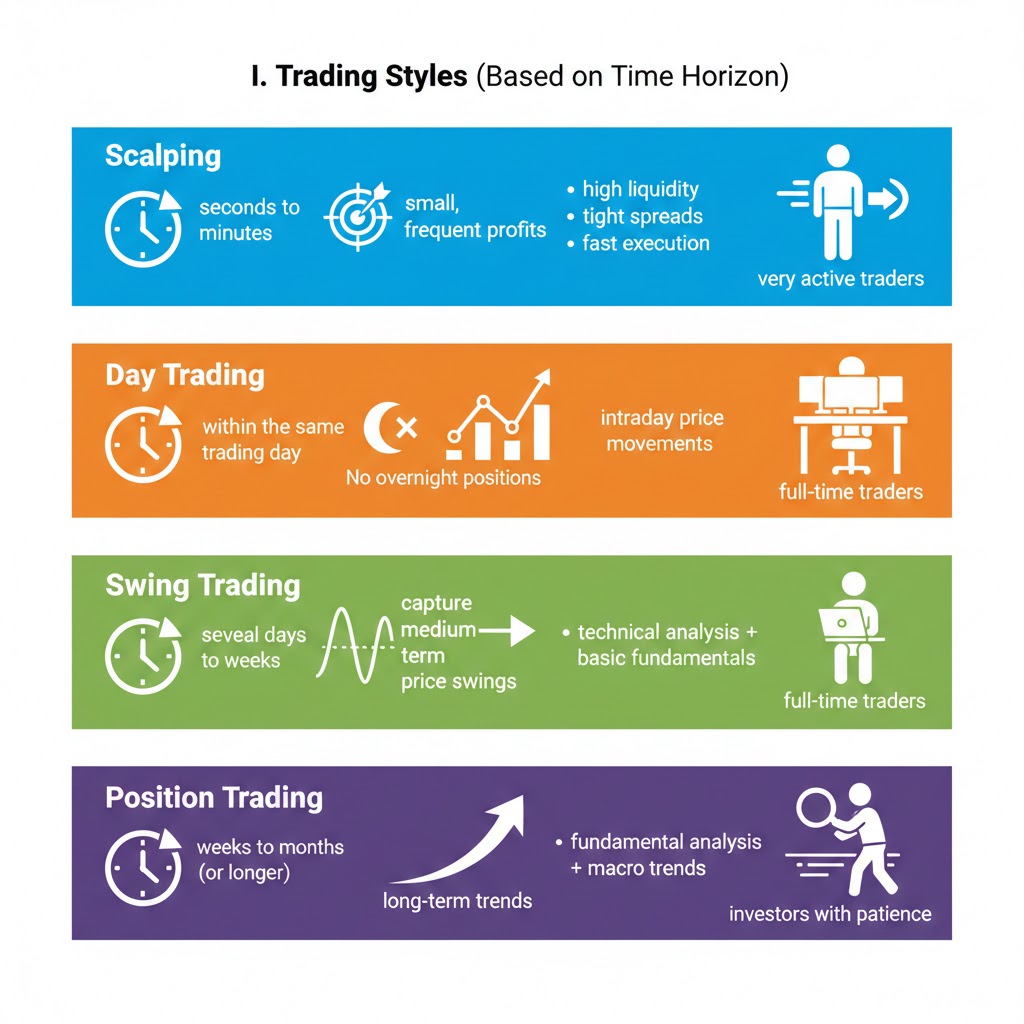
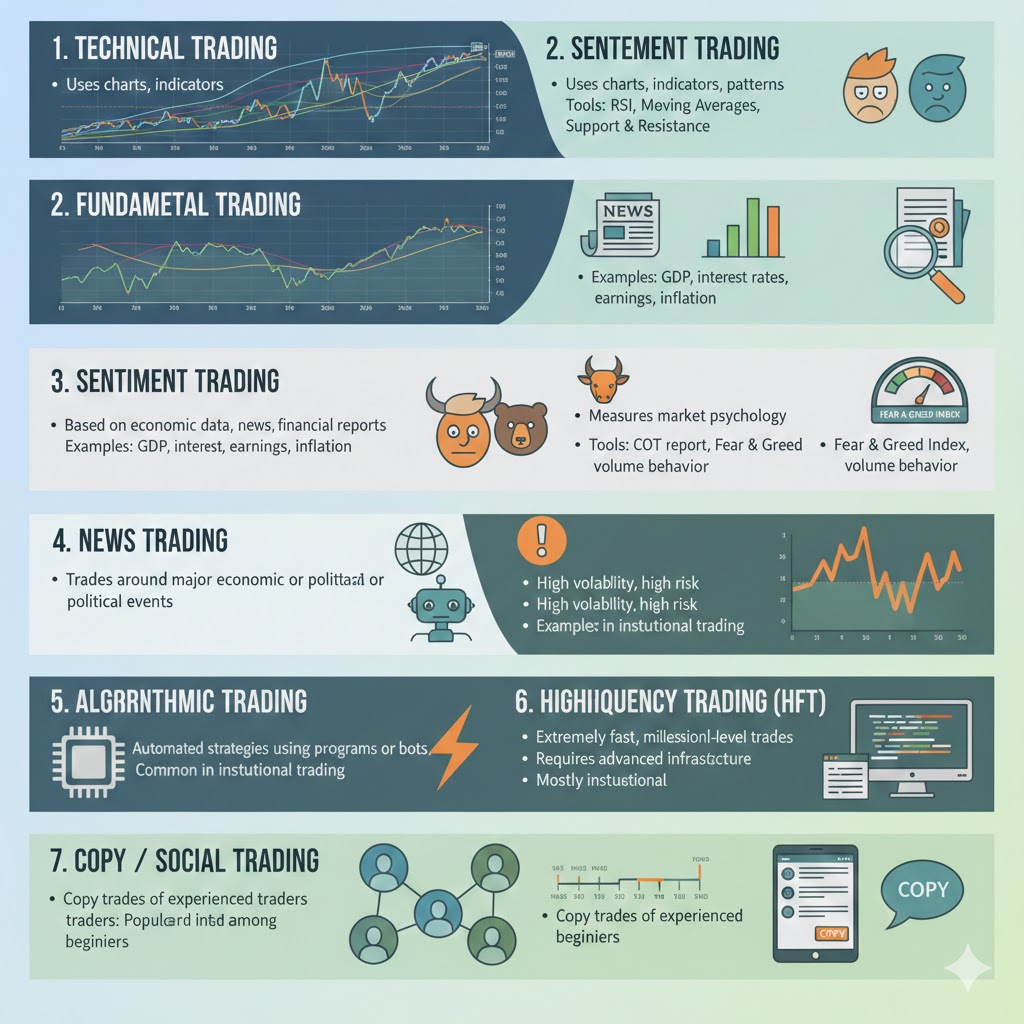
  • Trading Frameworks

    Trading Styles

    Types of Trading (Based on Strategy & Approach)
  • Trading Volume

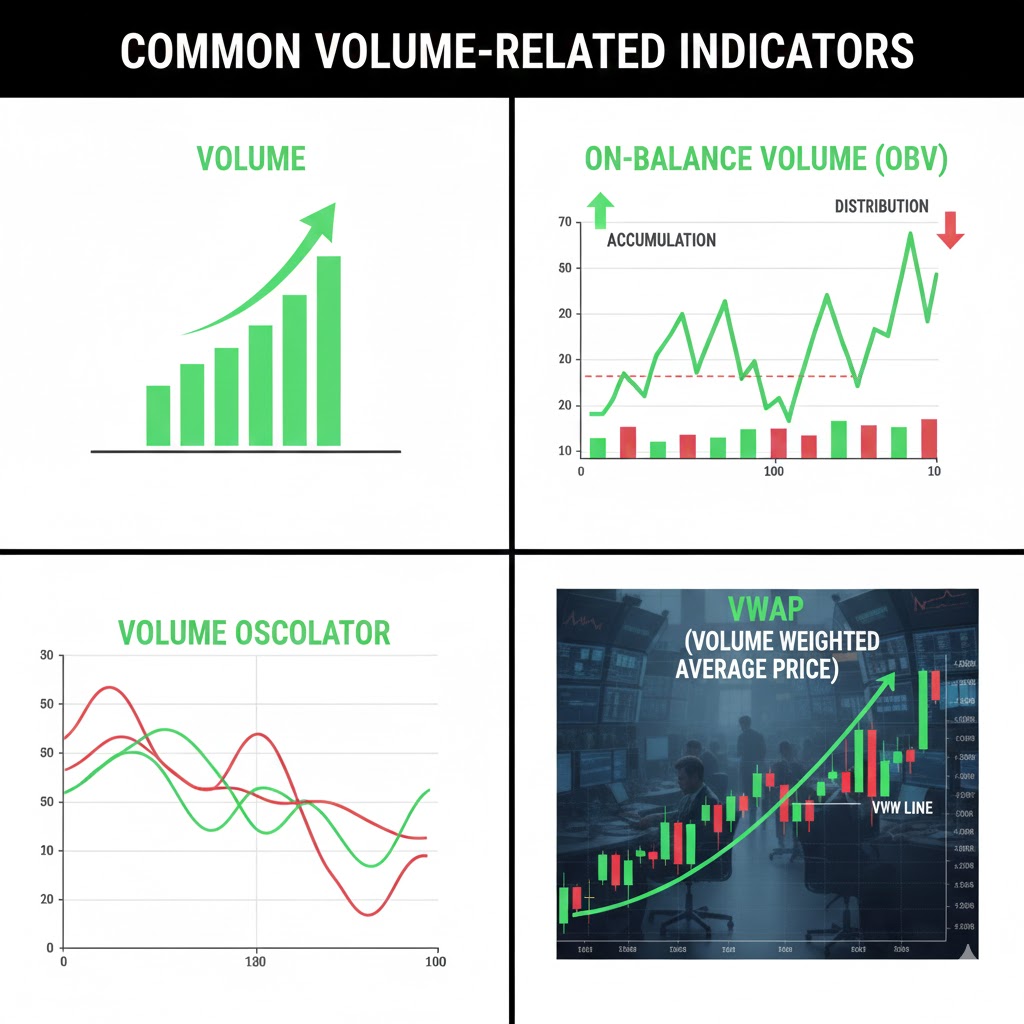
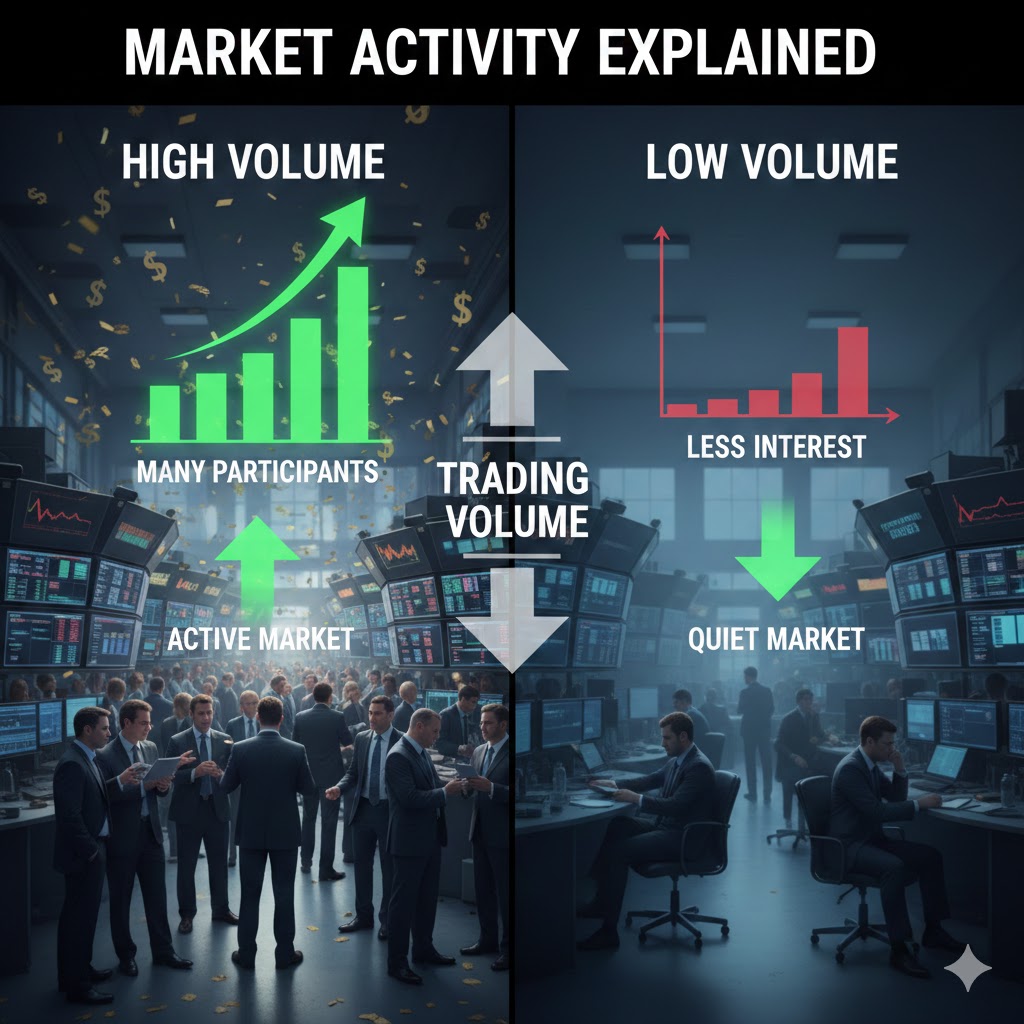
    Trading volume is the total amount of an asset that is bought and sold within a specific period of time in the financial market.
    📈Importance of trading volume

    1. Confirming price trends
      • Price rises + volume increases → a strong and reliable uptrend
      • Price rises + volume decreases → a weak trend, possible reversal
    2. Identifying market reversals
      • Sudden spikes in volume may indicate major news or new capital inflows
    3. Assessing liquidity
      • High volume → easy to enter and exit trades, lower spreads
      • Low volume → harder to trade, higher risk


    Short conclusion

    Trading volume reflects the strength of the market and the level of capital participation.
    Price shows where the market is going, while volume shows how strong the move is.

  • Technical Knowledge in Financial Markets

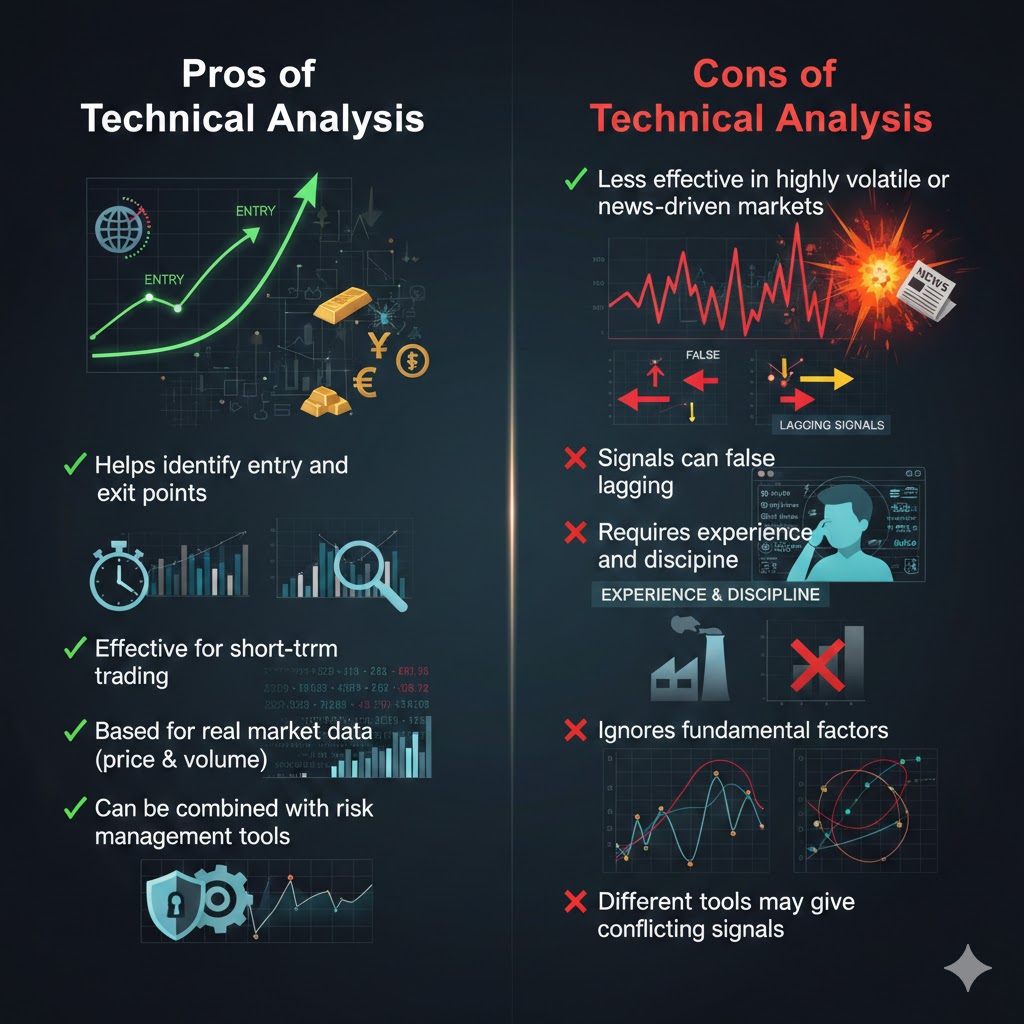
    Technical Knowledge in Financial Markets is the understanding and application of technical analysis tools and methods to analyze price movements and trading activity in order to forecast market trends and make trading decisions.

    It typically includes:

    • Price charts and chart patterns
    • Technical indicators (e.g. moving averages, RSI, MACD)
    • Volume analysis
    • Support and resistance levels
    • Market timing and entry/exit strategies

    Technical Analysis can be applied to

    • Stock Market
    • Forex
    • Cryptocurrency
    • Commodities
    • Derivatives (Futures, CFDs, Options)

    It is especially effective for day trading, swing trading, and scalping.
    In short

    It focuses on price behavior and market data rather than economic news or company fundamentals.

  • Economic Calendar

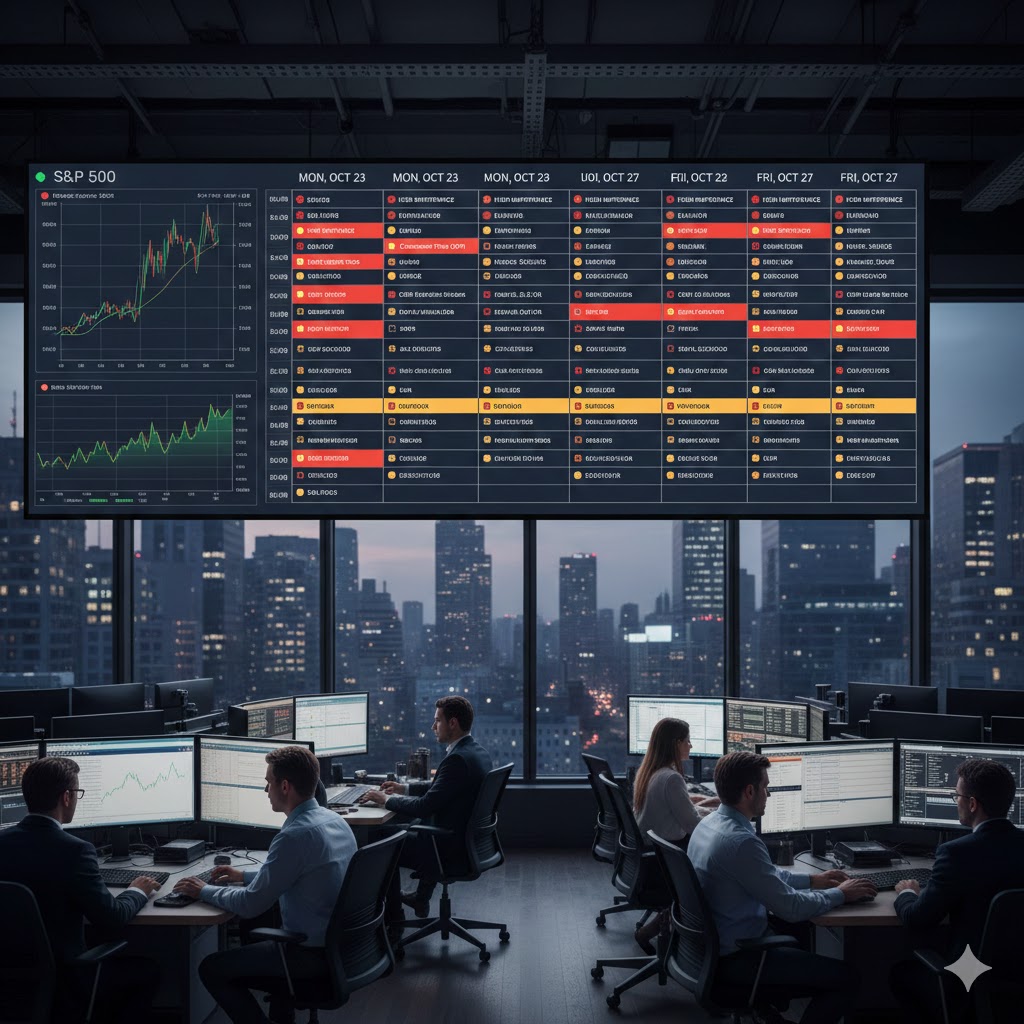
    An Economic Calendar is a tool used by traders, investors, economists, and analysts to track important scheduled economic events and data releases that can impact financial markets. These events include things like:
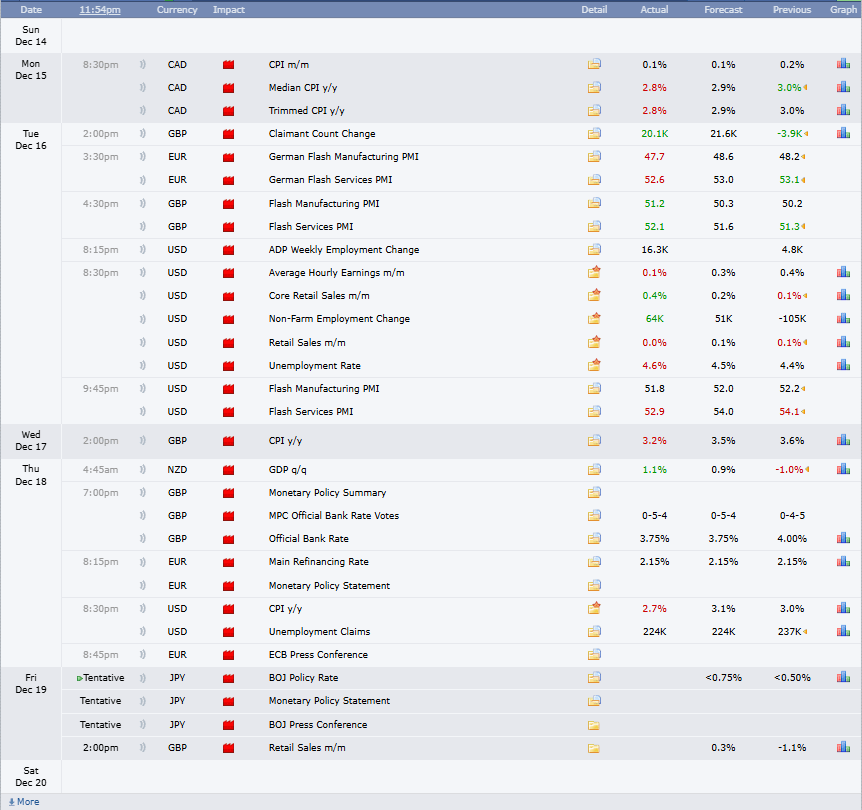
    • Economic indicators (e.g., GDP reports, inflation rates, employment data)
    • Central bank announcements (e.g., interest rate decisions, policy statements)
    • Government reports (e.g., trade balances, budget releases)
    • Speeches by key policymakers

    The calendar shows the date and time when these events will be released, often along with the expected figures and previous data for comparison. Market participants use this information to anticipate market volatility, make informed trading decisions, and manage risk.

    In summary

    • It’s a schedule of key economic events.
    • Helps forecast market movements.
    • Used widely in forex, stock, bond, and commodities trading.
  • SWOT Analysis

    SWOT Analysis is a strategic planning tool used to identify and analyze the Strengths, Weaknesses, Opportunities, and Threats related to a business, project, or situation. It helps organizations understand internal and external factors that can impact their success.
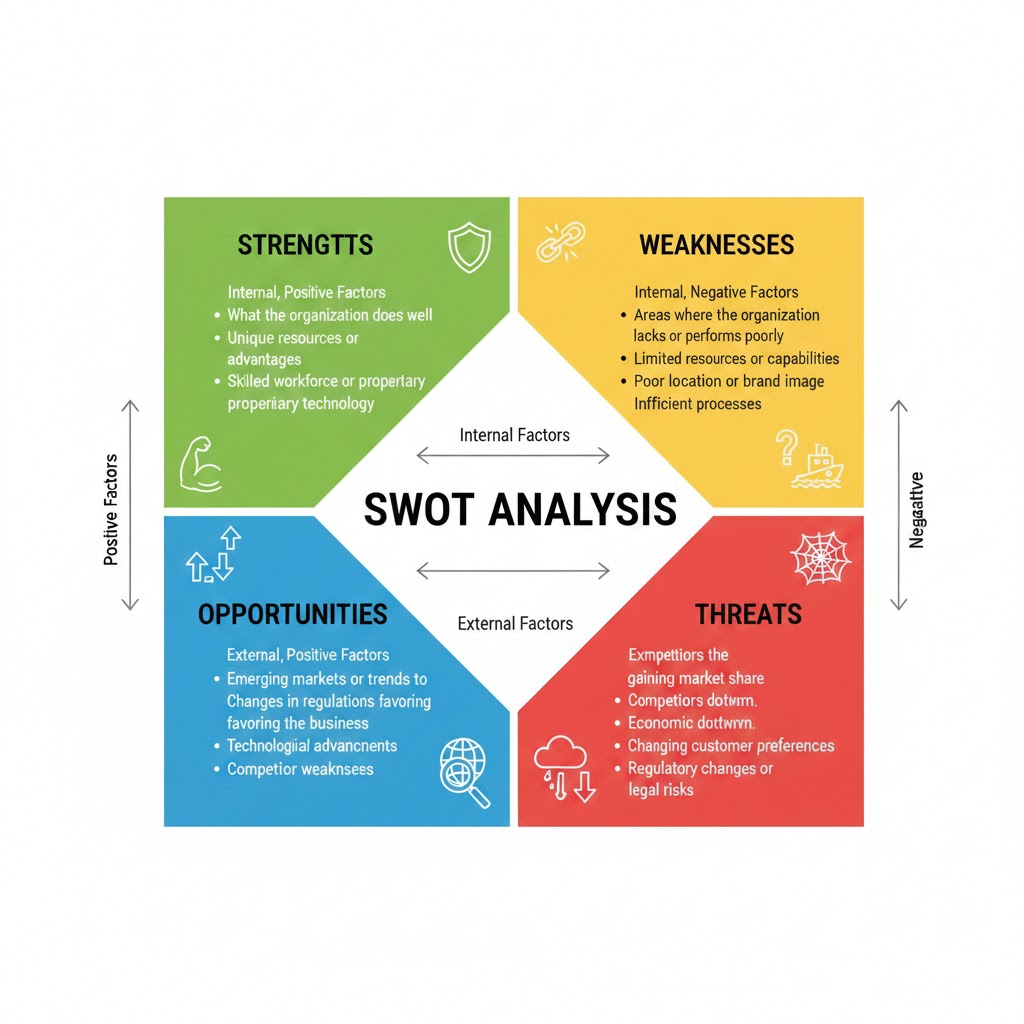
    Purpose of SWOT Analysis

    • To help make informed decisions
    • To leverage strengths and opportunities
    • To identify and mitigate weaknesses and threats
    • To develop strategies that align with the internal and external environment

    How to Conduct a SWOT Analysis

    • Gather a team with diverse knowledge about the business
    • Brainstorm and list internal strengths and weaknesses
    • Identify external opportunities and threats through market research
    • Analyze the results to create actionable strategies
  • Legal Factor

    Legal factors refer to the laws and regulations that a business must comply with in the countries or regions it operates. These factors are crucial because they set the legal framework within which businesses must function, and non-compliance can lead to fines, legal actions, or damage to reputation.

    Key Aspects of Legal Factors:

    1. Employment and Labor Laws
      • Regulations on hiring and firing
      • Minimum wage laws
      • Working hours and overtime rules
      • Workplace safety and health standards
      • Anti-discrimination laws
      • Employee rights and benefits
    2. Consumer Protection Laws
      • Product safety standards
      • Truth-in-advertising regulations
      • Privacy and data protection laws (e.g., GDPR)
      • Warranties and refunds policies
      • Fair trading laws
    3. Health and Safety Regulations
      • Occupational safety requirements
      • Environmental health standards
      • Industry-specific safety protocols
      • Mandatory training and certification
    4. Intellectual Property Laws
      • Patents, copyrights, trademarks protection
      • Protection against infringement and piracy
      • Licensing and royalties regulations
    5. Competition and Antitrust Laws
      • Rules to prevent monopolies and promote fair competition
      • Regulations against price fixing, collusion, or abuse of market power
      • Mergers and acquisitions controls
    6. Industry-Specific Regulations
      • Compliance requirements for sectors like finance, healthcare, food, pharmaceuticals, telecommunications, and transportation
      • Licensing and permits
      • Reporting and audit obligations
    7. Taxation Laws
      • Corporate tax obligations
      • VAT and sales tax regulations
      • Tax incentives or penalties
    8. Environmental Laws
      • Compliance with pollution control laws
      • Waste disposal regulations
      • Emission limits and sustainability mandates

    Why Legal Factors Matter

    • They protect businesses and consumers by setting clear rules.
    • They influence business costs through compliance expenses.
    • They affect operational flexibility and strategic choices.
    • They can create barriers to entry or competitive advantages.
    • Non-compliance can lead to legal penaltieslawsuits, and reputational damage.
  • Environmental Factor

    The Environmental factor looks at ecological and environmental aspects that can impact a business or industry. It involves how environmental concerns, regulations, and sustainability issues influence operations and strategies.

    Key Elements of Environmental Factors:

    • Climate and Weather:
      Impact of climate change, extreme weather events, and seasonal variations on business continuity and supply chains.
    • Environmental Regulations:
      Laws and policies related to pollution control, waste management, emissions, and resource usage.
    • Sustainability Practices:
      Pressure to adopt eco-friendly processes, renewable energy use, and sustainable sourcing.
    • Carbon Footprint and Emissions:
      Monitoring and reducing greenhouse gas emissions in operations.
    • Natural Resource Availability:
      Access to water, minerals, and raw materials critical for production.
    • Waste Disposal and Recycling:
      Regulations and practices around handling and reducing waste.
    • Consumer Environmental Awareness:
      Growing demand for green products and corporate social responsibility.

    Why is the Environmental Factor Important?

    • Environmental concerns can lead to stricter regulations, increasing compliance costs.
    • Sustainability is becoming a key competitive differentiator.
    • Risks from environmental damage (floods, droughts) can disrupt business.
    • Positive environmental practices can improve brand image and customer loyalty.
  • Technological Factor

    The Technological factor involves how technological innovations, developments, and trends impact a business and industry. It covers the adoption of new technologies that can improve products, processes, or create new opportunities.

    Key Elements of Technological Factors
    • Innovation and R&D:
      Level of investment in research and development; pace of innovation in the industry.
    • Automation and Digitalization:
      Use of robotics, AI, data analytics, and digital tools to improve efficiency and reduce costs.
    • Technology Infrastructure:
      Availability and quality of internet, telecommunications, and IT infrastructure.
    • Emerging Technologies:
      Technologies such as blockchain, 5G, IoT, virtual reality, or renewable energy impacting the market.
    • Technology Lifecycle:
      Rate at which technologies become obsolete and replaced by new ones.
    • Intellectual Property:
      Protection of patents, copyrights, and trade secrets influencing competitive advantage.
    • Technology Access and Adoption:
      How quickly customers and competitors adopt new technology.

    Why is the Technological Factor Important?

    • Enables companies to improve products, reduce costs, and streamline operations.
    • Creates new product categories and disrupts existing markets.
    • Determines competitive advantage in fast-changing industries.
    • Helps assess threats from new entrants using advanced tech.
  • Social Factor

    The Social factor refers to the cultural, demographic, and societal aspects that affect consumer needs, behaviors, and market demand. It considers how society’s attitudes, values, and trends influence a business environment.
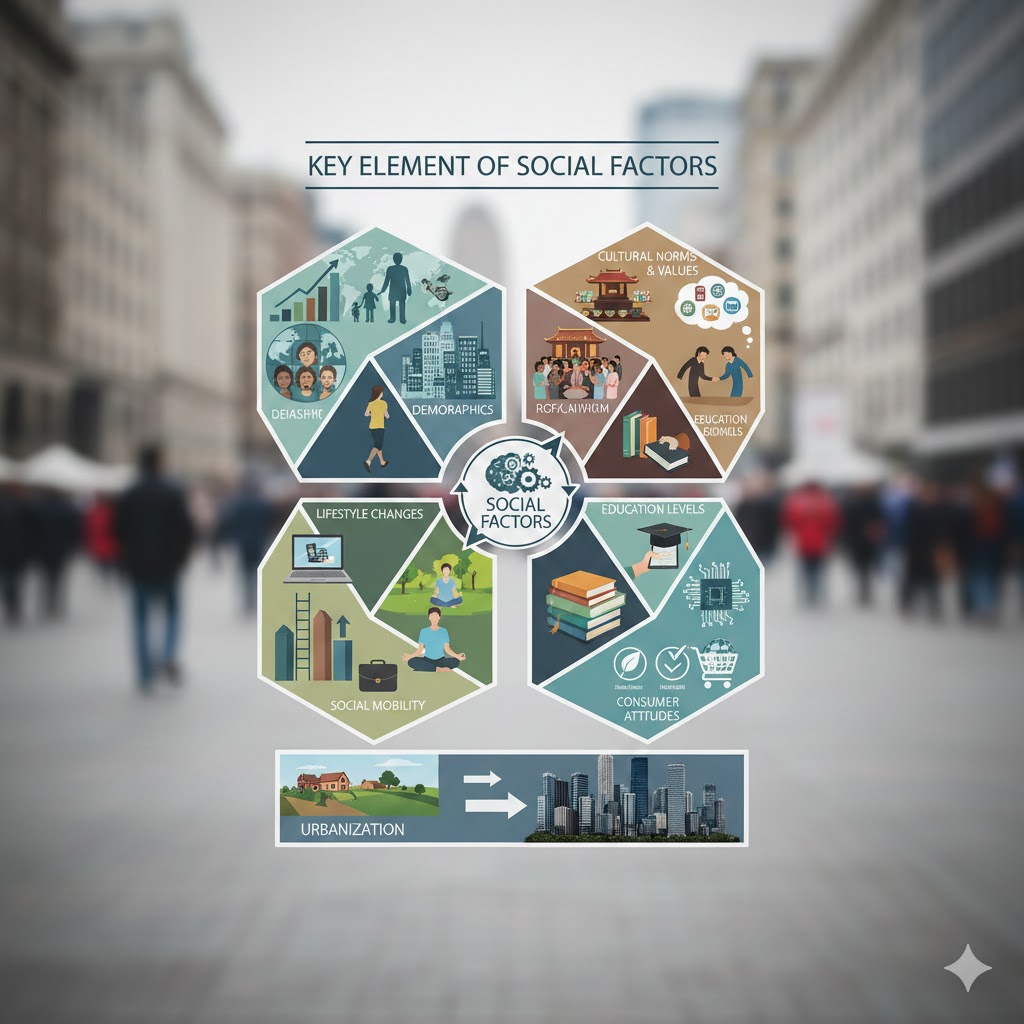
    Key Elements of Social Factors

    • Urbanization
      Migration trends from rural to urban areas influencing market demand and infrastructure.
    • Demographics
      Age distribution, population growth rate, family size, ethnicity, and population density.
    • Cultural Norms and Values
      Traditions, beliefs, social behaviors, and attitudes towards products or services.
    • Lifestyle Changes
      Shifts in how people live, work, and spend leisure time (e.g., health consciousness, remote work trends).
    • Education Levels
      Affects workforce skills, consumer awareness, and product/service complexity.
    • Social Mobility
      Opportunities for individuals to move within social strata, affecting consumption patterns.
    • Consumer Attitudes
      Toward health, environment, sustainability, brand ethics, and social responsibility.

    Why is the Social Factor Important?

    • Influences product development, marketing strategies, and customer service approaches.
    • Helps anticipate changing consumer needs and tailor offerings.
    • Social trends can create new market opportunities or threaten existing products.
  • Economic Factor

    The Economic factor examines how the overall economy and economic conditions impact businesses. It focuses on factors that influence consumer purchasing power, costs, and demand.

    Key Elements of Economic Factors
    • Economic Growth Rate
      GDP growth or contraction affects demand for products and services.
    • Inflation Rate
      Rising prices can reduce consumers’ spending power and increase costs.
    • Interest Rates
      Affect borrowing costs for businesses and consumers, influencing investment and spending.
    • Unemployment Levels
      High unemployment can reduce demand but may lower labor costs.
    • Exchange Rates
      Affect the cost of imports/exports and competitiveness internationally.
    • Disposable Income
      The amount of money consumers have available after taxes to spend or save.
    • Consumer Confidence
      How optimistic consumers feel about the economy affects their spending habits.
    • Fiscal and Monetary Policies
      Government spending and taxation, central bank policies impact overall economic conditions.

    Why is the Economic Factor Important?

    • Economic conditions directly influence sales volume, pricing strategies, and profitability.
    • Changes in interest or inflation rates affect business financing and consumer behavior.
    • Helps businesses forecast demand and adjust operations accordingly.
  • Political Factor

    The Political factor refers to how government actions, policies, and political stability affect businesses and the broader industry environment. It covers all aspects of the political environment that can influence organizational operations.

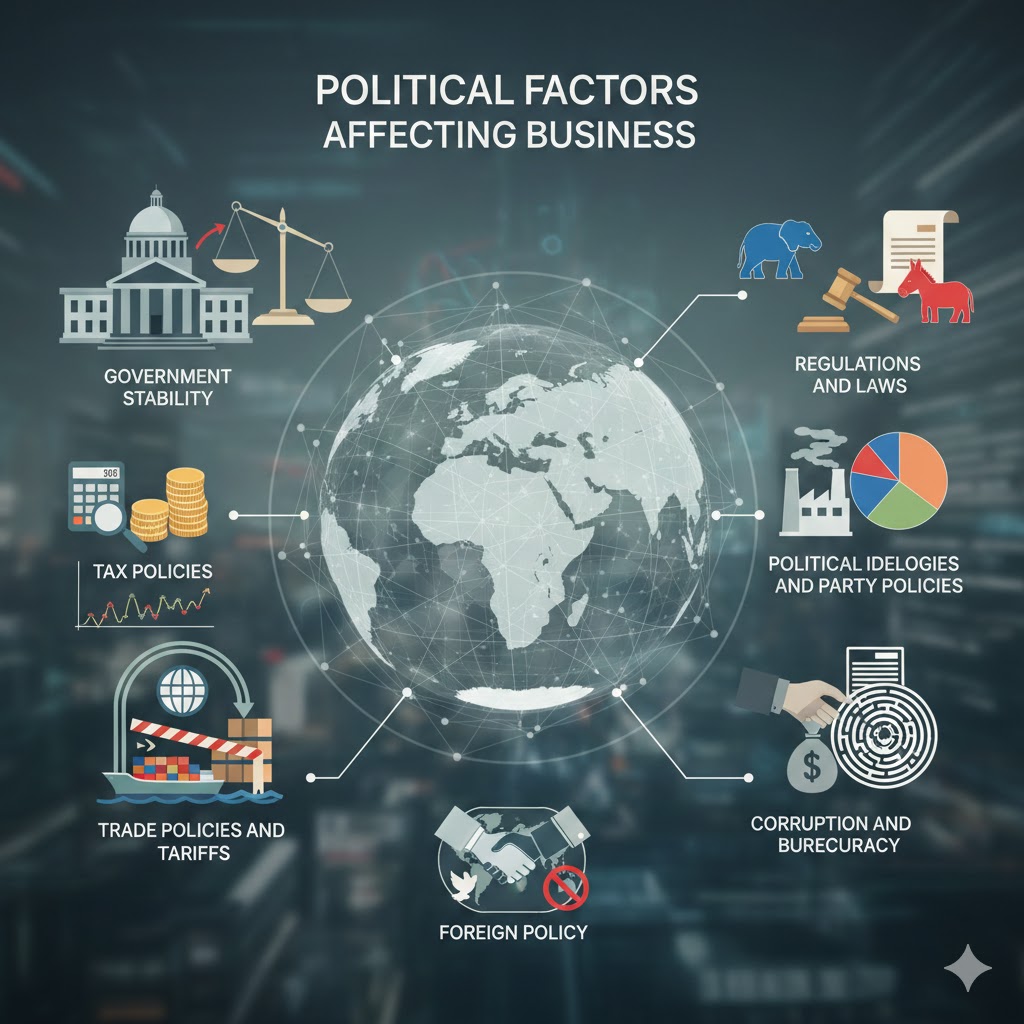
    Why is the Political Factor Important?

    • Political decisions can directly affect market conditions, operational costs, and the legal environment.
    • Businesses in unstable political climates may face risks like policy changes, nationalization, or conflict.
    • Understanding political factors helps companies mitigate risks and capitalize on favorable policies.
  • Open Economy

    An Open Economy is an economic system that allows for the free flow of goods, services, capital, and labor across its borders. Unlike a closed economy, which does not engage in international trade or financial exchanges, an open economy interacts with other countries through imports, exports, foreign investments, and currency exchange.

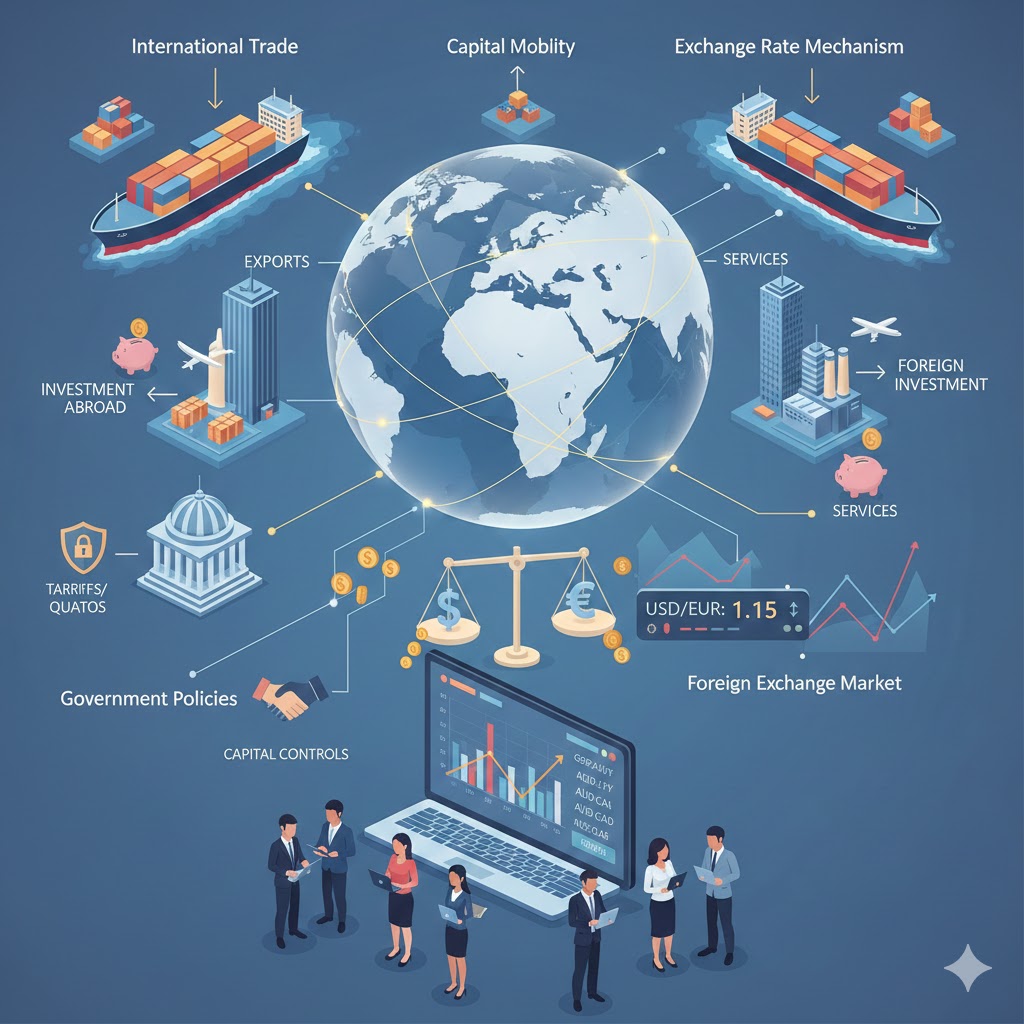
    Key Features of an Open Economy
    • International Trade: It buys and sells goods and services from and to other countries.
    • Capital Mobility: Investors can invest in foreign assets, and foreign investors can invest domestically.
    • Exchange Rate Mechanism: Currency values fluctuate based on trade and investment flows.
    • Foreign Exchange Market: A platform for trading different currencies.
    • Government Policies: May include tariffs, quotas, trade agreements, and capital controls to regulate or promote trade and investment.

    Why Open Economies Matter

    • They allow countries to specialize in producing goods and services where they have a comparative advantage.
    • They promote economic growth through access to larger markets and capital.
    • They can improve efficiency and innovation by exposing domestic firms to international competition.
  • Labour Market

    The Labour Market (or job market) is the place or system where workers (labor supply) and employers (labor demand) interact. It’s where people offer their skills and work in exchange for wages or salaries, and where employers seek to hire employees to fill job positions.
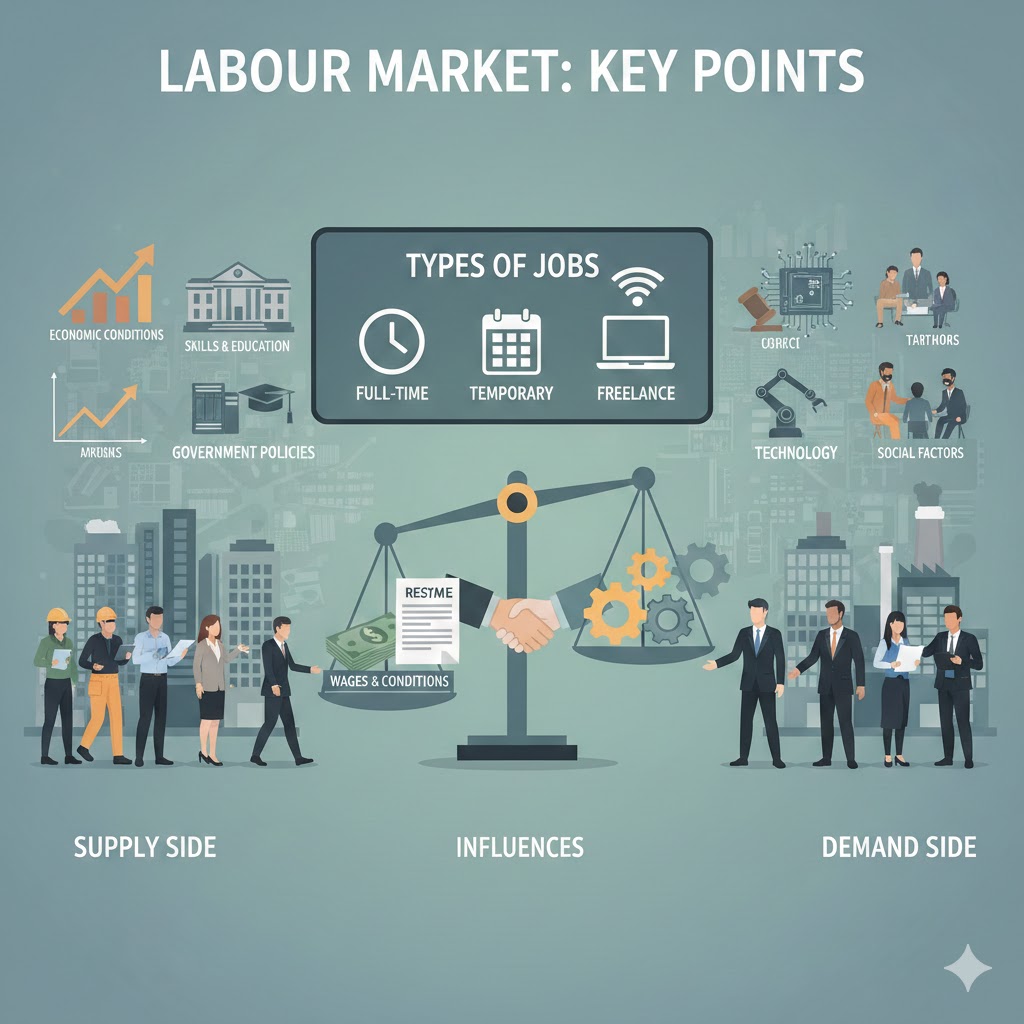
    In short, the labour market is where the exchange of work for pay happens, balancing the needs of workers and employers.
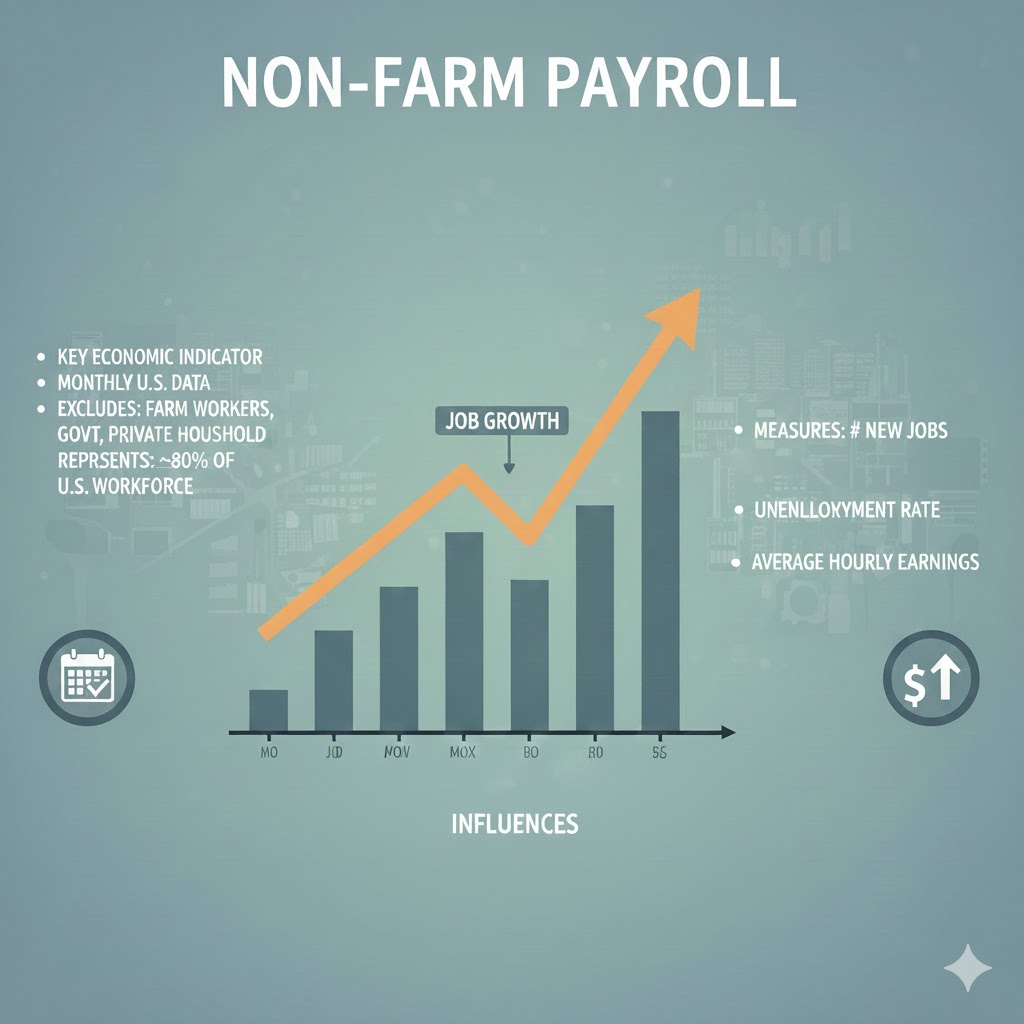
    What is Non-Farm Payroll (NFP)?

    • Non-Farm Payroll represents the total number of paid workers in the U.S. excluding those employed in the farming sector, private households, non-profit organizations, and government employees.
    • It reflects employment levels in all industries except agriculture.

    Why is Non-Farm Payroll Important?

    • It is released monthly by the U.S. Bureau of Labor Statistics (BLS) as part of the Employment Situation report.
    • The NFP data shows how many jobs were added or lost in the economy, giving insight into economic health.
    • It affects financial markets strongly because it signals labor market strength and can influence Federal Reserve monetary policy decisions.

    In short

    • Non-farm payment likely means non-farm payroll, which is the count of workers paid outside the farming sector.
    • It’s a major indicator of employment trends and economic performance.
  • Money Market

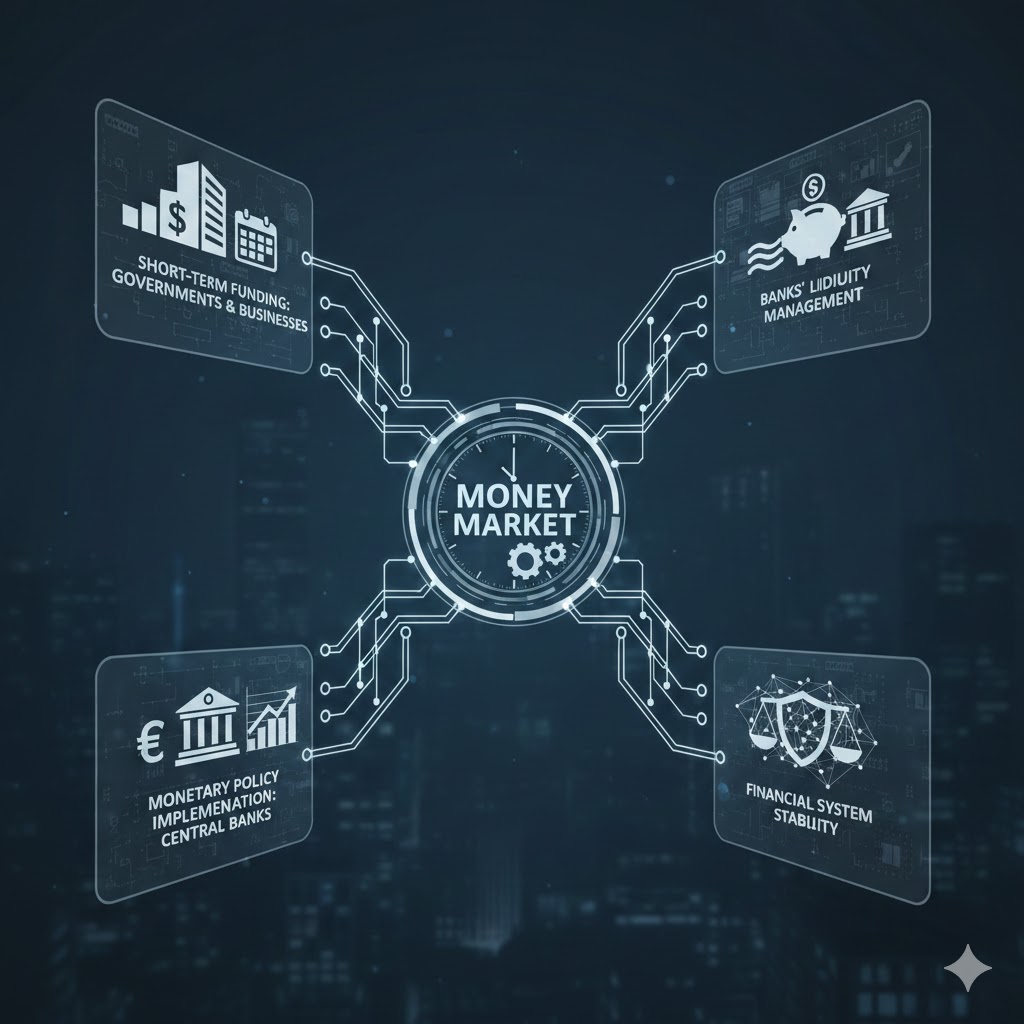
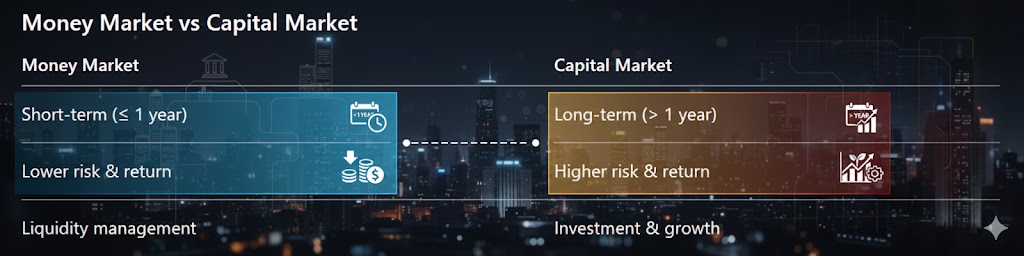
    Money Market is a segment of the financial market where short-term funds are borrowed and lent, usually for periods of less than one year. It is mainly used to manage liquidity and meet short-term financing needs, rather than for long-term investment.

    Key characteristics

    • Short maturity: Overnight to under 1 year
    • Low risk & high liquidity
    • Large transaction sizes
    • Lower returns compared to capital markets

    Main participants
    • Central banks
    • Commercial banks
    • Financial institutions
    • Corporations
    • Governments

    Common money market instruments

    • Treasury Bills (T-Bills): Short-term government securities
    • Commercial Paper (CP): Unsecured short-term corporate debt
    • Certificates of Deposit (CDs): Time deposits issued by banks
    • Repurchase Agreements (Repos): Short-term borrowing using securities as collateral
    • Interbank loans: Loans between banks

    Functions of the money market

    In short, the money market keeps the financial system running smoothly by ensuring that cash is available where and when it’s needed.

  • Public Finance

    Public Finance is a branch of economics that studies how governments raise, allocate, and manage financial resources to support public services and achieve economic and social objectives.
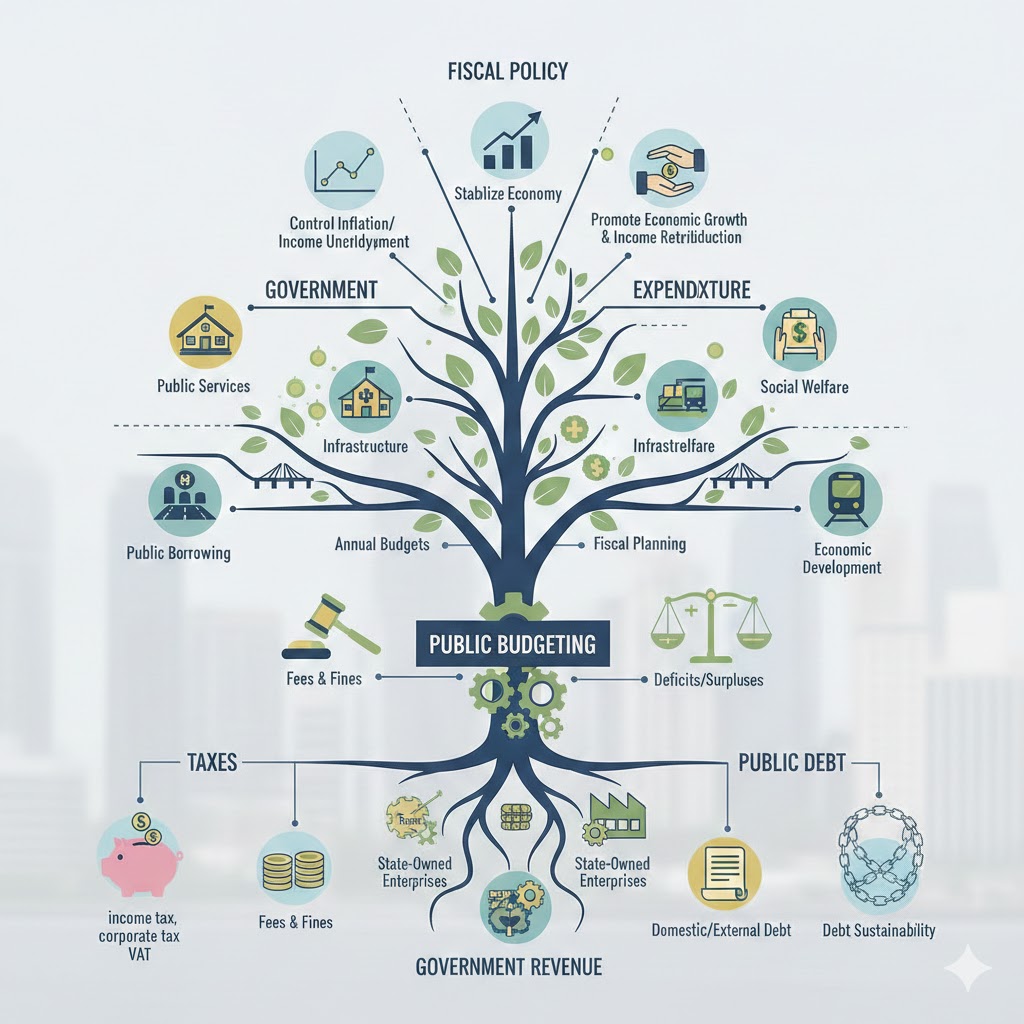
    Why Public Finance matters

    Public Finance helps ensure:

    • Efficient allocation of resources
    • Fair income distribution
    • Macroeconomic stability
    • Provision of public goods that the private sector cannot efficiently supply

    In short

    Public Finance explains how governments get money, how they spend it, and how those decisions affect the economy and society.

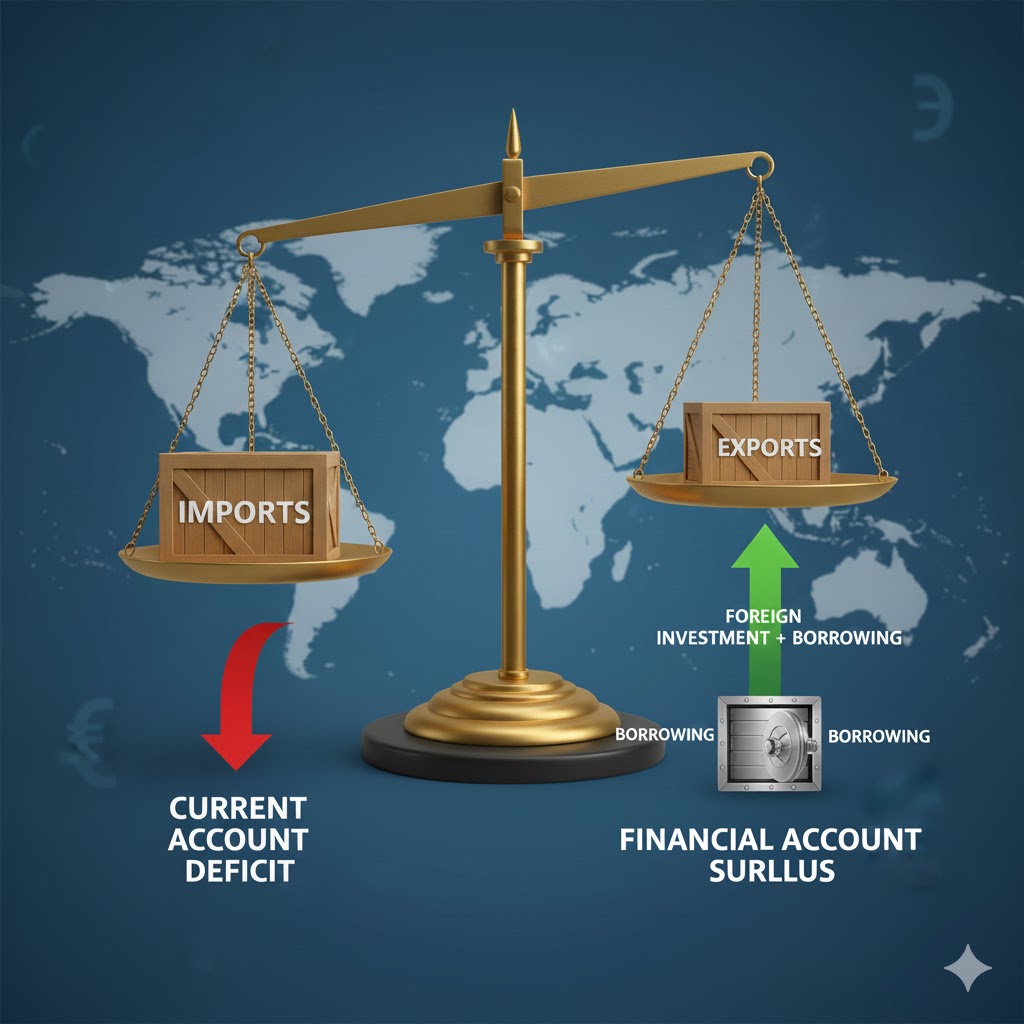
  • Balance of Payments (BoP)

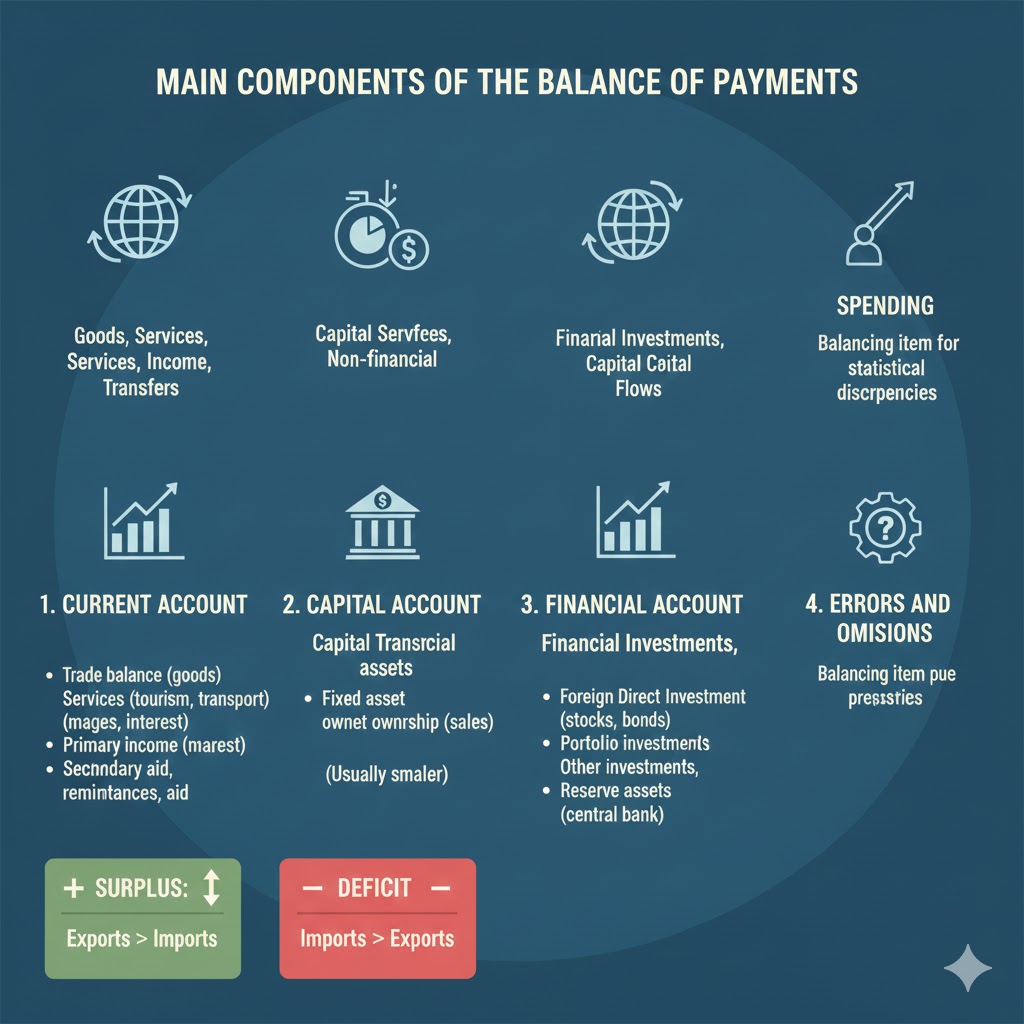
    Balance of Payments (BoP) is a comprehensive record of all economic transactions between a country and the rest of the world over a specific period (usually a quarter or a year).
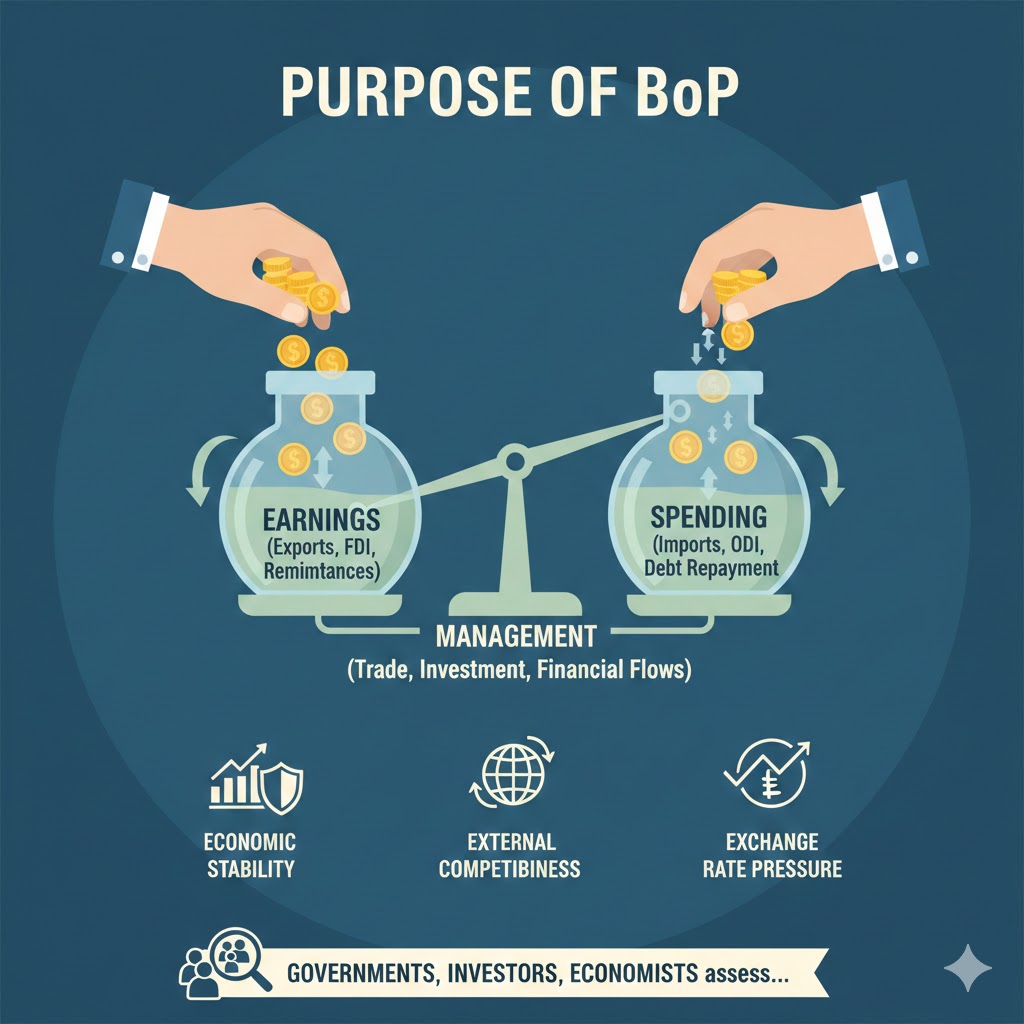
    Key Rule of BoP

    In theory, the Balance of Payments always balances

    Any deficit or surplus in one account must be offset by changes in other accounts or reserves.


    Why BoP Matters

    • Influences exchange rates
    • Signals economic strength or vulnerability
    • Guides monetary and fiscal policy
    • Important for foreign investors and international trade decisions

    Example

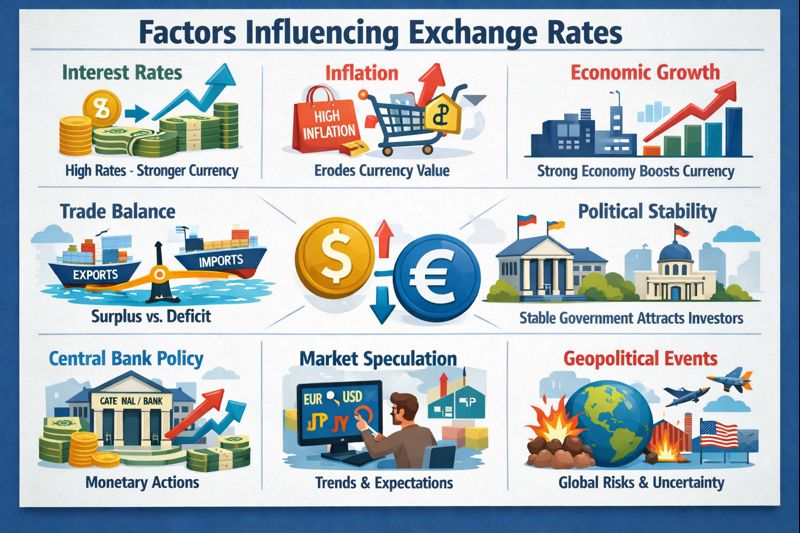
  • Exchange Rate

    An exchange rate is the price of one country’s currency in terms of another country’s currency. It tells you how much of one currency you need to exchange for another.

    Exchange rate = value of one currency expressed in another currency
    Foreign Exchange rate (Forex)
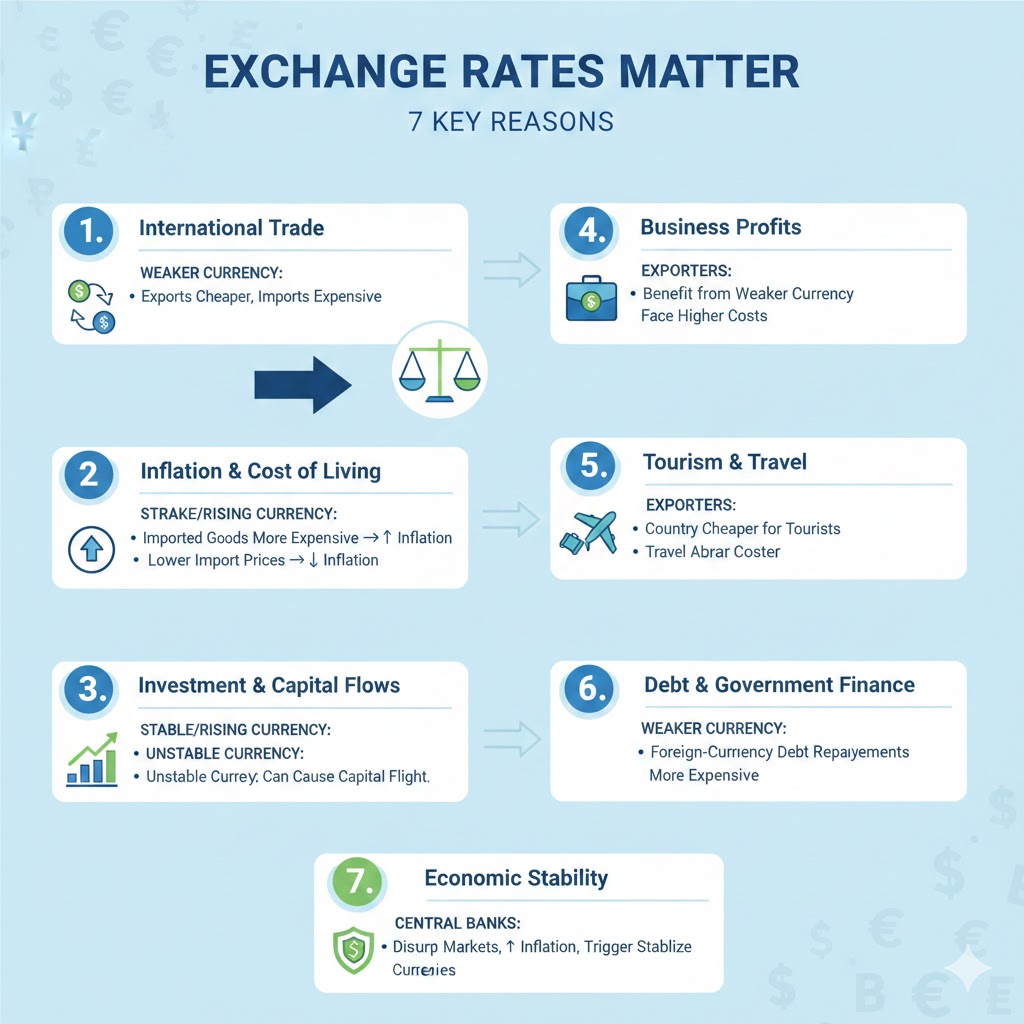
    Types of exchange rate systems

    1. Floating exchange rate
      • Determined by supply and demand in the market
      • Example: USD, EUR, JPY
    2. Fixed (pegged) exchange rate
      • Currency is pegged to another currency or a basket
      • Central bank intervenes to keep it stable
    3. Managed float
      • Mostly market-driven, but central bank intervenes when needed
      • Vietnam uses this system

    Appreciation vs Depreciation

    • Currency appreciation: Currency becomes stronger
    • Currency depreciation: Currency becomes weaker
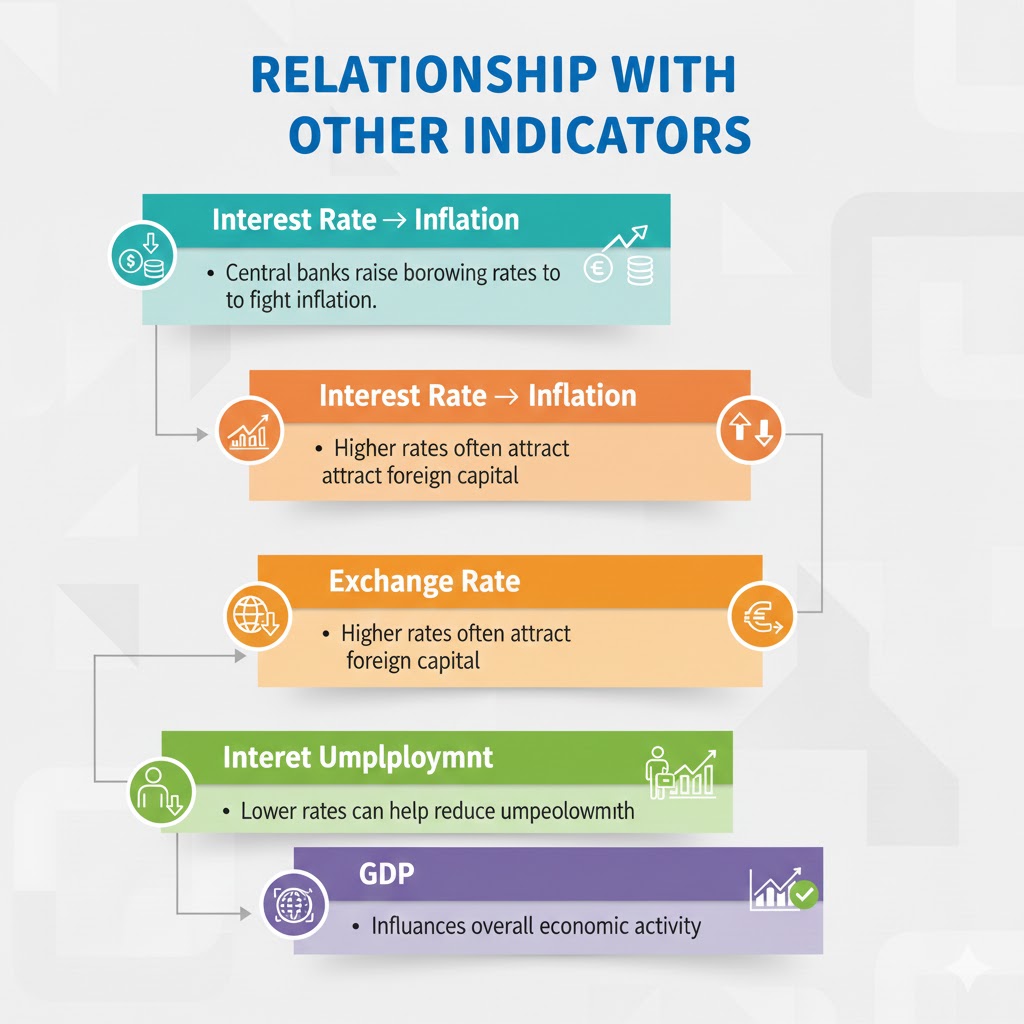
  • Interest Rate

    Interest Rate is the cost of borrowing money or the return on saving/investing money, usually expressed as a percentage per year.

    • For borrowers: Interest rate is the price you pay to use someone else’s money (e.g. loans, mortgages).
    • For savers/investors: Interest rate is the income you earn from lending money (e.g. bank deposits, bonds).
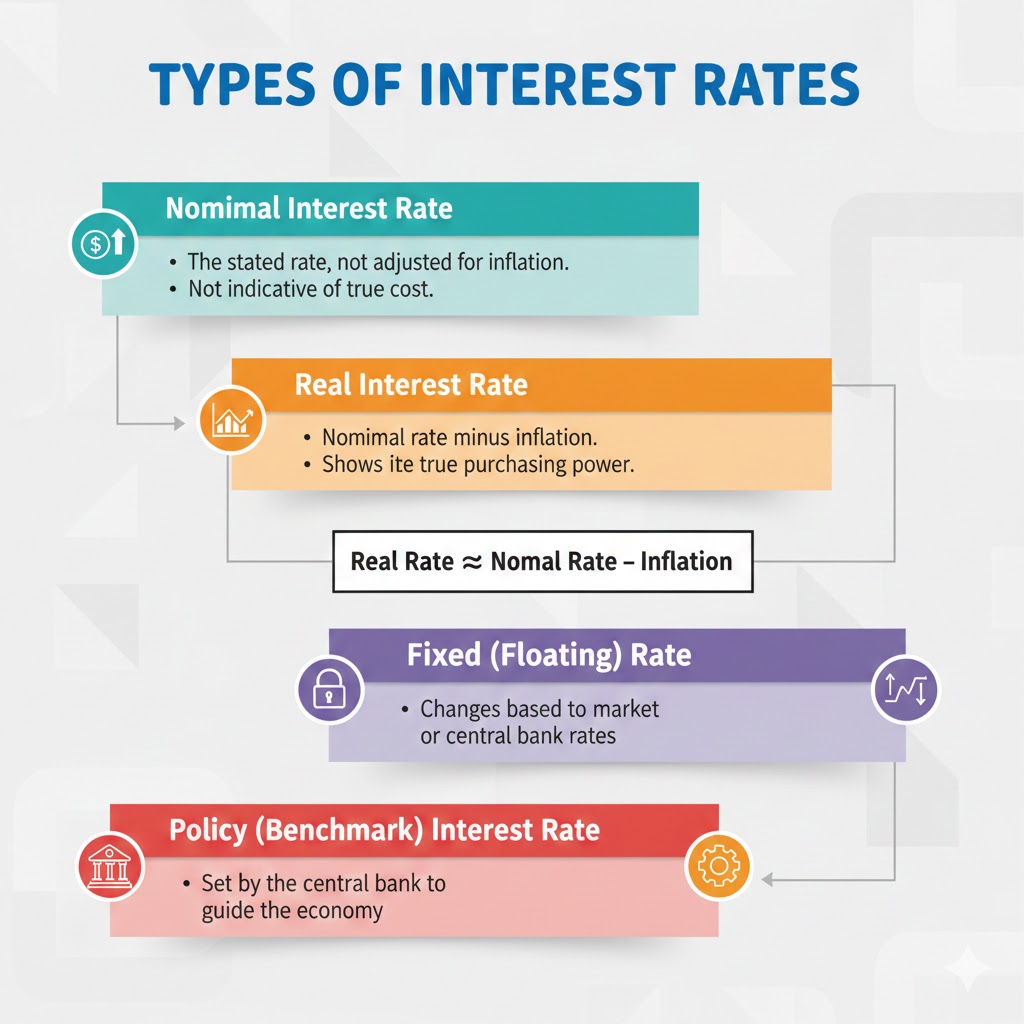
    Why Interest Rates Matter

    Interest rates affect almost every part of the economy:
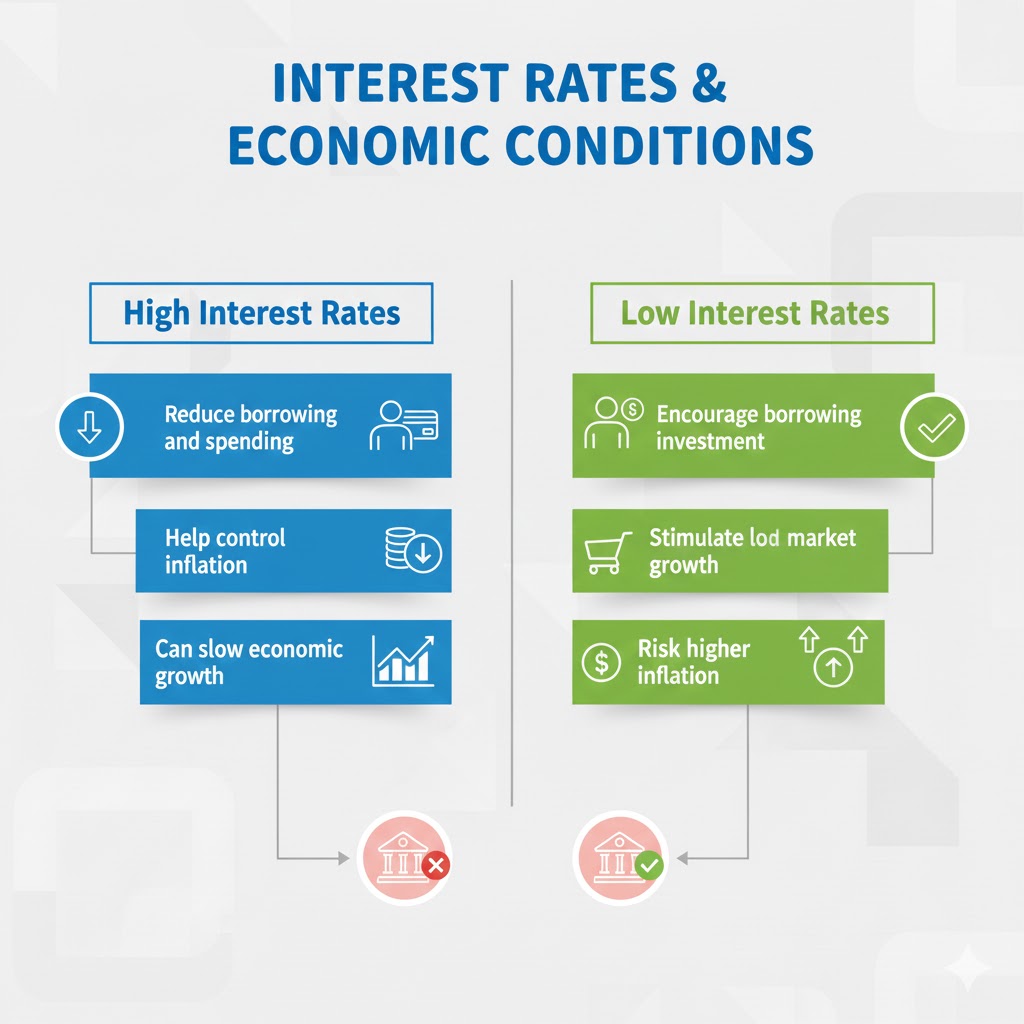
    • Consumers: borrowing, spending, saving decisions
    • Businesses: investment and expansion costs
    • Financial markets: stocks, bonds, currencies
    • Inflation: controlling price stability
    • Economic growth: encouraging or slowing activity

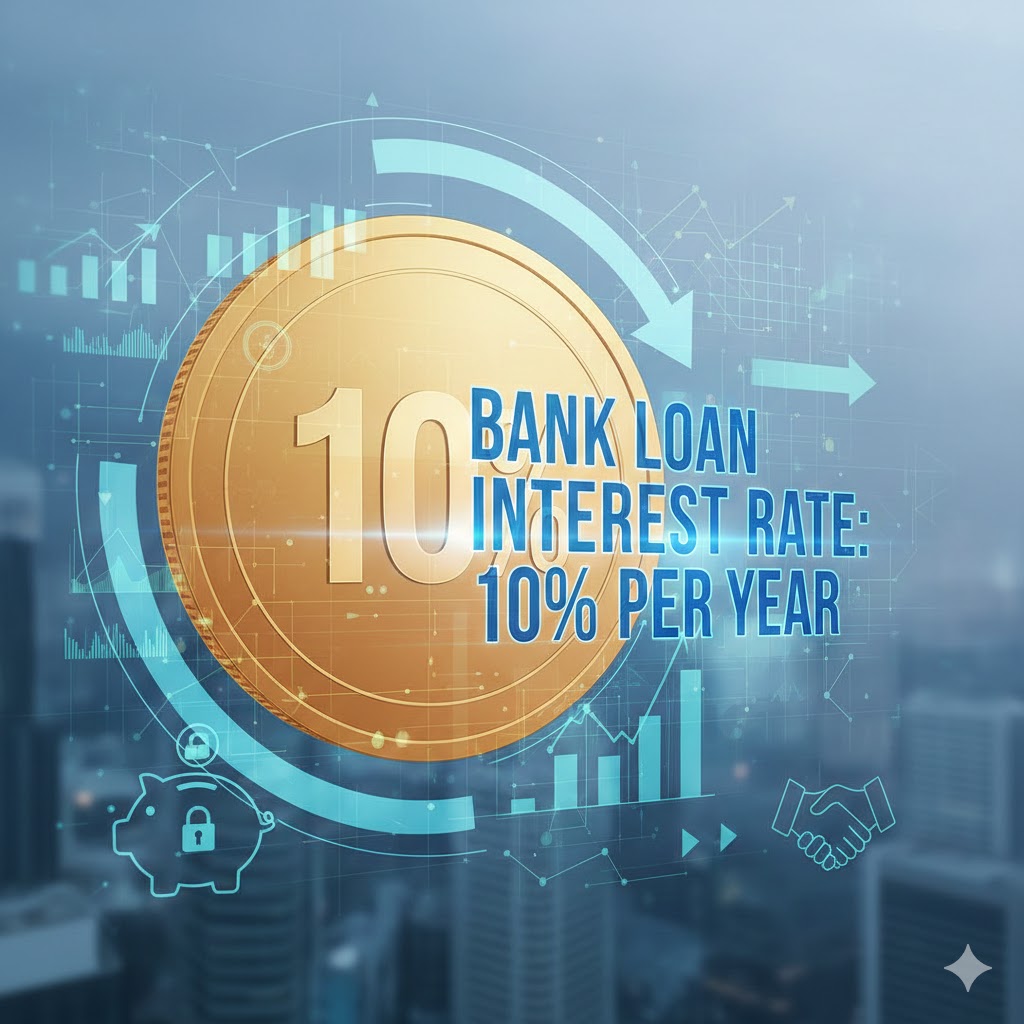
    Simple Example

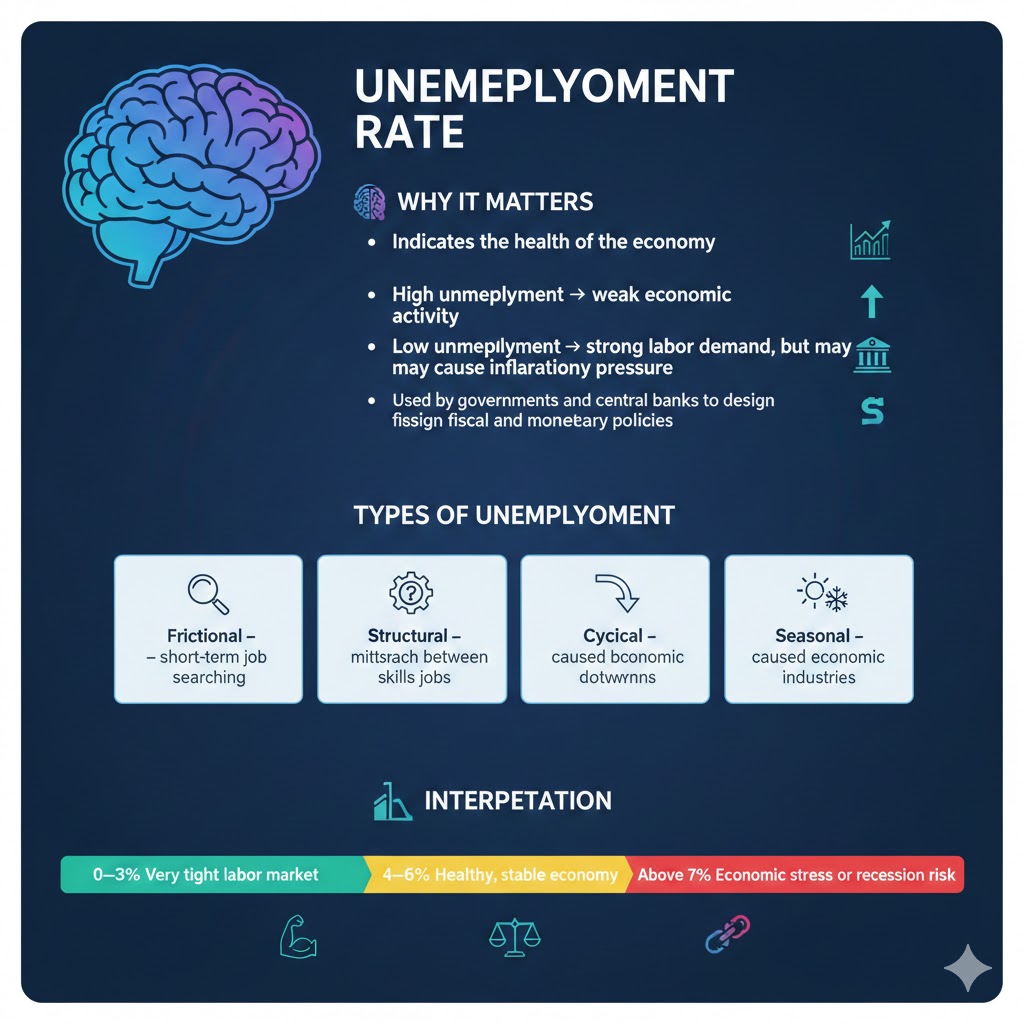
  • Unemployment Rate

    Unemployment Rate is a key macroeconomic indicator that measures the share of people in the labor force who are able and willing to work but cannot find a job.

    The unemployment rate shows how efficiently an economy is using its labor resources.
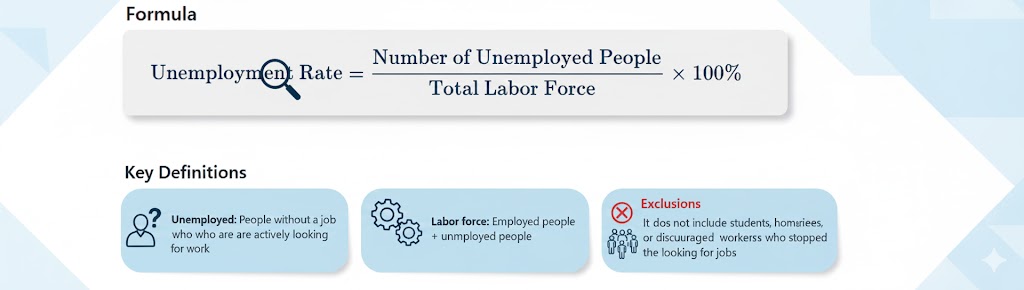
    In practice

    • Investors watch unemployment data to anticipate interest rate changes
    • Businesses use it to plan hiring and expansion
    • Educators and policymakers use it to assess workforce readiness
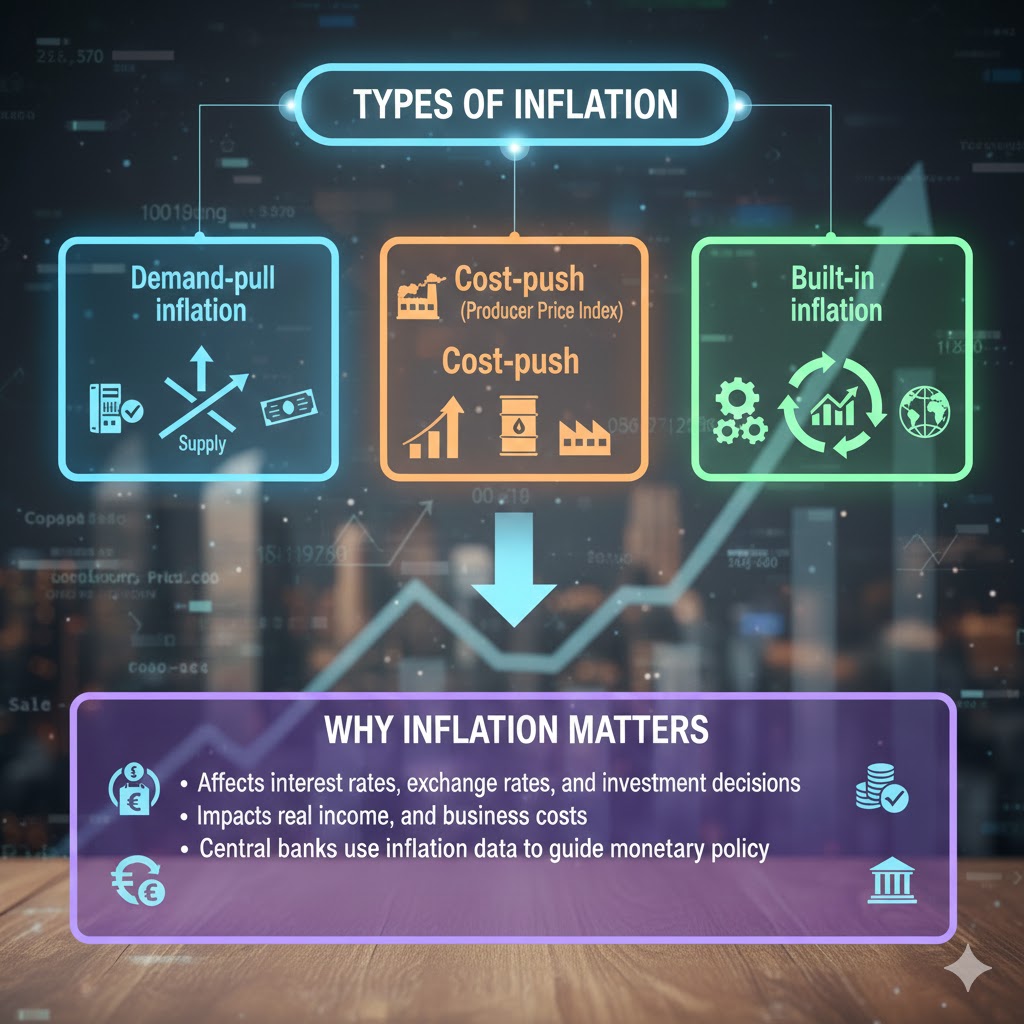
  • Inflation Rate

    Inflation Rate is the percentage change in the general price level of goods and services over a specific period, usually measured year-over-year (YoY) or month-over-month (MoM).
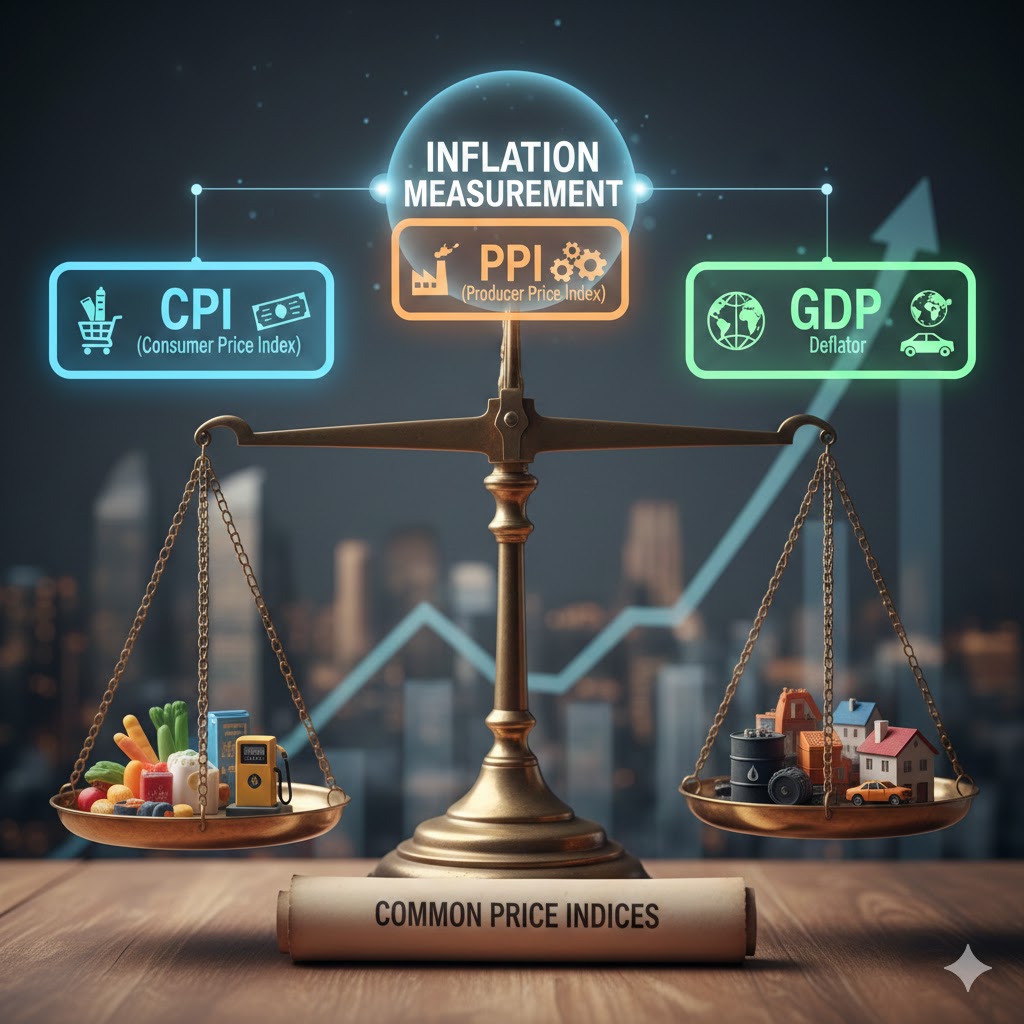
    Key points

    • 📈 Positive inflation: Prices rise → purchasing power falls
    • 📉 Negative inflation (deflation): Prices fall
    • 🎯 Moderate inflation (around 2%) is often considered healthy for economic growth

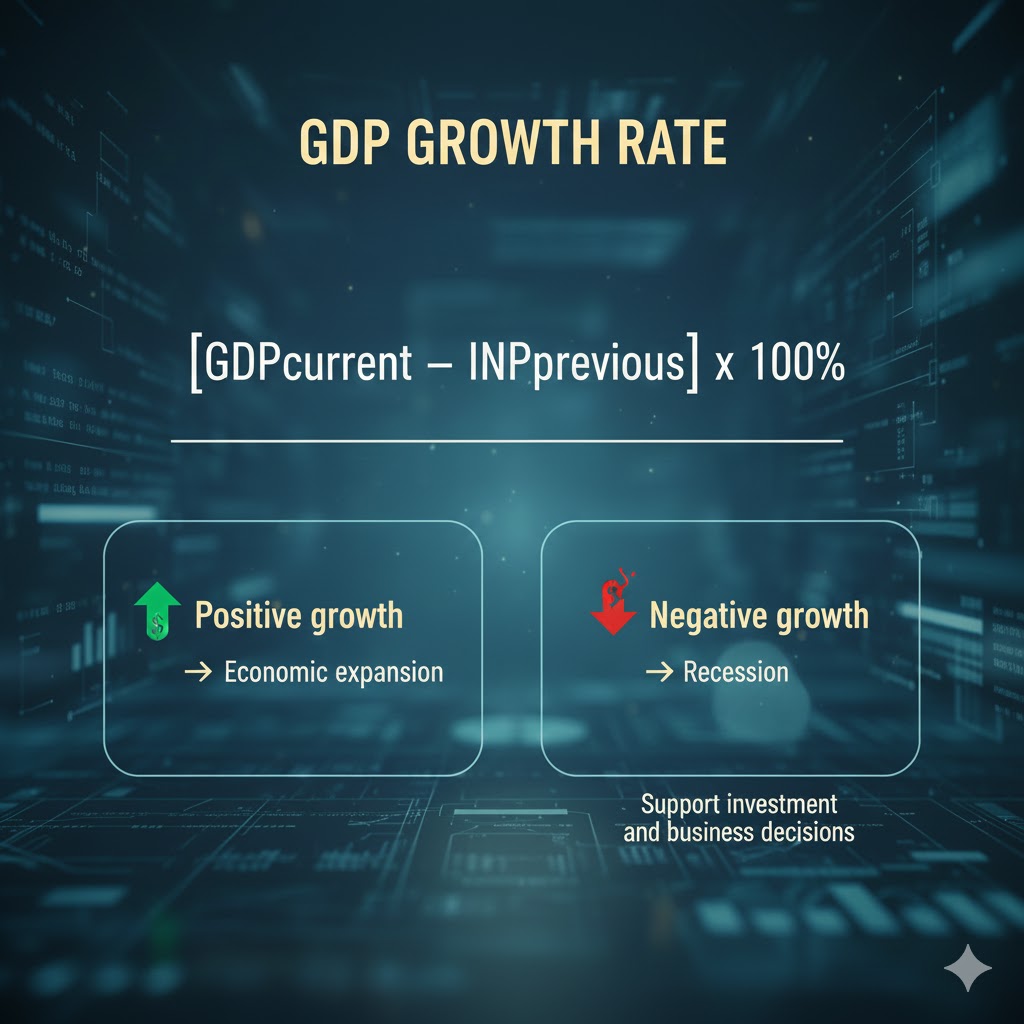
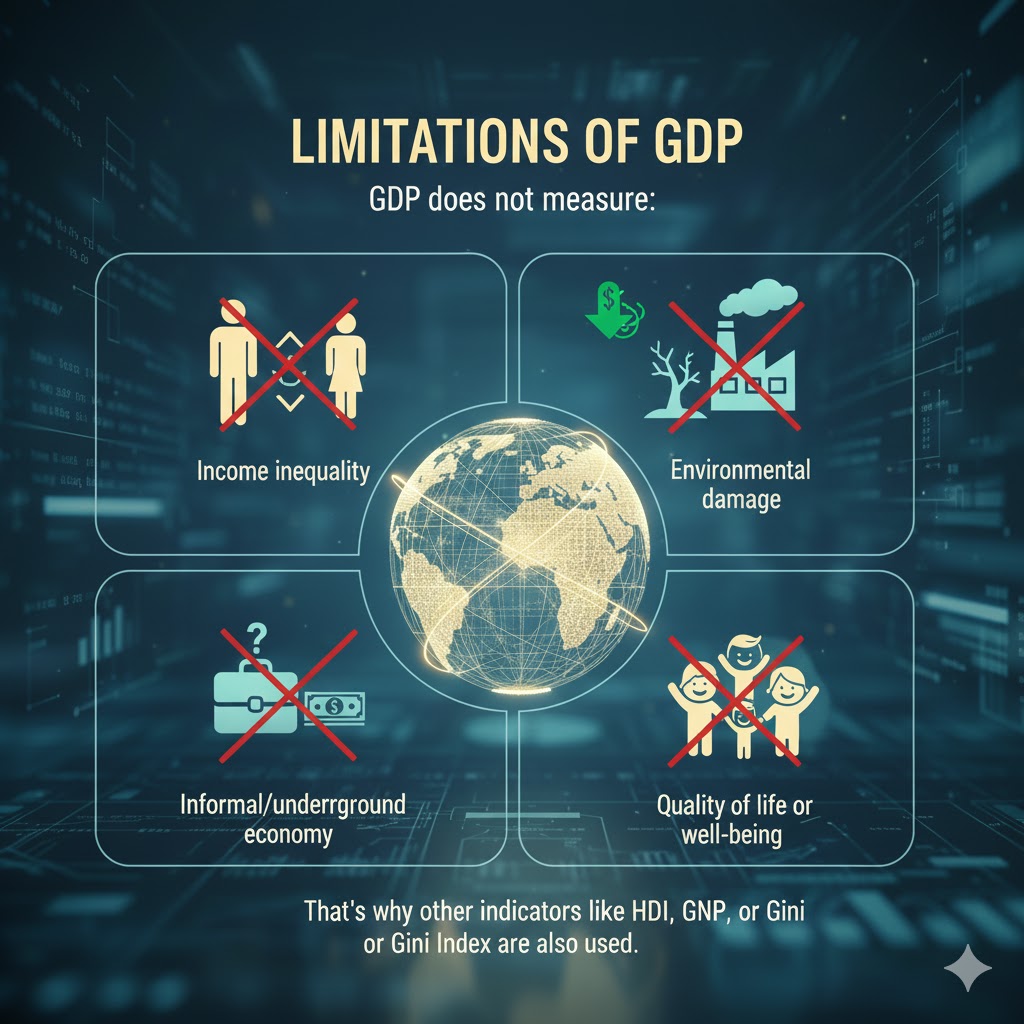
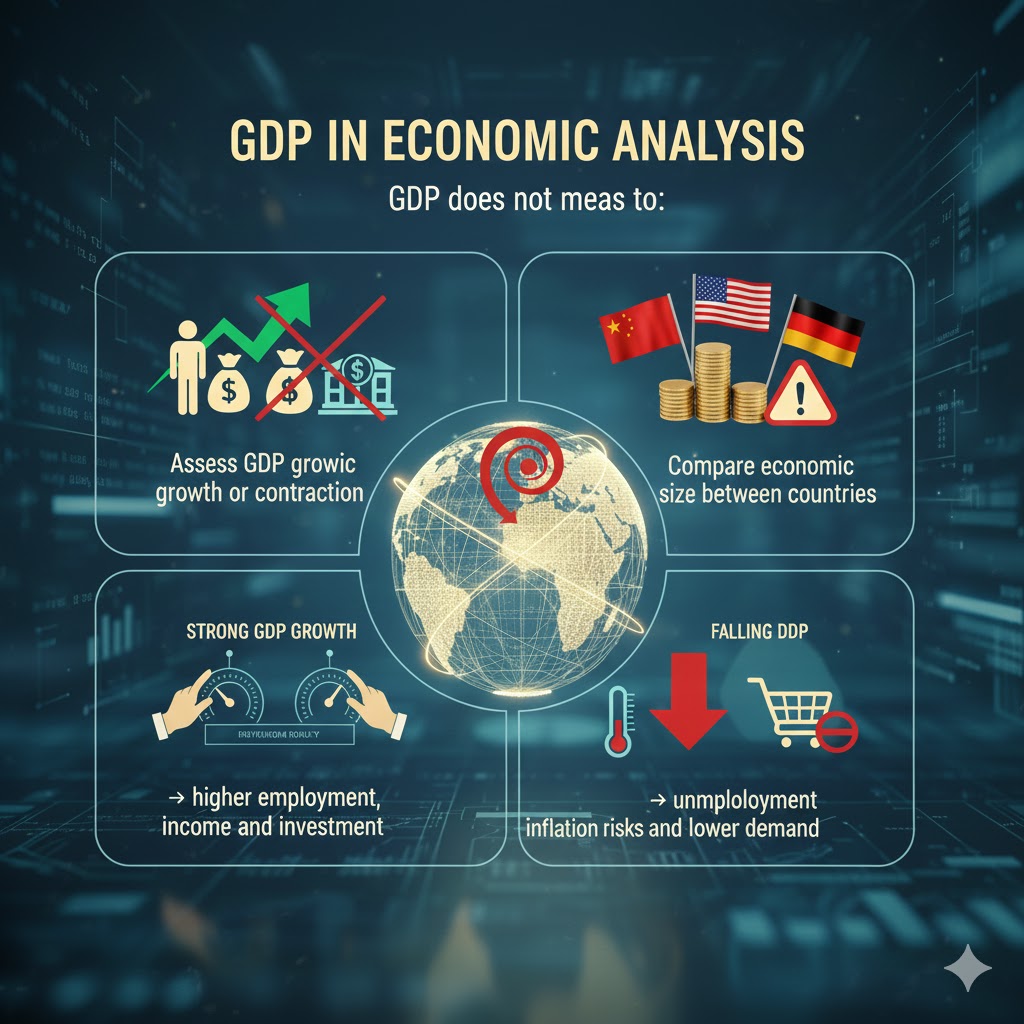
  • Gross Domestic Product (GDP)

    GDP is the total market value of all final goods and services produced within a country’s borders during a specific period (usually quarterly or annually).

    “Final goods” means products sold to end users (to avoid double counting).
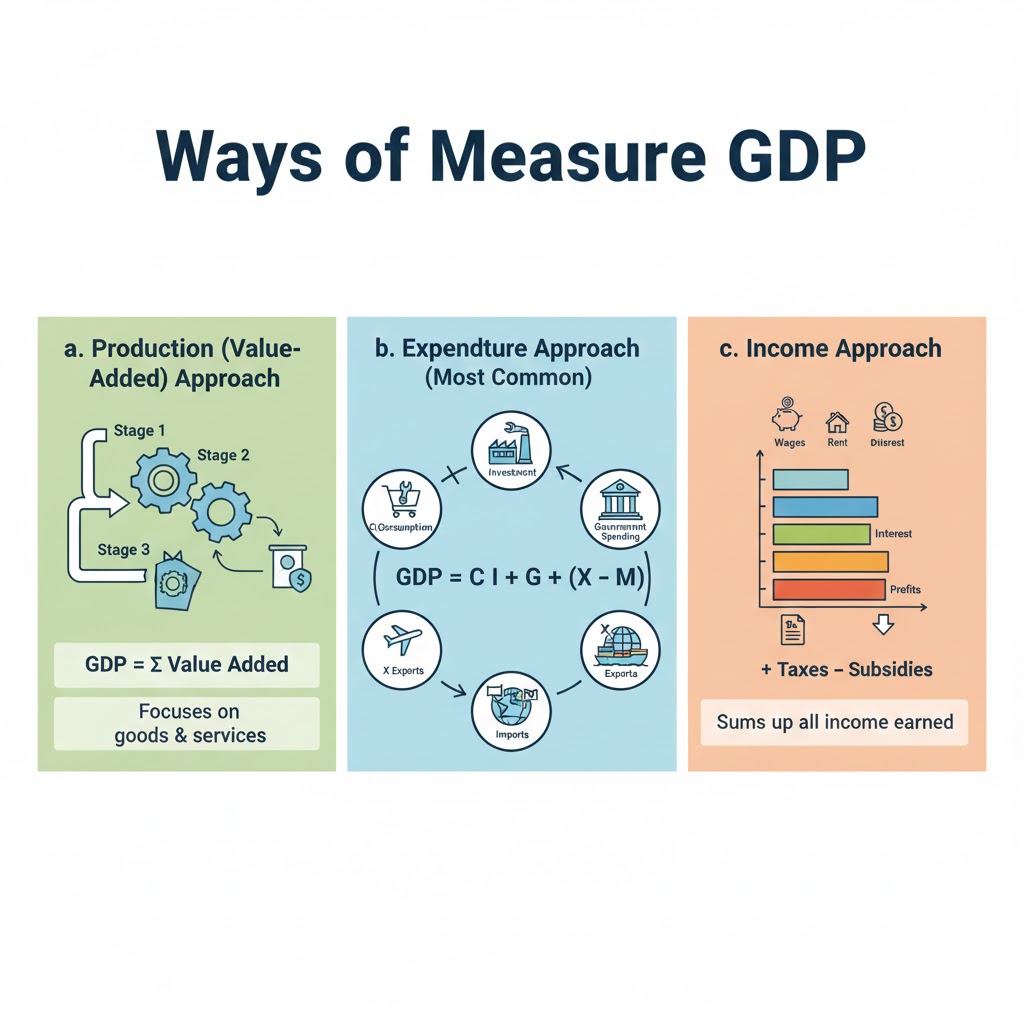
    Types of GDP

    • Nominal GDP – Measured at current prices (affected by inflation)
    • Real GDP – Adjusted for inflation (shows real economic growth)
    • GDP per Capita – GDP ÷ Population (standard of living indicator)

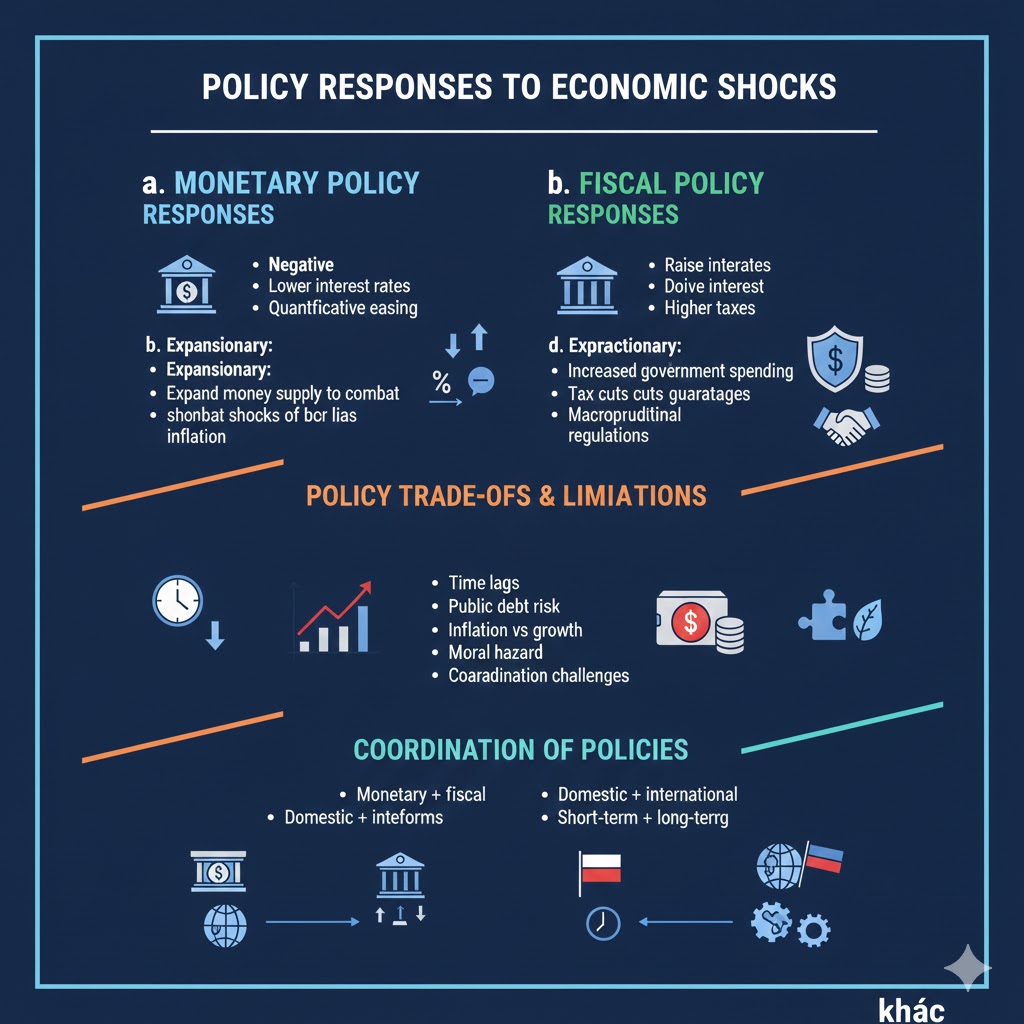
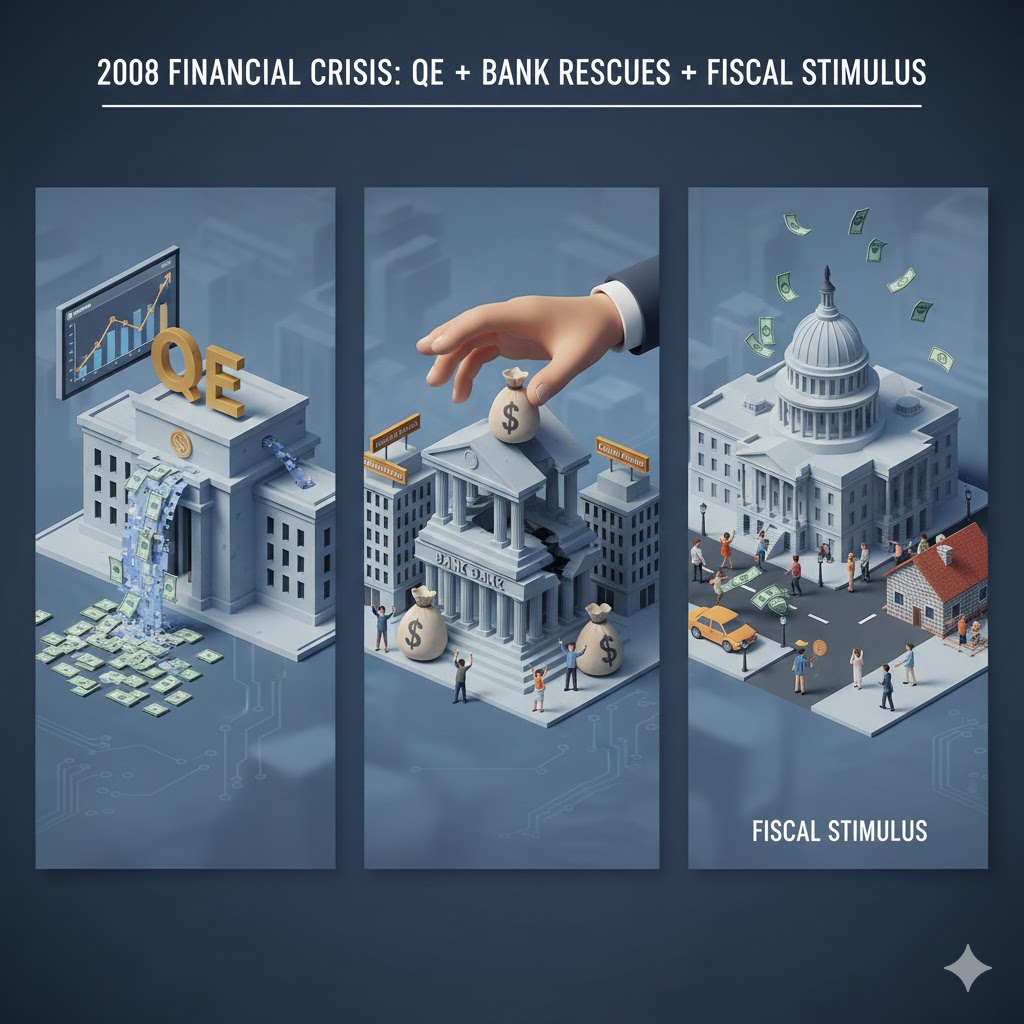
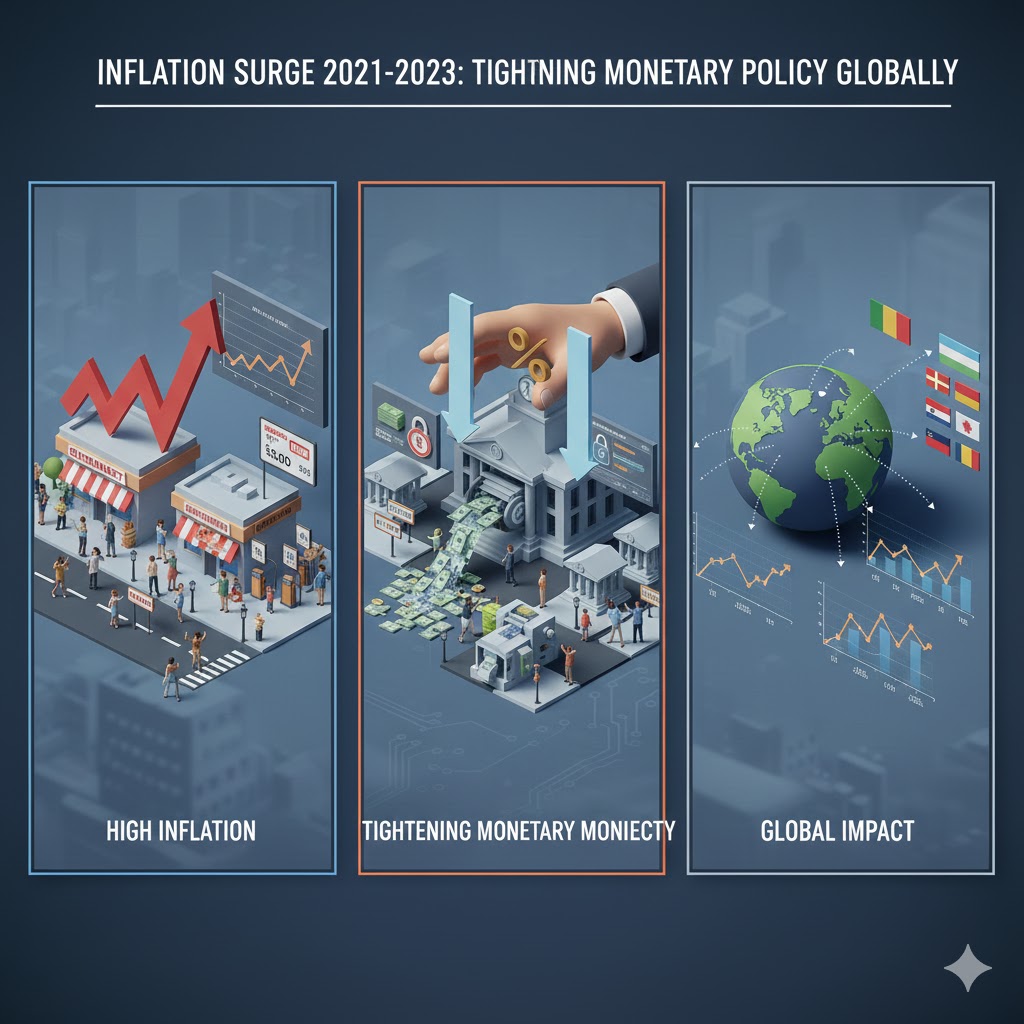
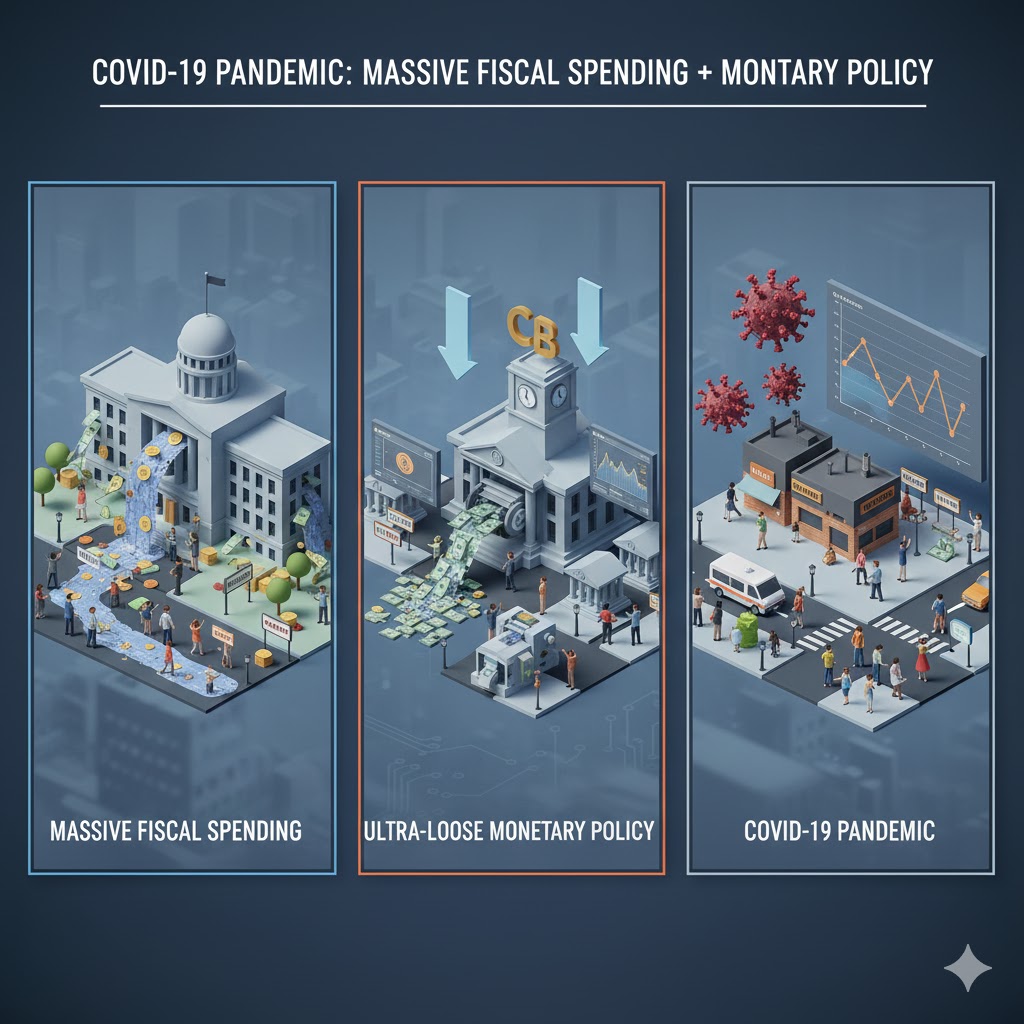
  • Economic Shocks & Policy Responses

    Economic shocks are sudden, unexpected events that disrupt the normal functioning of an economy, causing sharp changes in output, employment, prices, or financial markets. Shocks can be short-term or long-lasting, domestic or global.

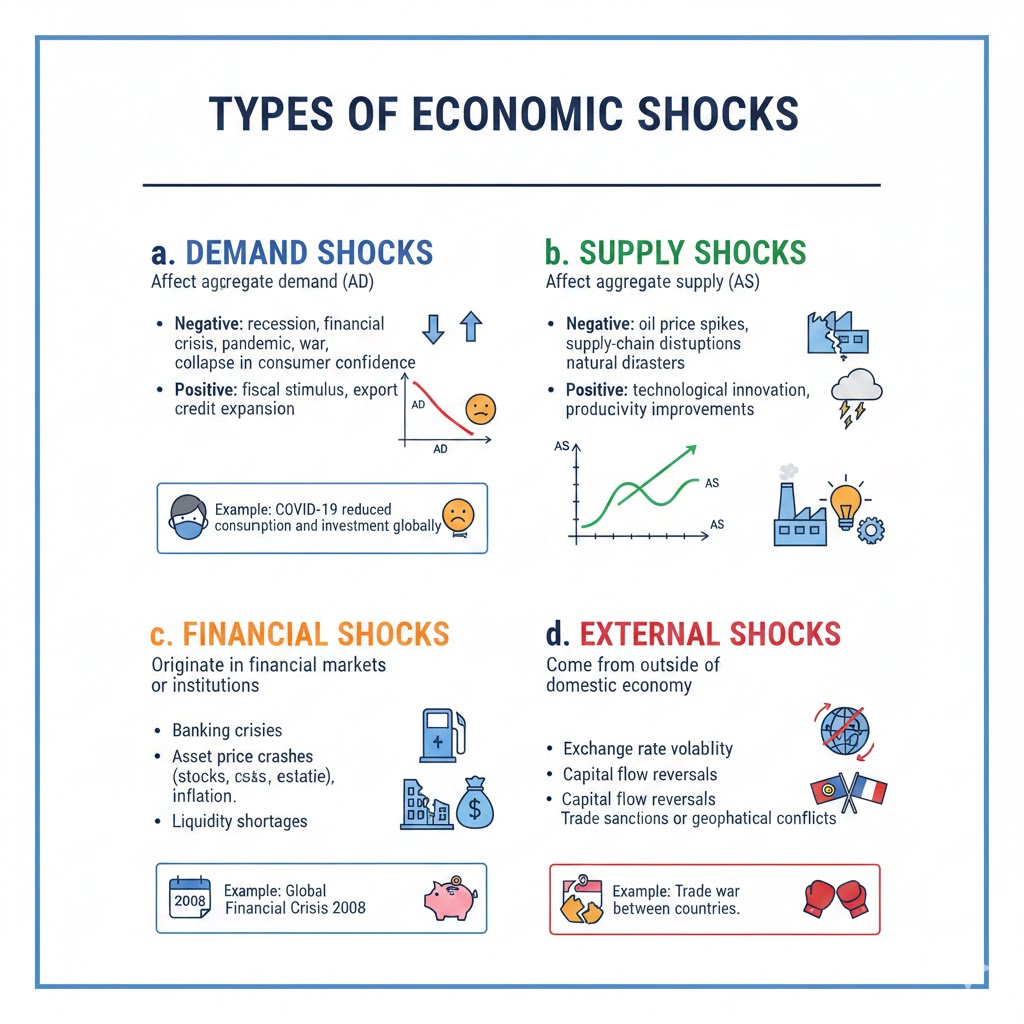
    Economic Impact of Shocks

    Economic shocks typically lead to:

    • GDP contraction or overheating
    • Rising unemployment
    • Inflation or deflation pressures
    • Exchange rate instability
    • Increased market volatility and uncertainty

    Real-world Examples

    Key Takeaway

    Economic shocks are unavoidable, but timely, flexible, and well-coordinated policy responses can significantly reduce economic damage and speed up recovery.

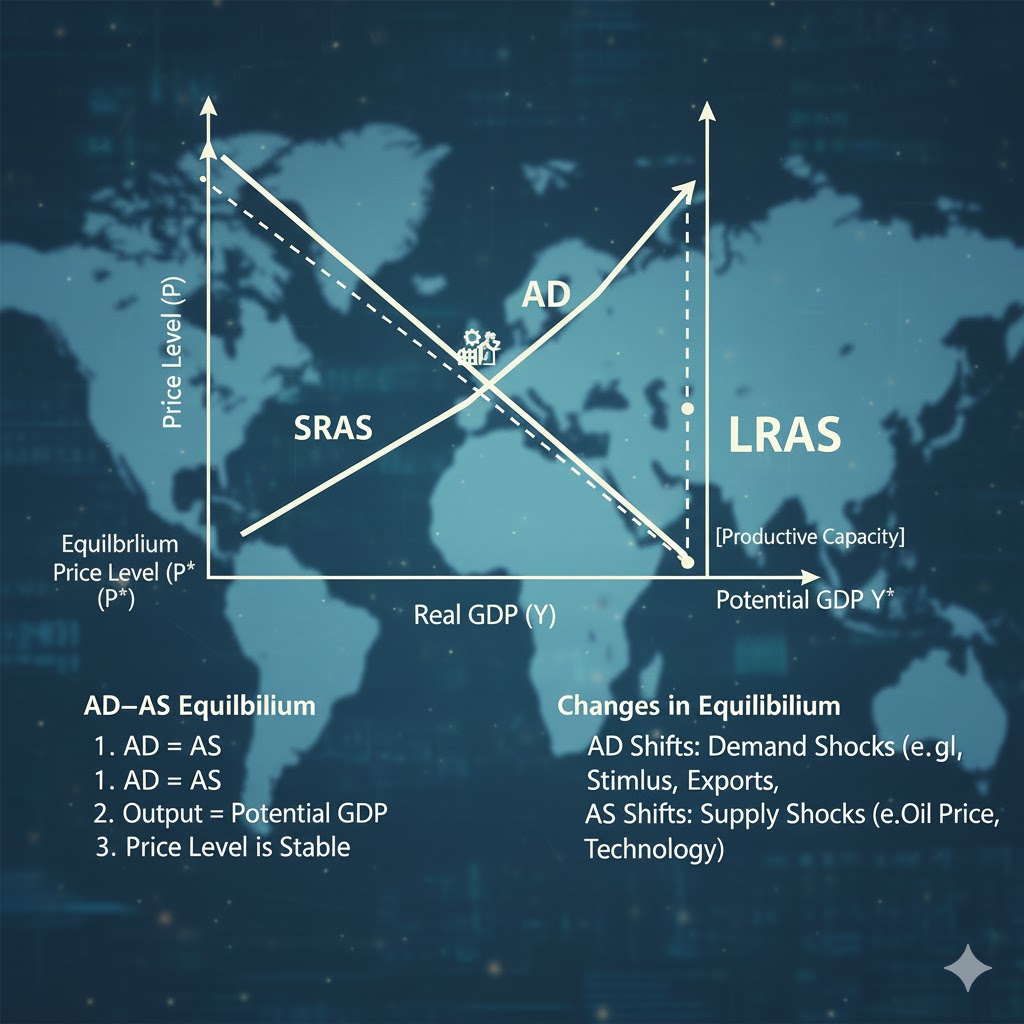
  • Aggregate Demand & Supply (AD & AS)

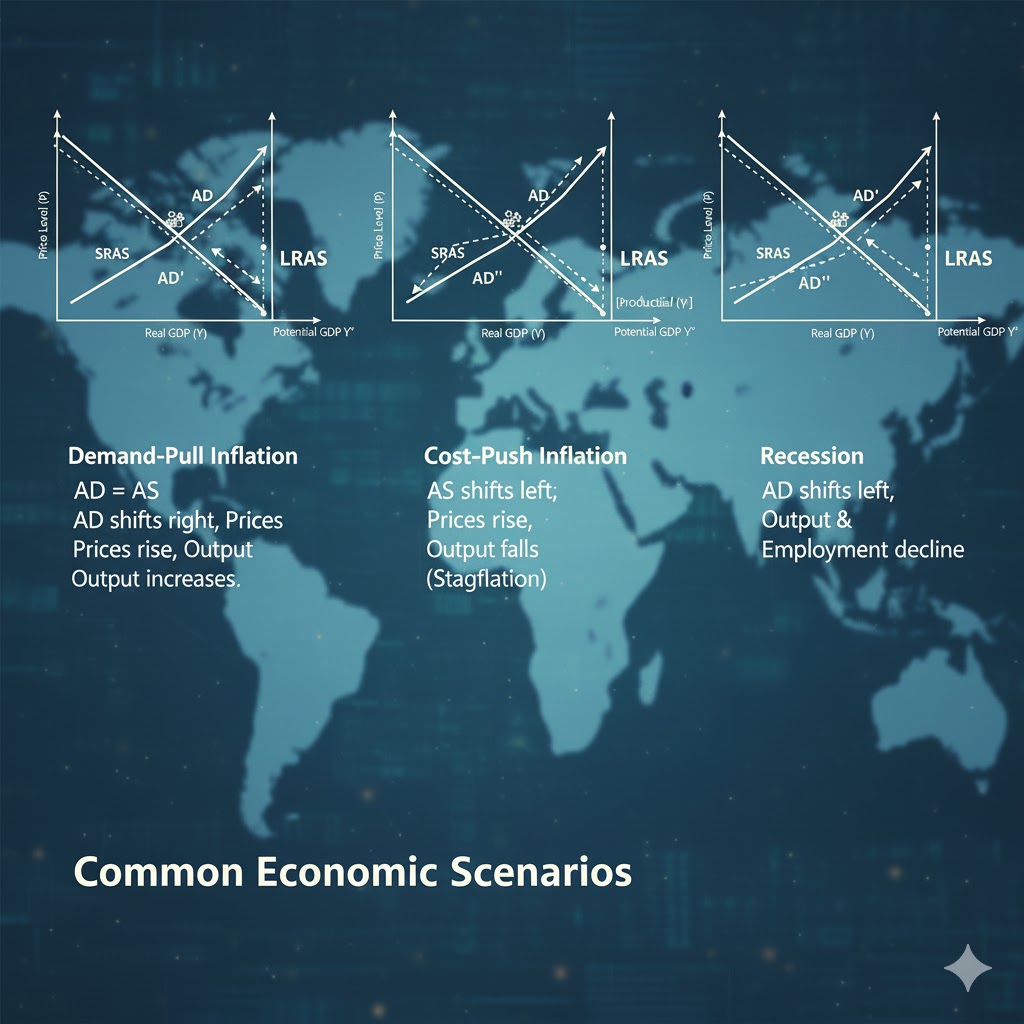
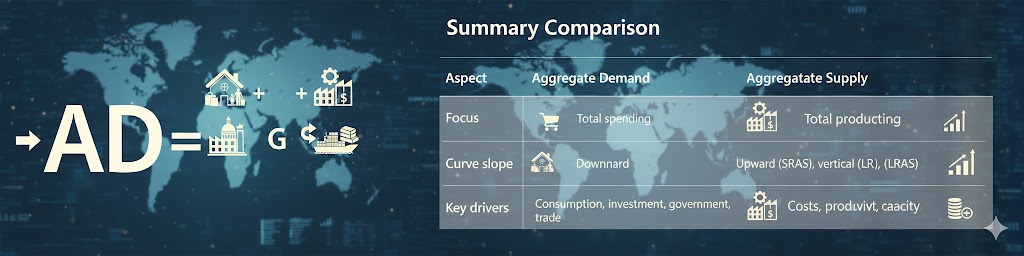
    Aggregate Demand (AD) and Aggregate Supply (AS) are core macroeconomic concepts used to explain overall price levels, output, and economic fluctuations in an economy.

    Aggregate Demand (AD)

    Aggregate Demand is the total demand for all final goods and services in an economy at a given price level and during a specific period.
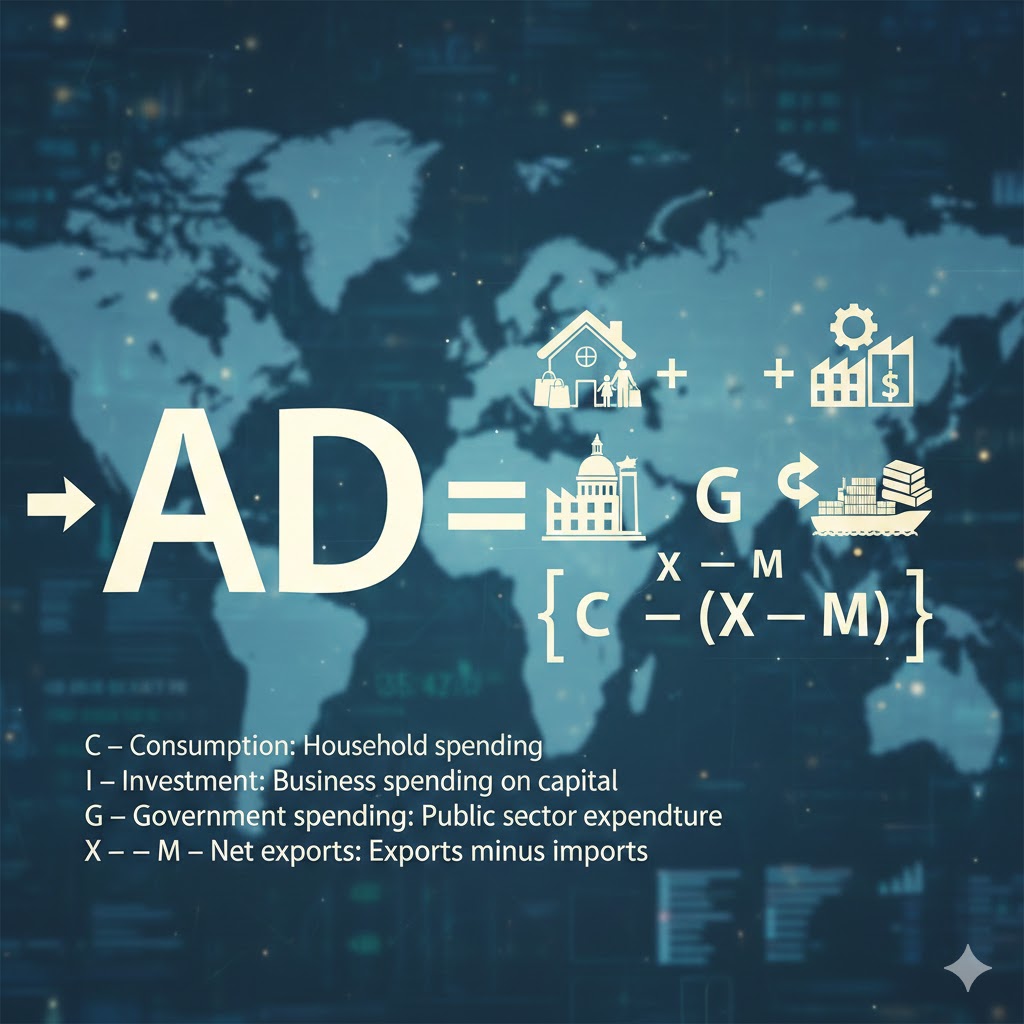
    Why AD slopes downward:

    • Interest rate effect
    • Wealth effect
    • Exchange rate effect

    Aggregate Supply (AS)

    Aggregate Supply shows the total output firms are willing to produce at different price levels.
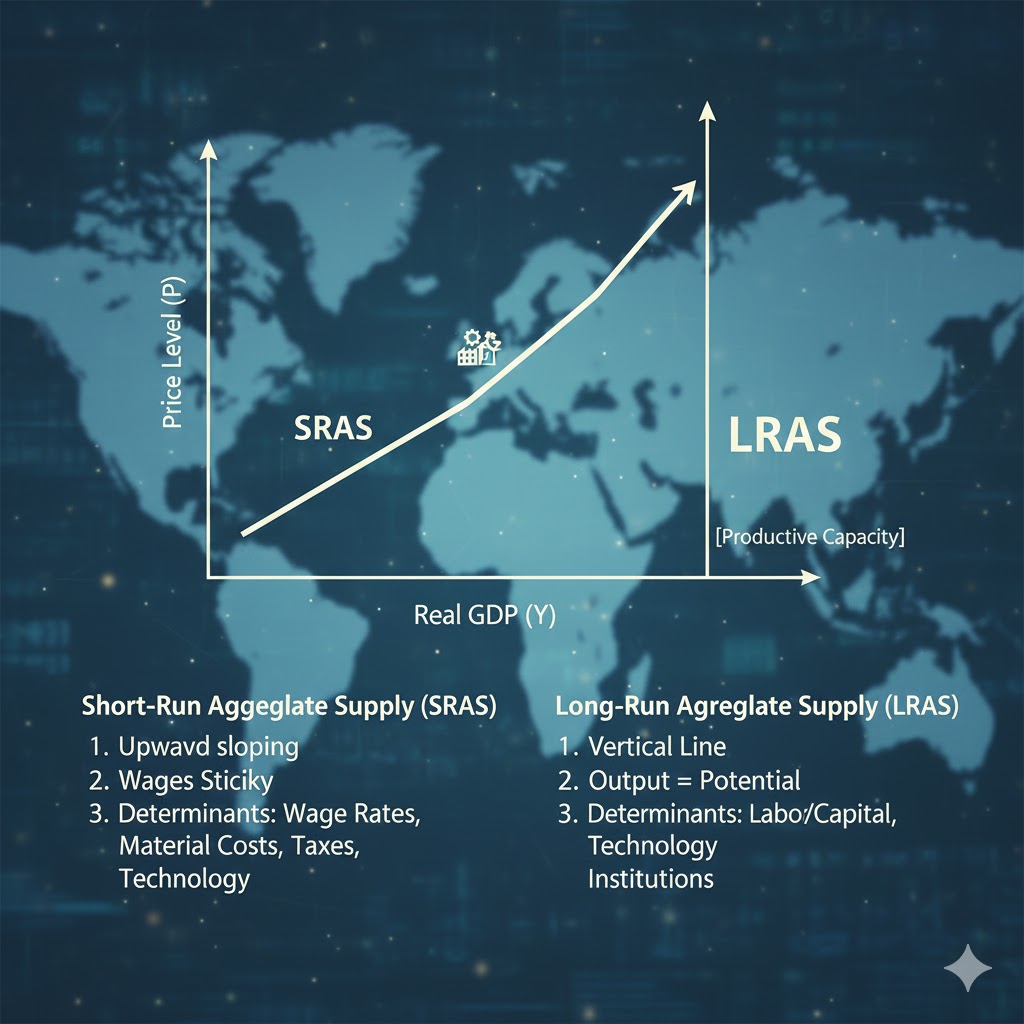

    AD–AS Equilibrium

  • Inflation vs Deflation

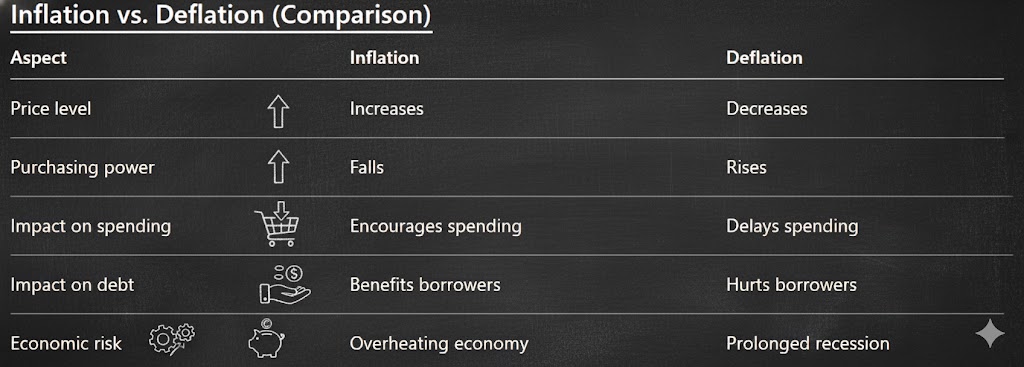
    Inflation and deflation describe opposite movements in the general price level of goods and services in an economy, and both have significant impacts on economic activity, businesses, and individuals.

    Inflation

    Inflation is a sustained increase in the general price level over time, which reduces the purchasing power of money.
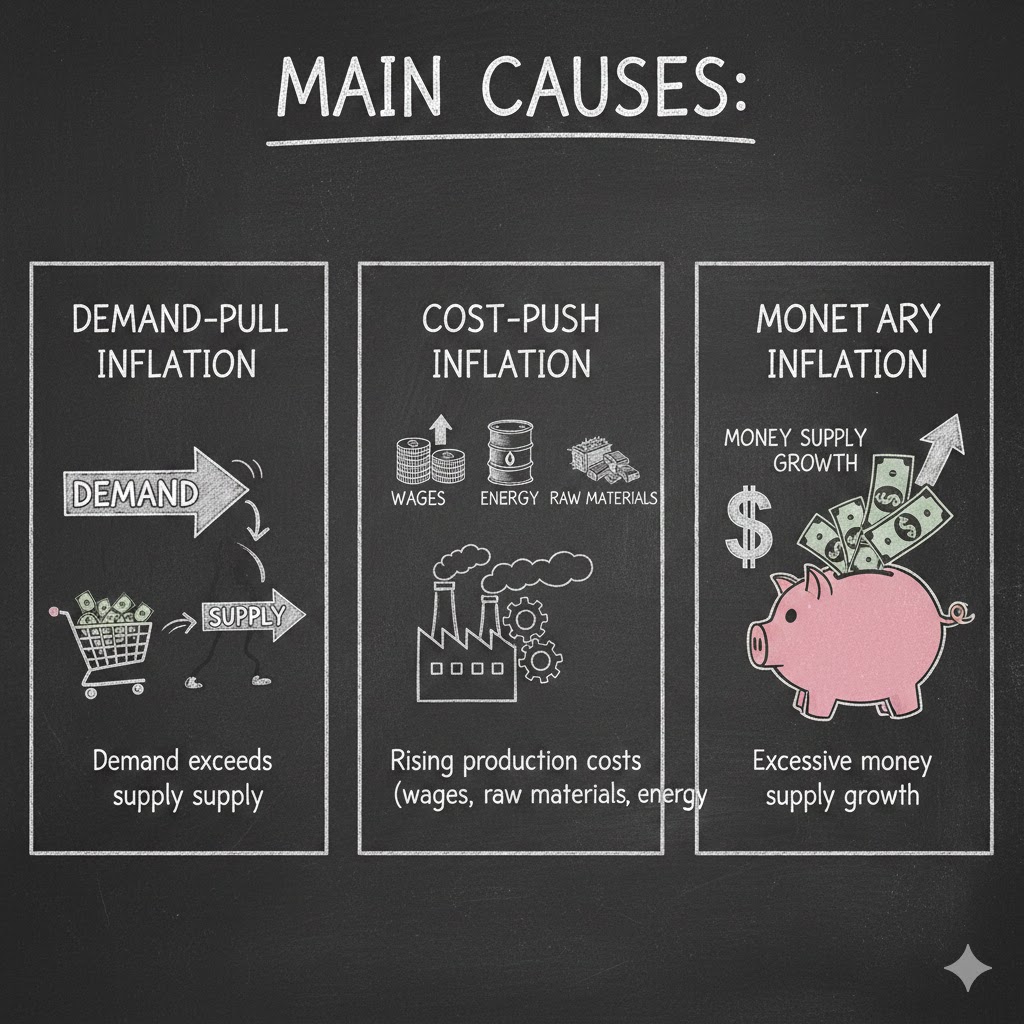
    Key characteristics:

    • Money buys less over time
    • Usually measured by indicators like the Consumer Price Index (CPI)
    • Moderate inflation is considered normal in growing economies

    Effects

    • Higher living costs
    • Borrowers benefit, savers lose purchasing power
    • Can encourage spending and investment if inflation is stable and predictable

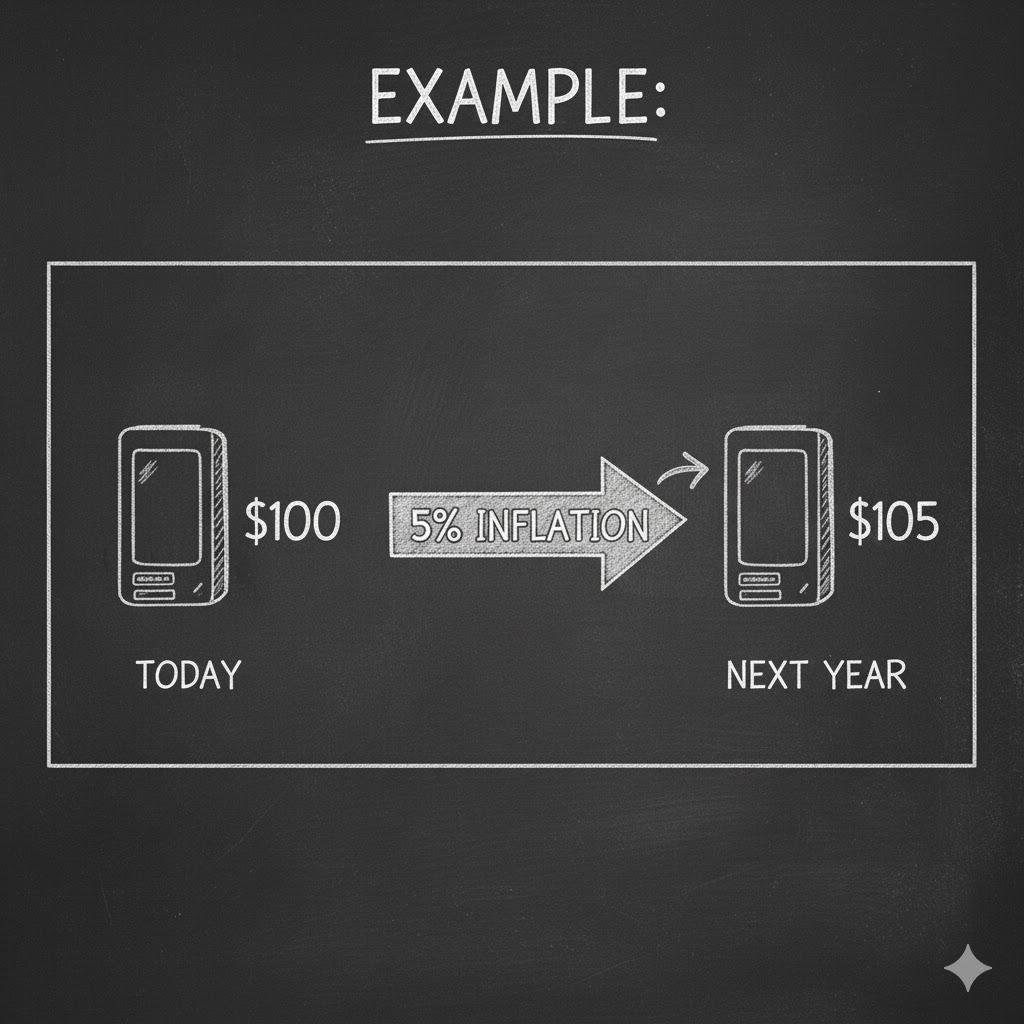
    If inflation is 5% per year, an item costing $100 today will cost $105 next year.

    Deflation

    Deflation is a sustained decrease in the general price level, increasing the purchasing power of money.
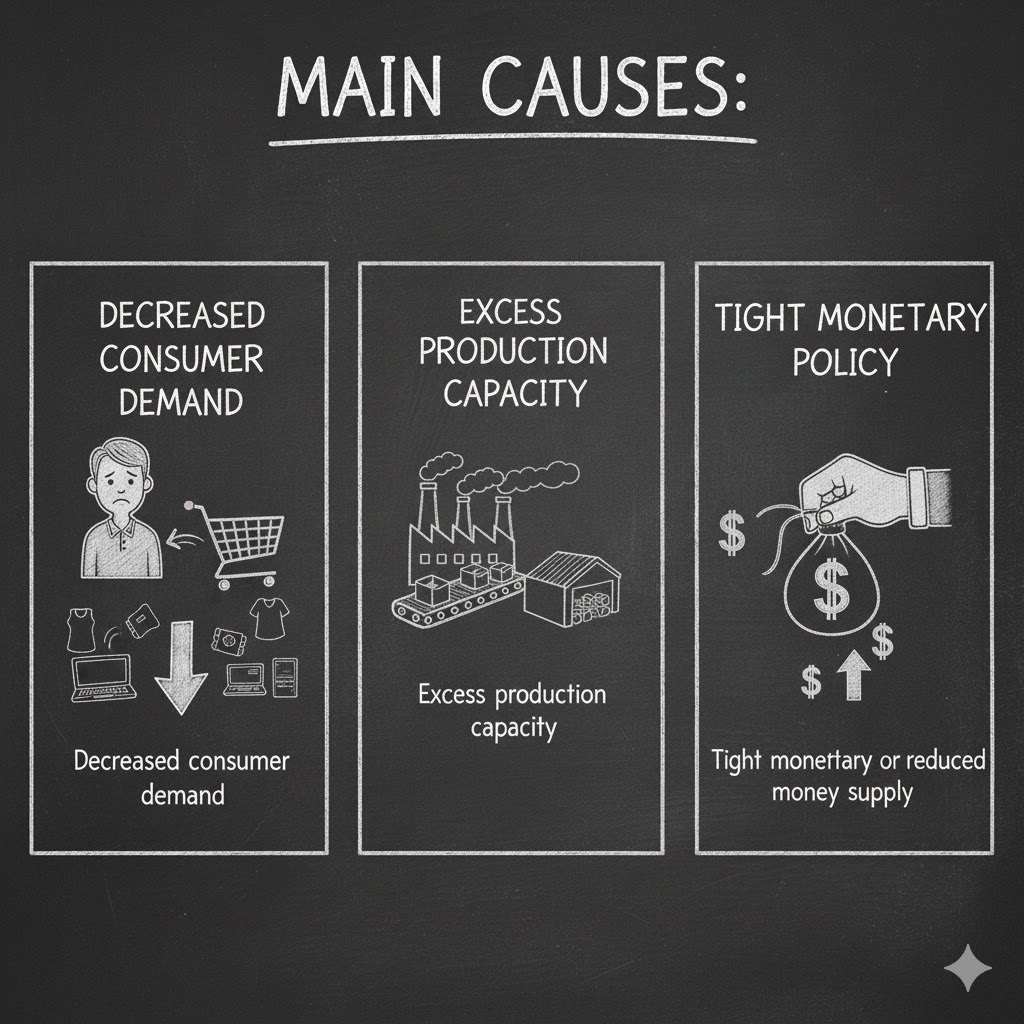
    Key characteristics

    • Money buys more over time
    • Often associated with economic slowdowns or recessions

    Effects

    • Consumers delay spending, expecting lower prices
    • Business revenues and profits decline
    • Higher real value of debt, harming borrowers
    • Can lead to rising unemployment

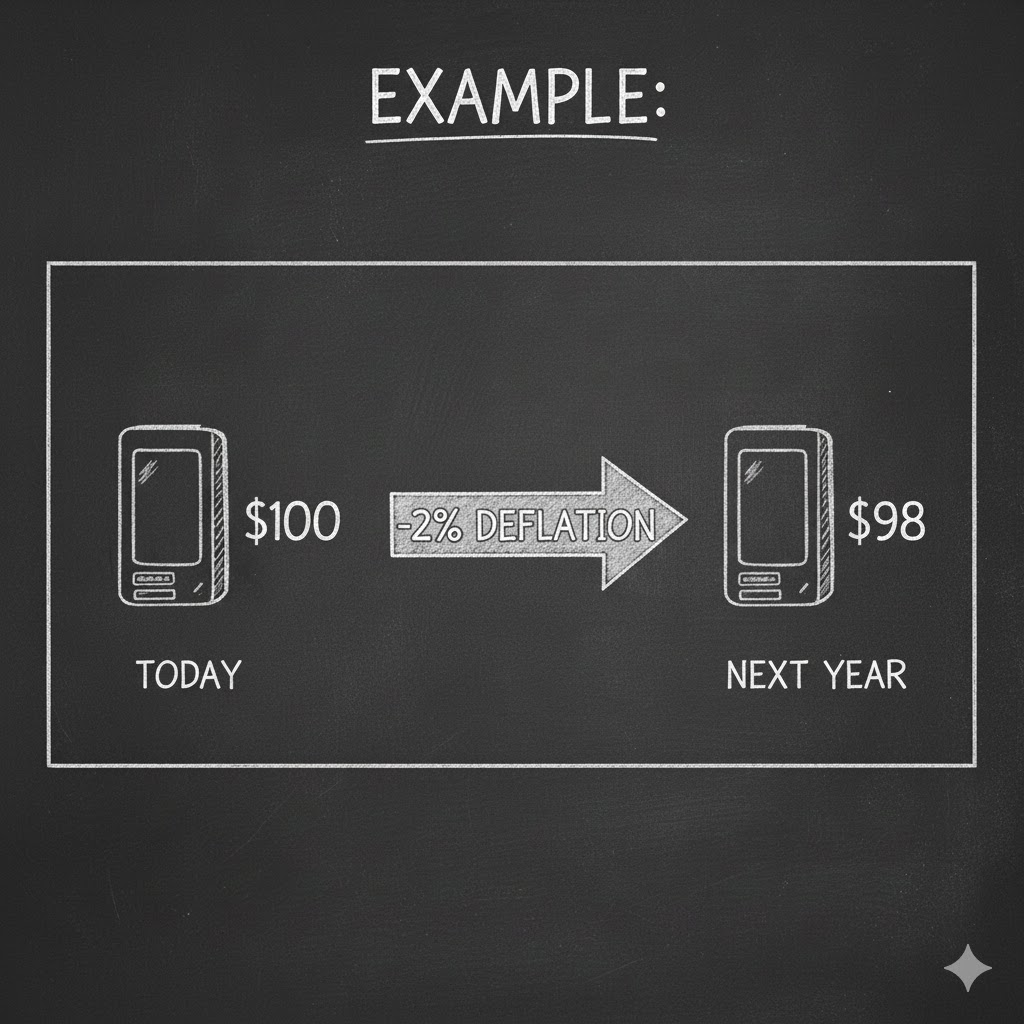
    If deflation is −2%, an item costing $100 today will cost $98 next year.

    Which is More Dangerous?

    • Moderate inflation is generally manageable and often preferred by policymakers.
    • Deflation is considered more dangerous because it can create a deflationary spiral—lower prices → lower profits → layoffs → lower demand → even lower prices.
  • Macroeconomics

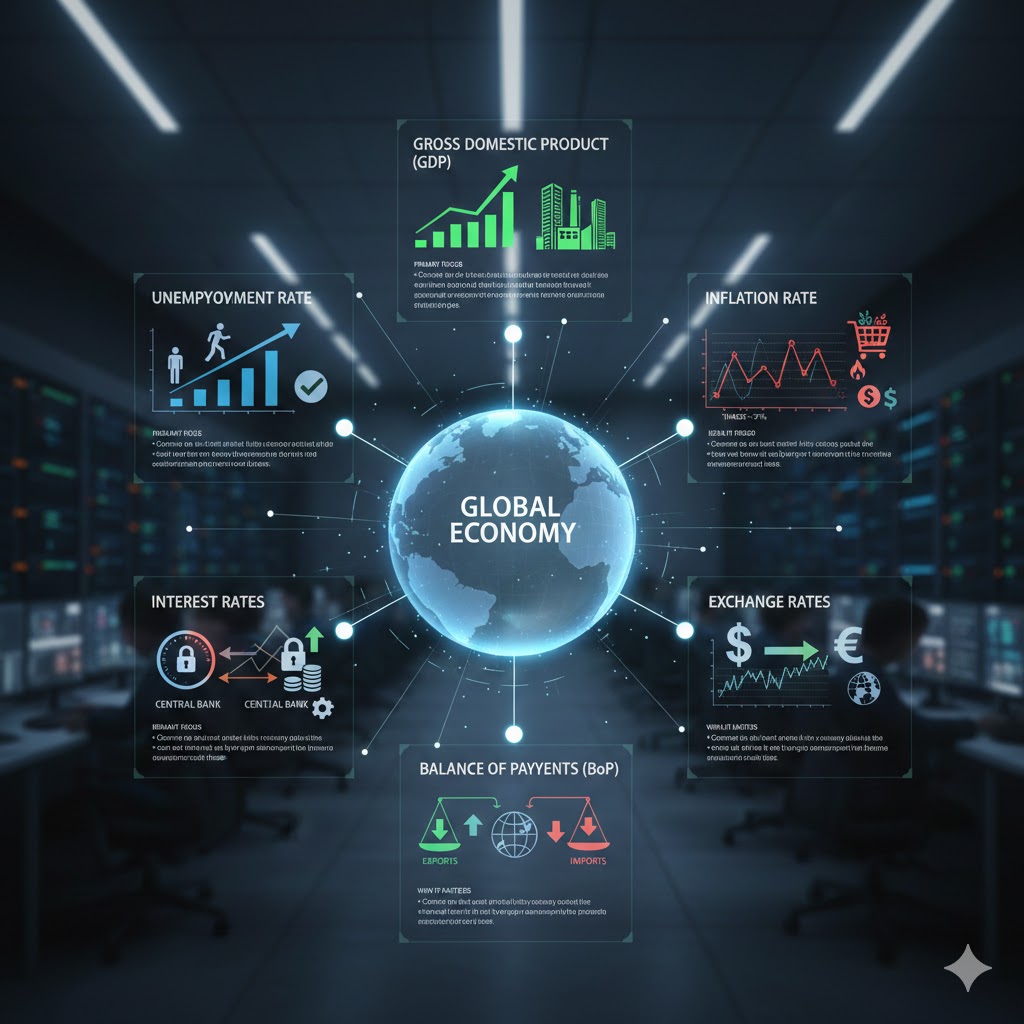
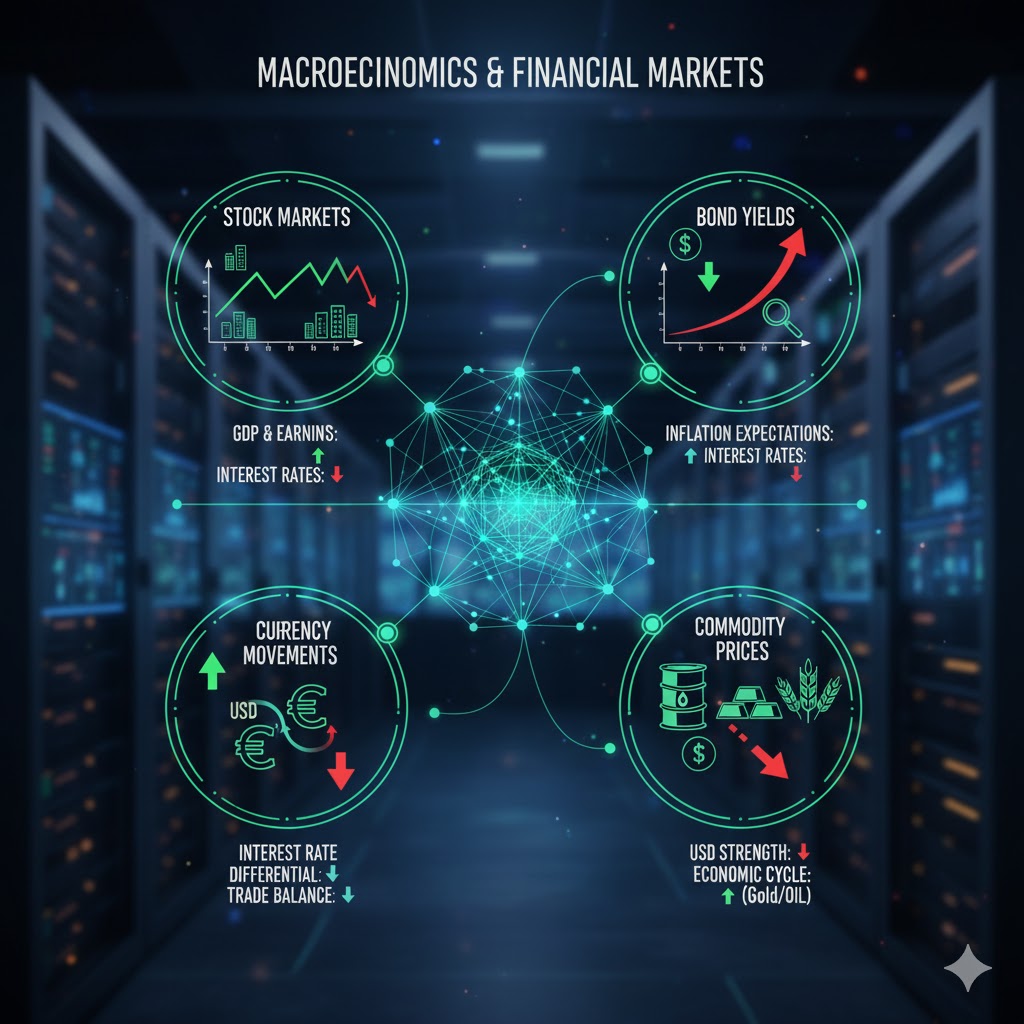
    Macroeconomics is the branch of economics that studies the overall performance and behavior of an economy as a whole, rather than individual markets or firms.

    It focuses on big-picture economic issues such as growth, inflation, employment, and national income.
    Key objectives of macroeconomics

    1. Economic growth – increasing a country’s output and income
    2. Price stability – controlling inflation
    3. Full employment – reducing unemployment
    4. Economic stability – minimizing business cycles and crises

    Major macroeconomic policies

    1. Fiscal policy

    • Government spending and taxation
    • Used to stimulate or slow down the economy
    • Managed by the government

    2. Monetary policy

    • Control of money supply and interest rates
    • Implemented by the central bank
    • Tools include interest rates, open market operations, reserve requirements

    Key takeaway

    Macroeconomics helps governments, businesses, and investors understand economic trends and make informed decisions.

  • Business Life Cycle

    The Business Life Cycle describes the stages a business typically goes through from its creation to possible decline or renewal. Understanding this cycle helps entrepreneurs, investors, and managers make better strategic decisions at each phase.
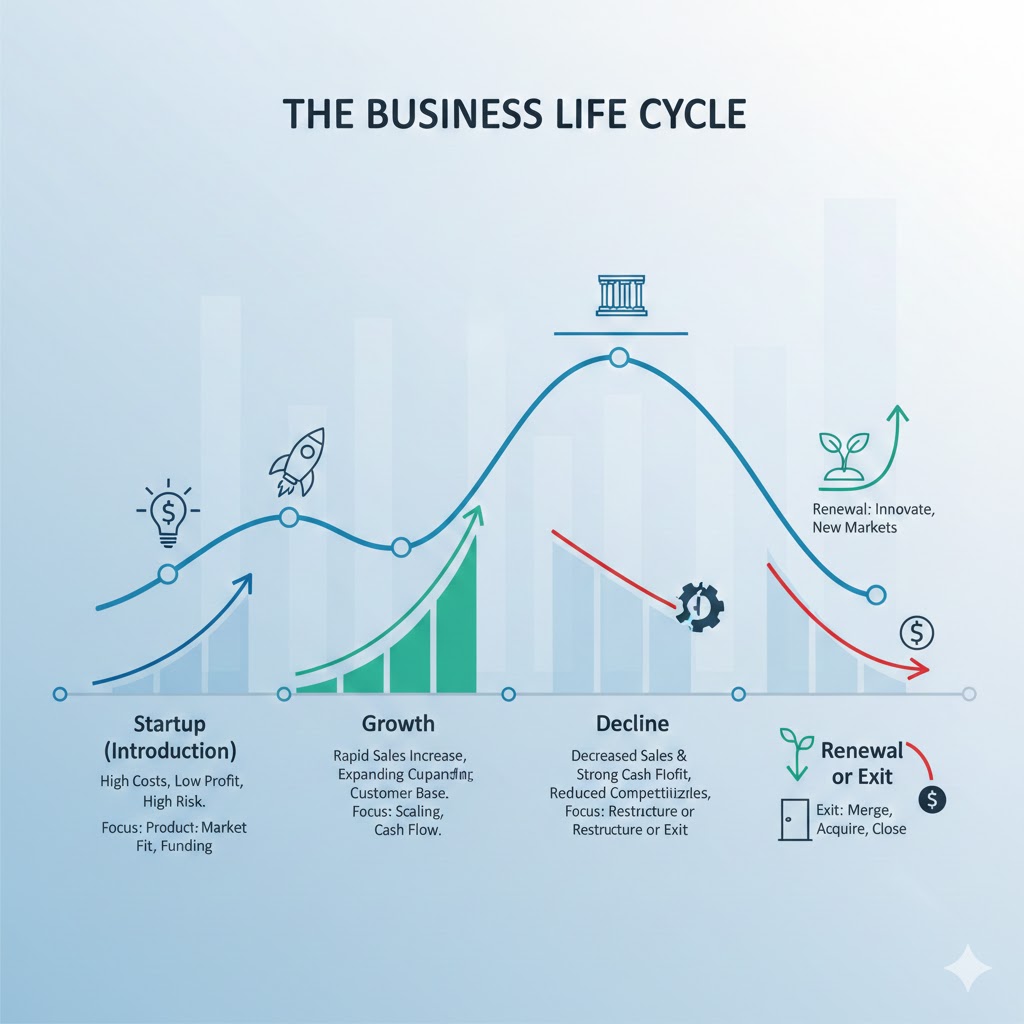
    Why the Business Life Cycle Matters

    • Helps align strategyinvestment decisions, and risk management.
    • Investors can assess risk and return potential at each stage.
    • Managers can anticipate challenges and prepare appropriate responses.
  • Market Structure

    Market structure describes the organization and characteristics of a market, especially how firms compete, set prices, and produce goods or services.

    It explains how a market works and how much power firms have.
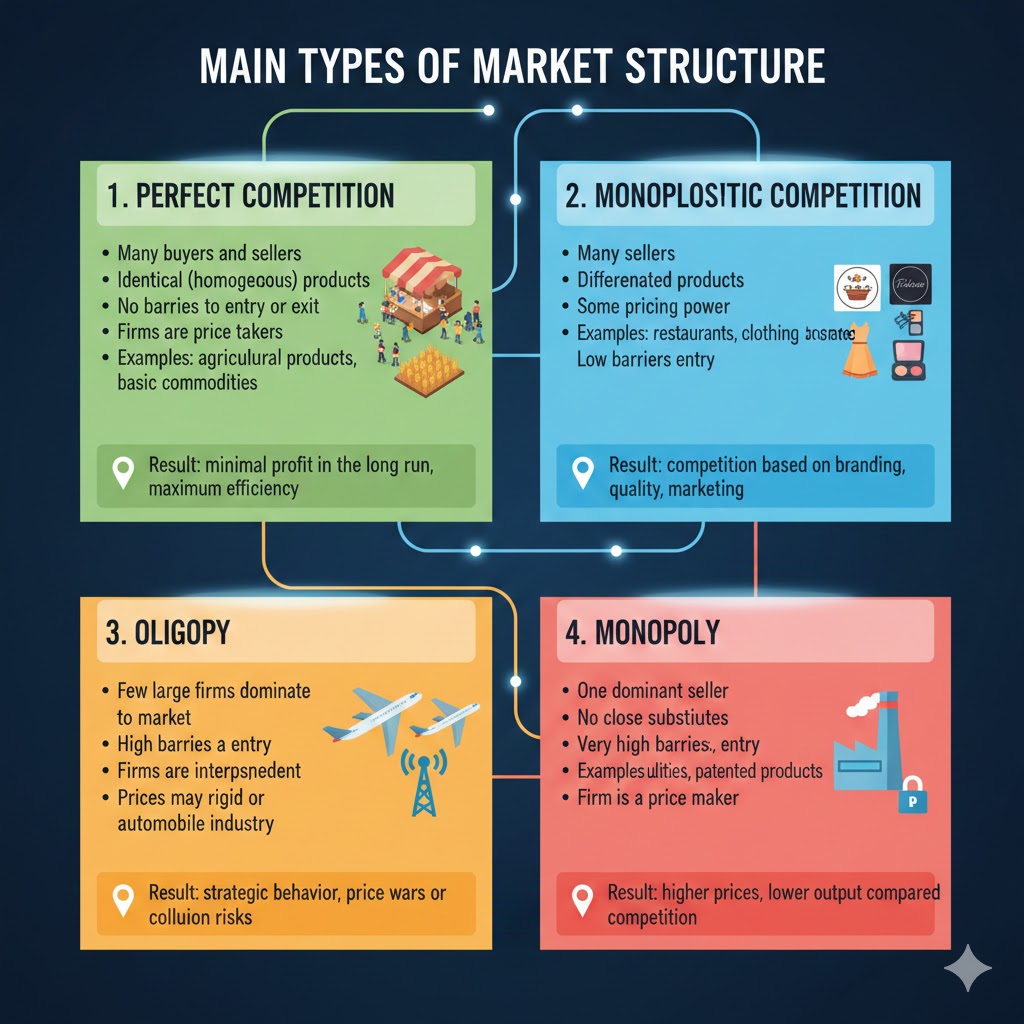
    Market structure and firm behavior

    Market structure affects:

    • Pricing strategies
    • Output decisions
    • Innovation and R&D
    • Efficiency and consumer welfare

    Key takeaway

    Market structure determines competition intensity, pricing power, and economic efficiency.

    Understanding market structure helps businesses, investors, and policymakers make better decisions.

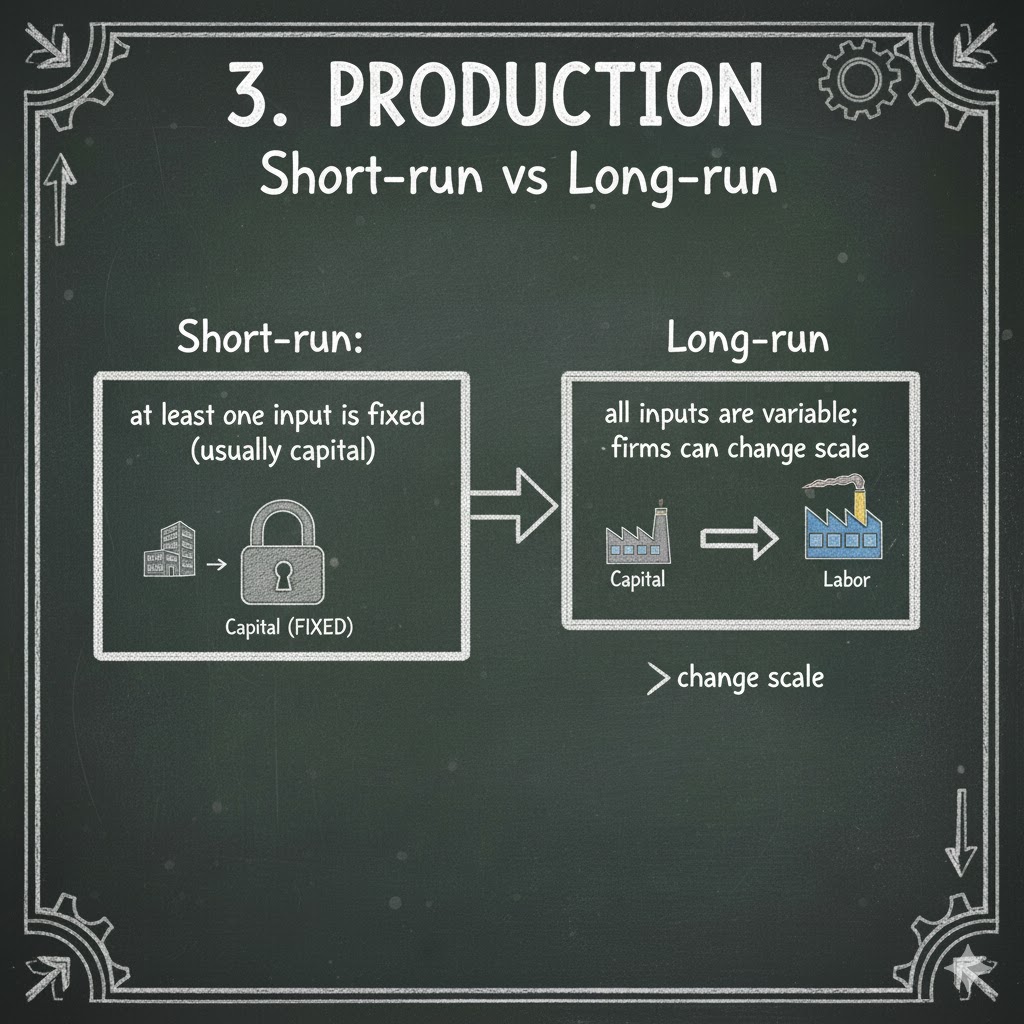
  • Production and Cost

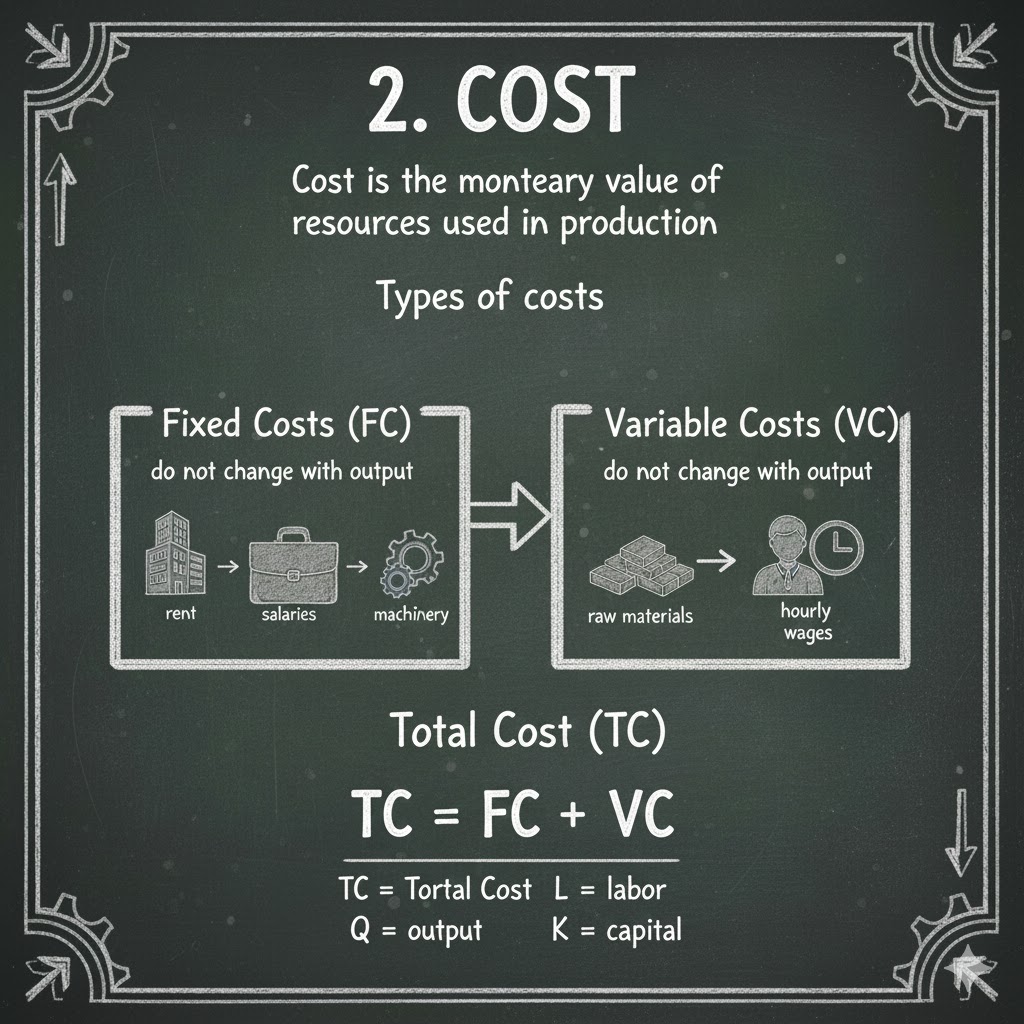
    Production and cost describe how firms transform inputs into goods or services and the expenses incurred in that process. Understanding this relationship helps explain pricing, profitability, efficiency, and business decisions.
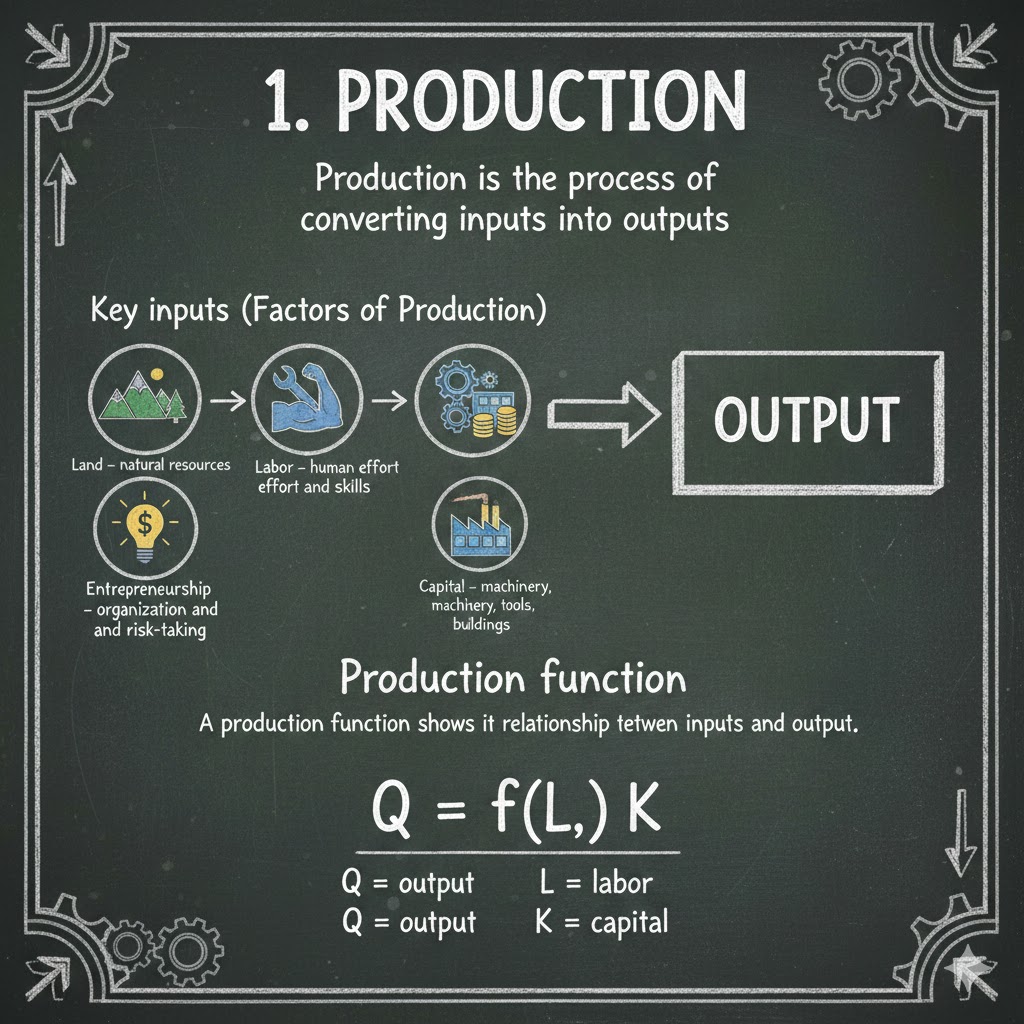
    Cost measures

    • Average Cost (AC)AC=TCQAC=QTC​
    • Marginal Cost (MC): cost of producing one more unit:MC=ΔTCΔQMC=ΔQΔTC​

    📌 Marginal cost is crucial for production decisions and pricing.


    Production, cost, and profit

    • Profit = Total Revenue (TR) − Total Cost (TC)
    • Firms maximize profit where:

    MR=MCMR=MC

    (Marginal Revenue equals Marginal Cost)


    Key takeaway

    Efficient production minimizes cost and maximizes profit.
    Understanding cost structures helps firms decide how much to produce, at what price, and at what scale.

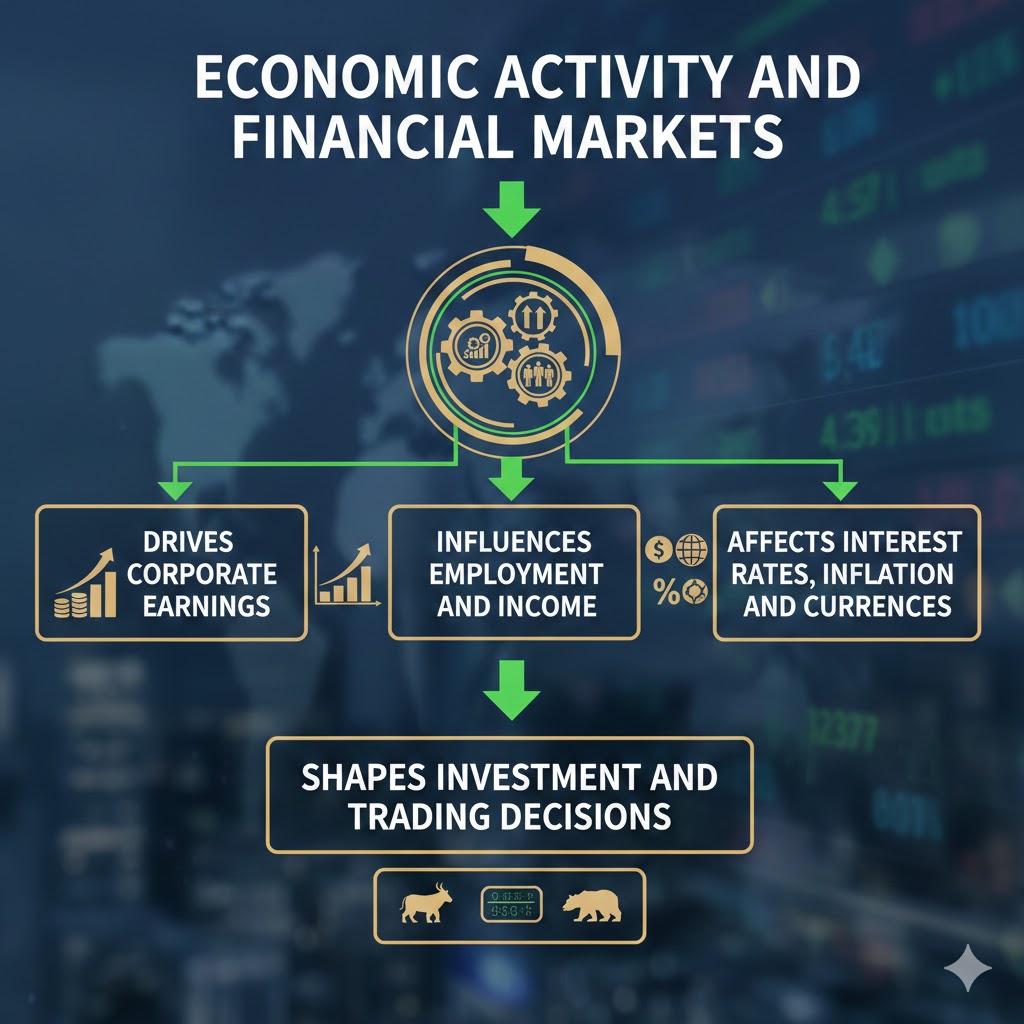
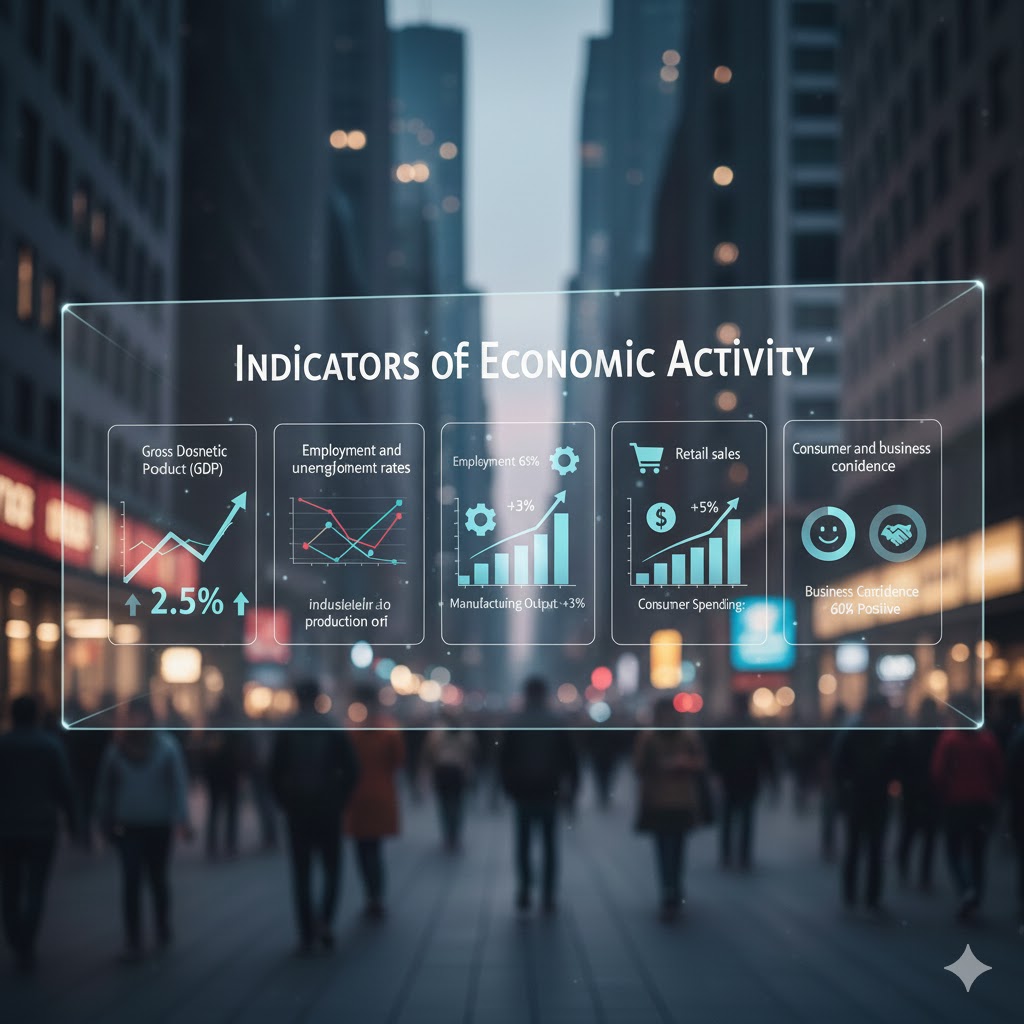
  • Economic Activity

    Economic activity refers to all actions involved in the production, distribution, exchange, and consumption of goods and services within an economy.

    It is everything people and businesses do to create, buy, sell, and use economic value.
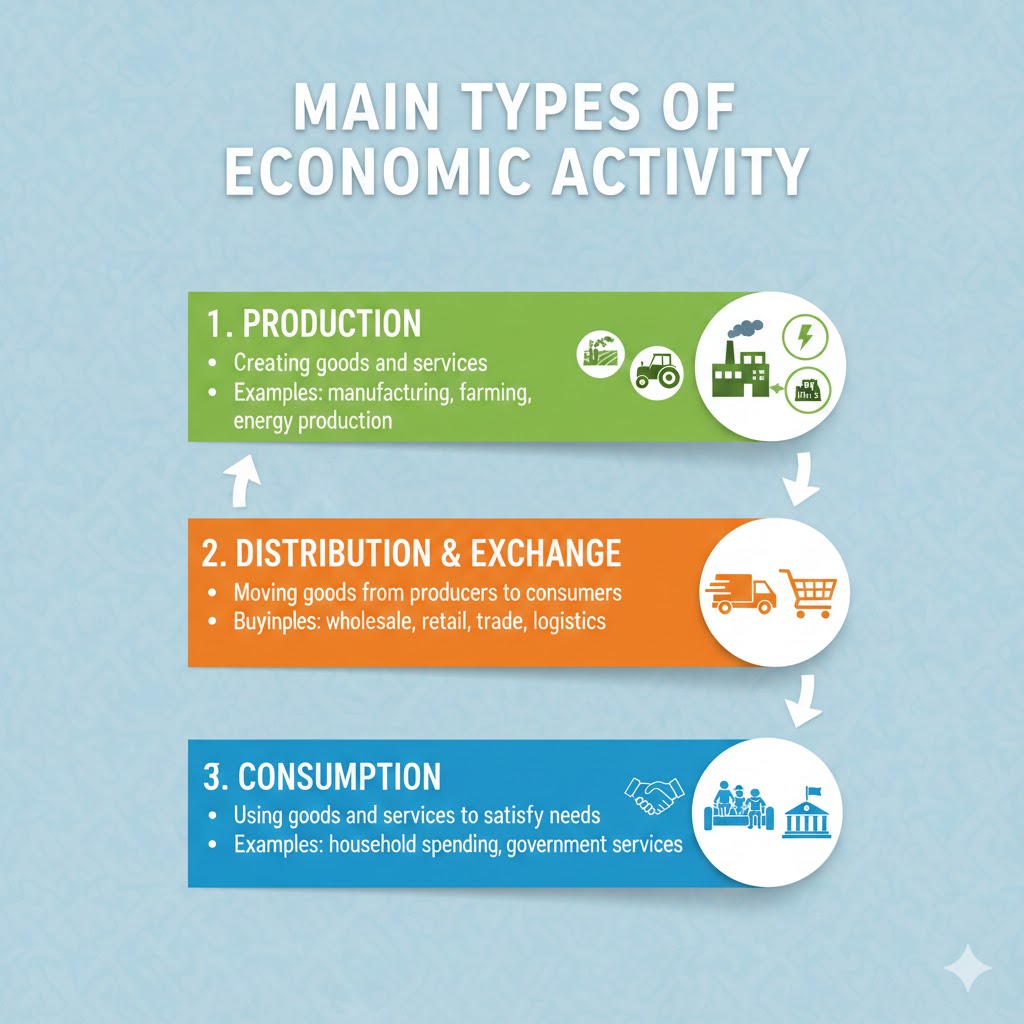
    Sectors of economic activity

    1. Primary sector – natural resources
      (agriculture, mining, fishing)
    2. Secondary sector – manufacturing and processing
      (factories, construction)
    3. Tertiary sector – services
      (finance, education, healthcare, tourism)
    4. Quaternary sector – knowledge & technology
      (IT, R&D, data, innovation)


    Key takeaway

    Strong economic activity supports growth and investment,
    while weak activity may signal slowdown or recession.

  • Opportunity Cost

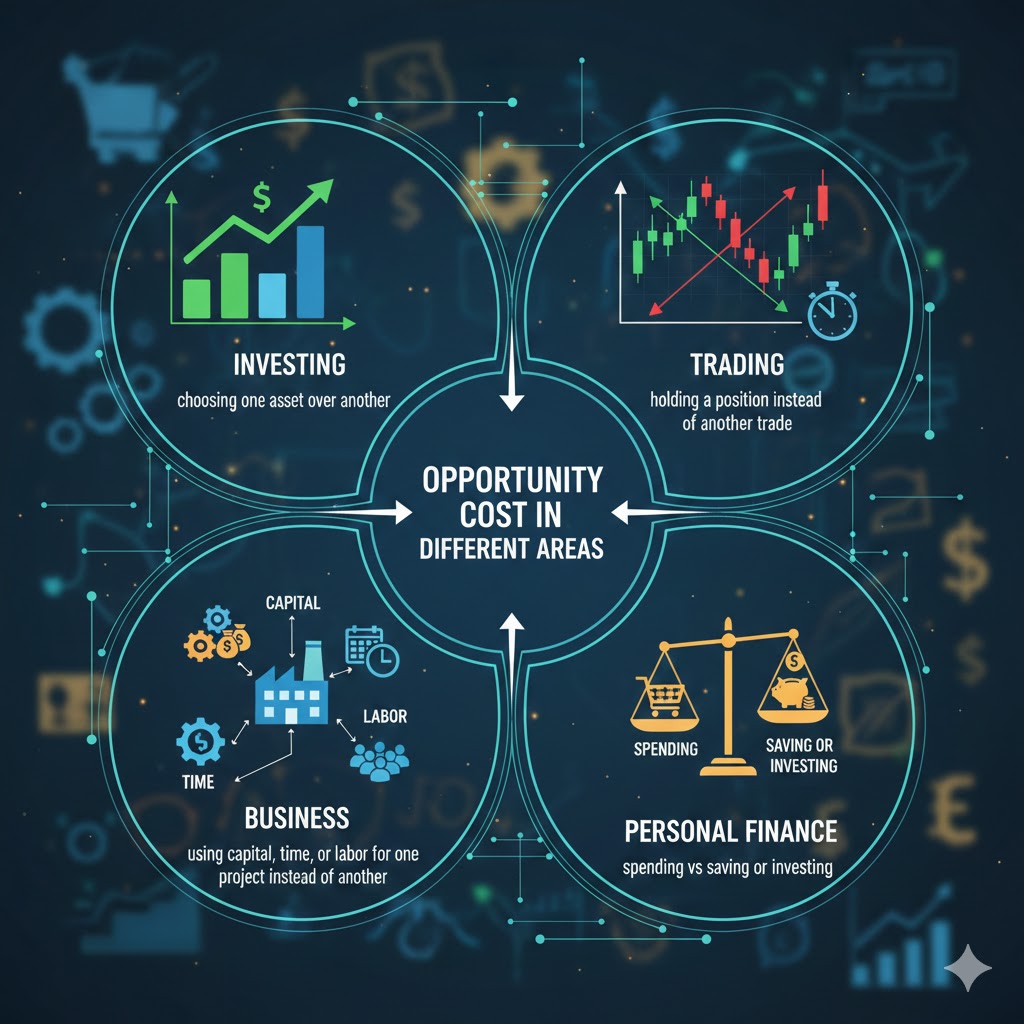
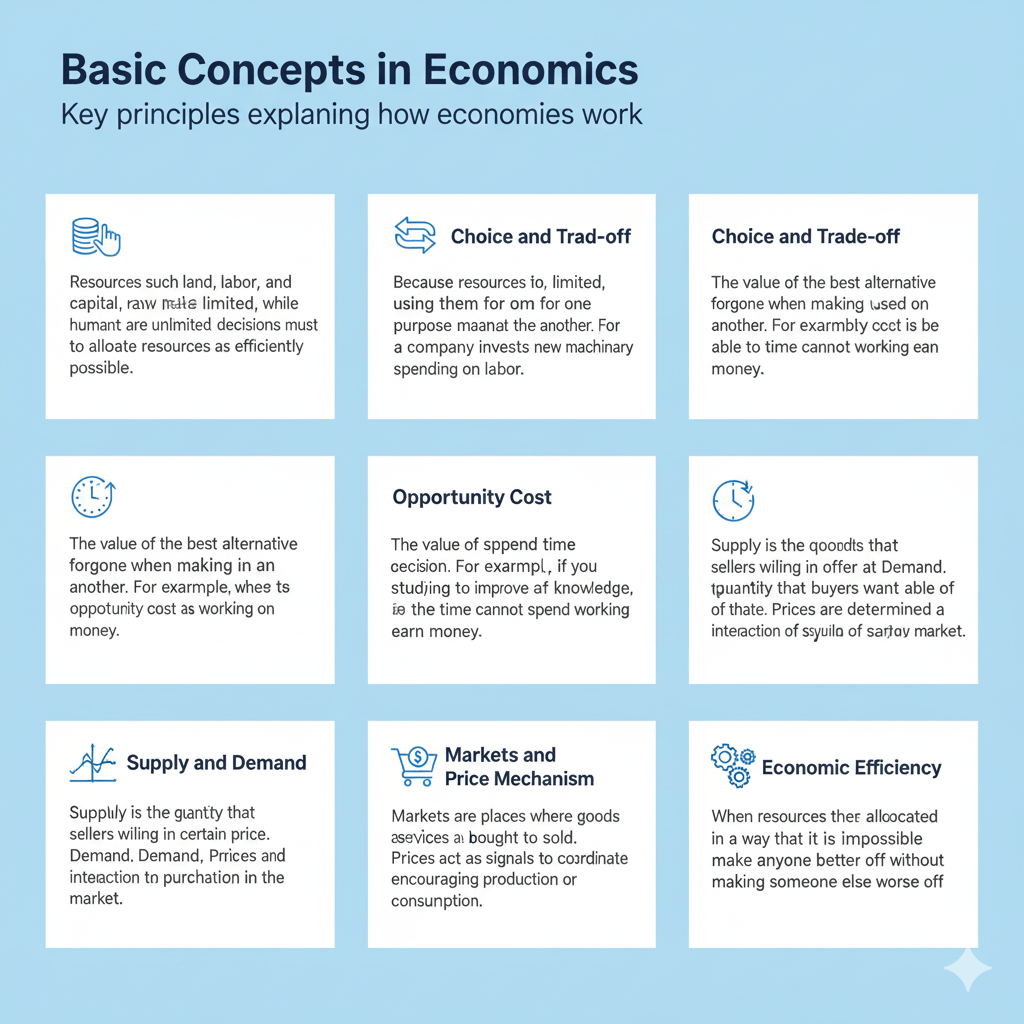
    Opportunity cost is the value of the next best alternative you give up when you choose one option over another.

    It is what you lose by not choosing the best alternative option.
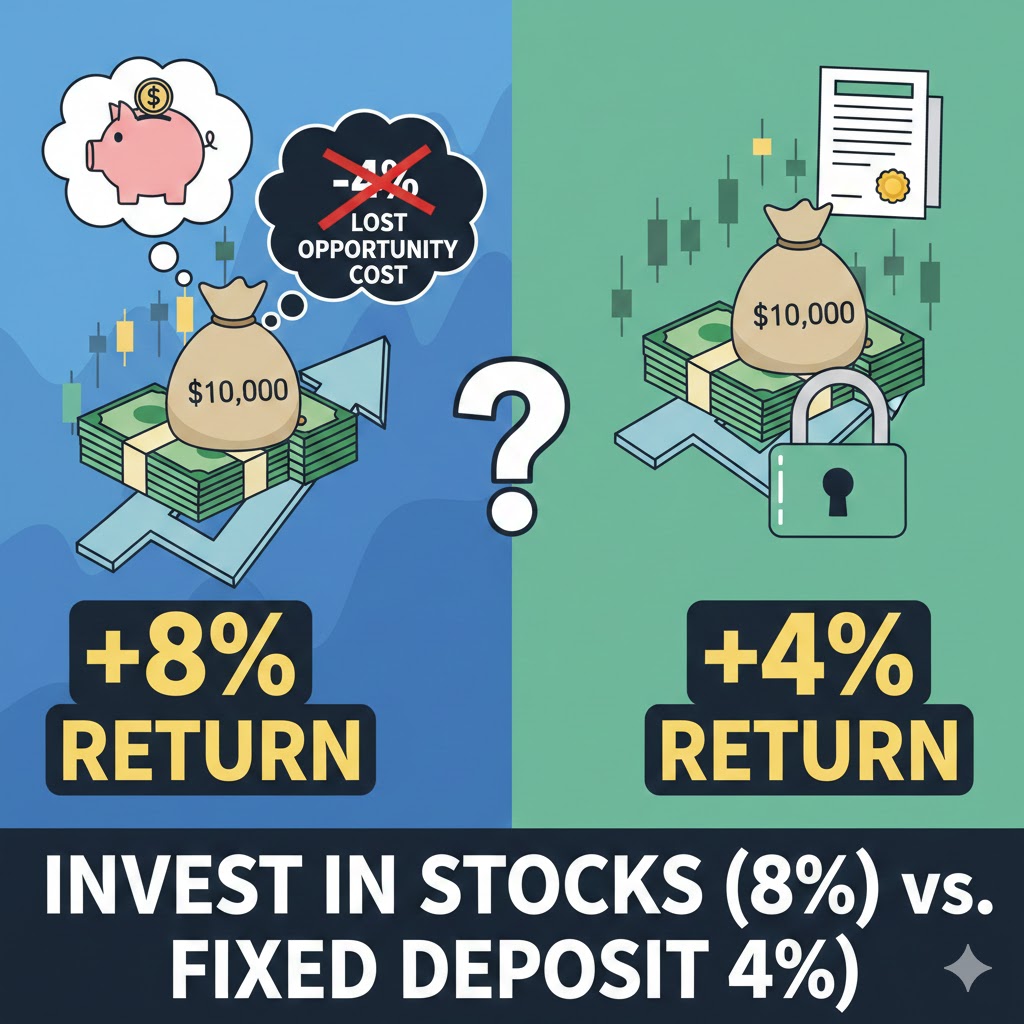
    Why opportunity cost matters

    • Helps make better financial and business decisions
    • Forces comparison between available alternatives
    • Highlights hidden costs beyond money
    • Essential in investment, trading, and resource allocation

    Opportunity cost vs Sunk cost

    • Opportunity cost: future value you give up
    • Sunk cost: past cost that cannot be recovered (should not affect decisions)

    Key takeaway

    Every decision has a cost—even if no money is paid.
    The true cost of any choice is the value of the best alternative forgone.

  • Scarcity

    Scarcity is a fundamental concept in economics that refers to the limited availability of resources relative to the unlimited wants and needs of people.

    Key Points

    • Limited Resources: Resources such as land, labor, capital, and raw materials are finite and cannot meet all human desires.
    • Unlimited Wants: Human wants and needs are virtually infinite and constantly evolving.
    • Economic Problem: Scarcity forces individuals, businesses, and governments to make choices about how to allocate resources efficiently.
    • Trade-offs: Because resources are scarce, choosing one option means giving up another (opportunity cost).
    • Basis of Economic Study: Economics exists primarily to address scarcity and understand how societies manage resource allocation.

    Example of Scarity

    Implications of Scarcity

    • Necessitates prioritization and decision-making at all levels of the economy.
    • Drives the study of efficiency and optimization in production and consumption.
    • Leads to the development of markets and prices as mechanisms to allocate scarce resources.
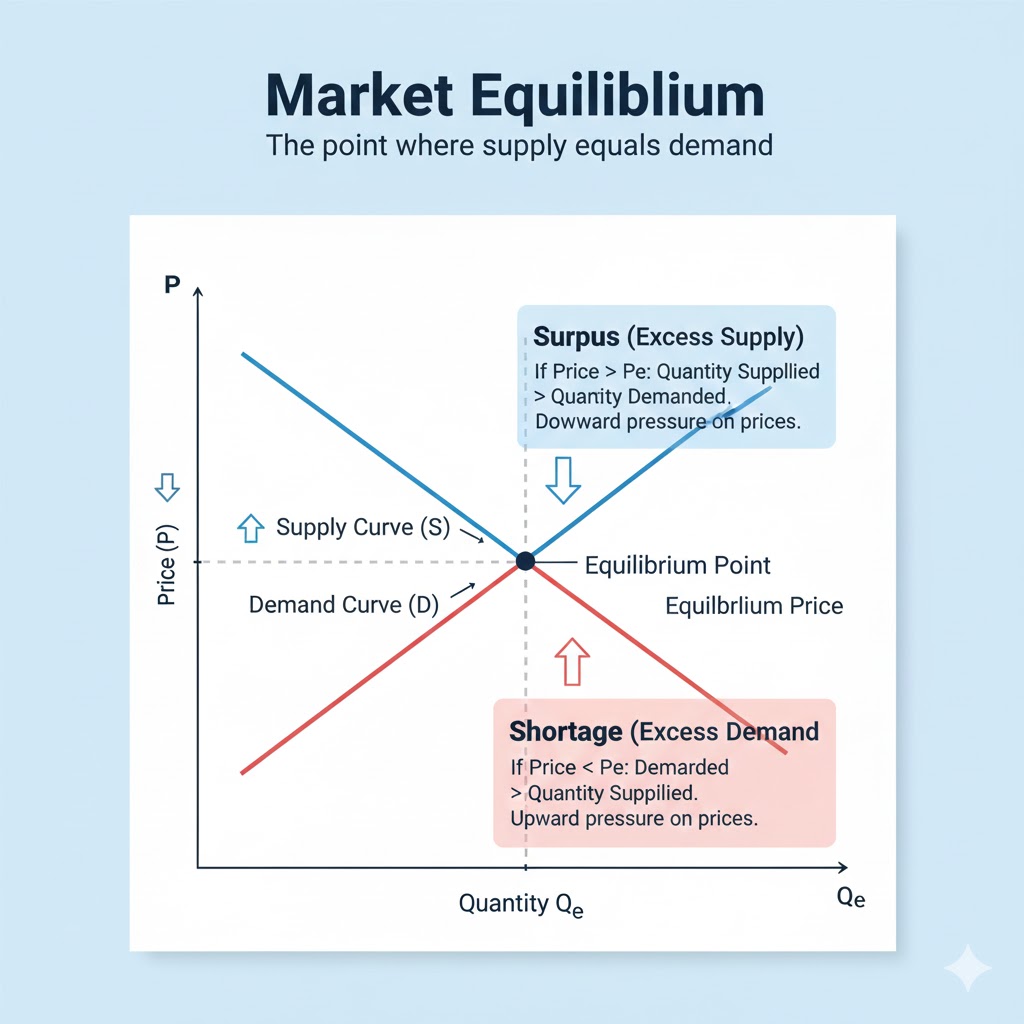
  • Supply and Demand

    Supply and Demand is a fundamental concept in economics that describes how prices and quantities of goods and services are determined in a market.

    Demand

    • Definition: Demand is the quantity of a product or service that consumers are willing and able to buy at different prices over a certain period.
    • Law of Demand: There is an inverse relationship between price and quantity demanded — as price decreases, demand usually increases, and vice versa.
    • Demand Curve: A downward-sloping curve that shows the relationship between price and quantity demanded.

    Supply

    • Definition: Supply is the quantity of a product or service that producers are willing and able to offer for sale at different prices over a certain period.
    • Law of Supply: There is a direct relationship between price and quantity supplied — as price increases, supply usually increases, and vice versa.
    • Supply Curve: An upward-sloping curve showing the relationship between price and quantity supplied.

    Factors Affecting Supply and Demand

    Factors Affecting Demand

    • Consumer income
    • Preferences and tastes
    • Prices of related goods (substitutes and complements)
    • Expectations about future prices
    • Number of buyers

    Factors Affecting Supply

    • Production costs
    • Technology
    • Prices of related goods
    • Expectations about future prices
    • Number of sellers

    Importance of Supply and Demand

    • Helps explain how prices are set in competitive markets
    • Provides insights into how changes in market conditions affect prices and quantities
    • Forms the basis for economic policy and business strategy decisions
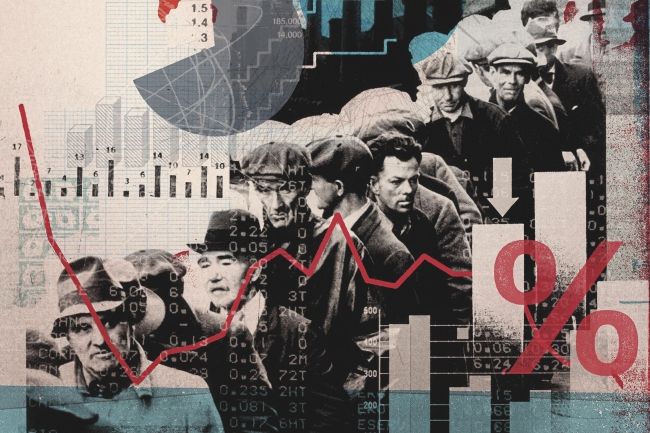
  • Economics

    Economics is the social science that studies how individuals, businesses, governments, and societies make choices about allocating scarce resources to satisfy their unlimited wants and needs.
    Purpose of Economics

    • To understand and predict economic behavior.
    • To develop policies that improve economic welfare.
    • To allocate resources efficiently.

    Basic Concepts in Economics

    Main Fields of Economics

    • Microeconomics
      Studies the behavior of individuals, households, and firms and how they make decisions in specific markets.
    • Macroeconomics
      Studies the overall economy, including economic growth, unemployment, inflation, monetary and fiscal policies.

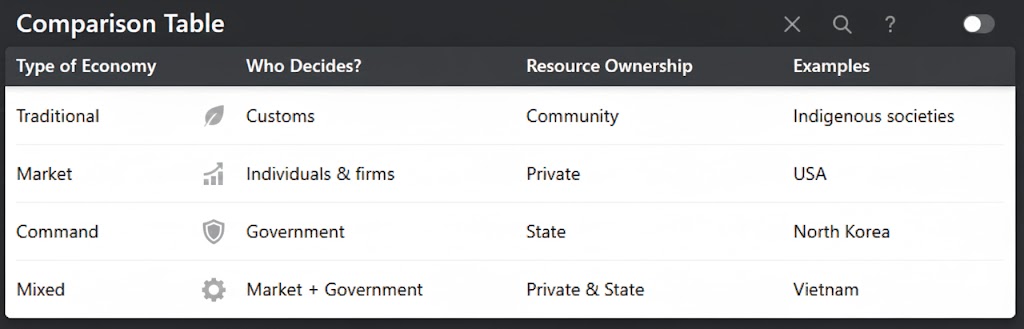
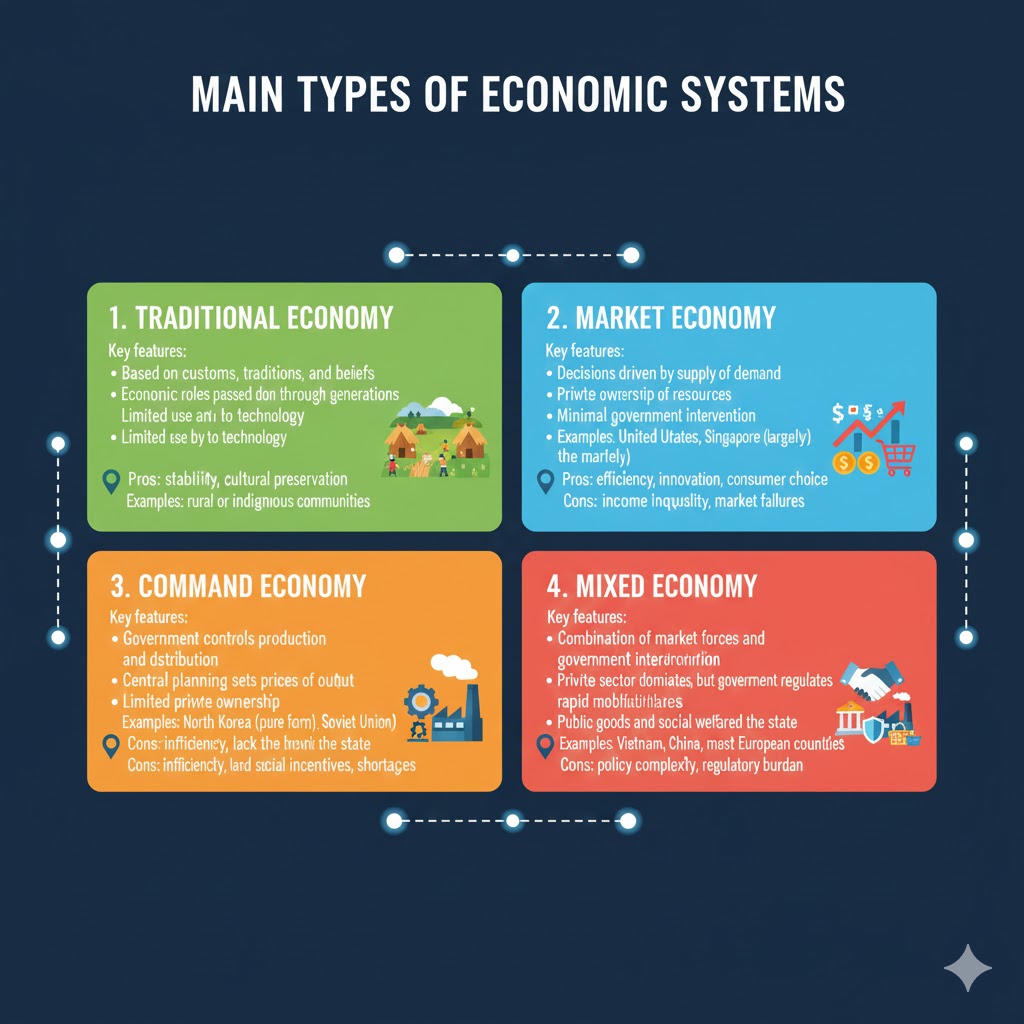
    Types of economies describe how a society organizes production, distribution, and consumption of goods and services—specifically, who makes economic decisions and how resources are allocated.
    Key takeaway

    Most modern economies are mixed economies, combining market efficiency with government regulation to promote stability and social welfare.

  • Contract for Difference (CFD)

    CFD (Contract for Difference) is a derivative financial instrument where two parties (a trader and a broker) agree to exchange the difference in the price of an asset between the time the position is opened and closed.
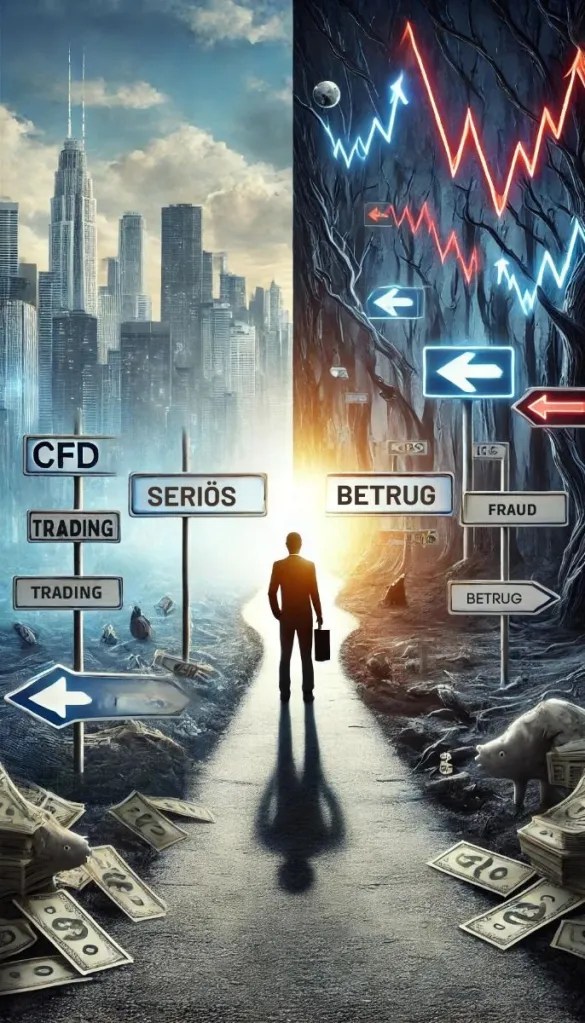
    • You do NOT own the underlying asset (stock, gold, index, etc.).
    • You are only trading price movements.

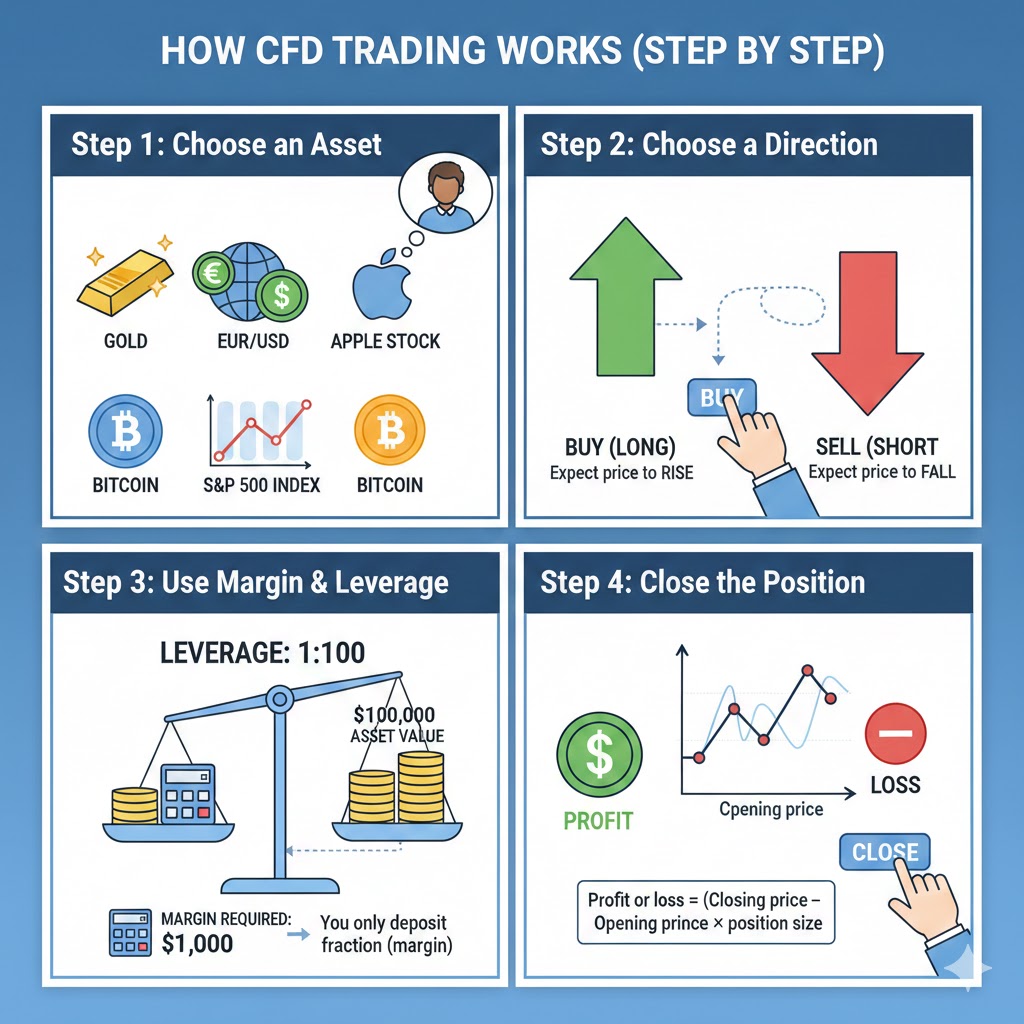
    How CFD trading works (step by step)

    Long vs Short (Very important)

    🔼 Going Long

    You profit when the price increases.

    Example:

    • Buy at 100
    • Sell at 110
    • Profit = +10

    🔽 Going Short

    You profit when the price decreases.

    Example:

    • Sell at 100
    • Buy back at 90
    • Profit = +10

    ⚠️ This ability to profit in falling markets is a key feature of CFDs.

    Leverage explained in depth

    Leverage allows you to control a large position with a small amount of capital.

    LeverageMargin Required
    1:1010%
    1:502%
    1:1001%
    1:5000.2%

    ⚠️ Risk of leverage

    • 1% price move with 1:100 leverage = 100% gain or loss
    • Losses can exceed expectations if risk is unmanaged

    Costs in CFD trading

    1️⃣ Spread

    • Difference between Bid and Ask
    • Paid when opening a trade

    2️⃣ Commission

    • Some brokers charge commission (usually on stocks)

    3️⃣ Overnight / Swap fee

    • Charged if you hold a position overnight
    • Based on interest rate differentials

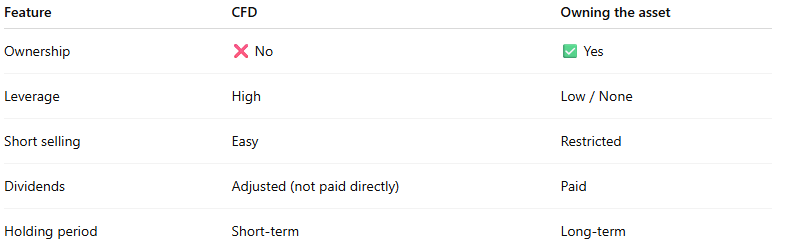
    CFD vs Owning the asset


    Markets available via CFDs

    CFDs allow access to global markets from one account:
    • Forex – currencies
    • Commodities – gold, oil, silver
    • Indices – Nasdaq, Dow Jones
    • Stocks – global equities
    • Cryptocurrencies – price exposure only


    Are CFDs regulated?

    • CFDs are legal and regulated in many jurisdictions
    • Regulation depends on the broker’s license (FCA, ASIC, CySEC, etc.)
    • Some countries restrict or ban retail CFD trading

    👉 Broker selection is critical.


    Key advantages & disadvantages

    ✅ Advantages

    • Trade rising and falling markets
    • High capital efficiency
    • Access to global markets
    • Fast execution

    ❌ Disadvantages

    • High risk due to leverage
    • No ownership benefits
    • Psychological pressure
    • Broker dependency
  • Pips and Lots

    In trading (especially Forex)pips and lots are basic units used to measure price movement and trade size.

    What is a Pip?

    Pip = Percentage in Point
    It is the smallest standard price movement in a currency pair.

    Standard rules

    • For most currency pairs:
      1 pip = 0.0001
      • Example: EUR/USD moves from 1.1000 → 1.1001 = +1 pip
    • For JPY pairs:
      1 pip = 0.01
      • Example: USD/JPY moves from 145.20 → 145.21 = +1 pip

    Some platforms show pipettes (fractional pips):

    • 1 pip = 10 pipettes

    What is a Lot?

    lot measures the size of your trade (how much currency you are buying or selling).

    Common lot sizes

    Lot TypeUnits of Base Currency
    Standard lot100,000 units
    Mini lot10,000 units
    Micro lot1,000 units
    Nano lot100 units (some brokers)

    Pip Value (Why Lots Matter)

    The pip value depends on the lot size.

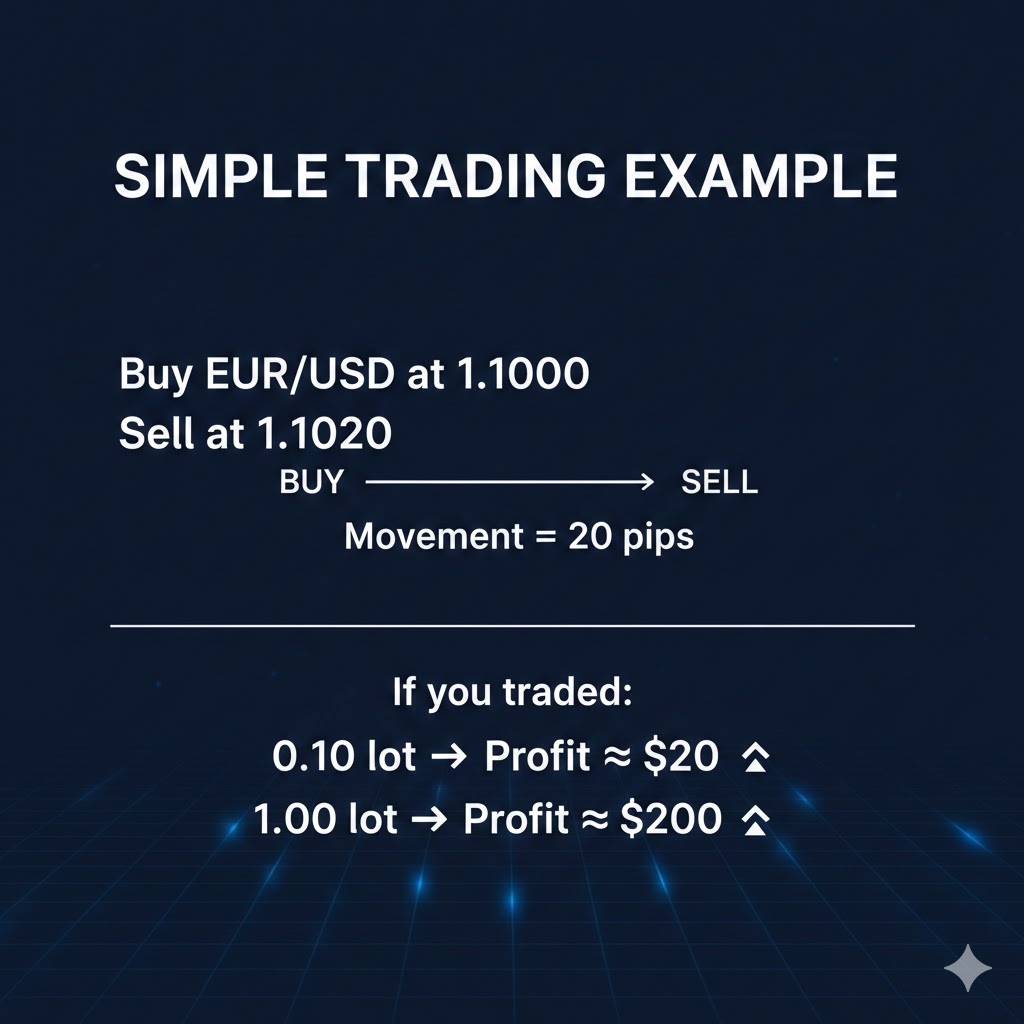
    Example (EUR/USD)

    Lot SizePip Value
    1.00 lot≈ $10 per pip
    0.10 lot≈ $1 per pip
    0.01 lot≈ $0.10 per pip

    So:

    • 20 pips profit with 1 lot ≈ $200
    • 20 pips profit with 0.1 lot ≈ $20

    Quick Summary

    • Pip = how far price moves
    • Lot = how big your trade is
    • Pips × Lot size = Profit or Loss
  • Bid & Ask and Spread

    Bid and Ask

    Bid price

    • The Bid is the highest price buyers are willing to pay
    • If you sell immediately, you sell at the bid
    • Think of it as: “What the market will pay me right now”

    Ask price (also called Offer)

    • The Ask is the lowest price sellers are willing to accept
    • If you buy immediately, you buy at the ask
    • Think of it as: “What it costs to buy right now”

    Example

    If EUR/USD shows

    • Bid: 1.1048
    • Ask: 1.1050

    This means

    • You can sell EUR/USD at 1.1048
    • You can buy EUR/USD at 1.1050
    • The difference (0.0002) is the spread

    Why bid is always lower than ask

    • The gap between them is the spread
    • The spread represents:
      • Broker/market maker profit
      • Liquidity conditions
      • Transaction cost for traders

    Key takeaway

    • Buy → Ask
    • Sell → Bid
    • Spread = Ask − Bid
  • Long Position and Short Position

    Long position

    • Long (Buy)
    • Opening a buy position with the expectation that the price will increase.
    • A trader makes a profit when the market price moves up.

    Short position

    • Short (Sell / Short Selling)
    • Opening a sell position with the expectation that the price will decrease.
    • A trader makes a profit when the market price moves down.

    Quick comparison

    Long and short positions apply to the following markets

    • Forex (FX) – currencies
    • Stock market – especially stocks that allow margin trading or short selling
    • Commodities – gold, oil, agricultural products
    • Cryptocurrencies – spot, margin, and derivatives markets
    • Derivatives markets – futures, options, CFDs, swaps

    Key note

    • Long positions are available in almost all markets.
    • Short positions are not always available in spot markets and usually require derivatives or margin trading.
  • Centralized market and Decentralized market

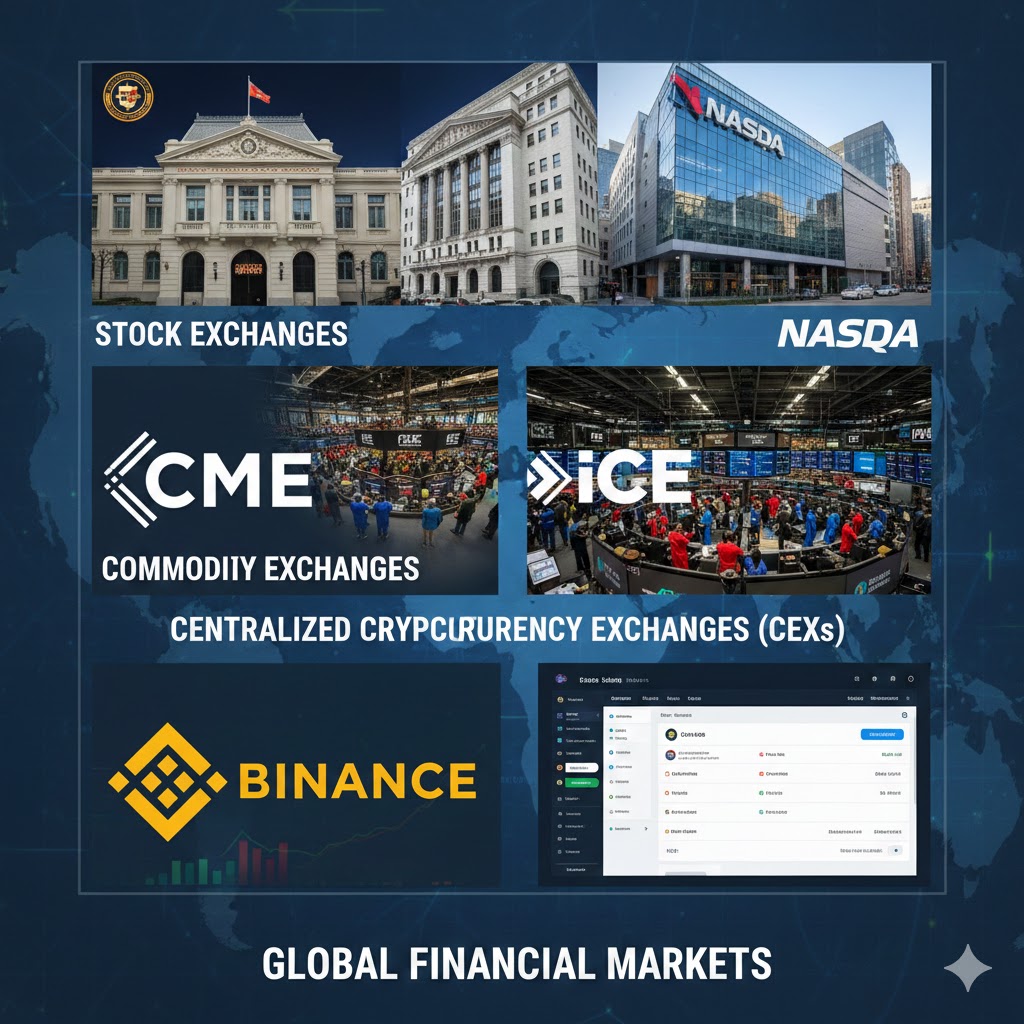
    Centralized Market

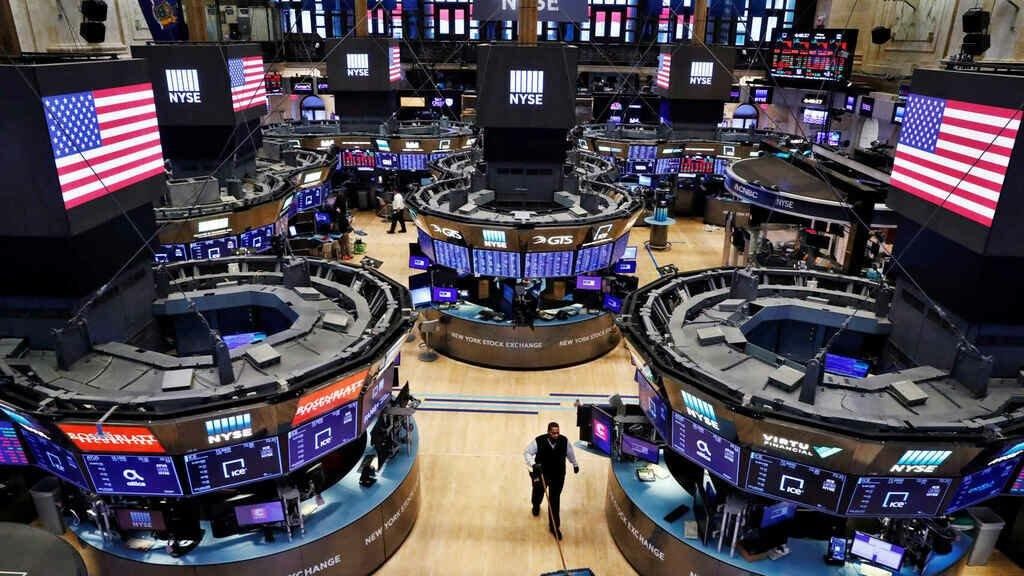
    A centralized market is a market in which buying and selling activities take place at a single central location or through a central system. All transactions are processed and supervised by a central authority or platform.
    Key characteristics

    • Operated and regulated by a central authority
    • Transparent and publicly quoted prices
    • High liquidity due to the concentration of buyers and sellers
    • Easier to monitor and regulate

    Examples

    • Stock exchanges: HOSE, NYSE, NASDAQ
    • Commodity exchanges: CME, ICE
    • Centralized cryptocurrency exchanges (CEXs): Binance, Coinbase

    Advantages

    • High price transparency
    • Fast execution and strong liquidity
    • Clear legal and regulatory framework

    Disadvantages

    • Dependence on a central intermediary
    • Systemic risk if the central platform fails or is disrupted

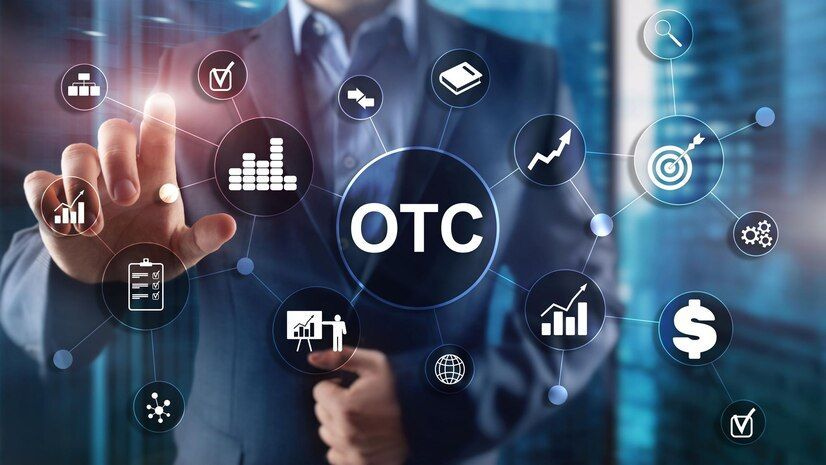
    Decentralized Market

    A decentralized market is a market without a single central authority, where buyers and sellers trade directly with each other through a network or bilateral agreements.

    Key characteristics

    • No central governing body
    • Prices may vary across participants or locations
    • High flexibility
    • Limited centralized control

    Examples

    • The interbank foreign exchange (Forex) market
    • Over-the-counter (OTC) markets
    • Decentralized cryptocurrency exchanges (DEXs): Uniswap, PancakeSwap
    • Traditional agricultural markets

    Advantages

    • Greater flexibility and independence
    • Suitable for customized or private transactions
    • Less vulnerable to a single point of failure

    Disadvantages

    • Lower price transparency
    • Higher counterparty risk
    • Uneven liquidity
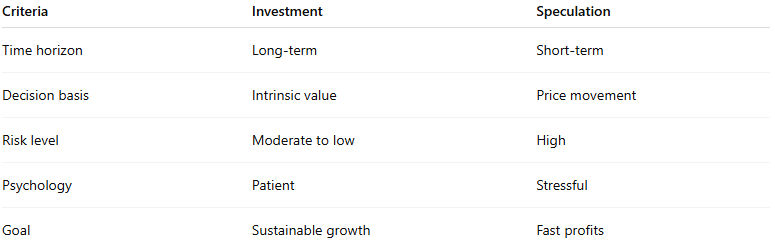
  • Investment and Speculation

    The difference between investment and speculation lies mainly in objectives, time horizon, decision-making approach, and risk level. In simple terms:


    Investment

    Allocating capital to an asset with intrinsic value, expecting it to grow sustainably over time and/or generate cash flow.
    Key characteristics

    • Long-term (several years or more)
    • 🔍 Based on fundamental analysis (financials, business model, management quality, industry outlook, etc.)
    • 💰 Focused on stable, sustainable returns
    • ⚖️ Controlled risk
    • 📈 Willing to tolerate short-term volatility

    Examples

    • Buying shares of a strong company and holding for 5–10 years
    • Investing in rental real estate
    • Investing in a Shan Tuyet tea business to build a long-term brand and ecosystem

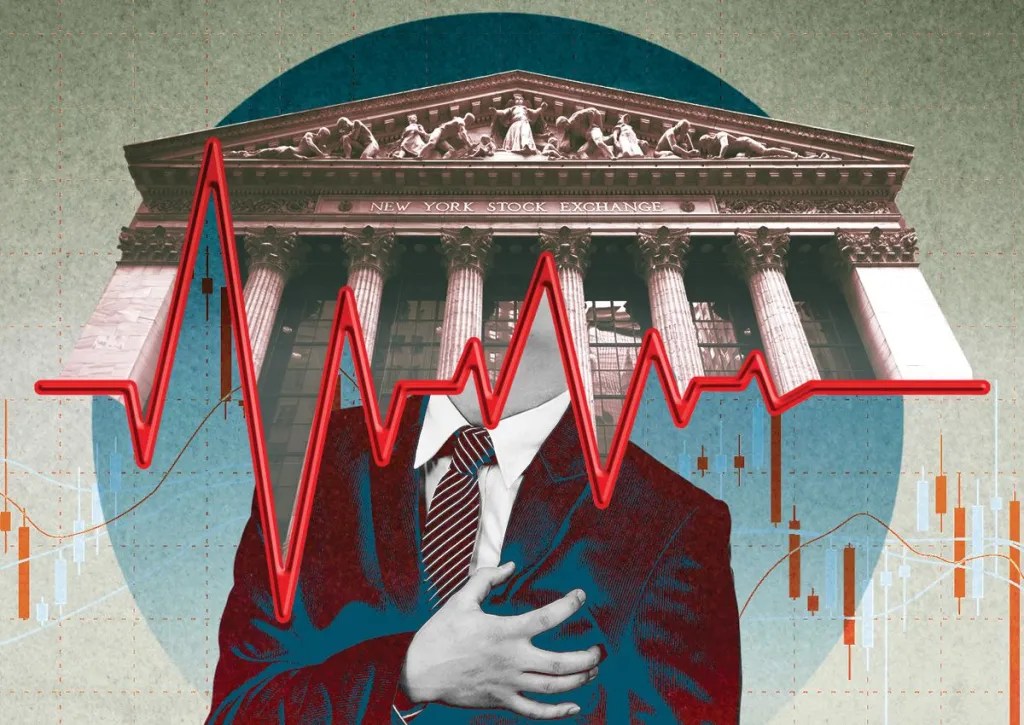
    Speculation

    Allocating capital to profit from short-term price movements, with little emphasis on intrinsic value.
    Key characteristics

    • Short-term (days, weeks, or a few months)
    • 📊 Heavily reliant on technical analysis, news, and market sentiment
    • 🎯 Aimed at quick profits
    • 🔥 High risk
    • 💥 Significant losses if the market moves against expectations

    Examples

    • Short-term stock trading based on rumors
    • Short-term forex or crypto trading
    • Buying assets simply because “prices are rising fast”

    Quick comparison


    An important point

    It is not the asset itself that determines whether an activity is investment or speculation, but how it is used.

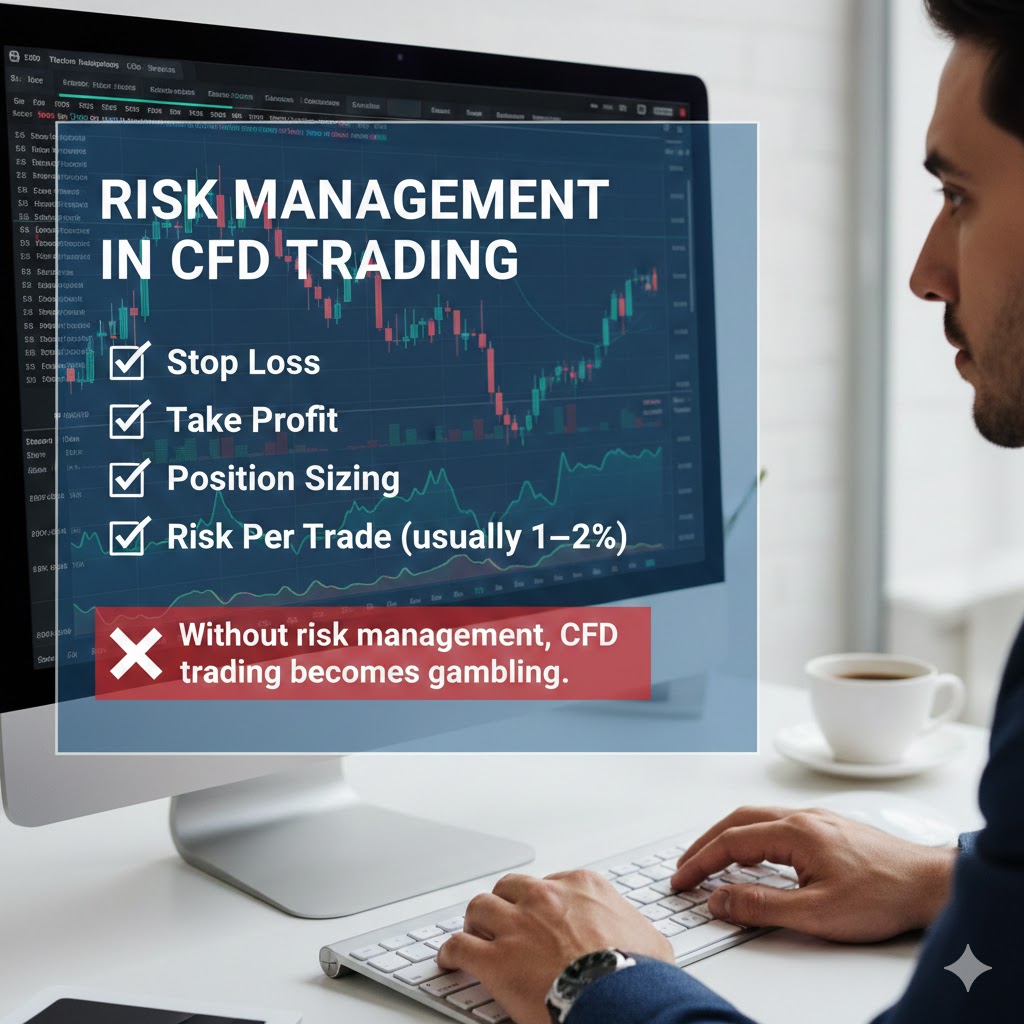
  • Risk Management

    Risk management is the process of identifying, assessing, and controlling threats or risks that could negatively impact an individual, organization, or project. The goal is to minimize the potential losses or harm by planning how to handle uncertainties effectively.
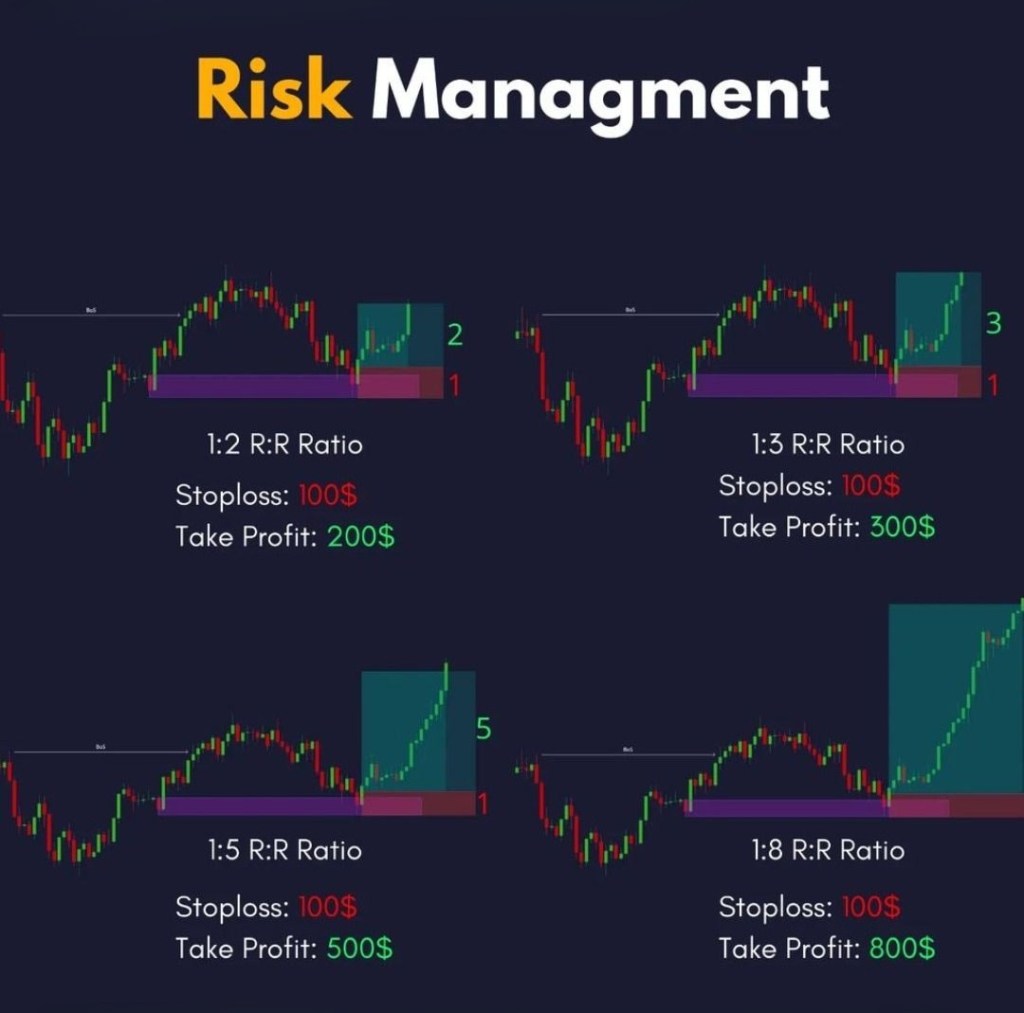
    In finance or trading, for example, risk management involves strategies to limit potential losses—such as setting stop-loss orders, diversifying investments, or controlling position sizes—so that even if the market moves unfavorably, the damage is limited.

    Risk management is crucial for capital preservation and achieving long-term objectives. Even the top global financial institutions prioritize it above all else.

  • Market Sessions & Trading Activity

    Market sessions refer to the specific time periods during which major global financial markets are open. Because financial markets operate across different time zones, trading activity follows a continuous cycle, with varying levels of liquidity and volatility throughout the day.
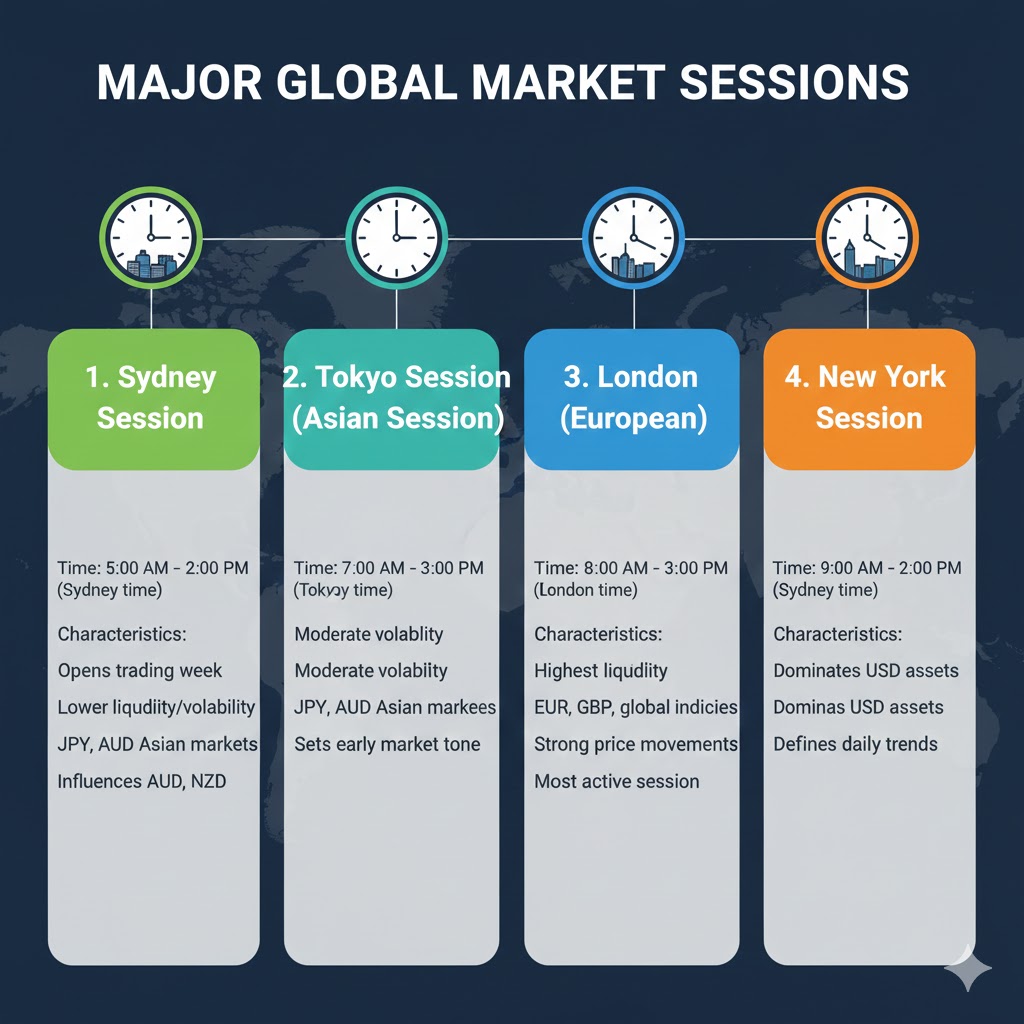
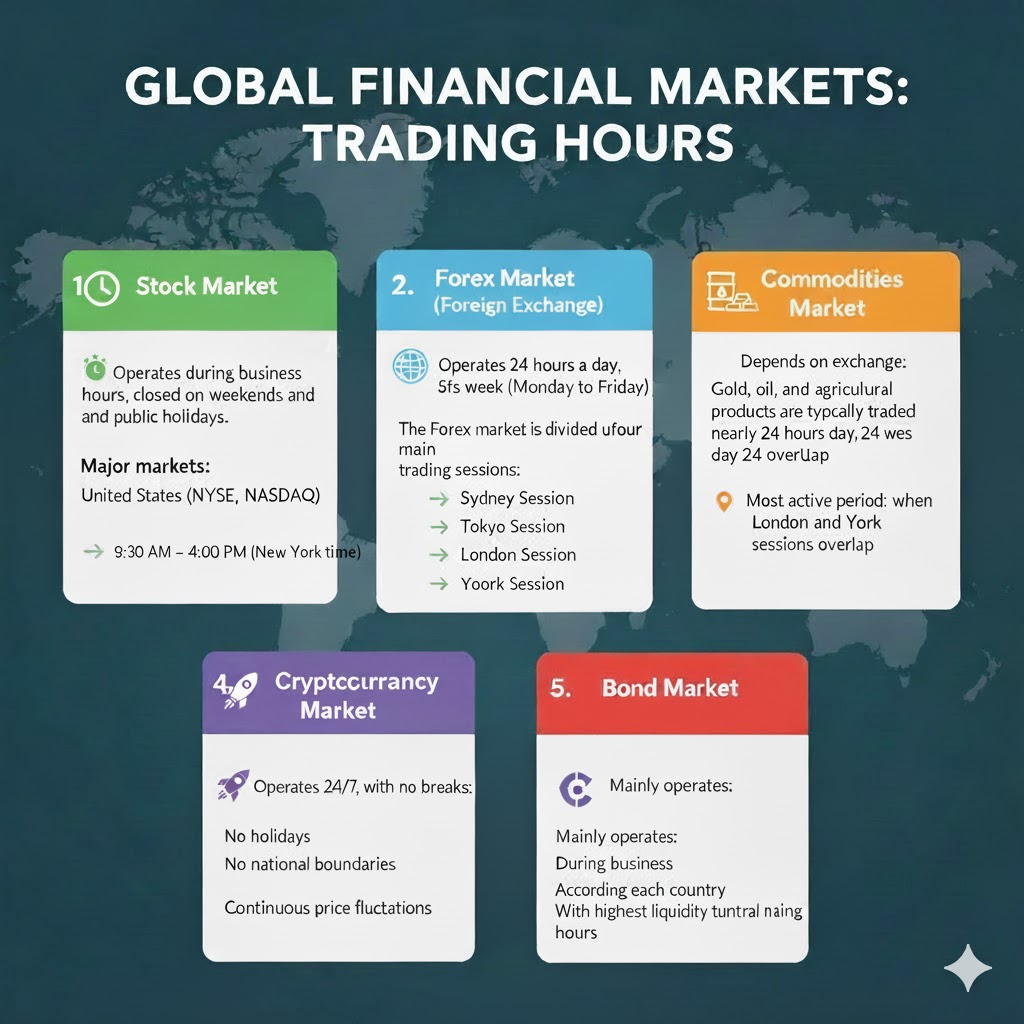
    Key Takeaway

    Trading activity is not evenly distributed throughout the day.
    Understanding market sessions helps traders choose the right time to trade, manage risk, and optimize performance.

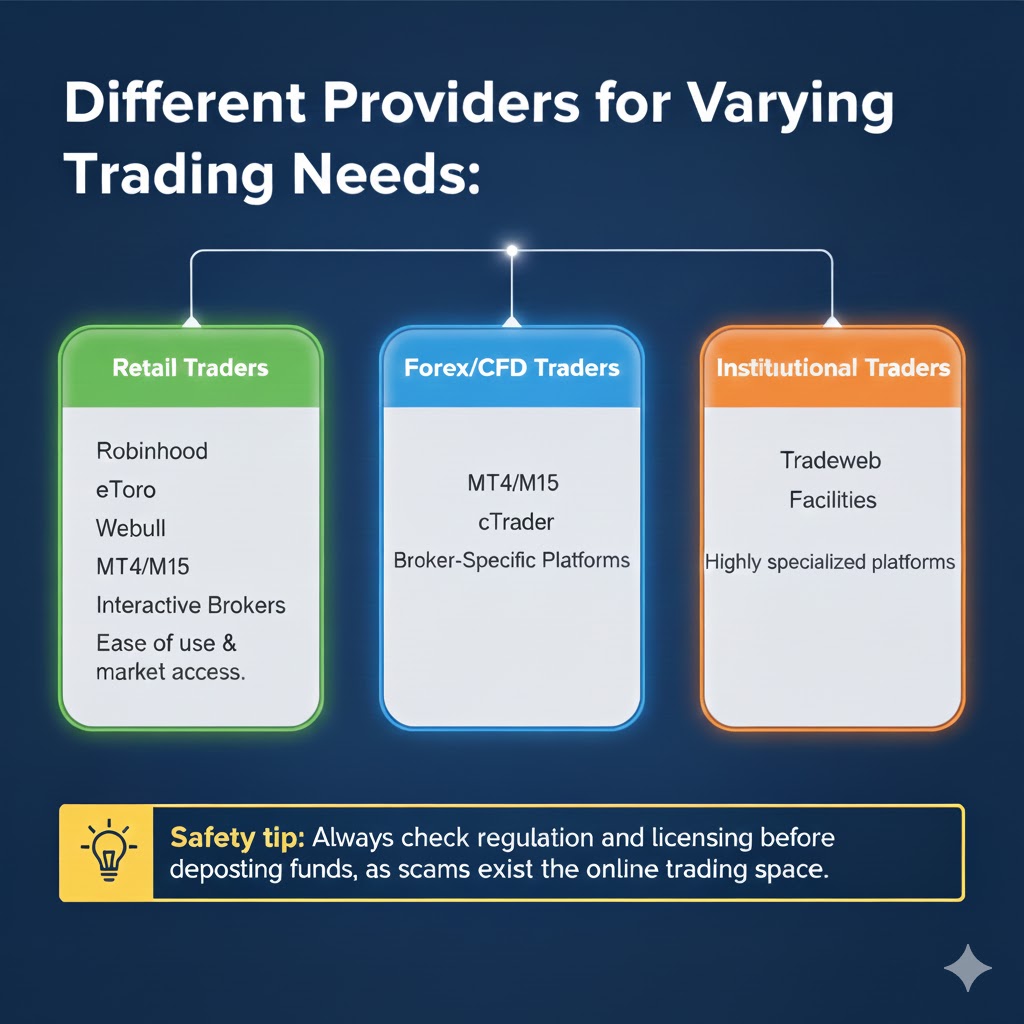
  • Trading Platforms

    trading platform is a software system or application that allows users to buy, sell, and manage financial instruments in financial markets.

    It is the tool traders use to access the market and execute trades.
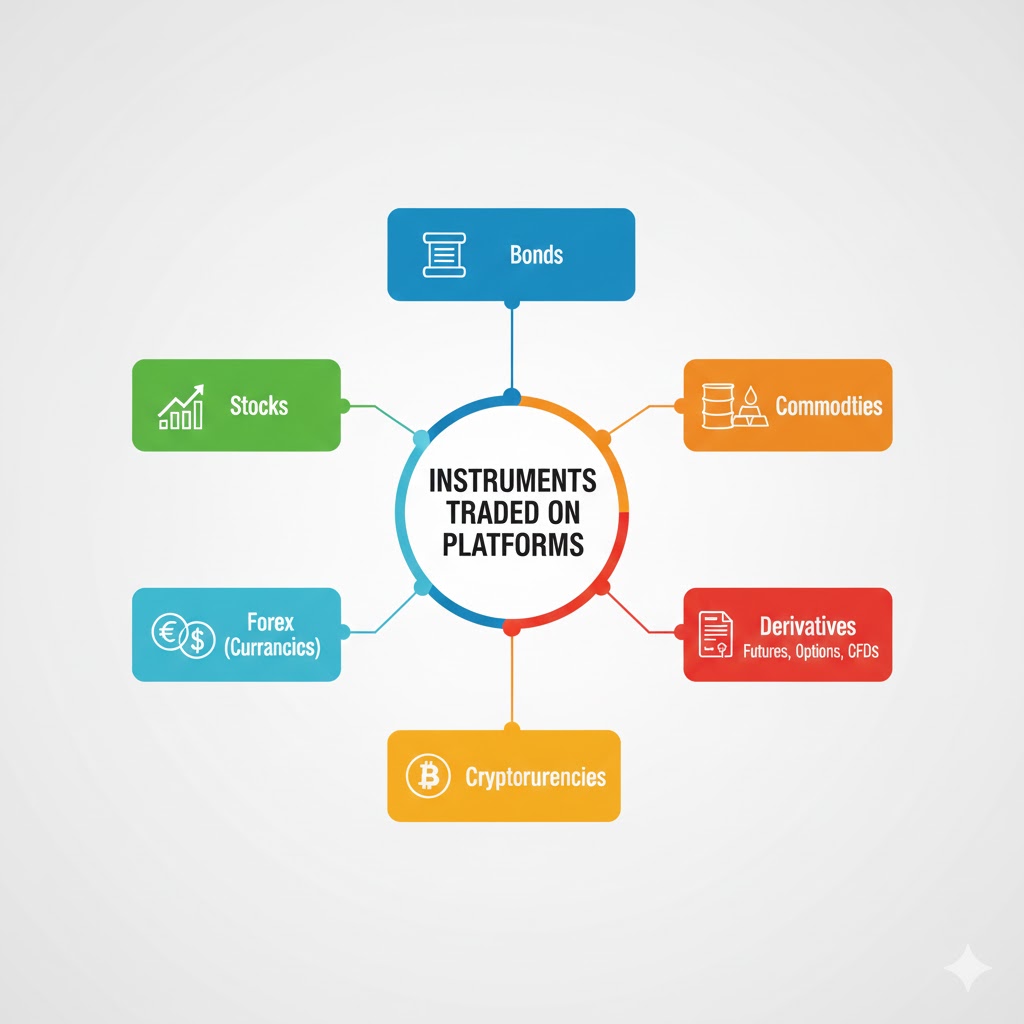
    What trading platforms allow you to do

    • Place buy and sell orders
    • View real-time prices and charts
    • Perform technical analysis
    • Manage positions, margin, and leverage
    • Set risk controls (stop-loss, take-profit)
    • Track account balance and performance

    Types of trading platforms

    • Desktop platforms – advanced tools for professional traders
      (e.g. MetaTrader, Thinkorswim)
    • Web-based platforms – browser access, no installation
    • Mobile platforms – trading on smartphones and tablets
    • Institutional platforms – used by banks, funds, and prop firms

  • Leverage and Margin

    Leverage is the use of borrowed resources (money or financial instruments) to increase exposure to an investment or activity, aiming to amplify potential returns.

    Leverage = controlling a larger position with a smaller amount of your own capital

    How it works

    When a company or investor uses debt instead of only their own capital:

    • If returns are higher than the cost of debt, leverage amplifies profits
    • If returns are lower than the cost of debt, leverage amplifies losses

    So leverage increases both opportunity and risk.
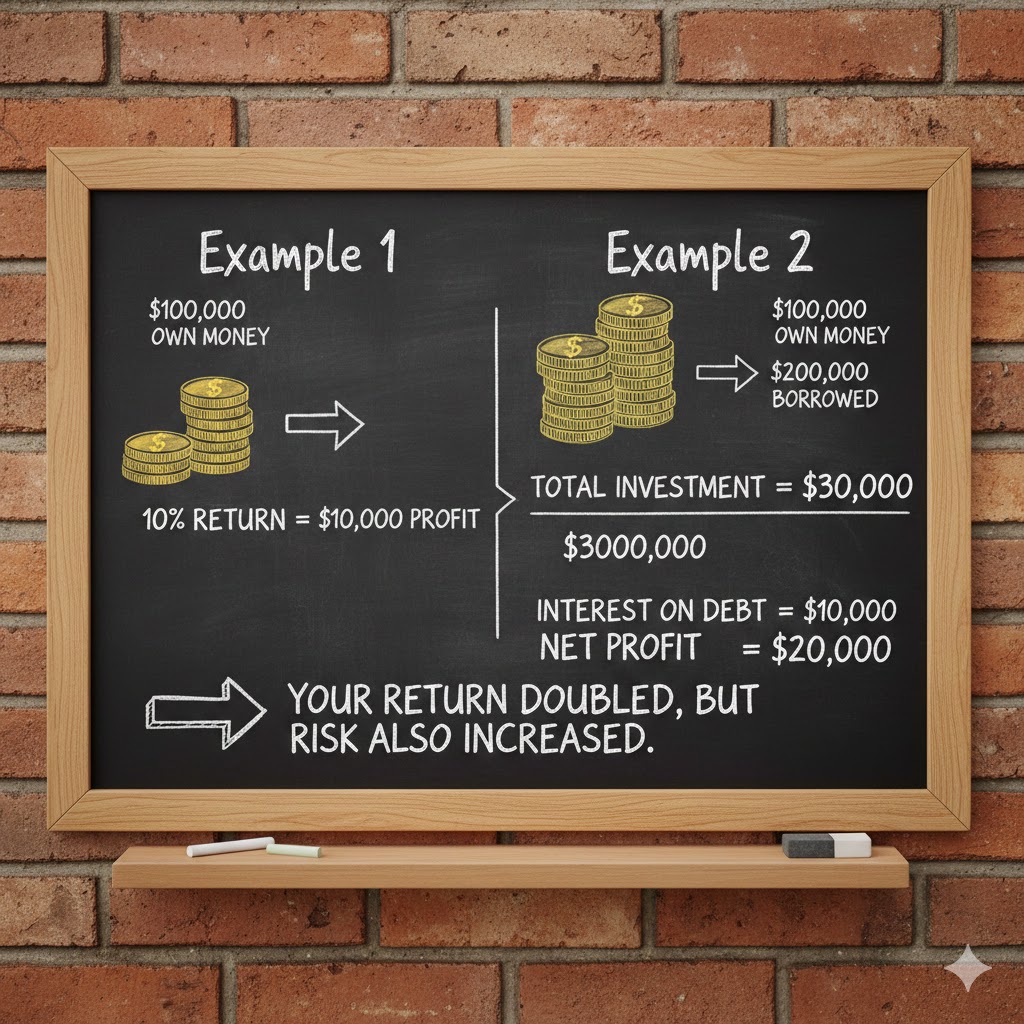

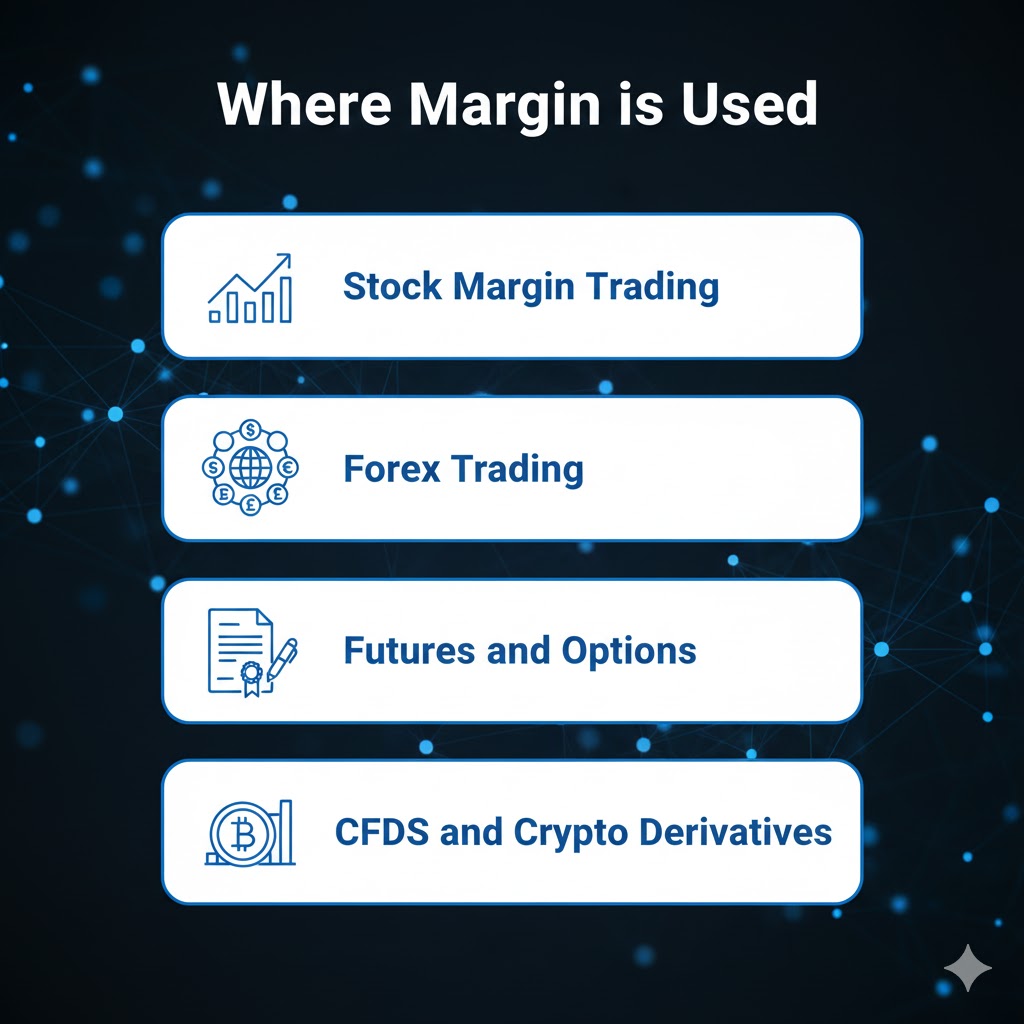
    Where financial leverage is used

    • Corporate finance (business expansion, acquisitions)
    • Investment & trading (stocks, derivatives, forex, crypto)
    • Real estate (mortgages)
    • Private equity & IPO structuring

    Key takeaway

    Financial leverage magnifies outcomes:
    higher leverage = higher potential return + higher risk.


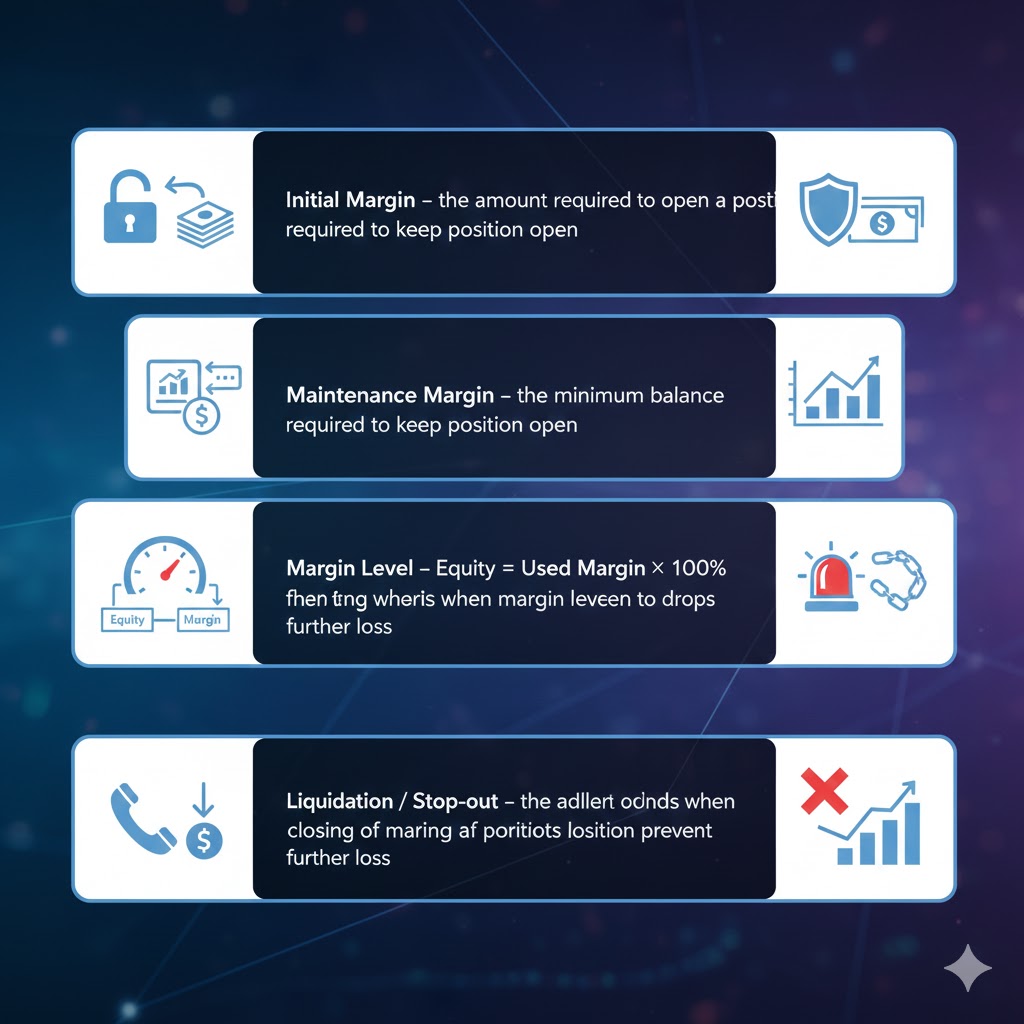
    Margin is the money you deposit with a broker to open and maintain a leveraged trading position.

    Margin is a security deposit, not a fee, that allows you to trade a larger position than your actual cash.
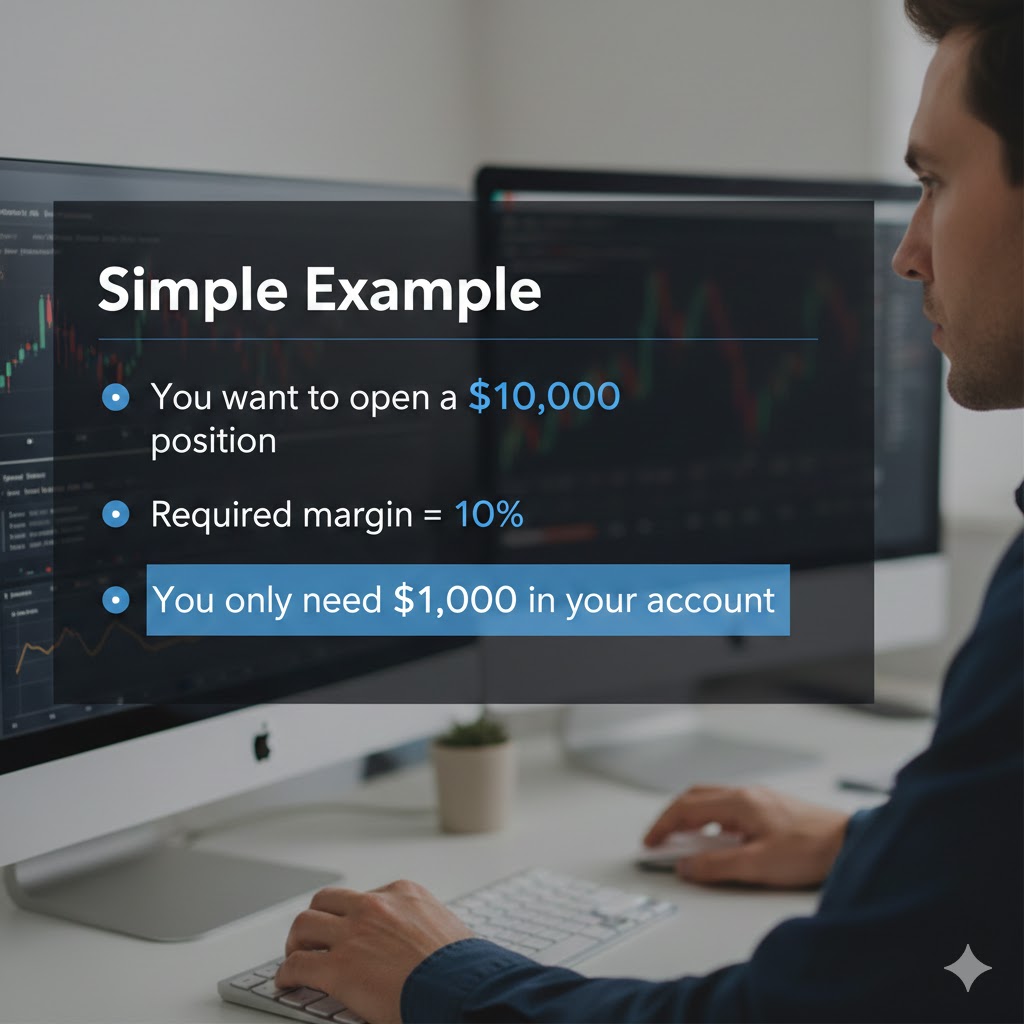
    How margin works

    • You deposit a small amount of capital (margin)
    • The broker allows you to control a larger position
    • The remaining amount is effectively borrowed from the broker

    Key Margin Terms

    Key takeaway

    Key takeaway

    Margin enables leverage, but poor margin management is the main cause of trading losses.

  • Behavioural Finance

    Behavioural Finance is a field of study that combines psychology and finance to understand how emotions, cognitive biases, and social factors influence investors’ decisions and financial markets.
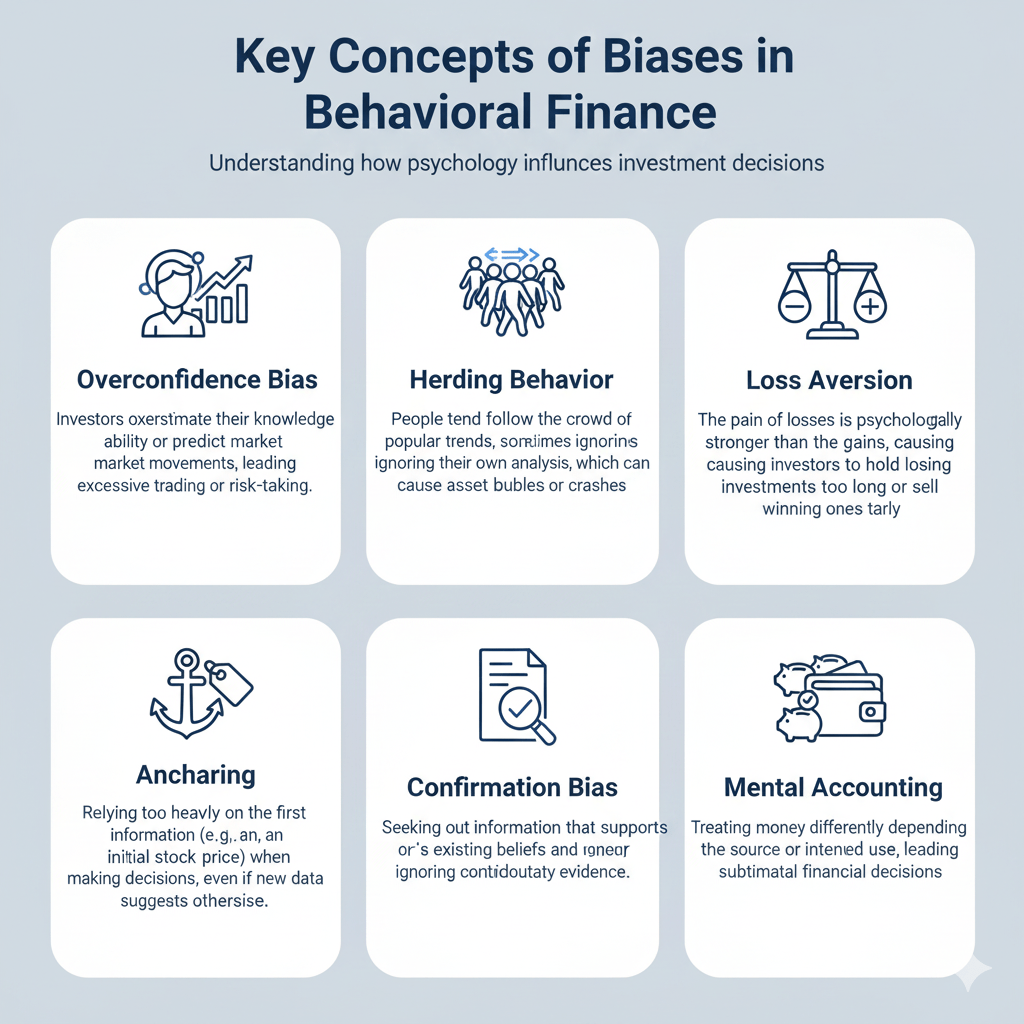

    Key Points:

    • Unlike traditional finance, which assumes investors are fully rational, behavioural finance acknowledges that people often make irrational decisions.
    • It studies common biases such as overconfidenceherding behaviorloss aversion, and confirmation bias.
    • These biases can lead to market anomalies like bubbles, crashes, and mispricing of assets.
    • Understanding behavioural finance helps investors and financial professionals recognize and mitigate emotional and cognitive errors in decision-making.

    Impacts on Financial Markets

    • Market bubbles and crashes often result from collective irrational behaviour driven by biases.
    • Asset prices may deviate from their true value because of emotional trading.
    • Investors’ decisions are influenced by mood, social pressures, and cognitive shortcuts rather than purely rational analysis.

    Practical Applications

    • Investment Strategies: Incorporating behavioural insights to improve decision-making and portfolio management.
    • Risk Management: Recognizing biases helps in avoiding excessive risk-taking or panic selling.
    • Financial Education: Teaching investors about common biases to foster better habits.
    • Market Regulation: Regulators use behavioural finance to design policies protecting investors.

    Summary

    Behavioural Finance bridges the gap between psychology and economics, explaining why markets are not always efficient and why investor behaviour often deviates from rational models. Understanding these concepts can lead to smarter investing and better financial outcomes.

  • The Evolution of Technical Analysis

    The Evolution of Technical Analysis reflects how market analysis has developed over time, from simple price observations to sophisticated data-driven models used in modern trading.
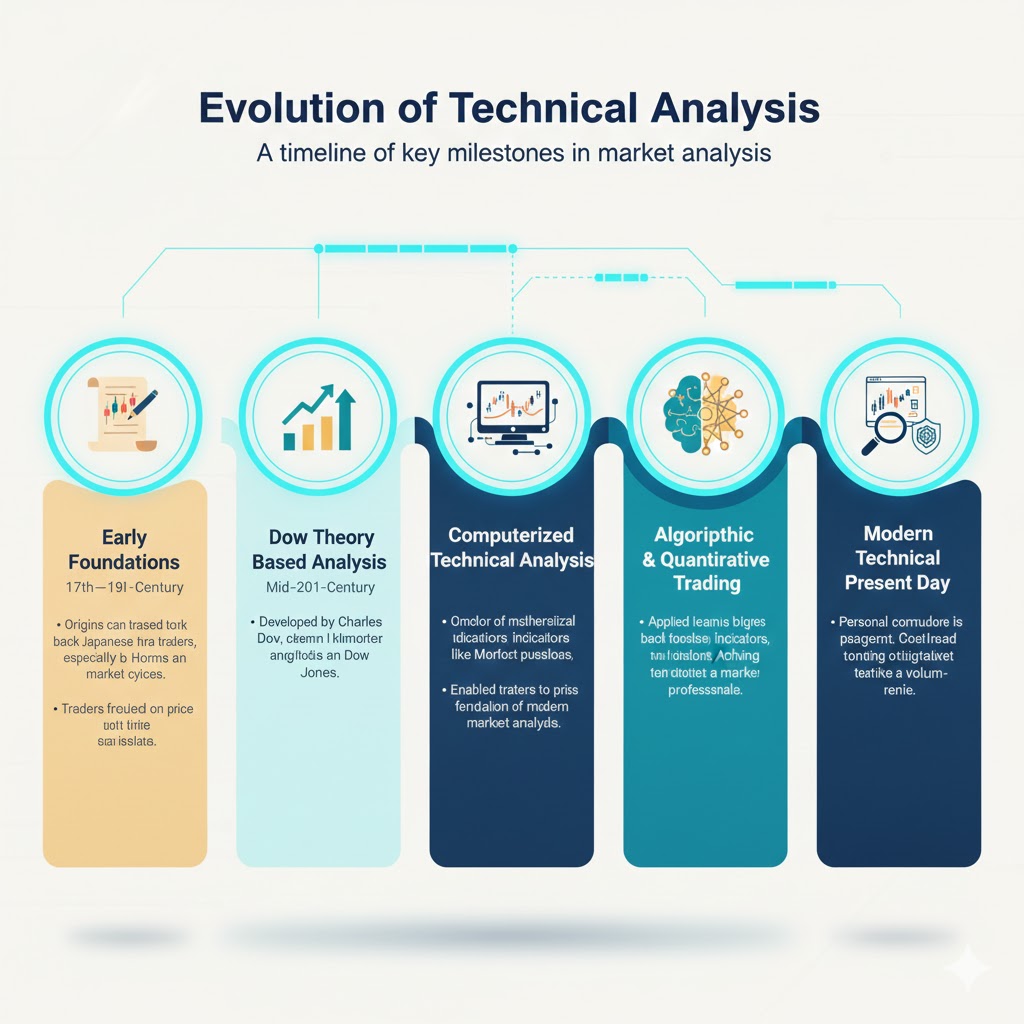
    Technical analysis has evolved from visual chart reading to advanced, technology-driven systems, remaining a vital tool for understanding market behavior and timing trades.

    Without a solid foundation and fundamental knowledge, it is difficult to achieve profits or build wealth. Successful individuals and companies never rely solely on technical knowledge to grow their wealth—they combine it with strong fundamentals and a clear vision for long-term growth.

    The Eternal Sovereign – Thanh Nguyen

  • The International Financial System

    The International Financial System (IFS) is the global framework that enables the flow of money, capital, and financial services across countries. It connects national financial systems and facilitates international trade, investment, and economic cooperation. The international financial system consists of institutions, markets, rules, and instruments that allow governments, businesses, and individuals to conduct cross-border financial transactions efficiently and securely.
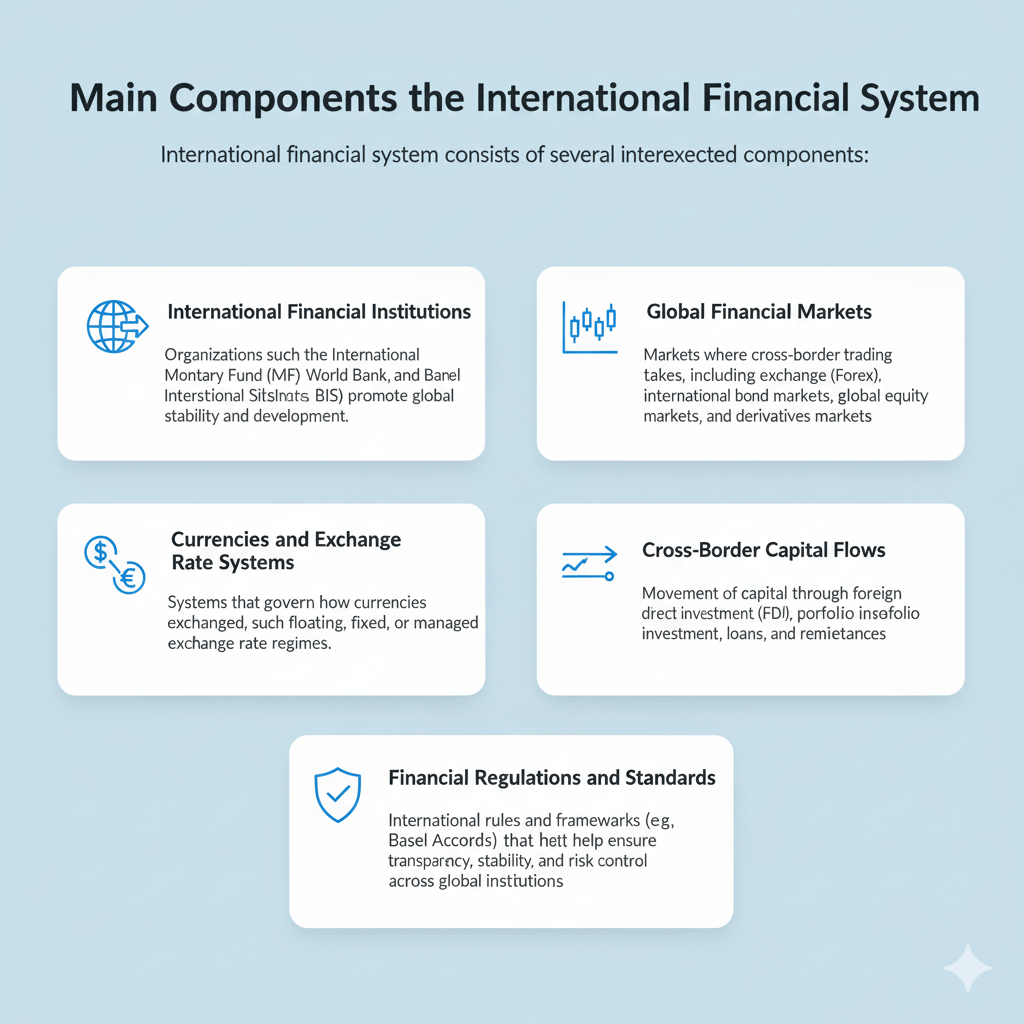
    Functions of the International Financial System

    • Facilitates international trade and investment
    • Enables global capital allocation
    • Supports economic growth and development
    • Promotes financial stability and risk management
    • Provides mechanisms for crisis prevention and resolution

    A well-functioning international financial system helps reduce uncertainty, manage global financial risks, and support sustainable economic growth worldwide.

  • Portfolio Management

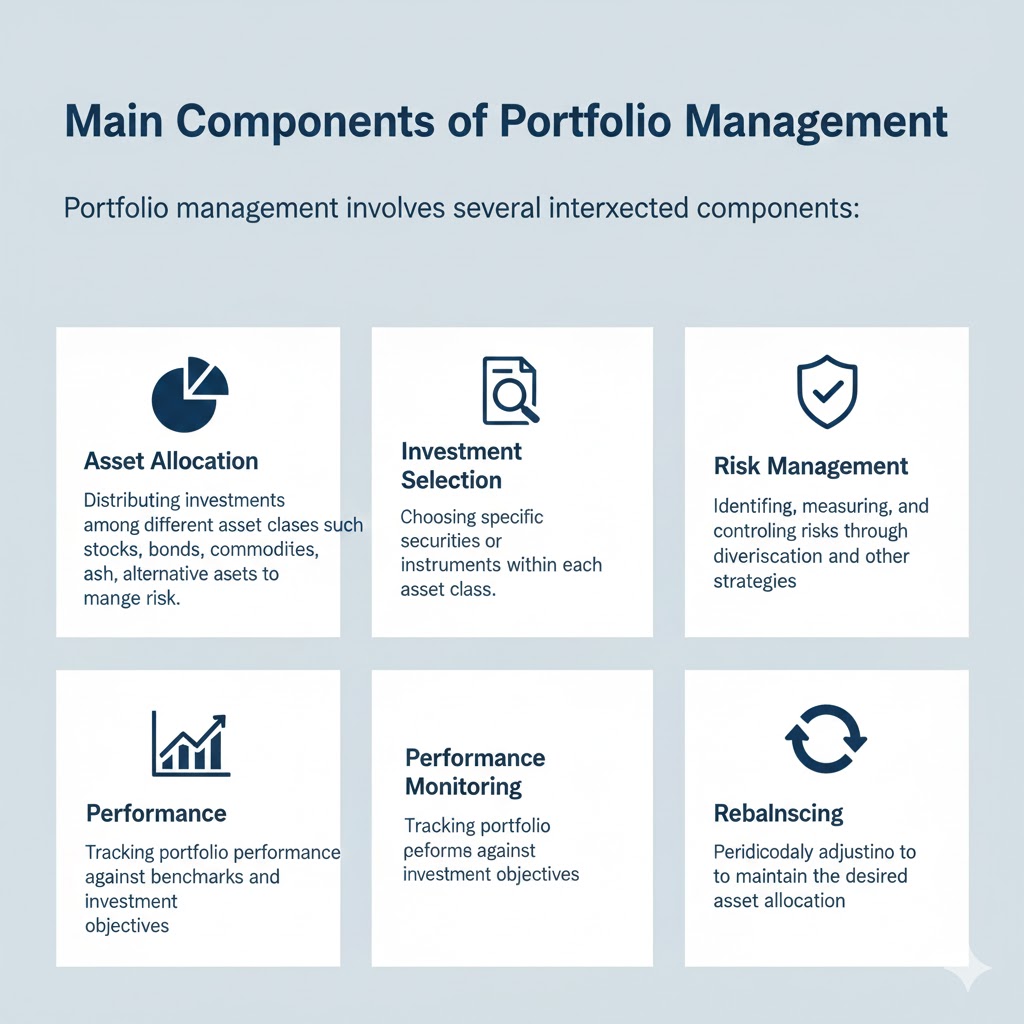
    Portfolio Management is the process of selecting, managing, and monitoring a collection of investments (a portfolio) to achieve specific financial goals while balancing risk and return. Portfolio management involves deciding what to invest inhow much to invest, and when to adjust investments based on an investor’s objectives, risk tolerance, time horizon, and market conditions.
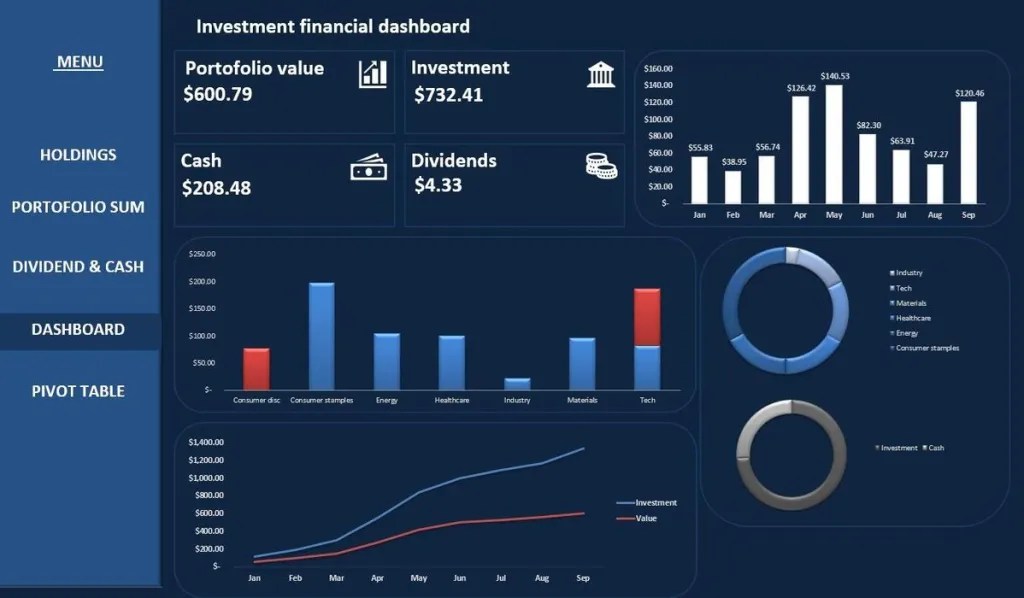
    Main Components of Portfolio Management

    • Asset Allocation
      Distributing investments among different asset classes such as stocks, bonds, commodities, cash, or alternative assets to manage risk.
    • Investment Selection
      Choosing specific securities or instruments within each asset class.
    • Risk Management
      Identifying, measuring, and controlling risks through diversification and other strategies.
    • Performance Monitoring
      Tracking portfolio performance against benchmarks and investment objectives.
    • Rebalancing
      Periodically adjusting the portfolio to maintain the desired asset allocation.

    Types of Portfolio Management

    • Active Portfolio Management:
      Managers actively buy and sell assets to outperform the market.
    • Passive Portfolio Management:
      Focuses on matching market performance, often through index funds.
    • Discretionary Portfolio Management:
      Managers make decisions on behalf of clients.
    • Non-discretionary Portfolio Management:
      Managers provide advice, but final decisions are made by clients.

    The main goal of portfolio management is to maximize returns for a given level of risk or minimize risk for a desired level of return.

  • Derivative Securities

    Derivative securities are financial instruments whose value is derived from the value of an underlying asset, index, or rate. Common underlying assets include stocks, bonds, commodities, currencies, interest rates, or market indexes. Derivatives are primarily used for hedging risk, speculation, or arbitrage.
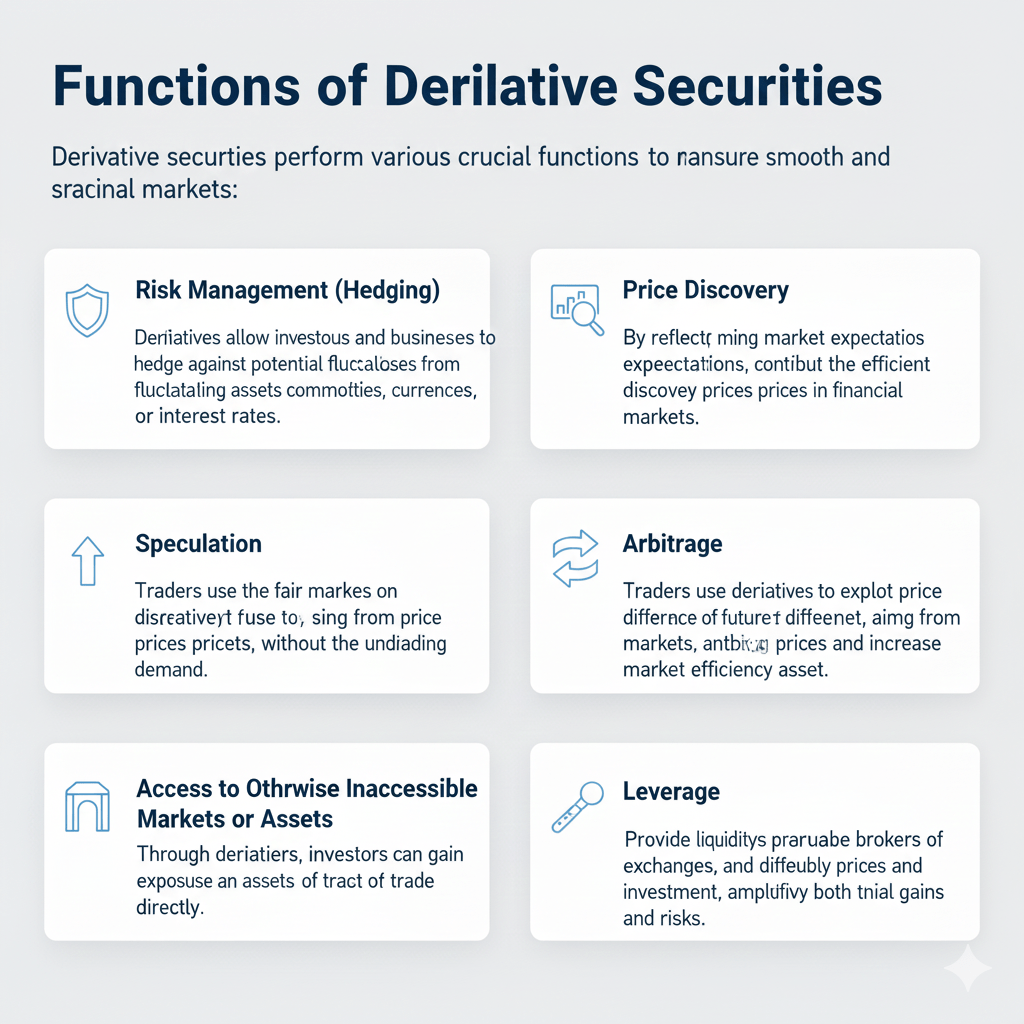
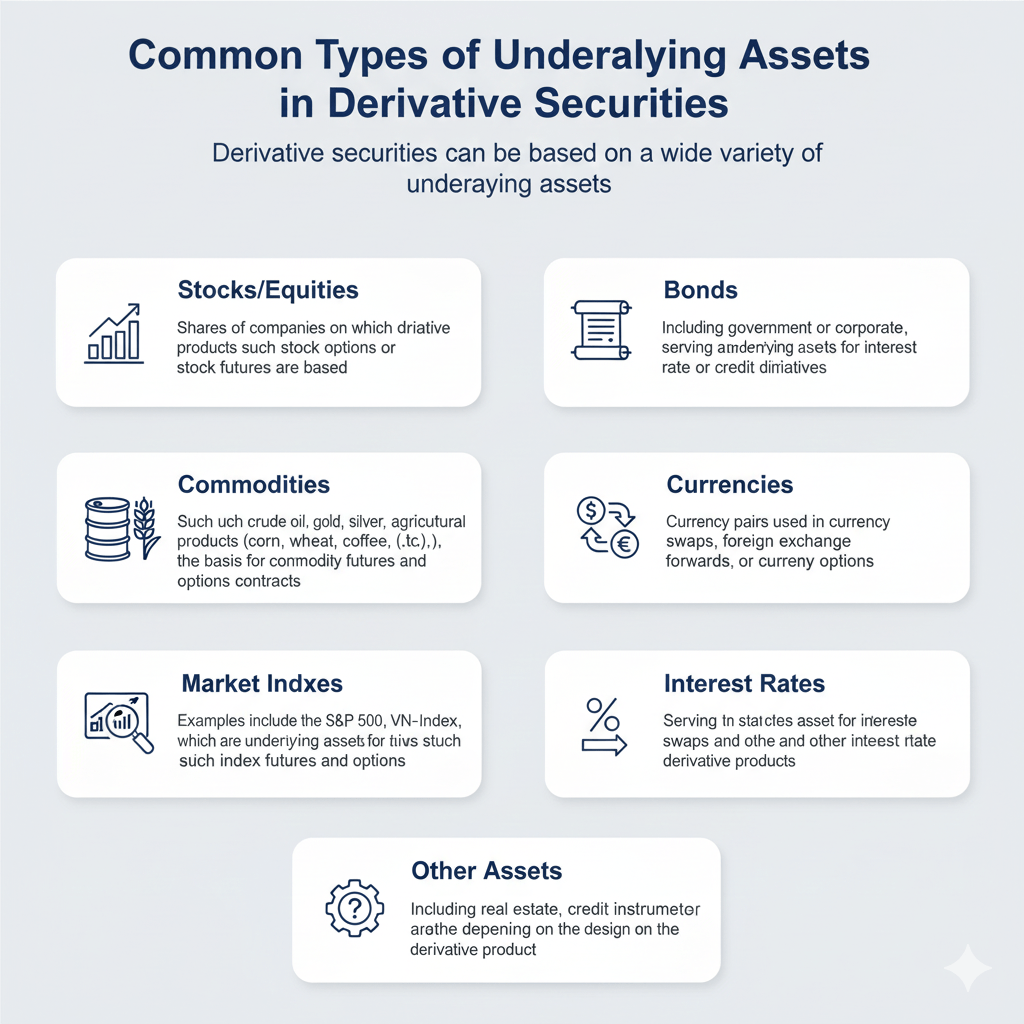
    Main Types of Derivative Securities

    • Futures Contracts
      Standardized agreements traded on exchanges, obligating the parties to buy or sell an asset at a predetermined price on a specified future date.
    • Options
      Contracts granting the holder the right, but not the obligation, to purchase (call option) or sell (put option) an asset at a specified price within a defined time period.
    • Swaps
      Customized, over-the-counter agreements between parties to exchange cash flows or financial instruments, commonly used to manage interest rate or currency risks.
    • Forwards
      Private, non-standardized contracts between two parties to buy or sell an asset at an agreed price on a future date, typically traded over-the-counter.

    Markets for Trading Derivative Securities

    1. Exchange-Traded Market (ETM):
      This is where standardized derivative contracts are traded on formal exchanges such as the Chicago Mercantile Exchange (CME), NYSE, or Vietnam’s Commodity Exchange (MXV).
    2. Over-The-Counter (OTC) Market
      This market involves direct trading between parties without going through formal exchanges. Contracts are often customized according to the agreements between the parties.
  • Liquidity Providers

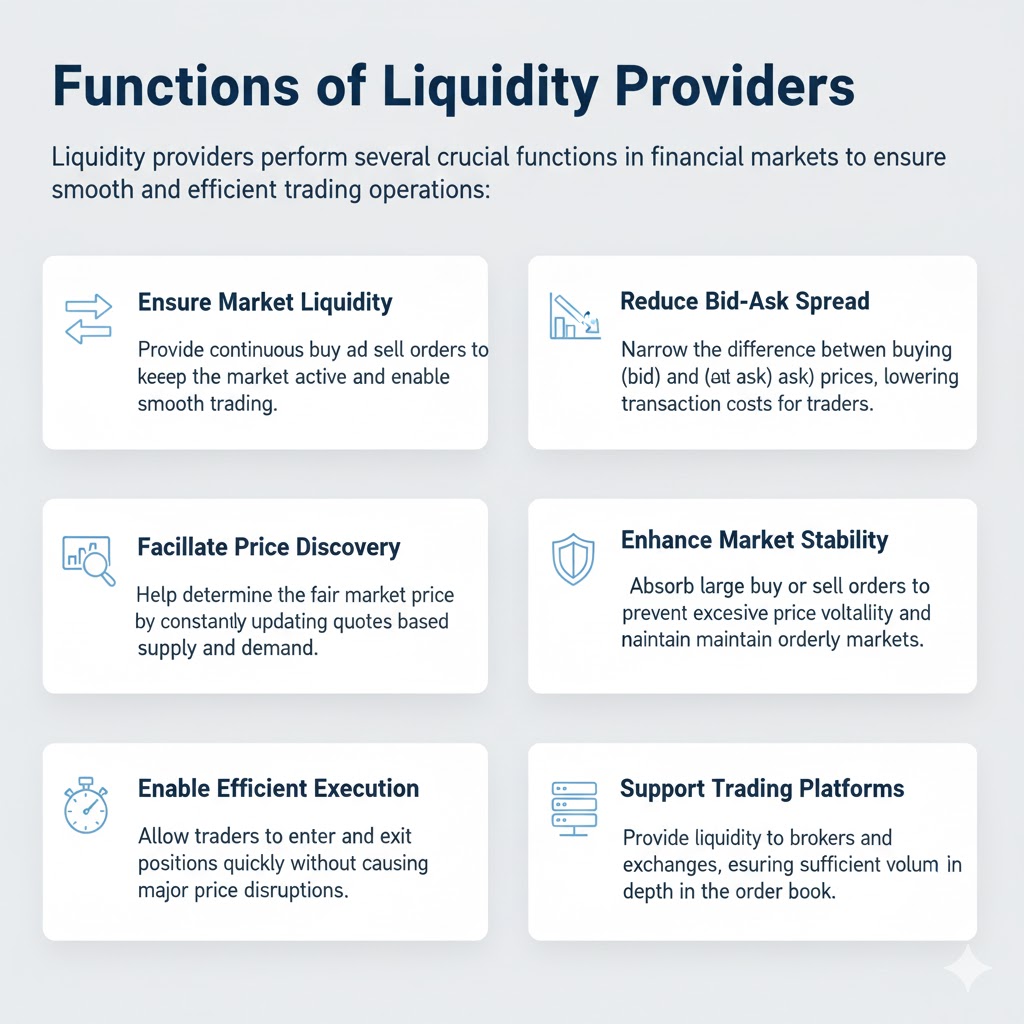
    Liquidity Providers are entities or institutions that supply the market with liquidity, meaning they make it easier to buy or sell assets without causing significant price changes. They ensure there’s enough volume of assets available so trades can happen smoothly and quickly.
    More details:

    • In financial markets (like stocks, forex, or cryptocurrencies), liquidity providers often include banks, market makers, or large financial firms.
    • They place buy and sell orders on exchanges or trading platforms to maintain active markets.
    • By doing so, they reduce the bid-ask spread, which is the difference between the buying price and selling price, making trading more efficient and less costly.
    • For example, in forex trading, liquidity providers are usually big banks or financial institutions that offer currency prices to brokers and traders.

    Financial companies without liquidity providers become scammers by using large price fluctuations to cause clients to incur losses.

  • The Role of the Central Bank

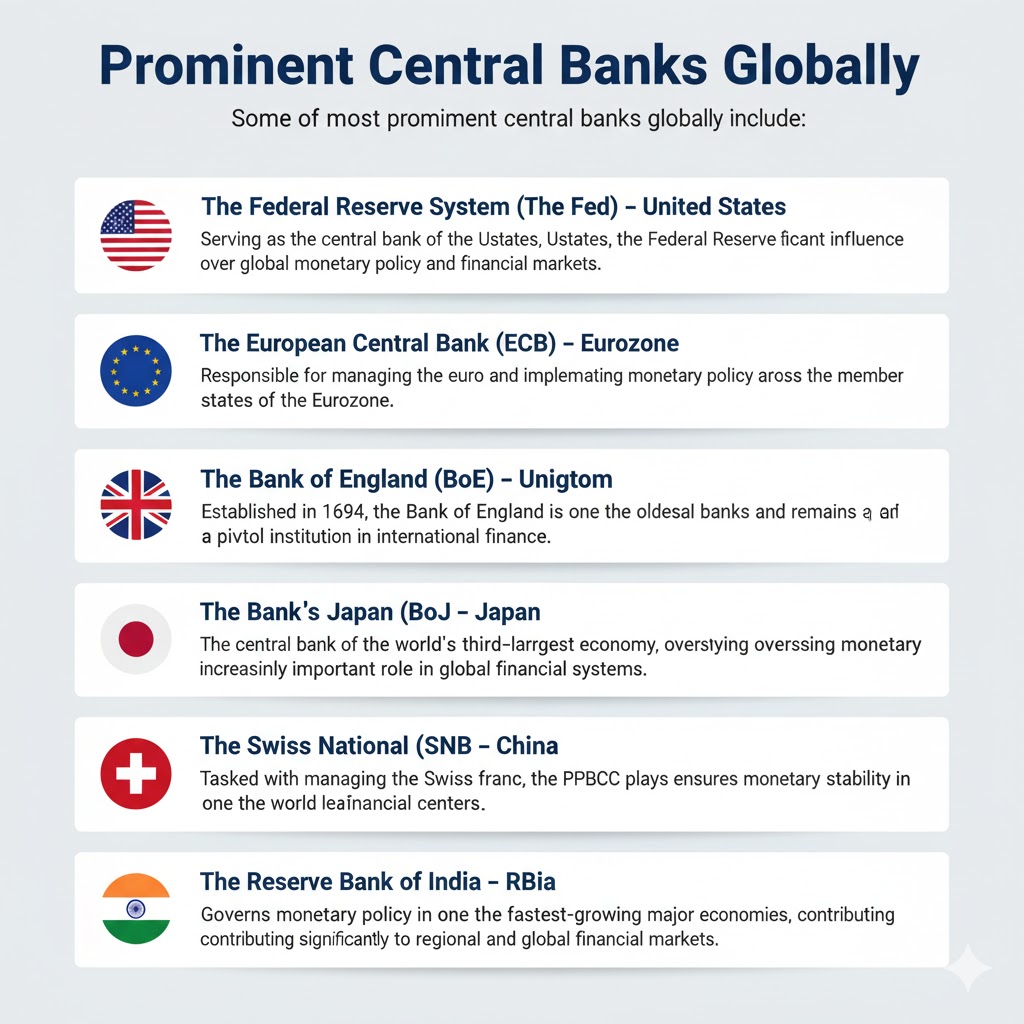
    The Central Bank plays a critical role in a country’s financial and economic system. It is the main authority responsible for regulating and supervising the banking sector, implementing monetary policy, and maintaining financial stability. The Central Bank controls the money supply and interest rates to achieve economic goals such as controlling inflation, supporting employment, and fostering sustainable economic growth. Additionally, it acts as a lender of last resort to financial institutions in times of crisis, manages the country’s foreign reserves, and oversees the issuance of the national currency. Through these functions, the Central Bank helps ensure confidence in the financial system and promotes the overall health of the economy.
    Main Functions of the Central Bank

    1. Monetary Policy Implementation
      Regulates money supply and interest rates to control inflation, stabilize exchange rates, and promote economic growth.
    2. Currency Issuance
      Sole authority to issue and manage the national currency in circulation.
    3. Lender of Last Resort
      Provides emergency liquidity support to financial institutions facing difficulties to maintain system stability.
    4. Bank Regulation and Supervision
      Ensures the safe and sound operation of commercial banks and financial organizations.
    5. Maintaining Financial Stability
      Prevents and manages systemic risks to protect the stability of financial markets.
    6. Foreign Exchange Reserve Management
      Holds and manages foreign currency reserves and intervenes in the forex market when necessary.
    7. Government’s Banker
      Manages government financial transactions, public debt issuance, and administration.
    8. Credit Control
      Coordinates credit volume and capital costs to foster balanced economic development.
  • Financial Services License

    A Financial Services License is a certification issued by the financial regulatory authority that allows an organization or individual to legally provide financial services such as investment advice, securities brokerage, fund management, insurance, lending, and other related financial services.

    In each country, this license is issued by the corresponding financial regulator, for example:
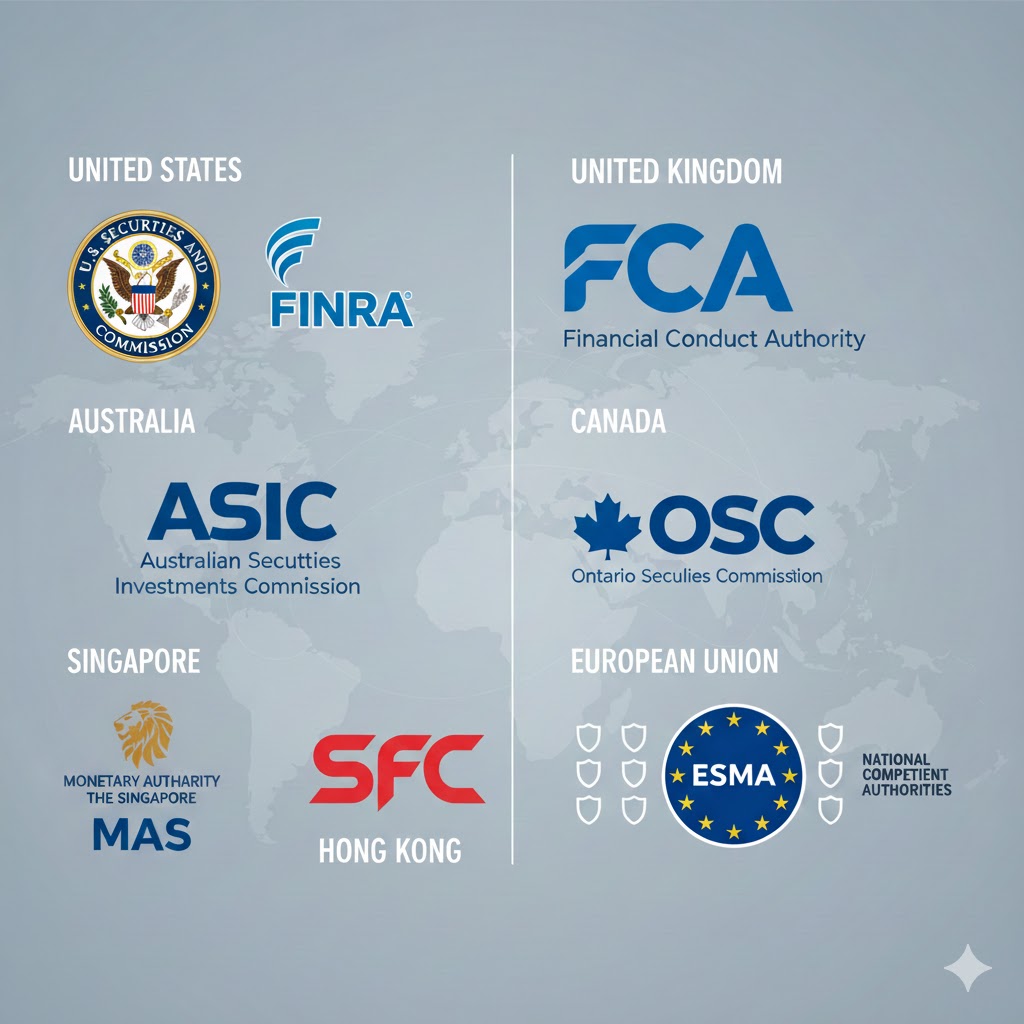
    • United States: Securities and Exchange Commission (SEC) or the Financial Industry Regulatory Authority (FINRA)
    • United Kingdom: Financial Conduct Authority (FCA)
    • Australia: Australian Securities and Investments Commission (ASIC)
    • Canada: Canadian Securities Administrators (CSA) and provincial regulators such as the Ontario Securities Commission (OSC)
    • Singapore: Monetary Authority of Singapore (MAS)
    • Hong Kong: Securities and Futures Commission (SFC)
    • European Union: National competent authorities in each member state, coordinated under the European Securities and Markets Authority (ESMA)

    Scope of Activities

    The license clearly defines the scope of permitted services, such as investment advice, securities brokerage, fund management, insurance, consumer lending, financial payment services, etc.

    Requirements for Licensing

    • Complete legal documents (business registration, establishment certificates, etc.)
    • Financial capacity and qualified professional personnel as required
    • Risk management policies, compliance with laws and anti-money laundering regulations
    • Internal procedures, reporting systems, and activity monitoring

    Compliance Responsibilities

    License holders must strictly comply with regulations, including:

    • Undergoing audits and inspections when required
    • Periodic reporting of financial activities
    • Compliance with risk management and customer protection regulations

    Therefore, any enterprise that conducts marketing activities to attract customers without being granted a financial services license is undoubtedly operating as a fraudulent entity.

  • An Overview of Financial Markets

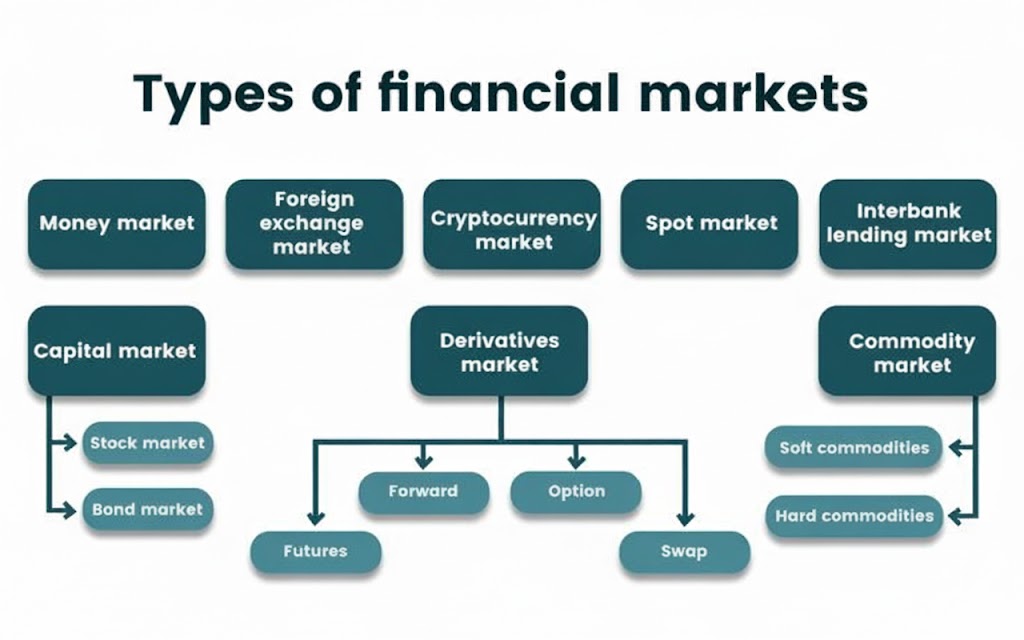
    Financial markets play a crucial role in the global economy by facilitating the efficient allocation of resources and capital. These markets provide a platform where buyers and sellers can trade financial instruments such as stocks, bonds, currencies, and derivatives. By enabling the transfer of funds from savers to borrowers, financial markets support business growth, innovation, and economic development. Additionally, they offer investors opportunities to diversify their portfolios and manage risks.

    The main types of financial markets include the stock market, bond market, crypto market, money market, and foreign exchange market, each serving distinct functions but collectively contributing to market liquidity and price discovery. Understanding the dynamics of financial markets is essential for investors, policymakers, and businesses to make informed decisions and sustain economic stability.
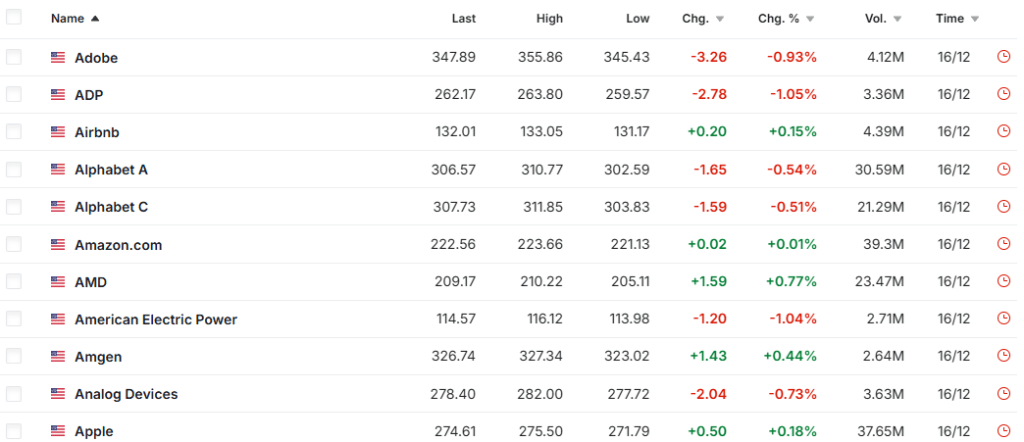
    Stock Market

    The stock market is a vital component of the financial system where shares of publicly traded companies are bought and sold. It serves as a marketplace that connects companies seeking capital with investors looking for potential returns. By issuing stocks, companies can raise funds to expand their operations, invest in new projects, or pay off debt. For investors, the stock market offers an opportunity to own a portion of a company and potentially benefit from its growth through price appreciation and dividends. The stock market also plays a key role in reflecting the overall health of an economy, as stock prices often react to economic indicators, corporate performance, and global events. Major stock exchanges like the New York Stock Exchange (NYSE) and Nasdaq provide structured environments that ensure transparency, liquidity, and regulatory oversight to protect investors.
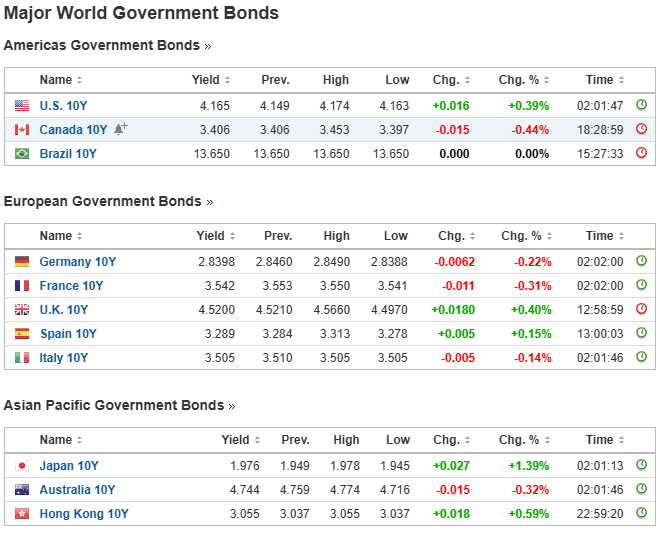
    Bond Market

    The bond market, also known as the debt market or fixed-income market, is where investors buy and sell bonds—essentially loans made to governments, corporations, or other entities. When an organization issues a bond, it borrows money from investors and agrees to pay back the principal amount on a specific maturity date, along with periodic interest payments called coupons. The bond market plays a critical role in financing large projects, government spending, and corporate growth by providing a stable source of long-term funding. For investors, bonds are generally considered lower-risk investments compared to stocks, offering steady income and portfolio diversification. The bond market also helps influence interest rates and overall economic conditions, as central banks and policymakers monitor bond yields to guide monetary policy. Major participants in the bond market include governments, financial institutions, pension funds, and individual investors.
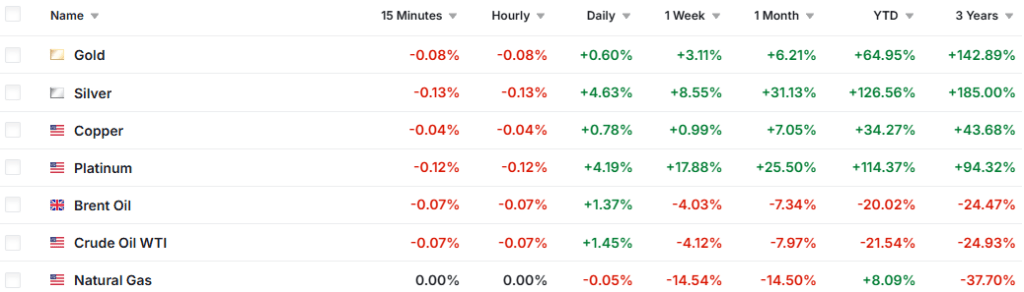
    Commodity Market

    The commodities market is a marketplace where raw materials and primary agricultural products are bought, sold, and traded. These commodities include physical goods such as oil, gold, natural gas, coffee, wheat, and metals. The market plays a vital role in the global economy by allowing producers, consumers, and investors to manage price risks through contracts like futures and options. Commodities markets help stabilize prices by providing transparency and liquidity, enabling participants to hedge against fluctuations caused by factors such as weather, geopolitical events, and supply-demand imbalances. There are two main types of commodities markets: the spot market, where goods are traded for immediate delivery, and the derivatives market, where contracts for future delivery are exchanged. Investing in commodities can provide portfolio diversification and serve as a hedge against inflation, attracting both individual and institutional investors worldwide.
    Currency Market (Foreign Exchange – Forex)

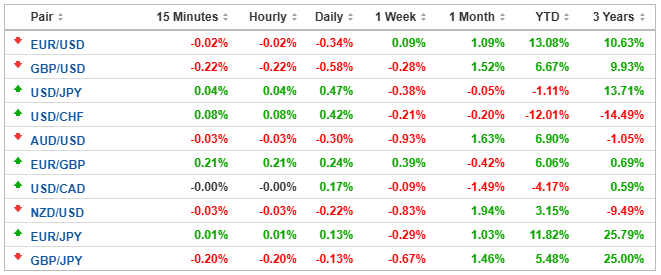
    The currencies market, commonly known as the foreign exchange market or Forex, is the largest and most liquid financial market in the world. It involves the buying and selling of different currencies, allowing businesses, governments, investors, and traders to convert one currency into another. Forex operates 24 hours a day, five days a week, across global financial centers, making it highly accessible. The market plays a critical role in facilitating international trade and investment by enabling currency conversion and helping manage exchange rate risks. Currency prices fluctuate constantly due to factors like economic indicators, interest rates, geopolitical events, and market sentiment. Traders in the Forex market range from large banks and multinational corporations to individual investors, all seeking to profit from currency movements or hedge against currency risks. Because of its high liquidity and volatility, the Forex market offers significant opportunities but also carries considerable risk.
    Cryptocurrecy Market

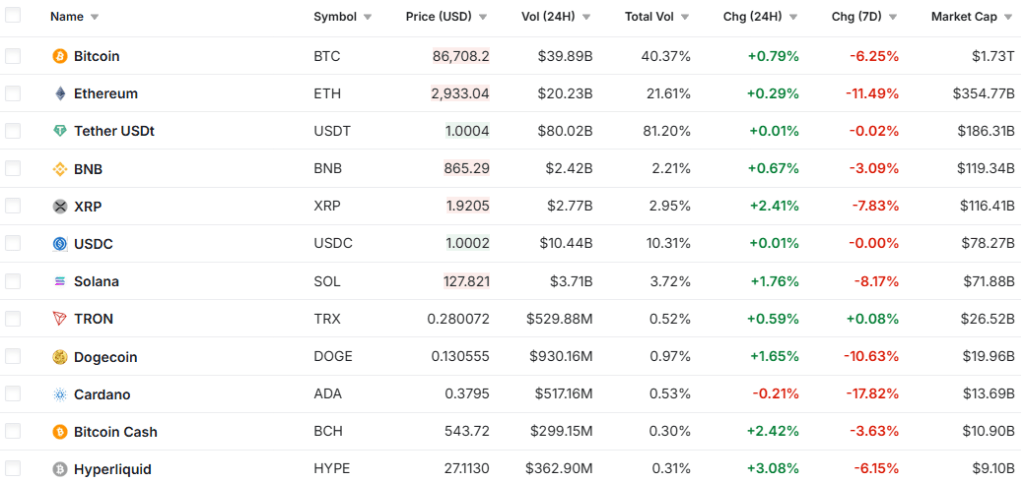
    The cryptocurrency market is a relatively new and rapidly evolving segment of the financial world where digital currencies like Bitcoin, Ethereum, and many others are traded. Unlike traditional currencies issued by governments, cryptocurrencies operate on decentralized blockchain technology, which ensures transparency, security, and immutability of transactions. The market enables investors and traders to buy, sell, and exchange cryptocurrencies on various online platforms called exchanges. It has gained popularity due to its potential for high returns, innovation in financial technology, and the growing adoption of blockchain applications. However, the cryptocurrency market is known for its high volatility and regulatory uncertainty, which can lead to significant risks for participants. Despite these challenges, it continues to attract interest from retail investors, institutional players, and developers aiming to reshape the future of finance and digital assets.
    The Participants of The Financial Markets

    A wide range of participants join financial markets, each with different goals and roles:
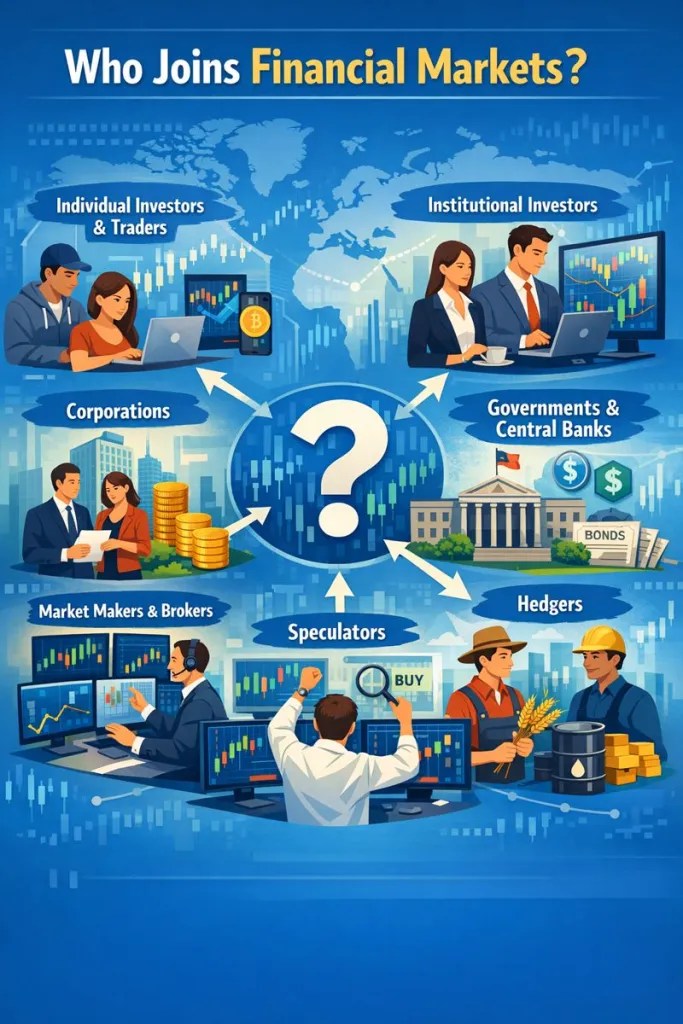
    More information about these participants.
    1. Individual Investors and Traders
      These are everyday people who buy and sell assets like stocks, bonds, currencies, or cryptocurrencies to grow their wealth, save for retirement, or speculate on price movements.
    2. Institutional Investors
      Large organizations such as mutual funds, pension funds, insurance companies, and hedge funds. They invest significant amounts of capital to achieve long-term growth, manage risk, or generate income for their clients or beneficiaries.
    3. Corporations
      Companies participate in financial markets to raise capital (by issuing stocks or bonds), hedge against risks (such as currency or commodity price changes), or invest surplus cash.
    4. Governments and Central Banks
      Governments issue bonds to finance public spending, while central banks intervene in currency markets to stabilize exchange rates and implement monetary policy.
    5. Market Makers and Brokers
      Market makers provide liquidity by continuously buying and selling assets, ensuring smoother trading. Brokers act as intermediaries, executing trades on behalf of clients.
    6. Speculators
      Traders who seek to profit from short-term price fluctuations by taking on higher risks.
    7. Hedgers
      Participants like farmers, manufacturers, or importers who use markets (especially commodities or Forex) to protect themselves from unfavorable price changes.

    Each participant contributes to market liquidity, price discovery, and overall market efficiency.