Tag: economics

  • Strong Growth Forecasts Overlook a Lingering Confidence Red Flag

    Recent U.S. growth data have pointed to notable economic resilience — but consumer sentiment tells a more cautious story.

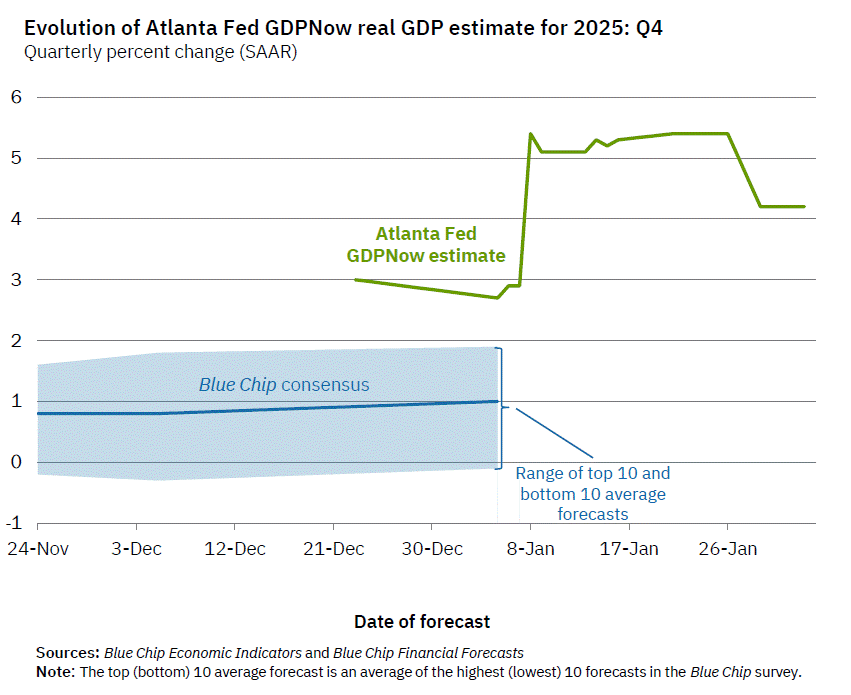
    According to the Federal Reserve Bank of Atlanta, real Gross Domestic Product is projected to have expanded at an annualized pace of 4.2% in the fourth quarter of 2025. That figure exceeded expectations and represents one of the strongest quarterly performances in the past two years.

    The expansion was supported by steady consumer spending, firmer exports, and higher government expenditures. Household consumption climbed 3.5%, its fastest rate of increase this year. On the surface, these numbers portray a macroeconomy that remains firmly in growth mode.
    Gross Domestic Product (GDP) represents the total value of goods and services produced within the United States. Of that total, personal consumption expenditures (PCE) account for roughly 68%. Put simply, the consumer is the backbone of the U.S. economy — as household spending goes, so too goes overall economic growth.
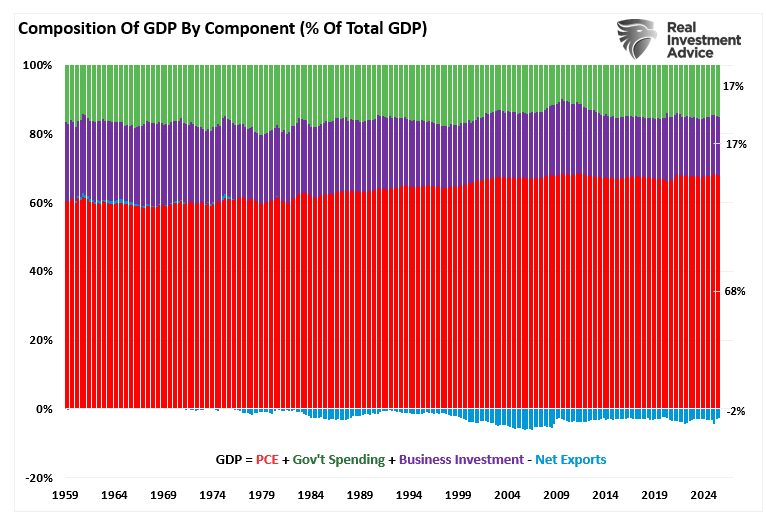
    When GDP rises, it reflects an increase in overall economic activity — stronger consumer demand that supports higher production and broader expansion. For that reason, growth rates are closely watched by policymakers, investors, and corporate leaders. Strong GDP figures are often interpreted as a signal of improving sales prospects and profit potential.

    However, GDP does not tell the whole story of household financial well-being.

    By design, economic growth data measure aggregate output. They do not reveal how income is distributed, how conditions vary across regions, or how millions of families actually experience the economy. A clear illustration is the breakdown of consumer spending by income level. At present, roughly half of all U.S. consumer spending is driven by the top 10% of earners — a share that has been increasing — while the spending contribution from the bottom 90% has been declining.

    In other words, headline growth can appear solid even as the underlying breadth of participation narrows.
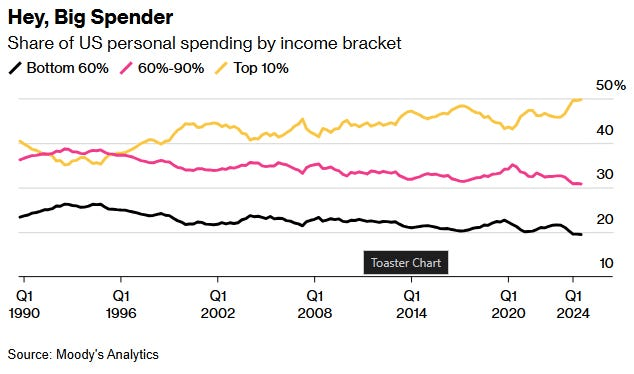
    In short, strong headline growth can conceal areas of financial strain among households and small businesses. Expansion driven primarily by exports or government spending may not meaningfully filter through to broad segments of workers, creating a disconnect between aggregate output and lived experience.

    A clear example of this distortion appeared in 2025. In the first quarter, a surge in imports aimed at front-running tariffs weighed heavily on GDP. When those trade fears subsided in the second quarter, import flows normalized, producing a sharp rebound in growth. Yet these swings in trade data had limited direct impact on most consumers. The volatility was largely statistical rather than reflective of a dramatic shift in household conditions.

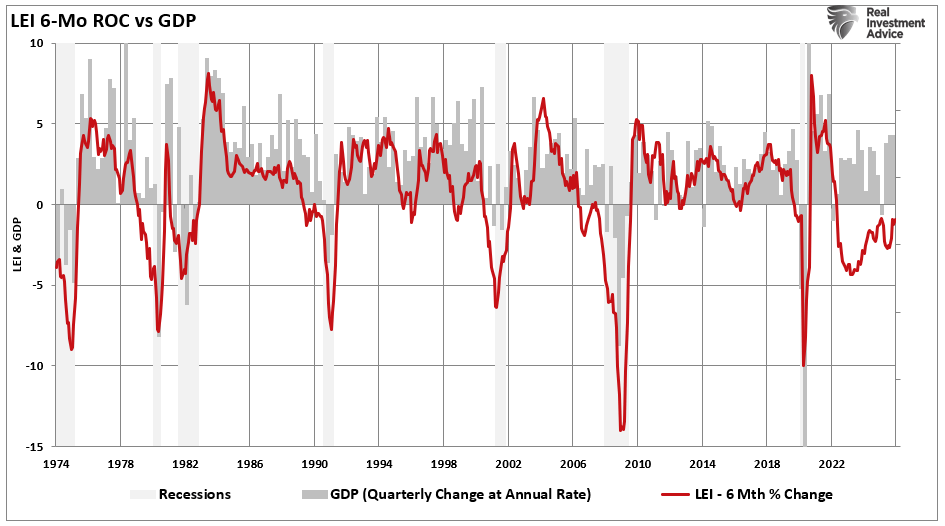
    While GDP figures suggest a sturdy economic backdrop, other coincident and leading indicators tell a more cautious story. The The Conference Board Leading Economic Index (LEI), which historically leads the U.S. economy by roughly six months, has remained in contraction for an extended period. Its six-month rate of change has long been regarded as one of the more reliable signals of impending slowdowns or recessions.

    Notably, however, despite the prolonged weakness in the LEI, the broader economy has not formally entered recession — underscoring the growing divergence between traditional warning signals and realized economic outcomes.
    At first glance, headline growth data suggest the economy remains on firm footing. Output is expanding, spending is holding up, and aggregate indicators point to continued resilience.

    But a closer examination reveals a more nuanced picture. Beneath the surface, several crosscurrents — from uneven income distribution and trade-related distortions to persistent weakness in leading indicators — point to a mixed underlying environment.

    That divergence helps explain why economic sentiment can feel far weaker than the headline numbers imply. Strong aggregate growth does not automatically translate into broad-based confidence, particularly if gains are concentrated or forward-looking indicators continue to flash caution.

    The Gap Between Rising Stocks and Weak Consumer Sentiment

    Historically, it makes sense that stock markets and economic data would trend in the same direction over the long run. Corporate earnings ultimately derive from economic activity, and sustained growth in output and income should support higher equity valuations over time.

    As discussed in “Return Expectations Are Too High,” long-term market returns are anchored to the growth of the underlying economy, productivity gains, and profit expansion — not simply short-term momentum or sentiment-driven rallies.

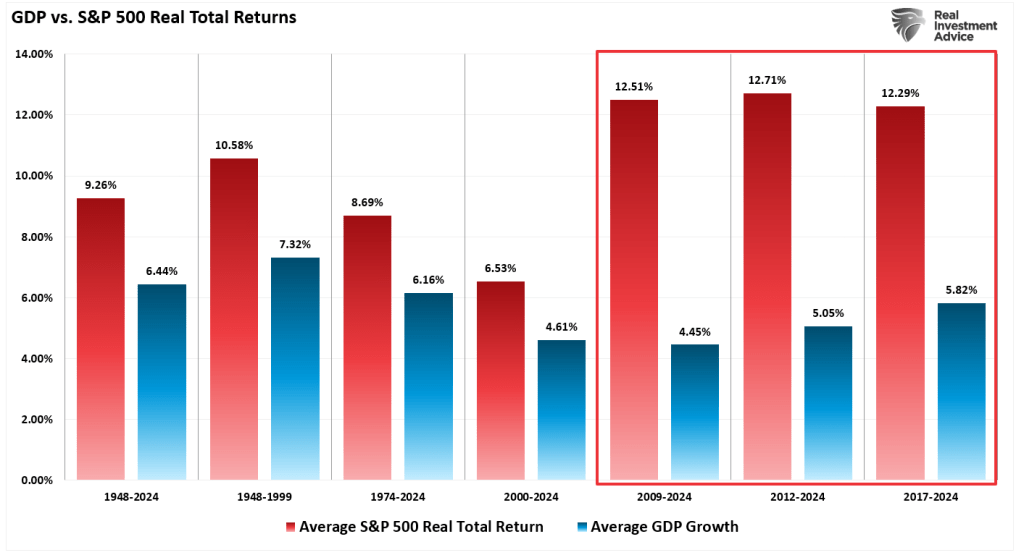
    “The chart illustrates average annual inflation-adjusted total returns (including dividends) dating back to 1948, using total-return data compiled by Aswath Damodaran at the NYU Stern School of Business. From 1948 through 2024, the stock market delivered an average real return of 9.26%.

    However, in the years following the 2008 financial crisis, inflation-adjusted total returns increased by nearly three percentage points across the last three measured periods.

    Here’s the challenge: real (inflation-adjusted) equity returns are relatively straightforward to conceptualize. Over time, they reflect economic growth (GDP) plus dividend income, minus inflation. That relationship broadly held from 1948 to 2000.

    Since 2008, though, the math has diverged. Nominal GDP growth has averaged roughly 5%, and dividend yields have hovered near 2%. Yet actual market returns have significantly exceeded what that underlying economic engine would normally justify in terms of sustainable earnings expansion.”
    That 15-year divergence is not particularly surprising. As discussed in “Pavlov Rings the Bell,” markets have repeatedly been cushioned from deeper corrections by aggressive fiscal and monetary intervention.

    Over the past decade and a half, major drawdowns were often met with policy stimulus — whether through deficit spending or actions by the Federal Reserve. Each episode of support was followed by market recovery, reinforcing a powerful feedback loop: intervention became associated with rising asset prices.

    In effect, investors were conditioned to expect rescue during periods of stress — to buy every dip under the assumption that policymakers would step in. That conditioning ties directly to the concept of “moral hazard.”

    Moral hazard (noun, economics): A reduced incentive to guard against risk when one is shielded from its consequences — as with insurance protection.

    Following the Global Financial Crisis, near-zero interest rates and repeated rounds of quantitative easing strengthened the belief that a policy backstop would reappear whenever volatility increased. Over time, that expectation hardened into a reflexive behavior: assume support, assume recovery, assume higher prices.

    Those sustained supports — in both the real economy and financial markets — helped drive a wedge between underlying economic fundamentals and realized financial returns. In other words, policy intervention became a key force behind the growing disconnect between economic reality and asset-price performance.
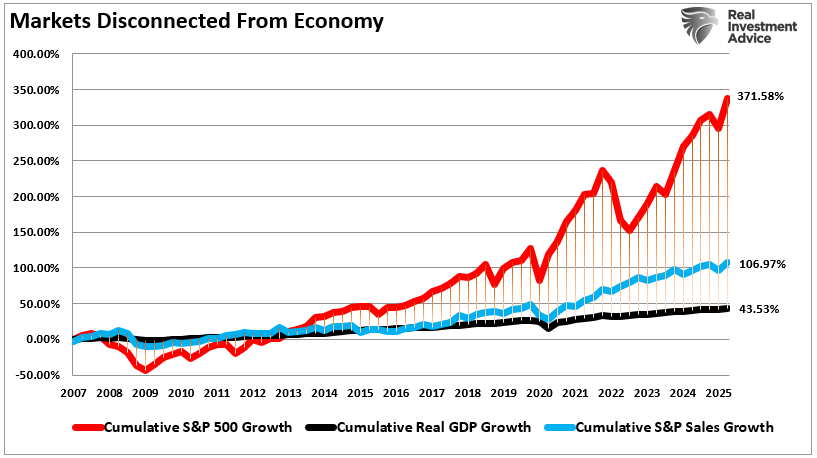
    At present, GDP growth has continued to surprise to the upside, and several macro indicators reflect ongoing resilience. At the same time, major equity benchmarks such as the S&P 500 have climbed to record levels. That advance has been fueled less by current consumer sentiment and more by expectations of future earnings growth.

    The challenge, however, is that equity valuations appear increasingly disconnected from underlying revenue growth. Markets are pricing in optimism about future expansion, even as broad-based income and demand trends remain uneven.

    There is also a structural limitation embedded in the “wealth effect.” Rising stock prices can support consumption by boosting household net worth. Yet equity ownership in the United States is highly concentrated. Roughly 87% of equities are owned by the top 10% of households. As a result, the transmission from higher stock prices to broader economic activity is narrower than headline gains might suggest.

    That concentration is reflected in spending patterns as well. The top 40% of income earners now account for approximately 80% of total consumption. Consequently, while financial asset values have surged, the macroeconomic lift from those gains is disproportionately tied to higher-income households — leaving sentiment among the broader population more subdued than market performance alone would imply.
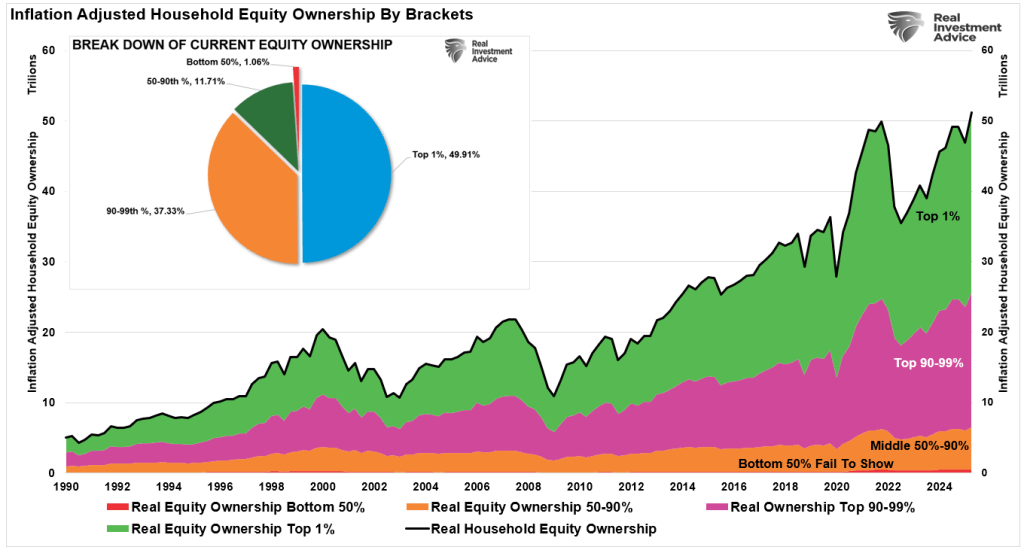
    That divergence goes a long way toward explaining the disconnect between subdued consumer sentiment and robust headline economic data.

    When growth and market gains are concentrated among higher-income households — and asset-price appreciation primarily benefits those with significant equity exposure — aggregate statistics can remain strong even as large segments of the population feel financial strain.

    In other words, the macro numbers reflect the strength of those driving the bulk of spending and asset ownership, while sentiment surveys capture the broader lived experience. The result is an economy that looks resilient on paper but feels far less secure to many households.

    Consumer Confidence Surveys Remain Soft Even as Economic Data Stays Strong

    In clear contrast to upbeat macroeconomic indicators and strong equity market gains, consumer sentiment readings have deteriorated significantly. Both the Conference Board Consumer Confidence Index and the University of Michigan Surveys have fallen steeply over the past two years, even as stock prices have climbed. Historically, consumer sentiment tends to move in tandem with rising markets, which is intuitive. The chart below presents a composite measure combining these two leading sentiment indicators.
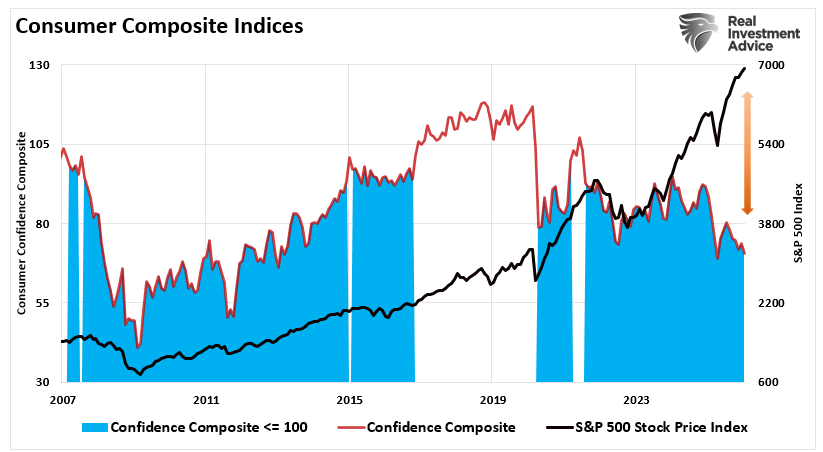
    In both surveys, readings on current conditions and future outlook remain notably subdued, with the expectations component dropping to levels that have historically been linked to recession warnings.
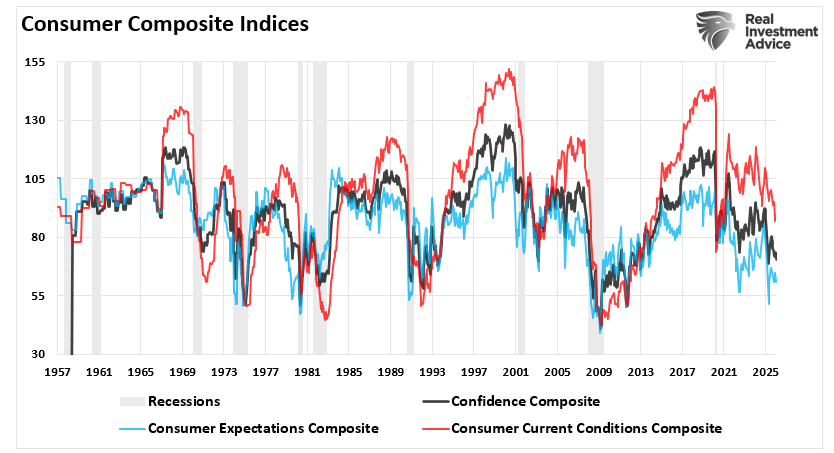
    The downturn in sentiment points to rising concerns over employment prospects, business conditions, and future income. Respondents frequently highlighted worries about inflation, elevated prices, food and energy expenses, the affordability of health insurance, and broader geopolitical and political uncertainty. Yet despite this widespread unease, GDP has continued to grow.

    Importantly, the gap between soft sentiment data and hard economic figures is not unprecedented. Analysts have often observed that consumer attitudes tend to lag underlying economic performance, and sentiment could improve if expansion persists. In the near term, surveys typically capture prevailing fears and uncertainty, which can weigh on confidence even when actual spending remains relatively solid. Although nominal figures indicate that consumer spending is holding up, much of that resilience reflects paying higher prices for the same—or even fewer—goods, rather than an increase in real consumption, which helps explain the sustained weakness in sentiment readings.
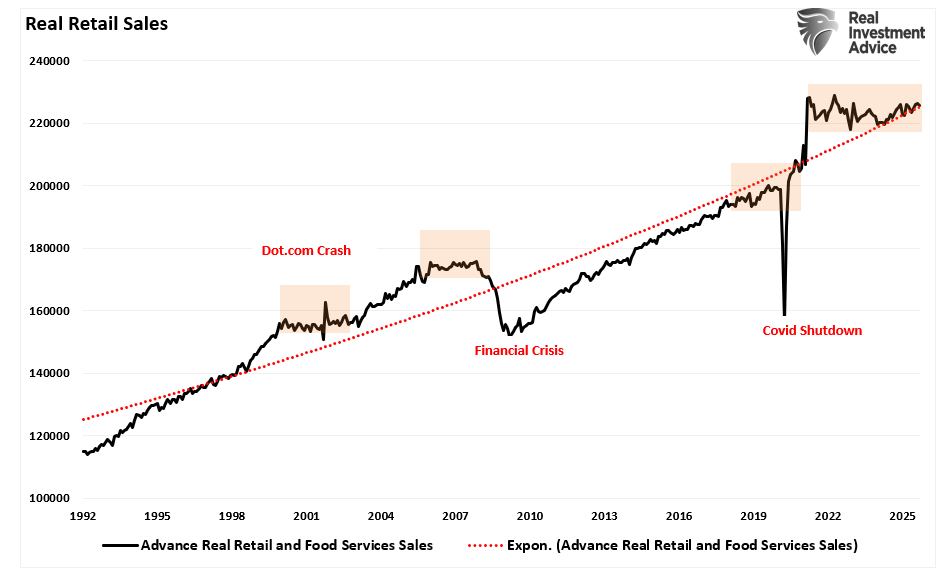
    Importantly, if consumer sentiment influences spending—and consumption accounts for roughly 68% of the economy—then that spending ultimately represents demand for businesses of all sizes. In a genuinely strong growth environment, we would expect improving demand to be mirrored by rising confidence across households. Yet, as the composite index illustrates, sentiment levels remain subdued. The historical relationship between confidence measures and the future trajectory of economic activity underscores why this divergence warrants attention.
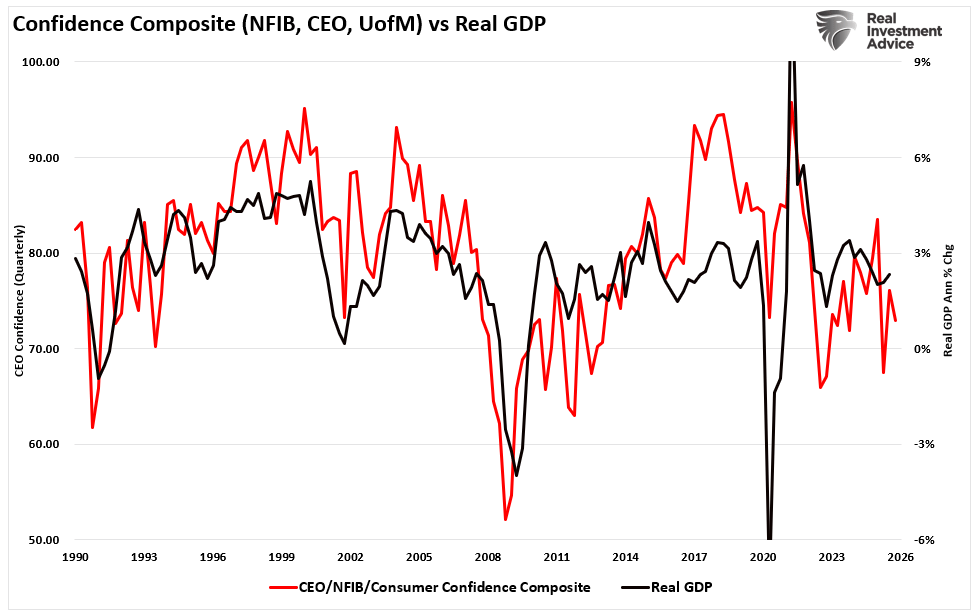
    Soft sentiment readings do not necessarily signal an imminent downturn. However, they do reflect a guarded mindset among both consumers and business owners. That caution can translate into more restrained spending across key components of GDP. If confidence remains depressed, a moderation in economic activity would be a reasonable outcome.

    Why the Divergence Matters and What It May Signal Ahead

    The gap between solid economic data, rising equity markets, and subdued consumer confidence carries meaningful implications. On the surface, macro indicators point to continued expansion, reinforcing higher stock prices and optimistic earnings forecasts. Yet beneath that strength, households and many business owners report lingering insecurity and pessimism about the future.

    This disconnect prompts several key questions:

    • Can growth remain durable if confidence stays depressed?
    • Will corporate earnings hold up if consumers begin to retrench?
    • Could persistent pessimism eventually shape real-world behavior, leading to slower spending and softer growth?

    History offers cautionary precedents where negative sentiment foreshadowed downturns—not because the hard data was inaccurate, but because sentiment ultimately influenced economic decisions.

    The divergence also highlights distributional dynamics. Aggregate growth figures often mask disparities in income and wealth. Higher-income households account for roughly half of total consumption, while lower-income groups may not fully share in the benefits of expansion. That imbalance helps explain weaker sentiment readings. It also leaves markets vulnerable to any shock that prompts affluent consumers to scale back spending—particularly in an environment where the gap between economic “haves” and “have-nots” remains wide.

    Investment Implications

    For investors, this mixed backdrop argues for disciplined risk management. Markets may continue advancing on elevated earnings expectations, but those expectations can shift quickly as economic conditions evolve.

    • Scrutinize valuations. Rising indices do not preclude overpricing. Favor firms with strong balance sheets, reliable cash flows, and pricing power.
    • Diversify thoughtfully. Sector performance can diverge sharply. Defensive areas such as utilities, consumer staples, and healthcare often prove more resilient during sentiment-driven slowdowns.
    • Track leading indicators. Watch employment trends, consumer credit conditions, and forward-looking economic indices. Weak confidence can precede softer activity.
    • Maintain liquidity. Holding cash provides flexibility amid volatility created by divergence.
    • Consider hedging strategies. Exposure to bonds or volatility-linked instruments may help cushion downside risks.
    • Emphasize quality. Companies with durable competitive advantages are typically better positioned to navigate uncertainty.

    The split between hard data, market performance, and consumer mood represents a meaningful economic signal. While there are persuasive arguments that markets can continue climbing and that pullbacks should be bought, prudence requires acknowledging alternative outcomes.

    To borrow a well-known observation from Bob Farrell:

    Historically, when “all experts agree,” discipline and preparation for the unexpected have often proven wise.

    Sources: Lance Roberts
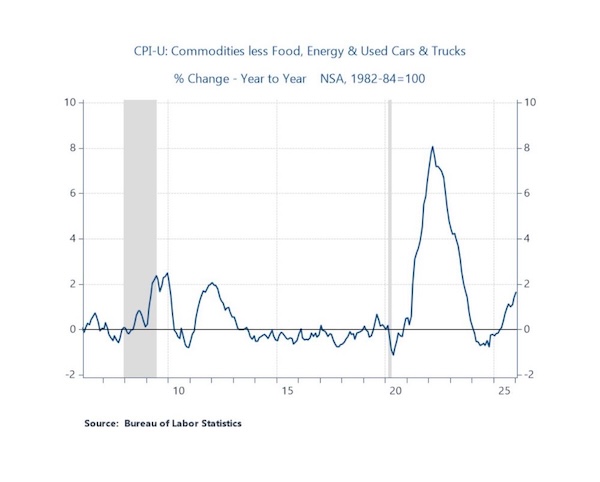
  • Core inflation (excluding shelter) edges higher, signaling that tariff-related risks still persist.

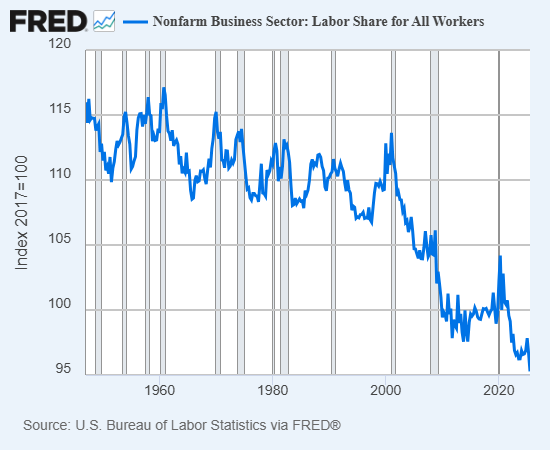
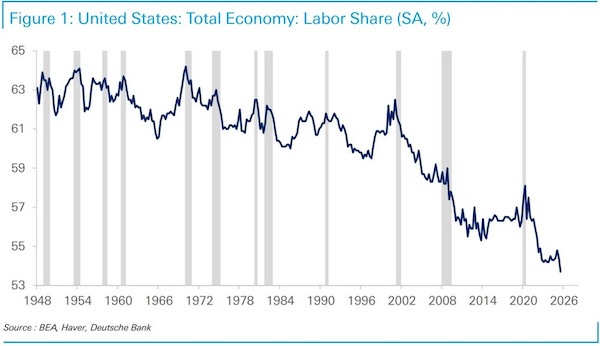
    One of the most significant macroeconomic trends of recent decades has been the sharp decline in labor’s share of income. As David Hay notes, the rise of populism in the US mirrors the long expansion in corporate profit margins — essentially the flip side of a prolonged downturn in labor’s share.

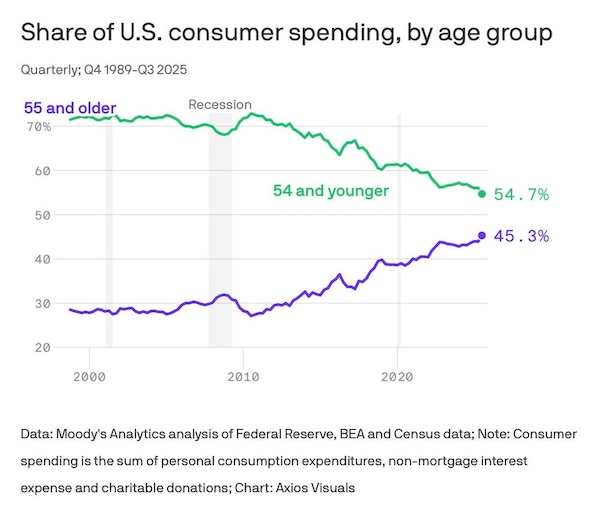
    This shift was largely driven by favorable demographics and accelerating globalization. However, both forces now appear to be reversing. On the demographic front, Axios recently highlighted that older Americans are increasingly powering economic growth — a “gray-shaped” dynamic rather than the previously discussed K-shaped recovery.

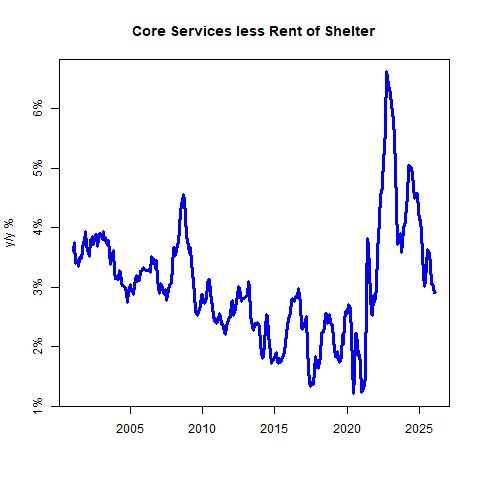
    Meanwhile, the inflationary cost of deglobalization may only be beginning to surface. According to Brean Capital, core CPI excluding used vehicles and shelter has ticked higher, with the three-month annualized rate climbing to 2.9% from 1.1% in December. This suggests tariff-related pressures may still be lingering, complicating hopes for a smooth return to the Fed’s 2% inflation target.

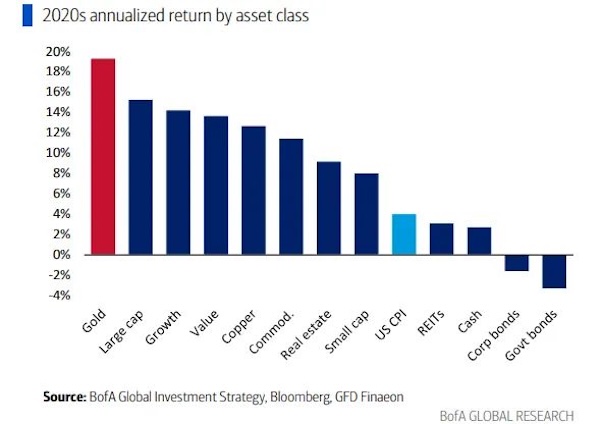
    Financial markets are already reacting to these evolving macro conditions. As Callum Thomas observes, gold has been the best-performing asset class of the 2020s so far, while bonds have lagged significantly — raising questions about how the rest of the decade will unfold.

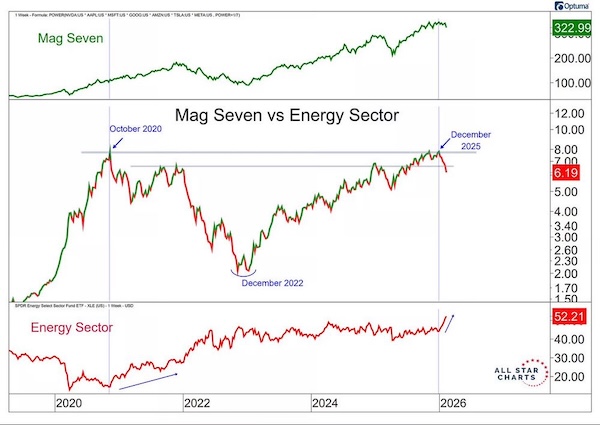
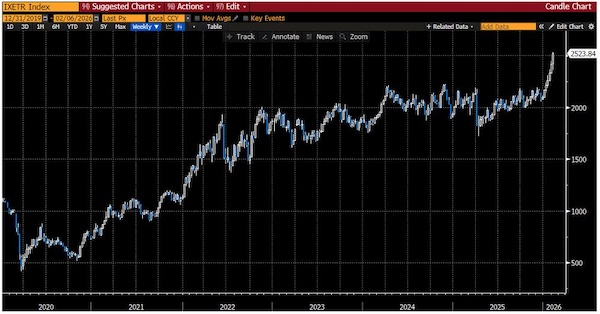
    Leadership within equities is also shifting. Research from Daily Chartbook indicates that the “Magnificent Seven” peaked relative to the energy sector in December 2025, matching the same relative level seen in October 2020 — just before the Energy Select Sector SPDR Fund embarked on a 250% rally over the following two years.

    So far this year, energy stands out as the stock market’s top-performing sector. According to Rob Thummel, the sector delivers what investors increasingly value: strong free cash flow, rising dividends, significant share buybacks, inflation hedging characteristics, and tangible asset exposure.

    Echoing this thematic rotation, Goldman Sachs suggests the market may be entering what one seasoned client calls the “revenge of the dinosaurs” phase — a resurgence of traditional, capital-intensive industries in an era marked by structural inflation pressures and shifting global dynamics.

    Sources: Jesse Felder

  • Why the January 2026 CPI Paints a Distorted Picture: How the Government Shutdown Skewed the Data

    A few months ago, a government shutdown led to a missed CPI release because the Bureau of Labor Statistics (BLS) lacked sufficient data to calculate the October 2025 figure. The bigger issue, however, was methodological: when compiling the November index, the BLS was effectively required to assume that prices in several major categories—especially rents—were unchanged in October. This created an artificial drop in year-over-year inflation.

    While some of that distortion has already begun to reverse, a more significant rebound is expected in a few months when the Owners’ Equivalent Rent (OER) survey rotation triggers a sharp offsetting increase—precisely six months after the initial dip. Until that adjustment plays out, inflation data will remain hard to interpret, and the annual comparisons will understate true price pressures. So claims that the latest report shows the smallest yearly increase in core inflation since 2021, suggesting the Federal Reserve is near its target, are misleading.

    In reality, core year-over-year inflation is roughly 0.25%–0.3% higher than reported. Markets for CPI fixings already anticipate headline inflation rising to about 2.82% in four months—not because of energy prices, but due to this statistical catch-up.

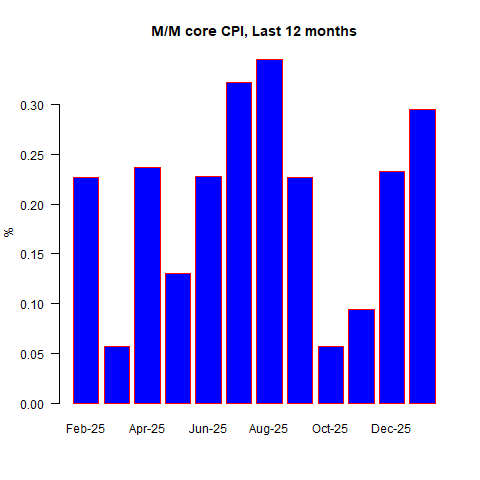
    January is typically a challenging month for inflation data anyway, as businesses often offer discounts in December before implementing annual price hikes in January. Because these adjustments are irregular, they are difficult to seasonally adjust, making January surprises common. This time, consensus forecasts called for a 0.27% month-over-month rise in headline CPI and 0.31% in core, with some estimates—such as from Barclays—as high as 0.39% for core. Much of the speculation centered on whether remaining tariff-related price increases would be passed through at the start of the year. Ultimately, they were not. The actual figures came in at +0.17% for headline and +0.30% for core.

    The weaker headline reading was largely due to gasoline pricing dynamics. Although gas prices increased over the course of January, the monthly average was still lower than December’s average, because prices had fallen sharply in December. Since the BLS calculates CPI based on average monthly prices rather than end-of-month levels, this produced a softer headline figure.

    Core inflation, meanwhile, appeared close to target at first glance: the 2.5% year-over-year rate is the lowest since March 2021. Yet the 0.30% monthly increase was the third-highest in the past year and translates to an annualized pace of 3.6%. That hardly signals a smooth return to 2% inflation—raising questions about whether it is truly “mission accomplished” for the Fed.

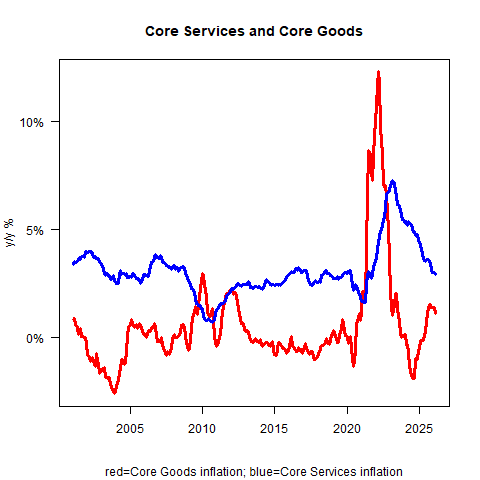
    Core inflation was also somewhat flattered by a sharp 1.84% month-over-month decline in used car prices. In reality, used car prices did rise in January, but by less than the typical seasonal pattern, which translated into a sizable seasonally adjusted drop and created a noticeable drag on the core figure. (That said, it’s important not to dismiss components simply because they don’t align with the broader narrative.) Overall, core goods inflation slowed to 1.1% year over year from 1.4%, while core services edged down to 2.9% from 3.0%.

    Although core goods inflation declined more than expected due to the sharp move in used cars, some moderation isn’t surprising. The real issue isn’t whether core goods will reaccelerate to 3–4%, but whether it remains in positive territory or slips back into the persistent deflation that characterized the sector for many years. That distinction matters, even if core goods make up only about 20% of the CPI basket. Until recently, the narrative centered on tariffs; going forward, it may shift toward onshoring. The decades-long trend of goods deflation—driven by offshoring production to low-wage countries—may not reassert itself if manufacturing activity continues to migrate back. That’s the broader theme to monitor, though it’s not the main takeaway from January 2026’s data.

    On autos specifically, new car prices posted a modest increase. It’s worth considering how changes in sales composition might evolve now that electric vehicles are no longer being actively promoted by the executive branch. Traditional gasoline-powered cars tend to be cheaper upfront, so if buyers shift back toward them—absent tax incentives for EVs—the average transaction price could decline. However, it’s unclear how significantly overall sales patterns will change, or how production strategies will adjust now that automakers may feel less pressure to meet EV quotas. It’s also uncertain how granular the Bureau of Labor Statistics survey is in accounting for shifts in fleet composition. If there is any measurable impact on CPI, it would likely be slightly negative—and probably modest in size.

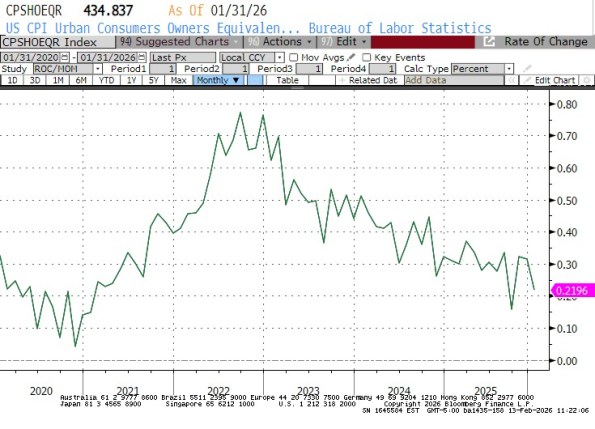
    As for rents, Owners’ Equivalent Rent (OER) rose 0.22% month over month, down from 0.31% previously, while Rent of Primary Residence increased 0.25%, slightly below last month’s 0.27%. The month-to-month trend in OER shows a clear deceleration—though notably, it omits the artificial zero recorded in October due to the earlier data disruption.

    While the slowdown is evident, my model suggests the pace should now be stabilizing around this level rather than continuing to decline sharply. In other words, rents are cooling, but likely nearing a plateau. That isn’t the defining story of January 2026—but it may well become one of the central inflation themes for the rest of 2026.

    Medicinal drug prices slipped 0.15% month over month. Some observers had anticipated a much larger decline, partly due to efforts by the Trump Administration to push manufacturers to align U.S. drug prices more closely with those abroad. So far, however, no clear downward trend is evident. A potentially more consequential development is the Trump RX initiative, aimed at increasing pricing transparency and reducing the role of intermediaries in the highly opaque pharmaceutical distribution chain—long dominated by three major wholesalers and three large pharmacy benefit managers.
    If successful, it could meaningfully reduce out-of-pocket drug costs for consumers. That said, when medications are paid for by insurers rather than directly by households, the impact does not show up straightforwardly in the CPI, appearing only indirectly—an accounting nuance that complicates interpretation. In short, consumer drug prices may decline, but the timing and visibility of that effect in CPI data remain uncertain.

    The most encouraging element of the report was the continued slowdown in core services excluding rents—often referred to as “supercore” inflation—which eased further even as airfares jumped 6.5% on the month.

    Gotcha. The apparent improvement in “supercore” inflation is another illusion created by the missing October data, which flatters the year-over-year comparison. On a month-over-month basis, core services ex-rents actually surged 0.59% (seasonally adjusted)—the largest increase in a year.

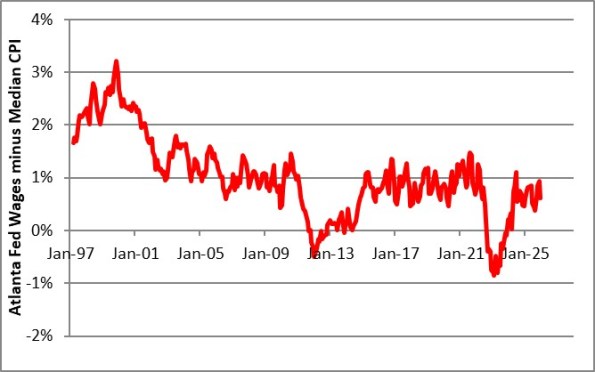
    Even so, the broader trend may still be one of gradual cooling, particularly as median wage growth continues to decelerate. Admittedly, that data is also somewhat noisy at the moment. Still, the gap between median wage growth and median inflation remains around 1%, suggesting real income growth is positive, even if inflation progress is bumpier than headline figures imply.

    There are tentative signs that wage growth’s downward drift may be stabilizing. If so, that would naturally limit how quickly supercore inflation can cool. At the same time, brewing cost pressures in insurance markets are likely to surface over the next six months. Still, none of that defines January 2026.

    The real story this month is that inflation data remain clouded by the government-shutdown gap. The missing October observations continue to flatter year-over-year comparisons, overstating the degree of progress. That statistical quirk makes it easier for the Administration to claim victory, even though underlying inflation does not appear to be cleanly converging back to target.

    Assuming the Federal Reserve recognizes these distortions, the policy outlook seems relatively straightforward. Core inflation—abstracting from the shutdown gap—appears to be running near 3.5%, labor market data have surprised to the upside, and the current Fed leadership has shown little inclination to accommodate political pressure. Under those conditions, there is scant reason to expect a near-term adjustment in overnight rates; if anything, the argument for tightening may be stronger than for easing.

    To be fair, rents continue to decelerate even after adjusting for the October distortion, though my model suggests that slowdown is unlikely to persist much further. Even if it does, a return to outright housing deflation seems improbable. Moderation in supercore inflation is encouraging, but probably insufficient to deliver the degree of cooling the Fed would require. Core goods inflation also looks to have peaked; the open question is whether it settles into low positive territory or slips back into deflation.

    Taken together, my modeling suggests that median inflation around 3.5% (excluding the shutdown effect) may represent something close to a new equilibrium. It’s not unreasonable to see constructive signals in the recent data, but neither do they justify expectations of imminent easing. If disinflation trends persist and leadership dynamics shift—potentially with someone like Kevin Warsh assuming the chair—the door to rate cuts later in the year could open.

    But that is not January 2026’s story.

    Sources: Michael Ashton

  • Week Ahead: Jobs and CPI Data May Reset March Fed Expectations

    As a polar vortex brings arctic conditions across the U.S., the economic calendar is set to heat up. The week ahead features two of the most consequential data releases for shaping Federal Reserve policy expectations: the January employment report and the Consumer Price Index (CPI).

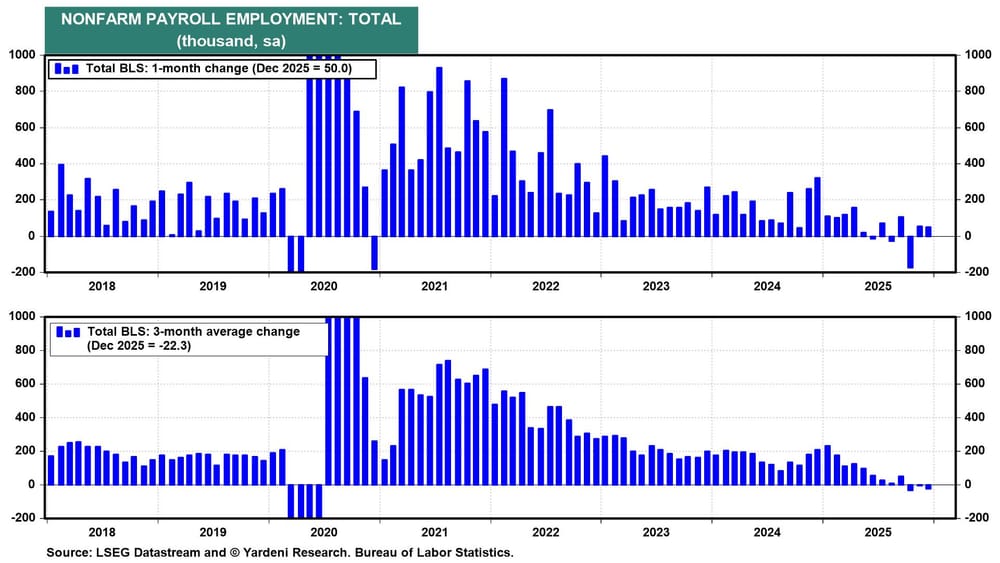
    Owing to recent government shutdowns, the January employment report (Wednesday) and CPI release (Friday) will be published unusually close together. The labor report is particularly significant, as January data typically incorporates annual revisions to employment figures, raising the possibility of notable downward adjustments for the year through March 2025.

    A key reference point will be the Federal Reserve’s own assessment of potential overstatement in jobs growth. In December, Fed Chair Jerome Powell noted that internal research suggested official figures may have overstated monthly job gains by as much as 60,000 since April. Given that reported job growth averaged just under 40,000 per month over that span, the scope of upcoming revisions could have meaningful implications for the FOMC’s March policy decision.

    The week also features remarks from several Fed officials, including Governors Christopher Waller (Monday), Stephen Miran (Monday and Thursday), and Michelle Bowman (Wednesday). Among voting Fed presidents this year, Cleveland Fed President Beth Hammack and Dallas Fed President Lorie Logan are both scheduled to speak on Tuesday.

    Markets will also be watching price action on Wall Street following last week’s record close for the Dow Jones Industrial Average above 50,000. The ongoing AI-led shakeout among major technology stocks bears close scrutiny, as does the renewed “old economy” rotation bringing previously sidelined sectors—such as oil and gas, chemicals, transportation, and regional banks—back into focus. Adding to the cross-currents is gold’s continued rally, occurring alongside a sharp pullback in bitcoin.

    The following data releases carry the greatest potential to move markets and shape the Federal Reserve’s assessment of whether further rate cuts are warranted:

    Employment

    We expect nonfarm payrolls to rise by 60,000 in January, following a 50,000 increase in December (see chart). Markets will be closely focused on the size and direction of revisions to prior data. A meaningful downside surprise could increase pressure on Chair Powell to consider a rate cut later this month, even though we do not believe monetary policy can directly address the underlying weaknesses in the labor market.

    CPI 

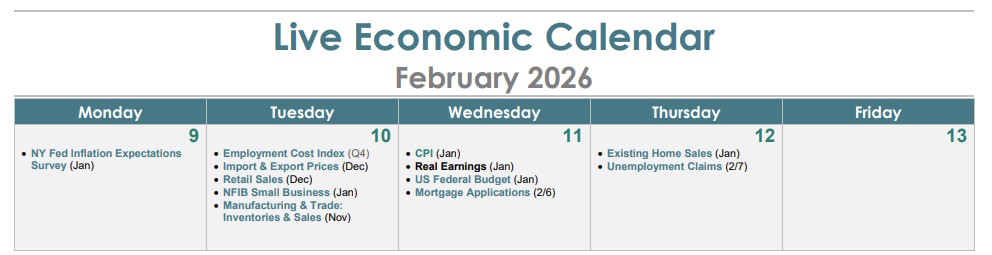
    Markets are seeking further confirmation that inflation continued to ease in January. December’s 2.6% year-over-year reading matched a four-year low in core CPI inflation (see chart). The Cleveland Fed’s Inflation Nowcasting model currently projects a 0.22% month-over-month increase in core inflation, translating to a 2.45% annual rate. Additional insight on inflation pressures will come from the Q4 2025 Employment Cost Index and December import and export prices, both due Tuesday, as well as the New York Fed’s January inflation expectations survey on Monday.

    Retail sales

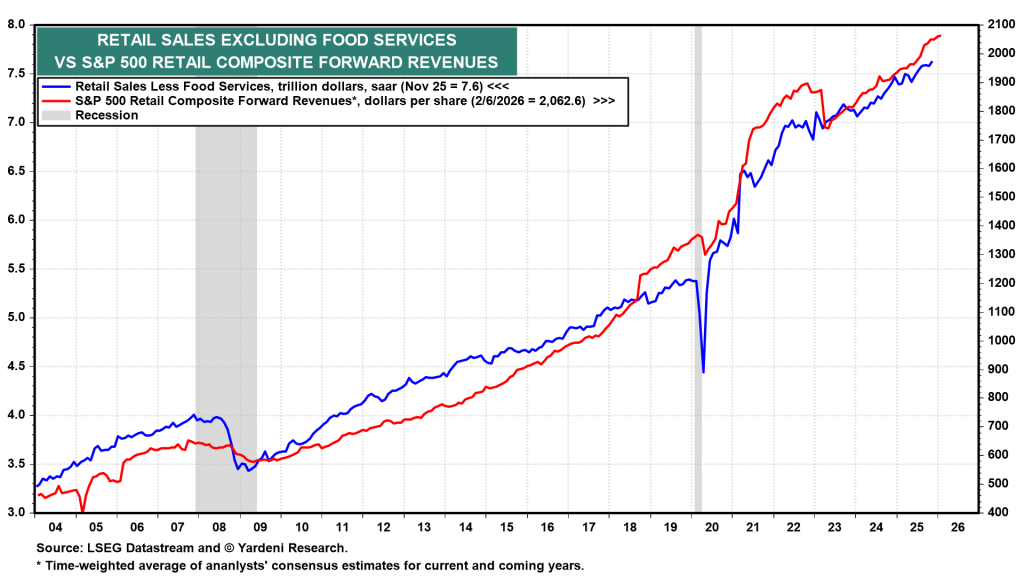
    Despite ongoing concerns about the cost of living and a fragile labor market, household spending continues to show resilience. Retail sales in December, due Tuesday, are expected to post another solid gain following November’s 0.6% month-over-month increase. Looking ahead, larger annual tax refunds should help sustain consumer spending momentum. Reflecting this strength, forward earnings for the S&P 500 Retail Composite climbed to a record high during the week of February 6 (see chart).

    Jobless claims

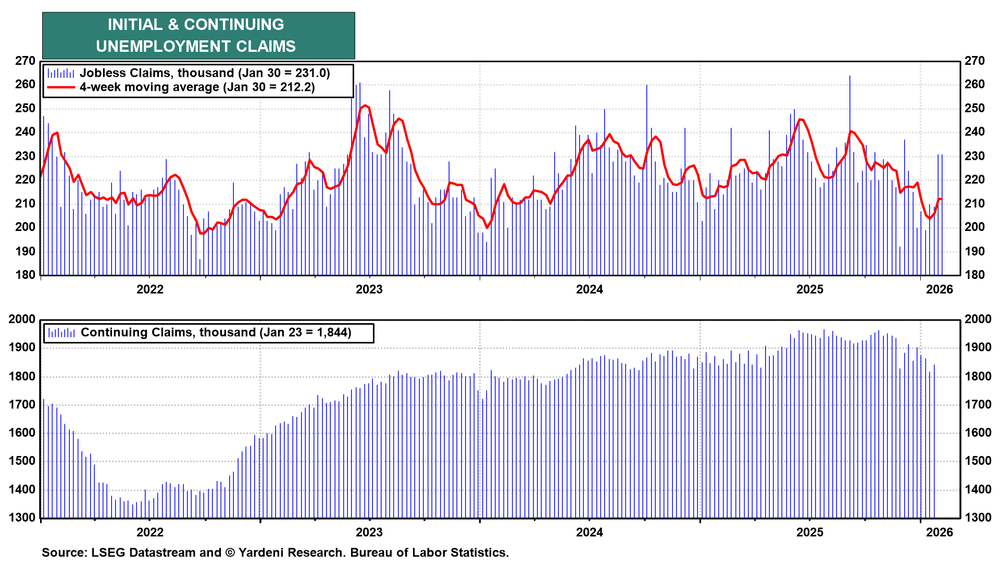
    Initial jobless claims due Thursday will draw heightened scrutiny as investors look to determine whether last week’s jump to 231,000 was driven by severe winter storms rather than a broader acceleration in layoffs. The balance of evidence points to a weather-related distortion, which would likely reassure the Fed that the labor market remains on relatively stable footing.

    Sources: Ed Yardeni

  • Australian dollar slips even as China’s RatingDog PMI shows improvement

    The Australian Dollar softened even as China’s RatingDog Manufacturing PMI edged up to 50.3 in January from 50.1. Meanwhile, Australia’s TD-MI Inflation climbed 3.6% year over year, though the monthly increase eased to 0.2%, its slowest pace since August. The US Dollar could gain further support after Donald Trump nominated Kevin Warsh as Fed Chair, a move seen as signaling a more cautious stance on monetary easing.

    The Australian Dollar weakened against the US Dollar on Monday, extending losses after falling more than 1% in the prior session. The AUD/USD pair stayed under pressure despite China’s RatingDog Manufacturing PMI ticking up to 50.3 in January from 50.1 in December, in line with market expectations. While the reading signaled a modest expansion in factory activity, it marked the strongest growth since October.

    Meanwhile, Australia’s TD-MI Inflation Gauge rose to 3.6% year over year in January from 3.5% previously. On a monthly basis, inflation increased by 0.2%, easing sharply from December’s two-year high of 1% and registering its slowest pace since August.

    ANZ Job Advertisements surged 4.4% month over month in December 2025, rebounding from a revised 0.8% decline and marking the first increase since July. The rise was also the strongest monthly gain since February 2022, pointing to renewed hiring momentum toward the end of the year.

    The data come ahead of the Reserve Bank of Australia’s policy meeting on Tuesday, following the central bank’s decision to keep the cash rate unchanged at 3.6% for a third consecutive meeting in December. Policymakers are widely expected to maintain a cautious stance, as underlying inflation remains above target and labor market conditions stay relatively tight, supporting a restrictive and data-dependent policy approach.

    Meanwhile, Australia’s Consumer Price Index increased 3.8% year over year in December, up from 3.4% previously. With headline inflation still exceeding the RBA’s 2–3% target range, recent PMI and employment indicators strengthen the argument for a tighter monetary policy bias.

    US Dollar edges lower ahead of ISM Manufacturing PMI

    The US Dollar Index (DXY), which tracks the Greenback against six major currencies, is edging lower after posting gains of more than 1% in the previous session, trading near 97.10 at the time of writing. Market attention is turning to the release of the US ISM Manufacturing PMI for January later in the day.

    Despite the modest pullback, the US Dollar had recently drawn support following President Donald Trump’s nomination of Kevin Warsh as the next Federal Reserve Chair, a move markets viewed as signaling a more disciplined and cautious approach to monetary easing. The Greenback also benefited from improved risk sentiment after the US Senate reached an agreement to advance a government funding package, averting a potential shutdown, according to Politico.

    US producer-side inflation data further underpinned the Dollar, reinforcing the Federal Reserve’s restrictive policy stance. Headline PPI remained unchanged at 3.0% year over year in December, exceeding expectations for a slowdown to 2.7%. Core PPI, which excludes food and energy, accelerated to 3.3% YoY from 3.0%, defying forecasts for a decline to 2.9% and highlighting persistent upstream price pressures.

    Federal Reserve officials echoed a cautious tone on easing. St. Louis Fed President Alberto Musalem said additional rate cuts are not justified at present, describing the current 3.50%–3.75% policy rate range as broadly neutral. Atlanta Fed President Raphael Bostic also urged patience, arguing that monetary policy should remain modestly restrictive.

    In Australia, inflation and trade data pointed to continued price pressures. The RBA’s Trimmed Mean inflation rose 0.2% month over month and 3.3% year over year, while the monthly CPI jumped 1.0% in December from zero previously, exceeding forecasts of 0.7%. Export prices increased 3.2% quarter over quarter in Q4 2025, rebounding from a 0.9% decline in Q3 and marking the strongest gain in a year, while import prices climbed 0.9%, beating expectations for a fall and reversing a prior decline.

    Following the data, markets now price in more than a 70% probability of a 25-basis-point rate hike by the Reserve Bank of Australia from the current 3.6% cash rate, up from around 60% previously. Rates are fully priced at 3.85% by May and near 4.10% by September.

    Australian Dollar slides toward key confluence support near 0.6900

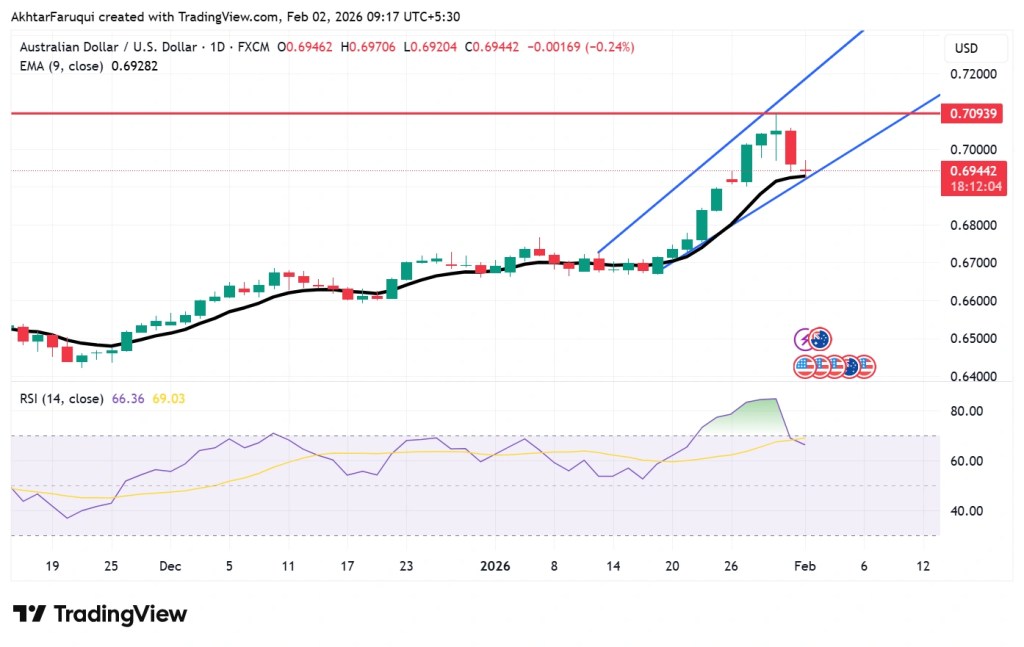
    The AUD/USD pair is trading near 0.6940 on Monday. Analysis of the daily chart shows the pair continuing to move higher within an ascending channel, pointing to a sustained bullish bias. The 14-day Relative Strength Index has eased from the 70 level to around 67, suggesting a cooling in bullish momentum rather than a trend reversal.

    On the upside, AUD/USD could recover toward 0.7093, its highest level since February 2023, reached on January 29. A sustained break above this level would open the door for a test of the channel’s upper boundary near 0.7190. On the downside, initial support is seen at a confluence zone around the nine-day Exponential Moving Average at 0.6927, which aligns closely with the lower boundary of the ascending channel near 0.6920.

    AUD/USD: Daily Chart

    Sources: Investing

  • Asia FX trades flat as stronger dollar weighs; yen weakens following Takaichi comments

    Most Asian currencies traded in narrow ranges on Monday, while the dollar strengthened as investors assessed U.S. President Donald Trump’s nomination for the next Federal Reserve chair.

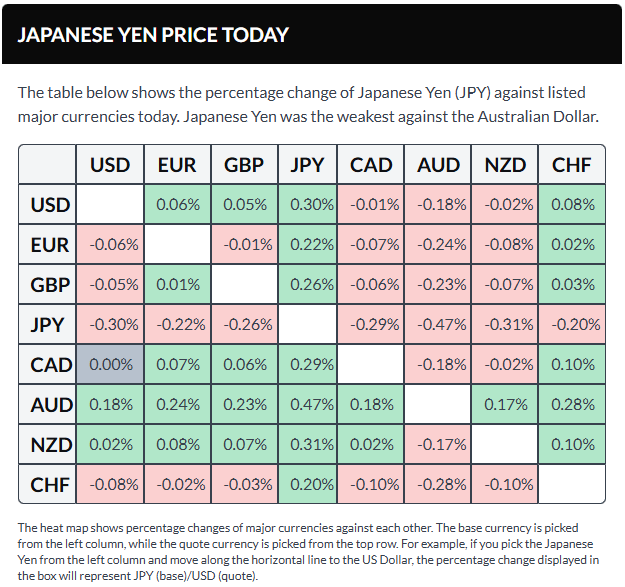
    The Japanese yen weakened in volatile trading after remarks from Prime Minister Sanae Takaichi suggested a reduced likelihood of currency market intervention by Japanese authorities.

    Broader moves across Asian currencies were subdued as investors awaited further economic signals this week, including a policy meeting by the Reserve Bank of Australia and the release of key U.S. jobs data.

    Dollar gains after Trump taps Warsh as Fed chair nominee

    The dollar index and its futures each rose around 0.1% in Asian trading, extending last week’s gains after the greenback staged a sharp rebound from a near four-year low.

    The dollar’s advance was driven largely by U.S. President Donald Trump’s nomination of former Federal Reserve governor Kevin Warsh to succeed Jerome Powell as Fed chair.

    Warsh is broadly seen as aligned with Trump’s push for significantly lower interest rates, but is also viewed as a critic of the Fed’s asset-purchase programs—suggesting that longer-term monetary policy under his leadership may prove less dovish than markets initially expected.

    “We expect a Warsh-led Fed to favour a smaller balance sheet, limiting support for large-scale fiscal expansion,” ANZ analysts said in a note.

    The analysts added that Warsh may view labour market weakness as the greater threat to the Fed’s dual mandate of maximum employment and price stability, and would likely back additional rate cuts if confirmed in the months ahead.

    Powell’s term is set to expire in May. The current Fed chair said last week that his successor should remain independent of political pressures.

    Yen weakens after Takaichi remarks

    The Japanese yen underperformed its Asian peers on Monday, with USD/JPY climbing as much as 0.5% to trade above the 155 level.

    The currency weakened after comments from Sanae Takaichi highlighted the benefits of a softer yen during a recent campaign speech—remarks that contrasted with earlier warnings from her administration against sustained currency weakness. Takaichi later appeared to moderate her stance, noting that a weaker yen supports exporters.

    Previously, a series of comments from Japanese officials, including Takaichi, cautioning against excessive yen moves had fueled speculation of possible government intervention. That speculation helped the yen strengthen sharply in January, though it remains near levels that have triggered intervention in the past. Recent media reports have suggested Japan and the United States may be considering coordinated measures to support the currency.

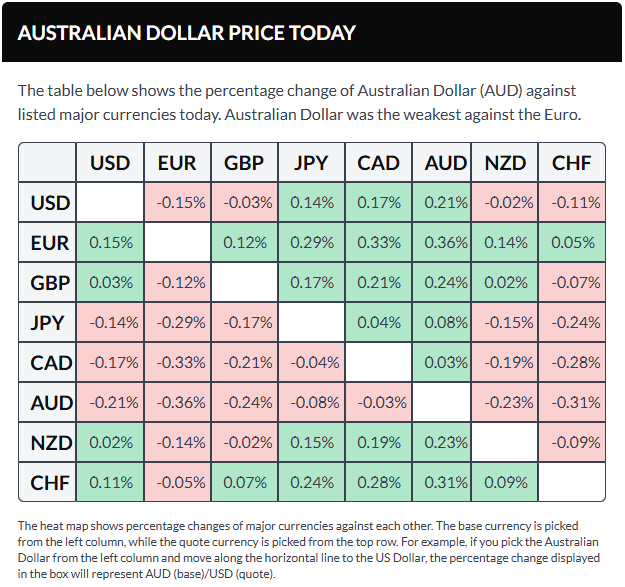
    Elsewhere in Asia, currencies traded in a narrow to softer range amid a lack of near-term catalysts. The Australian dollar slipped about 0.2% against the U.S. dollar, with attention focused on Tuesday’s Reserve Bank of Australia meeting, where a 25-basis-point rate hike is widely expected.

    Expectations of a rate hike by the Reserve Bank of Australia were driven mainly by data pointing to a rebound in Australian inflation during the second half of 2025.

    The South Korean won weakened, with USD/KRW climbing about 0.5%, as heavy outflows from domestic equity markets weighed on the currency amid selloffs in major technology stocks.

    The Chinese yuan was largely unchanged, with USD/CNY flat as markets showed little response to mixed January purchasing managers’ index readings.

    The Singapore dollar edged higher, with USD/SGD slipping 0.1%, while the Taiwan dollar was steady against the greenback.

    The Indian rupee also weakened, with USD/INR rising roughly 0.2% and hovering near record levels, after investors reacted cautiously to the government’s fiscal 2027 budget, which signaled increased spending to bolster the manufacturing sector.

    Sources: Investing

  • Will the ECB react to the euro’s recent strength? Analysts asses

    The euro’s recent surge has brought renewed attention to the European Central Bank, though economists argue it is unlikely to prompt any near-term policy action.

    Last week, the single currency climbed to $1.20 against the U.S. dollar for the first time since mid-2021, marking an unusually swift move by historical standards. According to Capital Economics, the euro has strengthened by a similar scale over a 10-day period only a few times in the past decade, while its trade-weighted exchange rate has reached a record high.

    Even so, analysts expect the inflationary impact across the euro zone to remain modest. Capital Economics cited ECB sensitivity analysis showing that if the euro stabilizes at current levels, headline inflation next year would be roughly 0.1 percentage points lower than projected in the ECB’s December forecasts.

    While this slightly increases downside risks to inflation, the brokerage said it falls far short of the threshold that would justify foreign-exchange intervention on price-stability grounds.

    The ECB is likely to address the euro’s strength at its meeting next week, but concrete action appears improbable. Although the central bank has the authority to intervene in currency markets to prevent disorderly moves that could threaten price stability, Capital Economics noted that the euro would need to rise much further before such measures were considered. Even then, intervention through dollar purchases is viewed as highly unlikely.

    Historically, the ECB has stepped into currency markets only twice—once in late 2000 and again in March 2011—both times to support, rather than weaken, the euro. Those interventions were coordinated with other major central banks. Capital Economics added that a coordinated effort to push the euro lower now looks extremely unlikely, particularly given the U.S. administration’s preference for a weaker dollar.

    ECB officials have so far played down the recent appreciation. Vice President Luis de Guindos has previously described levels above $1.20 as “complicated,” while also calling the level itself “perfectly acceptable.” Meanwhile, Austria’s central bank governor has characterized the latest rise as “modest.”

    Capital Economics expects ECB President Christine Lagarde to reiterate that policymakers are closely monitoring exchange-rate developments, but not to actively try to talk the currency down.

    Although intervention is unlikely in the near term, prolonged euro strength could influence policy over time. Capital Economics said ECB analysis suggests that if the euro were to appreciate gradually to between $1.25 and $1.30 over the next three years, headline inflation in 2028 would be about 0.3 percentage points lower.

    Under such conditions, policymakers would be more inclined to respond through stronger verbal guidance and lower interest rates rather than direct currency market intervention.

    For now, economists say the euro’s rise largely reflects U.S. dollar weakness rather than stronger euro zone fundamentals, reducing the need for an immediate response. As a result, the ECB is expected to remain on the sidelines unless the appreciation becomes substantially larger and more persistent, according to Capital Economics.

    Sources: Investing

  • Economic Behavior

    Economic behavior refers to the way individuals, households, businesses, or organizations make decisions and take actions related to the production, distribution, exchange, and consumption of economic resources such as money, time, labor, and natural resources.

    Simply put, it is how people choose when resources are limited but needs are unlimited.

    Key characteristics of economic behavior

    1. Based on choice

    Because resources are scarce, people must choose one option over another.

    2. Benefit-oriented

    Decisions usually aim to maximize benefits (profit, satisfaction) and minimize costs.

    3. Influenced by many factors

    • Income and prices
    • Information and expectations
    • Psychology, habits, and culture
    • Government policies and the social environment

    4. Not always perfectly rational

    Behavioral economics shows that people often make decisions influenced by emotions, cognitive biases, or personal beliefs.

    Examples of economic behavior

    • Consumers compare prices and quality before buying tea
    • Businesses expand production when demand increases
    • Investors choose gold as a safe-haven asset during market volatility
    • People save more when they fear an economic downturn

    Types of economic behavior

    Consumption behavior

    Consumption behavior refers to how individuals or households decide what goods and services to buy, how much to buy, and when to buy in order to satisfy their needs and wants.

    Key decision factors

    • Income level and disposable income
    • Prices of goods and services
    • Preferences, tastes, and lifestyle
    • Psychological factors (brand perception, emotions, habits)
    • Social and cultural influences
    • Expectations about future income or prices

    Examples

    • A consumer choosing between premium tea and mass-market tea based on budget and perceived quality
    • Buying more during promotions or discounts
    • Reducing spending when economic uncertainty increases

    Economic significance

    Consumption drives demand, which in turn influences production, employment, and economic growth.

    Production behavior

    Production behavior describes how firms or producers decide what to produce, how much to produce, and which production methods to use.

    Key decision factors

    • Market demand and consumer preferences
    • Production costs (labor, raw materials, energy)
    • Technology and efficiency
    • Competition and market structure
    • Government regulations and taxes
    • Expected profits

    Examples

    • A tea company deciding to produce organic tea instead of conventional tea
    • Investing in automation to reduce labor costs
    • Cutting production when demand declines

    Economic significance

    Production behavior determines supply, pricing, productivity, and the efficient allocation of resources.

    Investment behavior

    Investment behavior refers to decisions made by individuals or organizations regarding how and where to allocate capital to generate future returns.

    Key decision factors

    • Expected rate of return
    • Risk tolerance and uncertainty
    • Interest rates and inflation
    • Market conditions and economic outlook
    • Time horizon (short-term vs long-term)

    Examples

    • Investors buying stocks, bonds, gold, or real estate
    • A business expanding factories or investing in R&D
    • Choosing safe-haven assets during financial instability

    Economic significance

    Investment fuels capital formation, innovation, and long-term economic growth.

    Saving behavior

    Saving behavior involves decisions about how much income to set aside for future use rather than current consumption.

    Key decision factors

    • Income stability and employment security
    • Interest rates and returns on savings
    • Life cycle stage (youth, working age, retirement)
    • Precautionary motives (emergency funds)
    • Cultural attitudes toward saving

    Examples

    • Households increasing savings during a recession
    • Individuals saving for education, housing, or retirement
    • Businesses retaining earnings instead of distributing dividends

    Economic significance

    Savings provide funds for investment and help stabilize financial systems.

    Exchange (Market) Behavior

    Exchange behavior refers to how economic agents buy, sell, and negotiate in markets.

    Key decision factors

    • Market prices and transaction costs
    • Bargaining power and competition
    • Information availability and transparency
    • Trust and contractual enforcement

    Examples

    • Negotiating wholesale tea prices with suppliers
    • Online trading of financial assets
    • Choosing platforms based on fees and convenience

    Economic significance

    Exchange behavior ensures the circulation of goods, services, and capital in the economy.

    Labor (Work) Behavior

    Labor behavior focuses on decisions related to working, hiring, wage setting, and skill development.

    Key decision factors

    • Wage levels and benefits
    • Working conditions and job security
    • Education and skill requirements
    • Work-life balance preferences
    • Labor market regulations

    Examples

    • Workers choosing between higher pay or better working conditions
    • Firms hiring skilled labor to improve productivity
    • Employees investing in training to increase income potential

    Economic significance

    Labor behavior directly affects productivity, income distribution, and employment levels.

    Behavioral (Psychological) Economic Behavior

    This type highlights how psychological biases and emotions influence economic decisions, often leading to outcomes that deviate from rational models.

    Key influences

    • Loss aversion
    • Overconfidence
    • Herd behavior
    • Anchoring and framing effects

    Examples

    • Panic selling during market crashes
    • Consumers overpaying due to brand loyalty
    • Investors following market trends without analysis

    Economic significance

    Understanding behavioral factors helps explain real-world market anomalies and improves policy and business strategies.

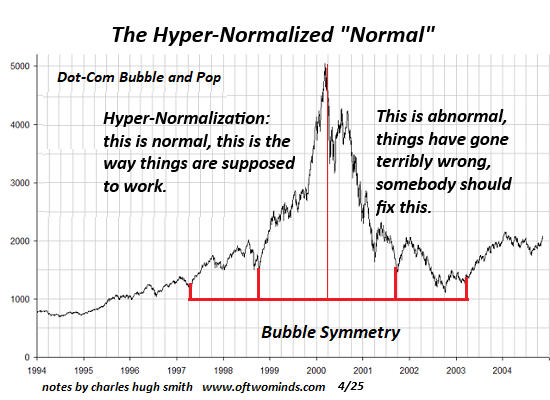
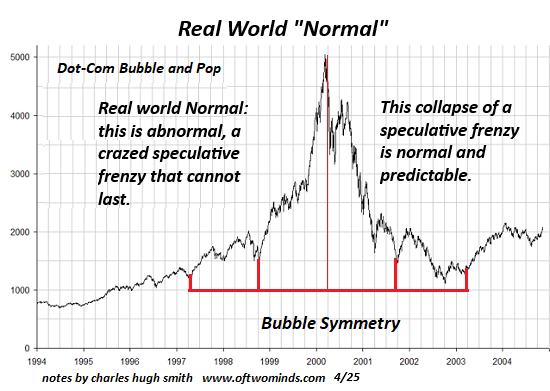
  • Why the Next Recession Could Trigger a Depression

    Narrative control functions by offering ready-made answers to every doubt or challenge. At its core, the prevailing narrative claims that the Federal Reserve and the central government possess sufficient tools to quickly counter any decline in GDP—otherwise known as a recession—and steer the economy back toward growth.

    Implicit in this view is the assumption that recessions are inherently harmful, while uninterrupted expansion is inherently desirable. Few question the fact that this framework departs from true free-market capitalism. Instead, central banking and government intervention are justified as mechanisms to smooth out capitalism’s rough edges through a form of state capitalism—one that can create or borrow as much money as needed to neutralize economic disruptions, including recessions.

    What this narrative leaves out is the role recessions play as a natural and necessary part of market dynamics. Instead, it reduces economic cycles to a simplistic binary: contraction is bad, expansion is good. Yet markets are ultimately driven by human behavior—particularly fear and greed—which express themselves through borrowing and speculation. During periods of confidence, when growth appears limitless, participants take on increasing levels of debt and channel capital into progressively riskier investments in pursuit of higher returns.

    As borrowed funds flow into speculative assets, prices rise, boosting the value of collateral and enabling even more borrowing to finance further speculation. Debt, asset prices, collateral and risk-taking thus reinforce one another, creating the illusion of an endlessly self-sustaining expansion in which everyone appears to grow wealthier.

    However, this layering of debt and paper wealth carries within it two forces that eventually unwind the process: interest and risk. Every loan carries an obligation to pay interest, which compensates lenders for the risks they assume. As overall debt grows—and as investments become more speculative—debt servicing costs increase accordingly, especially for higher-risk borrowers.

    While central banks can attempt to suppress interest rates even as risk rises, their influence is inherently limited. They control only a portion of total outstanding debt and therefore cannot dominate the market entirely.

    Their role in prolonging debt expansion and speculation relies less on absorbing most new debt and more on signaling. By projecting the message that the Federal Reserve will step in to backstop losses, recapitalize lenders, and cap interest rates below market-clearing levels, policymakers encourage continued borrowing and risk-taking. This reinforces the belief that debt and speculation can keep expanding indefinitely.

    Yet signaling alone cannot solve the underlying problem. It does not increase the income required to service growing debt burdens, nor does it ensure speculative investments will deliver returns. These limitations expose the fundamental weakness of the central banking “perpetual motion” model. For most borrowers—both private and public—income does not automatically rise alongside debt. Instead, income depends on market conditions, technological change, government policy, and the broader cycle of credit expansion or contraction.

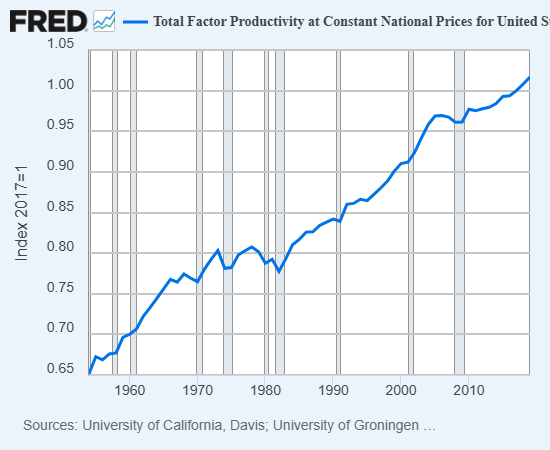
    At the level of the overall economy, what ultimately matters is total factor productivity and how its gains are distributed among workers, businesses, asset owners, and the state, which extracts revenue from each through taxation. This distribution is not fixed; it shifts with changing social, political, and financial forces.

    Over the past five decades, the benefits of productivity growth have increasingly accrued to capital—corporations and asset owners—rather than to workers. As a consequence, households and small businesses are left servicing debt with a diminishing share of overall economic income. This imbalance makes additional borrowing progressively more hazardous for both borrowers and lenders alike.

    As a growing share of economic output accrues to corporations and asset owners, their collateral values, income streams, and perceived creditworthiness strengthen. This allows them to borrow larger sums at lower interest rates than wage earners and small businesses. Greater access to cheap credit enables further asset accumulation, which in turn generates additional income—creating a self-reinforcing cycle.

    This dynamic sits at the heart of widening wealth and income inequality. Those at the top grow richer not simply because they earn more, but because they can finance income-producing assets at costs far below those faced by workers. Unlike wages, income derived from assets tends to rise alongside asset values, which can be leveraged as collateral to support even more borrowing.

    At a deeper structural level, the system becomes unstable once economic growth fails to raise household incomes enough to support higher debt servicing. The entire framework of expanding credit, collateral, and speculation then comes under strain. Asset-driven income ultimately depends on one or more of three forces: continued credit expansion, increased risk-taking in financial markets, or sustained consumer spending. These forces are tightly linked, as any slowdown in borrowing, investing, or spending eventually undermines the ability to service debt and brings the credit cycle to a halt.

    Because debt inherently carries default risk, an economic model reliant on ever-expanding borrowing also amplifies systemic vulnerability—particularly when household incomes stagnate while debt levels and interest obligations continue to rise.

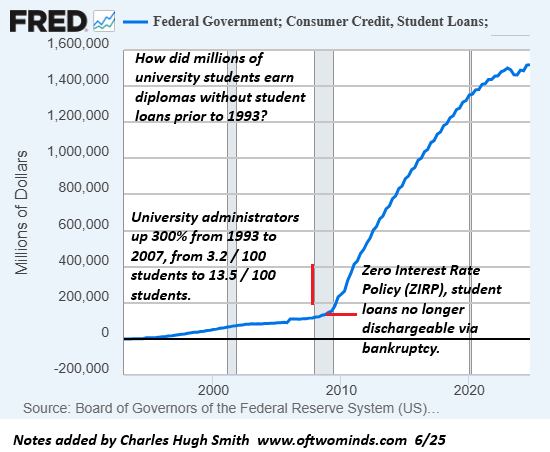
    With the share of output flowing to wages declining for decades, households have increasingly relied on borrowing to sustain consumption. Before the 2000s, student debt was relatively limited; today it totals trillions of dollars. Auto loans and credit card balances have also surged, alongside less visible forms of leverage such as installment-based financing and other shadow-banking channels that are often underreported.

    Speculative investments carry intrinsic risk, as there is no guarantee they will generate returns. When such speculation is financed through borrowing, failure does not only harm the investor—it also inflicts losses on the lender, as both sides are exposed when the bet collapses.

    Taken together, stagnant income growth, rising reliance on debt to sustain consumption, and increasingly risky, debt-backed speculation have produced an economy dependent on credit-driven asset bubbles. Growth now hinges on the continual expansion of debt to support spending and fuel speculative activity that inflates asset prices, thereby boosting collateral values and enabling even more borrowing.

    When income growth can no longer keep pace with rising debt obligations, defaults begin to ripple through the system. Households fall behind on rent, auto loans, student debt, credit cards, and mortgages, triggering a collapse in consumer spending. The resulting strain spreads to lenders and employers, who respond by tightening credit, cutting back borrowing, and laying off workers—further eroding income across the economy.

    Speculative investments that appeared viable during the expansion unravel as credit conditions tighten. Lenders withdraw from riskier loans, household demand dries up, and asset prices fall as investors rush to sell risk assets in order to raise cash and reduce leverage. Collateral values deteriorate rapidly, amplifying losses.

    Economies dependent on credit-fueled asset bubbles function as tightly interconnected systems. Any decline in income or asset prices, any increase in interest rates, any reduction in available credit, or any erosion of collateral feeds back into the broader structure. These shocks reinforce one another, creating a downward spiral marked by defaults, layoffs, and falling valuations.

    In an economy already saturated with debt, policy stimulus no longer produces real growth; instead, it fuels inflation, which constrains central banks’ ability to respond. Once markets lose confidence in the belief that policymakers will always step in to backstop losses, both speculation and the borrowing that sustained it begin to dry up. As the flow of new, credit-funded investment slows, asset prices enter a self-reinforcing decline.

    In a credit-asset-bubble-dependent system, this inevitable unwinding is often perceived not as a structural outcome, but as a sudden and unforeseen crisis.

    In an economic system that permits recessions to purge unsustainable debt and excess speculation, the bursting of credit-driven asset bubbles is seen as a natural and unavoidable process rather than an aberration.

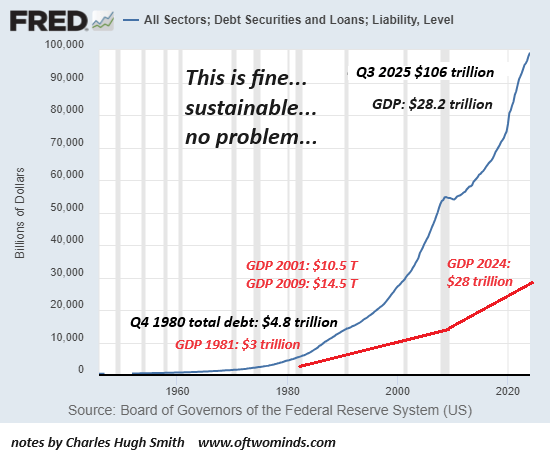
    Few recognize two critical realities: first, the last true recession that meaningfully purged excess debt, leverage, and speculation occurred in 1980–82—more than four decades ago; second, the shock absorbers that enabled recovery back then no longer exist. In 1980, total debt stood at roughly 150% of GDP. Today, it is closer to three times GDP. This makes debt-driven expansion unworkable: borrowers are already struggling to service existing obligations, let alone take on more.

    Nor can the Federal Reserve rescue the system simply by cutting rates to zero. The Fed holds only a small fraction of the roughly $106 trillion in outstanding debt; its primary influence is psychological, signaling that risk is low. In reality, risk continues to rise as debt burdens, interest costs, leverage, and speculation compound.

    A repeat of the 2008-style bailout is equally implausible. Then, the system was stabilized by recapitalizing the financial sector—the engine of new credit creation. Today, however, the economy is saturated with debt, incomes have stagnated, and borrowers lack the capacity to sustain additional leverage. Meanwhile, housing and financial asset bubbles have expanded to historically fragile extremes.

    This is why a recession that finally cleanses excess debt and speculation would leave behind an economy unable to rebound. The current system depends entirely on debt, leverage, and speculative excess not just for growth, but for basic stability. Once that structure collapses—as all bubbles eventually do—the confidence, signaling, and perceived wealth that sustained it will vanish as well.

    Proposals to “save” the system by shifting fiat money into gold or cryptocurrencies offer no escape. The debt itself—and the income required to service it—would also be carried over, leaving the underlying dynamics unchanged. The collapse of credit-driven asset bubbles, and the economic activity built upon them, would still unfold.

    For this reason, the next recession is likely to trigger a full-scale breakdown of a credit-asset-bubble-dependent economy. While policymakers may attempt to reflate another bubble as a solution, such an approach will no longer be sustainable. A durable recovery would instead require restructuring the economy around real productivity gains that are broadly shared, rather than concentrated among asset holders.

    This transition will be slow and painful. Those who benefited most from the bubble economy will resist losing both extraordinary returns and their disproportionate share of gains. Yet neither can be preserved. The adjustment will demand time, sacrifice, and large, long-term investment in genuinely productive assets.

    Ultimately, the systemic risks embedded in a credit-asset-bubble economy cannot be eliminated—only disguised or shifted elsewhere. These temporary fixes allow the bubble to grow larger, but the cost is borne by society at large when the system’s internal dynamics inevitably bring it crashing down.

    Sources: Charles Hugh Smith

  • Ueda Speech: BoJ Governor addresses the policy outlook following an anticipated interest rate hold

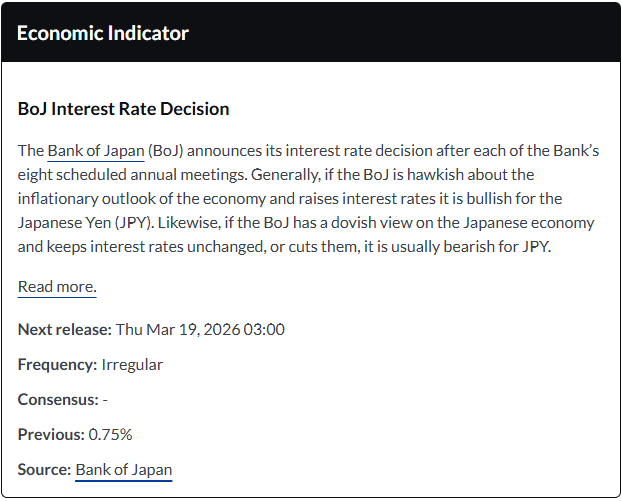
    Bank of Japan (BoJ) Governor Kazuo Ueda is speaking at a press conference, outlining the rationale for keeping the benchmark interest rate unchanged at 0.75% at the January policy meeting.

    Key takeaways from the BoJ press conference

    Japan’s economy is showing a moderate recovery and is expected to continue growing at a steady pace.

    The government’s economic stimulus package has improved the overall outlook.

    Underlying inflation is projected to rise gradually and move closer to the 2% target.

    Board members Takata and Tamura suggested revisions to the outlook report.

    The BoJ will continue to raise interest rates if economic and price projections are realized.

    Lending rates tied to the BoJ’s policy rate are already trending higher.

    Financial conditions remain accommodative despite the December rate hike.

    Foreign exchange movements are influenced by multiple factors.

    The governor refrained from commenting on specific yen levels but emphasized close monitoring of FX developments.

    Government bond yields are increasing at a rapid pace.

    The BoJ stands ready to conduct bond-buying operations flexibly in exceptional circumstances.

    Measures may be taken to support stable yield formation when necessary.

    Currency movements, particularly the yen, may be having a stronger impact on prices.

    Greater attention will be paid to foreign exchange trends going forward.

    The rise in long-term yields is partly influenced by end-of-fiscal-year factors.

    Price developments in April will be an important consideration when assessing the timing of future rate hikes.

    The section below was published at 3:35 GMT on January 23 to cover the Bank of Japan’s monetary policy announcement and the initial market reaction.

    The Bank of Japan (BoJ) board voted to keep the short-term policy rate unchanged at 0.75% at the conclusion of its two-day monetary policy meeting on Friday, a move that was widely expected.

    As a result, borrowing costs remain at their highest level in roughly three decades.

    Key takeaways from the BoJ’s policy statement

    Japan’s economy is expected to continue a moderate recovery.

    Consumer inflation is likely to pick up gradually.

    The virtuous cycle in which wage growth and inflation reinforce each other is expected to be sustained.

    The output gap is projected to improve over time and expand at a moderate pace.

    Medium- to long-term inflation expectations are seen rising gradually.

    No major imbalances are observed in Japan’s financial activity.

    The overall financial system remains stable.

    Firms’ moves to pass higher wages on to selling prices could strengthen more than previously anticipated.

    The recent increase in food prices, including rice, mainly reflects temporary supply-side factors.

    Significant uncertainty surrounds the global economic outlook, particularly due to trade policies that could push up import prices through supply-side channels.

    Trade measures announced so far may weigh on global economic growth.

    Regarding the US economy, close attention is needed on how tariffs could affect employment and income via weaker corporate profits.

    High uncertainty persists around China’s economic outlook, especially the future pace of growth.

    A sharp rise in import prices could further reinforce households’ cautious stance on spending.

    Current trade policies could lead to a shift in the long-term trend of globalisation.

    The Board raised its median real GDP growth forecast for fiscal 2025 to +0.9% from +0.7% in October.

    The fiscal 2026 median growth forecast was revised up to +1.0% from +0.7%.

    The fiscal 2027 median growth forecast was lowered to +0.8% from +1.0%.

    BoJ’s Quarterly Outlook Report: Key Highlights

    The Board kept its median core consumer price index forecast for fiscal 2025 unchanged at +2.7%, the same as in October.

    The median real GDP growth forecast for fiscal 2025 was revised up to +0.9% from +0.7% in October.

    Real interest rates remain at significantly low levels.

    Risks to the economic outlook are assessed as roughly balanced.

    The impact of foreign exchange volatility on prices has become more pronounced than in the past, as firms are more willing to raise prices and wages.

    Core consumer inflation is expected to slow to below 2% during the first half of this year.

    Companies’ efforts to pass higher wages on to selling prices could strengthen more than anticipated.

    Japan’s economy is projected to continue a moderate recovery.

    Market reaction following the BoJ policy announcements

    USD/JPY climbed further toward 158.60 in an immediate reaction to the Bank of Japan’s (BoJ) decision to keep interest rates unchanged, rising 0.11% on the day.

    The section below was published at 23:00 GMT on January 22 as a preview of the Bank of Japan’s interest rate decision.

    • The Bank of Japan is widely expected to leave interest rates unchanged at 0.75% on Friday.
    • The central bank is likely to wait and assess the effects of December’s rate hike before considering further tightening.
    • February’s general elections introduce an additional layer of uncertainty to the BoJ’s monetary policy outlook.

    The Bank of Japan (BoJ) is widely expected to keep its benchmark interest rate unchanged at 0.75% following the conclusion of its two-day monetary policy meeting next Friday.

    The Japanese central bank raised interest rates to their highest level in three decades in December and is now likely to keep policy unchanged on Friday to better evaluate the economic impact of earlier hikes.

    BoJ Governor Kazuo Ueda is expected to reaffirm the bank’s commitment to continued policy normalisation. As a result, investors will closely scrutinise his press conference for clues on the timing and extent of the next phase of the tightening cycle.

    What to anticipate from the Bank of Japan’s interest rate decision?

    The Bank of Japan is broadly expected to leave interest rates unchanged in January while signaling the possibility of further tightening if economic conditions unfold as projected.

    In December, the BoJ raised rates by 25 basis points to 0.75%, and the meeting minutes showed that some policymakers favor additional tightening, noting that real interest rates remain sharply negative once inflation is taken into account.

    Markets, however, have ruled out consecutive rate hikes, especially following Prime Minister Sanae Takaichi’s surprise call for snap elections and her proposal to suspend food and beverage taxes for two years to ease the burden on households amid rising inflation.

    While the implications of these political developments for monetary policy remain uncertain, the BoJ has emphasized a cautious, gradual normalization of policy, aiming to withdraw stimulus without undermining economic growth. As a result, the central bank is likely to wait for greater political clarity and for the effects of past rate increases to become clearer before moving again.

    Meanwhile, the yen has weakened steadily amid speculation surrounding the snap election. This raises the question of whether the currency’s depreciation will push the BoJ to adopt a firmer stance on monetary tightening.

    How might the Bank of Japan’s monetary policy decision influence the USD/JPY exchange rate?

    Markets have fully priced in a Bank of Japan rate pause on Friday, but the central bank will need to clearly signal further monetary tightening to curb the Yen’s ongoing weakness.

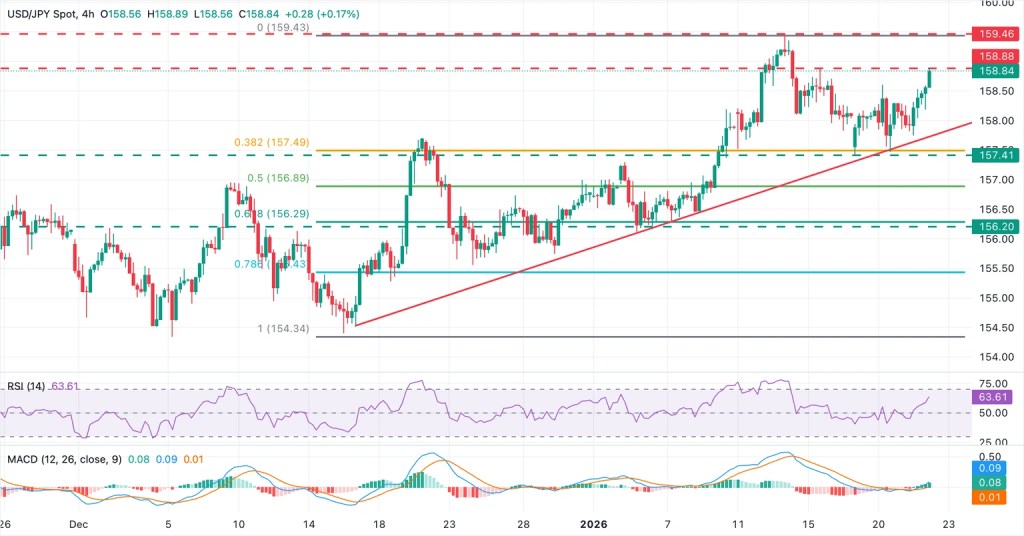
    Yen sellers have eased off in recent days, helped by broad US Dollar softness linked to the EU–US trade dispute following President Donald Trump’s threats over Greenland. Even so, USD/JPY is still up roughly 0.7% year to date and remains close to last week’s 18-month peak around 159.50.

    Investors are also concerned that Prime Minister Takaichi could secure stronger parliamentary backing after the elections, allowing her to push ahead with expansionary fiscal policies such as higher spending and tax cuts. This has heightened worries about Japan’s already stretched public finances, driving the Yen lower and pushing long-term government bond yields to record highs amid fears of a potential fiscal crisis.

    Meanwhile, recent remarks from BoJ Governor Ueda have reinforced the bank’s cautious tightening stance, suggesting Japan is transitioning toward a more sustainable inflation environment where wages and prices rise together. For the Yen’s recent, still-fragile rebound to continue, markets will need clearer evidence that interest rate hikes are on the horizon.

    USD/JPY 4-Hour Chart

    From a technical standpoint, FXStreet analyst Guillermo Alcalá views USD/JPY as undergoing a bearish correction, with an important support zone just above 157.40. He notes that while the pair has pulled back from recent highs, Yen buyers would need to push it below the 157.40–157.60 support area to invalidate the short-term bullish structure and open the door to a move toward the early-January lows near 156.20.

    A cautious or non-committal message from the BoJ would likely disappoint markets and weaken the Yen. In that scenario, Alcalá expects USD/JPY to climb to new long-term highs. He points out that technical signals are improving, with the 4-hour RSI rebounding from the 50 level, indicating strengthening bullish momentum. At the time of writing, the pair is challenging resistance around 158.70 (the January 16 high), which stands as the final hurdle before the 18-month peak close to 159.50.

    Sources: Fxstreet

  • UK CPI seen edging higher in December

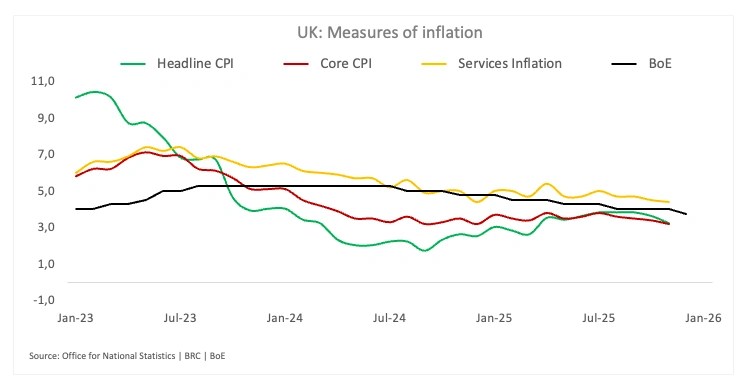
    The UK’s Office for National Statistics (ONS) is set to release December CPI data on Wednesday. Headline inflation is expected to edge up to 3.3%, while core inflation is projected to remain sticky above 3.0% year-on-year.

    The UK Office for National Statistics (ONS) is scheduled to publish December Consumer Price Index (CPI) data at 07:00 GMT on Wednesday, a release closely watched by financial markets. Economists anticipate a mild pickup in inflationary pressures.

    UK inflation remains a key consideration for the Bank of England (BoE) and is typically a significant driver of Sterling movements. With the Monetary Policy Committee (MPC) due to meet on February 5, markets largely expect policymakers to leave the bank rate unchanged at 3.75%, though this week’s inflation figures are likely to influence the guidance and tone of the decision.

    What might the upcoming UK inflation report reveal?

    Headline UK CPI is projected to tick up to 3.3% year-on-year in December, compared with 3.2% in November. On a monthly basis, inflation is expected to rebound by 0.4%, reversing the 0.2% month-on-month decline seen previously.

    Meanwhile, core inflation—which excludes volatile food and energy prices and is more closely monitored by the Bank of England—is anticipated to remain steady at 3.2% annually. Month-on-month, core CPI is forecast to rise by 0.3% after falling 0.2% in November.

    What impact will the UK CPI data have on GBP/USD?

    In December, the Bank of England’s Monetary Policy Committee narrowly voted 5–4 to reduce the bank rate by 25 basis points to 3.75%, marking its fourth cut in 2025. Although policymakers pointed to easing inflation pressures and initial signs of a softening labour market, they emphasised that any additional policy loosening would proceed cautiously.

    The December Decision Maker Panel (DMP) survey largely reinforced this outlook and failed to alter expectations around the policy path. Persistent wage pressures continue to constrain the potential for significant repricing at the short end of the yield curve.

    One-year-ahead wage growth expectations rose slightly to 3.7% from 3.6%, while actual pay growth over the past year remains in the mid-4% range. Both indicators remain well above levels consistent with a sustained return of inflation to the BoE’s target.

    Overall, the survey does little to shift sentiment and supports the argument against accelerating rate cuts. Markets currently price in just over 42 basis points of easing for the year, with the BoE widely expected to keep rates unchanged at its next meeting.

    From a technical perspective, Pablo Piovano highlights that GBP/USD is facing resistance near its yearly lows around 1.3340, recorded on January 19. A further decline could open the door to the 55-day simple moving average at 1.3309, followed by the December low at 1.3179. Conversely, if buyers regain control, the year-to-date high at 1.3567 may act as the first upside hurdle, with little resistance beyond that until the September 2025 peak at 1.3726.

    Piovano also notes that momentum indicators remain supportive, with the Relative Strength Index rebounding to around 54 and the Average Directional Index near 20, pointing to a reasonably firm underlying trend.

    Sources: Fxstreet

  • Week Ahead: GDP and PCE inflation take center stage before next Fed meeting

    This is shaping up to be a highly unpredictable week for U.S. and global markets, with numerous wildcard risks—largely tied to developments from the White House.

    Investors will be closely watching for any developments related to the Justice Department’s investigation into Federal Reserve Chair Jerome Powell. Attention will also turn to the Supreme Court on Wednesday, when it hears arguments concerning President Trump’s attempt to remove Fed Governor Lisa Cook.

    Trade policy remains a major wildcard, with tariff headlines likely to emerge rapidly after Trump threatened over the weekend to impose a new 10% levy on imports from eight European countries opposing his push on Greenland. The Supreme Court could also rule this week on the legality of Trump’s tariffs. Meanwhile, fresh rhetoric around Iran, renewed intrigue involving Venezuela, or actions targeting other geopolitical flashpoints could further unsettle markets.

    In Japan, the Bank of Japan is widely expected to keep interest rates unchanged on Friday. However, a weakening yen has revived speculation about possible intervention, leaving the future of the massive yen carry trade hanging in the balance. In China, fourth-quarter GDP growth slowed amid the ongoing property downturn, potentially prompting a policy response.

    All of this sets the stage for a busy week in Davos, where global leaders and policymakers are gathering, with President Trump scheduled to address the forum.

    In the United States, a slate of economic data will keep both investors and Federal Reserve officials engaged during the holiday-shortened week. A revision to third-quarter GDP could clarify whether the initially reported 4.3% growth overstated the economy’s strength or accurately reflected underlying momentum.

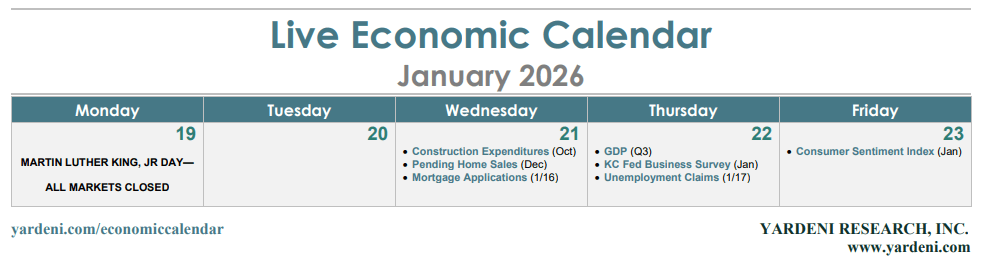
    Below are the key data releases this week that are most likely to shape the FOMC’s outlook ahead of its January 27–28 policy meeting.

    GDP Update: Growth Momentum in Focus

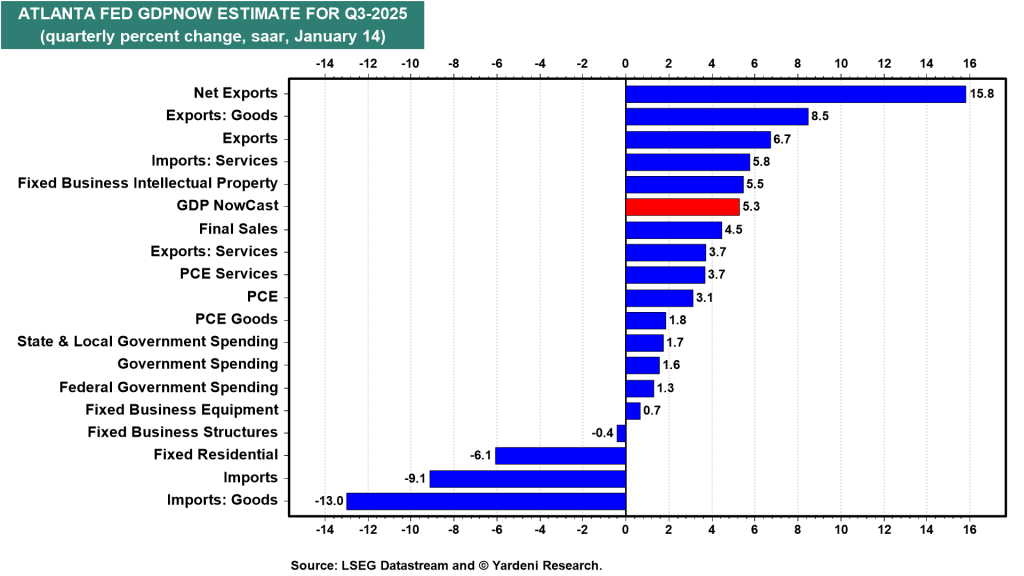
    Overall data indicate the economy stayed resilient through the final three quarters of 2025. Despite a notable slowdown in employment growth, household demand exceeded expectations, while AI-related capital investment surged. Although a modest upward or downward revision to Q3 real GDP (Thursday) is possible, Q4 real GDP is currently tracking at a strong 5.3% annualized pace (see chart).

    Personal income, consumption, and saving

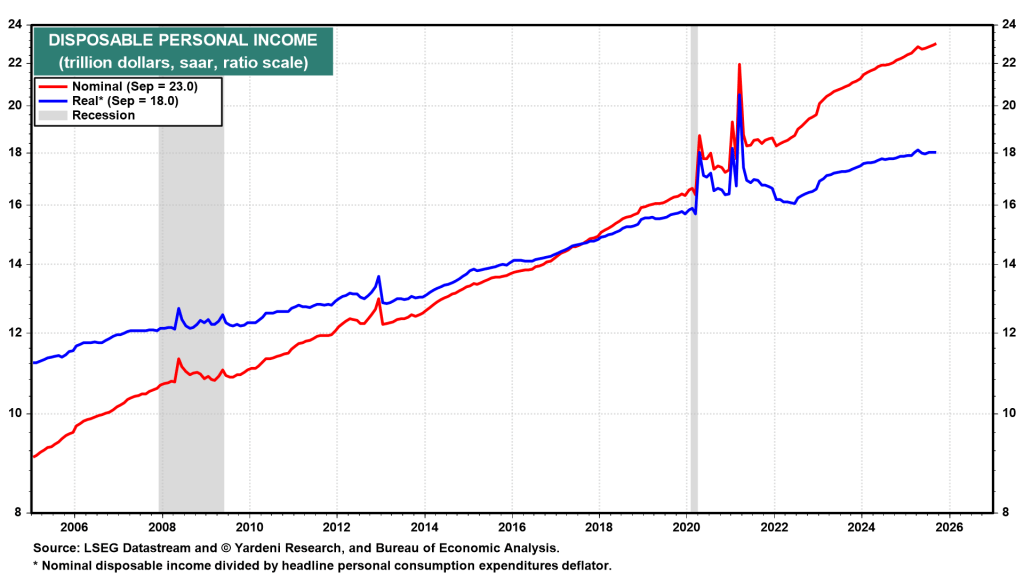
    Personal income data for October and November (Thu) may reinforce the view that real disposable income growth has stalled. This likely reflects demographic effects, as retiring Baby Boomers exit the labor force and no longer generate wage income. If consumer spending remains resilient, it would suggest households—particularly retirees—are increasingly drawing on retirement savings.

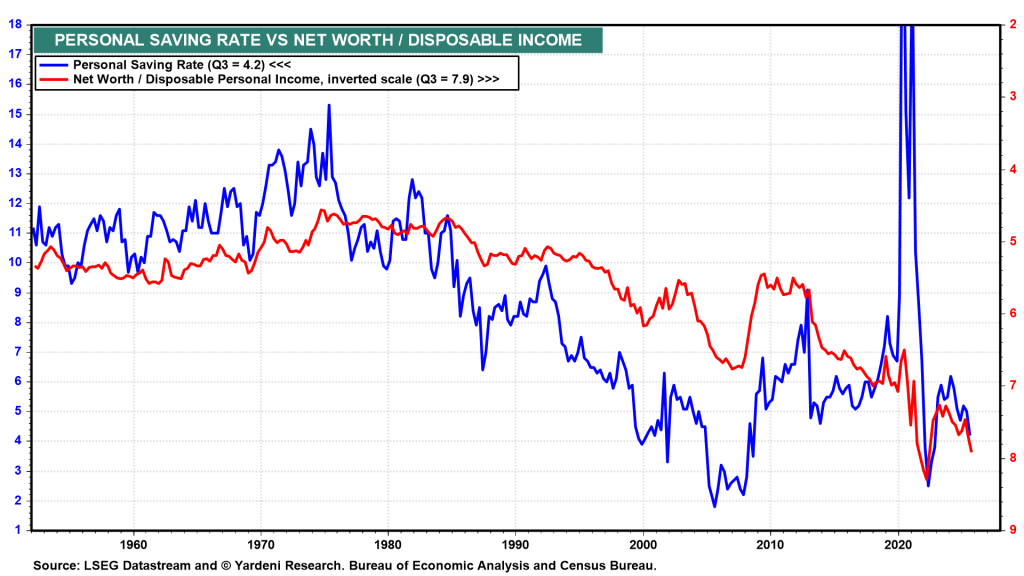
    The personal saving rate (Thu) is likely to continue declining under our framework, particularly if household net worth keeps rising to record levels relative to disposable income (chart).

    PCE inflation

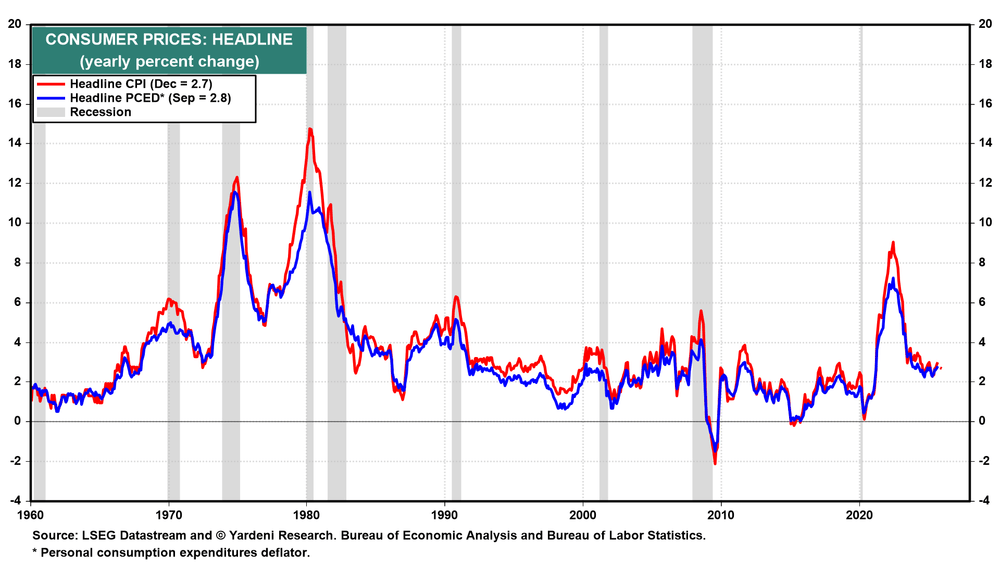
    The Bureau of Economic Analysis will calculate October PCE inflation (Thu) using the average of September and November CPI data. Meanwhile, the Cleveland Fed’s Inflation Nowcasting model projects headline and core PCE inflation at 2.65% y/y and 2.70% in November (chart).

    Unemployment claims

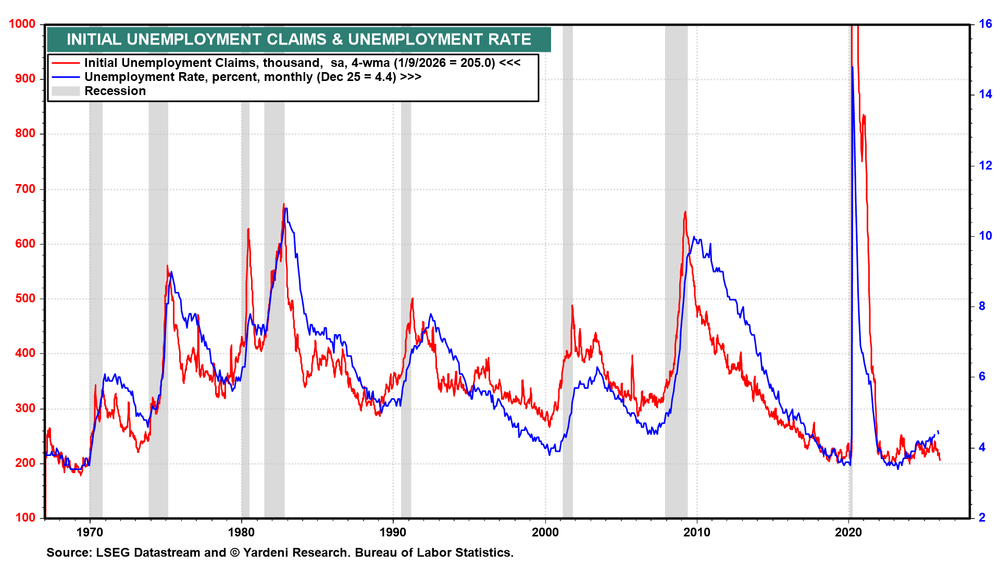
    Initial jobless claims (Thu) have declined in recent weeks, indicating that January’s unemployment rate likely edged lower from December’s 4.4% (chart).

    Sources: Yardeni

  • GBP/CAD Holds Steady Amid Mixed Canadian Employment Data

    GBP/CAD is trading close to one-month highs as investors react to mixed employment data from Canada. Higher unemployment rates and weaker wage growth have capped gains for the Canadian dollar. Attention now turns to the upcoming UK employment and GDP reports scheduled for next week.

    The Canadian Dollar (CAD) remained largely unchanged against the British Pound (GBP) on Friday, with GBP/CAD showing little directional movement as the market reacted modestly to Canada’s latest employment data. At the time of writing, the pair is trading around 1.8636, close to a one-month high.

    Statistics Canada reported that employment increased by 8,200 jobs in December, surpassing expectations of a 5,000 job decline but significantly lower than November’s 53,600 gain. Meanwhile, the unemployment rate rose to 6.8% from 6.5%, higher than the anticipated 6.6%.

    Wage growth showed signs of slowing, with average hourly wages rising 3.7% year-over-year in December, down from 4.0% previously.

    From a monetary policy standpoint, the mixed employment report is unlikely to significantly change short-term expectations for the Bank of Canada (BoC). The market largely anticipates that the central bank will keep interest rates steady throughout most of 2026.

    While some analysts had speculated about a possible rate hike later in the year, the recent labor data—characterized by rising unemployment and slower wage growth—weighs against that possibility and supports a cautious, wait-and-see approach.

    At its December meeting, the BoC held its policy rate at 2.25%, describing it as “about the right level.” Market participants are now focused on upcoming Canadian inflation figures expected later this month, which could influence near-term monetary policy forecasts.

    In the UK, attention is shifting to key economic releases next week, including labor market data on Tuesday and the November GDP report on Thursday.

    On a broader scale, the interest rate gap between the BoC and the Bank of England (BoE) continues to favor the British Pound, maintaining upward momentum for GBP/CAD.

    Additionally, the Canadian Dollar remains sensitive to developments in the oil market. Increased U.S. regulation of Venezuelan oil supplies has raised expectations of greater global output, heightening concerns over oversupply that could pressure oil prices and weigh on the Loonie, given Canada’s role as a major energy exporter.

    Sources: Fxstreet