Tag: WTI

  • Oil prices hold steady as Greenland tariff concerns ease; US crude inventories in focus

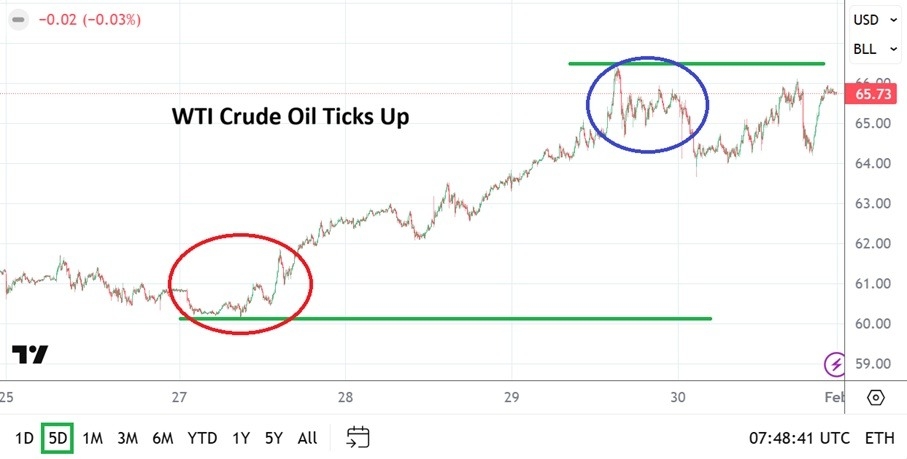
    Oil prices were largely flat in Asian trade on Thursday as U.S. President Donald Trump eased tariff threats related to Greenland. Market participants also weighed an increase in U.S. crude inventories alongside recent supply disruptions. At 22:07 ET (03:07 GMT), March Brent futures inched up 0.1% to $65.31 a barrel, while WTI crude rose 0.2% to $60.74. Both benchmarks have posted modest gains over the past two sessions, underpinned by supply concerns after OPEC+ member Kazakhstan suspended production at the Tengiz and Korolev oilfields on Sunday.

    Trump retreats from tariff threats against Greenland

    Market sentiment improved after President Trump unexpectedly softened his position on Greenland on Wednesday, stepping back from threats to impose tariffs on European countries as leverage to annex the Danish territory. He ruled out the use of force and indicated that a framework for a potential deal was emerging, easing concerns over a sharp escalation in U.S.–EU tensions that could have pressured global growth and energy demand. The de-escalation supported broader risk appetite, although oil markets remained cautious amid mixed supply and demand signals.

    U.S. crude inventories increase again, API data shows

    The American Petroleum Institute (API) reported that U.S. crude stockpiles increased by 3.04 million barrels in the week ending Jan. 16, following a build of more than 5 million barrels the previous week. Gasoline inventories surged by 6.21 million barrels, signaling weaker demand, while distillate stocks—including diesel and heating oil—slipped by 33,000 barrels.

    On the demand front, oil prices drew some support after the International Energy Agency raised its forecast for global oil demand growth in 2026 on Wednesday. Despite the upward revision, the IEA continues to expect the oil market to remain in a substantial surplus through 2026.

    Sources: Investing

  • WTI falls under $59.50 amid easing Iran tensions and rising US – EU trade war fears

    • WTI crude prices edged lower to around $59.25 in early European trading on Tuesday.
    • Tensions surrounding Iran have eased in recent days following earlier speculation about a potential U.S. attack.
    • Market attention is now turning to developments around Greenland after President Trump threatened to escalate tariffs on eight European countries.

    West Texas Intermediate (WTI), the U.S. crude oil benchmark, was trading near $59.25 during early European hours on Tuesday. Prices edged lower as concerns over supply disruptions from Iran eased, while traders continued to assess the implications of the U.S. push to take control of Greenland.

    There were no signs of escalating tensions in Iran over the weekend, although Supreme Leader Ayatollah Ali Khamenei said that 5,000 people were killed in anti-government protests this month, according to Reuters. The easing of tensions has reduced the risk of a potential U.S. attack that could disrupt supplies from a major OPEC producer, weighing on WTI prices.

    Traders are turning their focus to the Greenland crisis after U.S. President Donald Trump said on Saturday that Washington would impose an additional 10% import tariff from February 1 on goods from Denmark, Norway, Sweden, France, Germany, the Netherlands, Finland and the United Kingdom until the U.S. is permitted to purchase Greenland.

    Trump is expected to discuss Greenland at the World Economic Forum in Davos, Switzerland, on Wednesday, while European Union leaders are set to hold an emergency summit in Brussels on Thursday. Concerns that tensions could escalate into a broader U.S.–EU trade war have weighed on market sentiment and may add selling pressure to oil prices.

    “With fears around Iran easing in recent days following rumors of a U.S. attack, market attention has shifted to the Greenland issue and the potential depth of any fallout between the U.S. and Europe, as an expanded trade conflict could weigh on demand,” said Janiv Shah, an analyst at Rystad.

    Meanwhile, the American Petroleum Institute’s (API) crude inventory report is due later on Tuesday. A larger-than-expected draw could signal stronger demand and support WTI prices, while a bigger-than-forecast build would point to weaker demand or oversupply, potentially pressuring prices lower.

    Sources: Fxstreet

  • Crude Oil Outlook: WTI Climbs to Highest Levels in Over Three Months as Escalating Iran Tensions Stir Market Worries

    Oil prices are rising sharply, as WTI nears $62 and Brent crude moves up toward $66 per barrel. These increases highlight the market’s responsiveness to geopolitical tensions, despite no actual disruptions in supply. The question remains: where will prices go from here?

    Main Highlights of WTI Crude Oil

    • WTI Crude Oil prices are sharply rising amid concerns that ongoing protests in Iran might escalate and impact production or disrupt the Strait of Hormuz.
    • However, this upward pressure is balanced by underlying fundamentals and a global surplus.
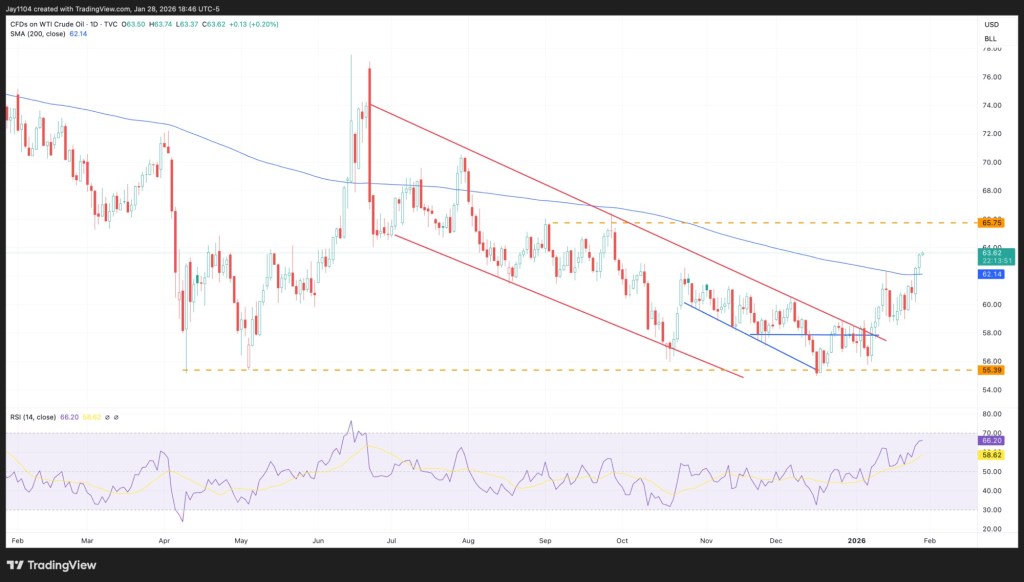
    • The current price around $62 is a crucial threshold: surpassing this resistance level could pave the way for a rally toward the six-month highs near $66.

    In today’s trading environment, it can be difficult for market participants to isolate the key drivers of price action on a day‑to‑day basis. Beyond enduring themes like economic growth trajectories, inflation trends, the expansion of AI infrastructure, and sovereign debt pressures, fresh geopolitical tensions seem to emerge almost daily.

    Amid simmering issues in places like Venezuela — and speculation about other potential flashpoints — Iran has become the dominant focus for energy markets. Nationwide protests there, sparked by severe economic strains and a collapsing currency, have raised serious questions about stability in one of the world’s most influential oil‑producing countries.

    Although these demonstrations have not yet led to direct disruptions in oil output, the unrest has prompted traders to price in a growing geopolitical risk premium. Concerns about possible escalation — including the risk of broader conflict or disruption to key infrastructure such as the Strait of Hormuz, through which a large share of global seaborne oil exports transit — are contributing to recent volatility in crude prices.

    As a reminder, Iran remains a key influence on global energy markets due to both its oil production capacity and its control over the Strait of Hormuz — a vital maritime chokepoint through which nearly 20 million barrels per day of crude and petroleum products transit, representing a large share of seaborne global oil flows. Any actual or perceived threat to exports or shipping through this route can have outsized impacts on pricing and risk sentiment.

    Against this backdrop, oil prices have recently climbed, with Brent trading in the mid‑$60s and WTI previously approaching the $62 per barrel area, as traders price in geopolitical risk tied to the unrest in Iran. This reflects markets’ sensitivity to potential escalations, even though there have been no confirmed widespread production outages to date.

    However, this upside is balanced by broader market fundamentals. Global oil inventories remain substantial, and additional output from other producers — including resumed Venezuelan exports and lingering oversupply concerns — continues to temper the rally. This backdrop helps explain why prices have fluctuated and, at times, pulled back when geopolitical anxieties ease.

    Looking ahead, the future direction of crude prices is likely to hinge on developments in Iran’s domestic unrest and whether tensions translate into actual disruptions in oil production or interference with key export infrastructure such as the Strait of Hormuz. So far, most of the price appreciation has been driven by risk premium and sentiment rather than physical losses of barrels.

    If broader instability were to disrupt supply routes or exports, markets could respond with a more pronounced and sustained price surge, particularly given the strategic importance of Middle East exports to the global oil system. However, short‑term moves are also currently influenced by macro factors such as inventory data and demand signals, as well as comments from policymakers that can quickly recalibrate risk perceptions.

    Technical Analysis of Crude Oil: Daily Chart for WTI

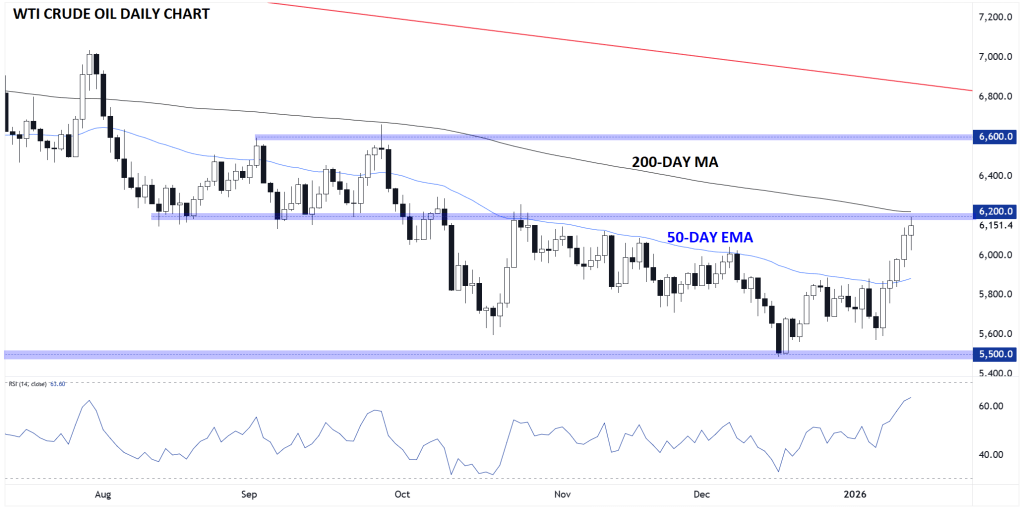
    Looking at the technicals, WTI Crude Oil is on a five-day winning streak, climbing from the lower end of its three-month trading range between $55 and $62 up to the upper boundary. Chart-wise, the current price level is a crucial threshold: a break above the $62 resistance — which also aligns with the 200-day moving average — could open the door for further gains toward the six-month highs around $66, where it would face resistance from the longer-term bearish trend line drawn from the second half of 2023’s peak.

    Conversely, if indications emerge that the protests are easing and stability is being restored in Iran, the geopolitical risk premium currently weighing on crude prices may diminish. This could trigger a reversal, causing prices to retreat below the $60 mark. Regardless of the outcome, oil traders should closely monitor developments in Iran in the days ahead.

    Sources: StoneX

  • WTI Falls Below $61 Amid Rising U.S. Stockpiles and Resumption of Venezuelan Oil Exports

    WTI crude slipped to around $60.70 during Wednesday’s Asian trading session, pressured by significant increases in U.S. crude stockpiles. Meanwhile, President Trump assured Iranian protesters that support is forthcoming.

    West Texas Intermediate (WTI), the U.S. crude oil benchmark, was trading near $60.70 during Wednesday’s Asian session, as prices edged lower amid rising supply pressures. WTI has been pressured by Venezuela restarting oil exports and the latest American Petroleum Institute (API) report showing a large build in U.S. crude inventories, while traders await the official Energy Information Administration (EIA) stockpile figures later in the day.

    According to Reuters and industry sources, Venezuela has begun reversing recent production cuts made under its previous U.S. oil embargo, allowing crude exports to resume. Two supertankers carrying roughly 1.8 million barrels each departed Venezuelan waters, potentially marking the first shipments under a 50‑million‑barrel supply arrangement with Washington, following U.S. control of the country’s exports after political developments.

    U.S. crude inventories saw a significant increase last week, with the American Petroleum Institute (API) reporting a build of 5.27 million barrels for the week ending January 9. This contrasts sharply with the previous week’s drawdown of 2.8 million barrels and defies market expectations, which had forecasted a 2 million barrel decline.

    Despite the growing stockpiles, ongoing geopolitical tensions in Iran—a key oil producer—could provide support for WTI prices. U.S. President Donald Trump canceled all planned meetings with Iranian officials and pledged assistance to protesters amid reports of a severe crackdown by Iranian security forces, which has resulted in hundreds of deaths. Trump has repeatedly warned that the U.S. would intervene if the Iranian government continues to target demonstrators.

    Sources: Investing

  • WTI Holds Steady Above $59 Amid Increasing Supply Concerns

    • WTI prices rise amid growing supply concerns linked to escalating unrest in Iran.
    • President Trump has warned Tehran against using force on protesters, while Iran has warned the U.S. and Israel against any intervention.
    • However, oil price gains may be capped due to anticipated resumption of Venezuelan exports and forecasts of a potential market oversupply.

    West Texas Intermediate (WTI) crude extended its gains for a third consecutive session, trading around $59.10 per barrel during Asian hours on Monday. The rise in oil prices is driven by growing supply concerns amid escalating protests in Iran. As OPEC’s fourth-largest producer, exporting nearly 2 million barrels per day, any conflict escalation poses a significant risk to global supply.

    The unrest, now in its third week and having reportedly resulted in hundreds of casualties, has prompted Iranian authorities to signal a harsher crackdown. Meanwhile, U.S. President Donald Trump warned Tehran against using force on protesters and suggested possible intervention if the situation worsens, while Iranian officials cautioned against any U.S. or Israeli involvement.

    Oil price gains may be restrained by expectations that Venezuelan crude exports could resume following political changes in the country, with the U.S. poised to receive or manage up to 50 million barrels of sanctioned oil under a new arrangement with interim authorities. This potential influx of supply has tempered some of the upside from geopolitical risk.

    However, uncertainty remains over the timing and scale of Venezuelan shipments, as shifting U.S. policy and the logistics of restarting exports from dilapidated ports and vessels cloud the outlook for actual flows.

    Meanwhile, traders are watching for possible supply disruptions from Russia amid ongoing Ukraine attacks on energy infrastructure and the prospect of tougher U.S. sanctions on Russian energy exports — factors that could add upward pressure on prices if they materially reduce output.

    Sources: Fxstreet

  • Oil prices climb on supply disruption risks as Venezuela market worries fade

    Oil prices advanced during Asian trading on Friday, extending the previous session’s rebound as investors focused on possible supply disruptions in Russia and Iran amid geopolitical risks.

    At the same time, fears of an immediate rise in Venezuelan oil output subsided after the U.S. Senate approved a measure requiring congressional authorization for further military action by President Trump.

    Analysts said oil production in the country is unlikely to increase sharply in the near term, even with U.S. intervention.

    Brent crude futures for March rose 0.7% to $62.44 a barrel, while WTI futures gained 0.7% to $58.03 by 21:04 ET (02:04 GMT). Both benchmarks rebounded to levels seen before last week’s U.S. military action in Venezuela after posting more than 4% gains on Thursday.

    Oil prices were supported by positive inflation data from China, the world’s top oil importer, signaling a tentative economic recovery. However, gains were limited as traders remained cautious ahead of key U.S. nonfarm payrolls data that could affect interest rate expectations.

    Markets focus on potential supply disruptions in Russia and Iran

    Concerns about possible supply disruptions in Russia and the Middle East lent support to oil prices this week.

    The conflict between Russia and Ukraine showed little sign of resolution, with ongoing military actions. A drone strike on a tanker headed to Russia in the Black Sea heightened fears of further interruptions to Russian crude supplies.

    Compounding these concerns, reports indicated that U.S. President Donald Trump plans to endorse a bipartisan bill imposing even tougher restrictions on countries trading with Russia, aiming to increase pressure on Moscow to seek a ceasefire.

    Meanwhile, Iraq’s government approved a move to nationalize operations at the West Qurna 2 oilfield—one of the world’s largest—in an effort to avoid supply disruptions stemming from U.S. sanctions on Russia.

    In Iran, escalating nationwide anti-government protests have raised worries about potential impacts on oil production. The government responded with a countrywide internet blackout as demonstrations spread across major cities protesting the Nezam regime.

    Market concerns over Venezuelan oil supply ease

    Oil prices benefited from easing worries that a U.S. intervention in Venezuela would lead to a significant near-term surge in global crude supply.

    Earlier this week, Trump stated that Caracas could deliver up to $3 billion worth of oil to the U.S. and indicated plans for long-term U.S. influence over the country.

    However, Congress has advanced legislation that may restrict U.S. military involvement in Venezuela.

    Many analysts noted that while U.S. involvement could eventually help boost Venezuelan oil production, persistent political turmoil and deteriorated infrastructure make any near‑term surge in output unlikely.

    Oil prices initially plunged after the U.S. detained Venezuelan President Nicolás Maduro and signaled control over the country’s oil industry, but prices had fully recovered by Friday as markets judged immediate changes to supply to be limited.

    Still, crude prices were experiencing their steepest annual decline in five years in 2025, weighed down by concerns over a widening supply glut and sluggish demand growth—an outlook echoed by major global institutions forecasting continued oversupply into 2026.

    Sources: Investing