Tag: WTI

  • Markets in focus: Nvidia, Salesforce results and U.S.–Iran nuclear negotiations

    Futures tied to the main U.S. stock benchmarks edged lower as investors focused on key earnings from the technology sector. Nvidia, a heavyweight in the U.S. equity market, delivered stronger-than-expected results, though investors are seeking clearer guidance on when its substantial cash flow will translate into greater shareholder returns. Salesforce shares declined after issuing a softer revenue outlook. Meanwhile, oil prices held steady ahead of crucial nuclear negotiations between U.S. and Iranian officials.

    Futures Edge Lower

    U.S. equity futures moved down Thursday as markets digested earnings from AI leader Nvidia.

    As of 03:05 ET (08:05 GMT), Dow futures were down 122 points, or 0.3%, S&P 500 futures slipped 0.1%, and Nasdaq 100 futures also fell 0.1%. This followed gains across all major Wall Street indices in the previous session, when investors positioned ahead of Nvidia’s earnings release.

    Sentiment had improved on renewed optimism surrounding artificial intelligence, marking another shift in what has been a volatile narrative around the emerging technology. The Nasdaq led prior gains as investors regained confidence that AI could eventually deliver broad economic benefits — contrasting with earlier concerns that new AI models might disrupt software firms and limit returns on heavy data center spending.

    Remarks from Richmond Fed President Tom Barkin also supported equities, as he noted uncertainty over whether automation would significantly raise unemployment and suggested AI could instead improve labor market efficiency.

    Nvidia Little Changed Despite Strong Results

    Nvidia reported better-than-expected earnings for the January quarter and issued revenue guidance above forecasts for the current period, yet its shares were mostly flat in after-hours trading.

    Some investors questioned whether the chipmaker is returning sufficient capital to shareholders. Yvette Schmitter, CEO of Fusion Collective, pointed out that while Nvidia generated $35 billion in cash during the fourth quarter, it returned just 12% to shareholders — sharply lower than 52% a year earlier.

    She also raised concerns about reduced buybacks despite record cash generation, especially as Nvidia highlights strong demand for its sold-out Ampere chips.

    These concerns echoed questions raised during the company’s earnings call, including from a UBS analyst who asked whether Nvidia plans to distribute more of the anticipated $100 billion in cash expected this year. CFO Colette Kress emphasized ongoing investment in the broader AI ecosystem, while CEO Jensen Huang underscored AI’s foundational role in the future of computing.

    Salesforce Drops on Soft Revenue Outlook

    Salesforce shares fell in extended trading after the company issued fiscal 2027 revenue guidance below Wall Street expectations, suggesting softer demand for enterprise software amid economic uncertainty and tighter corporate budgets.

    The company projected full-year revenue between $45.80 billion and $46.20 billion, slightly below consensus estimates at the midpoint.

    Salesforce continues to invest heavily in artificial intelligence to counter investor concerns that emerging AI models, such as those developed by startups like Anthropic, could erode demand. These pressures have contributed to stock volatility as the company works to defend its position within the software-as-a-service industry.

    However, Salesforce raised its fiscal 2030 revenue forecast to $63 billion from $60 billion, citing expected growth from agentic AI offerings. Analysts at Vital Knowledge described the report as not flawless but “good enough,” highlighting strong AI product momentum, stable core performance, and solid cash flow generation.

    Oil Steady Before U.S.- Iran Talks

    Oil prices were largely unchanged Thursday, remaining near seven-month highs as markets prepared for a third round of nuclear discussions between Washington and Tehran.

    Brent crude gained 0.2% to $70.84 per barrel, while U.S. West Texas Intermediate rose 0.2% to $65.62 per barrel.

    U.S. representatives, including special envoy Steve Witkoff and adviser Jared Kushner, are scheduled to meet Iranian officials in Geneva as negotiations continue over Iran’s nuclear program. President Donald Trump has warned that failure to make meaningful progress could lead to serious consequences, raising concerns that prolonged tensions may disrupt supply from Iran, a key OPEC producer.

    Gold Edges Higher

    Gold prices ticked up as uncertainty surrounding U.S. trade tariffs bolstered safe-haven demand, with investors also monitoring developments in the U.S.-Iran nuclear talks.

    Spot gold rose 0.6% to $5,196.55 per ounce, while U.S. gold futures dipped 0.5% to $5,200.54 per ounce.

    Markets are also evaluating the implications of newly announced U.S. tariffs following a Supreme Court ruling that struck down President Trump’s sweeping reciprocal tariff measures. Attention now turns to upcoming U.S. economic data, including weekly jobless claims. So far this year, gold has remained supported by geopolitical tensions, central bank buying, and portfolio diversification trends.

    Sources: Scott Kano

  • Gold gains on tariff jitters; oil steadies near seven-month highs before United States–Iran talks.

    Gold price

    Gold edged higher in Asian trading on Wednesday, recovering slightly after the prior session’s pullback driven by profit-taking, as markets weighed the effects of newly enacted U.S. tariffs and looked ahead to upcoming U.S.–Iran negotiations later this week.

    Spot gold climbed 0.8% to $5,184.55 per ounce as of 21:08 ET (02:08 GMT), while U.S. gold futures advanced 0.5% to $5,203.10 an ounce. The metal had dropped 1.6% on Tuesday, ending a four-day winning streak.

    On Tuesday, the U.S. began enforcing a temporary 10% blanket import tariff, with the Trump administration aiming to raise it to 15%. The move has heightened concerns about global trade disruptions and inflationary pressures. This action came after a U.S. Supreme Court decision last week invalidated earlier broad tariffs introduced under emergency powers, prompting the government to reinstate duties using alternative legal grounds.

    Investors also monitored geopolitical developments, as Washington and Tehran are scheduled to hold a third round of nuclear discussions in Geneva on Thursday.

    Despite the rebound, gold’s upside remained limited amid expectations that U.S. interest rates will stay higher for longer. Two Federal Reserve officials indicated on Tuesday that there is little urgency to adjust monetary policy, reinforcing a rate outlook that tends to weigh on non-yielding assets like gold.

    Additional pressure came from a firmer U.S. dollar, which makes commodities priced in dollars more expensive for foreign buyers. The U.S. Dollar Index was broadly unchanged after rising 0.1% in the previous session.

    Among other precious metals, silver gained 1.6% to $88.59 per ounce, while platinum surged 2.3% to $2,224.60 an ounce.

    Oil price

    Oil prices stayed close to seven-month peaks on Wednesday, as fears of potential U.S.–Iran military confrontation that could disrupt crude supplies kept investors cautious ahead of fresh talks scheduled for Thursday.

    Brent crude rose 43 cents, or 0.6%, to $71.20 per barrel by 0400 GMT, while WTI gained 38 cents, or 0.6%, to $66.01. Brent touched its highest level since July 31 last week, and WTI reached its strongest point since August 4 earlier this week. Both benchmarks have remained elevated as Washington deployed additional military assets to the Middle East in an effort to pressure Tehran into negotiations over its nuclear and ballistic missile programs.

    A prolonged conflict could threaten exports from Iran—the third-largest producer within Organization of the Petroleum Exporting Countries—as well as other key producers in the region. Analysts at ING noted that persistent uncertainty is likely to keep a significant geopolitical risk premium embedded in prices, leaving markets highly responsive to new developments.

    U.S. representatives Steve Witkoff and Jared Kushner are expected to meet Iranian officials in Geneva on Thursday for a third round of negotiations. Iran’s Foreign Minister Abbas Araqchi said a deal is achievable, provided diplomacy takes precedence. Meanwhile, Donald Trump has warned of “very bad consequences” if no agreement is reached, with uncertainty remaining over whether Iran’s potential concessions would satisfy Washington’s demand for zero uranium enrichment, according to IG analyst Tony Sycamore.

    Heightened tensions have also coincided with reports that Iran and China are advancing discussions over the purchase of Chinese anti-ship cruise missiles, which could pose a threat to U.S. naval forces stationed near Iran’s coastline. Experts say such weapons would significantly bolster Tehran’s strike capabilities.

    Trump is set to address Congress in his State of the Union speech on Tuesday evening, where he is expected to outline his Iran strategy, though specific details have not been disclosed.

    Beyond geopolitics, traders are monitoring supply-demand dynamics. The American Petroleum Institute reportedly showed a sharp 11.43-million-barrel increase in U.S. crude inventories for the week ended February 20, even as gasoline and distillate stocks declined. Official data from the U.S. Energy Information Administration is due later Wednesday.

  • Oil stays near seven-month highs ahead of U.S.–Iran talks, with tariff uncertainty clouding the outlook.

    • Oil prices edged higher during Asian trade on Tuesday, remaining just under the seven-month peaks reached in the prior session, as markets looked ahead to upcoming U.S.–Iran discussions later this week. Ongoing uncertainty surrounding trade tariffs continued to temper investor sentiment.
    • At 22:22 ET (03:22 GMT), Brent crude futures climbed 0.8% to $72.04 per barrel, while U.S. West Texas Intermediate (WTI) crude futures also advanced 0.8% to $66.81 per barrel.
    • Both benchmarks had approached seven-month highs in the previous session before ending slightly lower.

    Market participants are holding back ahead of US – Iran talks scheduled for later this week.

    Markets stayed tense ahead of a third round of nuclear talks between Washington and Tehran set for Thursday in Geneva. Strains have persisted since last week amid indications that the situation could escalate. The U.S. pulled some non-essential embassy staff from Beirut, underscoring concerns that diplomacy might collapse and spark conflict.

    President Donald Trump warned in a social media post on Monday that it would be a “very bad day” for Iran if no agreement is reached.

    “In the event of a deal, we would likely see a significant unwinding of the risk premium currently built into prices — though securing such an agreement is far from straightforward,” analysts at ING noted.

    A failure in negotiations could heighten worries about stricter sanctions enforcement or potential disruptions in the Strait of Hormuz, a crucial corridor for global crude shipments. Fears of a possible military clash contributed to a 6% surge in oil prices last week.

    Tariff tensions under Donald Trump weigh on demand outlook

    Oil markets are also contending with wider macro uncertainty after the Supreme Court of the United States invalidated an earlier round of tariffs introduced under emergency powers.

    Donald Trump has since sought to reinstate duties of up to 15% using alternative legal provisions and cautioned that countries that “play games” in trade negotiations with the U.S. could be hit with steeper tariffs.

    The risk of renewed trade tensions has darkened the global growth and fuel demand outlook, limiting oil’s advance even as geopolitical concerns continue to lend support to prices.

    Sources: Ayushman Ojha

  • Oil declines amid US – Iran nuclear negotiations and uncertainty over Trump tariffs.

    Oil prices fell more than 1% in Asian trading on Monday, taking a breather after last week’s sharp rally, as investors assessed the likelihood of a third round of U.S.-Iran nuclear negotiations and renewed uncertainty around U.S. trade policy.

    By 20:50 ET (01:50 GMT), Brent crude for April delivery dropped 1% to $71.03 a barrel, while WTI crude declined 0.9% to $65.75 a barrel.

    Both benchmarks had climbed nearly 6% last week amid signs of a potential U.S.-Iran confrontation and an unexpected drawdown in U.S. crude inventories, which supported prices.

    Traders watch third round of U.S.- Iran nuclear talks

    Iran and the United States are expected to hold a third round of nuclear discussions on Thursday in Geneva, raising hopes that tensions may ease.

    Iranian Foreign Minister Abbas Araghchi told CBS’s “Face the Nation” on Sunday that there is a strong possibility of reaching a diplomatic resolution, adding that an agreement is within reach. Markets viewed the remarks as a signal of potential compromise.

    Iran is a major producer within OPEC and possesses some of the largest proven oil reserves globally. The country also borders the Strait of Hormuz, a vital chokepoint that handles about one-fifth of the world’s seaborne oil. Any escalation involving Iran could disrupt shipments and drive up freight and insurance costs.

    Trump raises global tariffs to 15%

    Meanwhile, U.S. President Donald Trump unveiled new global tariffs, initially imposing a 10% duty on imports for 150 days after the U.S. Supreme Court invalidated his previous, broader tariff plan.

    The administration increased the rate to 15% on Saturday—the maximum permitted under the applicable law—adding fresh uncertainty to global trade and demand prospects.

    Higher tariffs can strain supply chains and prompt retaliatory actions from trade partners. Slower trade activity and weaker industrial production typically weigh on fuel consumption.

    Sources: Ayushman Ojha

  • Oil hovers near six-month peak on US-Iran tensions, poised for strong weekly gains.

    Oil prices moved modestly higher in Asian trading on Friday, building on strong gains from the prior two sessions and putting major benchmarks on course for roughly a 6% weekly advance, as rising tensions between the U.S. and Iran heightened concerns about potential supply disruptions in the Middle East.

    By 22:41 ET (03:41 GMT), Brent for April delivery climbed 0.2% to $71.81 a barrel, while West Texas Intermediate (WTI) crude rose 0.5% to $66.78 a barrel.

    Both contracts were hovering near their highest levels since early August and were set to record weekly gains of more than 6%.

    Oil near six-month high on US-Iran tensions

    Investor anxiety has intensified after U.S. President Donald Trump warned Tehran that “bad things” could follow if a nuclear agreement is not reached within roughly 10–15 days, raising the possibility of military action.

    According to a Wall Street Journal report, Trump is considering a limited strike on Iranian targets to pressure Tehran into accepting a nuclear deal.

    Any escalation involving Iran — a key OPEC producer — could jeopardize shipments through the Strait of Hormuz, a vital passageway that handles about one-fifth of global oil trade, thereby increasing the market’s sensitivity to geopolitical risk.

    This week’s rally also marked a rebound from earlier losses, when prices slipped at the start of the week on hopes that U.S.-Iran negotiations were making progress. The renewed tough rhetoric has since restored a geopolitical risk premium, pushing crude back toward multi-week highs.

    US crude inventories drop sharply – EIA

    Data from the U.S. Energy Information Administration on Thursday showed crude stockpiles fell by around 9 million barrels last week, defying expectations for a 1.7 million-barrel increase.

    The report also indicated declines in gasoline and distillate inventories, both coming in below forecasts, suggesting solid demand from refiners and consumers.

    Markets are now awaiting the release of the U.S. Personal Consumption Expenditures (PCE) Price Index later on Friday — the Federal Reserve’s preferred measure of inflation.

    Following recent hawkish Fed minutes that signaled policymakers are in no rush to cut interest rates, the PCE data could offer additional insight into the central bank’s policy trajectory.

    Sources: Ayushman Ojha

  • WTI holds above $65.00 amid persistent geopolitical tensions.

    • WTI prices could stage a rebound as supply concerns intensify amid escalating US-Iran tensions and stalled Ukraine-Russia negotiations.
    • Talks between Washington and Tehran have yielded little concrete progress, with Iranian officials only اشاره to a broad framework for a potential nuclear agreement, leaving uncertainty over future crude exports.
    • Meanwhile, peace discussions between Ukraine and Russia held in Geneva concluded without a breakthrough, sustaining geopolitical risks that may continue to underpin oil prices.

    West Texas Intermediate (WTI) crude slips slightly on Thursday after plunging 4.9% in the previous session, hovering around $65.00 per barrel during Asian trading. Despite the recent drop, oil prices may find support from potential supply disruptions linked to rising US-Iran tensions and stalled Ukraine-Russia peace efforts.

    Negotiations between Washington and Tehran remain unresolved. Iranian officials have pointed to a “general agreement” on the framework of a possible nuclear deal, but key differences persist. US Vice President JD Vance stated that Iran failed to meet Washington’s red lines, while US President Donald Trump reiterated that military action remains an option. Reports suggest that any potential US strike could develop into a prolonged campaign, with Israel advocating for an outcome aimed at regime change in Iran.

    Meanwhile, peace talks in Geneva between Ukraine and Russia concluded without tangible progress, according to Reuters. Ukrainian President Volodymyr Zelenskiy accused Moscow of stalling US-backed diplomatic efforts to end the four-year conflict. Trump has urged Kyiv to consider a deal that could involve significant concessions, even as Russian forces continue attacking energy infrastructure and making battlefield advances.

    On the trade front, India’s state-run Bharat Petroleum Corporation Limited (BPCL) reportedly made its first-ever purchase of Venezuelan crude, while HPCL Mittal Energy Limited resumed buying cargoes from Venezuela for the first time in two years.

    In US inventory data, the American Petroleum Institute (API) reported a 0.609 million-barrel decline in weekly crude stocks, partially offsetting the previous week’s massive 13.4 million-barrel build — the largest increase since January 2023.

    Sources: Akhtar Faruqui

  • Oil prices remain stable while attention centers on US-Iran geopolitical risks.

    Oil prices moved sideways in Asian trading on Monday, as attention centered on renewed diplomatic engagement between the U.S. and Iran, with investors wary of possible supply disruptions in the Middle East.

    Trading activity remained subdued due to public holidays in China and the U.S., while weak Japanese growth figures added to worries about slowing demand. Brent crude for April delivery slipped 0.2% to $67.65 per barrel by 21:15 ET (02:15 GMT).

    U.S.– Iran nuclear talks to resume

    The U.S. and Iran are set to hold a second round of discussions in Switzerland this week regarding Tehran’s nuclear program, following the restart of negotiations earlier in February. However, diplomatic efforts coincided with Washington deploying a second aircraft carrier to the Middle East and signaling readiness for extended military action should talks collapse.

    President Donald Trump reiterated warnings that Iran must agree to a deal or risk further military measures. Over the weekend, Iranian officials indicated a willingness to make concessions on their nuclear activities in exchange for relief from tough U.S. sanctions, adding that the next move rests with Washington.

    Tensions between the two countries have recently supported oil prices, as traders factored in a higher geopolitical risk premium amid fears of renewed conflict that could disrupt Iranian oil output.

    OPEC+ considering renewed output increases

    At the same time, some of oil’s geopolitical premium was tempered by a Reuters report suggesting that OPEC+ intends to restart production hikes from April. Higher output would enable member countries to capitalize on recent price gains, though increased supply could weigh on prices over the longer term.

    The group is scheduled to meet on March 1.

    Oil markets were pressured throughout 2025 by concerns of excess supply in 2026. Although OPEC+ gradually raised production last year, it paused further increases in December due to persistent oversupply worries.

    Nonetheless, crude prices climbed to a six-month high in early 2026 amid escalating Middle East tensions, while signs of global economic resilience fueled expectations that demand would stay firm.

    Sources: Ambar Warrick

  • Oil prices remain under pressure amid supply glut outlook; U.S. CPI data in focus.

    Oil prices were mostly stable in Asian trading on Friday but remained on course for a weekly loss after plunging nearly 3% in the prior session, as expectations of a substantial supply surplus and rising inventories pressured sentiment. By 21:07 ET (02:07 GMT), Brent crude for April delivery was up 0.1% at $67.56 a barrel, while WTI crude also edged 0.1% higher to $62.87. Both benchmarks had dropped close to 3% previously, leaving them down about 1% for the week.

    IEA projects oil supply surplus and weaker demand growth outlook.

    The International Energy Agency, in its latest monthly report, projected that the global oil market could see a surplus exceeding 3.7 million barrels per day in 2026, pointing to a pronounced supply overhang.

    It also noted that global stockpiles grew last year at one of the fastest paces since the pandemic, reflecting comfortable supply levels. The agency lowered its forecast for global demand growth, citing a softer economic outlook and moderating consumption, even as non-OPEC production stays strong. This combination of weaker demand and resilient output has intensified concerns about prolonged oversupply.

    In the U.S., the Energy Information Administration reported an 8.53 million-barrel increase in crude inventories this week—well above expectations and the largest build since January 2025—indicating sluggish refinery demand and abundant supply.

    U.S.- Iran nuclear talks under scrutiny; U.S. CPI data awaited.

    Meanwhile, investors monitored geopolitical developments after Donald Trump said negotiations over a potential U.S.-Iran nuclear deal could last up to a month.

    The possibility of extended talks eased immediate fears of supply disruptions in the Middle East, reducing the geopolitical premium that had previously supported prices. Attention is also turning to U.S. CPI data due later Friday, which may provide further insight into the Federal Reserve’s rate outlook after strong January employment figures dampened hopes for near-term rate cuts.

    Sources:

  • Brent crude rises as geopolitical tensions support oil prices – Deutsche Bank

    Deutsche Bank analysts highlight that Brent crude has continued to climb as investors respond to escalating geopolitical tensions involving Iran, along with new remarks from President Trump following his meeting with Israel’s Prime Minister.

    According to the bank, speculation over a possible US military strike on Iran, combined with ongoing diplomatic talks, is helping to underpin oil prices, pushing both Brent and WTI higher.

    Iran-related risk premium lifts Brent

    Regarding recent developments, President Trump met Israeli Prime Minister Netanyahu at the White House yesterday, stating that he had “urged that negotiations with Iran proceed to determine whether a deal can ultimately be reached.”

    He later wrote on social media that “Previously, Iran chose not to make a deal and faced Midnight Hammer — which did not turn out well for them. Hopefully, this time they act more reasonably and responsibly.”

    By the end of the session, Brent crude had risen 0.87% to $69.40 per barrel, and it gained a further 0.25% this morning to reach $69.57 per barrel.

    Sources: Fxstreet

  • Oil rises on U.S.-Iran tensions, China demand eyed.

    Oil prices advanced in Asian trading on Wednesday as investors monitored developments in U.S.-Iran relations and looked ahead to travel demand during an upcoming major holiday in China.

    Crude rebounded from part of the previous session’s losses, supported by a softer U.S. dollar ahead of key economic data releases.

    By 21:04 ET (02:04 GMT), April Brent futures climbed 0.6% to $69.18 a barrel, while WTI crude futures also gained 0.6% to $64.19 a barrel.

    Oil prices rise amid US-Iran tensions over potential supply disruptions.

    On Tuesday, Iranian officials stated that recent nuclear discussions with the United States helped Tehran assess Washington’s intentions, adding that diplomatic engagement between the two nations would continue.

    The remarks followed talks held last week regarding Iran’s nuclear program, which came after U.S. President Donald Trump sent several warships to the Middle East.

    Although both sides indicated some progress from their weekend negotiations, attention shifted after the U.S. issued a maritime warning for vessels passing through the Strait of Hormuz.

    Media reports also suggested that Trump was weighing the deployment of a second aircraft carrier near Iran—a step that could significantly heighten regional tensions.

    Amid the uncertainty, oil markets incorporated a risk premium, as traders grew concerned that potential military action might disrupt Iranian oil supplies.

    China’s Lunar New Year travel surge draws attention as CPI data falls short of expectations.

    Oil prices found some support on expectations of stronger Chinese fuel consumption during the upcoming Lunar New Year holiday.

    This year’s Lunar New Year, marking the Year of the Horse in the Chinese zodiac, falls on February 17 and will be observed with an extended nine-day public holiday from February 15 to 23.

    The festive period typically drives higher consumer spending in China, particularly in travel. Authorities project a record 9.5 billion passenger journeys during the spring holiday travel rush.

    International travel is set to include several favored destinations across Southeast Asia, though flights to Japan have reportedly declined sharply amid escalating diplomatic tensions between Beijing and Tokyo.

    Meanwhile, recent economic data signaled that deflationary pressures persist in China, as consumer price index figures came in below expectations and producer prices continued to contract.

    Sources: Ambar Warrick

  • Oil prices tick lower as markets watch U.S.–Iran tensions.

    Oil prices edged lower in Asian trade on Tuesday, giving back some of the previous session’s gains as markets focused on U.S.–Iran tensions and awaited key economic data. Crude had jumped more than 1% earlier after reports suggested Washington was taking a more cautious stance toward Iran, offsetting optimism from weekend talks.

    A weaker dollar had supported prices, though the greenback stabilized on Tuesday. Brent futures slipped 0.1% to $68.99 a barrel, while WTI fell 0.2% to $64.06.

    The United States has released a maritime advisory concerning Iran.

    On Monday, the U.S. Maritime Administration warned U.S.-flagged ships to keep as much distance as possible from Iranian waters while transiting the Strait of Hormuz and the Gulf of Oman, advising vessels to remain closer to Oman due to the risk of boarding by Iranian forces.

    The advisory underscored ongoing tensions between Washington and Tehran, despite recent diplomatic talks showing some progress and commitments to further negotiations on Iran’s nuclear program, which remain strained as Iran has largely dismissed calls to halt nuclear enrichment.

    Markets are awaiting upcoming economic data releases from the United States and China.

    This week’s focus is on economic data from the world’s largest oil consumers, which is expected to shape demand expectations. In the U.S., January nonfarm payrolls are due on Wednesday, followed by consumer price index inflation data on Friday, with both releases likely to influence interest-rate outlooks amid an upcoming leadership transition at the Federal Reserve. In China, CPI data is also scheduled for Friday, just ahead of the week-long Lunar New Year holiday, when travel activity and fuel demand are expected to increase.

    Sources: Ambar Warrick

  • Oil prices slip after the U.S. and Iran signal progress in negotiations

    Oil prices slipped in Asian trading on Monday as the United States and Iran indicated they would continue negotiations over Tehran’s nuclear program, easing concerns about heightened tensions in the Middle East.

    Crude prices were also weighed down by a firmer U.S. dollar ahead of a busy week of key U.S. economic data, extending losses after a roughly 2% decline last week. Investors are additionally awaiting major economic releases from China, the world’s largest oil importer.

    Brent crude futures for April dropped 0.7% to $67.57 a barrel by 21:17 ET (02:17 GMT), while West Texas Intermediate futures also fell 0.7% to $63.12 a barrel.

    U.S. and Iran agree to press ahead with nuclear negotiations

    Washington and Tehran said over the weekend that indirect nuclear negotiations will continue following what both sides described as constructive talks in Oman on Friday.

    The statements helped ease fears of an imminent military confrontation in the Middle East, particularly after the United States had earlier deployed several warships to the region.

    Concerns over a potential conflict had previously pushed traders to build a higher risk premium into oil prices, with former President Donald Trump also issuing threats of military action against Iran.

    However, the likelihood of a full-scale war in the region now appears reduced, even as Tehran indicated it will continue advancing its nuclear enrichment activities.

    Markets await key U.S. and China economic data

    Attention this week is also on a slate of major economic data from the world’s largest oil-consuming economies.

    In the United States, January nonfarm payrolls figures are due on Wednesday, followed by CPI inflation data on Friday. These releases will be closely scrutinized for further signals on the interest-rate outlook, as markets continue to assess the direction of monetary policy under Warsh.

    In China, January CPI data is also scheduled for release on Friday, providing fresh insight into conditions in the world’s biggest oil importer.

    The data arrives just ahead of China’s week-long Lunar New Year holiday, which is expected to boost fuel demand across the country.

    Sources: Ambar Warrick

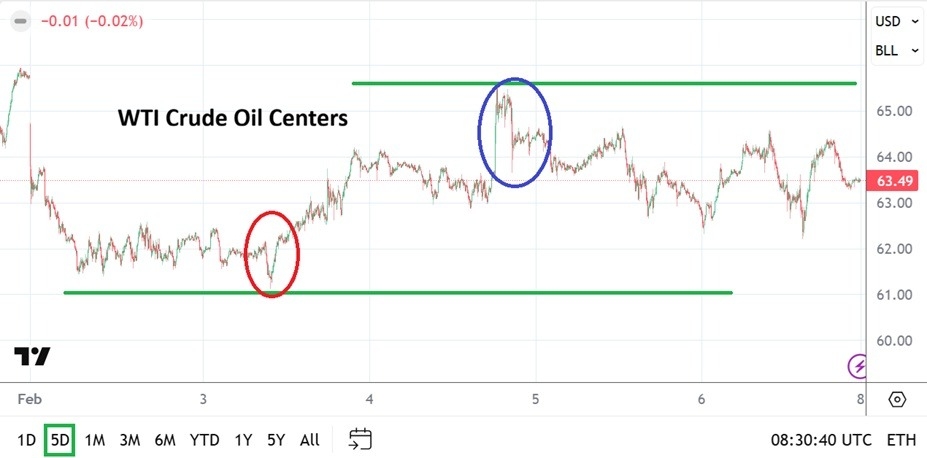
  • WTI Crude Oil Weekly Outlook: Established Range Reasserts Its Pull

    After closing the prior week comfortably above the 65.000 level, WTI Crude Oil began this past Monday with a sharp selloff, dropping to nearly 63.300. From there, price action largely revolved around that area throughout the week, with technical levels guiding the back-and-forth movement.

    Heading into the weekend, WTI is trading near 63.490 and is likely to open with early momentum when markets reopen on Monday. Overall, crude appears to have formed a central pricing zone, reflecting a higher equilibrium that remains reluctant to drift too far from lower levels. Resistance seems to be forming near 65.500, while the 61.000 area is acting as a key support floor—though, of course, there is no guarantee prices will remain confined within this range.

    Short-Term Outlook and Retrospective Analysis

    While some market participants attribute higher WTI crude prices to geopolitical concerns in the Middle East—particularly surrounding Iran and the buildup of U.S. military forces in the region—another factor may be the recent stretch of record cold temperatures across the United States. Notably, WTI crude had been trading with support near the 59.000 level up until January 22.

    The challenge with any of these explanations is the possibility that WTI crude is simply trading higher due to speculative forces, even though broader factors are clearly influencing market sentiment. The combined impact of geopolitical tensions involving Iran and unusually cold weather in the U.S. may be shaping positioning decisions among large market participants. At the same time, WTI has returned to a price range that was already tested back in August 2025, underscoring that this valuation zone is not unfamiliar territory for the commodity.

    Support and Resistance Levels in Focus This Week

    Broader financial markets continue to display signs of unease, with many large traders and institutions positioning defensively and expressing limited confidence in signals coming from other asset classes.

    By contrast, WTI crude oil has continued to grind along within a familiar and well-defined range, potentially creating opportunities for speculative positioning. The opening price action on Monday will be worth watching, especially given that the prior week began with a sharp selloff at the open. A repeat of that move appears less likely this time, as market anxiety seems to have eased somewhat compared with last week. If WTI opens in a more orderly fashion, it could present attractive opportunities to engage around key technical levels.

    WTI Crude Oil Weekly Market Outlook

    If WTI crude oil moves higher at the start of Monday’s session and approaches the 64.000 level, traders may look to target slightly higher price zones. That said, day traders should avoid becoming overly aggressive, as the 64.500 area could present stiff resistance unless upside momentum is firmly maintained. For now, a sharp acceleration to higher levels appears unlikely, with a decisive breakout probably requiring fresh catalysts—such as escalating developments involving Iran—to overcome established resistance.

    Conversely, if WTI opens lower on Monday, the early reaction around the 63.000 support level will be key. A successful hold there would suggest larger participants are comfortable maintaining the current price equilibrium. However, a sustained break below 63.000 lasting several hours could indicate reduced concern among major oil players, potentially opening the door to further downside movement.

    Sources: Robert Petrucci

  • Oil prices were steady, heading for a weekly decline as US-Iran talks remained in focus.

    Oil prices slipped in Asian trading on Friday and were on track for a weekly loss, as markets focused on whether upcoming U.S.–Iran talks could ease Middle East tensions. Investors also priced in a lower risk premium and took profits after last week’s strong gains. Brent futures for April held at $67.58 a barrel, while WTI futures edged up 0.1% to $63.09 by 21:13 ET (02:13 GMT).

    U.S.–Iran negotiations are scheduled to be held in Oman.

    U.S. and Iranian officials are scheduled to hold talks in Oman later on Friday, as military tensions in the Middle East intensify following Washington’s deployment of at least two naval fleets to the region. Investors are optimistic that dialogue between Tehran and Washington could ease tensions and reduce the risk of a wider conflict, prompting traders to strip some geopolitical risk premium from oil prices this week.

    However, differences have emerged over the scope of the discussions, with Iran rejecting U.S. demands to address its missile program and insisting that talks will focus solely on its nuclear ambitions. Iran is a key global oil producer and sits alongside the Strait of Hormuz, a critical chokepoint for global crude shipments.

    Oil set for weekly decline as profit-taking and a stronger dollar weigh

    Brent and WTI futures were down between 2.5% and 4% for the week, as prices came under pressure from profit-taking after six straight weeks of gains. Crude had earlier been supported by expectations of tighter supply, particularly after extreme weather in the U.S. disrupted output nationwide.

    Supply disruptions in Kazakhstan and concerns over an escalation of conflict in the Middle East also lent support to prices. However, sentiment shifted this week as traders locked in profits, while a broader selloff across commodities—driven by a strengthening U.S. dollar—further weighed on oil markets. The dollar was on track for its strongest weekly performance since October, as investors viewed Kevin Warsh, U.S. President Donald Trump’s nominee for the next Federal Reserve chair, as a less dovish choice.

    Sources: Ambar Warrick

  • Oil prices fell more than 1% as markets focused on ongoing U.S.– Iran talks.

    Oil prices fell in Asian trading on Thursday as traders pared back risk premiums after the U.S. and Iran confirmed talks would take place on Friday.

    Crude was also weighed down by a stronger U.S. dollar, which firmed ahead of key January nonfarm payrolls data due on Friday. Attention was additionally focused on major central bank meetings in Europe and the UK later on Thursday.

    Prices reversed some of Wednesday’s strong gains as investors locked in profits, though oil remained on track for a weekly decline after earlier losses driven by a broader selloff in commodity markets.

    Brent crude futures for April slipped 1.4% to $68.50 a barrel, while West Texas Intermediate futures fell 1.3% to $63.80 a barrel by 20:42 ET (01:42 GMT).

    Earlier, oil had found support from data showing U.S. inventories declined more than expected last week, as extreme cold weather disrupted production across the country.

    U.S.– Iran talks are set to be held in Oman on Friday.

    U.S. and Iranian officials are due to meet in Oman on Friday, as confirmed by both sides this week, though disagreements persist over the scope of the talks.

    Washington has repeatedly pushed for the discussions to include Iran’s missile program, while Tehran has said it is only willing to negotiate on its nuclear activities. These differences had earlier raised doubts about whether the meeting would go ahead, a factor that helped lift oil prices earlier in the week.

    Markets have also priced in a higher risk premium for crude amid concerns that U.S. President Donald Trump could follow through on threats to launch new strikes against Iran.

    A stronger dollar weighs on markets as investors await central bank meetings and upcoming payrolls data.

    A firmer dollar added pressure to oil prices, as the greenback attracted strong demand this week.

    Expectations around interest rate decisions from the Bank of England and the European Central Bank on Thursday prompted traders to move into the dollar, while attention also remained on upcoming U.S. nonfarm payrolls data.

    The dollar rebounded sharply from near four-year lows after President Donald Trump nominated Kevin Warsh as the next Federal Reserve chair, a choice seen as less dovish by markets.

    Investors are now focused on January nonfarm payrolls data due on Friday, which is expected to provide clearer signals on the future path of U.S. interest rates.

    Sources: Ambar Warrick

  • WTI edges higher above $63.50 after U.S. downs Iranian drone

    • WTI crude prices edged higher to around $63.75 during Wednesday’s Asian trading session.
    • The move came after the U.S. military said it shot down an Iranian drone that “aggressively approached” a U.S. aircraft carrier, heightening geopolitical tensions.
    • Oil prices were also supported by data showing U.S. crude inventories recorded their largest decline since August 2023.

    West Texas Intermediate (WTI), the U.S. crude oil benchmark, was trading near $63.75 during Asian hours on Wednesday, edging higher amid rising concerns over escalating tensions between the United States and Iran. Market participants are also positioning ahead of the release of the U.S. Energy Information Administration’s (EIA) crude oil inventory report later in the day.

    According to CNBC, the U.S. military shot down an Iranian drone on Tuesday that had “aggressively” approached the USS Abraham Lincoln aircraft carrier in the Arabian Sea. The incident comes at a time of heightened Middle East tensions, as U.S. President Donald Trump weighs potential military action against Iran.

    Iran has also insisted that talks with the United States this week be held in Oman rather than Turkey, and that negotiations be limited to bilateral discussions focused solely on nuclear issues, further complicating an already fragile diplomatic process. Any escalation in tensions between Washington and Tehran—OPEC’s fourth-largest crude producer—could provide near-term support to WTI prices.

    Meanwhile, the American Petroleum Institute’s (API) weekly report showed that U.S. crude inventories fell by 11.1 million barrels in the week ended January 30, sharply deeper than the 250,000-barrel decline seen the previous week and well below market expectations for a 700,000-barrel build. The sizeable drawdown in stockpiles could lend additional support to oil prices.

    On the downside, renewed demand for the U.S. dollar may cap gains in dollar-denominated commodities. U.S. President Donald Trump’s nomination of Governor Kevin Warsh as the next Federal Reserve chair has led traders to expect a slower pace of interest rate cuts and a greater emphasis on reducing the Fed’s balance sheet under his leadership.

    Sources: Lallalit Srijandorn

  • Oil prices rise more than 1% amid escalating Iran tensions and expectations of a sharp drop in U.S. inventories.

    Oil prices climbed sharply during Asian trading on Wednesday, driven by reports of escalating tensions between the United States and Iran, which heightened fears of possible supply disruptions in the Middle East.

    Crude prices also found support from industry figures showing an unexpected and substantial drawdown in U.S. oil inventories last week, as severe cold weather across the country curtailed production.

    April Brent futures advanced 1.2% to $68.15 per barrel, while U.S. West Texas Intermediate crude rose 1.4% to $63.69 per barrel as of 21:01 ET (02:01 GMT).

    Oil prices climb amid escalating U.S.-Iran tensions ahead of nuclear negotiations

    Overnight reports indicated that U.S. forces shot down an Iranian drone that was approaching a U.S. aircraft carrier in the Arabian Sea.

    In a separate incident, several Iranian gunboats were observed nearing a U.S.-flagged oil tanker in the Strait of Hormuz.

    These developments came just ahead of planned talks between Washington and Tehran later this week. However, Iranian officials have reportedly insisted that the negotiations—scheduled for Friday—be limited to bilateral discussions focused solely on nuclear issues, raising uncertainty over whether the talks will proceed at all.

    U.S. President Donald Trump has warned of further military action if Iran fails to comply with U.S. demands to rein in its nuclear program, while Tehran has vowed strong retaliation against any U.S. aggression.

    Any escalation of military activity in the Middle East could potentially disrupt regional oil supplies, a risk that has helped support crude prices in recent trading sessions.

    U.S. oil inventories fall sharply amid production disruptions, API data shows

    Oil prices also found support from industry figures showing a large and unexpected drawdown in U.S. crude inventories.

    Data from the American Petroleum Institute indicated that U.S. stockpiles fell by 11.1 million barrels in the week ended January 30, sharply contrasting with expectations for a 0.7 million-barrel build.

    API figures often signal a similar outcome in the official inventory report due later in the day.

    The sizeable drawdown was driven by severe cold weather across the United States, which disrupted oil production nationwide and hampered exports from the Gulf Coast.

    Supply disruptions in the U.S. have also contributed to stronger oil prices in recent weeks.

    Sources: Ambar Warrick

  • Oil prices tumble more than 3% on U.S.-Iran talks as OPEC+ keeps output steady.

    Oil prices slid sharply in Asian trading on Monday after reports of talks between the U.S. and Iran reduced some of the geopolitical risk premium in crude, while traders also took profits following recent gains.

    The decline came after the Organization of the Petroleum Exporting Countries and its allies (OPEC+) kept output levels unchanged at a weekend meeting, in line with expectations.

    Brent crude futures for April delivery plunged 3.3% to $67.07 a barrel by 20:31 ET (01:31 GMT).

    Oil had climbed to near six-month highs last week amid fears of increased U.S. military action against Iran, while severe cold weather in North America was also seen as a threat to supply. However, prices came under pressure on Monday as traders moved to lock in profits.

    Crude was further weighed down by a rebound in the U.S. dollar from recent four-year lows, after the greenback strengthened following President Donald Trump’s nomination of Kevin Warsh as the next Federal Reserve chair.

    Trump says Iran is in “serious talks” with the U.S.

    U.S. President Donald Trump said over the weekend that Iran was engaged in “serious talks” with his administration, raising the prospect of a possible easing of tensions between the two countries.

    His remarks followed statements from Iranian officials indicating that preparations were underway for negotiations with Washington.

    Trump has repeatedly warned of potential military action against Iran amid disputes over its nuclear program and domestic unrest, and has ordered the deployment of U.S. naval forces to the Middle East.

    The move heightened fears of renewed U.S. strikes on Iran, raising the risk of further geopolitical instability in the Middle East and potential disruptions to regional oil supply. Crude prices surged as markets factored in a higher geopolitical risk premium.

    Escalating tensions, alongside recent weather-related disruptions in the United States, helped lift oil prices despite lingering concerns over weak global demand and the possibility of an oversupplied market in 2026.

    More recently, a significant production outage in Kazakhstan has also provided support to oil prices.

    OPEC+ keeps output levels unchanged

    OPEC+ on Sunday kept its oil output for March unchanged, reinforcing its decision to pause further production increases despite a recent rise in crude prices.

    The group has raised output by roughly 2.9 million barrels per day through 2025, but announced an open-ended halt to additional hikes in November, after oil prices fell by around 20% over the past year.

    OPEC+ also offered no forward guidance on production, likely reflecting elevated uncertainty surrounding the global economic outlook and ongoing geopolitical risks.

    Sources: Investing

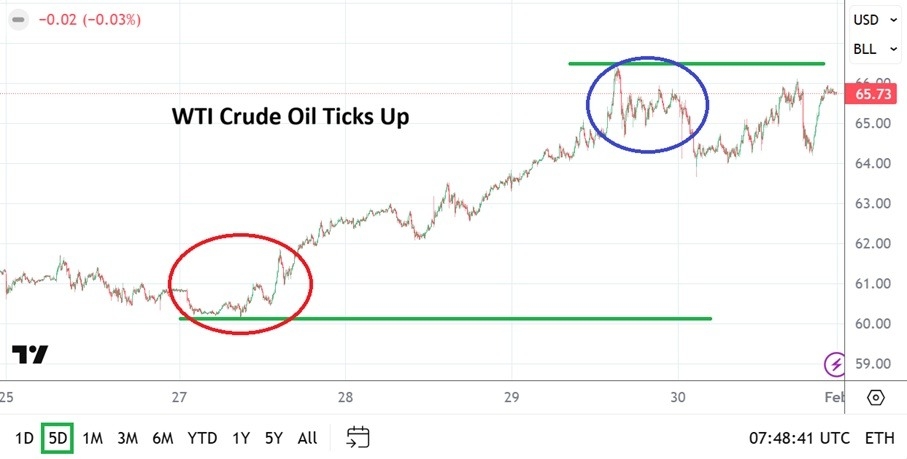
  • WTI Crude Weekly Outlook: Gradual Gains as Speculative Buying Emerges

    WTI crude oil has delivered two consecutive weeks of gains, giving day traders a favorable backdrop, and closed the weekend trading near $65.73. Prices at this level were last seen in the final week of September.

    The previous period when WTI consistently held at similar elevated levels was from mid-June through the end of July 2025. While crude has traded higher at times since then, the notable development for technical traders is the growing durability of the current upward momentum.

    From a chart perspective, support around $60.00 per barrel remained intact throughout the past week and began to demonstrate strength as early as Friday, January 23. As the new trading week gets underway, this technical stability may encourage renewed speculative buying, with some traders positioning for further upside in WTI prices.

    Volatility and Turmoil Mark Commodity Markets Over the Past Week

    In reality, WTI crude oil has remained relatively orderly, particularly given the absence of any extreme or destabilizing price swings. While the commodity did move higher, the advance was measured rather than explosive.

    On Tuesday, WTI rose from the mid-$60 range to around the mid-$62 level, showing early signs of upward pressure. By Wednesday, prices continued to firm, reaching the mid-$63 area. Momentum strengthened further into Thursday and Friday, when price action clearly accelerated to the upside, reinforcing the constructive tone in crude oil trading.

    By comparison with the turmoil seen in metals markets—and even in soft commodities such as cocoa and coffee—WTI crude oil has remained relatively restrained. Whether that composure will persist is an open question.

    Commodity markets often experience bursts of speculative intensity in cycles, yet WTI has been notably subdued over the past several months. That said, the prolonged bearish trend, marked by steadily declining prices, appears to have paused and reversed, with crude moving higher over the last two weeks.

    While geopolitical risks tied to Iran remain in the background, they are unlikely to be the primary driver behind the recent upside move in WTI prices.

    Iran, Venezuela, and Shifting Dynamics in the Global Energy Market

    Few things dominate markets like noise, with well-intentioned commentary offering countless explanations for sudden price moves in commodities. Weather events, wars, politics, trade agreements—even trivial anecdotes—are all quickly cited as causes. But the question remains: how many of these explanations actually reflect the true drivers behind price changes?

    • Commodity traders are highly seasoned, and major market participants operate with extensive intelligence gathered over months and even years. They work within long-term outlooks, but there is also one unavoidable factor: speculation.
    • At times, commodities move quickly simply because large orders enter the market and collective sentiment shifts. WTI crude oil is no exception to these forces. Over the past two weeks, buying interest in the energy sector has clearly increased.
    • Is this driven by speculative positioning, concerns about potential instability in the Middle East, or a blend of both? Beyond those considerations, fundamentals such as supply and demand also play a role—and by most measures, they remain relatively strong.

    WTI Crude Oil Weekly Outlook: Market Poised After Recent Stabilization

    The speculative trading range for WTI crude oil is seen between $59.20 and $70.10.

    WTI has clearly pushed higher, with the $60.00 level and the mid-$60s now appearing to act as near-term support. As the new week begins, the key question is whether the $65.00 area can hold and establish itself as a more durable floor. Broader commodity markets have displayed renewed strength across several sectors in recent weeks.

    The sharp advance in WTI may seem sudden, but it reflects a noticeable return of buying interest. Seasoned traders know crude oil has sustained higher price levels in the past, and its ability to post and maintain incremental gains has been evident over the last two weeks.

    That said, risk management remains critical when trading WTI. Price reversals can occur quickly, and without disciplined controls, such moves can result in significant losses for speculative traders.

    Sources: Robert Petrucci

  • WTI slips toward $64.00 despite heightened geopolitical tensions

    • WTI prices slipped but were still on course for roughly 12% monthly gains, underpinned by elevated geopolitical risk premiums.
    • Iran warned of an unprecedented response following renewed threats from President Trump over nuclear negotiations.
    • Meanwhile, the Trump administration loosened some sanctions on Venezuela’s oil sector on Thursday to attract U.S. investment.

    West Texas Intermediate (WTI) crude edged lower after three consecutive sessions of gains, trading near $64.00 a barrel during Asian hours on Friday. Still, the benchmark remained on track for about a 12% monthly increase, supported by a strengthening geopolitical risk premium.

    Geopolitical tensions stayed elevated after Iran warned it would “defend itself and respond like never before” following renewed threats from U.S. President Donald Trump, who urged Tehran to engage in nuclear negotiations. Iranian officials cautioned that any provocation would be met with retaliation.

    Tensions escalated further after the European Union designated Iran’s Islamic Revolutionary Guard Corps as a terrorist organization. Concerns were compounded by reports that the United States was bolstering its military presence near Iran, while Tehran announced live-fire military exercises in the strategically vital Strait of Hormuz, heightening worries over regional security.

    Markets are closely watching the potential impact of these developments on shipping through the Strait of Hormuz, a critical chokepoint between Iran and the Arabian Peninsula that handles daily flows of crude oil and LNG. According to Dow Jones Newswires, Westpac Strategy Group warned that any regime change in Iran would likely be disorderly, unlike the U.S-backed removal of Venezuela’s Nicolas Maduro or targeted strikes such as those on Fordow.

    Separately, the Trump administration eased certain sanctions on Venezuela’s oil sector on Thursday to attract U.S. investment following President Nicolas Maduro’s removal earlier this month. The U.S. Treasury authorized transactions involving Venezuela’s government and state-run PDVSA, allowing U.S. firms to produce, transport, sell, and refine Venezuelan crude.

    Earlier this month, oil prices also drew support from supply disruptions in Kazakhstan, freeze-offs in the United States, and tighter U.S. restrictions on Russian oil purchases, helping underpin prices this year despite lingering expectations of global oversupply.

    Sources: Fxstreet

  • Fed holds steady, earnings mixed, oil in focus

    The S&P 500 ended the session largely unchanged ahead of a largely uneventful Federal Reserve meeting, which offered little new information beyond reaffirming that the U.S. economy remains in fairly solid condition. The tone of Chair Jay Powell’s press conference also suggested that, at least while he remains at the helm, there are likely to be few—if any—interest-rate cuts in the near term.

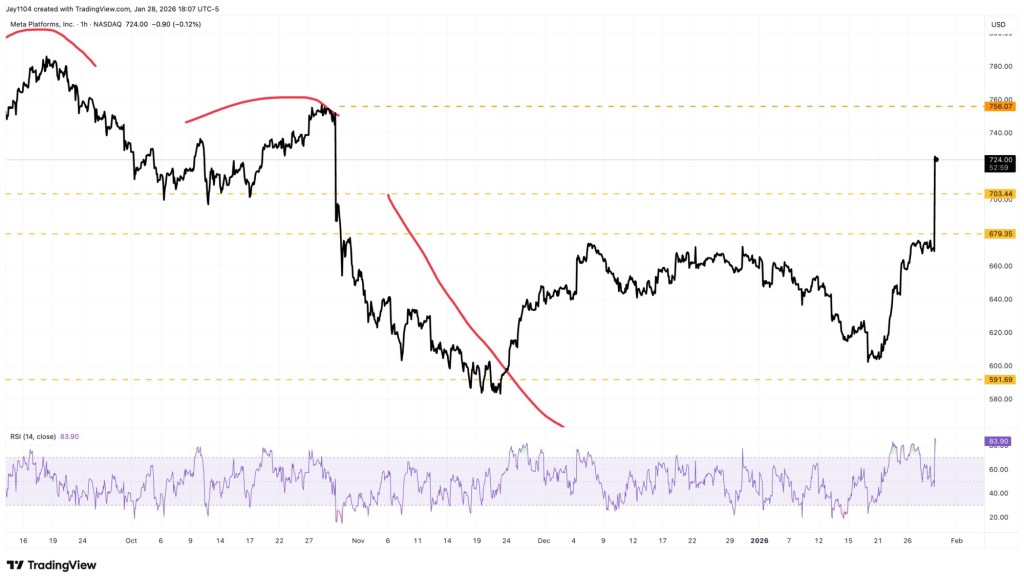
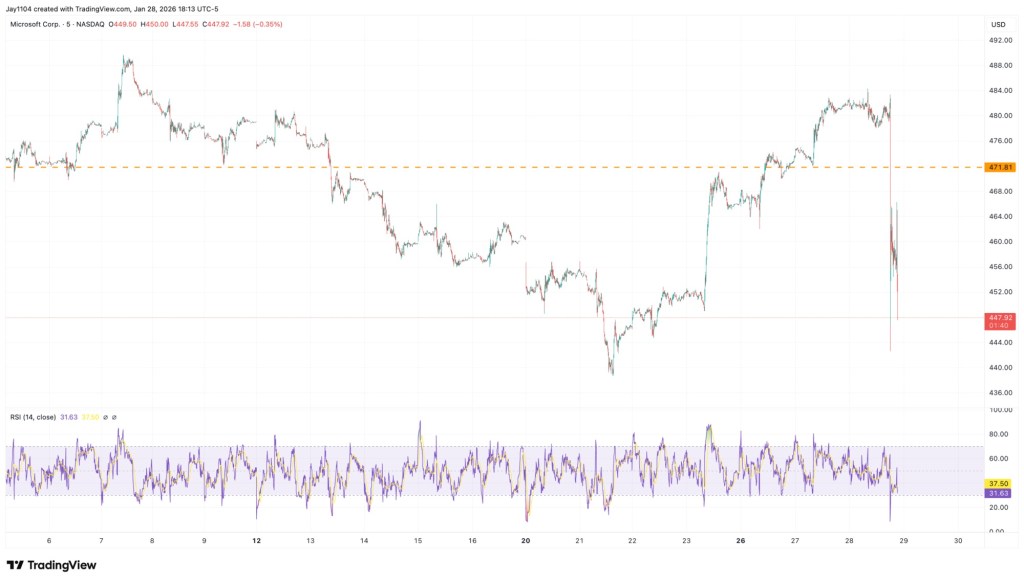
    Earnings released after the close were mixed. Microsoft (NASDAQ: MSFT) fell roughly 6.5%, while Meta Platforms (NASDAQ: META) surged about 7.5%. From an options standpoint, both stocks had bearish setups heading into earnings, with elevated implied volatility and heavy call-delta positioning at higher strike levels. Following the results, implied volatility declined, causing higher-strike calls to lose value and prompting the unwinding of hedges.

    For Meta, the key technical level was $700, which the stock managed to break through, at least initially. Revenue guidance significantly exceeded expectations, leading the market to overlook higher-than-expected capital expenditures for now. The key question will be whether Meta can hold above the $700 level once regular trading resumes.

    For Microsoft, the key level was $500, which the stock failed to break despite reporting better-than-expected results. Investor sentiment was weighed down by weaker-than-expected growth in its Azure cloud business.

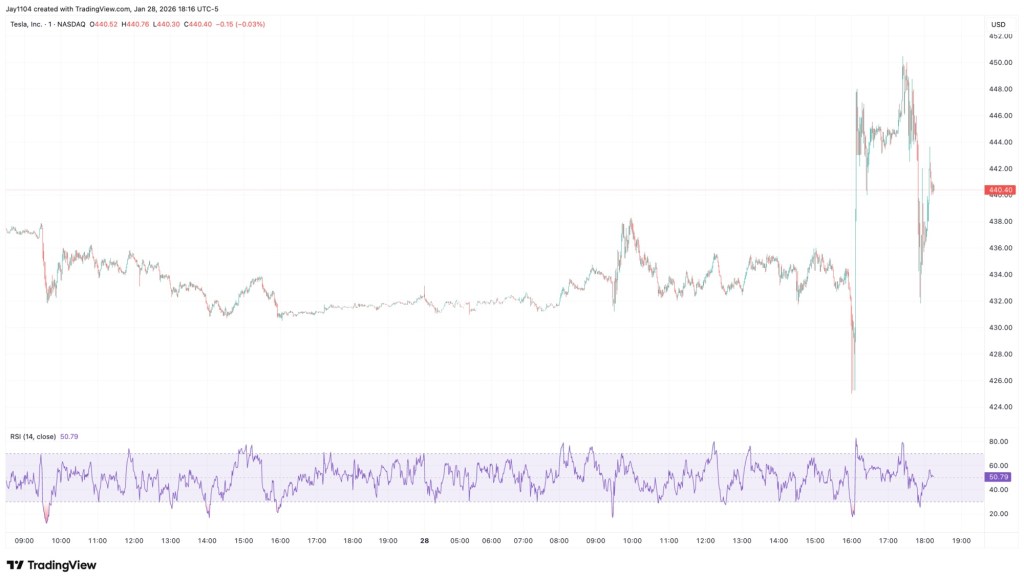
    For Tesla (NASDAQ: TSLA), the setup ahead of earnings was more mixed, but $450 clearly stood out as the key level to break. So far, the stock has tested that threshold but has been unable to hold above it.

    After-hours moves can be unpredictable, which is why it often makes sense to wait and see how price action develops during regular trading hours. How the CDS market trades tomorrow may be even more telling, potentially offering a clearer read on the true implications of the earnings reports.

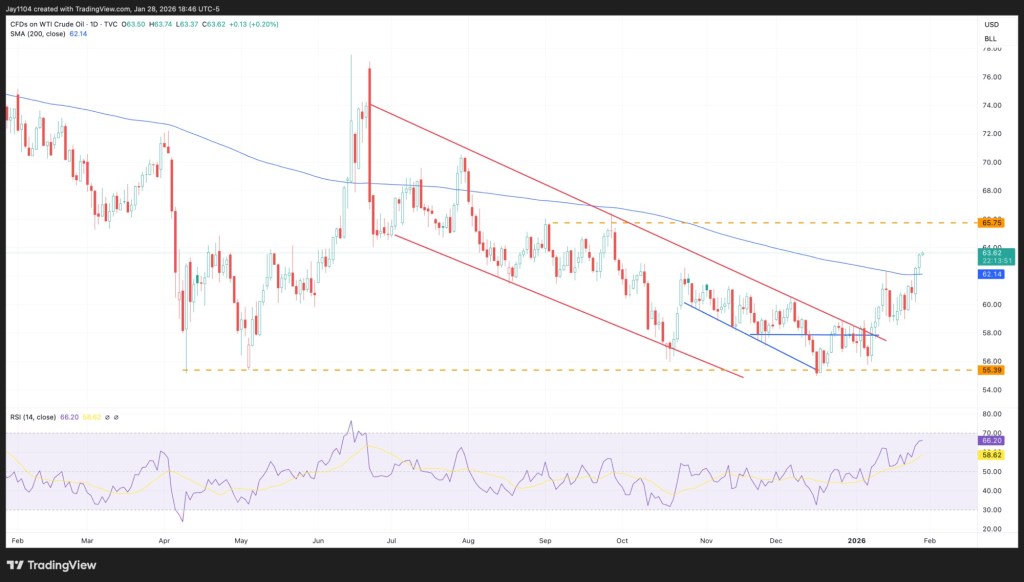
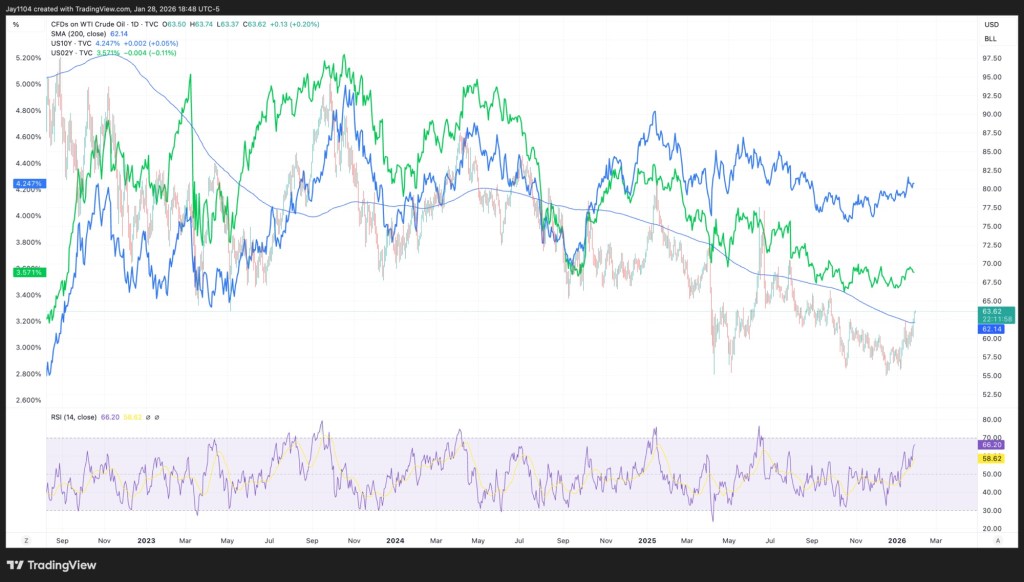
    For now, near-term rate expectations appear more closely tied to oil than to any other factor. Crude has broken out and moved above its 200-day moving average, a technical development that could set the stage for a rally toward $65 in the near term.

    Whether looking at the 2-year or 10-year Treasury yield, the correlation with oil prices since late 2022 has been remarkably strong. As a result, if oil continues to move higher, it would likely put upward pressure on interest rates as well. In that sense, oil may have been the final missing link in the case for higher rates.

    Sources: Michael Kramer

  • Oil prices gain on U.S. supply disruptions and weaker dollar

    Oil prices climbed in Asian trading on Wednesday, extending the previous session’s gains after severe cold weather disrupted U.S. production, signaling tighter supply conditions.

    Crude was also supported by a weaker dollar, which slid to near a four-year low this week, while markets continued to monitor heightened tensions between the United States and Iran following comments from President Donald Trump that a second armada was heading to the Middle East.

    Brent futures for March edged up 0.1% to $67.66 a barrel, hovering near a four-month high, while U.S. West Texas Intermediate futures rose 0.2% to $62.53 a barrel by 20:49 ET (01:49 GMT).

    Oil prices jump as U.S. snowstorm disrupts supply

    Oil’s advance this week was largely fueled by a powerful winter storm sweeping across the United States, which disrupted crude output in several producing regions.

    Exports from the U.S. Gulf Coast were also brought to a standstill, as heavy snowfall and sub-zero temperatures blanketed large parts of the country. According to Reuters estimates, roughly 2 million barrels per day of production were affected over the weekend.

    These supply interruptions have prompted traders to brace for sharp drawdowns in U.S. crude inventories in the weeks ahead, signaling tighter supply conditions in the world’s largest oil-consuming market.

    API data points to declining U.S. inventories

    Figures from the American Petroleum Institute released late Tuesday showed an unexpected decline in U.S. crude inventories last week. Stockpiles fell by roughly 250,000 barrels, according to the API, defying expectations for a 1.45 million-barrel build.

    The API report often foreshadows a similar trend in the official inventory data, which is scheduled for release later on Wednesday.

    Oil gains on softer dollar ahead of Fed rate call

    A weaker dollar also lent support to oil prices, as declines in the greenback tend to boost demand for commodities priced in the U.S. currency.

    The dollar index fell to near a four-year low on Tuesday, weighed down by investor concerns over U.S. economic uncertainty, the impending Federal Reserve interest rate decision, and intermittent trade and geopolitical policy moves under President Donald Trump.

    The Fed is broadly expected to keep interest rates unchanged at the end of its meeting later in the day, with markets focused on signals from Chair Jerome Powell regarding the policy outlook for the year ahead.

    Sources: Investing

  • Oil prices slip as markets weigh US-Iran tensions and winter-related supply disruptions.

    Oil prices edged lower in Asian trading on Tuesday as markets focused on rising US-Iran tensions, while also monitoring potential supply disruptions caused by extreme winter weather in the United States.

    Crude had gained in recent sessions on fears that tensions with Iran could disrupt supply, while a severe snowstorm in the US was estimated to have shut in up to 2 million barrels of oil production over the weekend.

    However, expectations of tighter supply were tempered after Kazakhstan signaled it would resume production at the Tengiz oil field, its largest producing asset.

    Brent crude futures for March slipped 0.6% to $65.22 a barrel, while West Texas Intermediate futures fell 0.5% to $60.33 a barrel by 21:20 ET (02:20 GMT).

    Iran tensions, US weather disruptions in focus

    A US aircraft carrier and several destroyers were seen arriving in the Middle East over the weekend. President Donald Trump said last week that an “armada” was headed toward Iran, though he expressed hope it would not be used.

    The deployment followed Trump’s warnings to Iran over the killing of protesters during recent nationwide demonstrations, although unrest has eased in recent weeks and his rhetoric toward Tehran has softened.

    Meanwhile, a severe snowstorm in the US caused widespread disruptions, halting oil production and straining the power grid, with markets closely watching whether prolonged outages could further tighten crude supplies.

    Kazakhstan signals plans to resume production at the Tengiz oil field.

    Kazakhstan said on Monday it will resume output at the Tengiz oil field after a fire and power outage halted production. However, Reuters reported that initial volumes are expected to be limited, as the country has yet to lift a force majeure on CPC Blend exports.

    Kazakhstan is the world’s 12th-largest oil producer and a member of OPEC and its allies. The group is expected to keep production levels unchanged at its February 1 meeting, after steadily increasing output through 2025 before announcing a pause late last year to curb prolonged weakness in oil prices.

    Sources: CNBC

  • Oil prices hold steady as Greenland tariff concerns ease; US crude inventories in focus

    Oil prices were largely flat in Asian trade on Thursday as U.S. President Donald Trump eased tariff threats related to Greenland. Market participants also weighed an increase in U.S. crude inventories alongside recent supply disruptions. At 22:07 ET (03:07 GMT), March Brent futures inched up 0.1% to $65.31 a barrel, while WTI crude rose 0.2% to $60.74. Both benchmarks have posted modest gains over the past two sessions, underpinned by supply concerns after OPEC+ member Kazakhstan suspended production at the Tengiz and Korolev oilfields on Sunday.

    Trump retreats from tariff threats against Greenland

    Market sentiment improved after President Trump unexpectedly softened his position on Greenland on Wednesday, stepping back from threats to impose tariffs on European countries as leverage to annex the Danish territory. He ruled out the use of force and indicated that a framework for a potential deal was emerging, easing concerns over a sharp escalation in U.S.–EU tensions that could have pressured global growth and energy demand. The de-escalation supported broader risk appetite, although oil markets remained cautious amid mixed supply and demand signals.

    U.S. crude inventories increase again, API data shows

    The American Petroleum Institute (API) reported that U.S. crude stockpiles increased by 3.04 million barrels in the week ending Jan. 16, following a build of more than 5 million barrels the previous week. Gasoline inventories surged by 6.21 million barrels, signaling weaker demand, while distillate stocks—including diesel and heating oil—slipped by 33,000 barrels.

    On the demand front, oil prices drew some support after the International Energy Agency raised its forecast for global oil demand growth in 2026 on Wednesday. Despite the upward revision, the IEA continues to expect the oil market to remain in a substantial surplus through 2026.

    Sources: Investing

  • WTI falls under $59.50 amid easing Iran tensions and rising US – EU trade war fears

    • WTI crude prices edged lower to around $59.25 in early European trading on Tuesday.
    • Tensions surrounding Iran have eased in recent days following earlier speculation about a potential U.S. attack.
    • Market attention is now turning to developments around Greenland after President Trump threatened to escalate tariffs on eight European countries.

    West Texas Intermediate (WTI), the U.S. crude oil benchmark, was trading near $59.25 during early European hours on Tuesday. Prices edged lower as concerns over supply disruptions from Iran eased, while traders continued to assess the implications of the U.S. push to take control of Greenland.

    There were no signs of escalating tensions in Iran over the weekend, although Supreme Leader Ayatollah Ali Khamenei said that 5,000 people were killed in anti-government protests this month, according to Reuters. The easing of tensions has reduced the risk of a potential U.S. attack that could disrupt supplies from a major OPEC producer, weighing on WTI prices.

    Traders are turning their focus to the Greenland crisis after U.S. President Donald Trump said on Saturday that Washington would impose an additional 10% import tariff from February 1 on goods from Denmark, Norway, Sweden, France, Germany, the Netherlands, Finland and the United Kingdom until the U.S. is permitted to purchase Greenland.

    Trump is expected to discuss Greenland at the World Economic Forum in Davos, Switzerland, on Wednesday, while European Union leaders are set to hold an emergency summit in Brussels on Thursday. Concerns that tensions could escalate into a broader U.S.–EU trade war have weighed on market sentiment and may add selling pressure to oil prices.

    “With fears around Iran easing in recent days following rumors of a U.S. attack, market attention has shifted to the Greenland issue and the potential depth of any fallout between the U.S. and Europe, as an expanded trade conflict could weigh on demand,” said Janiv Shah, an analyst at Rystad.

    Meanwhile, the American Petroleum Institute’s (API) crude inventory report is due later on Tuesday. A larger-than-expected draw could signal stronger demand and support WTI prices, while a bigger-than-forecast build would point to weaker demand or oversupply, potentially pressuring prices lower.

    Sources: Fxstreet

  • Crude Oil Outlook: WTI Climbs to Highest Levels in Over Three Months as Escalating Iran Tensions Stir Market Worries

    Oil prices are rising sharply, as WTI nears $62 and Brent crude moves up toward $66 per barrel. These increases highlight the market’s responsiveness to geopolitical tensions, despite no actual disruptions in supply. The question remains: where will prices go from here?

    Main Highlights of WTI Crude Oil

    • WTI Crude Oil prices are sharply rising amid concerns that ongoing protests in Iran might escalate and impact production or disrupt the Strait of Hormuz.
    • However, this upward pressure is balanced by underlying fundamentals and a global surplus.
    • The current price around $62 is a crucial threshold: surpassing this resistance level could pave the way for a rally toward the six-month highs near $66.

    In today’s trading environment, it can be difficult for market participants to isolate the key drivers of price action on a day‑to‑day basis. Beyond enduring themes like economic growth trajectories, inflation trends, the expansion of AI infrastructure, and sovereign debt pressures, fresh geopolitical tensions seem to emerge almost daily.

    Amid simmering issues in places like Venezuela — and speculation about other potential flashpoints — Iran has become the dominant focus for energy markets. Nationwide protests there, sparked by severe economic strains and a collapsing currency, have raised serious questions about stability in one of the world’s most influential oil‑producing countries.

    Although these demonstrations have not yet led to direct disruptions in oil output, the unrest has prompted traders to price in a growing geopolitical risk premium. Concerns about possible escalation — including the risk of broader conflict or disruption to key infrastructure such as the Strait of Hormuz, through which a large share of global seaborne oil exports transit — are contributing to recent volatility in crude prices.

    As a reminder, Iran remains a key influence on global energy markets due to both its oil production capacity and its control over the Strait of Hormuz — a vital maritime chokepoint through which nearly 20 million barrels per day of crude and petroleum products transit, representing a large share of seaborne global oil flows. Any actual or perceived threat to exports or shipping through this route can have outsized impacts on pricing and risk sentiment.

    Against this backdrop, oil prices have recently climbed, with Brent trading in the mid‑$60s and WTI previously approaching the $62 per barrel area, as traders price in geopolitical risk tied to the unrest in Iran. This reflects markets’ sensitivity to potential escalations, even though there have been no confirmed widespread production outages to date.

    However, this upside is balanced by broader market fundamentals. Global oil inventories remain substantial, and additional output from other producers — including resumed Venezuelan exports and lingering oversupply concerns — continues to temper the rally. This backdrop helps explain why prices have fluctuated and, at times, pulled back when geopolitical anxieties ease.

    Looking ahead, the future direction of crude prices is likely to hinge on developments in Iran’s domestic unrest and whether tensions translate into actual disruptions in oil production or interference with key export infrastructure such as the Strait of Hormuz. So far, most of the price appreciation has been driven by risk premium and sentiment rather than physical losses of barrels.

    If broader instability were to disrupt supply routes or exports, markets could respond with a more pronounced and sustained price surge, particularly given the strategic importance of Middle East exports to the global oil system. However, short‑term moves are also currently influenced by macro factors such as inventory data and demand signals, as well as comments from policymakers that can quickly recalibrate risk perceptions.

    Technical Analysis of Crude Oil: Daily Chart for WTI

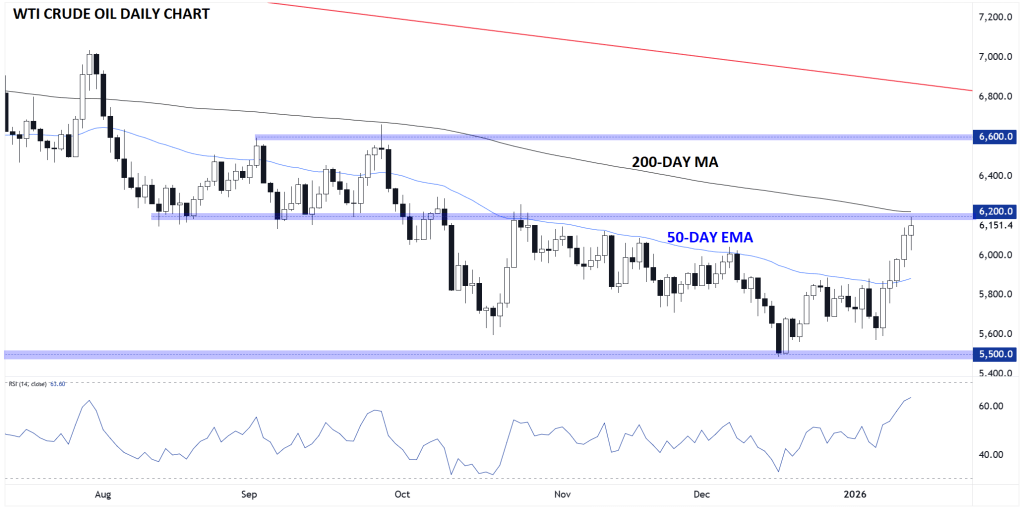
    Looking at the technicals, WTI Crude Oil is on a five-day winning streak, climbing from the lower end of its three-month trading range between $55 and $62 up to the upper boundary. Chart-wise, the current price level is a crucial threshold: a break above the $62 resistance — which also aligns with the 200-day moving average — could open the door for further gains toward the six-month highs around $66, where it would face resistance from the longer-term bearish trend line drawn from the second half of 2023’s peak.

    Conversely, if indications emerge that the protests are easing and stability is being restored in Iran, the geopolitical risk premium currently weighing on crude prices may diminish. This could trigger a reversal, causing prices to retreat below the $60 mark. Regardless of the outcome, oil traders should closely monitor developments in Iran in the days ahead.

    Sources: StoneX

  • WTI Falls Below $61 Amid Rising U.S. Stockpiles and Resumption of Venezuelan Oil Exports

    WTI crude slipped to around $60.70 during Wednesday’s Asian trading session, pressured by significant increases in U.S. crude stockpiles. Meanwhile, President Trump assured Iranian protesters that support is forthcoming.

    West Texas Intermediate (WTI), the U.S. crude oil benchmark, was trading near $60.70 during Wednesday’s Asian session, as prices edged lower amid rising supply pressures. WTI has been pressured by Venezuela restarting oil exports and the latest American Petroleum Institute (API) report showing a large build in U.S. crude inventories, while traders await the official Energy Information Administration (EIA) stockpile figures later in the day.

    According to Reuters and industry sources, Venezuela has begun reversing recent production cuts made under its previous U.S. oil embargo, allowing crude exports to resume. Two supertankers carrying roughly 1.8 million barrels each departed Venezuelan waters, potentially marking the first shipments under a 50‑million‑barrel supply arrangement with Washington, following U.S. control of the country’s exports after political developments.

    U.S. crude inventories saw a significant increase last week, with the American Petroleum Institute (API) reporting a build of 5.27 million barrels for the week ending January 9. This contrasts sharply with the previous week’s drawdown of 2.8 million barrels and defies market expectations, which had forecasted a 2 million barrel decline.

    Despite the growing stockpiles, ongoing geopolitical tensions in Iran—a key oil producer—could provide support for WTI prices. U.S. President Donald Trump canceled all planned meetings with Iranian officials and pledged assistance to protesters amid reports of a severe crackdown by Iranian security forces, which has resulted in hundreds of deaths. Trump has repeatedly warned that the U.S. would intervene if the Iranian government continues to target demonstrators.

    Sources: Investing

  • WTI Holds Steady Above $59 Amid Increasing Supply Concerns

    • WTI prices rise amid growing supply concerns linked to escalating unrest in Iran.
    • President Trump has warned Tehran against using force on protesters, while Iran has warned the U.S. and Israel against any intervention.
    • However, oil price gains may be capped due to anticipated resumption of Venezuelan exports and forecasts of a potential market oversupply.

    West Texas Intermediate (WTI) crude extended its gains for a third consecutive session, trading around $59.10 per barrel during Asian hours on Monday. The rise in oil prices is driven by growing supply concerns amid escalating protests in Iran. As OPEC’s fourth-largest producer, exporting nearly 2 million barrels per day, any conflict escalation poses a significant risk to global supply.

    The unrest, now in its third week and having reportedly resulted in hundreds of casualties, has prompted Iranian authorities to signal a harsher crackdown. Meanwhile, U.S. President Donald Trump warned Tehran against using force on protesters and suggested possible intervention if the situation worsens, while Iranian officials cautioned against any U.S. or Israeli involvement.

    Oil price gains may be restrained by expectations that Venezuelan crude exports could resume following political changes in the country, with the U.S. poised to receive or manage up to 50 million barrels of sanctioned oil under a new arrangement with interim authorities. This potential influx of supply has tempered some of the upside from geopolitical risk.

    However, uncertainty remains over the timing and scale of Venezuelan shipments, as shifting U.S. policy and the logistics of restarting exports from dilapidated ports and vessels cloud the outlook for actual flows.

    Meanwhile, traders are watching for possible supply disruptions from Russia amid ongoing Ukraine attacks on energy infrastructure and the prospect of tougher U.S. sanctions on Russian energy exports — factors that could add upward pressure on prices if they materially reduce output.

    Sources: Fxstreet

  • Oil prices climb on supply disruption risks as Venezuela market worries fade

    Oil prices advanced during Asian trading on Friday, extending the previous session’s rebound as investors focused on possible supply disruptions in Russia and Iran amid geopolitical risks.

    At the same time, fears of an immediate rise in Venezuelan oil output subsided after the U.S. Senate approved a measure requiring congressional authorization for further military action by President Trump.

    Analysts said oil production in the country is unlikely to increase sharply in the near term, even with U.S. intervention.

    Brent crude futures for March rose 0.7% to $62.44 a barrel, while WTI futures gained 0.7% to $58.03 by 21:04 ET (02:04 GMT). Both benchmarks rebounded to levels seen before last week’s U.S. military action in Venezuela after posting more than 4% gains on Thursday.

    Oil prices were supported by positive inflation data from China, the world’s top oil importer, signaling a tentative economic recovery. However, gains were limited as traders remained cautious ahead of key U.S. nonfarm payrolls data that could affect interest rate expectations.

    Markets focus on potential supply disruptions in Russia and Iran

    Concerns about possible supply disruptions in Russia and the Middle East lent support to oil prices this week.

    The conflict between Russia and Ukraine showed little sign of resolution, with ongoing military actions. A drone strike on a tanker headed to Russia in the Black Sea heightened fears of further interruptions to Russian crude supplies.

    Compounding these concerns, reports indicated that U.S. President Donald Trump plans to endorse a bipartisan bill imposing even tougher restrictions on countries trading with Russia, aiming to increase pressure on Moscow to seek a ceasefire.

    Meanwhile, Iraq’s government approved a move to nationalize operations at the West Qurna 2 oilfield—one of the world’s largest—in an effort to avoid supply disruptions stemming from U.S. sanctions on Russia.

    In Iran, escalating nationwide anti-government protests have raised worries about potential impacts on oil production. The government responded with a countrywide internet blackout as demonstrations spread across major cities protesting the Nezam regime.

    Market concerns over Venezuelan oil supply ease

    Oil prices benefited from easing worries that a U.S. intervention in Venezuela would lead to a significant near-term surge in global crude supply.

    Earlier this week, Trump stated that Caracas could deliver up to $3 billion worth of oil to the U.S. and indicated plans for long-term U.S. influence over the country.

    However, Congress has advanced legislation that may restrict U.S. military involvement in Venezuela.

    Many analysts noted that while U.S. involvement could eventually help boost Venezuelan oil production, persistent political turmoil and deteriorated infrastructure make any near‑term surge in output unlikely.

    Oil prices initially plunged after the U.S. detained Venezuelan President Nicolás Maduro and signaled control over the country’s oil industry, but prices had fully recovered by Friday as markets judged immediate changes to supply to be limited.

    Still, crude prices were experiencing their steepest annual decline in five years in 2025, weighed down by concerns over a widening supply glut and sluggish demand growth—an outlook echoed by major global institutions forecasting continued oversupply into 2026.

    Sources: Investing