Tag: Tesla

  • Could 2026 mark the long-anticipated breakthrough for Tesla’s Semi truck?

    When Tesla introduced the Semi in 2017, it billed the vehicle as a game-changer for the heavy-duty trucking industry. Almost ten years on, however, only a limited fleet is in operation. Repeated production delays and Tesla’s focus on higher-visibility ventures such as passenger cars, AI, and robotics have kept the Semi on the sidelines. Still, 2026 could prove to be the decisive year in determining whether the truck can evolve from a pilot project into a viable commercial offering.

    Worldwide sales of heavy-duty trucks reached roughly 2.8 million units in 2024, including about 400,000 in the U.S. Yet electrification in the Class 8 segment remains minimal, as fleet operators tend to prioritise total cost of ownership over branding or technological novelty.

    Tesla argues that the Semi offers a strong economic proposition, citing a claimed 500-mile range from an approximately 850 kWh battery, ultra-fast charging rates of up to 1.2 MW, and significantly lower energy and maintenance costs compared with diesel alternatives. Elon Musk has repeatedly characterised demand as “ridiculous” and the business case as a “no-brainer” for fleet operators.

    On paper, momentum appears to be building. Filings associated with California’s electric-truck incentive programme indicate that nearly 900 Semis were applied for in 2025—more than any traditional truck manufacturer has historically secured. Early customers, including DHL and RoadOne, report performance exceeding expectations and have signalled intentions to expand their fleets once mass production begins.

    Execution risks, however, remain substantial. Tesla is aiming for annual output of up to 50,000 units from its Nevada facility by the end of 2026, a lofty target given that the entire U.S. day-cab tractor market totals fewer than 100,000 units per year. Additional concerns include battery supply constraints following a significant writedown by a major 4680-cell supplier, while drone footage suggests the Nevada production line is not yet fully installed.

    Bernstein analysts also caution that, based on current assumptions, the Semi’s total cost of ownership may still marginally exceed that of best-in-class diesel trucks.

    For established manufacturers such as Daimler, Volvo, and Paccar, Tesla’s influence is unlikely to be felt immediately. Diesel-powered trucks continue to dominate the market, and the electrification of long-haul freight is expected to progress gradually.

    However, if Tesla succeeds in scaling production in 2026, the Semi could alter industry perceptions, prompting increased investment and putting pressure on margins within one of the sector’s most important profit pools.

    Sources: Investing
  • Tesla Stock Rally in Question Following Four Straight Days of Declines

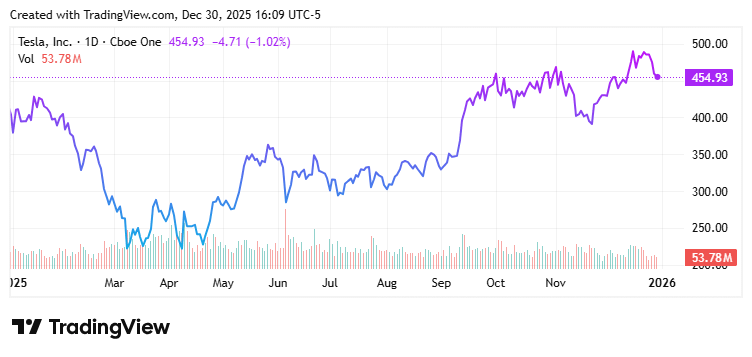
    Shares of auto giant Tesla Inc. closed lower for the fourth consecutive session on December 29, signaling a notable shift in momentum just days after the stock reached a fresh all-time high. Since that peak just before Christmas, Tesla shares have declined nearly 8%, marking a sharp reversal after a hard-fought rally.

    The timing of Tesla’s recent pullback makes it particularly notable. In a market hovering near record highs, Tesla’s sudden loss of momentum just as it enters blue sky territory raises a critical question: is this a healthy pause or an early sign that the rally is losing steam?

    Let’s explore the arguments on both sides.

    A Pullback Was Always Possible Amid Tesla’s Rapid Rally

    Tesla has surged more than 100% since April, with its longer-term uptrend remaining firmly intact. Even after the recent decline, the stock has not broken any major trend structures—it simply looks more pronounced coming off a record high. Many investors had anticipated the rally to accelerate after Tesla finally cleared long-term resistance, rather than pull back.

    From a technical perspective, a pullback of this magnitude is normal and consistent with previous corrections the stock has experienced this year. The latest rally phase was largely one-directional, making profit-taking after major milestones expected.

    Tesla’s shares could fall another 8% and still remain within the rising trend channel that has supported the stock since spring. Viewed this way, the recent selloff represents a period of digestion rather than a breakdown. Healthy uptrends rarely move in straight lines—something Tesla investors are all too familiar with.

    This outlook is further supported by Tradesmith’s Health Indicator, a volatility-based measure of stock price strength. According to this indicator, Tesla (TSLA) stock has remained in the green zone for four consecutive months, signaling a healthy underlying trend despite recent pullbacks.

    A Change in Tone Marks Shift in Market Sentiment Around Tesla Stock

    While a pullback is normal after reaching an all-time high, four consecutive lower closes suggest there is more at play than just short-term profit-taking. The sustained selling pressure indicates that bears have firmly taken control from the bulls, with little defense visible so far.

    The critical question now is whether buyers will quickly re-enter the market. If they do, this pullback may be seen as a buying opportunity for long-term investors. If not, the market could begin to reassess the remaining upside potential ahead of the next major catalyst—January’s earnings report.

    Analyst Support Remains Strong as Tesla Navigates Recent Price Decline

    Despite recent weakness, analyst conviction in Tesla remains firm. Over the past week, both RBC and Canaccord Genuity reaffirmed their Buy ratings on the stock. Canaccord Genuity even raised its price target to $551, implying roughly 20% upside from current levels.

    These positive calls suggest that the recent selloff is a minor pullback within a larger, ongoing uptrend that still has significant room to grow, even if near-term price action appears uncomfortable. While Sell ratings, such as one from UBS Group last week, persist, they remain rare exceptions in an otherwise solid analyst consensus.

    This broader trend of sustained analyst support is particularly important during periods of market uncertainty like the current one.

    Why the Next Few Trading Sessions Are Crucial for Tesla Stock

    Despite the ongoing pullback, it would be a mistake to dismiss the recent price action entirely. Runs of consecutive red days like this are rare for Tesla, especially so soon after hitting new highs. The fact that this is occurring while the broader market remains strong adds an extra layer of concern.

    Tesla’s high valuation intensifies this tension. Trading with a price-to-earnings ratio above 300, the stock leaves little margin for error. Any sign of disappointment in the company’s upcoming earnings report at the end of January could lead to a swift selloff. Confidence, not just momentum, is now a crucial factor.

    This makes the upcoming sessions particularly important. How Tesla performs through the remainder of the holiday week and into early January will provide vital clues about the health of the rally. Stabilization or a quick rebound would suggest the pullback is routine. Continued weakness, however, would encourage bearish sentiment and shift the narrative from consolidation to growing doubt.

    Sources: Investing