Tag: oil trading

  • Missile strikes by Iran have brought the conflict to the edge of the Persian Gulf, reinforcing support for the joint campaign led by the United States and Israel.

    Thunderous explosions and massive fireballs from missiles launched by Iran across the Gulf underscored a long-feared reality for regional leaders: Tehran can carry the fight directly to their territory. The attacks are likely to solidify Arab governments’ backing for joint action by the United States and Israel.

    Even on the Palm Jumeirah — Dubai’s most exclusive enclave — blasts shook buildings and struck a luxury hotel, sending residents scrambling as missiles and interceptors streaked overhead. The scenes made clear that the conflict had spilled beyond Iran’s borders, just as Tehran had cautioned.

    “What has now been demonstrated is that we — not the United States — are directly exposed,” said Ebtesam Al-Ketbi of the Emirates Policy Center. “When Iran attacked, it hit the Gulf first, claiming it was targeting U.S. bases.”

    Analysts say Tehran’s strikes are designed to show that no American ally in the region is out of reach and to increase the price of supporting Washington’s campaign. But they warn that any error in judgment could turn calibrated signaling into full-scale war.

    Gulf officials argue that by hitting oil-producing neighbors, Iran is widening the battlefield and putting global energy supplies at risk, not merely regional stability. For rapidly expanding economies such as Saudi Arabia, Qatar and the United Arab Emirates — all reliant on open skies, safe sea lanes and steady trade — a broader confrontation would be severely destabilizing.

    By casting the confrontation as a campaign for regime change in Iran, President Donald Trump has raised the stakes, increasing the likelihood that Tehran could retaliate more aggressively, observers say.

    If Iran were to misjudge and directly attack Gulf Cooperation Council states, the nature of the conflict would shift dramatically. Regional governments would be under intense pressure to respond as lives and strategic assets come under threat.

    Some Gulf analysts contend that Iran is undermining its own strategic interests by striking neighboring states. While Tehran insists it is targeting U.S. military installations, Gulf capitals view the attacks as clear violations of sovereignty.

    In recent indirect talks with Washington aimed at defusing tensions, Iran signaled willingness to negotiate over its nuclear program but refused to discuss its ballistic missile arsenal or its backing of regional militias. Tehran has suggested that such issues be handled in a regional dialogue excluding the United States — a proposal Gulf states argue would weaken rather than strengthen the existing security framework, given their longstanding reliance on U.S. protection.

    From their perspective, Iran’s missile capabilities and network of proxies pose immediate threats. Without external security guarantors, they see little credibility in a regional-only arrangement.

    Meanwhile, Trump’s rhetoric has shifted notably. Whereas he previously described potential U.S. strikes as leverage to secure a nuclear agreement, he has more recently framed them in terms that imply regime change. Unlike the large-scale 2003 invasion of Iraq under George W. Bush, which involved a prolonged troop deployment and occupation, the current strategy appears focused on limited air operations designed to achieve swift, visible outcomes while minimizing American casualties and domestic political fallout.

    The bet is that a short, decisive campaign would yield political benefits, whereas a drawn-out war — especially one disrupting oil flows or the broader economy — could carry heavy costs.

    Should the conflict expand to include U.S. bases, diplomatic missions, energy infrastructure, or the crucial maritime corridor of the Strait of Hormuz, the economic and political repercussions for the United States, the Gulf, and global markets would escalate sharply.

    Sources: Reuters

  • Markets in focus: Nvidia, Salesforce results and U.S.–Iran nuclear negotiations

    Futures tied to the main U.S. stock benchmarks edged lower as investors focused on key earnings from the technology sector. Nvidia, a heavyweight in the U.S. equity market, delivered stronger-than-expected results, though investors are seeking clearer guidance on when its substantial cash flow will translate into greater shareholder returns. Salesforce shares declined after issuing a softer revenue outlook. Meanwhile, oil prices held steady ahead of crucial nuclear negotiations between U.S. and Iranian officials.

    Futures Edge Lower

    U.S. equity futures moved down Thursday as markets digested earnings from AI leader Nvidia.

    As of 03:05 ET (08:05 GMT), Dow futures were down 122 points, or 0.3%, S&P 500 futures slipped 0.1%, and Nasdaq 100 futures also fell 0.1%. This followed gains across all major Wall Street indices in the previous session, when investors positioned ahead of Nvidia’s earnings release.

    Sentiment had improved on renewed optimism surrounding artificial intelligence, marking another shift in what has been a volatile narrative around the emerging technology. The Nasdaq led prior gains as investors regained confidence that AI could eventually deliver broad economic benefits — contrasting with earlier concerns that new AI models might disrupt software firms and limit returns on heavy data center spending.

    Remarks from Richmond Fed President Tom Barkin also supported equities, as he noted uncertainty over whether automation would significantly raise unemployment and suggested AI could instead improve labor market efficiency.

    Nvidia Little Changed Despite Strong Results

    Nvidia reported better-than-expected earnings for the January quarter and issued revenue guidance above forecasts for the current period, yet its shares were mostly flat in after-hours trading.

    Some investors questioned whether the chipmaker is returning sufficient capital to shareholders. Yvette Schmitter, CEO of Fusion Collective, pointed out that while Nvidia generated $35 billion in cash during the fourth quarter, it returned just 12% to shareholders — sharply lower than 52% a year earlier.

    She also raised concerns about reduced buybacks despite record cash generation, especially as Nvidia highlights strong demand for its sold-out Ampere chips.

    These concerns echoed questions raised during the company’s earnings call, including from a UBS analyst who asked whether Nvidia plans to distribute more of the anticipated $100 billion in cash expected this year. CFO Colette Kress emphasized ongoing investment in the broader AI ecosystem, while CEO Jensen Huang underscored AI’s foundational role in the future of computing.

    Salesforce Drops on Soft Revenue Outlook

    Salesforce shares fell in extended trading after the company issued fiscal 2027 revenue guidance below Wall Street expectations, suggesting softer demand for enterprise software amid economic uncertainty and tighter corporate budgets.

    The company projected full-year revenue between $45.80 billion and $46.20 billion, slightly below consensus estimates at the midpoint.

    Salesforce continues to invest heavily in artificial intelligence to counter investor concerns that emerging AI models, such as those developed by startups like Anthropic, could erode demand. These pressures have contributed to stock volatility as the company works to defend its position within the software-as-a-service industry.

    However, Salesforce raised its fiscal 2030 revenue forecast to $63 billion from $60 billion, citing expected growth from agentic AI offerings. Analysts at Vital Knowledge described the report as not flawless but “good enough,” highlighting strong AI product momentum, stable core performance, and solid cash flow generation.

    Oil Steady Before U.S.- Iran Talks

    Oil prices were largely unchanged Thursday, remaining near seven-month highs as markets prepared for a third round of nuclear discussions between Washington and Tehran.

    Brent crude gained 0.2% to $70.84 per barrel, while U.S. West Texas Intermediate rose 0.2% to $65.62 per barrel.

    U.S. representatives, including special envoy Steve Witkoff and adviser Jared Kushner, are scheduled to meet Iranian officials in Geneva as negotiations continue over Iran’s nuclear program. President Donald Trump has warned that failure to make meaningful progress could lead to serious consequences, raising concerns that prolonged tensions may disrupt supply from Iran, a key OPEC producer.

    Gold Edges Higher

    Gold prices ticked up as uncertainty surrounding U.S. trade tariffs bolstered safe-haven demand, with investors also monitoring developments in the U.S.-Iran nuclear talks.

    Spot gold rose 0.6% to $5,196.55 per ounce, while U.S. gold futures dipped 0.5% to $5,200.54 per ounce.

    Markets are also evaluating the implications of newly announced U.S. tariffs following a Supreme Court ruling that struck down President Trump’s sweeping reciprocal tariff measures. Attention now turns to upcoming U.S. economic data, including weekly jobless claims. So far this year, gold has remained supported by geopolitical tensions, central bank buying, and portfolio diversification trends.

    Sources: Scott Kano

  • Gold gains on tariff jitters; oil steadies near seven-month highs before United States–Iran talks.

    Gold price

    Gold edged higher in Asian trading on Wednesday, recovering slightly after the prior session’s pullback driven by profit-taking, as markets weighed the effects of newly enacted U.S. tariffs and looked ahead to upcoming U.S.–Iran negotiations later this week.

    Spot gold climbed 0.8% to $5,184.55 per ounce as of 21:08 ET (02:08 GMT), while U.S. gold futures advanced 0.5% to $5,203.10 an ounce. The metal had dropped 1.6% on Tuesday, ending a four-day winning streak.

    On Tuesday, the U.S. began enforcing a temporary 10% blanket import tariff, with the Trump administration aiming to raise it to 15%. The move has heightened concerns about global trade disruptions and inflationary pressures. This action came after a U.S. Supreme Court decision last week invalidated earlier broad tariffs introduced under emergency powers, prompting the government to reinstate duties using alternative legal grounds.

    Investors also monitored geopolitical developments, as Washington and Tehran are scheduled to hold a third round of nuclear discussions in Geneva on Thursday.

    Despite the rebound, gold’s upside remained limited amid expectations that U.S. interest rates will stay higher for longer. Two Federal Reserve officials indicated on Tuesday that there is little urgency to adjust monetary policy, reinforcing a rate outlook that tends to weigh on non-yielding assets like gold.

    Additional pressure came from a firmer U.S. dollar, which makes commodities priced in dollars more expensive for foreign buyers. The U.S. Dollar Index was broadly unchanged after rising 0.1% in the previous session.

    Among other precious metals, silver gained 1.6% to $88.59 per ounce, while platinum surged 2.3% to $2,224.60 an ounce.

    Oil price

    Oil prices stayed close to seven-month peaks on Wednesday, as fears of potential U.S.–Iran military confrontation that could disrupt crude supplies kept investors cautious ahead of fresh talks scheduled for Thursday.

    Brent crude rose 43 cents, or 0.6%, to $71.20 per barrel by 0400 GMT, while WTI gained 38 cents, or 0.6%, to $66.01. Brent touched its highest level since July 31 last week, and WTI reached its strongest point since August 4 earlier this week. Both benchmarks have remained elevated as Washington deployed additional military assets to the Middle East in an effort to pressure Tehran into negotiations over its nuclear and ballistic missile programs.

    A prolonged conflict could threaten exports from Iran—the third-largest producer within Organization of the Petroleum Exporting Countries—as well as other key producers in the region. Analysts at ING noted that persistent uncertainty is likely to keep a significant geopolitical risk premium embedded in prices, leaving markets highly responsive to new developments.

    U.S. representatives Steve Witkoff and Jared Kushner are expected to meet Iranian officials in Geneva on Thursday for a third round of negotiations. Iran’s Foreign Minister Abbas Araqchi said a deal is achievable, provided diplomacy takes precedence. Meanwhile, Donald Trump has warned of “very bad consequences” if no agreement is reached, with uncertainty remaining over whether Iran’s potential concessions would satisfy Washington’s demand for zero uranium enrichment, according to IG analyst Tony Sycamore.

    Heightened tensions have also coincided with reports that Iran and China are advancing discussions over the purchase of Chinese anti-ship cruise missiles, which could pose a threat to U.S. naval forces stationed near Iran’s coastline. Experts say such weapons would significantly bolster Tehran’s strike capabilities.

    Trump is set to address Congress in his State of the Union speech on Tuesday evening, where he is expected to outline his Iran strategy, though specific details have not been disclosed.

    Beyond geopolitics, traders are monitoring supply-demand dynamics. The American Petroleum Institute reportedly showed a sharp 11.43-million-barrel increase in U.S. crude inventories for the week ended February 20, even as gasoline and distillate stocks declined. Official data from the U.S. Energy Information Administration is due later Wednesday.

  • Oil stays near seven-month highs ahead of U.S.–Iran talks, with tariff uncertainty clouding the outlook.

    • Oil prices edged higher during Asian trade on Tuesday, remaining just under the seven-month peaks reached in the prior session, as markets looked ahead to upcoming U.S.–Iran discussions later this week. Ongoing uncertainty surrounding trade tariffs continued to temper investor sentiment.
    • At 22:22 ET (03:22 GMT), Brent crude futures climbed 0.8% to $72.04 per barrel, while U.S. West Texas Intermediate (WTI) crude futures also advanced 0.8% to $66.81 per barrel.
    • Both benchmarks had approached seven-month highs in the previous session before ending slightly lower.

    Market participants are holding back ahead of US – Iran talks scheduled for later this week.

    Markets stayed tense ahead of a third round of nuclear talks between Washington and Tehran set for Thursday in Geneva. Strains have persisted since last week amid indications that the situation could escalate. The U.S. pulled some non-essential embassy staff from Beirut, underscoring concerns that diplomacy might collapse and spark conflict.

    President Donald Trump warned in a social media post on Monday that it would be a “very bad day” for Iran if no agreement is reached.

    “In the event of a deal, we would likely see a significant unwinding of the risk premium currently built into prices — though securing such an agreement is far from straightforward,” analysts at ING noted.

    A failure in negotiations could heighten worries about stricter sanctions enforcement or potential disruptions in the Strait of Hormuz, a crucial corridor for global crude shipments. Fears of a possible military clash contributed to a 6% surge in oil prices last week.

    Tariff tensions under Donald Trump weigh on demand outlook

    Oil markets are also contending with wider macro uncertainty after the Supreme Court of the United States invalidated an earlier round of tariffs introduced under emergency powers.

    Donald Trump has since sought to reinstate duties of up to 15% using alternative legal provisions and cautioned that countries that “play games” in trade negotiations with the U.S. could be hit with steeper tariffs.

    The risk of renewed trade tensions has darkened the global growth and fuel demand outlook, limiting oil’s advance even as geopolitical concerns continue to lend support to prices.

    Sources: Ayushman Ojha

  • Oil declines amid US – Iran nuclear negotiations and uncertainty over Trump tariffs.

    Oil prices fell more than 1% in Asian trading on Monday, taking a breather after last week’s sharp rally, as investors assessed the likelihood of a third round of U.S.-Iran nuclear negotiations and renewed uncertainty around U.S. trade policy.

    By 20:50 ET (01:50 GMT), Brent crude for April delivery dropped 1% to $71.03 a barrel, while WTI crude declined 0.9% to $65.75 a barrel.

    Both benchmarks had climbed nearly 6% last week amid signs of a potential U.S.-Iran confrontation and an unexpected drawdown in U.S. crude inventories, which supported prices.

    Traders watch third round of U.S.- Iran nuclear talks

    Iran and the United States are expected to hold a third round of nuclear discussions on Thursday in Geneva, raising hopes that tensions may ease.

    Iranian Foreign Minister Abbas Araghchi told CBS’s “Face the Nation” on Sunday that there is a strong possibility of reaching a diplomatic resolution, adding that an agreement is within reach. Markets viewed the remarks as a signal of potential compromise.

    Iran is a major producer within OPEC and possesses some of the largest proven oil reserves globally. The country also borders the Strait of Hormuz, a vital chokepoint that handles about one-fifth of the world’s seaborne oil. Any escalation involving Iran could disrupt shipments and drive up freight and insurance costs.

    Trump raises global tariffs to 15%

    Meanwhile, U.S. President Donald Trump unveiled new global tariffs, initially imposing a 10% duty on imports for 150 days after the U.S. Supreme Court invalidated his previous, broader tariff plan.

    The administration increased the rate to 15% on Saturday—the maximum permitted under the applicable law—adding fresh uncertainty to global trade and demand prospects.

    Higher tariffs can strain supply chains and prompt retaliatory actions from trade partners. Slower trade activity and weaker industrial production typically weigh on fuel consumption.

    Sources: Ayushman Ojha

  • Oil hovers near six-month peak on US-Iran tensions, poised for strong weekly gains.

    Oil prices moved modestly higher in Asian trading on Friday, building on strong gains from the prior two sessions and putting major benchmarks on course for roughly a 6% weekly advance, as rising tensions between the U.S. and Iran heightened concerns about potential supply disruptions in the Middle East.

    By 22:41 ET (03:41 GMT), Brent for April delivery climbed 0.2% to $71.81 a barrel, while West Texas Intermediate (WTI) crude rose 0.5% to $66.78 a barrel.

    Both contracts were hovering near their highest levels since early August and were set to record weekly gains of more than 6%.

    Oil near six-month high on US-Iran tensions

    Investor anxiety has intensified after U.S. President Donald Trump warned Tehran that “bad things” could follow if a nuclear agreement is not reached within roughly 10–15 days, raising the possibility of military action.

    According to a Wall Street Journal report, Trump is considering a limited strike on Iranian targets to pressure Tehran into accepting a nuclear deal.

    Any escalation involving Iran — a key OPEC producer — could jeopardize shipments through the Strait of Hormuz, a vital passageway that handles about one-fifth of global oil trade, thereby increasing the market’s sensitivity to geopolitical risk.

    This week’s rally also marked a rebound from earlier losses, when prices slipped at the start of the week on hopes that U.S.-Iran negotiations were making progress. The renewed tough rhetoric has since restored a geopolitical risk premium, pushing crude back toward multi-week highs.

    US crude inventories drop sharply – EIA

    Data from the U.S. Energy Information Administration on Thursday showed crude stockpiles fell by around 9 million barrels last week, defying expectations for a 1.7 million-barrel increase.

    The report also indicated declines in gasoline and distillate inventories, both coming in below forecasts, suggesting solid demand from refiners and consumers.

    Markets are now awaiting the release of the U.S. Personal Consumption Expenditures (PCE) Price Index later on Friday — the Federal Reserve’s preferred measure of inflation.

    Following recent hawkish Fed minutes that signaled policymakers are in no rush to cut interest rates, the PCE data could offer additional insight into the central bank’s policy trajectory.

    Sources: Ayushman Ojha

  • WTI holds above $65.00 amid persistent geopolitical tensions.

    • WTI prices could stage a rebound as supply concerns intensify amid escalating US-Iran tensions and stalled Ukraine-Russia negotiations.
    • Talks between Washington and Tehran have yielded little concrete progress, with Iranian officials only اشاره to a broad framework for a potential nuclear agreement, leaving uncertainty over future crude exports.
    • Meanwhile, peace discussions between Ukraine and Russia held in Geneva concluded without a breakthrough, sustaining geopolitical risks that may continue to underpin oil prices.

    West Texas Intermediate (WTI) crude slips slightly on Thursday after plunging 4.9% in the previous session, hovering around $65.00 per barrel during Asian trading. Despite the recent drop, oil prices may find support from potential supply disruptions linked to rising US-Iran tensions and stalled Ukraine-Russia peace efforts.

    Negotiations between Washington and Tehran remain unresolved. Iranian officials have pointed to a “general agreement” on the framework of a possible nuclear deal, but key differences persist. US Vice President JD Vance stated that Iran failed to meet Washington’s red lines, while US President Donald Trump reiterated that military action remains an option. Reports suggest that any potential US strike could develop into a prolonged campaign, with Israel advocating for an outcome aimed at regime change in Iran.

    Meanwhile, peace talks in Geneva between Ukraine and Russia concluded without tangible progress, according to Reuters. Ukrainian President Volodymyr Zelenskiy accused Moscow of stalling US-backed diplomatic efforts to end the four-year conflict. Trump has urged Kyiv to consider a deal that could involve significant concessions, even as Russian forces continue attacking energy infrastructure and making battlefield advances.

    On the trade front, India’s state-run Bharat Petroleum Corporation Limited (BPCL) reportedly made its first-ever purchase of Venezuelan crude, while HPCL Mittal Energy Limited resumed buying cargoes from Venezuela for the first time in two years.

    In US inventory data, the American Petroleum Institute (API) reported a 0.609 million-barrel decline in weekly crude stocks, partially offsetting the previous week’s massive 13.4 million-barrel build — the largest increase since January 2023.

    Sources: Akhtar Faruqui

  • Fed holds steady, earnings mixed, oil in focus

    The S&P 500 ended the session largely unchanged ahead of a largely uneventful Federal Reserve meeting, which offered little new information beyond reaffirming that the U.S. economy remains in fairly solid condition. The tone of Chair Jay Powell’s press conference also suggested that, at least while he remains at the helm, there are likely to be few—if any—interest-rate cuts in the near term.

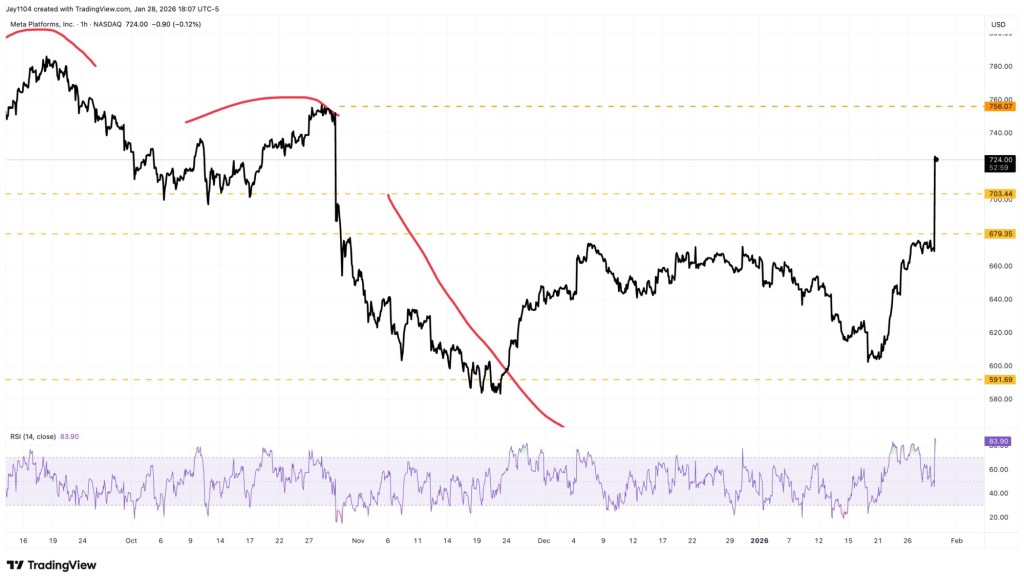
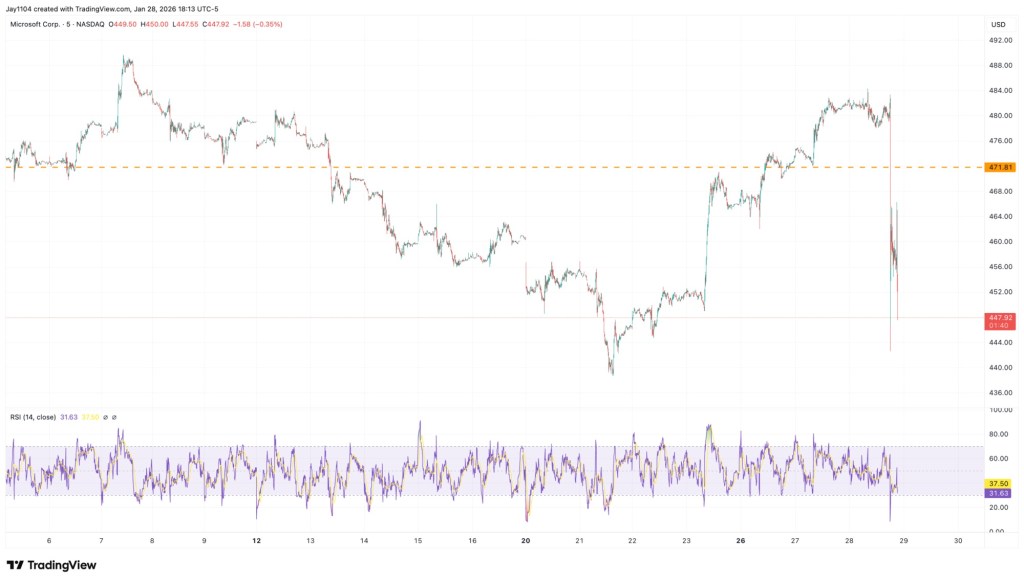
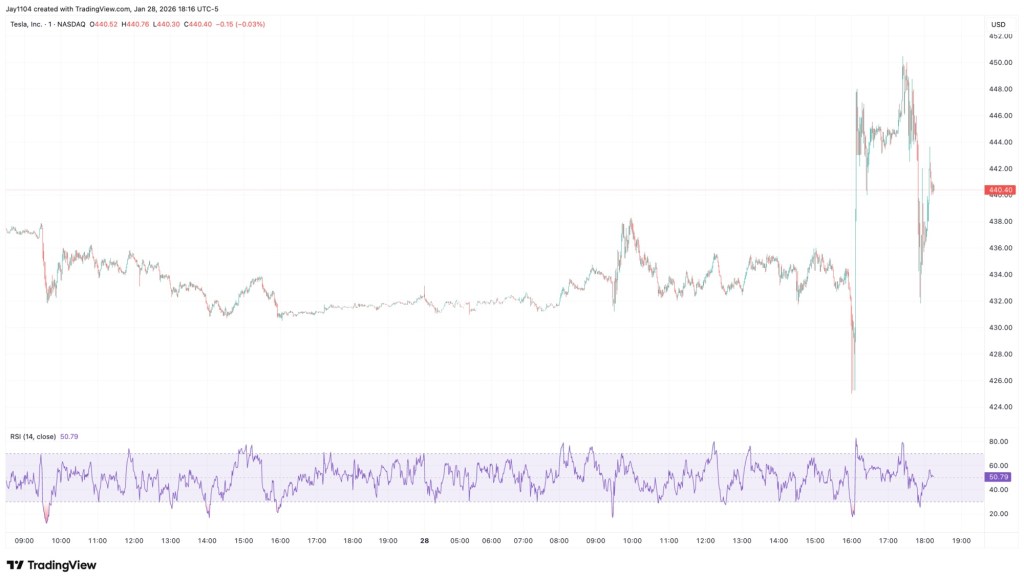
    Earnings released after the close were mixed. Microsoft (NASDAQ: MSFT) fell roughly 6.5%, while Meta Platforms (NASDAQ: META) surged about 7.5%. From an options standpoint, both stocks had bearish setups heading into earnings, with elevated implied volatility and heavy call-delta positioning at higher strike levels. Following the results, implied volatility declined, causing higher-strike calls to lose value and prompting the unwinding of hedges.

    For Meta, the key technical level was $700, which the stock managed to break through, at least initially. Revenue guidance significantly exceeded expectations, leading the market to overlook higher-than-expected capital expenditures for now. The key question will be whether Meta can hold above the $700 level once regular trading resumes.

    For Microsoft, the key level was $500, which the stock failed to break despite reporting better-than-expected results. Investor sentiment was weighed down by weaker-than-expected growth in its Azure cloud business.

    For Tesla (NASDAQ: TSLA), the setup ahead of earnings was more mixed, but $450 clearly stood out as the key level to break. So far, the stock has tested that threshold but has been unable to hold above it.

    After-hours moves can be unpredictable, which is why it often makes sense to wait and see how price action develops during regular trading hours. How the CDS market trades tomorrow may be even more telling, potentially offering a clearer read on the true implications of the earnings reports.

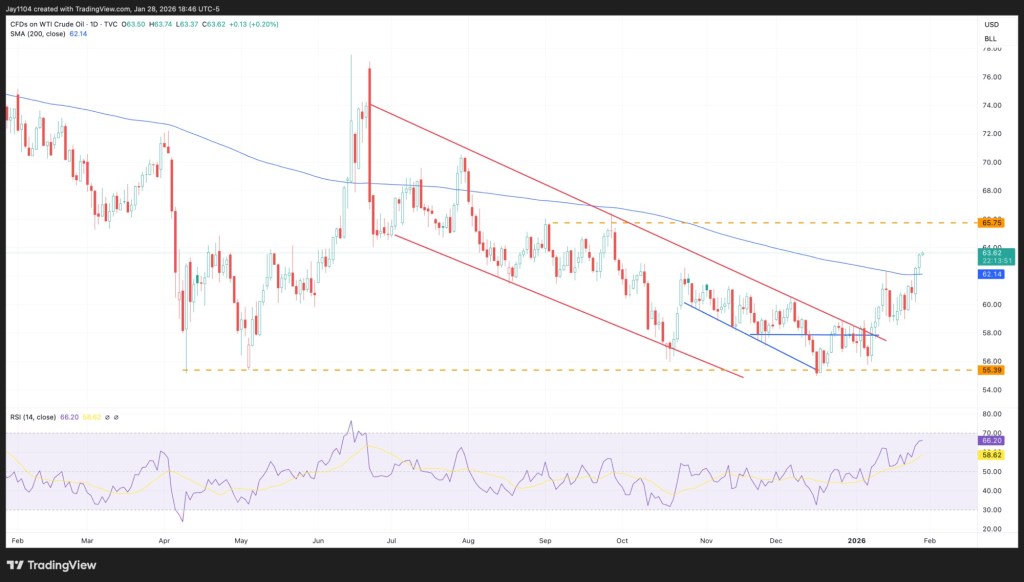
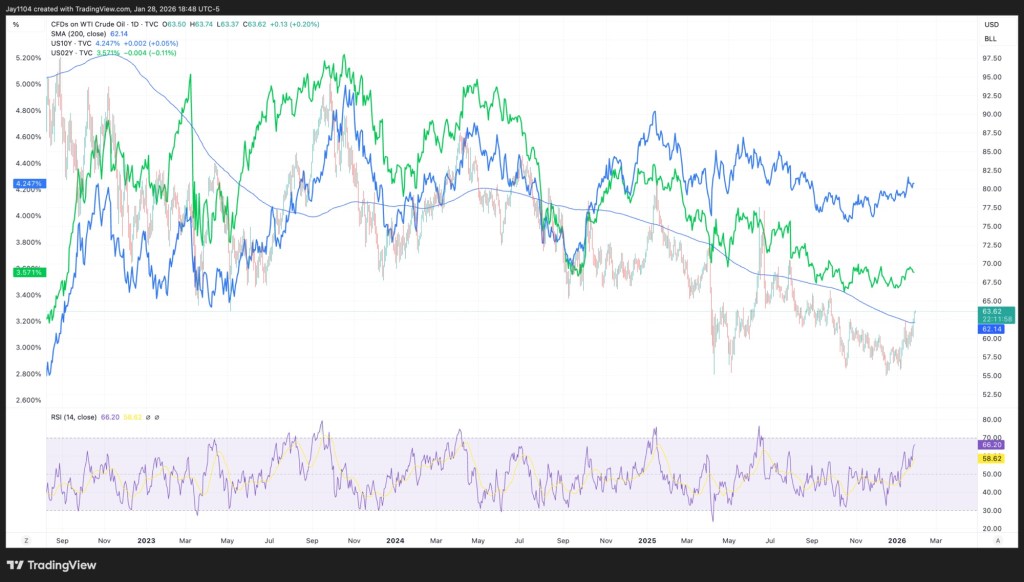
    For now, near-term rate expectations appear more closely tied to oil than to any other factor. Crude has broken out and moved above its 200-day moving average, a technical development that could set the stage for a rally toward $65 in the near term.

    Whether looking at the 2-year or 10-year Treasury yield, the correlation with oil prices since late 2022 has been remarkably strong. As a result, if oil continues to move higher, it would likely put upward pressure on interest rates as well. In that sense, oil may have been the final missing link in the case for higher rates.

    Sources: Michael Kramer

  • Crude prices climb as markets weigh U.S. stockpile draw and Venezuelan supply developments

    Oil prices climbed during Asian trading on Thursday, regaining some losses after sharp declines triggered by worries over rising Venezuelan crude supplies.

    Additionally, stronger-than-anticipated weekly declines in U.S. oil inventories supported the price recovery. Ongoing conflict between Russia and Ukraine also contributed to maintaining a risk premium in the market.

    March Brent crude futures increased by 0.7% to reach $60.38 per barrel, while West Texas Intermediate (WTI) futures also gained 0.7%, settling at $56.28 per barrel as of 20:25 ET (01:25 GMT). Both benchmarks had fallen more than 1% over the previous two sessions.

    Attention turns to US – Venezuela oil agreement after Trump highlights up to $3 billion in planned crude sales

    Oil markets are closely watching the impact of a new agreement between the U.S. and Venezuela on global oil supplies.

    U.S. President Donald Trump announced on Tuesday that Venezuela will deliver between 30 million and 50 million barrels of oil to the U.S., valued at up to $3 billion, shortly after U.S. forces detained Venezuelan President Nicolás Maduro.

    Trump also appeared to encourage multiple U.S. oil companies to expand production activities in Venezuela, with Chevron Corp (NYSE: CVX) leading these efforts. According to Reuters, Chevron is negotiating to broaden its license to operate in the country.

    Currently, Chevron is the only major U.S. oil company active in Venezuela, benefiting from special government exemptions that shield it from stringent sanctions imposed on the nation.

    Markets are worried that a significant rise in Venezuelan oil output could further swell global supplies, adding to prevailing fears of an oil glut in 2026. Traders are already pricing in ample supply conditions, with expectations that any additional barrels from Venezuela might weigh on crude prices.

    However, analysts caution that any meaningful increase in Venezuelan production is unlikely to happen quickly, given the country’s deep political instability and the extensive investment needed to rebuild its dilapidated oil infrastructure after recent upheavals.

    A Financial Times report also noted that U.S. oil firms are seeking strong legal and financial guarantees from the U.S. government before committing to major investments in Venezuela’s oil sector, reflecting industry hesitancy amid uncertain policy and market conditions.

    U.S. crude stockpiles decline beyond forecasts

    Government data released Wednesday revealed that U.S. oil inventories fell by 3.8 million barrels in the week ending January 2, significantly exceeding expectations of a 1.2 million barrel decline.

    This reduction was almost double the 1.9 million barrel draw reported the previous week, bolstering confidence that demand remains robust in the world’s largest fuel consumer.

    Attention this week centers on several key U.S. economic reports, especially the December nonfarm payrolls data set to be released on Friday, which is expected to influence interest rate forecasts.

    Sources: Investing