Tag: nasdaq

  • U.S. stock futures edged up as investors awaited the postponed employment report.

    U.S. equity futures moved slightly higher Tuesday night following a modest decline in the regular trading session, as investors assessed softer retail sales figures and looked ahead to a series of postponed U.S. economic reports due later in the week.

    By 20:11 ET (01:11 GMT), S&P 500 futures rose 0.2% to 6,978.25, Nasdaq 100 futures advanced 0.3% to 25,291.75, and Dow Jones futures added 0.2% to 50,385.0.

    Wall Street declined ahead of the upcoming jobs report, while the Dow posted a fresh record closing high.

    During Tuesday’s regular session, the S&P 500 declined 0.3% and the Nasdaq Composite dropped 0.6%, pressured by losses in technology and other growth-oriented stocks.

    In contrast, the Dow Jones Industrial Average managed a slight advance, closing above the 50,000 mark at a new record high for the third consecutive session.

    Earlier, investors reacted to U.S. retail sales figures showing flat monthly consumer spending, missing expectations. The softer data fueled worries that elevated borrowing costs may be starting to curb household demand, despite broader signs of economic resilience. This strengthened expectations that the Federal Reserve could move toward rate cuts later this year if growth continues to ease.

    Attention now shifts to the delayed monthly employment report, set for release Wednesday following the recent government shutdown. The data will offer the first detailed snapshot of labor market conditions in weeks, as policymakers monitor for indications of cooling.

    Markets are also awaiting the postponed U.S. consumer price index report on Friday, which could play a pivotal role in shaping near-term market sentiment.

    Robinhood and Lyft slide in after-hours trading.

    In company-specific developments, Robinhood Markets (NASDAQ: HOOD) fell 7.5% in after-hours trading after posting earnings that came in below expectations, as weaker-than-anticipated revenue and user figures pressured the stock.

    Shares of Lyft (NASDAQ: LYFT) plunged more than 17% in extended trading after the ride-hailing firm reported results that missed forecasts, further weighing on consumer-focused tech stocks.

    Meanwhile, Ford Motor Company (NYSE: F) delivered quarterly earnings that fell short of Wall Street estimates, citing costs related to its electric vehicle operations and ongoing supply chain challenges. Despite the miss, the automaker projected improved earnings in 2026. Ford shares rose 0.5% in after-hours trading.

    Sources: Ayushman Ojha

  • Nasdaq proposes “fast-track” rule to accelerate index inclusion for large new listings

    Nasdaq has put forward a proposal to accelerate the inclusion of newly listed large companies into its indexes, aiming to reduce the lengthy delays that have often kept major IPOs and exchange transfers out of benchmark indexes for months.

    The move comes as 2026 is shaping up to be a particularly active year for high-profile listings, with potential IPOs from companies such as Elon Musk’s SpaceX and artificial intelligence startup Anthropic. According to a source familiar with the discussions, advisers to SpaceX—following its recent acquisition of xAI—have contacted major index providers, including Nasdaq, to explore earlier-than-usual index entry. SpaceX did not immediately respond to a request for comment, and Nasdaq declined to comment.

    Under the proposed “Fast Entry” rule, a newly listed Nasdaq company would qualify for expedited inclusion if its market capitalization ranks within the top 40 of existing index constituents. Eligible companies would receive at least five trading days’ notice and be added to the index after 15 trading sessions.

    The proposal would waive the usual seasoning and liquidity requirements. Rather than replacing an existing constituent, the new entrant would temporarily expand the index’s size until the next annual reconstitution, consistent with Nasdaq’s approach to handling spin-offs.

    Michael Ashley Schulman, partner and chief investment officer at Running Point Capital Advisors, said faster inclusion would enhance Nasdaq’s appeal for large issuers by improving liquidity and narrowing bid-ask spreads through greater passive fund ownership.

    The lack of a fast-track mechanism has frequently created a gap between index composition and broader market realities, particularly given the scale and market influence of newly listed giants. Investors also expect major additions to be reflected promptly in the index, something the current framework often fails to deliver.

    The proposed rule could prove especially consequential in 2026, as artificial intelligence–driven technology leaders may seek valuations in the hundreds of billions of dollars. Nasdaq remains the preferred exchange for U.S. technology heavyweights, including trillion-dollar companies such as Alphabet and Nvidia.

    The Nasdaq 100 index, which includes the exchange’s largest listed firms, is closely watched by investors and analysts and is widely viewed as a key gauge of the health of technology and growth-focused sectors.

    “As this proposal shows, Nasdaq is signaling that no company is too large and no system is too established to be improved,” Schulman said.

    Sources: Reuters

  • Wall Street futures ticked up after a tech-driven selloff, with focus on Alphabet earnings.

    U.S. stock index futures ticked up slightly on Wednesday night after a weaker close on Wall Street, as technology stocks remained under pressure amid concerns over AI-driven disruption, while investors assessed Alphabet’s earnings report and new labor market data. S&P 500 futures rose 0.3% to 6,923.0, Nasdaq 100 futures advanced 0.4% to 25,088.75, and Dow Jones futures were mostly unchanged at 49,589.0.

    Technology stocks extended their sell-off, while investors turned their attention to Alphabet’s earnings report.

    In regular trading, the S&P 500 and the Nasdaq Composite fell 0.5% and 1.5%, respectively, as renewed selling pressure hit heavyweight technology and AI-related stocks. In contrast, the Dow Jones Industrial Average rose about 0.5% as investors shifted toward defensive and value names.

    Technology and AI shares led the decline, extending a sector-wide selloff that has persisted into early February. Software and services stocks slid amid growing concerns that rapid advances in AI could disrupt traditional business models and squeeze margins for established companies.

    Advanced Micro Devices was a key drag on market sentiment, with its shares plunging around 17% after the company reported earnings and issued guidance that failed to meet lofty market expectations. Although AMD pointed to strong AI-driven demand, investors focused on pricing pressures and intensifying competition in data centers, resulting in the stock’s sharpest one-day drop in years.

    Focus also turned to Alphabet’s earnings after the close. The Google parent posted solid advertising revenue and reaffirmed plans for significant investment in AI infrastructure, but caution lingered over the near-term impact on profitability. Alphabet shares fell more than 1% in extended trading.

    Meanwhile, Qualcomm shares slid nearly 10% after hours after the company forecast second-quarter revenue and profit below Wall Street estimates, citing a global memory chip shortage expected to weigh on smartphone sales and broader device demand.

    U.S. private-sector payrolls rose by less than expected in January, signaling some cooling in the labor market.

    Broader market sentiment was also influenced by economic data. Figures released on Wednesday showed private-sector employment increased by just 22,000 jobs last month, well short of the 50,000 gain expected, following a downwardly revised rise of 37,000 in December.

    A brief government shutdown led to the postponement of the closely watched monthly jobs report, which had been scheduled for release on Friday.

    Investors are now turning their attention to weekly jobless claims data due on Thursday, which should offer a near-term snapshot of labor market conditions ahead of the delayed nonfarm payrolls report.

    Sources: Ayushman Ojha

  • Nasdaq 100 Weakness Weighs on S&P 500 as Valuation Concerns Intensify

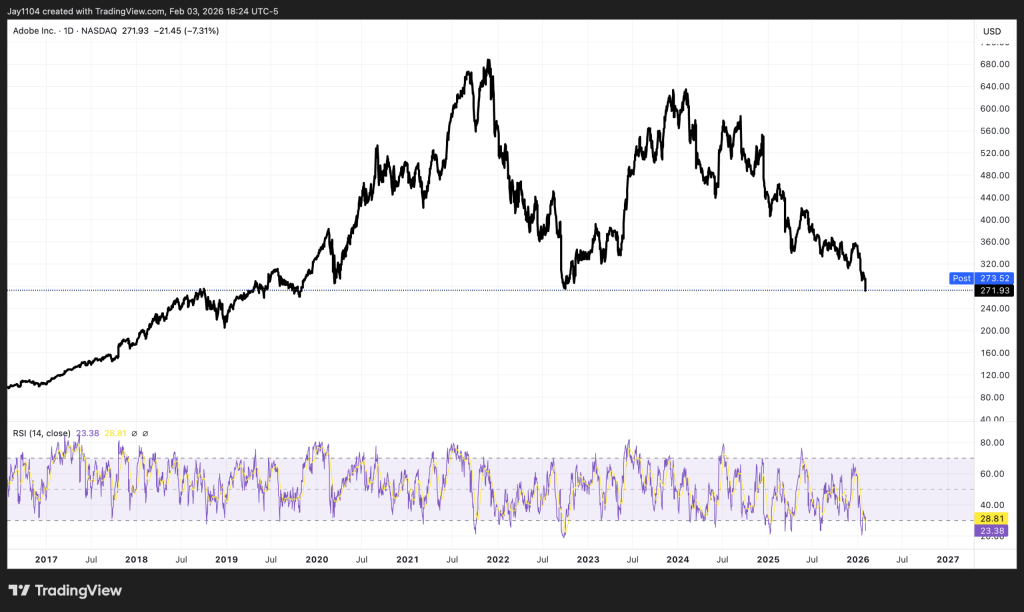
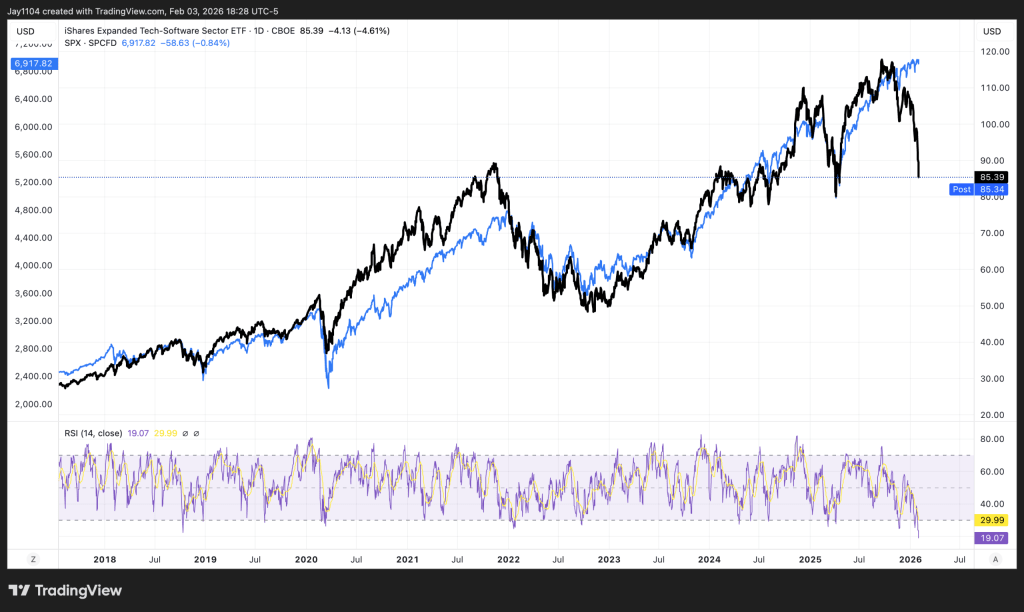
    Stocks came under heavy pressure, even as the S&P 500 ended the session with a relatively modest 85-basis-point decline. Losses were concentrated in technology and software, with the Nasdaq 100 sliding more than 1.5% and the XLK technology ETF falling over 2%. The selloff in software has been particularly severe, with several names now trading below their 2022 lows. Adobe, for instance, closed at its weakest level since October 2019.

    In some ways, the current environment echoes the shift from 2021 into 2022. The crucial difference is that the Federal Reserve is now in an easing cycle, whereas policy was tightening back then. Oil prices were also racing toward $100 at the time, while this week they have struggled to stay above $60. Even so, the pattern is familiar: the Software ETF (IGV) peaked well ahead of the S&P 500 and helped pull the broader market lower, a dynamic that has also played out across several other market segments.

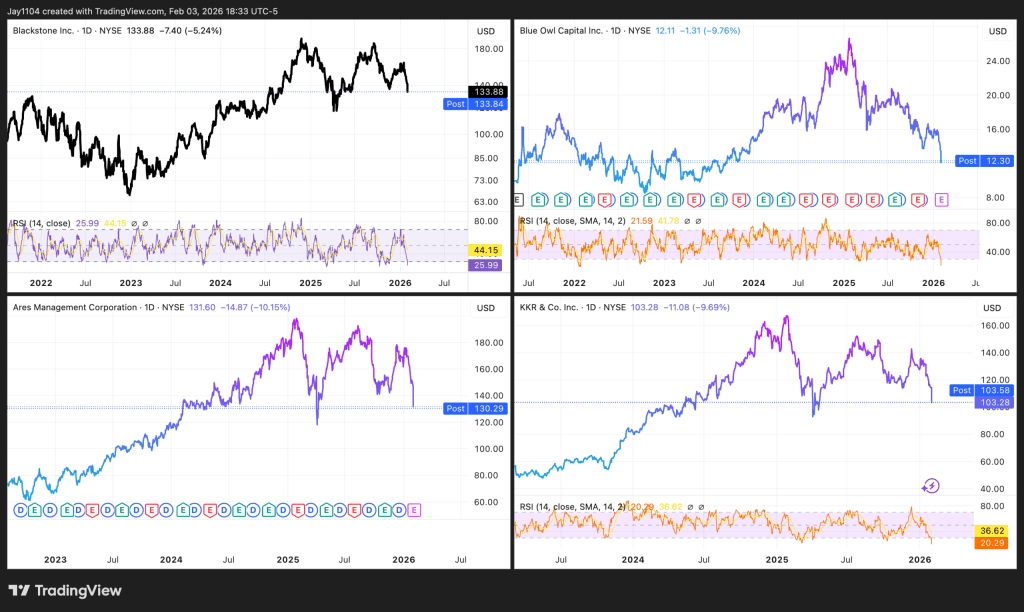
    Pressure has also resurfaced in private equity stocks, with many now trading below their November lows.

    Meanwhile, consumer staples—tracked by XLP—are surging to record highs in an unusually sharp move, reinforcing the view that markets are undergoing a broader re-rating of risk. This shift may reflect growing expectations of multiple compression, driven either by concerns that a new Fed chair could be less supportive of markets and liquidity, or by an increasing tendency among investors to separate winners from losers in the AI race.

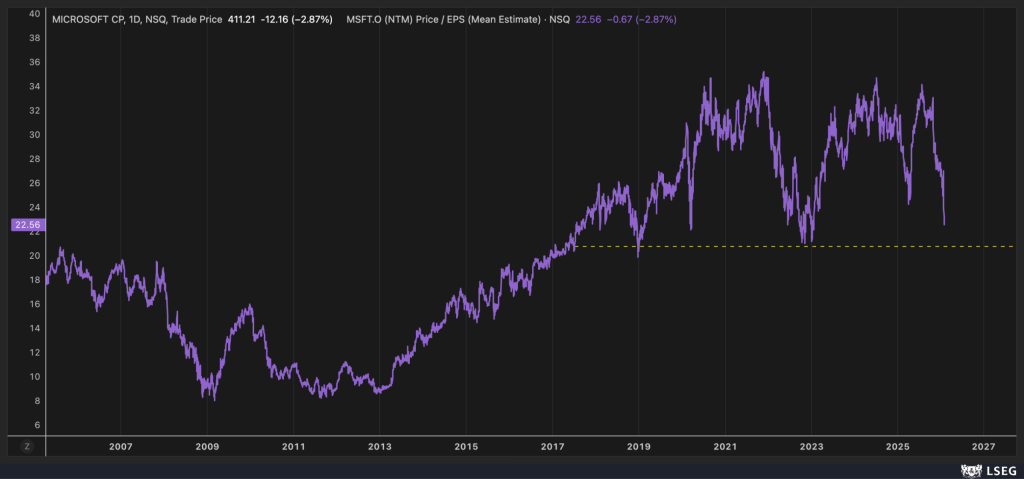
    I see this mainly as a re-pricing of risk and the early phase of multiple compression, a view that is reinforced by Microsoft’s (NASDAQ: MSFT) P/E ratio.

    Sources: Michael Kramer