The purpose here isn’t to make a forecast, but to stay open-minded about money as both a social construct and a carrier of utility value.
The prevailing view argues that the US dollar is destined to collapse, steadily declining toward worthlessness. According to this narrative, the United States will keep creating new dollars to sustain the illusion of stability, until excessive money printing ignites hyperinflation and erodes what little value the dollar has left.
This outlook draws heavily from historical episodes such as the Weimar Republic, where large-scale money creation ultimately destroyed the currency. It’s possible the dollar could follow a similar path.
But money behaves in complex ways. Because it is fundamentally a social agreement, its potential outcomes are broader than we often assume. So instead of assuming collapse, let’s imagine a case for continued dollar dominance.
Consider two hypothetical types of money. The first is a globally recognized currency backed by a basket of industrial commodities—metals like silver and copper, fuels like oil, and other tangible resources. Its value stems not from scarcity alone but from the practical utility of the assets supporting it. Since it is tied to a physical reserve, new units can only be issued if that reserve grows. It cannot be created through lending by banks.
The second type of currency expires after a set period and must be spent before it loses all value. This resembles “scrip” money. Together, these two examples illustrate money’s dual role: a store of value and a medium of exchange.
Naturally, we would save the first form for long-term security—its value rests on enduring real-world utility. The expiring currency, by contrast, would be spent quickly on goods and services.
Now consider another scenario: traveling abroad and collecting small amounts of foreign cash. Each note is valuable within its home country but useless elsewhere until exchanged. The same logic applies to precious metals. If you try to pay for a bowl of noodles with silver, the vendor must convert it into local currency, incurring transaction costs. And if taxes are owed, the government will not accept silver—only its own currency.
This highlights a frequently misunderstood aspect of fiat money. It isn’t “backed by nothing.” Its value lies in granting access to participate fully in the issuing country’s economy.
If that seems abstract, think of a work or residency permit. Without it, economic participation is limited and costly. With it, participation becomes smoother, safer, and more efficient. Currency functions similarly.
Now ask yourself: which currency would most likely be accepted almost anywhere in the world—from a remote market to a major city?
A crisp $100 US bill would probably be welcomed in more places than most alternatives. This isn’t because the paper itself has special intrinsic value. It reflects the network effect: what is already widely recognized and used carries greater practical utility than lesser-known options.
No single form of money perfectly combines store of value, ease of exchange, universal acceptance, and low friction. Searching for one flawless form is probably futile. Instead, currencies that provide:
Access to the largest economic sphere,
The strongest network effect and recognition, and
Reliable price discovery with relatively stable value
That will tend to have higher utility and lower transaction costs than competing alternatives.
Demand for a currency arises from multiple sources: the desire to preserve value, the need to transact, and the appeal of participating in the broadest economic network.
State-issued money has another distinctive trait: its supply can expand or contract. If supply grows more slowly than demand, purchasing power can rise—just as with any other commodity.
Supply is easier to measure than demand, which reflects the collective decisions of millions seeking safety, liquidity, efficiency, and opportunity.
The argument for continued US dollar dominance rests on its imperfect but still advantageous blend of features: relatively transparent pricing, low-friction transactions, powerful global network effects, and access to the world’s largest economic system.
These strengths are not merely products of short-term central bank policies. They reflect the broader framework of governance, institutions, economic depth, social trust, and cultural influence behind the issuing state.
If global uncertainty increases, demand for such a currency could outpace supply. As demand rises and network effects strengthen, a self-reinforcing cycle may emerge—supporting, rather than undermining, the dollar’s supremacy.
Money behaves in peculiar ways. We often assume we fully understand it, and even when we’re convinced a currency is about to collapse, it somehow endures—and sometimes even outperforms expectations.
The goal here isn’t to make a prediction. Rather, it’s to remain open-minded about currency as both a social construct and a vessel of utility value.
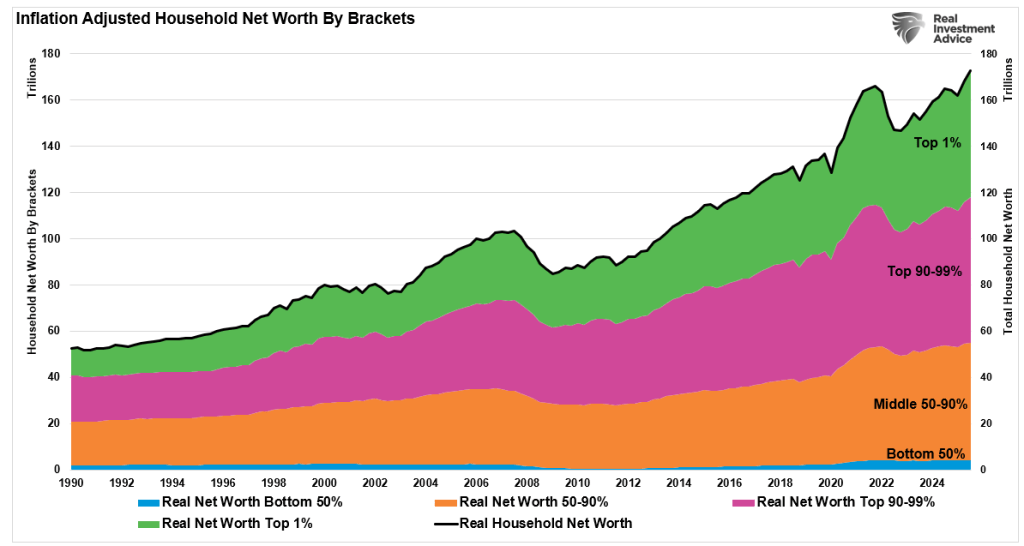
Money — everyone wants it, yet relatively few build lasting wealth. Recent data show the U.S. wealth gap continuing to widen, with the top 10% of earners controlling roughly two-thirds of total assets, while the bottom half owns only a small fraction. The frustration this creates fuels many narratives — corporatism, financial nihilism, inflation, stagnant wages, student debt, policy failures. These factors matter.
But they are not the root cause of individual financial outcomes.
At the personal level, wealth creation has always rested on a small set of enduring principles:
Spend less than you earn.
Save consistently.
Invest intelligently.
These rules are not new. They worked before the internet, before credit cards, and before retail trading apps. Most importantly, they still work — regardless of background, education, age, or economic cycle. Wealth is not a viral trend or a lucky break. It is a disciplined process repeated over time.
That does not dismiss today’s challenges. Inflation remains elevated compared to early-2000s norms. Real wage growth has struggled to outpace living costs. Mortgage rates have constrained affordability. Yet history shows that disciplined financial behavior, applied consistently, can overcome difficult macro environments.
Many people can articulate why the system feels unfair. Fewer commit to the habits that compound into independence. The difference between chronic financial stress and gradual wealth accumulation is often not luck or privilege alone — it is adherence to a workable framework.
This framework is neither radical nor controversial. It is the same path generations have followed to build stability and prosperity.
One uncomfortable truth is that we have largely failed to teach foundational money skills. Not advanced portfolio theory — but basics: budgeting, understanding credit, living below one’s means, and managing cash flow responsibly.
With that foundation in mind, here are the 10 Immutable Laws of Money.
10 Fundamental Principles of Money
Wealth Isn’t Created Effortlessly
Growing up, my father loved to share stories that, over time, I realized were slightly exaggerated. A few of his classics were:
“When I was your age, I walked uphill to school in the snow — both ways.” “I could see two movies, eat all the popcorn and drink all the soda I wanted for a nickel — and still get change back!” And, of course: “Where do you think money comes from? It doesn’t grow on trees!”
That last line stuck with me the most. What he was really trying to teach was respect — respect for the time, energy, and sacrifice required to earn a living. He often worked two jobs, sometimes even three, to provide for our family. We always had what we needed, though not always everything we wanted. As a child, I didn’t fully grasp the weight of that lesson. It wasn’t until I had a family of my own that I truly understood.
Most people work incredibly hard for their income. Yet it’s surprising how casually many treat the money they earn. They undermine their own efforts by overspending, living beyond their means, or making careless investment choices. If you value the work it takes to earn money, you should value how it’s managed.
One practical way to build that respect is by using the “envelope system” for a few months.
The idea is simple: cash your paycheck and divide the money into separate envelopes labeled for expenses — rent or mortgage, car payments, groceries, utilities, entertainment, and so on. Then live normally. When an envelope runs out, that category is done for the month. No borrowing from another envelope.
This method quickly reveals where money is leaking away and forces awareness around spending habits. More importantly, it restores discipline and respect for the effort behind every dollar earned.
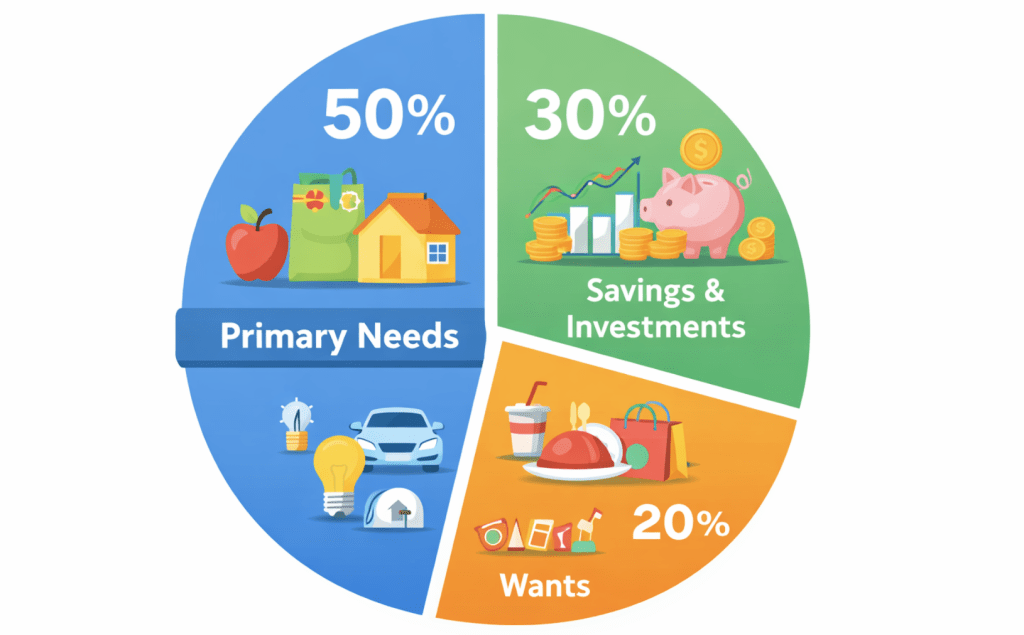
Note: The envelope system should cover about 80% of your overall budgeting approach, which we’ll explore shortly. The remaining 20% should be directed toward savings — but we’ll tackle that part step by step.
Desires Always Outpace Necessities
When I sit down with people to talk about financial planning, I’m always struck by the reaction the word “budget” triggers. The moment it’s mentioned, you’d think I had suggested something drastic — like giving up a limb.
But the reality is simple: financial success requires one fundamental rule — spend less than you earn.
I constantly hear people justify breaking this rule: “You don’t understand — I needed a new car.” “We needed a bigger house.” “We have to take our annual vacation.”
The line between a “want” and a “need” can occasionally blur, but most of the time they are worlds apart. Did you truly need a brand-new car — or could a reliable two-year-old model have saved you 20% in depreciation? Did you genuinely require more space, or could you have managed in your current home?
These are uncomfortable but necessary questions.
If your goal is to build wealth, your true needs are very limited:
Food
Shelter
Utilities
Taxes
That’s it. Everything else is a want.
Learning to control your wants is one of the most powerful steps toward financial stability. Before making a purchase, pause and ask yourself: Is this a need — or just a desire?
Here’s a practical guideline:
Your life should cost no more than 70–80% of your income.
When creating a budget, review your spending patterns and aim to keep your committed expenses at or below 70–80% of your gross income. That means 20–30% remains uncommitted — and that margin is where financial freedom begins.
This percentage isn’t a rigid law, but it’s a realistic and effective starting point. Once you structure your finances this way, constant expense tracking becomes less necessary. Your account balance itself becomes your guide. The real discipline lies in keeping those fixed obligations under control — and refusing to let wants quietly turn into “needs.”
What About the Remaining 20–30%?
That portion is what you “pay yourself first.”
Let’s break it down with a simple example.
Joe earns $100,000 per year and falls into a 25% tax bracket. If his goal is to save 30% of his income, he needs to set aside $22,500 annually.
Here’s how he does it:
$20,000 goes directly into his employer-sponsored retirement plan on a pre-tax basis.
He then contributes an additional $2,500 each year into a Roth IRA.
Just like that, Joe has hit his savings target.
After taxes and retirement contributions, the paycheck that lands in Joe’s bank account represents roughly 70% of his gross income. And here’s the beauty of the system: Joe is free to spend what’s in that account. He doesn’t have to think about saving — it’s already been handled.
Because the money moves into savings before he ever sees it, he adapts to living on the remaining amount. He never feels deprived because he never mentally counted that savings money as spendable income in the first place.
That’s the real secret to a budget that actually works.
Tracking every dollar you spend isn’t the magic solution — just like obsessively counting calories isn’t the true key to weight loss. The real power lies in building a financial structure that automatically balances income and spending, prioritizes saving, and leaves enough flexibility to absorb life’s inevitable surprises.
When the system is designed correctly, discipline becomes automatic — and wealth becomes a byproduct of structure, not willpower.
The Poor Owe — The Wealthy Own
This principle is straightforward: you cannot borrow your way to wealth — period.
There’s no late-night seminar teaching people how to become rich by shuffling balances between low-interest credit cards. Debt is not a wealth-building tool for consumers — it’s a wealth transfer mechanism, usually in the wrong direction.
For many people, high monthly credit card payments are the very reason their expenses feel suffocating. If you’re carrying significant non-mortgage debt, consider redirecting the 20% earmarked for long-term savings toward aggressively paying it down — but only after you eliminate access to more borrowing.
Every dollar of interest you don’t pay is equivalent to earning a guaranteed, risk-free, tax-free return equal to the interest rate on that debt. Few investments offer that kind of certainty.
And once the debt is gone — which can happen faster than you think if you apply 20% of your gross income toward it — immediately redirect that same money back into savings.
Signs You’re Damaging Your Financial Future
You may be off track if you:
See credit card balances rising while income is shrinking.
Pay only minimums — or less.
Shift balances or take cash advances to cover other cards.
Carry more credit cards than you can track.
Stay near your credit limits.
Charge more monthly than you repay.
Work overtime just to keep up with payments.
Avoid calculating your total debt.
Receive delinquency notices.
Use credit cards for essentials like food or gas.
Rely on credit because you lack cash.
Dip into savings or retirement accounts to cover bills.
Hide purchases from your spouse.
Open every unsolicited card offer.
Fear job loss because your debt load feels unmanageable.
The first step toward wealth is eliminating dependence on credit cards — for any reason. That may sound extreme, but you can’t break a habit while continuing the behavior. There’s no middle ground.
The Credit Card Roll-Up Strategy
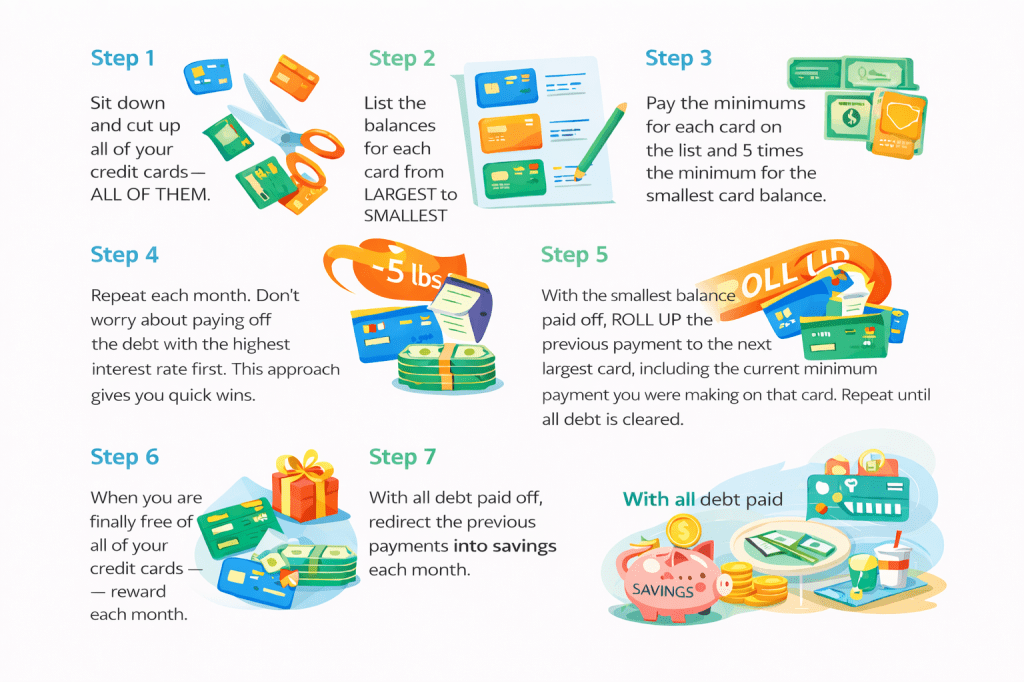
If you’re serious about becoming debt-free, this structured approach works:
Cut up all your credit cards. Every single one.
List balances from largest to smallest, along with minimum payments.
Pay minimums on all cards — but pay five times the minimum on the smallest balance.
Repeat monthly. Ignore interest rates for now; the goal is quick psychological wins.
Once the smallest card is paid off, roll that full payment (including its former minimum) onto the next smallest balance.
Continue rolling payments upward until you attack the largest balance with significant monthly firepower.
Momentum builds quickly. What starts small becomes powerful.
When you eliminate your final credit card balance, reward yourself modestly — perhaps with two months’ worth of what used to be your debt payments.
Then immediately return to discipline.
Every dollar that once serviced debt now goes into savings and investment. You’ll have ground to make up — but you’ll also have the structure and momentum to build real wealth.
Debt keeps you working for your past. Savings and investment put your money to work for your future.
You Are Not Immune to Moral or Physical Risk
I remember watching Fear Factor hosted by Joe Rogan and realizing something simple: people will do almost anything for fast, easy money.
“Sure, I’ll eat those South American hissing cockroaches for $50,000.”
Yet many of those same people won’t consistently skip luxuries, reduce spending, or sacrifice short-term comfort to save $50,000 the slow and responsible way.
We’ve been conditioned to look for shortcuts. Instead of discipline, we gamble. The lottery — essentially a tax on poor financial judgment — becomes the dream strategy. Yet roughly 80% of lottery winners end up broke within a decade because sudden money cannot compensate for weak financial habits.
If I borrowed a page from David Letterman, I’d create a segment called “Financially Stupid Human Tricks” — highlighting the so-called “smart” financial moves that often create long-term damage.
Borrowing From Your 401(k)
Many employer-sponsored retirement plans allow loans. It feels harmless. After all, you’re “paying interest to yourself,” right?
Technically true.
But here’s what gets overlooked:
If you lose your job, the loan usually must be repaid within about 60 days.
If you can’t repay it, the balance is treated as a distribution — taxed and penalized.
Depending on your bracket, penalties and taxes can reach 40% or more.
And it gets worse: you can’t restore the lost compounding.
If you borrowed $7,000 and that money could have compounded at 8% annually, over time that single decision could cost tens of thousands — even $75,000 or more — in retirement value.
Your retirement account and your home equity should be financial “break glass only in absolute emergency” assets. If everything else in life goes wrong, those two pillars protect your shelter and your dignity.
Stretching to Buy a House
Homebuyers face enormous pressure.
Real estate agents earn more when you spend more. It’s no accident that you’re often shown a home slightly beyond your range first. Once you’ve walked through the upgraded kitchen and spa bathroom, the affordable house feels like a compromise.
Friends and family may encourage the stretch: “It’s an investment.” “You’ll earn more later.” “Real estate always goes up.”
Maybe. Maybe not.
Being “house poor” is real. When too much of your income goes toward housing, everything else suffers — vacations disappear, dining out shrinks, retirement contributions stall, college savings fade. Instead of cutting lifestyle, many simply layer on more debt to preserve appearances.
A house should support your life — not dominate it.
The common thread in all of this is risk blindness. People assume bad outcomes won’t apply to them. They believe they’ll keep the job, the market will cooperate, income will rise, and nothing unexpected will happen.
But wealth isn’t built on optimistic assumptions. It’s built on margin, discipline, and respect for risk.
Quick money excites. Structured money endures.
The Most Valuable Things in Life Don’t Cost Money
Too often, we confuse “quality time” with “costly activity.” We assume that spending meaningful time with family or loved ones requires tickets, reservations, travel, and swiping a credit card.
But isn’t the real goal connection?
You don’t need a weekend getaway to build memories. You need presence.
Learn to be creative:
Board games at home
Playing sports in the yard
A walk in the park with music or an audiobook
Movie nights with homemade popcorn
Sitting around talking, gaming, or reading together
The activity matters far less than the interaction. Some of the best moments in life cost absolutely nothing.
Laugh at the Joneses (Just a Little)
Petty? Maybe. Effective? Absolutely.
Trying to “keep up with the Joneses” is one of the fastest paths to financial stress. The irony is that the Joneses often aren’t thriving — they’re financing appearances.
As of mid-2025, the average American household carried over $100,000 in consumer debt, including mortgages, credit cards, auto loans, personal loans, and student debt. Since that’s an average, half of households owe even more. Meanwhile, non-mortgage consumer debt has climbed to historic highs, while income growth hasn’t kept pace.
In other words, the lifestyle you envy may be leveraged.
Recognizing that reality makes it much easier to stop competing. Financial peace rarely comes from outward display — it comes from internal margin.
The best things in life — laughter, conversation, friendship, time, health — cannot be financed. And the more you understand that, the less tempted you’ll be to borrow in order to simulate happiness.
Wealth isn’t about looking rich. It’s about being free.
If a little harmless comparison keeps you disciplined, use it.
Watching your neighbor finance every new car, remodel, and vacation can actually reinforce your own commitment to smart money management. Quietly appreciating that your lower debt load earned you a better mortgage rate — or that you sleep better at night — can be motivating.
Is it a bit petty? Sure. Is it effective? Often.
This isn’t really a “law of money” as much as a psychological trick. Humans are wired for comparison. If observing someone else’s overextension strengthens your resolve to stay disciplined, that’s not the worst thing — just keep it internal. You still want the dinner invitations.
At the end of the day, frugality isn’t about deprivation. It’s about peace of mind.
You’re choosing restraint today to gain freedom tomorrow.
Whether you’re eliminating debt, increasing savings, or simply refusing to live beyond your means, the real goal is avoiding the anxiety and stress that come from financial chaos. That clarity — knowing you’re in control — is what sustains long-term discipline.
When you remember that financial stability equals emotional stability, it becomes much easier to avoid burnout, stay consistent, and reach your goals faster.
Wealth is not about impressing others. It’s about sleeping well at night.
Money Cannot Purchase Happiness
That familiar cliché is often dismissed as something people say to justify not pursuing financial success. And while it’s technically true that money cannot directly purchase happiness, it can certainly acquire many of the things that make happiness easier to experience.
Money doesn’t guarantee joy. But neither do debt, stress, anxiety, or 20% credit card interest.
Financial security won’t fix every challenge in life. It won’t repair broken relationships or create purpose. But it does eliminate many of the pressures that drain your mental energy — surprise expenses, medical bills, job uncertainty, emergencies.
A strong financial foundation buys breathing room.
And breathing room reduces stress. Reduced stress improves relationships, decision-making, and overall well-being.
A healthy bank balance is far more valuable than another gadget, another upgrade, or the newest phone release. Financial stability may not buy happiness — but it buys freedom, options, and peace of mind.
And those are often much closer to happiness than most purchases ever will be.
There’s No Such Thing as “Five Easy Payments”
Don’t fall for flashy financing tricks. People often justify using a certain credit card or payment plan because it advertises 0% interest — but that’s beside the point. A good rule of thumb: if you can’t pay for it in cash right now, you probably shouldn’t buy it. Chances are, it’s a “want,” not a necessity.
Debt is still debt, no matter how attractive it looks. In the end, it’s the fine print that catches you off guard and pulls you further away from your financial goals.
Cash in your pocket beats being stretched too thin.
About half of marriages in the U.S. end in divorce, with two leading causes often cited: infidelity and money problems. Financial pressure can strain relationships, and many of our spending choices are driven more by emotion than logic. If you want to eliminate debt and the stress that comes with it, here are seven hard truths to help you regain control and build real financial cushion:
1) Cut Housing Costs. Do you really need the pool or those extra bedrooms filled with clutter? Many people buy more house than they actually use. Downsizing and lowering your mortgage payment can free up significant monthly cash flow.
2) Reduce Car Expenses. Consider going from two cars to one, carpooling, or using alternative transportation. Even trading in for a reliable two- or three-year-old vehicle could shrink your monthly payment, insurance, fuel, and maintenance costs.
3) Take on Extra Income (Temporarily). A part-time job bringing in an additional $1,000 per month adds up to $12,000 a year toward debt repayment. It doesn’t have to be permanent — just long enough to reset your finances.
4) Eliminate Costly Habits. Smoking, frequent dining out, and impulse spending drain money quickly. Cooking at home and cutting unnecessary indulgences may not feel convenient, but it’s both financially smart and often healthier.
5) Live Below Your Means. Adjusting priorities, expectations, and even location can help you scale your lifestyle to something sustainable.
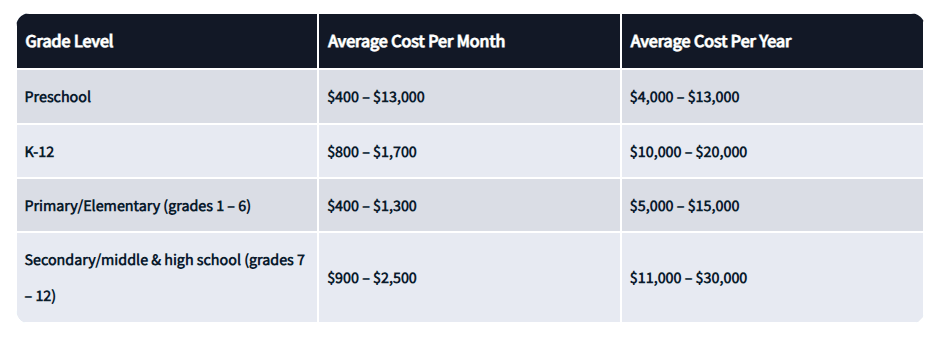
6) Reconsider Private School. Private education can cost around $15,000 per year, while you’re already funding public schools through taxes. Supplementing public education with involvement at home can strengthen both your child’s learning and your relationship — at little to no financial cost.
Getting out of debt requires tough choices, but each decision moves you closer to financial freedom and peace of mind.
7) Turn Clutter into Cash. Garage sales, eBay, and countless online marketplaces make it easier than ever to unload the stuff you’ve accumulated over the years. What’s collecting dust in your home could translate into extra money to put toward paying down debt.
You might resist some of these ideas at first — and they are only suggestions. But once you begin applying even a few of these principles, you’ll likely uncover additional ways to live within your means and take meaningful steps toward a less stressful, more financially secure life.
Dress with purpose, not pressure.
Millionaires with $2–$5 million in assets tend to look very different from the flashy stereotype.
Research by Thomas J. Stanley found:
Modest Homes: Among estates valued at $3.5 million or more, the median home value was about $469,000.
Small Share of Net Worth: Their primary residence typically represented less than 10% of total net worth.
Broader Trend: About 90% of millionaires live in homes worth $1 million or less, and nearly a third live in homes valued at $300,000 or less.
Income-Producing Assets First: They invest more in businesses and income-generating real estate than in luxury personal residences.
Stanley’s rule of thumb: your home’s market value should ideally be less than three times your annual realized household income. Even affluent households ($1M–$10M+) often stay in the same, practical homes for decades.
Other Key Patterns
Entrepreneurial Roots: Many built wealth by starting businesses and carving out profitable niches. They’re driven by building enterprises — wealth is the byproduct.
Comfortable, Not Flashy: They buy quality items but avoid waste. For example, they may purchase expensive shoes — but they resole them instead of replacing them.
Stable Households: They’re often married to financially responsible partners who run efficient homes — clipping coupons, buying in bulk, and managing spending carefully.
Simple Formula: They consistently spend less than they earn.
Investing Habits
Once their businesses mature, they turn to the stock market for steady capital growth. They are rarely speculators, seldom gamble, and almost never buy lottery tickets.
You might assume they avoid speculation because they’re already wealthy — but more likely, they became wealthy because they avoid speculation.
And if you think wealth comes from flashy appearances or shortcuts, you might as well put pantyhose over your head and ask strangers for cash — it’s about as effective.
Money Law #9: Dress for success — but build wealth quietly.
Start Living Differently from Everyone Else Today
As Dave Ramsey often says:
“If you live like no one else today, you’ll be able to live like no one else tomorrow.”
Building wealth isn’t complicated. Retiring comfortably isn’t reserved for the lucky. It starts with committing to disciplined money habits and consistent saving. That path may put you at odds with credit card companies, frustrate the banks, and make you stand out from the “keep up with the Joneses” crowd—but that’s the point.
Sacrifice isn’t suffering. It’s a calculated move.
Pass on the new car today, and you keep more cash. Save that cash, and you can invest in assets that appreciate. Invest steadily, and your money begins working for you. Compound growth drives the engine—but your savings fuel it.
That’s how ordinary people build extraordinary retirements.
Stop blaming circumstances. Start making intentional decisions. Your future won’t be shaped by what you post, wish for, or complain about.
It will be shaped by what you actually do.
And one day, you may find yourself financially secure—with cash reserves, a solid emergency fund, reliable investment income, and peace of mind.
Looking back, the early sacrifice won’t feel like loss.
Narrative control functions by offering ready-made answers to every doubt or challenge. At its core, the prevailing narrative claims that the Federal Reserve and the central government possess sufficient tools to quickly counter any decline in GDP—otherwise known as a recession—and steer the economy back toward growth.
Implicit in this view is the assumption that recessions are inherently harmful, while uninterrupted expansion is inherently desirable. Few question the fact that this framework departs from true free-market capitalism. Instead, central banking and government intervention are justified as mechanisms to smooth out capitalism’s rough edges through a form of state capitalism—one that can create or borrow as much money as needed to neutralize economic disruptions, including recessions.
What this narrative leaves out is the role recessions play as a natural and necessary part of market dynamics. Instead, it reduces economic cycles to a simplistic binary: contraction is bad, expansion is good. Yet markets are ultimately driven by human behavior—particularly fear and greed—which express themselves through borrowing and speculation. During periods of confidence, when growth appears limitless, participants take on increasing levels of debt and channel capital into progressively riskier investments in pursuit of higher returns.
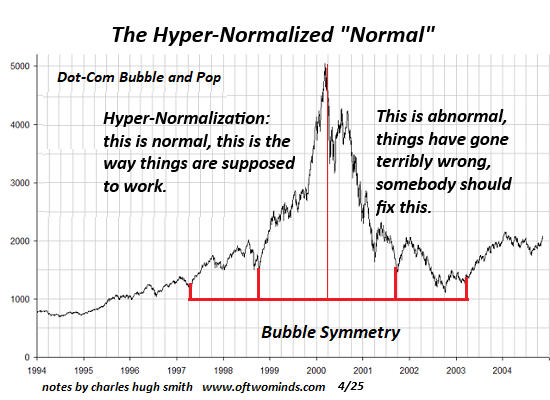
As borrowed funds flow into speculative assets, prices rise, boosting the value of collateral and enabling even more borrowing to finance further speculation. Debt, asset prices, collateral and risk-taking thus reinforce one another, creating the illusion of an endlessly self-sustaining expansion in which everyone appears to grow wealthier.
However, this layering of debt and paper wealth carries within it two forces that eventually unwind the process: interest and risk. Every loan carries an obligation to pay interest, which compensates lenders for the risks they assume. As overall debt grows—and as investments become more speculative—debt servicing costs increase accordingly, especially for higher-risk borrowers.
While central banks can attempt to suppress interest rates even as risk rises, their influence is inherently limited. They control only a portion of total outstanding debt and therefore cannot dominate the market entirely.
Their role in prolonging debt expansion and speculation relies less on absorbing most new debt and more on signaling. By projecting the message that the Federal Reserve will step in to backstop losses, recapitalize lenders, and cap interest rates below market-clearing levels, policymakers encourage continued borrowing and risk-taking. This reinforces the belief that debt and speculation can keep expanding indefinitely.
Yet signaling alone cannot solve the underlying problem. It does not increase the income required to service growing debt burdens, nor does it ensure speculative investments will deliver returns. These limitations expose the fundamental weakness of the central banking “perpetual motion” model. For most borrowers—both private and public—income does not automatically rise alongside debt. Instead, income depends on market conditions, technological change, government policy, and the broader cycle of credit expansion or contraction.
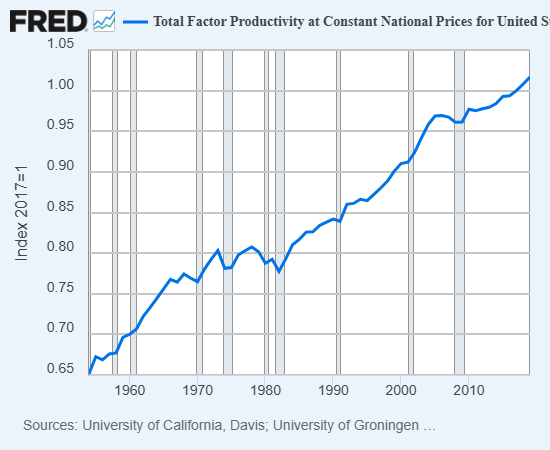
At the level of the overall economy, what ultimately matters is total factor productivity and how its gains are distributed among workers, businesses, asset owners, and the state, which extracts revenue from each through taxation. This distribution is not fixed; it shifts with changing social, political, and financial forces.
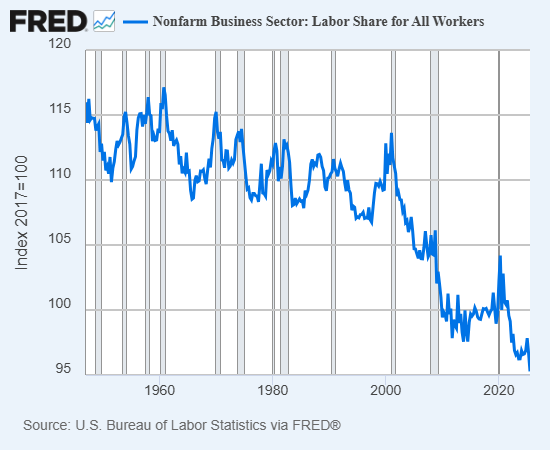
Over the past five decades, the benefits of productivity growth have increasingly accrued to capital—corporations and asset owners—rather than to workers. As a consequence, households and small businesses are left servicing debt with a diminishing share of overall economic income. This imbalance makes additional borrowing progressively more hazardous for both borrowers and lenders alike.
As a growing share of economic output accrues to corporations and asset owners, their collateral values, income streams, and perceived creditworthiness strengthen. This allows them to borrow larger sums at lower interest rates than wage earners and small businesses. Greater access to cheap credit enables further asset accumulation, which in turn generates additional income—creating a self-reinforcing cycle.
This dynamic sits at the heart of widening wealth and income inequality. Those at the top grow richer not simply because they earn more, but because they can finance income-producing assets at costs far below those faced by workers. Unlike wages, income derived from assets tends to rise alongside asset values, which can be leveraged as collateral to support even more borrowing.
At a deeper structural level, the system becomes unstable once economic growth fails to raise household incomes enough to support higher debt servicing. The entire framework of expanding credit, collateral, and speculation then comes under strain. Asset-driven income ultimately depends on one or more of three forces: continued credit expansion, increased risk-taking in financial markets, or sustained consumer spending. These forces are tightly linked, as any slowdown in borrowing, investing, or spending eventually undermines the ability to service debt and brings the credit cycle to a halt.
Because debt inherently carries default risk, an economic model reliant on ever-expanding borrowing also amplifies systemic vulnerability—particularly when household incomes stagnate while debt levels and interest obligations continue to rise.
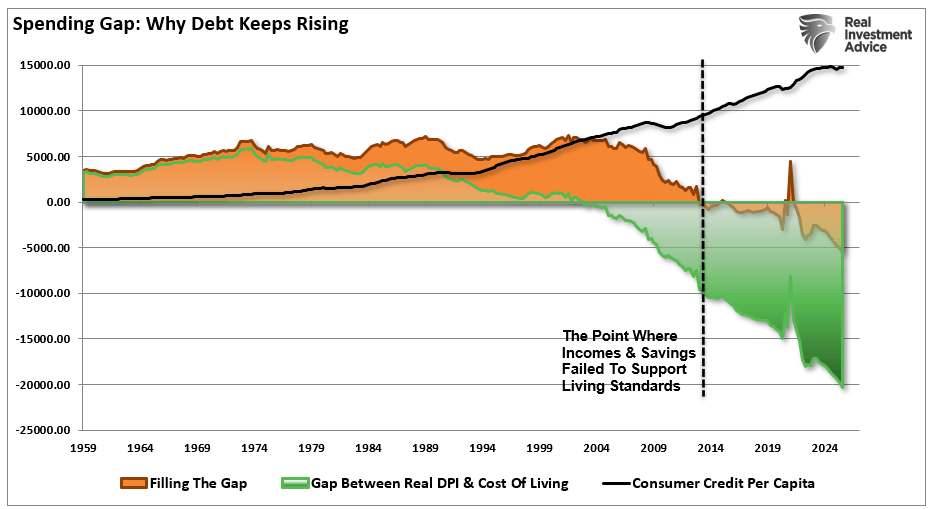
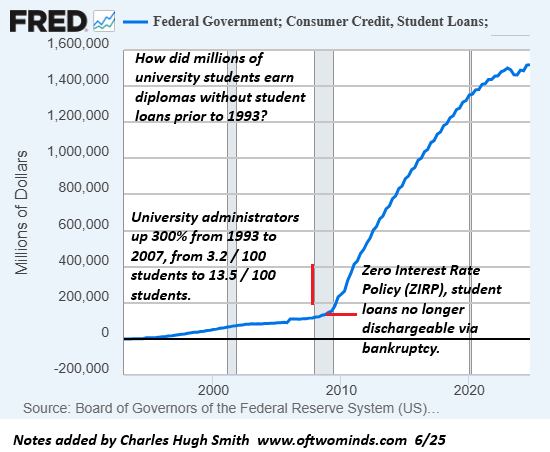
With the share of output flowing to wages declining for decades, households have increasingly relied on borrowing to sustain consumption. Before the 2000s, student debt was relatively limited; today it totals trillions of dollars. Auto loans and credit card balances have also surged, alongside less visible forms of leverage such as installment-based financing and other shadow-banking channels that are often underreported.
Speculative investments carry intrinsic risk, as there is no guarantee they will generate returns. When such speculation is financed through borrowing, failure does not only harm the investor—it also inflicts losses on the lender, as both sides are exposed when the bet collapses.
Taken together, stagnant income growth, rising reliance on debt to sustain consumption, and increasingly risky, debt-backed speculation have produced an economy dependent on credit-driven asset bubbles. Growth now hinges on the continual expansion of debt to support spending and fuel speculative activity that inflates asset prices, thereby boosting collateral values and enabling even more borrowing.
When income growth can no longer keep pace with rising debt obligations, defaults begin to ripple through the system. Households fall behind on rent, auto loans, student debt, credit cards, and mortgages, triggering a collapse in consumer spending. The resulting strain spreads to lenders and employers, who respond by tightening credit, cutting back borrowing, and laying off workers—further eroding income across the economy.
Speculative investments that appeared viable during the expansion unravel as credit conditions tighten. Lenders withdraw from riskier loans, household demand dries up, and asset prices fall as investors rush to sell risk assets in order to raise cash and reduce leverage. Collateral values deteriorate rapidly, amplifying losses.
Economies dependent on credit-fueled asset bubbles function as tightly interconnected systems. Any decline in income or asset prices, any increase in interest rates, any reduction in available credit, or any erosion of collateral feeds back into the broader structure. These shocks reinforce one another, creating a downward spiral marked by defaults, layoffs, and falling valuations.
In an economy already saturated with debt, policy stimulus no longer produces real growth; instead, it fuels inflation, which constrains central banks’ ability to respond. Once markets lose confidence in the belief that policymakers will always step in to backstop losses, both speculation and the borrowing that sustained it begin to dry up. As the flow of new, credit-funded investment slows, asset prices enter a self-reinforcing decline.
In a credit-asset-bubble-dependent system, this inevitable unwinding is often perceived not as a structural outcome, but as a sudden and unforeseen crisis.
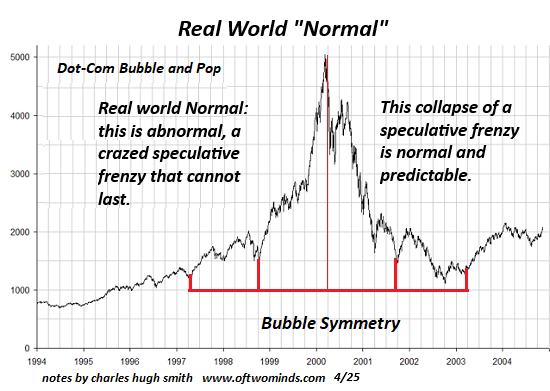
In an economic system that permits recessions to purge unsustainable debt and excess speculation, the bursting of credit-driven asset bubbles is seen as a natural and unavoidable process rather than an aberration.
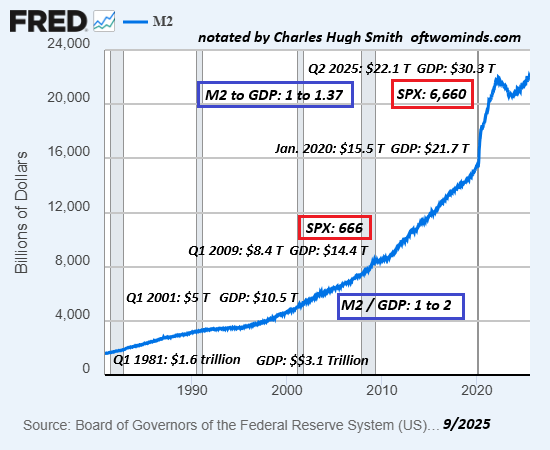
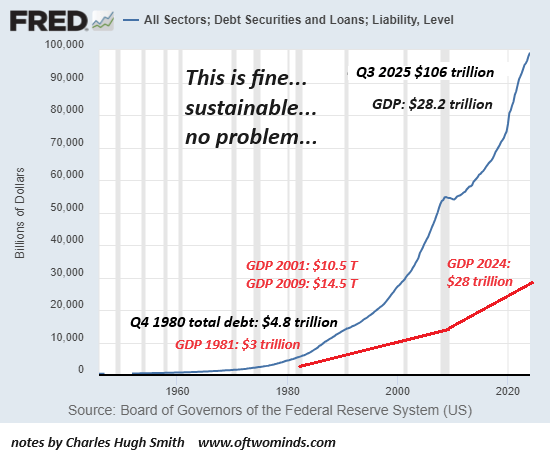
Few recognize two critical realities: first, the last true recession that meaningfully purged excess debt, leverage, and speculation occurred in 1980–82—more than four decades ago; second, the shock absorbers that enabled recovery back then no longer exist. In 1980, total debt stood at roughly 150% of GDP. Today, it is closer to three times GDP. This makes debt-driven expansion unworkable: borrowers are already struggling to service existing obligations, let alone take on more.
Nor can the Federal Reserve rescue the system simply by cutting rates to zero. The Fed holds only a small fraction of the roughly $106 trillion in outstanding debt; its primary influence is psychological, signaling that risk is low. In reality, risk continues to rise as debt burdens, interest costs, leverage, and speculation compound.
A repeat of the 2008-style bailout is equally implausible. Then, the system was stabilized by recapitalizing the financial sector—the engine of new credit creation. Today, however, the economy is saturated with debt, incomes have stagnated, and borrowers lack the capacity to sustain additional leverage. Meanwhile, housing and financial asset bubbles have expanded to historically fragile extremes.
This is why a recession that finally cleanses excess debt and speculation would leave behind an economy unable to rebound. The current system depends entirely on debt, leverage, and speculative excess not just for growth, but for basic stability. Once that structure collapses—as all bubbles eventually do—the confidence, signaling, and perceived wealth that sustained it will vanish as well.
Proposals to “save” the system by shifting fiat money into gold or cryptocurrencies offer no escape. The debt itself—and the income required to service it—would also be carried over, leaving the underlying dynamics unchanged. The collapse of credit-driven asset bubbles, and the economic activity built upon them, would still unfold.
For this reason, the next recession is likely to trigger a full-scale breakdown of a credit-asset-bubble-dependent economy. While policymakers may attempt to reflate another bubble as a solution, such an approach will no longer be sustainable. A durable recovery would instead require restructuring the economy around real productivity gains that are broadly shared, rather than concentrated among asset holders.
This transition will be slow and painful. Those who benefited most from the bubble economy will resist losing both extraordinary returns and their disproportionate share of gains. Yet neither can be preserved. The adjustment will demand time, sacrifice, and large, long-term investment in genuinely productive assets.
Ultimately, the systemic risks embedded in a credit-asset-bubble economy cannot be eliminated—only disguised or shifted elsewhere. These temporary fixes allow the bubble to grow larger, but the cost is borne by society at large when the system’s internal dynamics inevitably bring it crashing down.

 THE ETERNAL SOVEREIGN