The Japanese yen finds it hard to build on recent strong gains as worries over Japan’s fiscal position persist. However, a relatively hawkish Bank of Japan stance and concerns about potential currency intervention could continue to support the yen. Meanwhile, the US dollar remains near a four-month low on expectations of Fed rate cuts, helping to limit upside in USD/JPY.
The Japanese yen comes under modest selling pressure during Tuesday’s Asian session, pulling back further from its strongest level against the US dollar since November 2025, reached a day earlier. Sentiment toward the yen remains fragile as investors worry about Japan’s fiscal outlook, driven by Prime Minister Sanae Takaichi’s expansive spending proposals and tax cut plans. A broadly upbeat mood in equity markets, along with domestic political uncertainty ahead of the snap election scheduled for February 8, is also weighing on the safe-haven currency.

However, downside pressure on the yen may be limited by expectations that Japanese authorities could intervene to prevent excessive weakness, especially given the Bank of Japan’s relatively hawkish stance. Meanwhile, the US dollar stays near a four-month low as markets price in two additional Federal Reserve rate cuts this year. The ongoing “Sell America” theme further dampens demand for the greenback, which should help restrain USD/JPY movements as investors turn their attention to the key two-day FOMC meeting beginning later today.
Japanese yen bears remain cautious as intervention speculation offsets political uncertainty.
Japan’s already stretched public finances have come under sharper scrutiny following Prime Minister Sanae Takaichi’s campaign pledge to suspend the sales tax on food items ahead of the snap lower house election on February 8. Concerns over the country’s fiscal outlook have been a major driver behind the recent jump in long-dated Japanese government bond yields, which raises debt servicing costs and, in turn, limits the Japanese yen’s upside.
Data released earlier on Tuesday showed a slowdown in wholesale inflation, with the Producer Price Index rising 2.4% year-on-year in December, down from 2.7% in November. Additional figures indicated that the Corporate Service Price Index increased 2.6% YoY, slightly lower than the previous reading. Overall, the data offered little to challenge the Bank of Japan’s tightening trajectory and had a limited impact on the yen.
The BoJ recently raised its economic and inflation forecasts while keeping short-term rates unchanged at the conclusion of its two-day meeting last Friday, signaling its readiness to continue gradually lifting still-low borrowing costs. This stance contrasts sharply with expectations for a more dovish US Federal Reserve, leaving the US dollar under pressure near a four-month low and lending support to the yen amid fears of possible official intervention.
Reinforcing this view, Prime Minister Takaichi said on Sunday that authorities are prepared to take action against speculative and highly abnormal market moves, following rate checks by Japan’s Ministry of Finance and the New York Fed on Friday. Still, traders appear reluctant to take aggressive positions ahead of the two-day FOMC meeting beginning today, which is expected to be a key driver for the US dollar and the USD/JPY pair in the near term.
USD/JPY needs to establish a sustained break below the 100-day SMA to strengthen the case for further downside.
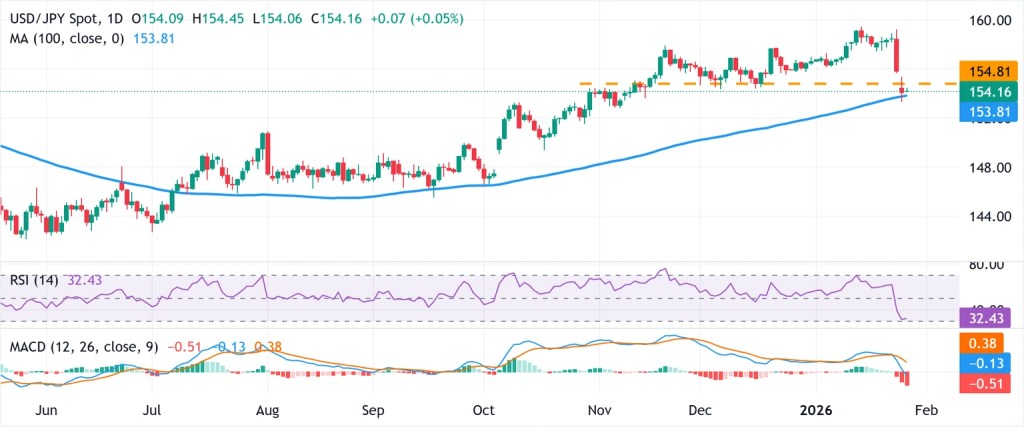
The USD/JPY pair showed signs of resilience below its 100-day Simple Moving Average (SMA) on Monday, although it continues to trade beneath the 154.75–154.80 horizontal support zone. The MACD histogram has moved further into negative territory, with the MACD line below the signal line, reflecting bearish momentum that remains below zero. Meanwhile, the RSI stands near 32, close to oversold territory, suggesting that the downside move may be becoming stretched.
A daily close below the 100-day SMA at 153.81, which currently provides near-term support, would give bears greater control. In contrast, sustained trading above this level would keep the broader bias supported by the rising SMA. Signs of stabilization would include a flattening MACD histogram and a move back toward the zero line, while an RSI rebound toward 50 would improve the overall tone. On the other hand, a dip below 30 on the RSI would increase the risk of deeper losses.
Sources: Fxstreet
 THE ETERNAL SOVEREIGN