Tag: japan

  • Yen rebounds from two-week low on intervention chatter, but fiscal worries limit upside

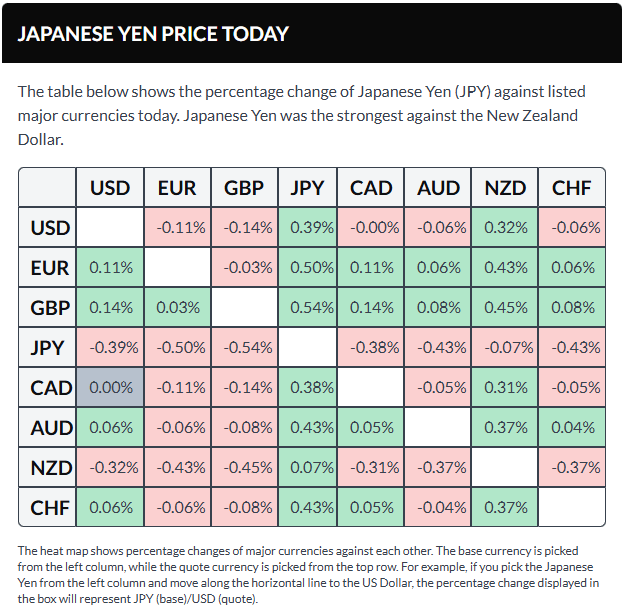
    The Japanese yen slid to a fresh two-week low as Sanae Takaichi’s landslide victory reignited concerns over Japan’s fiscal outlook. However, warnings of possible currency intervention sparked some intraday short covering in the yen, aided by broader U.S. dollar weakness.

    Still, downside momentum in the yen was partly limited after data showed a decline in Japan’s real wages, which reduced expectations for an immediate interest rate hike by the Bank of Japan and helped cap further moves in the currency.

    The Japanese yen began the new week on a softer footing after Prime Minister Sanae Takaichi’s landslide victory in Sunday’s election raised expectations of additional fiscal stimulus. That initial weakness proved short-lived, however, as Finance Minister Satsuki Katayama reiterated warnings over excessive currency moves and confirmed close coordination with the United States to counter disorderly FX fluctuations. Combined with continued U.S. dollar selling, the comments prompted an intraday reversal of nearly 150 pips in USD/JPY from the Asian session peak near 157.65.

    Meanwhile, data released earlier showed Japan’s real wages fell in December for a 12th straight month, with nominal pay growth slightly lagging cooling consumer inflation. This reinforces expectations that the Bank of Japan will proceed cautiously after lifting interest rates to a three-decade high in December. In addition, a more upbeat risk environment, supported by signs of easing tensions in the Middle East, limited further safe-haven demand for the yen, allowing USD/JPY to find support and stall its pullback around the 156.20 area.

    Yen bulls stay cautious as fiscal concerns and delayed BoJ hike bets offset intervention talk

    Japan’s ruling Liberal Democratic Party, led by Prime Minister Sanae Takaichi, secured a decisive victory in Sunday’s election, comfortably surpassing the 233-seat threshold needed for a lower-house majority. The result clears the path for proposed tax cuts and increased defense spending, bringing renewed attention to Japan’s already stretched public finances.

    Finance Minister Satsuki Katayama said on Monday that she stands ready to communicate with markets if necessary to help stabilize the yen. She reiterated that Japan remains in close coordination with U.S. Treasury Secretary Scott Bessent and emphasized Tokyo’s right to intervene if currency moves stray from economic fundamentals.

    Meanwhile, data from the labor ministry showed nominal wages rose 2.4% year-on-year in December 2025, accelerating from a revised 1.7% gain previously but still missing market expectations. Adjusted for inflation, real wages fell 0.1% from a year earlier, extending their decline to a 12th consecutive month.

    The figures have dampened expectations for an imminent Bank of Japan rate hike, as policymakers have stressed that further tightening hinges on sustained and broad-based wage growth. Together with a generally positive global equity backdrop, this has limited the yen’s rebound from a more than two-week low.

    Risk sentiment was further supported by indirect U.S.–Iran talks on Tehran’s nuclear program, which concluded on Friday with agreement to keep diplomatic channels open. The development eased fears of a military escalation in the Middle East and encouraged demand for risk assets at the start of the week, despite new U.S. sanctions on Iran.

    The U.S. dollar weakened for a second straight session amid growing bets that the Federal Reserve could cut interest rates twice more in 2026. This contrasts with expectations that the BoJ will continue its gradual policy normalization, helping to cap gains in USD/JPY and urging caution among bullish traders.

    Attention now turns to key U.S. data later this week, including the closely watched nonfarm payrolls report due Wednesday and consumer inflation figures on Friday, both of which are likely to shape dollar direction and drive fresh moves in USD/JPY.

    USD/JPY holds steady below 100-hour SMA as technical signals remain mixed
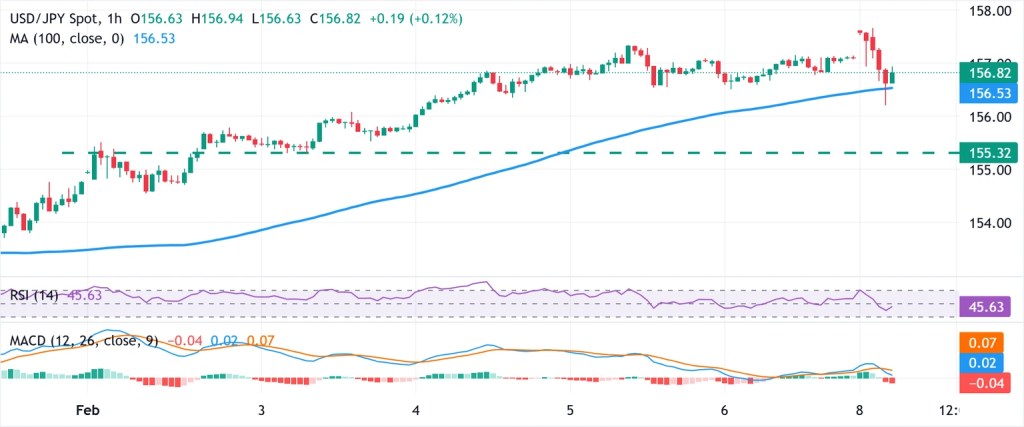
    The USD/JPY pair is showing modest resilience around the 100-hour Simple Moving Average (SMA), with its intraday pullback stalling near the 156.20 area, which now stands out as a key pivot for short-term traders. Momentum indicators, however, paint a mixed picture. The Moving Average Convergence Divergence (MACD) has formed a bearish crossover near the zero line, signaling rising downside pressure, while the Relative Strength Index (RSI) is hovering around 46, below the neutral 50 level, pointing to subdued momentum.

    At the same time, USD/JPY remains above the 100-hour SMA, currently located around the 156.55–156.50 zone, which preserves a mildly constructive near-term bias and provides dynamic support. A move by the MACD back into positive territory alongside an RSI break above 50 would strengthen the bullish case and open the door to further gains. On the other hand, a clear break and close below the 100-hour SMA would undermine the setup and increase the risk of a deeper corrective move.

    Sources: Haresh Menghani
  • The Japanese yen slides further against the dollar as fiscal and political worries outweigh the BoJ’s hawkish stance.

    • The Japanese yen stays under pressure as fiscal worries and political uncertainty outweigh stronger-than-expected data.
    • Concerns over possible intervention and the BoJ’s increasingly hawkish stance may deter traders from adding new bearish yen positions.
    • Rising expectations of further Fed easing weigh on the U.S. dollar and could limit upside in USD/JPY.

    The Japanese yen (JPY) continues its downward trajectory against the U.S. dollar for a fourth consecutive session on Wednesday, sliding to a near two-week low during Asian trading. Persistent concerns over Japan’s fiscal position—linked to Prime Minister Sanae Takaichi’s expansionary spending agenda—remain a key drag on the currency. In addition, heightened political uncertainty ahead of the February 8 snap election further weakens sentiment toward the yen, driving USD/JPY above the 156.00 level.

    At the same time, markets remain cautious amid the risk of coordinated Japan–U.S. intervention aimed at curbing excessive yen weakness. Expectations of gradual policy normalization by the Bank of Japan may also discourage traders from adding aggressive bearish positions. Meanwhile, expectations that the Federal Reserve will deliver two additional rate cuts limit U.S. dollar demand, potentially capping further upside in USD/JPY ahead of later U.S. economic data releases.

    Yen sellers stay in charge as fiscal strains and political uncertainty persist.

    Japan’s services sector gathered momentum at the start of 2026, with business activity expanding for a tenth straight month and at the fastest pace in nearly a year. The Jibun Bank Services PMI rose to 53.7 from 51.6 in December, coming in slightly above market expectations of 53.4. The figures point to a more sustained recovery in the services industry, which represents about 70% of Japan’s GDP.

    Despite the encouraging data, market reaction was subdued as concerns over Japan’s fiscal outlook continued to weigh on sentiment. Investor unease has been amplified by Prime Minister Sanae Takaichi’s expansionary fiscal agenda, including aggressive spending plans and proposed tax cuts. As part of her campaign ahead of the February 8 snap lower house election, Takaichi has pledged to suspend the 8% consumption tax on food for two years, bringing renewed focus to Japan’s already stretched public finances and keeping the yen under pressure on Wednesday.

    Meanwhile, a recent and unusual rate check by the New York Federal Reserve was interpreted as the clearest indication so far of coordination between Japanese and U.S. authorities to curb excessive yen weakness. This lowers the bar for potential intervention and could help limit further JPY losses, particularly alongside expectations of a more hawkish Bank of Japan.

    The Summary of Opinions from the BoJ’s January meeting, released Monday, revealed that policymakers discussed rising inflationary pressures stemming from a weaker yen. Board members also agreed that additional rate hikes would be appropriate over time, a stance that could provide underlying support for the JPY.

    On the other side, the U.S. dollar has struggled to extend last week’s rebound from a four-year low, despite support from the nomination of Kevin Warsh as the next Federal Reserve chair. Even the approval of a government funding package to end a partial shutdown failed to generate meaningful upside for the greenback.

    Looking ahead, traders are awaiting the U.S. ADP employment report and the ISM Services PMI. In addition, remarks from influential FOMC members could shape near-term USD demand amid expectations for two more Fed rate cuts in 2026, with implications for the USD/JPY pair.

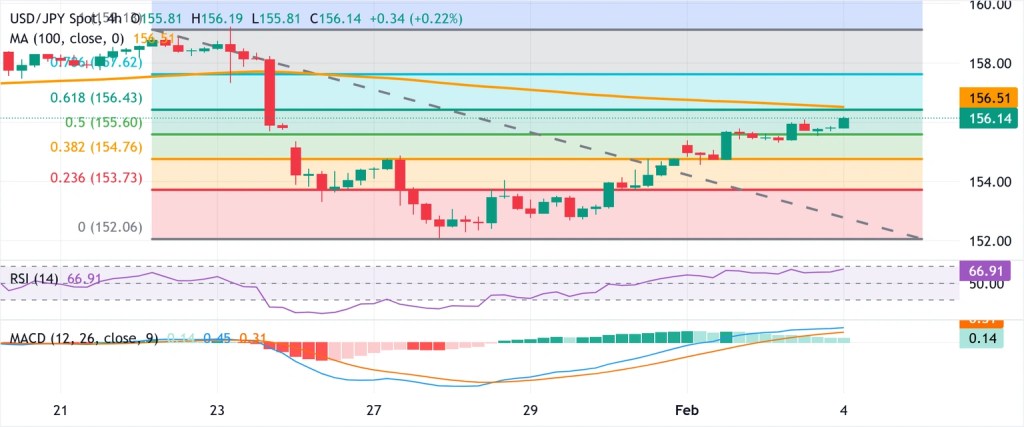
    USD/JPY must clear the 156.50 confluence zone to reinforce bullish momentum.

    Wednesday’s push above the 156.00 handle builds on the overnight breakout through the 50% retracement of the 159.13–152.06 decline, tilting the near-term bias in favor of USD/JPY bulls. The 14-period Relative Strength Index stands at 66.9, remaining below overbought territory and pointing to a solid, albeit increasingly mature, upswing.

    That said, the MACD histogram, while still in positive territory, is narrowing—an early sign of waning bullish momentum. The MACD line remains above the Signal line, with both oscillating close to the zero level, underscoring a more cautious and transitional setup.

    As a result, further upside is likely to face notable resistance around the 156.51 confluence, which combines the 100-period Simple Moving Average on the 4-hour chart and the 61.8% Fibonacci retracement. A sustained move above this zone would be required to reassert a constructive short-term outlook.

    A decisive break could pave the way toward the 78.6% retracement at 157.62. Conversely, an inability to clear this hurdle would leave the rebound exposed to renewed downside pressure. Moreover, USD/JPY continues to trade below a downward-sloping 100-period SMA, suggesting that upside attempts may remain constrained for now.

    Sources: Haresh Menghani

  • Japan’s Prime Minister highlights the benefits of a weak yen, even as the government takes steps to curb the currency’s decline.

    Japanese Prime Minister Sanae Takaichi highlighted the advantages of a weaker yen during a campaign speech, striking a note that contrasted with her finance ministry’s stance, which has kept all measures on the table to address excessive currency volatility.

    She later walked back her remarks, clarifying that she holds no particular preference regarding the yen’s direction.

    “Many people argue that the weak yen is a negative at the moment, but for exporters it represents a significant opportunity,” Takaichi said on Saturday, ahead of the snap election scheduled for February 8.

    “Whether in food exports or automobile sales, even with U.S. tariffs in place, the weaker yen has acted as a cushion. That support has been extremely valuable,” she added.

    Takaichi also said she aims to strengthen Japan’s economy against currency swings by encouraging greater domestic investment.

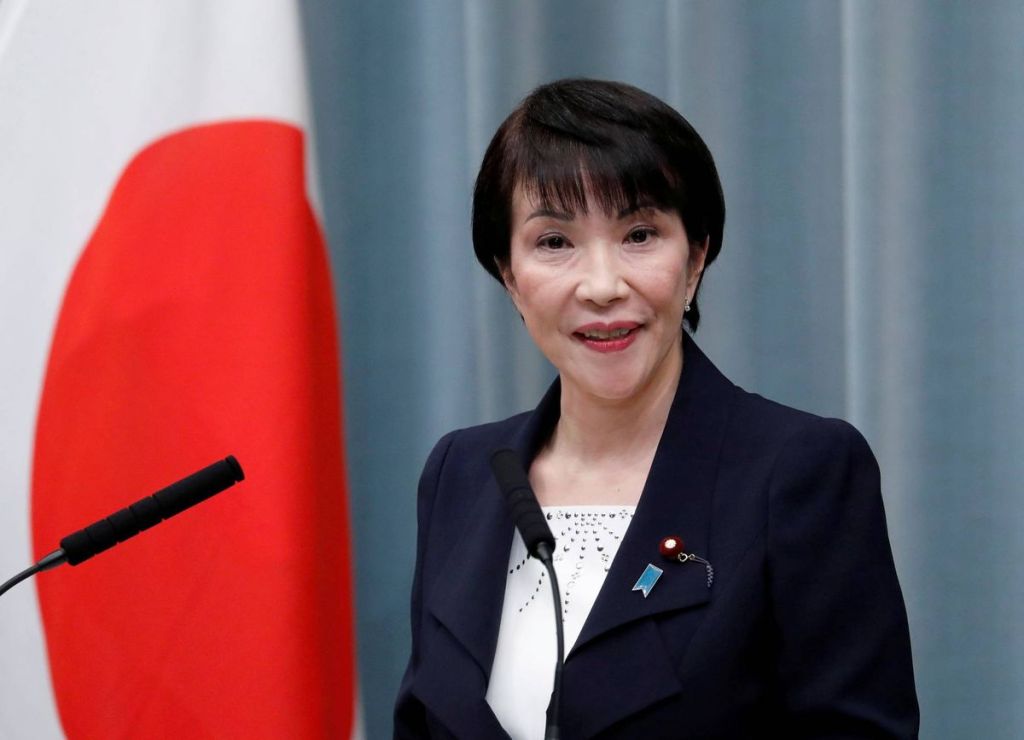
    FILE PHOTO: Japan’s Internal Affairs Minister Sanae Takaichi attends a news conference at Prime Minister Shinzo Abe’s official residence in Tokyo, Japan September 11, 2019. REUTERS/Issei Kato/File Photo

    The yen has been trading near 18-month lows against the U.S. dollar, fuelling inflation and raising expectations of potential interest-rate increases by the central bank. Finance Minister Satsuki Katayama has repeatedly stated that authorities are prepared to step in to stabilise the currency if needed — comments widely interpreted by markets as a signal of possible intervention.

    In a post on X on Sunday, Takaichi reiterated that she does not support either a strong or weak yen.

    “I did not state that one is better or worse,” she wrote, adding that the government is closely watching financial markets and that, as prime minister, she will avoid making specific remarks on exchange-rate levels.

    “My intention was simply to say that we want to build an economic framework capable of withstanding exchange-rate volatility, not — as some reports have implied — to promote the advantages of a weak yen.”

    Former prime minister and finance minister Yoshihiko Noda, who co-leads the largest and newly formed opposition group, the Centrist Reform Alliance, said a weak yen is hurting households, according to Nikkei on Sunday.

    “Amid an excessive depreciation of the yen, no one feels comfortable when they look at their household finances,” Noda was quoted as saying. “The viewpoint of ordinary citizens is absent, which once again raises serious concerns for me.”

    The yen jumped after reports that the New York Federal Reserve had joined Japanese authorities in contacting banks to inquire about exchange rates for potential yen purchases — a move traders often view as a signal that intervention could be imminent.

    The currency’s prolonged slide, alongside a recent surge in Japanese government bond yields to record levels, underscores investor unease over the country’s stretched fiscal position.

    Takaichi is seeking voter approval for her push to revive inflation and reflate the economy.

    Sources: Reuters

  • The Takaichi trade is under pressure from rising inflation, a weaker yen, and higher yields

    The recent rally in Japanese equities, sparked by Prime Minister Sanae Takaichi’s announcement of a snap election, could lose momentum if she ultimately achieves her political objectives, as increased fiscal spending risks stoking inflation and pushing up government borrowing costs.

    Japan’s Topix index jumped over 4% this week, marking its strongest advance since July, as investors revived the so-called “Takaichi trade,” betting on heavier government expenditure. Takaichi is seeking to strengthen her grip on power by expanding her party’s seat count, which would give her greater latitude to pursue expansionary economic policies.

    Market participants believe Takaichi could follow in the footsteps of her mentor, former Prime Minister Shinzo Abe, whose stimulus-driven Abenomics era propelled asset prices. She has identified sectors such as artificial intelligence, semiconductors, defense, space, and content industries as key targets for investment.

    Although Japanese equities are once again following a familiar pattern of rallying ahead of Lower House elections, sustained upside may hinge on the specifics of Takaichi’s fiscal agenda. Meanwhile, bond investors are demanding higher yields to compensate for holding Japanese government debt, even as global bond yields ease.

    “Rising break-even inflation rates suggest the market is pricing in looser, more inflationary policies after the election, with inflation staying above the Bank of Japan’s target for longer,” said Aninda Mitra, head of Asia macro and investment strategy at BNY Investments.

    Economists anticipate that Japan’s consumer inflation will ease to below 2.0% this year — falling under the Bank of Japan’s target for the first time in five years — helped in part by reductions in gasoline taxes and other regulated prices.

    However, the yen’s decline to a more than one-year low of 159.45 per dollar on Wednesday, and to its weakest level since 1992 on a trade-weighted basis, has reignited inflation worries. The currency’s weakness is also eroding its traditional support for exporter stocks. Pressure on the yen has intensified as Takaichi’s dovish stance on monetary policy is seen as constraining the BOJ’s ability to raise interest rates swiftly.

    “The yen is the biggest risk factor for Takaichi,” said Chisa Kobayashi, Japan equity strategist at UBS SuMi TRUST Wealth Management. “Further depreciation could push inflation higher, dampen consumer spending, and eventually weaken voter backing.”

    Neil Newman, head of strategy at Astris Advisory Japan, said a Takaichi election victory could drive another 5% rise in the Nikkei 225 Stock Average. “With the government planning targeted investments in strategic sectors, a surge in capital expenditure is likely,” he said.

    Despite Takaichi’s strong approval ratings, which have led many investors to expect a comfortable win, some analysts are growing more cautious after Komeito — previously a junior coalition partner of the Liberal Democratic Party — shifted toward cooperation with the main opposition party.

    As a result, the election outcome has become increasingly uncertain, said Shinichi Ichikawa, senior fellow at Pictet Asset Management Japan.

    “The one thing that’s clear is that both camps will be compelled to campaign on bold spending promises to attract voters,” he said.

    Sources: Bloomberg

  • The Japanese Yen remains weak amid ongoing fiscal concerns and uncertainty over the timing of the Bank of Japan’s rate hikes

    • Japanese Yen bulls stay cautious amid fiscal concerns and a generally positive risk environment.
    • Diverging expectations between the Bank of Japan and the Federal Reserve help contain further losses for the lower-yielding yen.
    • Meanwhile, subdued follow-through buying of the US dollar keeps USD/JPY capped ahead of upcoming US economic data.

    The Japanese Yen (JPY) remains under pressure against the US dollar during Wednesday’s Asian session, though significant depreciation remains limited. Key factors weighing on the yen include Japan’s fiscal concerns, a broadly risk-on market sentiment, and uncertainty around the timing of the Bank of Japan’s (BoJ) next rate hike.

    Despite this, the BoJ is expected to continue its policy normalization, creating a notable divergence from growing expectations of additional interest rate cuts by the US Federal Reserve (Fed). This divergence helps cap gains in the US dollar and offers some support to the lower-yielding yen. Additionally, speculation about possible intervention by authorities to support the yen calls for caution among those betting on further yen weakness.

    The Japanese Yen struggles to attract buyers as a mix of factors counterbalance expectations for Bank of Japan rate hikes.

    • Japan’s fiscal outlook remains a concern, especially after the cabinet approved Prime Minister Sanae Takaichi’s record ¥122.3 trillion budget. Meanwhile, uncertainty persists over the timing of the next Bank of Japan (BoJ) rate hike, as expectations that energy subsidies, stable rice prices, and low petroleum costs will keep inflation subdued through 2026.
    • BoJ Governor Kazuo Ueda stated on Monday that the central bank will continue raising rates if economic and price trends align with forecasts. He emphasized that adjusting monetary support will help sustain growth, and moderate, synchronized rises in wages and prices leave room for further policy tightening.
    • This outlook pushed yields on Japan’s rate-sensitive two-year and benchmark 10-year government bonds to their highest levels since 1996 and 1999, respectively. The narrowing yield gap between Japan and other major economies has discouraged aggressive bearish bets on the yen, especially amid speculation of possible intervention.
    • The US dollar has struggled to build on gains from the previous day due to dovish Federal Reserve expectations and concerns about the Fed’s independence under President Donald Trump’s administration. Traders are also holding back, awaiting key US economic data for clearer signals on the Fed’s rate cut trajectory.
    • Wednesday’s US economic calendar includes the ADP private-sector employment report, ISM Services PMI, and JOLTS Job Openings. However, attention will largely focus on Friday’s Nonfarm Payrolls (NFP) report, which is expected to be crucial in shaping the next directional move for the dollar ahead of Tuesday’s US consumer inflation data.

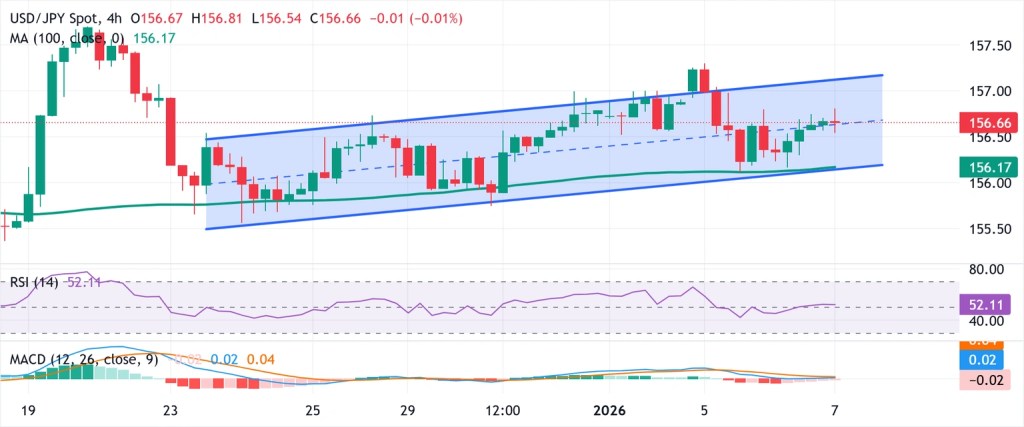
    USD/JPY’s mixed technical signals call for caution, with the key 156.15 confluence level serving as a crucial test for bullish momentum.

    The USD/JPY pair’s overnight rally confirmed support at the 156.15 confluence zone, which combines the 100-period Simple Moving Average (SMA) on the 4-hour chart with the lower boundary of a short-term ascending channel. This level is crucial—if decisively broken, it could trigger renewed bearish momentum and open the door to deeper declines.

    The Moving Average Convergence Divergence (MACD) histogram is slightly negative but contracting near the zero line, indicating weakening bearish pressure. Meanwhile, the Relative Strength Index (RSI) stands at 52, showing a neutral stance with a slight bullish bias. The rising SMA favors a buy-on-dips approach, though the subdued MACD suggests limited follow-through at this stage. RSI near the midpoint reinforces a consolidative phase within the channel.

    Initial support remains at the 156.15 confluence, while resistance is positioned at 157.15—the channel’s upper boundary. A close above 157.15 could trigger further upside, whereas failure to break this level would keep USD/JPY range-bound within the rising corridor.

    Sources: Fxstreet